Introduction
Cowpea, Vigna unguiculata (L.) Walp., is a widely cultivated legume that belongs to the family Leguminosae, subfamily Papilionaceae, Tribe Phaseoleae (Ileke et al., Reference Ileke, Bulus and Aladegoroye2013). In Tanzania, cowpea is grown mostly in semi-arid areas, including Shinyanga, Mtwara and Kigoma, due to its drought tolerance (Myaka et al., Reference Myaka, Kabissa, Myaka and Mligo2002). It is also efficient in fixing nitrogen and enriching the soil (Brisibe et al., Reference Brisibe, Adugbo, Ekanem, Brisibe and Figueira2011). Cowpea has nutritional benefits because it is rich in protein, making it suitable for many people who cannot afford to buy other protein sources such as meat and fish (Oparaeke et al., Reference Oparaeke, Dike and Amatobi2006; Brisibe et al., Reference Brisibe, Adugbo, Ekanem, Brisibe and Figueira2011). It is mostly cultivated as a grain legume, and is also widely used as a leafy vegetable. Cowpea production in Tanzania is relatively low and does not meet local demand, partly due to high insect infestation at both pre- and post-harvest stages (Swella and Mushobozy, Reference Swella and Mushobozy2007). The most important insect pest in stored cowpea is the bruchid, Callosobruchus maculatus (Fabricius 1775) (Coleoptera: Chrysomelidae) (Swella and Mushobozy, Reference Swella and Mushobozy2007). In Africa, 30–80% of cowpea production, valued at over US$ 300 million, is either lost or suffers damage annually as a result of bruchid infestation (Brisibe et al., Reference Brisibe, Adugbo, Ekanem, Brisibe and Figueira2011). Losses attributed to C. maculatus in stored cowpea result in both quantitative and qualitative reduction, manifested by food and nutrition insecurity, and low incomes for commercially oriented farmers (Ileke and Olotuah, Reference Ileke and Olotuah2012).
Management of C. maculatus has been dominated by chemical control using fumigants and synthetic insecticides (Lale and Kabeh, Reference Lale and Kabeh2004; Odeyemi et al., Reference Odeyemi, Gbaye and Akeju2006). However, the use of synthetic insecticides in crop protection programmes around the world has resulted in disruption of the environment, pest resurgences, development of resistance to pesticides, lethal effects to non-target organisms in agroecosystems, toxic residues in food and water bodies, as well as direct toxicity to users (Lale, Reference Lale2001; Schafer and Kegley, Reference Schafer and Kegley2002; Prakash et al., Reference Prakash, Rao and Nandagopal2008). This calls for an urgent need to develop alternative ecologically safer, economical, readily affordable and user-friendly pest control techniques, such as using locally available plants with insecticidal properties (Adedire et al., Reference Adedire, Obembe, Akinkurolere and Oduleye2011; Arannilewa et al., Reference Arannilewa, Ekrakene and Akinneye2006). In this study, the contact and fumigant toxicity of leaf powders derived from five known pesticidal plants, Tephrosia vogelii Hook. f., Dysphania ambrosioides (L.) Mosyakin & Clemants (Syn.: Chenopodium ambrosioides L.), Lippia javanica (Burm. f.), Tithonia diversifolia (Hemsl.) A. Gray and Vernonia amygdalina Delile, was evaluated.
Tephrosia vogelii is a deep-rooted, fast-growing leguminous, indigenous shrub found in the wild and cultivated in many parts of Africa as an inter-crop with maize or cover crop, to improve soil fertility through nitrogen fixation and to mine minerals from lower soil levels (Kamanula et al., Reference Kamanula, Sileshi, Belmain, Sola, Mvumi, Nyirenda and Stevenson2010; Grzywacz et al., Reference Grzywacz, Stevenson, Belmain and Wilson2014). Two chemotypes of T. vogelii have been identified: chemotype 1, which contains rotenoids (deguelin, rotenone, sarcolobine, tephrosin and α-toxicarol) that are required for pest control efficacy, and chemotype 2 in which rotenoids are absent (Stevenson et al., Reference Stevenson, Kite, Lewis, Forest, Nyirenda, Belmain, Sileshi and Veitch2012). Dysphania ambrosioides originates from Mexico where it is used as a culinary spice and is now found across the Tropics. Dysphania ambrosioides has been used traditionally to preserve post-harvest grains from weevil attack, and for medicinal purposes (to treat intestinal worm infections, nervous infections, cough, pulmonary obstruction, typhoid, influenza, and skin and kidney infections) (Jamali et al., Reference Jamali, Kouhila, Ait Mohamed, Jaouhari, Idlimam and Abdenouri2006; Lans et al., Reference Lans, Turner, Brauer, Lourenco and Georges2006; Nascimento et al., Reference Nascimento, Cruz, Pereira, Maciel, Silva, Azevedo and Guerra2006; Dembitsky et al., Reference Dembitsky, Shkrob and Hanus2008). The main bioactive constituents are ascaridole and various terpenes (Jardim et al., Reference Jardim, Jham, Dhingra and Freire2008). Lippia javanica, sometimes called fever tea bush, is a woody shrub found across south-eastern Africa and is regularly used as a traditional medicine to treat minor ailments and microbial infections such as coughs, colds, fungal infections, respiratory diseases and skin infections (Samie et al., Reference Samie, Tambani, Harshfield, Green, Ramalivhana and Bessong2010). The main active ingredients are quite variable, but contain linalool, carvone and myrcene (Viljoen et al., Reference Viljoen, Subramoney, van Vuuren, Başer and Demircia2004). Tithonia diversifolia is a woody herb or succulent shrub native to the New World, but now found across the Tropics. Tithonia diversifolia is often called the Mexican sunflower, and has been used traditionally as a medicine suitable for treating constipation, stomach pains, indigestion, sore throat, liver pains and malaria (García and Delgado, Reference García and Delgado2006; Obafemi et al., Reference Obafemi, Sulaimon, Akinpelu and Olugbade2006). It contains sesquiterpene lactones and diterpenoids that are known to have insecticidal properties (Adedire & Akkineye, 2004). Vernonia amygdalina has been traditionally used by nursing mothers to improve lactation, and has proven useful in diabetic patients (Anibijuwon et al., Reference Anibijuwon, Oladejo, Adetitun and Kolawole2012). It is a well-known African medicinal plant producing the anticancer agents vernodalin, vernolide and vernomygdine (Khalafalla et al., Reference Khalafalla, Abdellatef, Daffalla, Nassrallah, Aboul-Enein, Lightfoot and El-Semy2009). In this study, these plants were tested against C. maculatus in cowpea and compared with pirimiphos-methyl (Actellic dust, 2%).
Materials and methods
Insect culture
The bruchids used to establish a laboratory colony of C. maculatus were obtained from infested cowpea seeds collected from a local market in Morogoro, Tanzania. The bruchids were cultured at Sokoine University of Agriculture laboratory to obtain the parent stock of C. maculatus. These were then reared in the laboratory of Life Sciences and Engineering Department at the Nelson Mandela African Institution of Science and Technology (NM-AIST), Arusha, Tanzania, using disinfested cowpea seeds collected from farmers at Rombo District, Tanzania. The cowpea seeds were newly harvested, and free of insecticides. They were cleaned by washing with water, and then dried under sunlight and sorted to eliminate those already damaged by C. maculatus, before being disinfested by freezing at − 20 °C for 48 h, with subsequent heating in an oven at 70 °C for 24 h. The disinfested cowpea seeds were air dried at room temperature to prevent mouldiness before the introduction of the insects, and were then stored in plastic containers with airtight lids.
Collection of plant materials
A botanist from the Forest Training Institute – Olmotonyi, Arusha Tanzania, carried out the identification of the pesticidal plants. Voucher specimens are deposited at NM-AIST. The plant species used in these trials were selected because of their: (a) traditional use by local farming communities, (b) high local abundance in northern Tanzania (where this research was conducted) and (c) information from published research (Isman, Reference Isman2006).
Fresh leaves of the plants were collected from different locations around Arusha and Kilimanjaro, northern Tanzania. All T. vogelii collected for this study were confirmed to be chemotype 1. The leaves were rinsed in clean water to remove sand and other impurities, and then dried in the shade to avoid direct exposure to sunlight and possible decomposition of the bioactive compounds. They were ground into a fine powder using an electric mill, and the powders sieved to pass through 1 mm2 mesh (Ileke and Olotuah, Reference Ileke and Olotuah2012). The powders were packed in plastic containers with airtight lids, and stored in the dark at ambient conditions of 25 ± 3 °C and 75 ± 5% RH.
Contact and fumigant toxicity of leaf powders to Callosobruchus maculatus
To test for contact toxicity, fine powders of T. vogelii, D. ambrosioides, L. javanica, T. diversifolia and V. amygdalina were admixed with cowpea seeds, disinfested as above, at the rates of 0.01, 0.1, 1 and 3 g/10 g of cowpea seeds in 250 ml plastic containers. A positive control of pirimiphos-methyl (Actellic 2% dust at a concentration of 50 g/90 kg), and an untreated negative control were included. The dosages were set at different orders of magnitude from low (0.1%) to high (30%), so as to obtain the minimum effective dose. For fumigant toxicity, 10 g of cowpea seeds were placed into 500 ml transparent plastic bottles with perforated lids to allow air circulation, but restrict entry or exit of bruchids. Dysphania ambrosioides and L. javanica leaf powders were the only plant species used in this experiment, as only their bioactive constituents are known to be volatile. Fine leaf powders of D. ambrosioides and L. javanica (at doses of 5, 0.5, 0.05 and 0.005 g) were put into small bags made using muslin cloth, then tied with a piece of thread and hung inside the 500 ml plastic bottle containing the cowpea seeds. As with the above toxicity test, this fourfold dose magnitude was used to determine the minimum effective dose required. For both toxicity and fumigant trials, five male and five female adults of C. maculatus (2 to 3 days old), were introduced into each container. Untreated cowpea seeds (negative control) were similarly infested. Six replicates of the treatments (including controls) were laid out in a complete randomized block design. Insect mortality was assessed every 24 h for 4 days (Ileke and Olotuah, Reference Ileke and Olotuah2012; Ileke et al., Reference Ileke, Bulus and Aladegoroye2013). For fumigant toxicity, the assessment was done without opening the containers.
On the 4th day, all insects, both dead and alive, were removed from each container and the eggs laid on seeds counted. Insects were determined to be dead when they failed to move any part of their body in response to gentle probing of the exposed abdomen with forceps. The experiment was kept for another 30 days to allow for the emergence of the first filial (F1) generation. The number of days to first bruchid emergence, and the number of adults that emerged, were counted. The adults were removed daily for 14 days after the first emergence was observed (Denloye et al., Reference Denloye, Makanjuola, Teslim, Alafia, Kasali and Eshilokun2010). The percentage adult emergence (progeny development) was calculated using the formula:
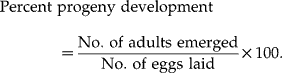 $$\begin{eqnarray} Percent progeny development = \frac {No. of adults emerged}{No. of eggs laid}\times 100. \end{eqnarray}$$
The number of undamaged and damaged seeds (perforated by bruchids), and the number of holes per seed were also recorded. Damage assessment was done through counting the total number of holes per cowpea seed. The number of holes per sub-sample of 10 randomly selected seeds, and the number of seeds with holes were recorded. Percentage damage (PD) was calculated according to Fatope et al. (Reference Fatope, Nuhu, Mann and Takeda1995) as:
 $$\begin{eqnarray} PD = \frac {Total number of sampled grains perforated}{Total number of sampled grains}\times 100. \end{eqnarray}$$
The Beetle Perforation Index (BPI) (Fatope et al., Reference Fatope, Nuhu, Mann and Takeda1995) was then calculated as:
 $$\begin{eqnarray} BPI = \frac {Percent treated cowpea grains perforated}{Percent untreated control cowpea grains perforated}\times 100. \end{eqnarray}$$
A BPI value exceeding 50% is regarded as enhancement of infestation by the beetle, or a negative ability of the plant material or insecticides tested (Ojiako and Adesiyun, Reference Ojiako and Adesiyun2013). Thus the Percent Protectant Ability (PPA) = 100 − BPI.
Collection of leaf volatiles and chemical analysis
Dry powdered leaf samples (5 g) were held in a 250-ml glass flask under laboratory conditions at approximately 25 °C, which was closed with aluminium foil. Volatiles were collected using a Solid-phase microextraction (SPME) fibre, coated with polydimethylsiloxane/divinylbenzene (Supelco, Sigma-Adrich, Poole, UK). The fibre was inserted through the foil and exposed to the headspace for 5 min. The fibres were desorbed using an Agilent 6890 gas chromatograph coupled to an Agilent 5973 mass spectrometer, and with a DB-5 fused silica capillary column (30 m length, 0.25 mm diameter and 0.25 μm film thickness) (Agilent Technologies, Wokingham, UK). Desorption was splitless, with helium at a constant flow rate of 1 ml/min as a carrier gas. The column temperature was held at 60 °C for 2 min then programmed to 240 °C at 6 °C/min. The ion source was held at 150 °C and the transfer line at 250 °C.
Data analysis
The bioassay data were subject to one-way analysis of variance (ANOVA) using the programme STATISTICA. Statistical differences between the means were separated using the least significant difference (LSD) test. Significance was set at the level of P= 0.05. Data on chemical analysis were analysed using ChemStation (Agilent). Compounds were identified using the NIST Mass Spectral Database and by comparison to pure samples.
Results
Contact toxicity of leaf powders to Callosobruchus maculatus
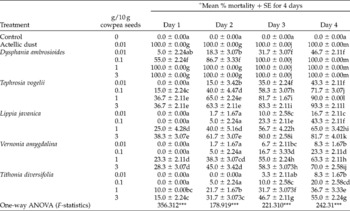
Table 1 shows the mortality of C. maculatus 4 days after treatment with the leaf powders in comparison with Actellic dust, and the untreated control. The leaf powder of D. ambrosioides caused 100% mortality of adult C. maculatus at 10% concentration within 24 h, which was similar to the Actellic dust. Grains treated with 1 and 0.1% of D. ambrosioides caused 100% mortality by the third day and 46.7% mortality on the fourth day, respectively. The leaf powder of T. vogelii caused 43.3, 71.7, 90 and 93.3% mortality of C. maculatus at concentrations of 0.01 g/10 g, 0.1 g/10 g, 1 g/10 g and 3 g/10 g of cowpea seeds on the fourth day, respectively. The corresponding values for L. javanica and V. amygdalina by the fourth day at concentrations of 0.01, 0.1, 1.0 and 3.0 g/10 g of cowpea seeds were 16.7, 43.3, 65 and 81.7%, and 8.3, 23.3, 63.3 and 70%, respectively. The toxicity of the leaf powders of the various plants was, therefore, dosage dependent. However, the leaf powder of T. diversifolia caused a significant effect only at the highest dosage of 3 g/10 g of cowpea seeds causing 55% mortality on the fourth day, whereas at lower concentrations the mortality was below 50%.
Mortality of adult Callosobruchus maculatus on cowpea seeds treated with different powders as contact insecticides

*** Significant at the level of P≤ 0.001. Means in a column followed by different letters are significantly different from each other at the level of P= 0.05 using Fisher's least significant difference (LSD) test.
+ Each value is expressed as mean ± standard error of six replicates.
Effect of leaf powders as contact toxicity on oviposition and progeny development of Callosobruchus maculatus
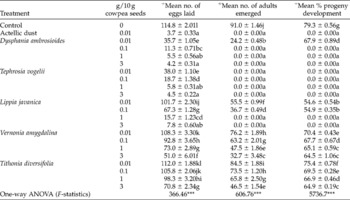
All the leaf powders of the target plants significantly reduced the number of eggs laid by C. maculatus compared with the untreated control (Table 2). Some of the plant leaf powders significantly suppressed progeny development. The leaf powder of T. vogelii completely inhibited the emergence of C. maculatus at all concentrations, similar to the Actellic dust, followed by D. ambrosioides that was able to inhibit adult emergence completely at concentrations of 0.1, 1 and 3 g/10 g of cowpea seeds. Complete inhibition of adult emergence was also observed in seeds treated with L. javanica at concentrations of 1 and 3 g/10 g of cowpea seeds. Oviposition and progeny development were high in untreated seeds, as well as in cowpea seeds treated with T. diversifolia and V. amygdalina at low concentrations (Table 2).
Effects of leaf powders on oviposition and progeny development of Callosobruchus maculatus on cowpea seeds

*** Significant at the level of P≤ 0.001. Means in a column followed by different letters are significantly different from each other at the level of P= 0.05 using Fisher's least significant difference (LSD) test.
+ Each value is expressed as mean ± standard error of six replicates.
Effects of contact toxicity of leaf powders on the number of days to first bruchid emergence
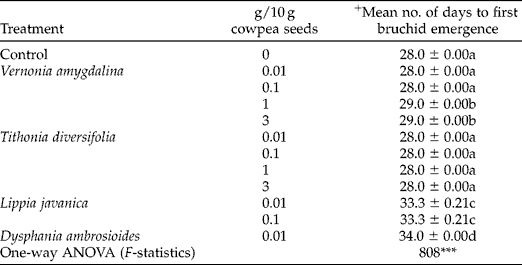
There was no bruchid emergence in T. vogelii-treated seeds at all concentrations, D. ambrosioides at concentrations of 0.1, 1 and 3 g/10 g of cowpea seeds, and L. javanica at concentrations of 1 and 3 g/10 g of cowpea seeds, over the whole period of the experiment. Some of the leaf powders increased the number of days to first bruchid emergence. In D. ambrosioides-treated seeds at a concentration of 0.01 g/10 g of cowpea seeds, the number of days to first bruchid emergence was 34 days compared with 28 days in the untreated control. In L. javanica at concentrations of 0.01 and 0.1 g/10 g of cowpea seeds, emergence was in 33 days, and it took only 29 days to first bruchid emergence in V. amygdalina-treated seeds at concentrations of 1 and 3 g/10 g of cowpea seeds (Table 3). There was no significant difference in the number of days to first bruchid emergence in seeds treated with V. amygdalina at concentrations of 0.01 and 0.1 g/10 g of cowpea seeds, and T. diversifolia at all concentrations compared with the untreated control seeds.
Effects of leaf powders as contact insecticides on the number of days to first bruchid emergence
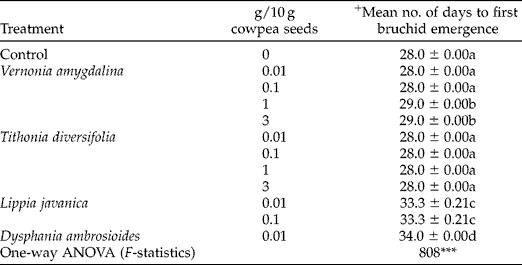
*** Significant at the level of P≤ 0.001. Means in a column followed by different letters are significantly different from each other at the level of P= 0.05 using Fisher's least significant difference (LSD) test.
+ Each value is expressed as mean ± standard error of six replicates.
Damage assessment of cowpea seeds
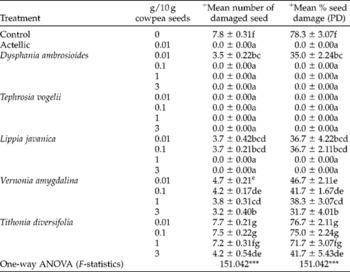
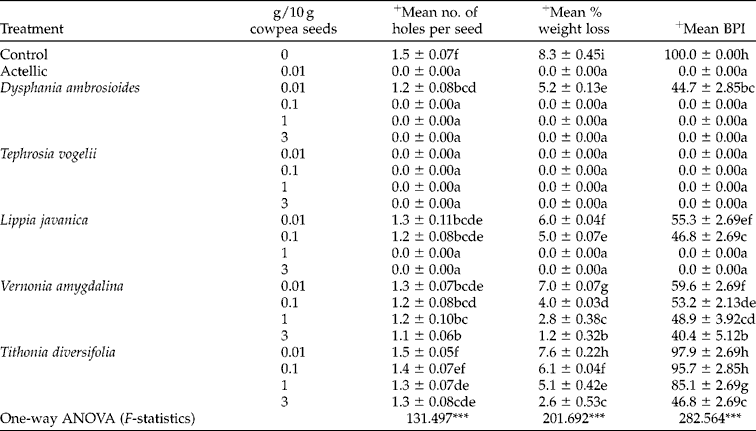
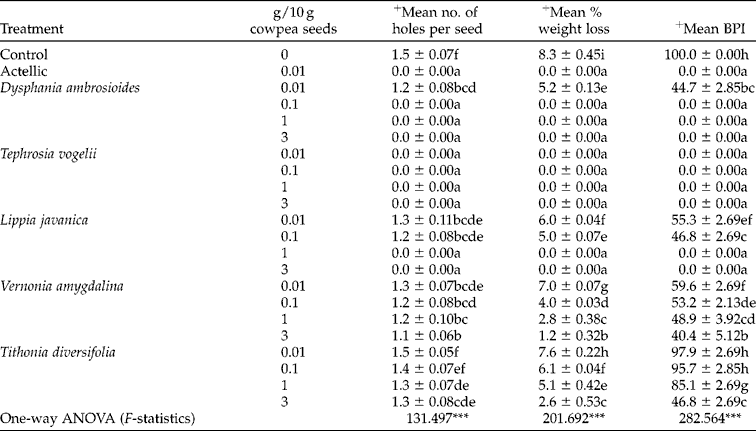
Treatment with the synthetic pesticide, T. vogelii at all concentrations, D. ambrosioides at concentrations of 0.1, 1 and 3 g, and L. javanica at concentrations of 1 and 3 g/10 g of cowpea seeds, protected the seeds completely against bruchid damage (Table 4a), and the BPI in these treatments was zero (Table 4b). Lower number of holes per seed, damaged seeds and weight loss were recorded in treated seeds at higher concentrations compared with untreated seeds (Table 4a and b). A BPI above 50% indicates negative protectant ability, and from the results of this study, the untreated control is set at a WPI of 100%. Other treatments that recorded negative protectant ability included L. javanica at a concentration of 0.01 g, V. amygdalina at concentrations of 0.01 and 0.1 g and T. diversifolia at concentrations of 0.01, 0.1 and 1 g (Table 4b).
Effects of leaf powders as contact insecticides: damage assessment of cowpea seeds for only damaged seeds

*** Significant at the level of P≤ 0.001. Means in a column followed by different letters are significantly different from each other at the level of P= 0.05 using Fisher's least significant difference (LSD) test.
+ Each value is expressed as mean ± standard error of six replicates.
Fumigant toxicity of leaf powders to Callosobruchus maculatus
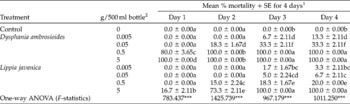
The fumigant toxicity of leaf powders to C. maculatus is presented in Table 5. Adult mortality significantly increased with the increasing concentration and days of exposure. The mortality ranged from 6.7 to 100% in the treated cowpea seeds compared with no mortality in untreated seeds on the fourth day after treatment. The highest value of 100% mortality was recorded in the treatment with D. ambrosioides at a concentration of 5 g/10 g of cowpea seeds after one day, and at a concentration of 0.5 g/10 g of cowpea seeds after two days; and in the treatment with L. javanica at a concentration of 5 g/10 g of cowpea seeds after three days of treatment (Table 5).
Effects of leaf powders as contact insecticides: damage assessment of cowpea seeds for holes, weight loss and perforation index
*** Significant at the level of P≤ 0.001. Means in a column followed by different letters are significantly different from each other at the level of P= 0.05 using Fisher's least significant difference (LSD) test.
+ Each value is expressed as mean ± standard error of six replicates.
Fumigant action of leaf powders on oviposition and progeny development of Callosobruchus maculatus
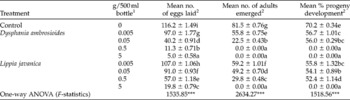
The leaf powder of both plants significantly reduced the number of eggs laid by C. maculatus compared with the control (Table 6). The number of adults that emerged decreased with increasing concentrations. Progeny development was significantly suppressed by the fumigant action of the leaf powders, where D. ambrosioides at concentrations of 0.5 and 5 g and L. javanica at a concentration of 5 g completely inhibited the emergence of C. maculatus. In the other treatments, the progeny development ranged between 52 and 56% with the highest percentage of progeny development in the untreated seeds recorded at 70.2% (Table 6).
Dysphania ambrosioides and Lippia javanica as fumigant insecticides: mortality of adult Callosobruchus maculatus

*** Significant at the level of P≤ 0.001. Means in a column followed by different letters are significantly different from each other at the level of P= 0.05 using Fisher's least significant difference (LSD) test.
1 Each value is expressed as mean ± standard error of six replicates.
2 Each bottle contained 10 g cowpea seeds.
Fumigant action of leaf powders on the number of days to first bruchid emergence
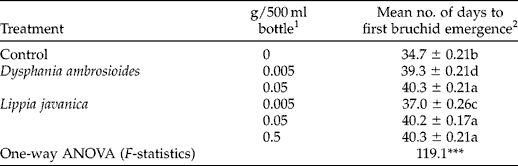
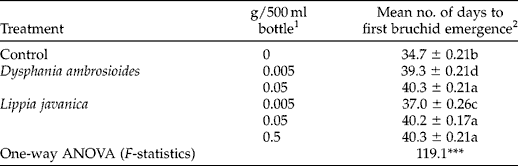
There was complete inhibition of bruchid emergence in seeds treated with D. ambrosioides at concentrations of 5 g and 0.5 g/10 g of cowpea seeds, as well as in seeds treated with L. javanica at concentrations of 5 g/10 g of cowpea seeds (Table 7). In the other treatments, the number of days to first bruchid emergence increased from 34.7 days in the untreated seeds to 37 days in L. javanica at a concentration of 0.005 g, 39 days in D. ambrosioides at a concentration of 0.005 g, and 40 days in D. ambrosioides at a concentration of 0.05 g, and L. javanica at concentrations of 0.05 g and 0.5 g (Table 7).
Effects of fumigant toxicity of leaf powders of Dysphania ambrosioides and Lippia javanica on oviposition and progeny development of Callosobruchus maculatus

*** Significant at the level of P≤ 0.001. Means in a column followed by different letters are significantly different from each other at the level of P= 0.05 using Fisher's least significant difference (LSD) test.
1 Each bottle contained 10 g of cowpea seeds.
2 Each value is expressed as mean ± standard error of six replicates.
Damage assessment of cowpea seeds
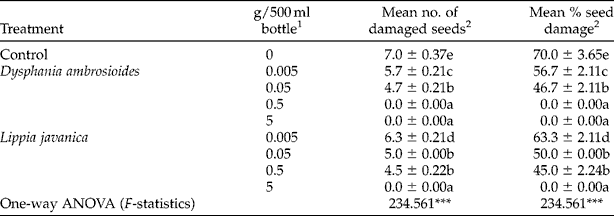
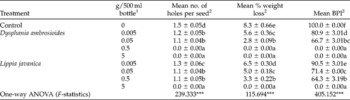
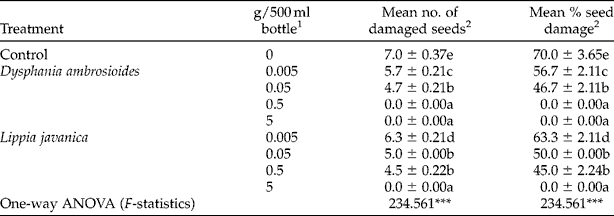
Complete protection of seeds was achieved in seeds treated with D. ambrosioides at concentrations of 0.5 g and 5 g and L. javanica at a concentration of 5 g in 500 ml bottles containing 10 g of cowpea seeds with a beetle perforation index of zero. Low number of holes per seed, damaged seeds and low weight loss were observed in all other treated seeds compared with untreated seeds (Table 8a, ).
Effects of fumigant toxicity of leaf powders on the number of days to first bruchid emergence
*** Significant at the level of P≤ 0.001. Means in a column followed by different letters are significantly different from each other at the level of P= 0.05 using Fisher's least significant difference (LSD) test.
1 Each bottle contained 10 g cowpea seeds.
2 Each value is expressed as mean ± standard error of six replicates.
Damage assessment of cowpea seeds through fumigant action for only damaged seeds
*** Significant at the level of P≤ 0.001. Means in a column followed by different letters are significantly different from each other at the level of P = 0.05 using Fisher's least significant difference (LSD) test.
1 Each bottle contained 10 g cowpea seeds.
2 Each value is expressed as mean ± standard error of six replicates.
Damage assessment of cowpea seeds through fumigant action for holes, weight loss and perforation index

*** Significant at the level of P≤ 0.001. Means in a column followed by different letters are significantly different from each other at the level of P= 0.05 using Fisher's least significant difference (LSD) test.
1 Each bottle contained 10 g cowpea seeds.
2 Each value is expressed as mean ± standard error of six replicates.
Chemical analysis of Lippia javanica and Dysphania ambrosioides
Chemical analysis allowed the identification of several components in the volatile odour trapped onto SPME columns and analysed by GC–MS. The major volatile component in the odour of L. javanica was camphor. This compound occurred along with other minor components (including camphene, α-pinene, eucalyptol, Z and E α-terpineol, linalool, cymene, thymol, 2-carene, caryophyllene and α-cubebene). The volatile chemistry of D. ambrosioides comprised several components of similar relative quantities, including ascaridole, cymene, 2-carene and diethyl phthalate.
Discussion
On the basis of properties required for controlling insects that feed on stored grains, e.g. toxicity to adults, reduction of oviposition and inhibition of adult emergence, the leaf powders of T. vogelii, D. ambrosioides and L. javanica showed the greatest potential as stored grain legume protectants. Products derived from Tephrosia had been shown to be effective in the control of a number of insect pests including cucumber beetle, leafhoppers, squash bugs, flea beetles, harlequin bug, spittle bugs, thrips, scales, mites, and some fruit worms (Muzemu et al., Reference Muzemu, Mvumi, Nyirenda, Sileshi, Sola, Chikukura, Kamanula, Belmain and Stevenson2011; Lina et al., Reference Lina, Manuwoto, Syahbirin and Prijono2013). Stevenson et al. (Reference Stevenson, Kite, Lewis, Forest, Nyirenda, Belmain, Sileshi and Veitch2012) conducted a comprehensive analysis of the chemistry of T. vogelii and the closely related species Tephrosia candida, and indicated that rotenoids were required for their biological activity. Rotenoids have known low mammalian toxicities (Belmain et al., Reference Belmain, Amoah, Nyirenda, Kamanula and Stevenson2012), making this species an organic alternative to commercial products.
The leaf powder of D. ambrosioides invoked 100% mortality of adult C. maculatus in stored cowpea seeds within 24 h. This insecticidal effect is in agreement with the findings of several workers (Tapondjou et al., Reference Tapondjou, Adler, Bouda and Fontem2002; Chiasson et al., Reference Chiasson, Vincent and Bostanian2004; Denloye et al., Reference Denloye, Makanjuola, Teslim, Alafia, Kasali and Eshilokun2010; Bossou et al., Reference Bossou, Mangelinckx, Yedomonhan, Boko, Akogbeto, De Kimpe, Avlessi and Sohounhloue2013) who have reported the efficacy of this plant against various insect pests. The reduced oviposition with no adult emergence observed in seeds treated with D. ambrosioides at concentrations of 0.1, 1 and 3 g/10 g of cowpea seeds could be due to high adult mortality of C. maculatus that occurred within 24 h after treatment. These results indicate that D. ambrosioides may be used to protect stored cowpea against C. maculatus in small storage systems. A major chemical component of the D. ambrosioides identified in these experiments was ascaridole, which occurred along with cymene and 2-carene; and these results are in agreement with a previous report (Chu et al., Reference Chu, Feng Hu and Liu2011). Chu et al. (Reference Chu, Feng Hu and Liu2011) also showed ascaridole to be the active component against the storage weevil Sitophilus oryzae. This compound is also known to be toxic to a variety of other invertebrates, including mosquitoes (Bossou et al., Reference Bossou, Mangelinckx, Yedomonhan, Boko, Akogbeto, De Kimpe, Avlessi and Sohounhloue2013) and cockroaches (Zhu et al., Reference Zhu, Zhao, Chu and Liu2012). Although D. ambrosioides may have some mild toxicity to mammals, it is a frequently consumed medicinal plant (Pereira et al., Reference Pereira, Ribeiro, Sousa, Serra, Mattar, Fortes and Nascimento2010) and culinary herb. Therefore, D. ambrosioides may provide a suitable alternative to synthetics for controlling bruchids in cowpea, perhaps with the proviso that the seeds are washed thoroughly before consumption.
The study demonstrated that the leaf powder of L. javanica reduced oviposition and completely inhibited emergence of the F1 generation of C. maculatus. Lippia also has potential as an environmentally benign alternative for the control of various insect pests (Shikanga et al., Reference Shikanga, Regnier, Combrinck and Botha2009), and as with D. ambrosioides, is a less toxic alternative to T. vogelii. Chemical analysis identified several volatile chemicals, but the major component was camphor, along with 2-carene, α-cubebene, linalool, terpineol and eucalyptol. Of these compounds, camphor has known biological activity against other insect species including storage pests (Suthisut et al., Reference Suthisut, Fields and Chandrapatya2011), and therefore may account for the greatest effect of this plant. The leaves of L. javanica are used for a well-known beverage taken to alleviate the symptoms of flu, and so are likely to provide another effective alternative protectant against storage pests with little risk of human toxicity.
The results suggest that the volatile chemistry of L. javanica and D. ambrosioides has insecticidal properties that can be used for storage of cowpea against C. maculatus. It has also been reported that D. ambrosioides is an important plant species with repellent potential for controlling stored grain pests (Silva et al., Reference Silva, Lagunes and Rodríguez2003; Denloye et al., Reference Denloye, Makanjuola, Teslim, Alafia, Kasali and Eshilokun2010). The repellent activity of L. javanica has been reported against mosquitoes (Lukwa et al., Reference Lukwa, Molgaard, Furu and Bogh2009). Repellent botanicals are intuitively perhaps the most useful plants for crop protection as the chemistry is typically based on components less toxic to mammals (Isman, Reference Isman2006). Furthermore, volatile compounds have low or no pesticide residue (Talukder et al., Reference Talukder, Islam, Hossain, Rahman and Alam2004). The results show that subsistence farmers may use both D. ambrosioides and L. javanica as fumigants to protect stored cowpea against C. maculatus in small storage systems.
The reduced oviposition and lower F1 emergence in cowpea seeds treated with V. amygdalina and T. diversifolia powder compared with untreated seeds demonstrates some pesticidal activity of these plants to C. maculatus (Adeniyi et al., Reference Adeniyi, Orjiekwe, Ehiagbonare and Arimah2010; Oyedokun et al., Reference Oyedokun, Anikwe, Okelana, Mokwunye and Azeez2011; Anibijuwon et al., Reference Anibijuwon, Oladejo, Adetitun and Kolawole2012; Bernard et al., Reference Bernard, David, Mark, Charles, Geoffrey, Charles, Laban and Willy2012). Several compounds have been isolated from the leaves, stem and flowers of T. diversifolia (including sesquiterpenes, diterpenes, monoterpenes and alicyclic compounds), some of which have demonstrated biological activities against different species of insects (García and Delgado, Reference García and Delgado2006; Kuroda et al., Reference Kuroda, Yokosuka, Kobayashi, Jitsuno, Kando, Nosaka, Ishii, Yamori and Mimaki2007; Obafemi et al., 2009). However, as 3 g of plant material per 10 g of seed (30% w/w) were required for some efficacy, this relatively weak biological activity may have no practical value to farmers with the exception of treating smaller quantities of seed material saved for sowing. However, it is of value to know that not all plant species reported to have pesticidal activity actually provide much protection even at such high concentrations. The continuous use of such plants as grain protectants by local farmers should, therefore, be discouraged through education.
Bioactivity through contact toxicity may also be aided by the physical action of the powder formulations where particles may block spiracles of the test insects and cause death by asphyxiation (Denloye et al., Reference Denloye, Makanjuola, Teslim, Alafia, Kasali and Eshilokun2010; Ileke et al., Reference Ileke, Bulus and Aladegoroye2013). Furthermore, plant powders may cause abrasion of the insect cuticle and lead to water loss, stress and eventual death (De Sousa et al., Reference De Sousa, Maracajá, da Silva, de Moura and de Andrade2005). Previous work by Belmain et al. (Reference Belmain, Amoah, Nyirenda, Kamanula and Stevenson2012) has shown that plant extracts coated onto seeds are less toxic than using plant powders at chemically equivalent concentrations.
The percentage of damage to seeds ranged between 0.0 and 78.3% in treated and untreated seeds. The BPI was effectively zero in seeds treated with the leaf powder of T. vogelii at all concentrations, D. ambrosioides at concentrations of 0.1, 1 and 3 g, and L. javanica at a concentrations of 1 and 3 g/10 g of cowpea seeds, which was similar to the effect of Actellic dust to prevent seed damage and protect cowpea from bruchid attack.
The results justify the use of leaf powder of T. vogelii, D. ambrosioides and L. javanica as plant-derived insecticides against C. maculatus. The leaf powder of these plants could be mixed with cowpea seeds before storage to prevent attack by this insect pest. Dysphania ambrosioides and L. javanica can also be used as fumigants in the storage rooms. According to the findings of this study, the minimum recommended rate is 0.1 kg of the leaf powder per 100 kg of cowpea seeds for T. vogelii, 1 kg leaf powder per 100 kg for D. ambrosioides, and 10 kg/100 kg of cowpea seeds for L. javanica. The availability of these plants, their non-toxicity to man or other mammals and the fact that they are eco-friendly, make them suitable candidates in post-harvest protection practices by resource poor farmers in sub-Saharan Africa.
Conclusion
Adult bruchids do not feed on stored cowpea seeds, but only deposit their eggs. As shown in this study, D. ambrosioides, T. vogelii and L. javanica have the potential for stored grain legume protection against bruchids by preventing oviposition. In addition, these plants were able to inhibit progeny development of C. maculatus at relatively low concentrations (1–10% w/w). This is important as both D. ambrosioides and L. javanica may provide effective, yet less toxic, alternatives to the more widely used T. vogelii by local farmers in Tanzania. The use of pesticidal plants that are naturally occurring has advantages over synthetic insecticides for the management of cowpea bruchids. For example, their natural levels of bioactive compounds are much safer to use than the highly concentrated amounts of active ingredients found in synthetic pesticides.
Acknowledgements
This study was funded by the McKnight Foundation as part of their Collaborative Crop Research Programme http://www.ccrp.org/ and we thank Canisius Kayombo, a botanist from Olmotonyi Forest Training Institute, who assisted in the identification of the plant species.