Stock transferability is regarded as a basic characteristic of the corporation, enabling businesses to continue even though their ownership is in constant flux.Footnote 2 Indeed, some scholars attribute the emergence of the corporation to the advantages which transferable shares provide investors.Footnote 3 In modern capital markets, easily transferable and liquid company shares are regarded as vital characteristics because they permit investors to encash and diversify their assets at low cost.Footnote 4 Ultimately, tradability and liquidity create incentives for economic agents to invest in long-run projects, which results in productivity growth and, eventually, economic growth.Footnote 5
Although a market for company shares had existed for just over two centuries in Britain, there was a dramatic increase in the breadth and depth of this market in the nineteenth century. Previous studies of the nineteenth-century capital market have focused on the promotion of companies, sources of capital and the characteristics of investors in railway and banking companies.Footnote 6 However, apart from the organisation of stock exchanges,Footnote 7 the secondary market for company shares in the nineteenth century has been relatively neglected by scholars.Footnote 8 In particular, we know very little about the level and determinants of trading activity and liquidity on nineteenth-century equity markets.
Using all the available data garnered from an extensive trawl of bank archives, this article analyses the tradability and liquidity of the secondary market for bank shares in the nineteenth century. Joint-stock banks were a major contributor to the growth of the nineteenth-century capital market: in the two decades following the liberalisation of banking incorporation law in the mid 1820s, circa 151 English and 19 Scottish joint-stock banks were established.Footnote 9 By 1870, the banking sector was the largest in the British equity market, constituting just over 20 per cent of total issues.Footnote 10
Our dataset not only enables us to analyse how tradability and liquidity changed over the century but, importantly, it enables us to ascertain the determinants of liquidity in the nineteenth-century capital market. First, it is believed that ownership concentration has a detrimental impact upon liquidity.Footnote 11 As diffusion of ownership and geographical diffusion of owners varies greatly across nineteenth-century British banks, we can assess the impact of ownership structure on liquidity. A major contribution of this article is our finding that diffuse ownership is closely associated with liquid stock.
Second, it is widely believed that extended shareholder liability, which was a common feature in the nineteenth-century capital market, hindered the liquidity of the market.Footnote 12 As all the banks in our study had unlimited shareholder liability and subsequently limited their liability, we are able to analyse the impact of shareholder liability extensions on liquidity. Surprisingly, we find that liability doesn't appear to affect liquidity.
Third, changes in share denomination are typically believed to affect liquidity.Footnote 13 Indeed, Jeffreys claims that the fall in share denomination in the nineteenth century had a liquidity-enhancing rationale.Footnote 14 As several of the banks in our study had stock splits, we examine their effect on liquidity: we find that they had an imperceptible impact.
Fourth, we examine the impact on liquidity of having a market listing. Modern corporations value a listing on a stock exchange partially because it is liquidity-enhancing. Although several of the banks in our study did not have their shares quoted/traded on a stock exchange, it appears not to have had a deleterious impact on their liquidity. Finally, we analyse the impact of directorial self-dealing on liquidity. Although the directors of modern corporations are typically reluctant to trade in the shares of their company, in contrast, many of the banks in our study permitted directors to buy and sell the bank's shares on behalf of the company. Based on our evidence, we suggest that this may have enhanced the liquidity of shares.
The article proceeds as follows. Section I provides some background on the evolution of English and Scottish joint-stock banks with transferable shares. Section II describes the trading of bank stock. Section III describes our data and methodology. Section IV examines the long-term trends in the tradability and liquidity of bank stock. Section V analyses the determinants of liquidity. The final section is a brief conclusion.
I
Following the financial crisis of 1825, which was attributed to the Bank of England's monopolistic position and the concomitant weak state of the partnership banks,Footnote 15 Parliament introduced joint-stock principles into English banking by enacting the Banking Copartnerships Act (1826).Footnote 16 Unlike the partnership banks which preceded them, these joint-stock banks had transferable ownership shares. However, despite a suggestion to introduce limited liability, bank owners were still subject to joint and several unlimited liability.Footnote 17
By the mid eighteenth century, Scotland had three state-chartered banks (Bank of Scotland, Royal Bank of Scotland, British Linen Company), which enjoyed the privileges of incorporation, limited liability and transferable shares. As these banks confined their business to Edinburgh, merchants in the Scottish provinces began to establish banks so as to provide a reliable means of payment and increase the availability of credit.Footnote 18 These banks, similar to their English counterparts, were restricted to the partnership form of organisation. However, unlike their English counterparts, these banks were able to take advantage of Scotland's flexible partnership law, which granted partnerships the privilege of having a separate legal personality, and as a consequence they had transferable shares.Footnote 19 In 1810 the era of joint-stock banking in Scotland commenced with the establishment of the Commercial Bank of Scotland. It was followed by the National Bank and Aberdeen Town and Country Bank, which both commenced in 1825. Although these banks had unlimited liability, they were significantly larger than the provincial banks in terms of owners and number of branches. As there was some legal uncertainty regarding these concerns, legislation was passed for Scotland in 1826 (7 Geo. IV, c. 67), which confirmed their legal status as joint-stock companies with unlimited shareholder liability and transferable shares.Footnote 20
The establishment of unlimited liability joint-stock banks with transferable shares progressed slowly at first, with 28 English banks and 5 Scottish banks having formed by 1833. Subsequently, there was a rapid expansion of the system, with a further 115 English banks and 13 Scottish banks establishing in the period up to and including 1844.Footnote 21
Several pieces of legislation enacted in the late 1850s permitted banks to adopt limited shareholder liability.Footnote 22 By 1875 there were no new limited liability banks in Scotland, but there were 47 limited liability banks in England.Footnote 23 Significantly, the majority of the established English joint-stock banks did not convert to limited liability.Footnote 24 The en masse conversion of the established banks to limited liability had to wait until the confidence in unlimited liability was undermined by the failure of the City of Glasgow Bank in October 1878.Footnote 25 This infamous failure appears to have changed shareholders' perception of the risks involved in holding unlimited bank shares,Footnote 26 and there was also a concern that shares in unlimited banks would be sold to low-wealth individuals.Footnote 27 Consequently, great pressure came from shareholders for a move to limited liability,Footnote 28 and as a result of this general concern, the Companies ActFootnote 29 was enacted in 1879 to aid the conversion of the old-established joint-stock banks to limited liability.Footnote 30 The Companies Act partially achieved this by creating ‘reserve liability’, which, if adopted, made shareholders liable for a predetermined multiple of paid-up capital in the event of bankruptcy. At the end of 1884, no Scottish banks had unlimited liability, and only 7 out of 115 English joint-stock banks had unlimited liability.Footnote 31
Although most banks only adopted limited liability in the early 1880s, from the mid 1820s, and earlier in the case of Scotland, banks had shares which were personal estate and transferable, subject to the bank's own regulations.Footnote 32 The importance of this transferability was recognised by a contemporary legal commentator who stated that:
The distinction between a banking copartnership and an ordinary trading partnership consists in the power and privilege which, by the provisions of the deed of settlement of the former, are given to a proprietor to retire and withdraw his capital from the concern, without a dissolution of the partnership, by transferring his shares. This power and privilege constitute very many inducements to the investment of capital in such concerns …Footnote 33
Given the importance of stock transferability to contemporaries, the focus of this article is on the determinants of the tradability and liquidity of joint-stock bank shares in the nineteenth century. The next section goes on to examine the trading of joint-stock bank shares.
II
From the 1830s, stock exchanges increasingly acted as intermediaries for traders in bank stock.Footnote 34 However, some small banks and banks located in regions which did not have a stock exchange were usually traded on informal markets, organised by stockbrokers operating in these localities.Footnote 35
The only provision in the English Banking Copartnership Act (1826) which may have directly affected the transferability of bank shares was section 13, which required banks to have joint and several unlimited shareholder liability and imposed a post-sale-extended liability on shareholders. This post-sale-extended liability provision made shareholders liable for the bank's debts for three years after they had sold their shares, and simply prevented opportunistic dumping of shares.Footnote 36 Although similar legislation didn't exist in Scotland, Scottish law held shareholders who sold their shares liable for debts incurred during their tenure if existing owners were unable to cover these losses from their own personal assets.Footnote 37 After the 1862 Companies Act, English and Scottish banks could register as unlimited liability companies, and as a result reduce their post-sale-extended liability to one year.
Notably, most economists and legal scholars believe that joint and several unlimited liability greatly diminishes the transferability and liquidity of shares.Footnote 38 The main explanation for this view is that there is no anonymity in the market for shares as each shareholder has to collect information on each candidate owner as well as co-owners due to the joint and several nature of the unlimited liability requirement. As all the banks included in our study were established in the early period of joint-stock banking, they all at one time had unlimited shareholder liability, allowing us to analyse the effect of unlimited shareholder liability upon transferability. Furthermore, the conversion of the unlimited liability banks to limited liability will enable us to examine the extent to which joint and several unlimited liability hindered the transferability and liquidity of bank shares. Although bank shareholders still had extended liability after the conversion to limited liability, it was pro rata, implying that shareholders faced dramatically reduced information costs as the wealth of co-owners had little bearing on their potential downside risk. Consequently, one should observe dramatically increased stock trading.Footnote 39
The only other legislation which had a direct bearing on the trading of bank shares was the Sale and Purchase of Shares in Joint Stock Banking Companies Act (1867), which was enacted ‘for the prevention of contracts for the sale and purchase of shares and stock in joint stock banking companies of which the sellers are not possessed or over which they have no control’.Footnote 40 Although the stated aim of this legislation was to prevent short selling and speculation in bank shares, it has been suggested that the real aim was to enable customers to determine exactly who a bank's shareholders were.Footnote 41
As well as legal constraints on the trading of bank shares, there was internal governance of trading. For example, the deeds or contracts of copartnership of English and Scottish joint-stock banks permitted shareholders to transfer or trade their shares provided that the prior approbation of the board of directors had been received. The main rationale for this process was that the existence of joint and several unlimited liability required a vetting mechanism to prevent low-wealth individuals from becoming owners.Footnote 42
In our data sample (see next section), apart from the Sheffield and Rotherham Bank, banks don't appear to record instances whenever directors' approbation of a transfer was refused. The directors' minutes and transfer journals of the Sheffield and Rotherham Bank report ten refusals of transfer in the period 1848–77.Footnote 43 A note beside one of these refusals indicates that the transfer was refused due to ‘the purchaser's circumstances not being satisfactory’.Footnote 44 On another occasion, approbation was given ‘if the enquiries be satisfactory as to his respectability’.Footnote 45 One possibility as to why no other banks reported transfer refusals is that there were none due to self-selection; no unsuitable person would incur the cost of agreeing to buy shares knowing that the bank directors would refuse them.
According to Withers and Palgrave, the limitation of liability did not result in changes to bank deeds with respect to the vetting of share transfers by directors.Footnote 46 Such vetting was still required because banks either had uncalled capital or reserve liability. George Rae, the banking expert, noted that:
Directors have the power to make this [shareholders that have adequate wealth to meet all calls] an indispensable condition of proprietorship: they are empowered by your Deed of Settlement to reject, as a shareholder, anyone of whom they do not approve…if it is not exercised, portions of the stock may gradually drift into the hands of persons of insufficient substance.Footnote 47
Nevertheless, given that reserve liability was a pro rata extended liability regime, there may have been less of an incentive for bank directors to vet share transfers than there had been under unlimited liability as the admission of low-wealth shareholders into the bank didn't impose the same externalities on other owners.
III
A comprehensive search of British banking archives was undertaken in order to locate trading data for bank shares. Our sample includes all of the banks for which we were able to locate share trading data. One important source of such data is share transfer journals, which provide details of every share transfer. Unfortunately, only the transfer books of Sheffield and Rotherham Bank (1861–1900) and Bank of Whitehaven (1866–1900) have survived.Footnote 48 These transfer books, as well as giving the biographical details of buyers and sellers, state the number of shares transferred.
Additional sources of trading data include stock journals and share registers. However, very few of these journals and registers have been preserved due to their size and minimal archival value. The stock registers and journals of the Ashton, Stalybridge, Hyde & Glossop (1837–99), Bank of Liverpool (1852–82), Caledonian Banking Company (1846–92), Central Bank of Scotland (1835–68), Huddersfield Banking Company (1836–97), Union Bank of Scotland (1862–81), and Wilts and Dorset Banking Company (1835–53) contain a chronological record of each share transfer.Footnote 49
Shareholders' registers also contain data on share transfers, but such data are not arranged chronologically; rather they are organised on an individual shareholder basis. For example, the shareholders' register of the Hampshire Banking Company (1836–77) contains 717 pages with one or two entries per page, and each entry includes shareholder biographical information as well as the dates of each of their purchases, sales and transfers of the bank's stock.Footnote 50 From these entries the trading activity of this bank's stock was pieced together. In a similar way, the trading activity of the Sheffield and Hallamshire Bank was constructed from its share registers (1836–99).Footnote 51
As directors vetted share transfers, the minutes of the boards of directors were also consulted. However, the majority of minute books examined either mention nothing about transfers or contain a general statement to the effect that the board took cognisance of transfers received. Unfortunately, this was the case for several of the larger banks, e.g. City Bank, London and Westminster, London and County Bank, London Joint Stock Bank, Manchester and Liverpool District Banking Company, North and South Wales Bank. Nevertheless, the minutes of six banks contain details of share transfers; three of these banks ceased recording transfers in their minute books in the late 1870s, possibly because liability was no longer unlimited and directors were a lot less circumspect in their vetting, if they even vetted at all. Using these minute books, data were collected on the share trading of Commercial Bank of Scotland (1815–81), County of Stafford Bank (1836–98), Leicestershire Banking Company (1836–99), Liverpool Union Bank (1835–79), Sheffield and Rotherham BankFootnote 52 (1851–60), and Union Bank of LondonFootnote 53 (1840–99).Footnote 54 All these minute books record the names of transferors, transferees and the number of shares transferred.
The minute books of the National Provincial Bank of England report details of transfers from 1842 until 1878.Footnote 55 Unfortunately, it appears that not all transfers were recorded in these minutes. Furthermore, it is sometimes difficult to distinguish between trades in the different types of shares which this bank issued.
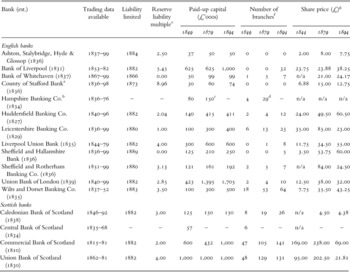
As we have no trading data for the vast majority of our banks prior to 1836 (see second column of Table 1), our analysis starts in that year. From Table 1, we see that our sample includes the Union Bank of London, which, similar to many London banks, had few branches, acted as agents for provincial banks and was extensively involved in international finance. In 1859 this was the third largest English bank in terms of paid-up capital and number of owners. Our sample also includes two of the larger Scottish joint-stock banks, and two of the smaller joint-stock banks in Scotland. Finally, we have trading data for eleven provincial banks from a variety of English regions. As can be observed from Table 1, these banks range from some of the smallest provincial banks (e.g. Ashton, Stalybridge, Hyde & Glossop Bank and County of Stafford) to some of the larger provincial banks (e.g. Bank of Liverpool).
Some characteristics of banks included in study

Notes: aThis bank was known as Bilston District Banking Co. until 1873.
bBecame Capital and Counties Bank in 1878 after merging with the North Wilts Banking Co. in 1877.
c,dThese are the 1874 figures. eThese are the 1884 figures. fThese figures include sub-branches. gThis is the last reported price of the year.
Sources: Banking Almanac and Yearbook, 1845, 1850, 1875, 1880, 1885, 1895; J. Orbell and A. Turton, British Banking: a Guide to Historical Records (Aldershot, 2001); The Course of the Exchange, 1844; Investors' Monthly Manual, 1879, 1894.
As can be seen from Table 1, the banks in this study include two out of the seven English joint-stock banks which converted to limited liability prior to 1879. Twelve other banks in Table 1 converted after 1879, with one not adopting limited liability until 1889. With respect to the reserve liability levels of these banks, there are wide-ranging liability extensions, ranging from zero to 8.96 times paid-up capital. The changes in liability regimes and the variation of reserve liability across banks will permit us to analyse the impact of liability extensions upon the tradability and liquidity of bank shares.
Following the usual convention, trading activity is measured by calculating the number of trades and volume of trade.Footnote 56 Although the usual method of measuring market liquidity in the empirical finance literature is to use the bid–ask spread quoted by market makers,Footnote 57 no such data exist for nineteenth-century bank stocks.Footnote 58 Consequently, in this study, several alternative metrics are used to measure liquidity. First, the average absolute price change between trades is used because an important aspect of liquidity is the extent to which large price changes between trades is absent.Footnote 59 Unfortunately, there only exists a complete set of price data for four banks. Second, the number of trades divided by the number of issued shares and volume of trade divided by the number of issued shares are used as proxy measures of liquidity. These metrics measure the turnover of issued shares, and are frequently used as measures of liquidity in inter-market comparisons.Footnote 60
The archive records of Bank of Liverpool, County of Stafford Bank, Hampshire Banking Company, Union Bank of London and Wilts and Dorset Bank do not enable us to distinguish between share sales and gratuitous assignments of shares. Gratuitous assignments were usually bequests from a deceased shareholder to their beneficiaries or inter vivos gifts between family members. An inability to distinguish between share sales and gratuitous assignments may result in an overestimation of the trading activity (and liquidity) of shares in these five banks. Using data on gratuitous transfers for three English banks on which data exist for all gratuitous transfers, one can assess the dimensions of this potential overestimation. Gratuitous trades as a percentage of total trades are 16.0, 8.5 and 4.1 per cent for the Leicestershire Banking Company, the Sheffield and Rotherham Bank, and the Sheffield and Hallamshire Bank respectively. The volume of shares transferred gratuitously as a percentage of total volume of transfers are as follows: Leicestershire Banking Company (16.0), Sheffield and Rotherham (11.9), and Sheffield and Hallamshire (4.8).
IV
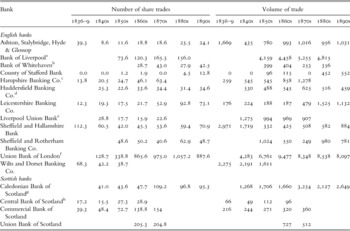
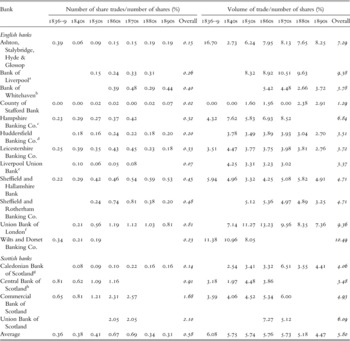
This section examines the long-term trends in share tradability and liquidity. From Tables 2, 3 and 4 several broad trends in trading activity and liquidity emerge. After the initial flurry and active trading of bank stock in the 1830s, the 1840s and 1850s are characterised by little activity and relative illiquidity. Overall, trading activity and liquidity increased somewhat in the 1860s, with trading activity reaching a zenith in the 1870s and early-to-mid 1880s. Trading, however, was less active and shares less liquid in the late 1880s and 1890s. Notably, as we can see from Table 3, from the mid 1830s until the end of the century, there appears to be little improvement in the liquidity of bank shares despite major progress in the development of organised exchanges.
Mean annual trading activity, 1836–99

Notes: aThe figures for the 1850s exclude 1850–2, and the figures for the 1880s only contain 1880–2. bThe figures for the 1860s only contain 1867–9. cFigures for 1870s only cover 1870–6. dFigures for 1890s only cover 1890–6. eFigures for 1840s only cover 1844–9. fFigures for 1840s cover 1842–9, and figures for 1870s cover 1870–8. gThe figures for the 1840s cover 1846–9, and the figures for the 1890s cover 1890–2. hThe figures for the 1860s only contain 1860–8.
Source: See text.
Mean annual liquidity, 1836–99

Notes: aThe figures for the 1850s exclude 1850–2, and the figures for the 1880s only contain 1880–2. bThe figures for the 1860s only contain 1867–69. cFigures for 1870s only cover 1870–6. dFigures for 1890s only cover 1890–6. eFigures for 1840s only cover 1844–9. fFigures for 1840s cover 1842–9, and figures for 1870s cover 1870–8. gThe figures for the 1840s cover 1846–9, and the figures for the 1890s cover 1890–2. hThe figures for the 1860s only contain 1860–8.
Source: See text.
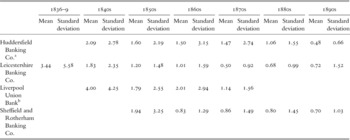
Annual average absolute change in prices, 1836–99

Notes: aFigures for 1890s only cover 1890–6. bFigures for 1840s only cover 1844–9.
Source: See text.
The question arises as to the relationship between the activity in the market for bank stock and the performance of the overall equity market, as measured by stock market indices.Footnote 61 Apart from the ‘bubble’ years of the mid 1840s, the overall market in the 1840s and 1850s was relatively flat. Thereafter, riding on the boom of new securities coming to the market, the market rose from 1860 until the early 1870s, apart from a substantial collapse in 1866. Up until this point, trading activity in bank shares, apart from during the mid 1840s mania, appears to mirror the movements in the overall market.Footnote 62 However, while the overall market falls from 1873 until the mid 1880s, trading activity in bank shares continues to increase, possibly because the banking sector performed better than the rest of the market in this period. Subsequently, the rise of the overall market from the late 1880s and during the 1890s coincides with a lacklustre period of trading in the market for bank stock.
An interesting issue is the extent to which nineteenth-century financial crises may have affected the tradability and liquidity of bank stock. The crises of 1837 and 1847 appear to have reduced trading activity in the shares of most banks. Of the eight banks for which we have data for the 1830s, six show a substantial fall in trading activity after the 1837 crisis. Eight out of the eleven banks on which we have data for the 1840s experience a significant fall in trading activity after the 1847 crisis. Only trading in the shares of the Commercial Bank of Scotland, Union Bank of London and Wilts and Dorset appear to be unaffected.
In contrast to the above crises, the 1857 financial crisis appears to have had a negligible impact upon trading activity. This even holds true for the three Scottish banks in Tables 2 and 3, which is remarkable given that the Western Bank of Scotland, Glasgow's premier bank at the time, collapsed in 1857, and its 1,280 shareholders had a call for just over £1 m.Footnote 63 The 1866 crisis, precipitated by the failure of Overend and Gurney, only affected the Liverpool banks in our sample.Footnote 64 Despite concerns that the City of Glasgow failure in 1878 would result in shares being offloaded, the trading data for the English banks do not demonstrate any change following the City of Glasgow crisis. Unsurprisingly, given the severity of the collapse, trading of shares in three Scottish banks increased substantially following the City of Glasgow collapse. This was particularly the case for the Caledonian Bank, which was the owner of four City of Glasgow shares. This bank was subsequently forced by the liquidators of the City of Glasgow to cease trading on 5 December 1878.Footnote 65
Overall, this evidence is consistent with the view that banks became more robust to crises over the nineteenth century. One possible explanation is that investors and depositors came to recognise that unlimited shareholder liability protected both parties from expropriation by bank directors. Concomitantly, it is generally believed that banks may have introduced more sophisticated risk-management practices over this time period.Footnote 66
V
As the liquidity of stock is an important consideration for the shareholders and managers of companies, in this section we want to ascertain the determinants of (and potential hindrances to) the liquidity of nineteenth-century bank stock. In particular, we examine the impact of the following on stock liquidity: ownership structure, shareholder liability, share denomination, being listed on a market, and directorial share dealing.
One would expect firms with more diffused ownership to have more liquid stocks.Footnote 67 Theoretically, the existence of unlimited liability may turn this on its head as the costs of monitoring larger numbers of owners could result in diminished liquidity.Footnote 68 Nevertheless, a director-vetting mechanism along the lines proposed by Hickson and Turner would substantially reduce the costs associated with trading unlimited liability stock so that diffuse ownership should result in more liquid stock.Footnote 69 We therefore analyse the impact of ownership structure on the liquidity of bank stock.
We were only able to obtain detailed shareholder data, which enabled us to calculate ownership concentration measures, for three of our sample banks. In the late 1870s and early 1880s, the top ten/twenty/thirty shareholders owned the following percentages of stock: Bank of Liverpool (14.1, 22.6, 31.5); Caledonian Banking Company (9.9, 16.8, 22.5); Union Bank of Scotland (19.3, 26.3, 31.2).Footnote 70 On this evidence, we can see that the ownership in these banks was relatively diffuse.Footnote 71
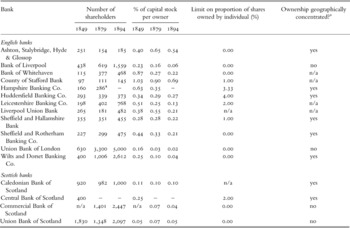
Table 5 contains two related proxies for ownership concentration: size of the shareholder constituency and the percentage of capital stock per owner. Based on these two proxies, three banks in our sample could be described as having relatively diffuse ownership – Union Bank of London, Commercial Bank of Scotland and Union Bank of Scotland. Although the Bank of Liverpool is relatively low on these measures, the evidence from its shareholder list suggests that its ownership was relatively diffuse. Notably, the Union Bank of London and Bank of Liverpool have the highest volume-of-trade liquidity measure, and the two Scottish banks have the highest number-of-trades liquidity measure. The very high share prices of the two Scottish banks, as can be seen from Table 1, explains why their volume-of-trade liquidity measure is lower than that of these two English banks.
Ownership characteristics of banks

Notes: aThe answer to this question is yes if a super-majority (66%) of shareholders came from the same county/city/region. Some of the trading data described in the text above provided details on the location of shareholders. 82.7% of share sales in the ASHG Bank between 1837 and 1899 were to individuals living in the ASHG area. Between 1853 and 1882, 47.4% of share transfers of Bank of Liverpool shares were to individuals living outside Liverpool. Only 20.6% of transfers in Hampshire Banking Co. shares between 1836 and 1876 were to individuals living outside Hampshire. Only 11.1% of share transfers in the Huddersfield Banking Co. between 1840 and 1896 were to individuals living outside Huddersfield and its immediate environs. Only 3.9% of all stock transfers in Sheffield and Hallamshire Bank between 1836 and 1899 were to individuals living outside Sheffield. 72.1% of all share sales in the Wilts and Dorset Banking Co. between 1837 and 1852 were to individuals living in Wilts and Dorset. Using shareholder lists for 1878 obtained from The London Gazette, the top four areas which Union Bank of London shareholders were located in were as follows: London (21.5%), Kent (12.3%), Ireland (11.6%), Sussex (8.3%). Using a Bank of Liverpool List of Shareholders for 1879 (Barclays Archives: ACC25-0204), we found that 33.5% were from Liverpool, 16.8% from Ireland and 7.6% from Manchester. Using A List of Proprietors of Scottish Bank Shares for 1845 (HBOS Archives: NSAS/1110/13/192/1), we found that the shareholders of the Commercial Bank of Scotland and Union Bank of Scotland were distributed throughout Scotland. Whereas, 68.1% of the Central Bank of Scotland's shareholders were from the northeast of the country. The Caledonian Bank's shareholders were located mainly in the northeast of the country (45.6%) and the Highlands and Islands (38.8%). The four banks on which we have no information undoubtedly had geographically concentrated ownership.
Sources: Banking Almanac and Yearbook, 1850, 1880, 1895. Deeds and Contracts of Copartnership.
At the other end of the spectrum, some of the smallest banks, with high percentages of capital stock per owner, have the lowest liquidity – Ashton, Hyde, Stalybridge and Glossop Bank (ASHG), County of Stafford Bank, Huddersfield Bank, Liverpool Union Bank. Notably, the Liverpool Union Bank and ASHG Bank have a large volume of trade despite having a low trading frequency. In both cases, this was as a result of significant block trades taking place as incumbent shareholders consolidated their holdings.Footnote 72 Consequently, as can be seen from Table 5, the number of shareholders fell significantly for both banks between 1849 and 1879.
Four banks with low shareholder numbers appear to have more liquid shares than other banks of a comparable size. However, from Table 5, we can see that the constitutions of these four banks (Hampshire Banking Company, Huddersfield Banking Company, Leicestershire Banking Company, Sheffield and Hallamshire Banking Company) placed an upper limit on the number of shares which one individual could own. By so doing, these banks were preventing a concentrated ownership arising, and subsequently enhancing the tradability and liquidity of their stock. Such restrictions were commonplace; however their existence may have been due to reasons other than liquidity-enhancement.Footnote 73
As can be observed from Table 5, the only bank in our sample which dramatically increased the size of its shareholder constituency was the Union Bank of London. Unlike the other banks in our sample, this institution was a large metropolitan bank with access to a large pool of capital. It is notable that in the 1850s, its liquidity increased substantially, whereas the liquidity of other banks' shares was stagnant. This increase occurred after the bank made its rights issue in 1854, resulting in a larger pool of capital and shareholders.Footnote 74 The trebling of its shareholder numbers between the mid 1850s and 1879 possibly accounts for the substantial increase in the liquidity of its stock.
One would normally expect geographically dispersed ownership to result in more liquid shares.Footnote 75 However, under unlimited liability, geographically dispersed ownership should result in lower liquidity because of the costs of enforcing the extended liability.Footnote 76 As can be seen from Table 5, the ownership of most of our sample banks was geographically concentrated. Notably, the four banks with the most liquid shares are the four banks which do not have their ownership concentrated in a particular region or city. This may simply be picking up the fact that diffuse ownership requires a geographical spread of owners. However, the Caledonian Bank, although its ownership was diffuse, had a geographically concentrated ownership. This may explain why its shares were less liquid than those of banks with similar or even smaller levels of ownership diffusion.
As mentioned above, many scholars believe that liquid capital markets cannot exist under circumstances where there is unlimited shareholder liability because there would be no anonymity in the market for shares. Consequently, the limitation of liability should result in an increase in trading activity and liquidity. However recent work by Hickson et al. has undermined this preconception.Footnote 77 As all of the banks in our sample converted to limited liability, we can test the impact of shareholder liability on tradability and liquidity.
The Bank of Whitehaven was one of the first unlimited liability joint-stock banks to convert to limited liability. However, as can be observed from Tables 2 and 3, in the 1870s its shares were no more actively traded or liquid than unlimited liability comparators.
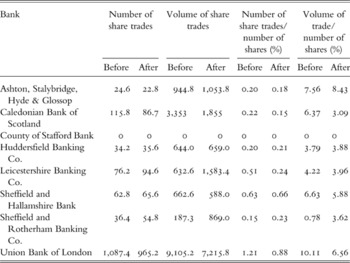
Table 6 compares trading activity and liquidity in the five years before and after banks limited their liability in an attempt to assess the impact limiting liability had on the market for shares. It is notable that the trading activity of only the Leicestershire Banking Company and Sheffield and Rotherham Banking Company increases significantly following the limitation of liability. These, as we shall see below, were the only two banks in Table 6 which had stock splits when they limited their liability.
Average annual trading activity and liquidity five years before and after limitation of liability

Source: See text.
As can be seen from Table 6, the limitation of liability had little impact on the liquidity of bank shares, with the liquidity of several bank shares actually decreasing. Notably, the shares of the Union Bank of London, the largest metropolitan bank in our sample, actually fall. One explanation as to why the limitation of liability appears to have little impact is that banks still had extended liability, and share transfers still had to be vetted. However, aside from the fact that directors' incentives to vet may have dramatically fallen, shareholders' liability had decreased dramatically and was now pro rata, implying that they were substantially less concerned about the financial standing of their co-owners.Footnote 78 Notably, as can be observed from Table 6, the tradability and liquidity of Sheffield and Hallamshire Bank shares appear to be unaffected by its conversion to limited liability despite its shareholders having no reserve liability. In the longer term, as can be observed from Table 2, trading activity and liquidity of most bank shares declined in the latter half of the 1880s and into the 1890s, probably due to wider economic conditions affecting the stock market.
Changes in share denomination, in the form of stock splits, are usually associated with a desire to increase the liquidity of a stock issue.Footnote 79 Somewhat paradoxically, consolidations of share issues or reverse splits have also recently been associated with liquidity enhancement.Footnote 80 Notably, our sample allows us to test for the impact of stock splits on liquidity as it contains three stock splits and two reverse stock splits.
The Sheffield and Rotherham Bank had a 4-for-1 reverse stock split in 1862 and its neighbour, the Sheffield and Hallamshire Bank, had a 5-for-1 reverse stock split in 1845. The reverse stock split of the Sheffield and Hallamshire Bank was followed by a reduction in the number of share trades and volume of trade (Table 2), and it had a small negative impact on the liquidity of its stock (Table 3). On the other hand, although the reverse stock split of the Sheffield and Rotherham Bank in 1862 appears to have reduced the volume of trade, as can be seen from Tables 3 and 4, this consolidation was followed by an increase in liquidity. A possible explanation for this finding is that reverse splits decrease the transactions costs of marketing shares and/or that higher share prices are a good indicator of quality.Footnote 81
The above two banks also had stock splits in the latter part of the nineteenth century (Sheffield and Rotherham – 1-for-4 split in 1880; Sheffield and Hallamshire – 1-for-5 split in 1897), and the Leicestershire Banking Co. had a 1-for-5 stock split in 1879. As can be seen from Tables 3 and 4, the Sheffield and Rotherham and Leicestershire splits had little or possibly a negative impact on the liquidity of their shares. Although the Sheffield and Hallamshire stock split resulted in dramatically increased trading activity, both liquidity metrics fall. Therefore, based on this evidence, it appears that stock splits did not necessarily enhance the liquidity of nineteenth-century bank stocks. One possible explanation for this finding is that stock splits were perceived by investors to be adverse signals of a stock's quality, which may explain why they were infrequent in this period.
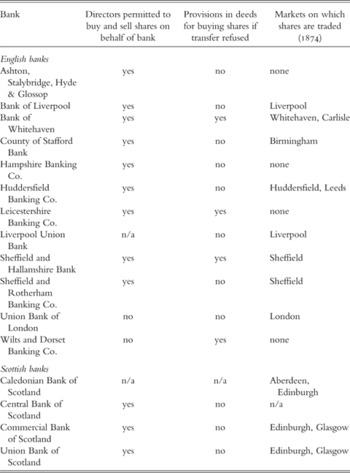
Modern firms are desirous of a stock market listing partially for its liquidity-enhancing effects. As can be seen from Table 7, four of the banks in this study did not have their shares listed on a stock exchange. Notably, for three of these banks, this does not appear to have affected their liquidity. As can be observed from Table 3, Hampshire Banking Company, Leicestershire Banking Company and Wilts and Dorset shares were liquid relative to banks of a similar size.
Market listings and directorial dealing

Sources: Deeds and Contracts of Copartnership. Markets on which shares were traded were obtained from Investors' Monthly Manual, 1874.
Table 4 contains the annual average absolute change in prices for the four banks for which complete per-trade-price data exist. The lower the value of this metric, the more liquid is the stock. Interestingly, according to this metric, Leicestershire Banking Company, which was not listed on a stock exchange, has the most liquid shares despite initially being the smallest bank in terms of paid-up capital (Table 1) and owners (Table 5). This admittedly limited evidence, taken with the above, suggests that listing on a stock exchange does not appear to have been for liquidity-enhancement reasons. This may have been because the informal (and unregulated) markets operated by local stockbrokers were more than adequate substitutes for stock exchanges.
As can be seen from Table 7, the deeds of only four banks committed directors, if requested by the seller, to purchase shares when they had refused to authorise a transfer. These clauses in the deeds typically stipulated that the price to be paid for such shares was to be equal to the average price of the last ten transfers.Footnote 82 These provisions may have existed to assure shareholders that they could exit their investment in the bank and liquidate their capital. Notably, the banks which had this clause typically had more liquid stock than their counterparts.
As can be seen from Table 7, bank deeds typically permitted directors to buy and sell shares on behalf of the bank, although they were not obliged to do so. Although such an activity would be regarded with suspicion in contemporary financial markets, it may have served a useful purpose in the development of early capital markets by effectively permitting shareholders to exit on demand, making bank shares more attractive to investors.Footnote 83 In our sample, only the Wilts and Dorset and Union Bank of London did not permit this activity. Notably, in the 1830s–50s, when the market for bank stock was still in its infancy, these two banks had the most liquid stock in terms of the volume-of-trade metric (Table 3). One possible explanation as to why these two banks didn't have directorial dealing in stock is that, due to their size and location, they had a wider pool of potential owners.
Although directorial dealing may have enhanced liquidity, not every contemporary believed it to be beneficial for shareholders. For example, two witnesses before Parliamentary select committees believed that bank directors shouldn't trade in shares because they could opportunistically buy them at below market prices.Footnote 84 The practice of directors purchasing shares is believed to have been ended voluntarily after it was discovered that the directors of the infamous City of Glasgow Bank purchased close to 15 per cent of its stock to support its price in the months before its collapse.Footnote 85
VI
The evidence above suggests that bank shares could be easily traded in the nineteenth century, and, even by the standards of modern financial markets, the market for bank shares was relatively liquid. For example, Easley et al. state that on major contemporary stock exchanges it is common for some stocks not to trade for days or weeks, and that over 1,000 stocks on the New York Stock Exchange average less than one trade per day.Footnote 86 Our evidence also suggests that the market for bank shares did not become more liquid over the nineteenth century despite the growth and development of organised exchanges.
We also find that the shares of banks which had a diffuse ownership were more liquid than the shares of banks with concentrated ownership. One implication of this result is that the liquidity of the market for shares may have dramatically increased with the growth of large banks in the second decade of the twentieth century. Although liquidity is usually perceived as something beneficial to the development of financial capitalism, there is a school of thought that suggests that capital markets can be too liquid, thus undermining governance by encouraging diffused ownership and passive investing.Footnote 87 Therefore, the very thin trading of some bank stocks in the nineteenth century may have resulted in better governance, with investors active in exercising the rights of participation that their ownership granted them.
Our findings support recent studies which suggest that extended shareholder liability may not have been a major hindrance to the development of financial capitalism.Footnote 88 Notably, our evidence also suggests that the introduction of limited liability did not result in an increase in trading activity or liquidity, raising some measure of doubt as to the importance of limited liability for the development of liquid secondary markets.