Introduction
It is recognised that even experienced surgeons progress through a ‘learning curve’ when learning new procedures.Reference Carney, Harris, McFarlane, Nasser and Esterman1 Due to recent advances in computer graphics and force-feedback (haptic) technology, it is now possible to simulate a wide range of surgical scenarios and to provide a risk-free, computerised training environment to help trainees achieve expert proficiency. Computerised simulation has been shown to be effective in teaching trainees how to undertake high-risk tasks, and it has an excellent track record in, amongst others, the aviation industry.
Subtotal tonsillectomy or intracapsular ‘tonsillotomy’ is increasingly being used to treat sleep-disordered breathing due to adenotonsillar hyperplasia.Reference Hultcrantz, Linder and Markstrom2 Several studies, including a retrospective trial, have now shown its benefits over traditional tonsillectomy in terms of reduced post-operative pain and a faster return to normal diet.Reference Koltai, Solares, Koempel, Hirose, Adelson and Krakovitz3, Reference Koltai4 Using mechanical or controlled electro-thermal dissection equipment, tonsillar tissue is removed from the surface inwards, leaving a thin layer of healthy capsule. The technique is completely different to that of traditional dissection tonsillectomy, and not all surgeons have experience in it. The technique requires the surgeon to remove most of the tonsillar tissue but to be aware of the approaching capsule, using a combination of identification of the slower dissection speed and recognition of the firmer fibrous tissue. If the capsule is breached, then muscle is exposed, with increased post-operative pain and bleeding risk. The benefits of the subtotal approach are then negated.
We hypothesised that a haptic virtual-reality simulator would be beneficial to both specialist and junior surgeons training to perform subtotal tonsillectomy.
Tonsillar tissue has a different consistency and firmness compared with tissues in the temporal bone or sinuses. The tonsils are soft, pliable tissues, in contrast to the rigid, bony tissues of the temporal bone and the firm, mucosa-lined sinus tissues. Current temporal bone and sinus simulators use voxel-based methods or finite element models to simulate these interactions; however, they are not suitable to create tonsillar tissue simulation (since they cannot simulate the deformable, interactive, volumetric remodelling required).
In this paper, we present our experiences in developing a haptic subtotal tonsil surgery simulator.
Materials and methods
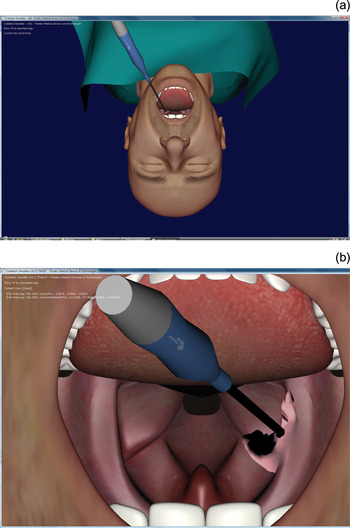
Realistic, three-dimensional computerised models of a patient were prepared (Figure 1). Detailed textures and shading techniques were used to give the simulated patient a realistic appearance. Detailed models of the mouth, teeth and throat were added and arranged to match presentations commonly encountered in the operating theatre.
Screen capture images showing (a) a simulated patient undergoing subtotal tonsillectomy using a Coblation hand-piece, and (b) a close-up view of the simulated patient's mouth.

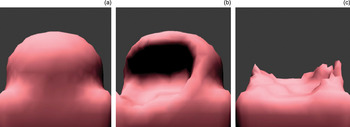
Particular attention was given to accurately simulating surgical interactions. A new method of tissue simulation, recently developed at Flinders University, was used to provide accurate tactile feedback. The tissue simulation (Figure 2) realistically modelled the behaviour of the tissue in response to user interactions. This was achieved using specialised algorithms that apply recent advances in the parallel computing power of graphics processing units, in order to perform a physically based simulation of tissue dynamics in real time. The simulated tissue could be interactively manipulated, cut and ablated.
Computed graphic images showing simulation of tissue mechanical dynamics and tactile responses in real time: (a) intact tonsillar tissue; (b) partially ablated tissue; and (c) dissected tonsil with subcapsule intact.

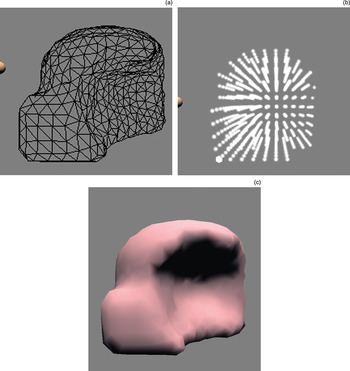
The virtual tissue was represented as separate visual and mechanical models that were efficiently coupled (Figure 3). This enabled high visual fidelity using a lower resolution mechanical simulation, enabling the system to maintain the high update rate required for stable and realistic haptic interaction. Realistic tissue behaviour was modelled using a novel mass-spring system with co-rotational and linear constraints that incorporated additional terms in order to model the viscoelasticity seen in the real tissue.Reference Ruthenbeck5
Computed graphic images showing the process of tissue simulation: (a) wireframe image; (b) mechanical simulation; and (c) final tissue.

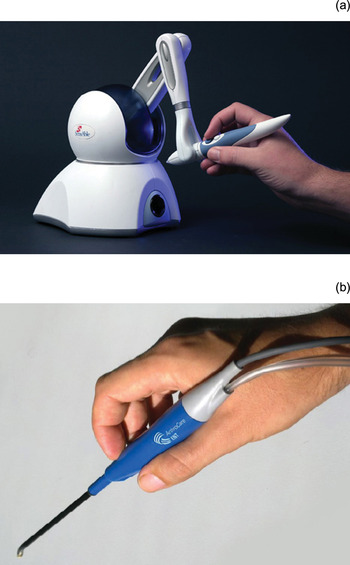
The haptic device used in this framework was the Sensable Omni (Sensable, Wilmington, Massachusetts, USA) (Figure 4), a stylus-based device that tracks six degrees of freedom for movement and allows three degrees of freedom for haptic feedback (rotational feedback is excluded). As this haptic device is designed for point-based interactions, a simple sphere was utilised as the virtual representation of the stylus. However, the implementation remained flexible so that forces could be averaged from multipoint interactions. The flexibility of the haptic device allowed an actual ablation tool to be modified so that its handle could be attached directly to the haptic device. This not only improved simulation realism but also maintained simulation validity for training and assessment purposes.
The Sensable Omni haptic device (a) provides precise force-feedback when controlling the Coblation hand-piece (b).

The integration of algorithms and testing of the overall framework was completed on a computer with the following relevant specifications: processor, Intel Core 2 Quad Q9450 (2.66 GHz) (Intel, Santa Clara, California, USA); random access memory, 4.0 GB; general processing unit, nVIDIA GeForce GTX 280 (NVIDIA, Santa Clara, California, USA); and application window resolution, 1680 × 1050 pixels.
Regular feedback from surgeons was used during development to ensure an accurate haptic experience was achieved.
Results
A visually and tactilely accurate prototype subtotal tonsillectomy simulator was created. Limitations included the absence of bleeding and the lack of variation in the shape of the tissues; future models will benefit from further refinement to more accurately represent tonsil anatomy and its normal variability. These limitations should be easily correctable with further development. The tonsillotomy simulator enabled the user to learn from their mistakes in a low-pressure environment. Like temporal bone simulators, visual and audible cues alerted the user when crucial structures such as the tonsil capsule were approached or breached. Figure 1 shows screen capture images of the current version of the simulator.
The haptic device mimicked a Coblation hand-piece, and gave plausible tactile feedback to the user when the simulated tissue was dissected. This allowed the trainee surgeon to practise ‘feeling’ the various degrees of resistance as the tonsillar tissue was cut at different speeds and pressures. With repetition, this allowed the trainee to improve their dexterity and movement economy and to reduce dissection errors, thus helping to instil confidence and increase operating speed, and ultimately to achieve an accurate and timely surgical performance.
Discussion
Virtual simulation and haptic interfaces are increasingly being used to develop teaching devices for ENT training. We believe this change in training practice is significant, because of the various advantages virtual simulation provides. Our simulator prototype has enormous flexibility and potential advantages, and could potentially be extended to numerous pharyngeal procedures.
Simulators have numerous benefits in the surgical profession, including the ability to simulate atypical anatomy and scenarios the surgeon could only expect to encounter infrequently. Virtual simulators are being increasingly accepted as an effective, risk-free training modality for medical students, surgical trainees and even fully accredited specialists. Such simulators can not only teach the relevant anatomy but can also help refine the surgeon's approach in order to minimise morbidity.
Many surgical simulators have demonstrated reliability and validity in different aspects of surgical training, such as anatomy teaching and specific motor skill refinement.Reference Solyar, Cuellar, Sadoughi, Olson and Fried6, Reference Fried, Sadoughi, Weghorst, Zeltsan, Cuellar and Uribe7 O'Leary et al. have shown that a networked system of virtual teaching in temporal bone surgery is effective in transferring anatomical knowledge and surgical planning skills to non-expert trainees.Reference O'Leary, Hutchins, Stevenson, Gunn, Krumpholz and Kennedy8 A series of validation studies of endoscopic sinus surgery simulation have clearly defined its reliability in terms of face, content, construct and predictive validity, and have postulated its ability for accurate transference of knowledge into the operating theatre.Reference Fried, Sadoughi, Gibber, Jacobs, Lebowitz and Ross9 However, the combined use of virtual simulation and haptic technology has not previously been used to simulate tonsil surgery.
Our simulator does not harm the patient or trainee. The simulated patient is realistically created and rendered by computer software and hardware. There is no real tissue involved in the model, unlike cadaveric temporal bone and sinus models.Reference Wiet, Stredney, Sessanna, Bryan, Welling and Schmalbrock10 Therefore, the user is not exposed to the hazards of bodily fluid or tissue. At the same time, computer simulation avoids the need for costly single-use tissue models. Ultimately, we hope to make the simulator accessible to anyone with suitable computer hardware, so that trainees can practise not only in training centres but also at home.
The virtual tissue can be repeatedly used to help practise specific dexterous and technical skills, in order to achieve expert performance. Expert skill acquisition can be achieved through extended and deliberate practice of specifically defined tasks, and does not depend solely on the number of hours spent in surgery.Reference Ericsson, Krampe and Tesche-Romer11 Fried et al. clearly demonstrated that, with sufficient practice using the Endoscopic Sinus Surgery Simulator II virtual simulator, novice trainees could attain the benchmark performance criteria of an expert surgeon.Reference Fried, Sadoughi, Weghorst, Zeltsan, Cuellar and Uribe7
Furthermore, given the shorter working hours of residents, and the subsequent reduction of opportunities to practise basic and focussed procedures, our virtual simulator device provides a realistic means of practising basic skills outside the operating theatre.Reference Watson, Flesher, Ruiz and Chung12, Reference Reznick and MacRae13
In addition to enabling simple repetition of tasks, our simulator has the flexibility to adapt to various different cognitive and motor learning styles, in response to each trainee's pattern of skill acquisition and level of experience. This flexibility reflects the widely accepted Fitts and Posner theory as well as the implicit motor learning theory.
According to the Fitts and Posner model, motor skill is learnt through a three-stage process, namely cognition, integration and automation.Reference Fitts and Posner14 In the first stage, the trainee understands the meaning and process of the task by careful and distinct performance of each step. With each subsequent practice repetition, accompanied by appropriate feedback, the trainee can begin to integrate the motor behaviour so that it involves less thinking and fewer interruptions. In the autonomous stage, the motor skill is performed with fluid movements and without deliberate thought, leaving more cognitive reserve for other aspects of the procedure or for surgical decision-making.
Our simulator provides not only visual and audible feedback but also tactile stimulation, thereby adding a third dimension of realistic feedback to evoke Fitts and Posners' model of learning, so that surgical skills can be successfully integrated and automation can be achieved with practice.
• Virtual-reality computer simulators are increasingly used in surgical education
• Tactile simulation is now possible using haptic force-feedback technology
• A virtual-reality subtotal tonsillectomy simulator is described, with realistic visual and tactile stimulation
• This provides a risk-free, low-pressure learning environment
• This simulator may be suitable for subtotal tonsillectomy training
In contrast to the Fitts–Posner model of motor skills learning, simulation also has the potential to facilitate implicit skills learning, whereby the trainee bypasses the cognitive stage to directly achieve an autonomous stage.Reference Masters, Poolton, Abernethy and Patil15 This can be achieved by tailoring the level of difficulty to the trainee's progress through the simulation model. Tissues of different shapes, sizes, vascularity and firmness can be simulated according to each trainee's individual level of experience. Preliminary verbal or written instructions from the virtual trainer or an expert surgeon can also be selected and added to the course. This is thought to help prevent the trainee from learning and automating undesirable movement behaviours, which would then require a high level of cognition and extended periods of time to unlearn. Hence, the application of implicit motor learning theory is an important consideration in surgical skills training, and one which can be addressed using our simulator. This type of simulator-based training should help to achieve accurate surgical treatment, improved patient safety and recovery, and reduced litigation risk, even in the face of reduced surgical hours and a shortened surgical training period.
Although our simulator is still evolving, it has already proven itself as an invaluable method of teaching surgical trainees the basics of subtotal tonsillectomy, and of refining the skills of expert operators. However, research is ongoing to evaluate surgical outcomes.
Conclusion
We have successfully produced a prototype virtual-reality haptic simulator for subtotal tonsillectomy. The simulator provides a risk-free environment in which surgeons can practise subtotal tonsillectomy using a surgical hand-piece. Early responses suggest that tactile feedback improves learning and thereby accelerates the development of expert proficiency. Other ENT techniques could also be taught using this computer methodology. Simulators are now becoming accepted as an effective method of surgical teaching, and there is the potential for training standards similar to those achieved in the aviation industry.
Acknowledgements
The work reported in this study was done at Flinders ENT, Flinders Medical Centre, and at the department of the School of Computer Science, Engineering and Mathematics, Flinders University, Bedford Park, South Australia, Australia. A proof-of-concept grant was received by A S Carney from Arthrocare Australia. The same author sits on the International Medical Advisory Board of Arthrocare Corp (International).