According to research on ‘the decline of cleavage politics’, parties and their electorates have changed in contemporary democracies. Voters have become more independent from traditional forms of group allegiances, while mass-based parties have been replaced first by catch-all parties, and then by electoral/cartel parties.Footnote 1 This body of work challenges a longstanding tradition, which regards class, religion and territory as the basis for the ‘insulation’ of voters in opposing camps brought about by parties,Footnote 2 through a kind of ‘social closure’,Footnote 3 which, mainly in Western Europe, eventually led to the ‘encapsulation’Footnote 4 of voters in distinct political enclaves and sub-cultures.
Although the empirical support for this thesis on the decline of cleavage politics is still a matter of some debate, more important is the fact that no shared consensus exists on the causal mechanisms underpinning and conditioning this process.Footnote 5 Previous research on the decline of cleavages in Western party systems has tended to fall into one of two camps: those that privilege social structural factors and those that emphasize political factors. The former – which have dominated the literature – highlight the primacy of changes in the social composition of the electorate and can be considered a ‘bottom-up’ approach to the structuring of political divisions. The latter, by contrast, argues that cleavage allegiances derive from the strategies of parties themselves and can be characterized as ‘top-down’ in nature.
The bottom-up approach argues that changes that have occurred within the electorate, such as rising living standards, the spread of affluence and the expansion of higher education, have increased the cognitive capacity of voters, making them more individualistic in their voting choices.Footnote 6 Accordingly, social mobility and the emergence of new issues have produced pressures on voters, which undermine the salience of traditional group identities,Footnote 7 and the increasing secularization of the electorate has similarly weakened the religious base of voting behaviour.Footnote 8 Moreover, new divisions among the electorates are thought to have emerged along cultural and value dimensions,Footnote 9 supposedly undermining the hold of traditional cleavage politics.Footnote 10 This ‘modernization thesis’ therefore posits that there has been gradual erosion in the political salience of cleavages over time and that this decline in cleavage politics ‘can be regarded as the consequence of the successful resolution by political systems of deep-seated conflicts of social interests’.Footnote 11
By contrast, the top-down approach has tended to focus on elite mobilization strategies, and according to this approach the electoral salience of traditional cleavages is a response to changes in the supply side of party policies.Footnote 12 With respect to social class, there is a substantial literature relating class voting to economic policy preferences.Footnote 13 The working class prefers redistribution and so votes for parties on the left, whereas the middle class tries to resist these claims and so votes for parties on the right. Accordingly, the degree to which parties differ in their economic policies in this regard is thought to influence the degree to which different classes support them. This assumption provides the backbone for studies that seek to explain class voting in relation to party positions. So, if parties differ in their policy outlook along dimensions strongly related to the cleavages, we would expect the salience, or strength, of these cleavages to be stronger than if the parties stand for much the same policy outlook.Footnote 14 This perspective recognizes the autonomous role of parties as the main players in attenuating or reinforcing traditional cleavages, and although empirical tests of this hypothesis have provided somewhat mixed results,Footnote 15 partial evidence that class voting is higher when there is a clear policy difference between parties has been found in Britain,Footnote 16 ItalyFootnote 17 and Northern Europe.Footnote 18
Although these top-down and bottom-up approaches are often considered to be competing, this is largely because there has been a considerable amount of controversy over whether the impact of social cleavages has in fact declined or not.Footnote 19 Accordingly, those who argue that there has been a gradual long-term decline in class voting tend to emphasize sociological explanations of change (which have also been gradual), while those who argue that there has been trendless fluctuation tend to emphasize political explanations to do with the polarization of the policy space (which also goes up and down). At a theoretical level, though, both approaches tap into important aspects of cleavage theory (group identity and political articulation), and potentially have independent effects on the strength of cleavages in party systems.
However, a crucial aspect of cleavage theory has hitherto been ignored. By far, and surprisingly, the least attention has been devoted to the third element in the notion of a cleavage, which focuses on the linkage between parties and organized society, generally referred to as ‘segmentation’. The capacity of parties to penetrate social groups, or to create parallel organizations, has been a key factor in reinforcing group identity and interest representation, so as to strengthen and perpetuate the cleavage structure.Footnote 20 According to Stein Rokkan, segmentation is the ‘degree of interlocking between cleavage specific organizations active in the corporate channel and party organizations mobilizing for electoral support’.Footnote 21 Building on this notion of segmentation, we argue that it is the structure of this linkage that provides the most persuasive account of why the strength of cleavages varies, both over time and in relation to each other.Footnote 22 Parties’ capacity and willingness to recruit politicians with ties to different social organizations signals to voters their commitment towards these social interests and also reflects the organizations’ involvement in the electoral process. It thus provides a direct channel of representation and incorporation between social groups and their political representatives. When this link is strong, voters are clearly able to identify which parties stand for their group and which parties do not, and so vote accordingly.
This idea of organized parties as vehicles for integrating and incorporating different social groups has a long history. Neumann argued that modern democracies could not survive unless democratic parties provided the kind of organizational integration offered by their non-democratic rivals and, in a similar vein, Duverger regarded the emergence of mass parties as a positive step in democratic evolution, precisely because their locally articulated structures ensured a ‘closer and more faithful contact between the mass of the people and their ruling elites’.Footnote 23 These local networks also served to foster political integration and channels of mobilization.Footnote 24 However, since the 1960s, the extent to which parties maintain and develop these linkages with grass-roots organizations has been questioned. The apparent demise of the mass party has been a central feature underpinning the literature on how parties have changed organizationally, and developed into catch-all parties, rational-efficient parties, electoral-professional parties and cartel parties.Footnote 25 However, previous empirical research has not paid much attention to how these changes at the party organizational level have affected patterns of voting behaviour at the individual level. Moreover, due to data limitations, the little, but noteworthy, empirical research that has attempted to investigate this link has only examined one component of organizational structure and has focused on the organizational density of union or religious associations in society at large, rather than in political parties in particular.Footnote 26 These accounts are, again, more society driven, and are of the bottom-up variety, thus failing adequately to address the full concept of segmentation, or party–organization linkage. Indeed, as examples from Latin America show, high levels of unionization need not necessarily translate into high levels of class voting.Footnote 27 What is crucial is the penetration of these organizations in political parties rather than just in society.
In this article we argue that the linkage between parties and social organizations constitutes a critical part of the process in translating membership in a social group into support for a political party. In particular, drawing on Sniderman and Bullock's notion of consistency theory, we would expect cleavage voting to be more likely to occur when the social characteristics of the individual voter are consistent with the cleavage-related organizational characteristics of the party.Footnote 28 By contrast, when the social characteristics of the voters are not consistent with the characteristics of the parties (that is when voters face cross-cutting pressures at the organizational level), cleavage voting would be much less likely to occur. The Italian dual cleavage system offers a clear opportunity to test these claims, since voters are exposed to different party–organizational pressures, and these pressures have changed radically and abruptly over time.Footnote 29 While previous studies have focused mainly on voters’ location in the dual Italian cleavage system, assessing the extent to which class voting is undercut by the pervasiveness of religion,Footnote 30 this research, to our knowledge, provides the first direct test of the relationship between the structure of party–organizational linkages and the strength of cleavage voting. In particular, we test the following hypotheses: party–organization linkage conditions the underlying strength of cleavage voting over time (H1), i.e. linkage is able to explain variation over time in the strength of cleavage voting; and party–organization linkage conditions the relative strength of cleavage voting between social groups (H2). The corollary of these hypotheses is that policy polarization is unable to account for the underlying strength of cleavage voting over time, though it may influence short-term variation (H3).
Research strategy
With the transition from what has been termed the First to the Second Republic,Footnote 31 the Italian case provides a particularly instructive natural experiment to test these claims. This is so because the dramatic change in the party system in the early 1990s, the demise of the ruling Christian Democratic and Socialist parties, the rise of new parties such as Forza Italia and the transformation of the former Communists into Democratici di Sinistra have allowed us to model the impact of changing structural alternatives at the party–organizational level, holding the social characteristics of the electorate relatively constant.Footnote 32
To test the impact of these changes on the level of cleavage voting over time in Italy we have analysed a merged dataset, which combines information on voters, policy polarization and party-organization linkages. First, to examine the social characteristics and voting behaviour of individuals over time, we use pooled cross-sectional data from national population surveys of the Italian electorate from 1963 to 2008.Footnote 33 This is the longest time-series data on political behaviour available in Italy covering thirteen elections and consisting of 30,009 interviews. Second, to examine the policy platforms of the political parties over time, we use Party Manifesto Data from the Manifesto Research Group,Footnote 34 supplemented by 2006 and 2008 data, which was provided by CIRCaP-Università di Siena.Footnote 35 Third, to examine the links between parliamentary representatives (MPs) and organizations affiliated to the major social cleavages over time, we use what we believe to be a unique dataset on the associational memberships of MPs (using data from the CIRCaP Italian Political Elite Study from 1963 to 2008).Footnote 36
Measurement
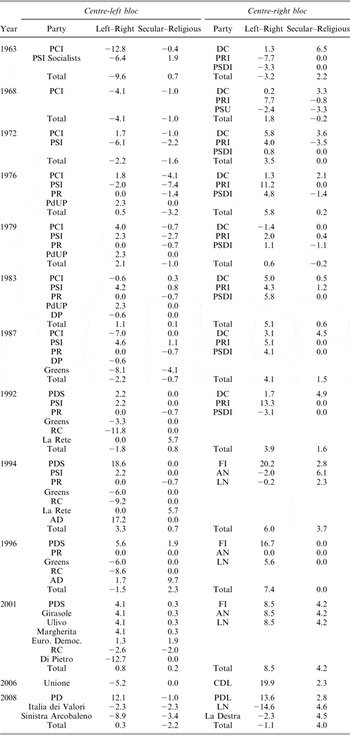
The structure of political competition in Italy has undergone a number of changes over the last fifty years, and some simplifying assumptions are obviously necessary in order to carry out comparative research over time. To this end, we focus on competition between party blocs.Footnote 37 From 1968 to 1992, the principal political conflict was between the leftist PCI bloc (in which we include PCI, PSI and the other minor left lists) and the centrist DC bloc (in which we include DC, PSDI and PRI). Following the corruption scandals of the early 1990s many of these parties disappeared and new parties entered the political stage. From 1994 onwards, the structure of electoral competition was somewhat different, and the principal opposition has been between the centre-left PDS bloc (Margherita, Verdi, etc.) and the centre-right Forza Italia/PDL bloc (AN, Lega). The implosion of the Christian Democrats led to the emergence of several DC splinter groups, which eventually aligned either on the left camp (Margherita) or on the right camp (CCD/UDC), contributing to the bipolar structure of competition that has characterized Italy's recent elections (see Appendix Table A for details of exact coding). This change in the party system allows us to examine the impact of changing political alternatives, holding social change more or less constant. The main dependent variable that we use is whether respondents voted for the (centre) left PCI-PDS bloc or the (centre) right DC-FI-PDL bloc.Footnote 38 The main independent variables that we consider at the individual level are class and religion. To measure class, we adopt a simple manual/non-manual dichotomy, while to measure religion we employ a binary measure of church attendance: whether respondents attend church every week, or rarely/never.Footnote 39 We also construct a four-fold variable, which combines these two measures to take into account voters’ overlapping class and religious characteristics.
Policy Space
To measure the polarization of the policy space, we follow previous research by drawing on party manifesto data. These data provide a useful indication of party positions since they represent the choices that the electorate faces before each election. We employ a slightly modified version of the traditional Laver and Budge methodology,Footnote 40 and compute the left–right scores of the various parties on explicit economic issues by summing up the percentages of all the sentences in the left category and subtracting their total from the sum of the percentages of the sentences in the right category.Footnote 41 Following Bartolini and Mair,Footnote 42 we focus purely on economic policy sentences in the parties’ manifestos, which are directly related to the class cleavage – that is individuals’ social position in the market – leaving aside other realms (i.e., military, freedom, human rights, peace, etc.), which, although relevant to the overall left–right divide, have a less distinctive cleavage content. Furthermore, it is the parties’ economic policies that are generally thought to have the greatest impact on class voting.Footnote 43 There are a number of ways in which these party positions can be summarized, and following previous research we employ a simple measure of policy difference between the two main political groups, where the policy position of each bloc is calculated as the mean policy position of each of its constituent parties.Footnote 44 A similar approach is used to describe the emphasis of religious issues, based on the two available items from the party manifesto data. The first refers to positive mentions of traditional morality (Item 603) and the second refers to negative mentions (Item 604).Footnote 45 The measures are computed in the same way as above.
Party–Organization Linkage
To measure the linkage between social cleavage group organizations and political parties, we use the study of MPs to examine their associational affiliations in each party bloc. We focus on two variables: whether they have held an official position in trade unions, and whether they have held an official position in organizations affiliated to the Catholic Church, such as parish councils or church-sponsored cultural or leisure organizations. Since Italy has historically exhibited a dual cleavage system based on both religion and class, we also take into account how these organizational affiliations overlap, that is, whether MPs belong to both church and union organizations (or neither). In this way, it is possible to relate the structure of the party–organizational links to the social characteristics of the voter at the individual level and measure the degree of congruence between the two. This allows us to move beyond macro and micro level approaches to voting behaviour to take into account the meso level, which provides the link between the two. The stronger the consistency between the organizational characteristics of the party and the social characteristics of the voter, the closer the links between voter and party and the more likely we would expect cleavage voting to occur.
There are a number of ways in which the structure of party–organization linkages can be summarized, and we have inspected various indices of difference, or dissimilarity. However, the problems with such indices is that they only provide an overall measure of difference (or similarity) between party organization characteristics and voters’ social characteristics and are not able to take into account the direction of this difference (for example, whether the voter is more similar to the left or the right). To summarize the consistency between party and voter, therefore, we have followed Lieberson and employed an Index of Net Difference (IND).Footnote 46 IND is a particularly appropriate measure of difference, since it can be applied to comparisons where an ordered distribution varies across groups, and, in addition, unlike the index of dissimilarity, it summarizes both difference and direction (either positive or negative), indicating to which party the voter is closest. The index of net difference is based on rank-sum comparisons between groups, in which populations X and Y are compared with characteristic I where X refers to MPs from the leftist bloc, Y refers to MPs from the centrist DC-FI-PDL bloc and I is the voters’ social characteristics. The Index of Net Difference provides a summary measure of the probability that the social characteristics of voter i are consistent with one party rather than another. The computational procedure is shown below. The order of the subscripts indicates the direction of the probability difference. Thus INDxy means that pr (Y > X) has been subtracted from pr (X > Y). Hence, a positive value indicates that the latter probability is higher, and a negative value indicates the opposite.


Since the structure of party–organization linkages creates different pressures on different sets of voters, according to the nature of the voters’ social characteristics, the rank-order of MPs’ associational linkages will vary from group to group. For example, secular working-class voters face reinforcing positive pressures from (a) MPs with union associational involvement (since this appeals on both a class and a secular basis) and negative pressures from those with (b) church involvement (for opposite reasons). However, the same voters face cross-cutting pressures from (c) MPs with church–union involvement (which appeals on class lines but not religious lines) and (d) no-association involvement (which is nominally secular, but not working-class either). Treating religion as the dominant cleavage in the dual cleavage system, the consistency between party characteristics and voter characteristics can be rank-ordered a, d, c, b (although alternative rank-orderings that do not differentiate between d and c produce almost identical results). In this way the structure of party–organization linkages can be rank-ordered for each group of voters in terms of the degree of congruence between party identity and voter identity. Table 1 summarizes the rank-order for each of the different social groups.
Rank Ordered Similarity between Party-Organization Affiliations and Voter Characteristics

The index is calculated with respect to each social group by year. An IND of 0.61 indicates that, for example, for the secular working class in 1968, the organizational links of an MP from the leftist bloc are more consistent with the voters’ social characteristics by 61 per cent more often than an MP from the centrist bloc. By contrast, a negative value indicates that the social characteristics of the voter in question are better represented by the associational linkages on the centre-right. For example, an IND of −0.55 indicates that for the Catholic working class in 1968, the organizational links of an MP from the centre-right bloc are more consistent with the voters’ social characteristics by 55 per cent more often than an MP from the left bloc. Finally, we compute the difference between the IND for each social group and the IND for the secular working class as our reference category. Thus, from the above example, the IND for the secular working class (0.61) minus the IND for the Catholic working class (−0.55) = 1.15. Positive values, then, indicate that the group in question (in this case the Catholic working class) faces stronger organizational linkages with the centre than the secular working class, and negative values indicate that they face weaker linkages. This then provides a summary measure of the incentives for each group of voters in relation to the secular working class to vote for the left bloc or the centre bloc.
Changes over time
Voting Behaviour
We begin, in Figure 1, by reporting the log odds of religious voting and class voting since the 1960s. In each election we use logistic regression with a binary-dependent variable contrasting vote for the centre-right DC-FI bloc (coded 1) and the centre-left PCI-DS bloc (coded 0). The independent variables are class (coded 1 for middle-class; 0 for working-class) and religion (coded 1 for regular church-goer; 0 for irregular/never).Footnote 47 A clear pattern is immediately evident. First, there is a sudden rupture in the relationship between both religion and vote and class and vote in 1994, with the transition to the Second Republic; the level of religious voting in 1994 was much lower than previously, and the level of class voting was somewhat lower than previously. Second, since 1994 the level of class voting has fluctuated up and down, and in 2006 was only a little lower than levels observed in the First Republic, only to drop down again in the last election in 2008. However, the religious cleavage has remained at historically very low levels.
The strength of religious and class cleavages, 1963–2008 (log odds of voting centre compared to left) Sources: Istituto per le Ricerche Statistiche e l'Analisi dell'Opinione Pubblica – Doxa, 1963 survey; Mass Election Study, 1968 and 1972; Political Action Study, 1975; Eurobarometer, 11 (1979); Four Nation Study, 1985; Italian National Election Study (ITANES), 1990, 1992, 1994, 1996, 2001, 2006, 2008.

The sudden nature of this rupture makes us sceptical about the claims of the modernization thesis, since changes in the social characteristics of the electorate cannot explain the sudden change in the determinants of electoral choice that we observe. This suggests that the structure of the political alternatives is the driving force behind the observed pattern, and for this reason it is on these political explanations that we now focus.
Policy Differences
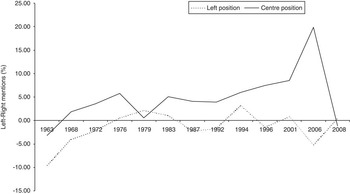
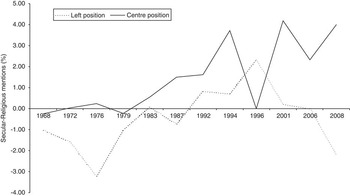
Figures 2 and 3 plot the policy positions of the centre-left bloc and centre-right bloc over time on each of the policy dimensions. Three noteworthy trends appear: first, left–right issues are consistently much more salient than religious–secular issues, as can be seen from the difference between the relative number of mentions that each of these issues receives.Footnote 48 Second, policy distance between the blocs on economic issues was small during the First Republic (particularly from 1976 to 1979 during the period of the historic compromise), mainly due to the fact that most of the ideologically polarized nature of Italian party politics was based on the West–East international divide.Footnote 49 In the Second Republic we observe increased policy difference on left–right issues. However, following the highly polarized elections of 2006 both party blocs have converged on the centre. Third, there is not much variation over time in the emphasis of religious–secular issues during the First Republic (with some convergence during the period of controversial legislation on abortion and divorce in the 1970s), while variation has grown in the last three elections. Overall, there has been considerably more variation in the emphasis of economic left–right issues than of religious ones.Footnote 50
Party bloc positions on left–right economic issues, 1963–2008 Sources: Party Manifesto Data from the Manifesto Research Group, 1963–2001 (see Ian Budge, Hans-Dieter Klingemann, Andrea Volkens, Judith Bara and Eric Tanenbaum, Mapping Political Preferences: Estimates for Parties, Electors, and Governments 1945–1998 (Oxford: Oxford University Press, 2001)); and CIRCaP-Università di Siena, 2006 and 2008.

Party bloc positions on secular–religious issues, 1968–2008 Sources: Party Manifesto Data from the Manifesto Research Group, 1963–2001 (see Budge et al., Mapping Political Preferences); and CIRCaP-Università di Siena, 2006 and 2008.

Class voting and left–right policy difference
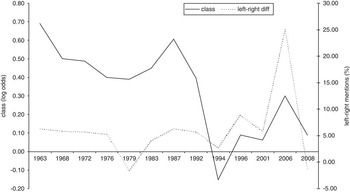
Next we turn to examine the impact of these policy positions on the politicization of social cleavages. The first hypothesis we test is that policy polarization does not explain per se the long-term trend of cleavage voting. Figure 4 depicts the trends over time for the association between class and vote (log odds) compared with the policy difference between the two main blocs on economic left–right issues. On first inspection, there appears to be a relatively close fit between the two time trends, particularly within each republic. When the policy difference decreases, the level of class voting also tends to decrease, and similarly when the policy difference increases the level of class voting also tends to increase. However, there is one important exception to this trend. The polarization of the policy space is unable to account for the sharp decline in class voting in 1994, nor its historically low level thereafter. Over the entire period, the correlation between policy difference and the strength of class voting is, therefore, not significant (R = −0.08).
Class voting (log odds) and polarization of left–right issues, 1963–2008 Sources: Istituto per le Ricerche Statistiche e l'Analisi dell'Opinione Pubblica – Doxa, 1963 survey; Mass Election Study, 1968 and 1972; Political Action Study, 1975, Eurobarometer, 11 (1979); Four Nation Study, 1985; Italian National Election Study (ITANES), 1990, 1992, 1994, 1996, 2001, 2006, 2008; Party Manifesto Data from the Manifesto Research Group, 1963–2001 (see Budge et al., Mapping Political Preferences); and CIRCaP-Università di Siena, 2006 and 2008.

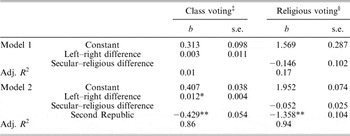
Table 2 formally tests this association by regressing at the aggregate level the strength of the class coefficients on policy difference over the 1963–2008 period. From Model 1 we can see that policy difference is not significant (b = 0.003) for the entire time period (and it is not significant when we include a lagged dependent variable either). There is thus little evidence that parties’ changing emphases of left–right issues explain the long-term trend of class voting. However, when we include a dummy for the transition to the Second Republic we can see (in Model 2) that policy difference does explain some of the variation within each republic (b = 0.012) and is significant at the 0.05 level. This suggests that policy difference has little impact on the underlying long-term level of class voting that we observe, although it may have some impact on the short-term residual variation.
Impact of Policy Difference on Strength of Cleavage Voting, OLS Regression, 1963–2008Footnote †

Sources: Istituto per le Ricerche Statistiche e l'Analisi dell'Opinione Pubblica – Doxa, 1963 survey; Mass Election Study, 1968 and 1972; Political Action Study, 1975; Eurobarometer, 11, 1979; Four Nation Study, 1985; Italian National Election Study (ITANES) 1990, 1992, 1994, 1996, 2001, 2006, 2008; Party Manifesto Data from the Manifesto Research Group, 1963–2001 (see Budge et al., Mapping Political Preferences); and CIRCaP-Università di Siena, 2006 and 2008.
† The dependent variables are the log odds of voting centre-right (rather than centre-left) of middle class voters (respect to working class) and regular church-goers (respect to irregular/never church-goer) computed for each election between 1963 and 2008.
‡ N=13.
§ N = 12 (religious attendance not available in the 1963 survey)
* p < 0.05; **p < 0.01.
Religious voting and religious–secular policy difference
Next we turn to inspect the relationship over time between religion (church attendance) and vote compared with the level of religious–secular policy difference. Figure 5 depicts the trends over time in the log odds for the association between religiosity and vote, compared with the policy difference between the two main blocs on religious–secular issues. There is very little sign of any correlation. But we must recall that, as we have already observed, the salience of religious issues in the party manifestos has tended to be very weak. It is, therefore, perhaps not surprising that voters do not respond to movement in what are basically relatively weak signals. However, our expectation that the centre bloc's move towards secularism during the late 1970s may have weakened religious voting is clearly not fulfilled, and despite this change of emphasis the religious cleavage was in fact, if anything, slightly stronger during this period. Similarly, even though the policy difference on religious–secular issues was much the same in 1994 as it was in 1992 (even a little higher), there was a pronounced drop in the log odds of religious voting. The findings are supported by the lack of statistical significance for the overall association between religious voting and religious policy difference (b = −0.146). And this holds also in the First Republic and the Second Republic (see Table 2). The religious cleavage does not, therefore, appear to respond to political polarization. It is able to explain neither residual variation nor the underlying level.
Religious voting (log odds) and polarization of religious issues, 1968–2008 Sources: Mass Election Study, 1968 and 1972; Political Action Study, 1975; Eurobarometer, 11 (1979); Four Nation Study, 1985; Italian National Election Study (ITANES), 1990, 1992, 1994, 1996, 2001, 2006, 2008; Party Manifesto Data from the Manifesto Research Group, 1963–2001 (see Budge et al., Mapping Political Preferences); and CIRCaP-Università di Siena, 2006 and 2008.

So, although we find partial evidence that policy difference influences the level of cleavage voting, there remains a number of important questions that previous approaches have been unable to answer. The dramatic decline in class and religious voting in 1994 cannot be attributed to changes in the policy difference between the parties – both class and religious issues were expressed in the electoral arena to more or less the same level as previously, nonetheless the level of cleavage voting sharply declined. Neither can this sudden decline be attributed to social change, since between 1992 and 1994 the social characteristics of the electorate were held more or less constant. Moreover, policy difference cannot explain why levels of religious voting have historically been much higher than class voting and, indeed, given the greater salience of left–right issues, would indicate that it should be the opposite way a round. This suggests that the variables that we have so far considered neglect a crucial part of the story.
Party–organization linkages
To shed light on this process we consider the organizational links between the political parties and their social constituents. This can be thought of as describing the ‘closure’ of the cleavage, and the level of party–organization mobilization. According to our first hypothesis, the stronger the involvement of organized groups in the parties, the more strongly voters perceive parties as being committed to the representation of their social interests and the higher we would expect the level of cleavage voting to be. The MPs’ data provide a unique way of examining how these linkages have changed over time, and whether these correlate with the strength of cleavage voting.
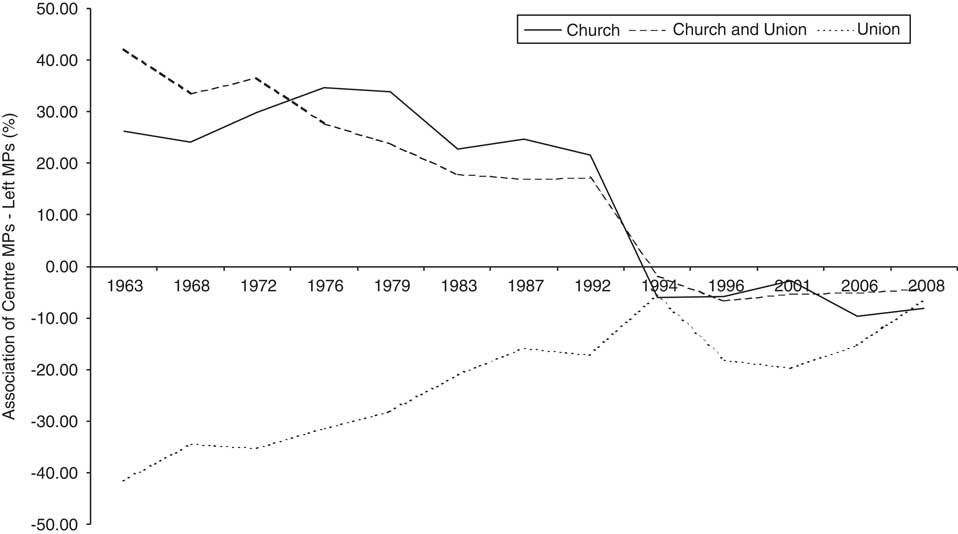
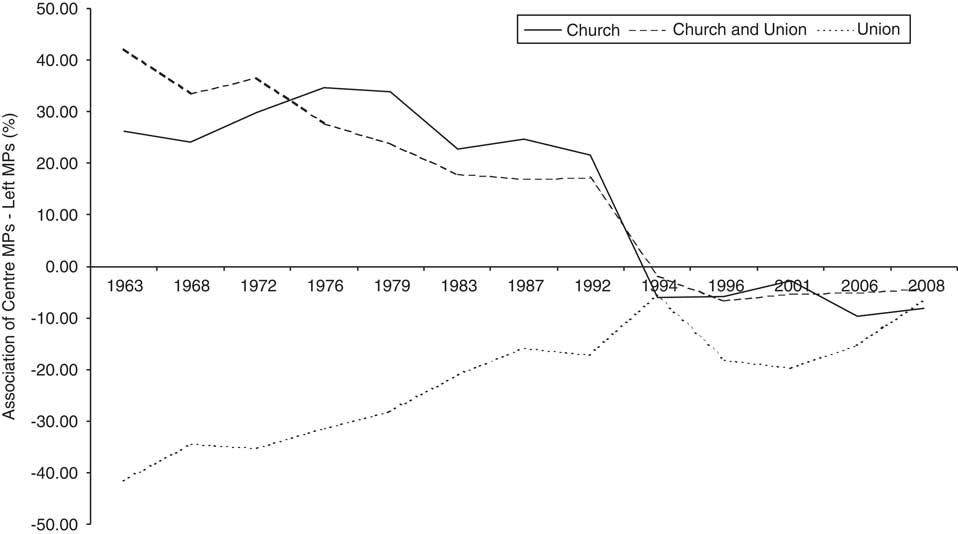
Figure 6 plots the difference in levels of organizational linkage between the left bloc and the centre according to the different types of cleavage associations that their MPs belong to (e.g. church only, church and union, union only).Footnote 51 The trend over time reveals a dramatic change in the structure of parties’ associational involvement. The early period is marked by high levels of church and church–union involvement in the centre bloc, and high union involvement in the left bloc. There are thus clear differences between the political alternatives and voters were then exposed to clear signs about each party's commitment to specific social interests. In the latter period these differences are much more blurred and, with the transition to the Second Republic, there is a sharp decline in the level of church and church–union involvement in the centre-right, and also a decline in the level of union penetration in the centre-left. Whereas the old DC bloc was characterized by close ties with the church, and to a lesser extent the unions, the Forza Italia-PDL bloc that emerged in its wake does not have this organizational base. It is made up largely of businessmen and professionals with little or no previous political experience, who lack established links with organized society.Footnote 52 After 1994 we see an increase in the level of union involvement in the left, but it is still at somewhat lower levels than the historical average from the First Republic. However, the level of church and church–union involvement remain very low, and is now even lower in the centre than it is in the left.
Changing structure of party-organisation linkages: differences between MPs on left and centre-right associated to social cleavage group organizations, 1963–2008 (percentage of centre representatives minus percentage of left representatives) Source: CIRCaP-Italian Political Elite Study.
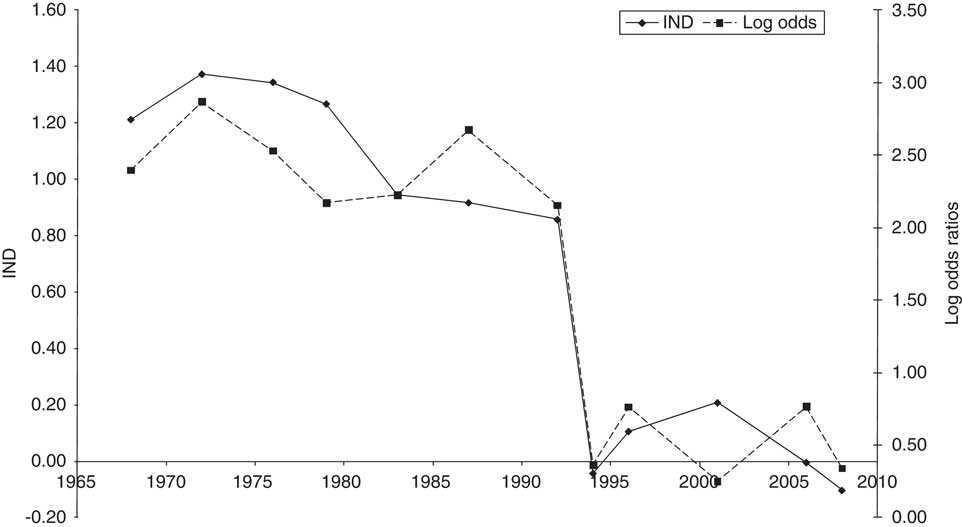
To summarize how these changes have altered the incentive structure for different groups of voters we need to take into account how the different social dimensions of party involvement combine to reinforce or cut across voters’ social identities. To this end we consider the Lieberson Index of Net Difference (IND) that we discussed in the measurement section, which provides a summary measure of the extent to which the organizational characteristics of parties reflect the social characteristics of voters. From Figure 7, according to the IND, we can see that during the First Republic the social characteristics of the Catholic working class and Catholic middle class were much more consistent with the organizational linkages of the MPs from the centre than they were with those from the left (shown by values of IND well below zero), whereas the social characteristics of the secular working class and the secular middle class were much more consistent with the structure of organizational affiliations of the MPs from the left (shown by values of IND well above zero). There were thus strong incentives for each of the social groups to favour one party over the other. However, the clarity of this choice breaks down in 1994, when these representational linkages were severely disrupted. The Catholic middle class and the secular working class after that date no longer had any clear organizational incentive to favour one party bloc over the other (as shown by an IND of close to zero), and the Catholic working class and the secular middle class then faced organizational incentives to support the bloc that historically they had been opposed to.
Index of Net Difference of party–organization linkages, 1968–2008 Source: CIRCaP-Italian Political Elite Study.

Given these changes in the structure of party organization linkages, we would expect the pattern of cleavage voting to be severely disrupted. To examine the impact that these changes in the structure of parties’ organization linkages have had on the level of cleavage voting over time, we need to consider the overlap between the class and religious identities that voters hold (such as whether they are Catholic and working-class, or secular and working-class, etc.) and relate the structure of the choice to the characteristics of the chooser. Therefore, we rely on the four-fold variable that combines information on the class and religious characteristics of the voters, distinguishing between: (1) secular working class, (2) secular middle class, (3) Catholic working class and (4) Catholic middle class. Using binary logistic regression we can estimate the likelihood of voting centre-right rather than centre-left in each election for each group in relation to the secular working class, which is our reference category. Similarly, in order to construct an equivalent comparison, we compare the IND for each group in question with the IND for the secular working class.Footnote 53
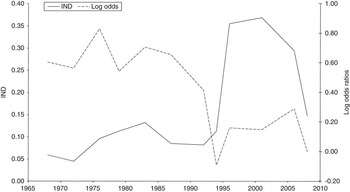
Figure 8 depicts the trends over time for the log odds of the secular middle class voting centre rather than the left, compared with the secular working class (reference category), and the corresponding Index of Net Difference, relative to the secular working class. At first glance there does not appear to be any correlation between the two time trends, although this should not come as too much of a surprise. Neither of the terms is particularly strong – the IND sends only a weak signal, and the log odds ratios register only a weak effect. Under these circumstances there is likely to be plenty of noise.
Log odds of secular middle-class (SMC) vs secular working-class voting centre/left and Index of Net Difference, 1968–2008 Sources: Mass Election Study, 1968 and 1972; Political Action Study, 1975; Eurobarometer, 11 (1979); Four Nation Study, 1985; Italian National Election Study (ITANES), 1990, 1992, 1994, 1996, 2001, 2006, 2008; CIRCaP-Italian Political Elite Study.

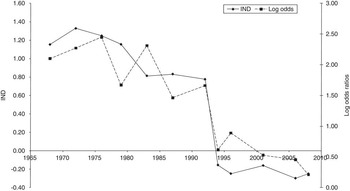
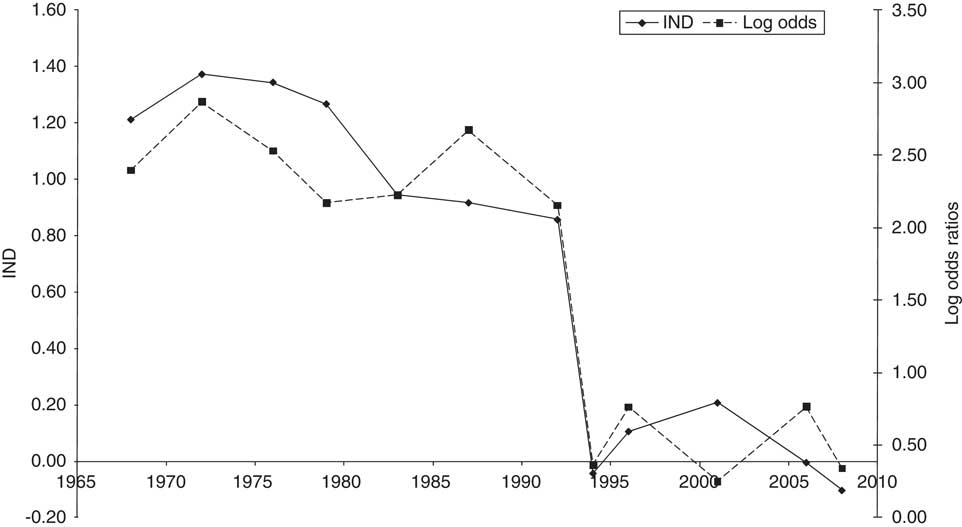
Figures 9 and 10 plot the trends over time for organizational mobilization and level of cleavage voting for the Catholic working class and Catholic middle class, respectively. In both cases a much clearer picture emerges and there appears to be a very strong correlation. The level of cleavage voting is much higher when the Index of Net Difference relative to the secular working class is high during the First Republic, and much lower when the IND is low during the Second Republic. The structure of the organizational linkages between the two blocs would, therefore, appear to be able to account for a great deal of the variation over time in the level of cleavage voting.
Log odds of Catholic working-class (CWC) vs secular working-class voting centre/left and Index of Net Difference, 1968–2008 Source: Mass Election Study, 1968 and 1972; Political Action Study, 1975; Eurobarometer, 11 (1979); Four Nation Study, 1985; Italian National Election Study (ITANES), 1990, 1992, 1994, 1996, 2001, 2006, 2008; CIRCaP-Italian Political Elite Study.

Log odds of Catholic middle-class (CMC) vs secular working-class voting centre/left and Index of Net Difference, 1968–2008 Source: Mass Election Study, 1968 and 1972; Political Action Study, 1975; Eurobarometer, 11 (1979); Four Nation Study, 1985; Italian National Election Study (ITANES), 1990, 1992, 1994, 1996, 2001, 2006, 2008; CIRCaP-Italian Political Elite Study.
We can test the relationship between the Index of Net Difference for the structure of party–organization linkages and cleavage voting more formally by use of linear regression. We specify the following autoregressive model, with a lagged dependent variable:

where Yt is the strength of cleavage voting (measured as the log odds of groupi voting centre rather than left compared with the secular working class) at time t; β 0 is the constant; β 1 is the lagged dependent variable; β 2 is the Index of Net Difference (for groupi in relation to secular working class) at time t, et is a random error term and the total number of observations in the dataset is 12.
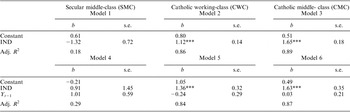
Table 3 presents the results for each social group. As suspected, there is little evidence of any association between the log odds of cleavage voting and the IND of party–organization linkage over time for the secular middle class (Model 1), but there is a highly significant association between the two measures for both the Catholic working class (Model 2) and the Catholic middle class (Model 3), where the signal coming from the structure of party–organization linkages is much more pronounced and clearly differentiated. These results are robust and the main effects of the structure of organization linkages still hold when we re-run the models with a lagged dependent variable (Models 4, 5 and 6). Overall then, the models provide a very good fit to the data, and provide a strong account of changes over time in the strength of cleavages. This finding clearly supports our main hypothesis that the structure of organizational linkages between cleavage specific groups and political parties conditions the underlying strength of social cleavages in the electoral arena. Whereas accounts of social change and policy mobilization are both unable to explain the long-term trends in cleavage voting observed in Italy, accounts that emphasize the organizational characteristics of the parties are much more able to do so.
Log Odds of Cleavage Voting and IND of Party–Organization Linkages, 1968–2008 (OLS Regression)

Source: Mass Election Study, 1968 and 1972; Political Action Study, 1975; Eurobarometer, 11 (1979); Four Nation Study, 1985; Italian National Election Study (ITANES), 1990, 1992, 1994, 1996, 2001, 2006, 2008; CIRCaP-Italian Political Elite Study.
Notes: N = 12; *Sig at 0.10 level; **sig at 0.05 level; ***sig at 0.01 level.
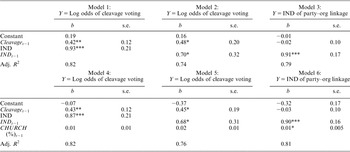
These results indicate that there is a strong correlation between party–organizational linkage and cleavage voting over time. Our hypothesis is that this is a causal relationship, and that linkage influences the level of cleavage voting. However, it is also possible that the causal arrow could flow in the opposite direction, and that the level of cleavage voting may influence linkage. From this perspective, as (or if) cleavage voting declines, parties will become less willing to recruit politicians with organizational ties, since this mobilization strategy becomes less electorally attractive. To examine this possibility we use lag variables to specify the relationship in the opposite direction, and model the impact of cleavage voting on party–organization linkage. Moreover, we also control for the size of the core (religious) electorate, by including the percentage of respondents who regularly attend church.
In order to do this we stack the dataset and treat the log odds of each social group voting centre/left in each election year as a separate case.Footnote 54 Since the observations for each year are not formally independent of each other, we focus on the strength and pattern of association rather than on levels of significance. This gives us thirty-three observations on cleavage voting. We test six models (Table 4). First, Model 1 regresses the strength of cleavage voting on the IND and the lagged dependent variable. Both terms are substantively large and in the predicted direction. This is consistent with the findings from above when applied to the entire dataset. Second, we specify alternative forms of this relationship. Model 2 uses only lagged variables at t−1 to predict the strength of cleavage voting at time t. The pattern is similar to that of Model 1 and provides further support for our central hypothesis since it suggests the correct temporal ordering. Model 3 specifies the relationship in the opposite direction, that, is it reverses the direction of the causal arrow. We use lagged terms to predict the IND at time t. The lag of IND at t−1 is substantively large, as we would expect, but the lag of cleavage voting at t−1 is effectively zero. This suggests that the relationship does not go in the opposite direction, and the decline of linkage in Italy is not being driven by a political response to the decline of cleavage voting.
Cleavage Voting and Party–Organization Linkages Using Lagged Variables, 1968–2008 (OLS Regression)

Source: Mass Election Study, 1968 and 1972; Political Action Study, 1975; Eurobarometer, 11 (1979); Four Nation Study, 1985; Italian National Election Study (ITANES), 1990, 1992, 1994, 1996, 2001, 2006, 2008; CIRCaP-Italian Political Elite Study.
N = 30; *Sig at 0.05 level; **sig at 0.01 level; ***sig at 0.001 level.
Finally, Models 4 to 6 also include the percentage of the population who regularly attends church since it could be argued that either linkage and/or cleavage voting is simply responding to shrinkage of the core religious electorate. We can see that, while the effect of church attendance is in the predicted direction, its inclusion does not materially alter the estimated effects of either the lagged IND or cleavage voting.
So far we have only considered the dynamics of cleavage voting over time for each of the different social groups, but the structure of organizational linkages also sheds light on the relative strength of these cleavages in relation to each other, such as why the log odds of the Catholic middle class voting centre were so much higher than the log odds of the secular middle class doing so (Hypothesis 2). To test this claim, we next turn our attention to see whether organizational linkages can also explain the relative salience of cleavages between groups, and in doing so provide a robust test for the impact that it has on voting behaviour. In order to do this, we merge the IND data on organizational linkages with our pooled cross-sectional survey data, creating a hierarchical multilevel model in which individuals are the level 1 unit, and party–organization linkages are the level 2 unit. Our expectation is that the magnitude of the coefficients for the impact of individual-level social characteristics on vote choice will increase when the IND of associational linkages also increases. That is, that the interaction term between IND and social characteristics will be significant and positive. Moreover, our second expectation is that this simple and parsimonious model will provide an accurate prediction of the actual variations that we observe in the level of cleavage voting, not only over time but also between groups: that the majority of the variation, both between groups and over time, can be explained with reference to the structure of organizational linkages, and any impact of other factors is hence marginal.
The general model we test is the following:

where VOTE is party support (1 = centre-right; 0 = centre-left) at election t, β 0 is the constant, β 1 is the social characteristics of the voter (where secular working class is the reference category and 1 = secular middle class, 2 = Catholic working class, 3 = Catholic middle class), β 2 is an interaction term between the IND of associational linkages and social characteristics of the voter, β 3 is an interaction term between policy difference on economic issues and social characteristics of the voter.Footnote 55 Since the dependent variable is a dichotomy, we use binomial logit analysis to estimate the parameter estimates. The model provides a strict test of our hypothesis since it assumes that the strength of cleavage voting has remained constant over time, with the only variation due to changes in the party structure of associational linkages.
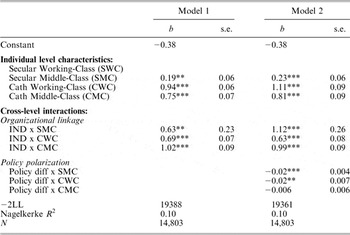
Table 5 reports the parameter estimates from the model. First, Model 1 includes class and religion at the individual level and the cross-level interaction between class and religion and the IND for party–organization linkages at the contextual level. We can see that the interaction term is highly significant and positive, indicating that the strength of cleavage voting does respond to the structure of organizational linkages. Since our intention is not to try and explain vote choice, but rather to explain differences in the observed levels of cleavage voting, we are not particularly interested in the model fit statistics. Instead, in order to assess how successfully we have managed to explain differences in cleavage voting we compare the predicted effect of class and religion on vote choice from Model 1 (imputing the observed value of IND for each year) against the observed effect of class and religion on vote choice over time. The correlation between our predicted estimates and our observed estimates is a highly significant 0.92. The R 2 is 0.84, indicating that our model manages to explain 84 per cent of the variation in the strength of cleavage voting between 1968 and 2008. Moreover, if we compare the kappa index of observed cleavage voting with the kappa index of the predicted cleavage voting, using just the interaction between IND and social characteristics, we get R 2 = 0.83 with b = 1.54, which is a very strong and positive correlation.Footnote 56 From this we can infer that variation in voting behaviour between social groups is strongly related to the variation in the Index of Net Difference of party–association linkages. This elegant and parsimonious model is, therefore, able to account for a considerable amount of the variation in cleavage voting, both in terms of why some cleavages are stronger than others (Hypothesis 2), and why the strength of these cleavages varies over time (Hypothesis 1).
Cleavage Voting, Party-Organization Linkages and Policy Polarization, 1968–2008 (Logistic Regression)

Source: Mass Election Study 1968 and 1972; Political Action Study 1975; Four Nation Study 1985; Italian National Election Study (ITANES), 1990, 1992, 1994, 1996, 2001, 2006, 2008; CIRCaP-Italian Political Elite Study. Party Manifesto Data from the Manifesto Research Group, 1963–2001 (see Budge et al., Mapping Political Preferences); and CIRCaP-Università di Siena, 2006 and 2008.
In Model 2 we see whether policy difference between the parties in terms of their manifestos has any impact on the strength of cleavage voting. The cross-level interaction between policy difference and voter characteristics does not have much impact on the strength of cleavage voting. It has no significant impact on the magnitude of the coefficient for Catholic middle class, and although it does have a significant impact on secular middle class and Catholic working class, it is only in the expected direction for the latter. These results thus confirm previous research, which has found only a patchy impact of policy difference on cleavage voting.
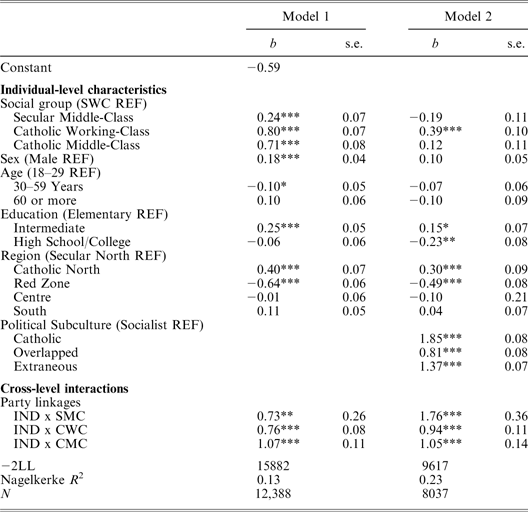
The final test that we run is to introduce more rigorous controls, to examine whether the impact of organizational linkages on cleavage voting still holds up when we control for a variety of other social and political factors. Since relevant controls are not available for all the surveys in our dataset we drop the studies for 1963, 1976 and 1979. Additional controls are specified for age, sex, education and region. We also control for political subculture, which refers to the socio-political identities that have long been found to have an important impact on voting behaviour in Italy.Footnote 57Table 6 presents the results of the logistic regression. Controlling for socio-demographics alone (Model 1) or socio-demographics and political subculture (Model 2), we can see that the interaction term between IND and class-religion is highly significant and in the expected direction, confirming our earlier hypotheses. We can, therefore, have a high degree of confidence that these results are robust, and hold up even when we control for other factors.
Cleavage Voting, Party–Organization Linkages and Policy Polarization with Controls, 1968–2008 (Logistic Regression)
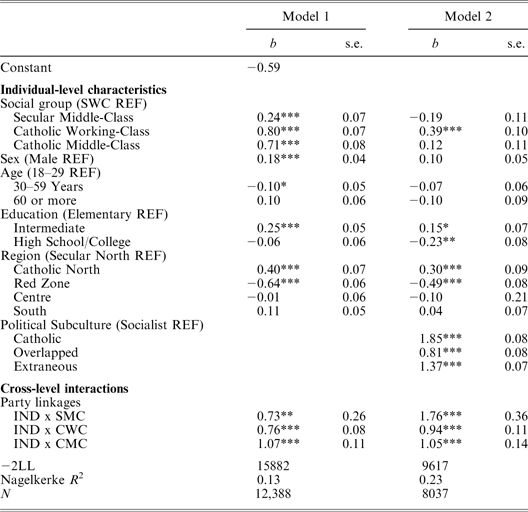
Source: Mass Election Study, 1968 and 1972; Four Nation Study, 1985; Italian National Election Study (ITANES), 1990, 1992, 1994, 1996, 2001, 2006, 2008; CIRCaP-Italian Political Elite Study; Party Manifesto Data from the Manifesto Research Group, 1963–2001 (see Budge et al., Mapping Political Preferences); and CIRCaP-Università di Siena, 2006 and 2008.
Conclusion
Previous research on the decline of cleavages has tended to emphasize two main factors – social change within the electorate, and political change in terms of the mobilizing strategies of parties to alter the salience of cleavage-related issues, as measured by what they say they will do in their manifestos. We have argued that neither of these factors is able to explain the dynamics of cleavage voting in Italy (and we would argue elsewhere as well) adequately, without taking into account a third factor: the linkage between parties and societal organizations, a factor capable of reinforcing group identity and interest representation and a key element in the notion of cleavage.
Our research shows that the dynamics of cleavage voting in Italy cannot be attributed to social change or to direct changes in party policy. As to the first, the sharp drop in the early 1990s in class and religious voting happened during too short a period for any social change to have taken place. As to the second, while there is partial evidence that the class cleavage responds to policy, evidence of this is lacking in the case of religious cleavage, and in either case it cannot explain the long-term trend and is not robust to the inclusion of additional variables. By introducing parties’ associational linkage – the interlocking of parties and cleavage-specific social organizations – as an explanatory variable we can account for these long-term trends in the level of cleavage voting, and also the relative strength of different social cleavages within the electorate.
We would finally argue that in Italy, and elsewhere in Europe, the erosion of traditional cleavages (both class and religious) is neither a forced scenario (driven by social change and modernization) nor a process immune to changes in the role parties play in the political and social arena. In this contribution we have sought to provide an explanation of the causal mechanisms underpinning and conditioning the decline of cleavage voting, but this is an open process with potentially different outcomes. This leads us to conclude that politics remains the key variable in explaining changes in the determinants of voting, and that the nature of parties plays a central role in the relationship between societal changes and political dynamics. To the extent that parties – as the literature on the cartel party in Europe assumes – become an institutional articulation of the state and lose systematic links with organized society, we can expect a further decline of cleavage voting. By contrast, the Italian case, together with some recent comparative research on organizations’ political intermediation, suggests that the changing nature of the relationship between parties and organized society need not assume a definitive separation between the two.Footnote 58 The structures of political linkage may change but, though at a lower level than it was in the heyday of cleavage politics and mass parties, the relationship between social identities and organized interests is likely to continue to constrain an extreme individualization of voting choices.
Appendix
Left–Right Positions and Secular-Religious Positions, Party Bloc and Party by Year, 1963–2006

Notes: PCI = Communist Party; PSI = Socialist Party; DC = Christian Democrats; PRI = Republican Party; PSDI = Social Democratic Party; PSU = Unified Socialist Party; PdUP = United Proletarian Party; PR = Radical Party; DP = Proletarian Democracy; RC = Refounded Communism; AD = Democratic Alliance; FI = Go Italy; AN = National Alliance; LN = Northern League; PDS = Democrats of the Left; CDL = House of Freedom; PD = Democratic Party.