


I
The rise of cities in medieval and early modern Europe went hand in hand with a high degree of political as well as financial autonomy. These cities were governed by elected or appointed mayors and aldermen and their respective town councils, and had their own municipal finances, based on local taxation, which enabled them to cover their administrative costs, provide public services and infrastructure, and pay taxes and other dues to their ruler. Most cities, however, also accumulated a considerable public debt, which was the result of a precarious balance between their financial requirements, their limited income, and extraordinary expenses that had to be financed with loans. These loans included short-term loans with bankers, but more often they consisted of annuities, which were sold to creditors within or outside the city and which were serviced by the income from urban taxation (Nicholas Reference Nicholas2003, p. 107; Boone, Davids and Janssens Reference Boone, Davids and Janssens2003, pp. 4–8). While there was nothing uncommon in urban public debt, it is remarkable that some cities seemed capable of managing their debts fairly well, whilst others had to deal with ever increasing debt rates throughout their history. A major explanatory factor was, of course, the economic environment. While cities in a period of economic prosperity offered good prospects for their investors and were generally able to attract creditors as well as pay back their loans due to their rising revenues, things often took a turn for the worse during periods of economic downturn, and subsequent declining tax returns.
A second element, crucial for explaining the prevalence of over-indebted cities, was the financial demands of the central state. Cities were important centres of capital accumulation and, as such, vital for the financial interests of the prince. Due to the increasing costs of state formation and warfare, European princes increased their tax requirements throughout the late Middle Ages and the early modern period. The financial relationship between the prince and the cities basically came down to two types of transfer, taxation and credit, both aspects being closely related to one another (Ehrenberg Reference Ehrenberg1896, pp. 19–21; Bonney Reference Bonney and Bonney1995, pp. 8–17). As far as taxation is concerned, cities were entitled to organise taxation within their walls autonomously. In addition to taxation, a second form of financial relationship between cities and their monarchs was credit. Urban communities, represented by their city governments, provided long-term credit for the state at a low interest rate by issuing annuities (Boone et al. Reference Boone, Davids and Janssens2003, pp. 4–8; 't Hart and Van der Heijden Reference Van Der Heijden2006a, pp. 3–35). Urban annuities became a highly effective mechanism for creating a stable long-term debt, with the urban communities as intermediaries between the state on the one hand and the individual moneylenders on the other. Thus a dynamic constellation arose which included the prince, the city governments, the moneylenders of the city and finally the urban taxpayers.
While these factors have been recognised as being crucial in determining the degree of urban indebtedness, recent studies have focused on the role of the urban rentiers and their relationship to the governing elite. As Marc Boone has shown for the case of late medieval Ghent, the buyers of annuities were mainly members of the political elite of the city, which led to a strong entanglement between the individual interests of the annuitants, the city government and finally the central state (Boone Reference Boone1990, p. 63; Reference Boone1991a, pp. 102–13; Reference Boone1991b, pp. 3–26). Manon van der Heijden, in a comparative analysis of the urban annuities market in three cities in the Dutch Republic (Dordrecht, Haarlem and Zwolle), focused on the profile of the urban moneylenders. Like Boone she pointed out that the buyers of annuities were mainly members of the urban elites while the fiscal burden was spread among the whole population (Van der Heijden Reference Van Der Heijden2006a, pp. 160–5). More recently Katia Béguin, after extensive research on the annuities issued by the city of Paris for the benefit of the Bourbon monarchy, similarly showed a close financial intertwining between town and state (Béguin Reference Beguin2012, pp. 29–51). José Ignacio Andrés Ucendo came to a similar conclusion with regard to the Castilian case (Andrés Ucendo Reference Andrés Ucendo and Caselli2008, p. 69). In the latter kingdom, the Madrilenian municipal council was more or less compelled to offer vast sums of donativos, in excess of 18 m ducats, between 1629 and 1679 to the Habsburg monarchs, significantly more than the towns of Seville, Malaga and Valladolid (Andrés Ucendo and Lanza Garcia Reference Andrés Ucendo, Lanza Garcia, Andrés Ucendo and Limberger2012, pp. 3–15).
During the early modern period, the Dutch Republic and England were the only two entities in western Europe that succeeded in establishing a substantial public debt at a higher political level, respectively the provinces and the state (Clark Reference Clark2001, pp. 426; Spufford Reference Spufford2006, pp. 171–8; Tracy Reference Tracy1985, p. 3; 't Hart Reference 't Hart, Jonker, Van Zanden and Hart1997, pp. 15–19). One of the key reasons why monarchs opted to seek funding through the larger cities, obliging them to increase their overall debt levels rather than establishing public debt at the level of the state, was recently approached from an economic perspective by David Stasavage. He made a compelling case, arguing that only representative assemblies could preserve long-term access to credit. In turn, the most effective representative assemblies were found in geographically small polities, for example the Italian city-states (Stasavage Reference Stasavage2011, pp. 68–9).
One of the key reasons why small political entities were so successful in obtaining vast sums of credit – much earlier than their larger counterparts – was the often close intertwinement of public and private finances. During the Middle Ages and much of the early modern period, urban officials – in particular the treasurer – often advanced private funds to keep the municipal finances afloat. Moreover, urban officials were often substantial owners of their city's debt (Boone Reference Boone1990, p. 63; 1991a, pp. 102–13; 1991b, pp. 3–26; Derycke Reference Derycke, Boone, Davids and Janssens2003, p. 173; Hanus Reference Hanus2007, p. 97; Kappelhof Reference Kappelhof2006, p. 108; Andrés Ucendo and Lanza Garcia Reference Andrés Ucendo, Lanza Garcia, Andrés Ucendo and Limberger2012, pp. 3–15; Van der Heijden Reference Van Der Heijden2006a, pp. 160–5). These practices can be explained with reference to the concept of civic duty and civic responsibility. When the town was in dire financial straits, the magistracy had the moral obligation to keep the town's finances sound. The flipside of the coin, however, was less idyllic. Whilst a small group of investors reaped the benefits of extending the municipality credit, the majority of the populace was confronted with an elevated taxation burden as a consequence of debt-servicing expenditures. Using the city of Antwerp as a case study, in this article, we analyse to what extent the comparative advantage of small political entities gaining access to finance could backfire in the long run. We argue that this was a result of the close link between the interests of the ruling elite and those of the annuity holders. In the Low Countries, as in the Italian city-states, a tight relationship between the financial interests of the ruling elite and the financial (mis-)fortune of the city could be discerned throughout the Middle Ages and early modern period. On the one hand, local officials did not hesitate to use urban funds for personal use. However, the local treasurer was frequently held accountable for the financial deficits incurred during his term in office (Aerts Reference Aerts1982, p. 281). In Brussels, for example, the local treasurers personally issued bonds and annuities during the second half of the eighteenth century to absorb the imbalance in the town's accounts (Bossuyt Reference Bossuyt2013, pp. 38–9). Additionally, when medieval and early modern city governments found themselves in dire financial straits, they frequently appealed to a limited circle of urban financiers in order to alleviate their financial woes. Since these urban lenders often held prominent positions within the city, or were part of the urban administrative elite through a complex network of family relations, a small group of well-informed individuals could make a relatively secure and high-yielding investment, whereas the city's entire population was confronted with an increased tax burden in order to support the debt repayments (Van der Heijden, Reference Van Der Heijden2006a, p. 165; Derycke Reference Derycke, Boone, Davids and Janssens2003, pp. 180–1; Boone Reference Boone1991b, p. 5; Stasavage Reference Stasavage2011, pp. 110–31). The persistence of this phenomenon makes it a recurring research question within current historiography. In virtually every case study within western Europe, urban elites were found to own substantial amounts of urban public debt (Van der Heijden Reference Van Der Heijden2006a, pp. 165–8 and Reference Van Der Heijden2006b, p. 126). Buying urban annuities could furthermore strengthen existing social relations between financiers and the political establishment and opened the possibilities for lucrative contracts (e.g. construction, heading emissary delegations etc.) (Van der Heijden Reference Van Der Heijden2006a, pp. 190–9). A similar pattern can be found in sixteenth-century 's-Hertogenbosch, where 33 per cent of the annuity holders were part of the municipal government or their extended families (Hanus Reference Hanus2007, p. 97). After the city's integration into the Dutch Republic, this trend continued. As a result of the declining rental income from agriculture, the urban officials of 's–Hertogenbosch continued funding a major part of the city's financial needs in the seventeenth century (Kappelhof Reference Kappelhof2006, p.108). In the southern Low Countries, urban elites were as dominant in the urban public credit markets as their northern counterparts. From the fourteenth century onwards, Ghent's ruling elite successfully restricted outsiders from the urban annuities market (Boone Reference Boone1990, pp. 20–1). In Bruges, buying urban annuities was de jure possible for every investor but de facto, the annuity holders originated from the same socio-economic groups that controlled the city's administration (Derycke Reference Derycke, Boone, Davids and Janssens2003, p. 173). Since holders of public debt could take a defaulting city's burghers hostage and confiscate their belongings to enforce reimbursement, this limited the economic fall-out in case the city was not able to service its debt. Consequently, cities and towns throughout the Low Countries, and Antwerp in particular because of its role as the leading economic centre in the sixteenth century, succeeded in obtaining a large credit, thus amassing huge amounts of debt during the early modern period (Van der Heijden Reference Van Der Heijden2006a, pp. 126–8; Van Zanden et al. Reference Van Zanden, Zuijderduijn and De Moor2012, pp.19–20; Zuijderduijn Reference Zuijderduijn2008, p. 118; Reference Zuijderduijn2009a, pp. 174–5; Reference Zuijderduijn2009b, p. 146; Reference Zuijderduijn, Schofield and Lambrecht2009c, pp. 40–5). Stasavage argued, however, that in the case of the Italian city-states the latters' comparative advantage would backfire. Those cities that could most successfully gain access to credit were led by relatively small oligarchies, which in the long run hindered financial innovation. Moreover, he reasoned that as a consequence of this failure to implement new financial techniques, the previously mercantile municipal governments would evolve into rent-seeking elites (Stasavage Reference Stasavage2011, pp. 110–31). In the Dutch Republic, the development of a system of provincial finances enabled the emission of debt on a broader economic, social and geographical basis, ensuring long-term credit at a low cost (Tracy Reference Tracy1985, p. 3; 't Hart Reference 't Hart, Jonker, Van Zanden and Hart1997, pp. 15–19). Here, the emergence of the concept of ‘citizenship’ during the Eighty Years' War proved to be a stimulus for the provinces' ability to raise capital though debt emissions (Van Zanden and Prak Reference Van Zanden and Prak2006, p. 114). Anne Murphy furthermore stressed the important role of both investors and the general public during financial crises. In making their grievances heard, they both encouraged decisive action by the government and formed an important deterrent for future financial mismanagement (Murphy Reference Murphy2013, pp. 188–95). While both London and (to a lesser extent) Amsterdam managed to assert their position as financially innovative centres throughout the seventeenth and eighteenth centuries, Antwerp did not (Schubert Reference Schubert1988, pp. 301–3; Spufford Reference Spufford2006, pp. 171–4; Carlos and Neal Reference Carlos and Neal2011, pp. 22–5).
The (often extractive) relationship between town and state and the general economic climate have been rightly identified as important determinants for the financial fortune of cities during the medieval and early modern period. In this article we argue that another element should be taken into account too, namely, the often dual position of the urban magistrates.Footnote 1 The goal of this article is twofold: to analyse the role of the political elites as both annuity buyers and (financial) policy-makers of the city, and to reveal how their actions helped seal Antwerp's financial fate. First, we elaborate on the gradual intertwining of the town's finances within the Spanish empire throughout the early modern period, and provide an in-depth analysis of the city's financial policy between 1640 and 1740 (Section II). We then assess the investment behaviour of Antwerp's ruling elite in Section III. To what extent did they dominate the urban public credit market? Was there an increased participation of the urban elite in periods of political and financial turmoil? Or did self-enrichment take primacy over citizenship? Using a number of targeted samples we show that participation of Antwerp's political elite varied widely over time. As time progressed and the city accumulated more debt, the members of the municipal council gradually lowered their overall participation in the urban public debt. Their unwillingness to extend credit in dire times in combination with a lack of technical innovation in debt management and an unwillingness to slash interest payments eventually forced the city to default. In Section IV, finally, we conclude by stating that the gradual decline from mercantile centre to ‘rentier republic’, a model established by Stasavage for the Italian city-states, was part of a more widespread phenomenon throughout Europe. According to this model, declining economic activity as a result of shifting power balances, in combination with an urban government that stifled financial innovation and a political elite that preferred private over public interests, drove the town's finances to ruin.
II
As an important merchant town, Antwerp had gained significant administrative and fiscal autonomy during the late Middle Ages. From the end of the fifteenth century onwards, the city underwent a drastic transformation when it became one of the largest financial and mercantile centres of western Europe, a true locus of capital accumulation. Between c. 1490 and 1566, Antwerp was the major centre of long-distance trade in northwestern Europe. It served as a distribution centre of English cloth, Portuguese spices, German copper, Spanish colonial goods, especially silver, a broad variety of luxury trades from Italy, and textiles and other urban manufactured goods from the Low Countries. As a result it grew to become one of the foremost economic, financial and cultural metropoles of western Europe (Van der Wee Reference Van Der Wee1963; Van der Stock Reference Van Der Stock1993). Due to the presence of a large number of wealthy merchants and some of the largest financial firms in Europe, Antwerp was one of the most important (financial) markets for government securities during the first half of the sixteenth century (Braudel Reference Braudel1959, pp. 191–202; Van der Wee Reference Van Der Wee1963, II, pp. 141–7). As in most early modern cities, Antwerp's urban revenues were mainly based on excise taxes on consumption goods (Limberger Reference Limberger, Andrés Ucendo and Limberger2012, pp. 131–9). Especially popular drinks such as beer and wine were of importance for urban finances (Limberger Reference Limberger, Andrés Ucendo and Limberger2012, pp. 131–9; Andrés Ucendo and Limberger Reference Andres Ucendo and Limberger2012). From the period 1530–42 onwards, they represented approximately 78 per cent of the town's revenues, a ratio that remained unchanged throughout the seventeenth and eighteenth centuries ('t Hart and Limberger Reference 't Hart and Limberger2006, pp. 61–6; De Vijlder Reference De Vijlder2012, pp. 47–73; Blockmans Reference Blockmans1952, pp. 46–61). Other basic foodstuffs such as wheat and salt were, in the case of Antwerp, of secondary importance. Traditionally, ordinary revenues sufficed to pay the city's administration, the maintenance of public buildings and infrastructure, and the city guards, in essence the town's running expenses. In case of unforeseen expenses, either levies of beden by the central government, urgent repair works or wartime expenditure, the town council regularly had to resort to loans. The clash between the logic of capital and the logic of coercion, to recall Charles Tilly's framework, had been settled in favour of the Habsburg monarchy in the middle of the sixteenth century ('t Hart and Limberger Reference 't Hart and Limberger2006, pp. 69–71). As a consequence, a large share of the annuities sold by the municipal council was used to meet the Spanish rulers' need for funds. During the early sixteenth century, the city itself became a major creditor of Charles V and his son Philipp II. Initially only short-term credit lines were offered, but over time long-term loans obtained by selling urban public debt took the upper hand. On the one hand, this provided the city with additional prestige and international appeal, but at the same time it created a dependency relationship in which the city was losing a significant amount of autonomy (De Vijlder Reference De Vijlder2012, pp. 47–73; 't Hart and Limberger Reference 't Hart and Limberger2006, pp. 36–72). Furthermore, these loans had important consequences for the town's financial soundness. By 1531, Charles V and his predecessors had accumulated a debt of over 572,000 guilders to the city. Some twenty years later a loan of 594,000 guilders was assigned to Philip II, which compelled the municipality to issue perpetual annuities at an unfavourable interest rate (penny 12; 8.3 per cent) (Masure Reference Masure1986, pp. 276 and 303). When the town tried to issue new annuities for the amount of 400,000 guilders in 1575, but could only obtain 240,000 guilders, the municipal council took action to alleviate the mounting debt levels. Interest rates on existing annuities were reduced, from 8 to 5 per cent for perpetual annuities and from 12 to 10 per cent for life annuities. Furthermore, an additional city treasury was founded, financed with new revenues from beer, wine and grain excises and charged with the reduction of the existing debt. While several annuity holders heavily contested the haircut, and the Great Council of Mechelen (the highest supreme court) deemed the actions illegal, the city council persevered and continued with the operation (Kreglinger Reference Kreglinger1845, p. 67). However, after the reconquest of the town by Alexander Farnese in 1585, Antwerp was, as a consequence of its disobedience towards Philip II, ordered to pay damages to the sum of 400,000 guilders. The city consequently founded a new separate account, the consumptiekas, with the sole purpose of restoring the balance of the city's two other accounts: the kas van domeinen and the reductiekas (Boumans Reference Boumans1965, pp. 56–7 and 95–9). Due to the economic downturn, however, hefty sums had to be raised in order to pay for the recurrent expenses.
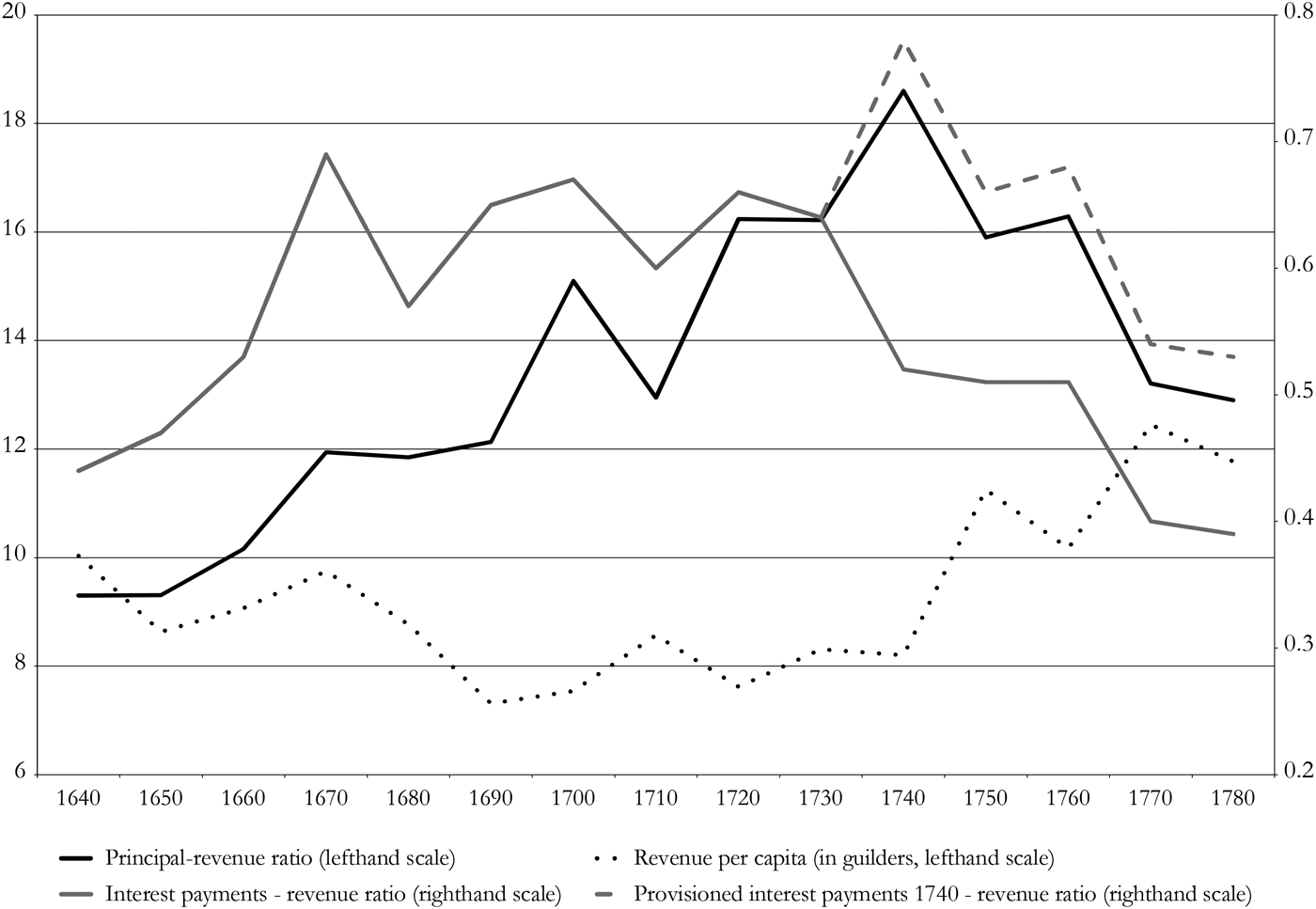
The town's economic and financial situation during the seventeenth century was by no means any better. The commercial position of Antwerp was severely damaged by the Dutch Revolt. Most of the major trading firms left Antwerp due to the religious troubles. From 1585 on, access to the sea via the river Scheldt was blocked by the frontier with the Republic. Ships to and from Antwerp had to unload their cargo and pay tolls. Alternative routes via the Flemish river network proved to be slow and complicated. The situation degraded further after the end of the war in 1648, when the Dutch could fully exercise their commercial activity (Gelderblom Reference Gelderblom2013). While Amsterdam went through its golden age, Antwerp remained cut off from the major commercial circuits and turned into a regional centre (Enthoven Reference Enthoven1996, pp. 38–52). The impact of these developments on urban finances was devastating. As can be seen in Figure 1, revenues per capita were declining steadily from 1640 onwards, only to bottom out around the first quarter of the eighteenth century. At the height of its golden age, around 1560, the city had just shy of 90,000 inhabitants. The political and military troubles during the final quarter of the sixteenth century resulted in a drastic decline in population. During the seventeenth century, the recovery was painstakingly slow: from approximately 50,000 inhabitants in 1610 to about 65,000 in around 1700. However, despite the municipal government's unceasing search for new revenues and a growing population during the second half of the seventeenth century, per capita revenues decreased substantially while the debt burden increased (Figure 1). As Brussels gradually overtook Antwerp as the leading city in the southern Low Countries and the fog of war lifted from the countryside during the first quarter of the eighteenth century, Antwerp's population declined yet again, bottoming out at 43,000 souls in 1750. However, the amelioration of the general economic climate as a consequence of the new (economic) policies introduced by the Austrian Monarchy, in combination with the successful implementation of a series of new taxes especially tailored to new consumer goods, resulted in steadily increasing per capita revenues from 1740 onwards.
Antwerp's public finances, 1640–1780

As a consequence of this economic stagnation from the second quarter of the seventeenth century onwards, the municipal council was forced to organise 59 annuity sales to cover expenses. Between 1630 and 1710, in excess of 3,500,000 guilders were raised against approximately 500,000 guilders of yearly revenues, implying a chronic budget deficit of about 10 per cent. To put it bluntly, Antwerp lived beyond its means.
Four periods were particularly costly for the town's finances: 1640–9, 1670–79, 1700–10 and 1740–50. During each of these four benchmarks, Antwerp had a recurrent budget deficit of between 10 and 19 per cent per annum. During the years in-between the recurrent deficit never surpassed 7 per cent. Between 1640 and 1649, in addition to the increased expenditures related to the final stages of the Eighty Years' War (for which the city sold renten in excess of a 600,000 guilders), Antwerp bought several seigniorial rights financed through annuity sales. In total the magistracy sold annuities in the amount of 1.073 m guilders, equalling 19 per cent of total revenues over this period. Similarly, during the other periods there was increased pressure on Antwerp's financial system as a consequence of increased wartime expenses. For example, since transfers from the Iberian Peninsula stopped in 1677, the governor of the Spanish Netherlands significantly increased the subsidies he demanded from the Estates. As a result, Antwerp had to issue new annuities in the amount of 732,000 guilders (reflecting a budget deficit of 12.5 per cent). A similar increase in military spending and the increased funding need of the central government during the wars of the Spanish and Austrian Succession had a detrimental impact on the city's debt, with respectively 551,000 and 660,000 guilders issued, against decennial revenues of 4.9 m guilders (1700–10) and 4.07 m guilders (1740–50).
Well over 40 per cent of all annuities sold were somehow connected to the Habsburg rulers. These expenses could take various shapes and sizes. For example, the Joyous entry of prince-cardinal Ferdinand in Antwerp during the summer of 1635, under the auspices of Pieter Paul Rubens as artistic director, proved to be an expensive undertaking for the town. Over 35,000 guilders had to be raised to finance the lively spectacle of parades, theatres and triumphal arches dotted along key locations throughout the city. Between 1630 and 1710 over 180,000 guilders were raised for the different Joyous entries with the necessary pomp and circumstance. However, the bulk of the urban annuities were issued to pay the royal subsidies. Between 1630 and the end of the Spanish Netherlands at the beginning of the eighteenth century, Antwerp sold annuities in the amount of 3,500,000 guilders, of which 1.3 m were raised in order to pay royal subsidies. As a consequence, it is safe to argue that Antwerp was, from a financial perspective, fully integrated into the Habsburg monarchy by the seventeenth century ('t Hart and Limberger Reference 't Hart and Limberger2006, p. 61).
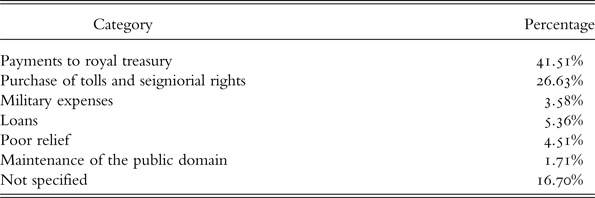
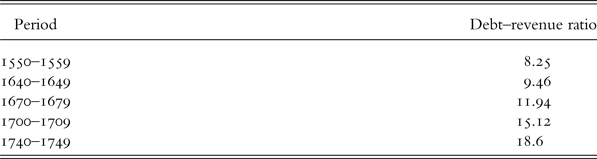
Notwithstanding the aforementioned entanglement of Antwerp's finances within the nascent Spanish empire, the municipal government actively tried to extend its grip on the economic life within the city and the surrounding countryside. Throughout the sixteenth, seventeenth and eighteenth centuries, the city was actively buying up tolls and seigniorial rights, which were funded through debt issuances. As can be seen in Table 1, about a quarter of the annuities sold were used to purchase tolls and seigniorial rights. The reason for this distinct policy, as opposed to outright cash transfers, is twofold. First, it enlarged the revenue base of the city, which was necessary to service the debt repayments (see Table 2). Second, it strengthened the city's economic jurisdiction within its walls and in the surrounding countryside. After all, although the balance between the logic of capital accumulation and the logic of power had shifted in favour of the latter, this did not mean that the regional particularism that had previously defined the political landscape in the southern Low Countries had faded. Hence, the purchases of seigniorial rights were driven not only by fiscal, but also by political and economic motives. After all, the council not only gained new revenues but also succeeded, at the same time, in strengthening its economic impact on the city and in forging closer links with the monarchy (De Vijlder Reference De Vijlder2012, pp. 71–3).
Reasons for urban annuity sales (1630–1710)a
a Antwerp City Archives, Accounts of the consumptiekas, R1350–1432. For the data concerning the period 1624–79 see 't Hart and Limberger (Reference 't Hart and Limberger2006, p. 61). A review of Antwerp's outstanding debt during eighteenth century can be found in Kreglinger (Reference Kreglinger1845).
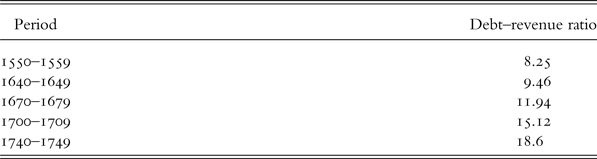
Evolution Antwerp's debt–revenue ratioa
a Antwerp, City Archives, accounts of the consumptiekas, R 1360–1370, R 1392–1401, R 1421–1432, R 1459–1468; Accounts of the reductiekas, R 780–816, R 894–932, R 972–982, R1013–1025; Accounts of the kas der domeinen, R 86–95, R 108–114, R 122–125, R 134–144, R 174–183; Masure (Reference Masure1986, pp. 329–30); Blockmans (Reference Blockmans1952, pp. 50–6).
For its financing needs, Antwerp depended almost completely on the issuance of long-term debt. While short-term loans could be obtained relatively swiftly through the placement of obligations within the existing merchant community, the high interest rates and short rollover period proved to be a significant downside. Annuities overcame these shortcomings. In theory, the capital sum never had to be repaid and the long duration implied lower interest rates. Whilst in theory never reaching maturity, these annuities could be sold on by the annuity holder. However, there is little evidence to show that this was common practice in Antwerp. Around the middle of the sixteenth century, Antwerp's perpetual annuities yielded approximately 6.25 per cent, declining to 5 per cent around 1670, 3 per cent in the 1720s and finally 2.6 per cent by the middle of the eighteenth century. Life annuities, confronted with a largely similar evolution, declined in a similar fashion from 12.5 per cent in 1560 to 7 per cent in 1745. Although life annuities were in the first instance more expensive than perpetual annuities, they had the benefit that, per definition, their duration was limited in time. Payments halted as soon as the annuitant had died.
Once sold, the annuities had to be serviced by the recurrent revenues of the city. The continuing debt build-up throughout the seventeenth century, against a backdrop of economic decline, was only possible when the recurrent revenues of the city could keep pace. This inherent logic, ‘la dialectique des rentes et impôts’ as articulated by Jacques Le Goff, would become the leitmotif of Antwerp's fiscal policy throughout the seventeenth century (Le Goff Reference Le Goff2010, p. 51). Hence, the gradual growth of the outstanding debt went hand in hand with a gradual growth in overall taxation levels. In the case of Antwerp, the municipal council used three strategies to enlarge its fiscal revenue base. Firstly, the existing tax rates were increased significantly, despite the ensuing political and popular unrest (Limberger Reference Limberger, Andrés Ucendo and Limberger2012, pp. 131–47). In addition, the city frequently bought excises and taxation rights of other levels of government (in particularly the monarch). Finally, the city government tried to expand its recurring revenue streams by levying new taxes. These targeted either ‘new’ consumption goods like tobacco, paper and tea or horse ownership (Blondé Reference Blondé2001, pp. 497–9; Limberger Reference Limberger, Andrés Ucendo and Limberger2012, pp. 131–9; De Vijlder Reference De Vijlder2012, pp. 63–73). However, despite the incessant flow of new taxes the general economic downturn caused per capita revenues to decline rather sharply between the end of the Eighty Years' War and the War of the Austrian Succession. Consequently, the peace treaty of Munster marked a turning point in the city's finances.
Between 1640 and 1740 Antwerp's magistracy was cornered between ongoing financial pressure from the central administration in Brussels, rising debt-servicing costs and structurally declining revenues. This precarious position is most clearly illustrated by the evolution of both the principal-versus-revenue and the interest-versus-revenue ratios. As can be seen in Figure 1, the city's debt gradually rose to an astounding 18 times its revenues by 1740. Around 1640, Antwerp serviced an outstanding debt of approximately 4,900,000 guilders. By 1700, this had risen to 7,400,000 guilders. Despite the fact that little new debt was emitted during the first half of the eighteenth century, the principal-versus-revenue ratio continued to rise as a result of decreasing tax revenues. The emission of 2,500,000 guilders in debt during the second half of the seventeenth century had a profound impact on Antwerp's financial and fiscal system. Throughout the sixteenth and early seventeenth centuries, debt servicing accounted for approximately half of the city's expenditures ('t Hart and Limberger Reference 't Hart and Limberger2006; Masure 1986; De Vijlder Reference De Vijlder2009; Van Lerberghe Reference Van Lerberghe2013). Once the economic climate had changed, as it did after the closing of the river Scheldt, servicing the existing debt, whilst issuing new annuities to keep revenues and expenses balanced, became an increasingly difficult challenge. Between 1670 and 1730, the yearly sums due to annuitants accounted for between 60 and 69 per cent of Antwerp's yearly expenses. By the 1730s the situation had spiralled out of control, and the annuity holders were only sporadically paid out. In 1730, payments were on average seven years in arrears, and between 1735 and 1740, payments stopped altogether. Without drastic measures, servicing its debt at the prevailing interest rate would have required over 70 per cent of Antwerp's revenues by 1740 (see Figure 1). At the eleventh hour, only after long and hefty discussions between the magistrates and the annuitants, the council of Brabant agreed in August 1740 to a comprehensive debt restructuring. The interest rates of all outstanding perpetual annuities were to be lowered from 5 to 3 per cent. This haircut caused the interest-payments-versus-revenue ratio to decline from .64 to .52, allowing the magistrates to cover the town's running expenses and again resume interest payments.
III
All decisions on annuities, as well as on any other financial matter, were discussed within the general council of the city, from the sixteenth century on called the Broad Council (Brede raad), which consisted of representatives of the main bodies of the urban community. The Broad Council had its origins in the Middle Ages; however, from the sixteenth century onwards, its importance, as well as the frequency of its meetings, increased. It consisted of four groups, the so-called members (leden): the magistracy, consisting of the mayor and the aldermen, the former aldermen, the ward masters (wijkmeesters) and representatives of the citizens, and finally the craft guilds. Each fraction of the council decided separately on the proposition presented by the city magistrates, in a separate meeting. In order to reach a decision, all the groups needed to come to a common agreement (Prims Reference Prims1933, pp. 161–92). This broad base of financial decision-making led to lengthy discussions between the various interest groups within the city, trying to weigh the (dis)advantages of different forms of funding. It was the magistrates, however, who played a dominant role. The magistracy was recruited from the urban aristocracy and to a lesser degree from the commercial elite. They were the highest authority in the city and had the final word in urban jurisdiction and administration. Throughout the seventeenth and eighteenth centuries, their composition as a social group changed very little (Blockmans Reference Blockmans1952, pp. 22–3), with most of the members of the magistracy being drawn from a limited number of prominent families. Whereas the economic growth of the sixteenth century created a possibility for entrepreneurial outsiders to obtain a seat within the magistracy, the seventeenth-century contraction stifled any possible form of upward mobility (Blockmans Reference Blockmans1952, pp. 22–3; Wouters Reference Wouters2004, p. 933). It was the magistrates, and in particular the city's pensionary, who formulated the initial proposals and painstakingly tried to convince the other members using a rather paternalistic discourse. As defenders of the royal authority and at the same time representatives of the city of Antwerp in the Estates of Brabant, their role in the city council was ambiguous. Arguments of loyalty and State interest were pushed aside by manifestations of urban particularism and the defence of the city's credit (Limberger Reference Limberger2006a). As for the practical arrangements for obtaining credit, it was in most cases the city's treasurer who organised the annuity sales. Considering his pivotal role in municipal finances, it is not surprising that (former) leading merchants frequently held this office. These men had the necessary financial knowledge to navigate the complex patchwork of financial transfers, single-entry bookkeeping and parallel accounts that made up Antwerp's finances (Masure Reference Masure1986, pp. 71–2). Their connections within the merchant and financial community were an additional benefit, since the treasurer had to scan the market to assess which financial product could be placed the quickest amongst those financiers willing to invest. For example, in the spring of 1677, during the negotiations between the municipal council and the governor of the Spanish Netherlands over the purchase of a seigniorial right (the lepelrecht/droit de louche) held by the dukes of Brabant (ipso facto the Spanish monarch), the initial idea was to fund the purchase by selling perpetual annuities in the amount of 300,000 guilders. However, this was recalled during the winter of 1677–8, because the treasurer had noted that the appetite amongst the financiers to invest such an amount in perpetual annuities had been greatly overestimated. Consequently, additional funding through life annuities had to be found (De Vijlder Reference De Vijlder2012, pp. 60–9).
However, this created a potential conflict of interest because indeed the members of the municipal council were active on both sides of the financial transactions. On the one hand they were responsible for setting out the lines of Antwerp's fiscal and financial policies, including raising capital through encouraging investment in public debt, and on the other hand they themselves were substantial investors in this debt. This situation leads us to reassess the dual role of the city's magistrates in Antwerp's financial operations. What was the role of these governing elites in the city's annuity sales? How was their investment behaviour affected throughout this financially, politically and economically tumultuous period? Research on Amsterdam's financial market in the eighteenth century has shown that insider trading was the rule rather than the exception (Koudijs Reference Koudijs2013, pp. 28–30) and while considerable research on the social profile of annuitants in early modern cities has been done, little attention has been paid to the ambiguous role of the cities' political elites.
Our analysis stretches over a century of urban finances, from the end of the Eighty Years' War to the end of the War of the Austrian Succession, using four sample periods (1640–50, 1670–80, 1700–10 and 1740–50). These proved to be exceptionally draining for the city's funds (see above) as a consequence of renewed war efforts. During these four periods, 2,031 annuities were sold to about 1,365 annuitants. While retracing the social background of each annuitant is unfeasible, through a combination of published and unpublished sources it is possible, nevertheless, to distinguish those annuitants who were part of the magistracy and ruling town council.Footnote 2 Since the focus in this article lies on the investment behaviour of the presiding magistracy, this, admittedly rather crude, breakdown lets us categorise the annuitants in two distinct groups, depending on whether or not they were part of the political establishment.
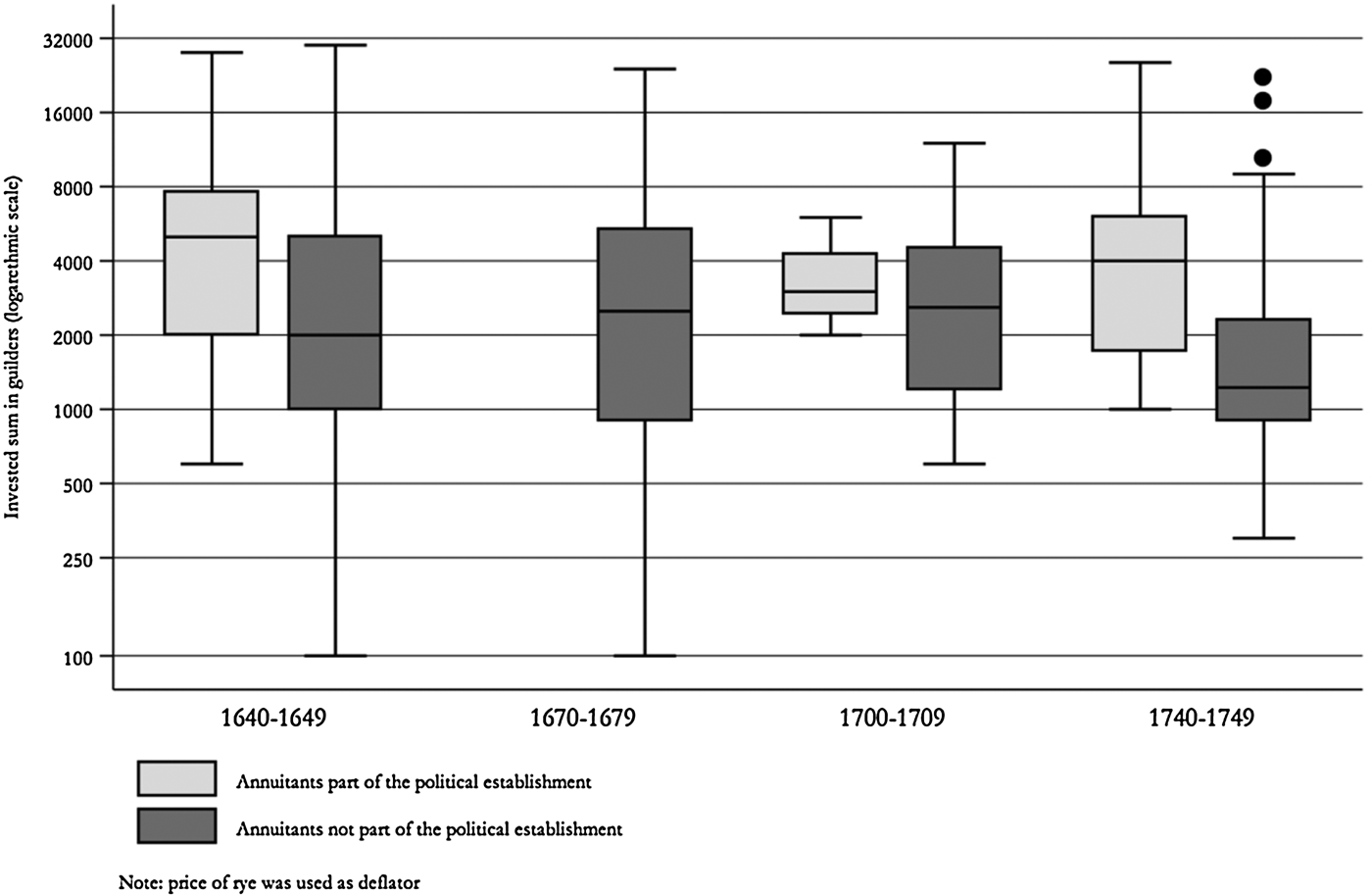
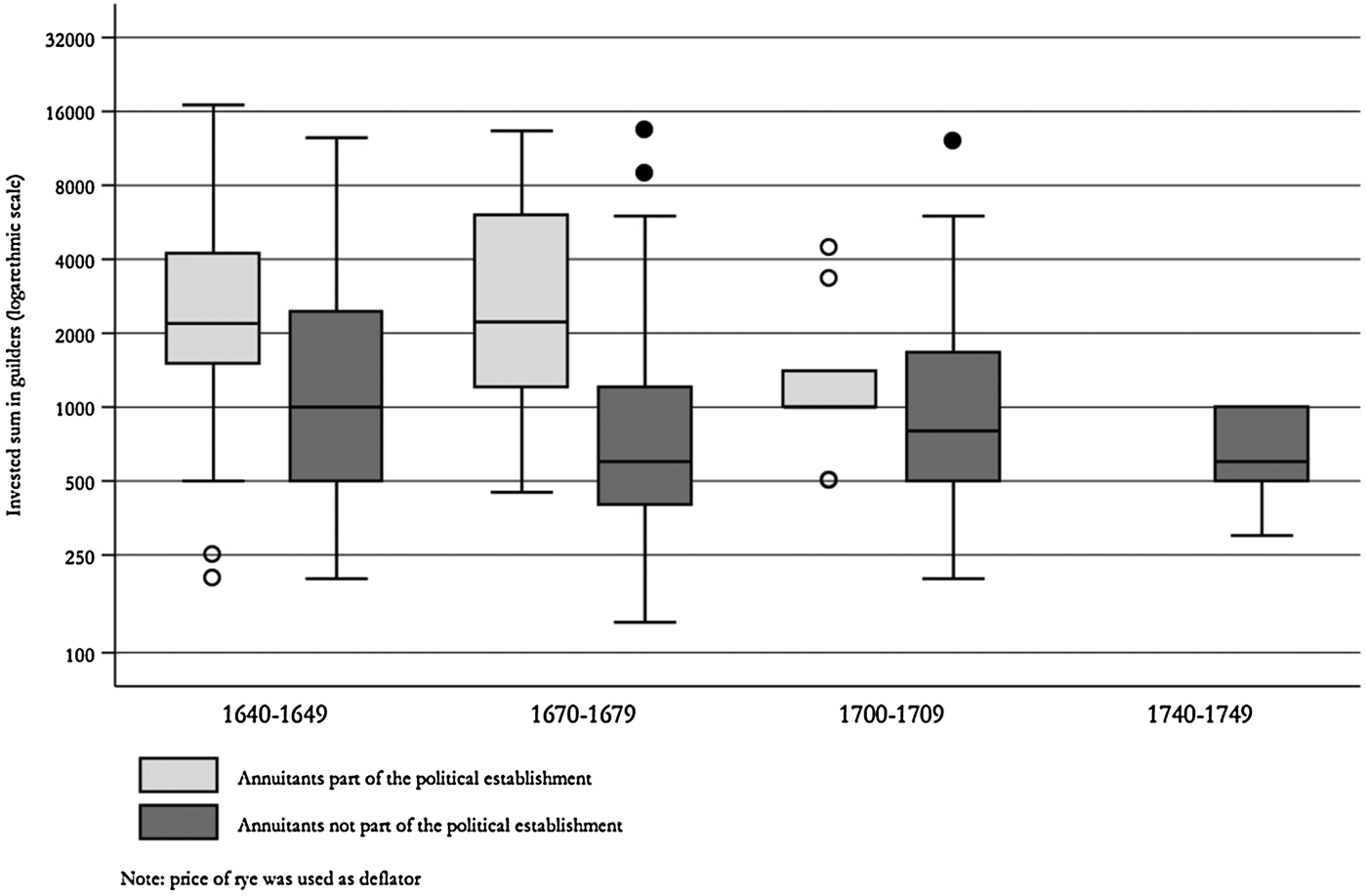
By the middle of the seventeenth century, the city council had turned exclusively towards the Antwerp market for the town's financing needs. This is quite a contrast with the period 1530–1 when, confronted with much lower debt-to-income ratios, the town's magistrates sourced investors from across the Duchy of Brabant.Footnote 3 While Figures 2 and 3 show that across the four periods under investigation both groups invested in urban debt (albeit not always in both types of renten), the amount invested per annuity buyer differed remarkably.Footnote 4 The large spread of the sums invested (the scale of both graphs is logarithmic) hints at a broad social mix of Antwerp's annuitants. This is in line with the findings of Marjolein 't Hart and Manon van der Heijden who found that in seventeenth-century Holland, Dordrecht and Zwolle, both life and perpetual annuities were bought by a broad spectrum of urban society ('t Hart Reference 't Hart1989b, p. 119; Van der Heijden Reference Van Der Heijden2006a, pp. 203–12). Whereas the first constitutes a well-defined social group (e.g. those annuitants belonging to the sitting city council), the second group consists of annuitants from all walks of life ranging from wealthy merchants to lawyers, doctors and surgeons, to widows and small shopkeepers. The extraordinary diversity of the latter group is reflected in the large spread of the sums invested. Between 1640 and 1649, amidst the final war efforts of the Eighty Years' War, the treasurer sold over a 169 perpetual annuities. The smallest amount invested was just shy of 100 guilders, whereas the largest annuity sold was worth the (small) fortune of 30,000 guilders – approximately. As expected, members of the city council were by far the biggest financiers, investing on average more than double the amount of the non-politically active annuity buyers. Still, the larger investors of the latter group, affluent merchants for example, were anything but inferior to the members of the sitting city council.
Distribution of invested sums in life annuities
Distribution of invested sums in perpetual annuities
In line with Richard Knipping's findings for Cologne, individuals bought life and perpetual annuities with clearly distinguishable strategies in mind (Knipping Reference Knipping1894, pp. 340–97). Because of their – in theory – indefinite maturity, perpetual annuities were ideally suited for intergenerational wealth transfer. Hence, they were in great demand amongst the wealthier urban circles. Conversely, because of their lower yield, perpetual annuities were less suited to the smaller investor, who focused mainly on intragenerational wealth transfers, e.g. the financial safeguarding of her and his old age (or in extremis that of their children). For them, life annuities were a logical choice. While the payments were limited, they did carry a higher interest. To optimise the duration of these pay-outs, annuities were bought on the lives of youngsters, frequently the youngest son or daughter (De Vijlder Reference Masure2010, pp. 94–6). Of all life annuities sold in 1548, over 45 per cent of the annuitants were younger than 20 years old, comparable with the structure of Antwerp's population pyramid during the early modern period (Masure Reference Masure1986, p. 243). By the seventeenth century, over half of the annuitants of life annuities were under 20 years of age, whereas the community's age structure remained unaltered (De Vijlder Reference De Vijlder2009, p. 95). In 1644 this was pushed to the limit when Gillis Bollaert bought several life annuities in the amount of 800 guilders on the life of his one-year-old son Francis. While these practices were part of an optimisation strategy from the annuitant's perspective, they clearly were a sub-optimal outcome for the town. The annuitants' profit-maximising strategy prolonged the duration of the annuity, resulting in higher interest expenses over a longer period and a slower decline in the city's outstanding debt.
Unlike other towns that faced similar problems, Antwerp's municipal council did not embrace any of the financial novelties available such as lowering the interest rate for young annuitants (Amsterdam, Rotterdam, Ghent) or excluding them from buying renten altogether (Amsterdam) (Weir Reference Weir1989, pp. 102–7; Van der Burg Reference Van Der Burg2002, pp. 44–5; Van der Heijden Reference Van Der Heijden2006a, p. 210; Alter Reference Alter1983, pp. 24–5; Boone Reference Boone1991b, pp. 11–12). Furthermore, while in both France and the Dutch Republic, tontines – which combined the low interest of perpetual annuities with the definite and shorter duration of life annuities – were used to alleviate cash-strapped and debt-riddled urban finances, (Gelderblom and Jonker Reference Gelderblom, Jonker, Atack and Neal2009, pp. 71–98), no such alternative means of financing were pursued in Antwerp. Similarly, unlike in Holland, annuities were not interchanged for bonds, despite the fact that these could be rolled over continuously and were far more easily transferable on the secondary market than perpetual annuities (Weir Reference Weir1989, pp. 102–7; Gelderblom and Jonker Reference Gelderblom, Jonker, Atack and Neal2009, pp. 90–2; Van der Burg Reference Van Der Burg2002, pp. 44–5). The reluctance of the magistracy to intervene is not surprising since they – more than the general public – bought life annuities for their younger family members. Whereas 42 per cent of the nondescript subgroup of life-annuitants were younger than 20 years of age, largely comparable to the sixteenth-century situation, for the subgroup belonging to the magistracy over 68 per cent of the annuity holders were under the age of 20. Consequently, for the sitting magistracy it was in their own best interest to leave the situation as it was and prevent the exploration of alternative means of financing.
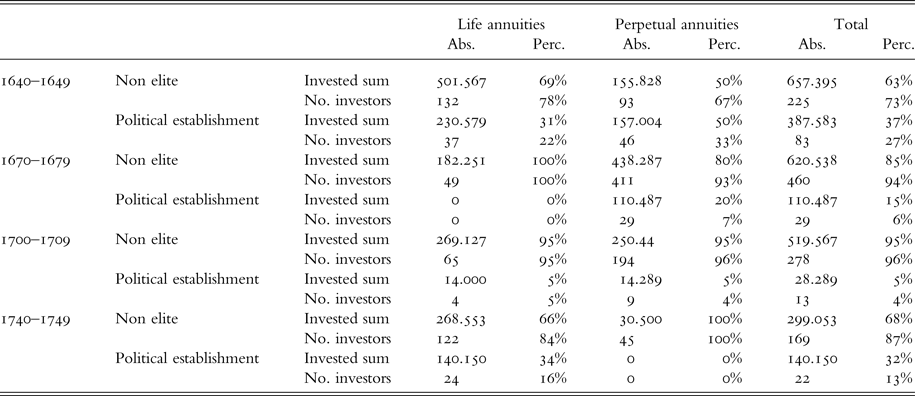
It is evident from Figures 2 and 3 and Table 3 that during the seventeenth century Antwerp's political elite had a tendency to invest more in perpetual than in life annuities, hence preferring long-term revenues to a higher yield. As noted earlier, at the individual level these politically well-connected burghers were on average the biggest investors in Antwerp's debt (see above). Despite the fact that at any given period this faction only entailed 80 people as a group, they were one of the city's most important financiers.Footnote 5 Previously we mentioned that in other cities in the Low Countries a remarkable entanglement came to exist between public finance on the one hand and private fortunes of the members of the city council on the other (Derycke Reference Derycke, Boone, Davids and Janssens2003, p. 176; Boone Reference Boone1991b, pp. 20–6; Van der Burg Reference Van Der Burg2002, pp. 69–73; 't Hart and Van der Heijden Reference Van Der Heijden2006a, pp. 6–7; Van Buyten Reference Van Buyten1981, p. 550). This appears to have been no different in Antwerp. As we have previously noted, the interests of different social groups within the urban administration were constantly balanced by those of the major urban moneylenders when it came to finding new revenues for the city (Limberger Reference Limberger2006a, pp. 1–2). Karin van Honacker came to a similar conclusion in her survey of collective actions in Brabant during the seventeenth and eighteenth centuries (Van Honacker Reference Van Honacker1994, pp. 290–337). In the case of fifteenth-century Ghent, Marc Boone concluded that if the choice needed to be made between direct taxation on property or the sale of new annuities (serviced by a wide range of excises), self-interest often prevailed (Boone Reference Boone1991b, p. 5). Up until the middle of the seventeenth century, the members of the municipal government thought of themselves as exemplary individuals, being obliged to answer the call when the city needed them. For example, when during the summer of 1626 the city for the first time issued perpetual renten at a lower interest rate of 4 per cent (whereas unredeemable annuities were previously sold at 5 per cent), the mayor Nicolaas Rockockx was the main investor, purchasing almost a fifth of the renten issued.Footnote 6 However, public interest did not always prevail over personal gain.
Social profile of annuity holders per type and per perioda
a Antwerp, City Archives, Accounts of the consumptiekas, R 1360–1370, R 1392–1401, R 1421–1432, R 1459–1468.
As already noted, in the years 1640–9, Antwerp sold annuities to the value of one million guilders in order to finance the Eighty Years' War, about 37 per cent of which was provided by the members of the magistracy. A mere twenty years later, the situation had altered substantially. In 1670, Charles II had just suspended the payments to the army in the Spanish Low Countries as a consequence of severe financial troubles. The impact of this decision was immediately perceptible at the urban level (Coppens Reference Coppens1992). Not only did it force the monarch to make an additional request to the Estates of Brabant and Flanders in order to raise the funds, he also engaged in direct negotiations with the major cities to collect additional financial resources (De Vijlder Reference De Vijlder2012, pp. 53–5). Responding to this significant demand for money, the city council once again resorted to selling annuities, thus putting an additional burden on the already debt-ridden urban finances in the process. Meanwhile, the economic downturn had caused the per capita revenues to decline, despite the city government's ongoing search for new revenue streams. Consequently, 69 per cent of all revenues were allocated to servicing the outstanding debt. Against this unfavourable financial backdrop, the members of the municipal council covered some 110,000 guilders or 15 per cent of the capital accumulated during this period. At the height of the War of the Spanish Succession, the participation of the members of the magistracy was at an absolute low. They provided merely 5 per cent of the capital collected. Some 30 years later (1740–9), during the War of the Austrian Succession, the investment behaviour of Antwerp's city council had once again shifted markedly, since they once again invested abundantly in urban annuities, buying over a third of the total debt issue.
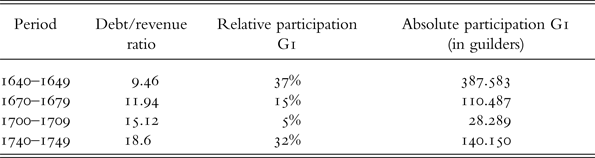
Throughout the researched period, the position of the municipality can be described as rather ambiguous. On the one hand, the magistrates minimised the indebtedness of Antwerp with regard to the broader population. During the 1677 negotiations in the Broad Council regarding the purchase of yet another seigniorial right, pensionary Martens did not respond to any of the financial concerns voiced by the district officers (wijkmeesters) regarding the price at which one could buy the droit de louche from the monarch (De Vijlder Reference De Vijlder2012, pp. 47–73). On the other hand, the investment behaviour of the magistrates and other members of the town council gradually mutated as a result of the changing soundness of Antwerp's finances. The inverse relationship between the overall health of Antwerp's finances, expressed as the debt-over-revenue and interest-payments-over-revenue ratios, and both the relative and absolute participation of the members of the municipal council are striking in this respect (Table 4). Consequently, the period 1670–1739 shows a clear gap between the official communication of the municipality and the individual preferences of its members. Since they were the only ones who had privileged access to all the information concerning the financial well-being of the city, they knew exactly how precarious the situation had become in the final quarter of the seventeenth and first quarter of the eighteenth century and adapted their actions accordingly, always with their own best interest in mind. While one might wonder whether the pull-out of the sitting magistracy was not caused by demand-side alterations, historical evidence points in the other direction. During the late seventeenth and early eighteenth century, the social make-up of the magistracy changed very little and was composed of members of the town's most prominent families. Their overall investment pattern remained unchanged throughout the period under investigation and was composed of rents on Antwerp and the surrounding municipalities, the provincial Estates, obligations, investments in chartered companies, investments in foreign public debt and an assortment of real estate, both within Antwerp and in the surrounding countryside (Degryse Reference Degryse1985, pp. 378–570; Riley Reference Riley, Klep and Cauwenberghe1994, pp. 497–505). Through specialised agents, bookkeepers and notaries, foreign investments were made possible for Antwerp's most affluent inhabitants (Degryse Reference Degryse2001, pp. 43–62). As these specialised intermediaries became increasingly active within Antwerp in the course of the eighteenth century, it is very possible that especially low-yielding perpetual annuities were increasingly substituted for foreign investments. However, further research is necessary to confirm this hypothesis. Still, while no archetypical financial estate existed, annuities on the city of Antwerp remained the common denominator. By the late seventeenth century, annuities on the city of Antwerp had become one of the cornerstones of their financial patrimony, making up about 5 to 10 per cent of their (financial) activity. Nevertheless, Karel Degryse noted a decrease in their importance during the first quarter of the eighteenth century, which corroborates our findings (Degryse Reference Degryse1985, pp. 437–40).
Evolution debt-revenue ratio versus relative participation of the city councila
a Antwerp, City Archives, accounts of the consumptiekas, R 1360–1370, R 1392–1401, R 1421–1432, R 1459–1468; Accounts of the reductiekas, R 780–816, R 894–932, R 972–982, R 1013–1025; Accounts of the kas der domeinen, R 86–95, R 108–114, R 122–125, R 134–144, R 174–183 and Masure (1986, pp. 329–30); Blockmans (Reference Blockmans1952, pp. 50–6).
During the first decade of the eighteenth century, the situation escalated. The historical debt of the city at that time appeared to have reached such high levels that a debt restructuring was inevitable. The expenses incurred in order to service the debt issued during the War of the Spanish Succession led to defaults on the older life and perpetual annuities. It is therefore illustrative that during exactly this period the municipality made hardly any investments in public debt. A first large-scale restructuring was introduced in 1729, whereby all existing perpetual annuities were reduced to 3.5 per cent. However, it turned out to be a failure. The initial response to the first reduction in 1729 was downright devastating for the credit of the city. Various annuity holders did not hesitate to plead for oversight of the urban finances by a government commissioner. Several of them even filed a lawsuit against the municipality for the injustice of the haircut, causing it to be recalled. The former alderman Gaspar Joseph van Horne, one of the few members of the magistracy still actively investing in Antwerp's debt during the early eighteenth century, stated that because of the injustice of the debt restructuring, he would cease to invest in the town's annuities (Degryse Reference Degryse1985, p. 438). As a consequence of this failed reorganisation, by the middle of the 1730s older annuities still had payment arrears of ten to fifteen years. In 1738, interest payments were once again halted completely. Pressured by the rentiers and the Austrian government, the city finally succeeded in getting their house in order during the spring and summer of 1740 (Degryse Reference Degryse1985, pp. 432–8). Combining a haircut on both life and perpetual annuities, whose interest rates were lowered from respectively 9 to 8 per cent and 5 to 3 per cent, the percentage of revenues ring-fenced for servicing the debt was slashed immediately (Table 4). In 1730, Antwerp had earmarked little over 302,000 guilders for debt servicing, but because of the haircut, this was lowered substantially to 212,000 guilders by the autumn of 1740. The rentiers furthermore expressed their need for a strong commitment of both the State and the town's magistracy to safeguarding their interests (Degryse Reference Degryse1985, p. 437). Consequently, an additional series of new excises was introduced. Together with an economic revival (and ensuing population and consumption growth) (Blondé Reference Blondé2001, pp. 497–9; Reference Blondé1999b, pp. 101–4; Blondé and Van Damme Reference Blondé and Van Damme2009, pp. 645–8), these measures resulted in a drastic lowering of the city's debt–revenue ratio in the following decades. Despite the initial unwillingness of Antwerp's creditors, similar to the events in 1729, the turmoil ceased as soon as regular payments started again. In the meantime, however, the preferences of the magistracy had shifted considerably. Whilst they preferred long-term, low-yielding perpetual annuities during the sixteenth and early seventeenth centuries, starting in the late seventeenth century, the magistracy increasingly preferred higher-yielding life annuities, maximising their private gains by buying them on the lives of their children. While new debt issues were hence a success, illustrated by the return of the city council as an important investor (Table 4), only life annuities were offered for sale.
IV
In this article, we presented a new analysis of Antwerp's annuity market during the early modern period. Initially, we emphasised the city's perspective. In particular, we focused on the financial and economic context in which public debt was sold, what the main objectives were and how these impacted Antwerp's financial policy in the long run. We showed that the economic stagnation from the second half of the seventeenth century onwards had profound effects on the financial strength of Antwerp. Confronted with a cash-strapped state and against the backdrop of structurally declining tax revenues, raising additional capital through the emission of annuities continued unabated. We revealed that this policy had a devastating effect on the debt-to-revenue ratio, complicating future debt servicing. The inability to implement new debt-managing instruments combined with the unwillingness to undertake drastic action when needed only aggravated the financial situation and only postponed the city's default.
Secondly, we took the annuity holders themselves into account. In particular, we reassessed the role of the city's political elite during the seventeenth and eighteenth centuries. Since they set out Antwerp's financial and fiscal policy but at the same time were substantial investors in the city's debt, a conflict of interest arose. As we have demonstrated, their investment behaviour was inversely correlated with the debt ratio of the city. The more severe Antwerp's financial position became, the more the political elite abstained from investing in public debt. This strategy, although highly rational from an economic viewpoint, was not beneficial for the town's financial health. As private interest prevailed over public welfare, Antwerp had to resort to selling additional life annuities. Since these yielded a higher interest rate, expenditures for annuity payments grew unabated. Hence the buyers' strike of the members of the municipal government unintentionally created an even bigger strain on the already debt-ridden urban finances. This, in combination with their unwillingness to innovate or restructure the city's debt in the late seventeenth century, made a hard landing inevitable. However, as soon as the inevitable default took place and consequently the town's financial stability was guaranteed, the urban political elite returned to the forefront as principal investors.
Antwerp's experience was by no means an isolated event. During the early modern period, several other cities in western Europe were confronted with similar experiences. At some stage during their development, as in Antwerp, they experienced vast economic growth during which capital could be raised effortlessly. The examples are abundant. Italian city-states such as Venice or Genoa, capital cities like Madrid and Paris or mercantile centres like Bruges, Ghent and Amsterdam, all found financiers willing to invest substantial amounts in the town's public debt during their rise to riches. In some instances, as was the case for Ghent, Bruges and Amsterdam, the magistracy sought these financiers within a broad geographical area. Antwerp's municipal council opted to seek funding within their city walls, as did others. Since holders of public debt could take a defaulting city's burghers hostage and confiscate their belongings to enforce reimbursement, this limited the economic fall-out in case the city was not able to service its debt. However, as we have illustrated for Antwerp, this created a close entanglement between the city government and its financiers. When economic decay set in, resulting in structurally declining revenue streams, this entanglement posed a problem for the magistracy. In order to keep overall indebtedness in check new instruments for (re)financing the debt had to be implemented. However, as this frequently implied lower yields, investors were not too keen on this alternative. Moreover, in several instances a certain number of the city's magistrates were substantial financiers for the city. As we highlighted for the city of Antwerp, this created a conflict of interest, giving the magistracy even less incentive to pursue financial innovations.