Introduction
The hemlock woolly adelgid, Adelges tsugae Annand, (Hemiptera: Adelgidae) is a non-native insect pest of hemlock trees (Pinaceae: Tsuga) in the eastern USA. Adelges tsugae was first collected in the eastern USA in 1951 in Richmond, Virginia (Stoetzel, Reference Stoetzel2002) and was likely introduced from southern Japan, where it is native (Havill et al., Reference Havill, Montgomery, Yu, Shiyake and Caccone2006, Reference Havill, Shiyake, Lamb, Foottit, Yu, Paradis, Elkinton, Montgomery, Sano and Caccone2016a). Feeding at the base of needles, individuals insert their stylets into xylem ray parenchyma cells, depleting host tree nutrients, and causing water stress and defoliation (Havill et al., Reference Havill, Vieira and Salom2016b). The insect can kill trees of all ages in four to fifteen years after initial infestation (Havill et al., Reference Havill, Vieira and Salom2016b). Mortality may reach 95% in some areas (Havill et al., Reference Havill, Vieira and Salom2016b).
In the Pacific Northwest there is a native cluster of clonal lineage of A. tsugae, closely related to the Japanese clone that was introduced to the eastern USA (Havill et al., Reference Havill, Montgomery, Yu, Shiyake and Caccone2006, Reference Havill, Shiyake, Lamb, Foottit, Yu, Paradis, Elkinton, Montgomery, Sano and Caccone2016a). Western A. tsugae feeds, develops, and reproduces on western hemlocks (T. heterophylla (Raf.) Sarg.) and mountain hemlocks (T. mertensiana (Bong.) Carriere) with no obvious defoliation or tree mortality (Kohler et al., Reference Kohler, Stiefel, Wallin and Ross2008). It is possible that native predators prevent A. tsugae populations from remaining at densities high enough to cause significant impacts to tree health in western North America. Among the 55 species of predators found associated with A. tsugae in a survey conducted throughout western Oregon and Washington, there were three species of adelgid-specific predators that were most abundant and frequently encountered (Kohler et al., Reference Kohler, Stiefel, Wallin and Ross2008). Those were two species of silver flies (Diptera: Chamaemyiidae), Leucopis argenticollis Zetterstedt, and Leucopis piniperda Malloch (misidentified as Le. atrifacies Aldrich, see Grubin et al., Reference Grubin, Ross and Wallin2011), and Laricobius nigrinus Fender (Coleoptera: Derodontidae). Both of the Leucopis species are also present in eastern North America where A. tsugae is a pest, but within each species, eastern populations are genetically diverged from western ones and eastern flies feed on pine adelgids (Pineus spp.), not A. tsugae (Havill et al., Reference Havill, Gaimari and Caccone2018). Laricobius nigrinus was previously known to be associated with A. tsugae in western North America and was introduced to the eastern USA as a biological control of A. tsugae beginning in 2003. Several hundred thousand La. nigrinus eggs and adults have been released and it has become established at over 100 sites in the eastern USA (Mausel et al., Reference Mausel, Salom, Kok and Davis2010; Havill et al., Reference Havill, Vieira and Salom2016b). However, to date, there has been no perceptible slowing of hemlock decline or mortality at sites with La. nigrinus compared to sites without La. nigrinus (Mausel et al., Reference Mausel, Davis, Lamb, Zilahi-Balogh, Kok, Salom, Onken and Reardon2011; Onken and Reardon, Reference Onken, Reardon, Onken and Reardon2011; Mayfield et al., Reference Mayfield, Reynolds, Coots, Havill, Brownie, Tait, Hanula, Joseph and Galloway2015). Kohler et al. (Reference Kohler, Stiefel, Wallin and Ross2008) were the first to report Le. argenticollis and Le. piniperda associated with A. tsugae. More recently, it was reported that the Leucopis spp. collectively were 2.3–3.5 times more abundant than La. nigrinus on A. tsugae infested trees in the western USA, and the larvae were present feeding on A. tsugae for a longer period of time than La. nigrinus (Kohler et al., Reference Kohler, Wallin and Ross2016). Furthermore, it was determined that the Leucopis spp. larvae feed on the egg stage of both A. tsugae generations (Kohler et al., Reference Kohler, Wallin and Ross2016), while La. nigrinus larvae feed only on the egg stage of the first generation and undergo a period of aestivation when eggs of the second adelgid generation are present (Zilahi-Balogh et al., Reference Zilahi-Balogh, Salom and Kok2003). Although many details of the life cycle of both Leucopis species are unknown, previous research suggests that there are at least two generations per year based on peaks in abundance of different life stages (Kohler et al., Reference Kohler, Stiefel, Wallin and Ross2008; Grubin et al., Reference Grubin, Ross and Wallin2011). Furthermore, F1 adults were collected in as little as 28 days after adult flies were released onto caged hemlock woolly adelgid infested branches in Tennessee and New York indicating that the flies complete a generation in less than 4 weeks (Motley et al., Reference Motley, Havill, Arsenault-Benoit, Mayfield, Ott, Ross, Whitmore and Wallin2017).
The objective of this study was to see if the results of Kohler et al. (Reference Kohler, Wallin and Ross2016), which were based on data collected at only two sites, one in Oregon and one in Washington, are representative of predator abundance throughout a wider portion of A. tsugae range in the Pacific Northwest. Also, in previous studies, it was not possible to determine the species of Leucopis immatures and so data on immature abundance were reported as Leucopis spp., collectively. Using a recently developed molecular technique to distinguish immature Leucopis species (Havill et al., Reference Havill, Gaimari and Caccone2018), it was possible for the first time to report Leucopis immature abundance by species across the study sites, providing information about the spatial and temporal coexistence of all three predator species.
Materials and methods
Adelges tsugae and associated adelgid-specific predator densities were quantified from samples collected at field sites in western Oregon and Washington USA. Based on previous research, the predators of interest were La. nigrinus, Le. argenticollis, and Le. piniperda (Kohler et al., Reference Kohler, Stiefel, Wallin and Ross2008). Field sites were chosen for their high A. tsugae abundance on western hemlock.
The number of trees sampled and their locations were: 13 trees at a Sierra Pacific Industries seed orchard on Whidbey Island, Washington (48.206898, −122.635276); six trees in Point Defiance Park in Tacoma, Washington (47.304070, −122.517184); four trees on Vashon Island, Washington (47.462193, −122.438922); and two trees in front of an apartment complex, Tanara Villa Apartments, 6322 N 26th St., Tacoma, Washington (47.271838, −122.523984). Additional sites were opportunistically sampled only once or twice since they supported low A. tsugae populations. However, data from collections at these sites were combined with the data from the four main sampling locations for predator totals and some analyses. These additional sites included two trees each sampled once in W.B. Nelson State Park on Highway 34 east of Waldport, Oregon (44.418321, −124.049365), one tree sampled twice in Grant Park in Portland, Oregon (45.540730, −122.628954), and one tree sampled once in a parking lot at NW Walnut St. and 9th St. in Corvallis, Oregon (44.594563, −123.251950). A total of 29 A. tsugae-infested western hemlock trees were sampled, of which 25 were at the four main sites in Washington.
Terminal twigs showing A. tsugae infestation by the white flocculence or ‘wool’ made by developing adelgids were collected from sample trees. Two to five haphazardly-chosen, 5–10 cm branch tips at least 0.5 m from each other were collected from each tree on each sampling date. At the four main sites, the same trees were repeatedly sampled at roughly two-week intervals April 3 to July 23, 2016. All twigs from each tree were pooled. Twigs were kept on ice in a cooler for transport and in a refrigerator in the lab prior to processing. In the lab, the numbers of A. tsugae nymphs and adults with eggs were counted. Although eggs were not counted, adults were always present with eggs.
Leucopis larvae and puparia were identified to species by sequencing DNA barcodes or by the restriction fragment length polymorphism (RFLP) method described in Havill et al. (Reference Havill, Gaimari and Caccone2018). DNA was extracted using the Mag-Bind Blood and Tissue Kit (Omega Bio-Tek, NorCross, Georgia). Insect cuticles were recovered following proteinase digestion, slide mounted as vouchers, and deposited at the Yale Peabody Museum of Natural History with accession numbers YPM#ENT 943594-YPM#ENT943628. For DNA barcode sequencing, the standard 658 base pair portion of the mitochondrial cytochrome oxidase I (COI) gene was amplified using primers LepF1 and LepR1 (Hebert et al., Reference Hebert, Penton, Burns, Janzen and Hallwachs2004). Sequences were deposited in GenBank with accession numbers MH837098–MH837159. Fly specimens for which amplification of the full DNA barcode fragment was not successful were identified using the polymerase chain reaction restriction fragment length polymorphism (PCR-RFLP) assay described in Havill et al. (Reference Havill, Gaimari and Caccone2018). This assay relies on nucleotide substitutions that are fixed for each species in a shorter fragment of COI that is easier to amplify with primers designed specifically for Leucopis. Briefly, a 245 base pair portion of the mitochondrial COI gene was amplified using primers LeucoShortF2 and LeucoShortR. PCR products were digested with restriction enzyme RsaI and run on a 1.5% agarose gel to visualize diagnostic banding patterns for Le. argenticollis vs Le. piniperda. Adult Leucopis were identified based on patterns of postpronotal setae (S. Gaimari, personal communication).
The numbers of Leucopis larvae, puparia, and adults of the two species were counted. Empty puparial cases were counted as puparia. However, except for one specimen identified using DNA sequencing, these puparial cases could not be identified to species by morphology or DNA sequencing. The numbers of La. nigrinus larvae and adults were counted. Laricobius nigrinus were identified based on morphology (Zilahi-Balogh et al., Reference Zilahi-Balogh, Kok and Salom2002; Havill et al., Reference Havill, Vieira and Salom2016b). As La. nigrinus pupates in the soil (Zilahi-Balogh et al., Reference Zilahi-Balogh, Kok and Salom2002), pupae of this species were not found on branches. The total length of sample twigs, including the length of side branches, was measured to express A. tsugae and predator densities per centimeter of hemlock stem.
Data analyses
Mean densities for each predator species and A. tsugae were calculated for all trees at each sample location. Each data point for mean cumulative densities represented the mean density of repeated measures of a species on a particular tree over all sampling events. These mean cumulative densities of the combined Leucopis spp. and La. nigrinus were found to be normally distributed and nearly normally distributed, respectively, by graphing the frequencies of occurrence of mean cumulative densities binned into groups across the range of values in histograms. Mean cumulative densities of each of the Leucopis spp., Le. argenticollis, and Le. piniperda, were found to be highly right-skewed and not normally distributed. Transformations could not consistently normalize these data because they included many zero values. Therefore, tests assuming normality were not applied to the mean cumulative densities of Le. argenticollis and Le. piniperda. Mean cumulative densities of each of the combined Leucopis spp., La. nigrinus, and A. tsugae were subjected to one-way ANOVA to assess the effect of site as a factor on cumulative density. These analyses informed further analysis by allowing site to be ignored if it was not significant in explaining density. Pearson's product-moment correlation was used to correlate pairwise mean cumulative densities among A. tsugae, La. nigrinus, and the combined Leucopis spp. Spearman's rank correlation coefficient was used to correlate the mean cumulative densities of Le. argenticollis and Le. piniperda, which were not normally distributed but did satisfy the Spearman's rank correlation coefficient test's assumptions of ordinal or continuous, and monotonically related, data. All statistical analyses were performed using the R-3.3.2 for Windows (32/64 bit) statistical package.
Results
Adelges tsugae adults were most abundant in early April [Julian Date (JD) 93], declining until early May (JD 123) and then increasing to a second peak in mid-June (JD 164) before declining until the end of sampling in late July (JD 204) (fig. 1). Adelges tsugae nymphs were at their lowest density in early April (JD 93), increased to a peak in early May (JD 126), and then declined gradually until the end of July (JD 124) (fig. 1).
Mean densities of Adelges tsugae nymphs and adults across the four main sample sites from April 3 to July 23, 2016. Error bars are standard errors of the mean. Prior to about Julian date 130, adults are sistentes and nymphs are prodgredientes, after Julian date 130, adults are progredientes and nymphs are sistentes.

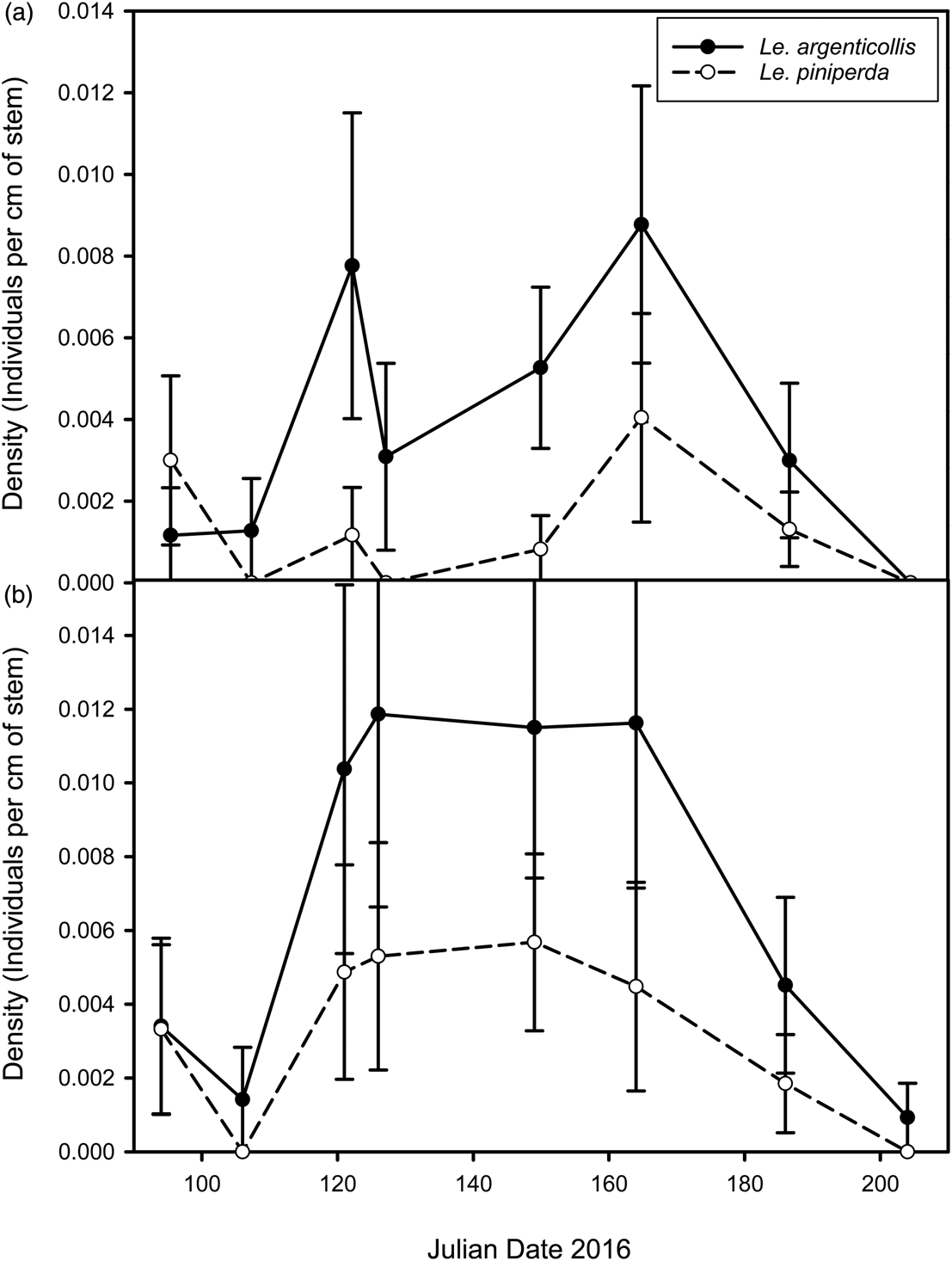
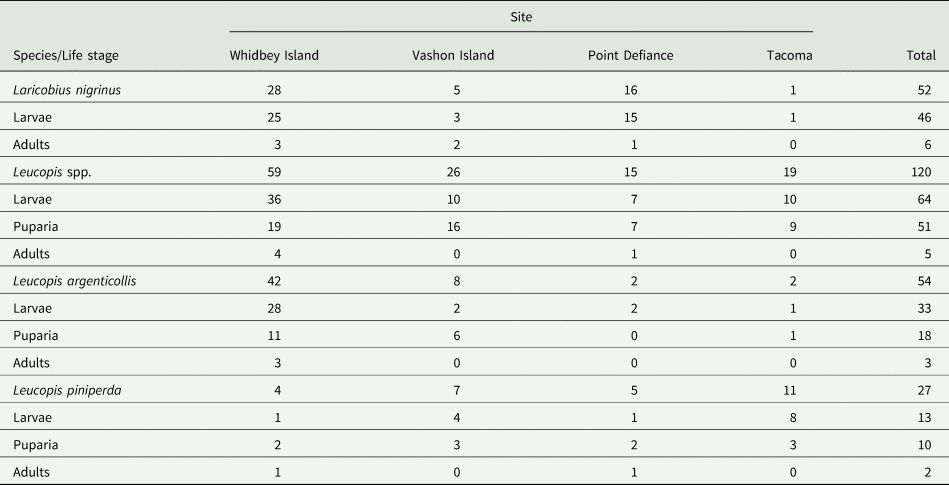
Sixty-two immature Leucopis specimens, were identified using full DNA barcode sequences and 14 were identified using PCR-RFLP. A total of 51 Le. argenticollis and 25 Le. piniperda larvae and puparia were identified (table 1). Overall, Leucopis argenticollis was more abundant than Le. piniperda. However, this difference was due entirely to the large number of Le. argenticollis compared to Le. piniperda collected at the Whidbey Island site (table 1). Nearly identical numbers of both species were collected at the Vashon Island site and slightly more Le. piniperda were collected compared to Le. argenticollis at the Point Defiance and Tacoma sites. Of the five adult Leucopis that were collected, or possibly emerged from puparia after collecting and before sample processing, three were Le. argenticollis and two were Le. piniperda (Table 1). The densities of Le. argenticollis and Le. piniperda followed similar patterns over time with only slight differences (fig. 2). Larvae of Le. argenticollis increased from early April (JD 93) to early May (JD 121), declined briefly in early May (JD 121–126), and then increased to a maximum in mid-June (JD 164) before declining consistently until the end of July (JD 204) (fig. 2a). In contrast to Le. argenticollis, Le. piniperda declined briefly from early to mid-April (JD 93–106), but then followed a similar pattern for the remainder of the summer (fig. 2a). Considering all life stages together both species followed a nearly identical pattern throughout the spring and summer, declining briefly from early to mid-April (JD 93–106) before increasing to a plateau from early May to mid-June (JD 126–164), and then declining steadily until the end of July (JD 204) (fig. 2b).
Mean densities of all identified Le. argenticollis and Le. piniperda larvae (a) and combined larvae, puparia, and adults (b) across the four main sample sites from April 3 to July 23, 2016. Error bars are standard errors of the mean.

Numbers of adelgid specific predators collected at four primary sample sites and total for all sample sites in Oregon and Washington, USA, from April 3 to July 23, 2016a

a Data are presented for all Leucopis combined and separately for each species. The sums for the individual species do not equal the values for the two species combined because our methods were unsuccessful at identifying every specimen to species.
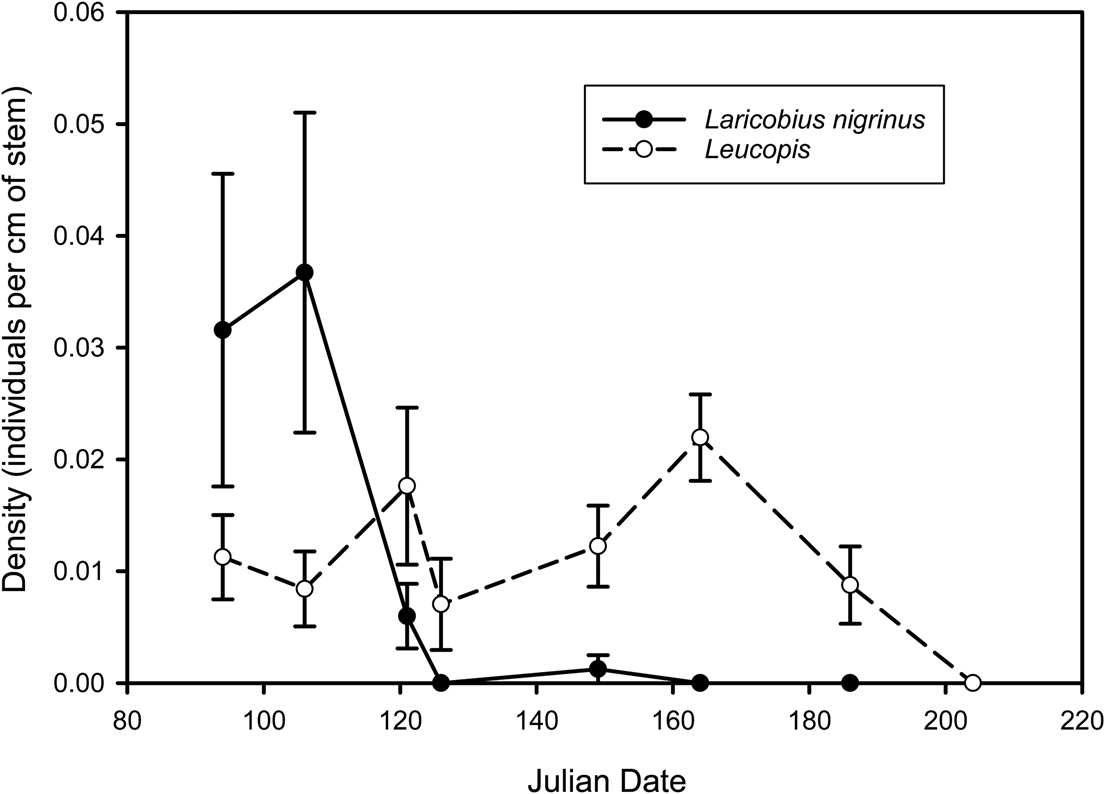
Across all sample dates and sites, over twice as many Leucopis spp. (n = 120) were collected than La. nigrinus (n = 52) (table 1), although during the first 2–3 weeks of sampling La. nigrinus was three times more abundant than the Leucopis spp. The total numbers of combined Leucopis spp. were consistently greater than La. nigrinus at each site, except Point Defiance, where there was one more La. nigrinus collected than Leucopis spp. (table 1). Also, across all sites, 70 of the 178 total samples had Leucopis spp. present, while only 24 samples had La. nigrinus present.
Leucopis spp. larvae were present in samples over a longer period of time than La. nigrinus larvae (fig. 3). Specifically, the overall densities of larval La. nigrinus were highest in April (JD 93–106), declined by early May (JD 121), and remained at low densities until sampling ended in late July (JD 204) (fig. 3). The overall densities of larval Leucopis spp. increased in May (JD 121), were highest in June (JD 164), and declined in late July (JD 204) (fig. 3). When compared across the four main sampling locations, there was no significant effect of site on A. tsugae (combined nymphs and adults) or predator (combined larval, puparial, and adult Leucopis spp., and combined larval and adult La. nigrinus) mean cumulative densities in three one-way ANOVAs (A. tsugae: F-value = 1.88, df = 3, 21, P-value = 0.17; Leucopis: F-value = 1.95, df = 3, 21, P-value = 0.15; La. nigrinus: F-value = 0.4, df = 3, 21, P-value = 0.75).
Mean densities of larval Leucopis spp. combined and La. nigrinus across all sites, from April 3 to July 23, 2016. Error bars are standard errors of the mean.

The Pearson's product-moment correlation of A. tsugae and combined larval and adult La. nigrinus densities was found to be non-significant, with an alternative hypothesis of positive correlation (t-value = −0.34; df = 23; P-value = 0.63; 95% CI = −0.40 to 1; estimated correlation = −0.07). The Pearson's product-moment correlation of A. tsugae and larval La. nigrinus densities was likewise found to be non-significant, with an alternative hypothesis of positive correlation (t-value = −0.63; df = 23; P-value = 0.73; 95% CI = −0.45 to 1; estimated correlation = −0.13). Combined larval and adult La. nigrinus and Leucopis spp. densities were significantly, moderately, negatively correlated, with an alternative hypothesis of negative correlation (t-value = −1.81; df = 23; P-value = 0.04; 95% CI = −1 to −0.02; estimated correlation = −0.35). Larval La. nigrinus and Leucopis spp. densities were significantly, moderately, negatively correlated, with an alternative hypothesis of negative correlation (t-value = −1.92; df = 23; P-value = 0.03; 95% CI = −1 to −0.04; estimated correlation = −0.37). Adelges tsugae density correlated significantly, moderately, and positively with both larval and combined larval, puparial, and adult Leucopis spp. densities, tests with an alternative hypothesis of positive correlation (A. tsugae and larval Leucopis: t-value = 2.64; df = 23; P-value < 0.01; 95% CI = 0.17 to 1; estimated correlation = 0.48; and A. tsugae and combined Leucopis: t-value = 1.98; df = 23; P-value = 0.03; 95% CI = 0.05 to 1; estimated correlation = 0.38). Leucopis argenticollis and Le. piniperda were to some degree significantly, negatively correlated (at P ≤ 0.10) using a non-parametric test, Spearman's rank correlation coefficient, with an alternative hypothesis of negative correlation (ρ = −0.28; df = 23; P-value = 0.09).
Discussion
Across all sample trees and dates, Leucopis spp. collectively were 2.3 times more abundant than La. nigrinus. This is consistent with a previous study that found Leucopis spp. to be 2.3–3.5 times more abundant than La. nigrinus (Kohler et al., Reference Kohler, Wallin and Ross2016). However, the earlier study reported data collected at only two sites, one in Oregon and one in Washington. The present study includes data from four primary sample sites in the Puget Sound area of Washington and three less intensively sampled sites in Oregon. These new data suggest that collectively Leucopis spp. are more abundant than La. nigrinus in the Pacific Northwest USA. The numbers above may be somewhat misleading regarding the relative abundance of the two genera. Since La. nigrinus pupates in the soil, this life stage would have been excluded from the clipped branch samples. In contrast, Leucopis spp. puparia are located on twigs near A. tsugae. Excluding puparia, a total of 69 Leucopis spp. were collected, about 1.3 times the number of La. nigrinus (n = 52). The results of the present study also confirm the previous finding that Leucopis spp. larvae are present on A. tsugae infested twigs for a much longer period of time than larvae of La. nigrinus (fig. 3) and that Leucopis spp. larvae feed on the egg stage of both A. tsugae generations while La. nigrinus larvae feed only on the egg stage of the first adelgid generation (Kohler et al., Reference Kohler, Wallin and Ross2016).
In all previous studies of these Leucopis spp., it was not possible to distinguish the species of immatures based on morphological characters. Using a recently developed DNA sequencing technique, 86% of the Leucopis spp. immatures collected in the present study were identified to species. Combining the immature and adult totals for each species, Le. argenticollis was more abundant (n = 51) than Le. piniperda (n = 25). In a previous study of predators on 116 A. tsugae infested western hemlock across 16 sites in western Oregon and Washington, USA, a total of 99 adult Leucopis spp. were collected. Eighty-seven percent of those adults were Le. argenticollis and 13% were Le. piniperda (misidentified as Le. atrifacies, see Grubin et al., Reference Grubin, Ross and Wallin2011) (Kohler et al., Reference Kohler, Stiefel, Wallin and Ross2008). The results reported here indicate that Le. argenticollis may be significantly more abundant than Le. piniperda at some sites in the Pacific Northwest, but the two species are present at similar population densities at others. Although Le. argenticollis is more abundant than Le. piniperda at some sites, there appears to be no difference in phenology between the two species (fig. 2). Since there was no significant effect of site on combined Leucopis spp., La. nigrinus, or A. tsugae cumulative densities, linear correlations were used to test interspecific associations across all sites. Laricobius nigrinus densities were not correlated with A. tsugae densities, while Leucopis spp. densities were positively correlated with A. tsugae densities. Grubin et al. (Reference Grubin, Ross and Wallin2011) and Motley et al. (Reference Motley, Havill, Arsenault-Benoit, Mayfield, Ott, Ross, Whitmore and Wallin2017) also found positive correlations between Leucopis spp. and A. tsugae densities. Kohler et al. (Reference Kohler, Stiefel, Wallin and Ross2008) found that the abundances of larval Leucopis spp. and La. nigrinus were positively correlated with A. tsugae abundance score. Collectively, these results suggest that Leucopis spp. populations respond positively to increasing A. tsugae populations and Laricobius nigrinus populations also respond positively to increasing A. tsugae populations but less consistently. The negative interspecific correlations between the intraguild predators may indicate possible competition or avoidance among the Leucopis spp. and La. nigrinus.
The data reported here add to the growing body of evidence that suggests the Leucopis spp. may be responsible for regulating A. tsugae populations below levels that cause any significant impact to western hemlock in the Pacific Northwest USA either independently or in combination with La. nigrinus. As reported here and in Kohler et al. (Reference Kohler, Wallin and Ross2016), the Leucopis spp. are more abundant than La. nigrinus and feed on both generations of A. tsugae while La. nigrinus feeds only on the first adelgid generation in their native ranges of the Pacific Northwest USA. Furthermore, both Leucopis species appear to be restricted to A. tsugae as prey in the Pacific Northwest USA, although both species have been reported from other adelgid hosts across North America and Le. argenticollis has been reported from other adelgid hosts in Europe, Japan, India and Russia (Ross et al., Reference Ross, Gaimari, Kohler, Wallin, Grubin, Onken and Reardon2011, Reference Ross, Kohler and Wallin2017; Havill et al., Reference Havill, Gaimari and Caccone2018). Recently, it was demonstrated that Leucopis species from the Pacific Northwest USA are able to feed and develop to adults on A. tsugae populations from the eastern USA both in the laboratory and under field conditions (Motley et al., Reference Motley, Havill, Arsenault-Benoit, Mayfield, Ott, Ross, Whitmore and Wallin2017). Collectively, these results support the continuing study of the Leucopis species as potential biological control agents for A. tsugae in the eastern USA, and further study of all three predators in the Pacific Northwest to clarify niche partitioning that may explain their coexistence on a common prey.
Acknowledgements
We thank Doug Sand and Sierra Pacific Industries for providing access to one of the field sites. Dan Cress helped facilitate this access and we thank him as well. We gratefully acknowledge the role of Ariel Muldoon in the Department of Forest Ecosystems and Society, College of Forestry, Oregon State University for her advice to the lead author on statistical design and computing. Thanks also to the USDA Forest Service Hemlock Woolly Adelgid Initiative for funding this work.