


Few findings in political science have received as much attention as the “democratic peace,” the discovery that democracies almost never fight other democracies (Doyle Reference Doyle1986; Russett Reference Russett1993). To some, the absence of military conflict among democracies is so consistent that it approaches the status of an “empirical law” (Levy Reference Levy1988).
Some authors have attempted to explain the democratic peace by highlighting the role of public opinion. They observe that democratic leaders are beholden to voters and claim that voters oppose war because of its human and financial costs. This argument, which dates to Immanuel Kant, predicts that democracies will behave peacefully in general—avoiding war not only against democracies but also against autocracies. History shows, however, that democracies frequently fight autocracies.
A different possibility is that democratic publics are primarily averse to war against other democracies. If leaders are responsive to voters and voters are more reluctant to fight democracies than otherwise equivalent autocracies, then public opinion could play an important role in the dyadic democratic peace. To date, however, surprisingly few studies have investigated whether democratic publics are more reluctant to attack democracies than autocracies.Footnote 1 Moreover, the small body of existing work has not accounted for variables that could confound the relationship between shared democracy and public support for war, nor has it investigated the mechanisms by which the regime type of the adversary affects the public mood. Despite decades of research on the democratic peace, we still lack convincing evidence about whether and how public opinion contributes to the absence of war among democracies.
We used experiments to shed new light on these important questions.Footnote 2 Our experiments, embedded in public opinion polls that were administered to nationally representative samples of British and American citizens, involved a situation in which a country was developing nuclear weapons. When describing the situation, we randomly and independently varied four potential sources of peace: the political regime, alliance status, economic ties, and military power of the adversary. We then asked individuals whether they would support or oppose a preventive military strike against the country's nuclear facilities.
Participants in our experiments were substantially less supportive of military strikes against democracies than against otherwise identical autocracies. Moreover, because we randomly and independently manipulated the regime type of the adversary, the observed preference for peace with other democracies was almost certainly causal, rather than spurious. Our findings therefore provide empirical microfoundations for the hypothesis that the preferences of ordinary voters contribute to peace among democracies.
In addition to estimating the overall effect of democracy, we investigated the mechanisms through which shared democracy reduces public enthusiasm for war. Democratic publics may feel reluctant to attack other democracies for a variety of reasons: They may view democracies as less threatening (Risse-Kappen Reference Risse-Kappen1995; Russett Reference Russett1993), regard democracies as more formidable opponents (Bueno de Mesquita et al. Reference Bueno de Mesquita, Morrow, Siverson and Smith1999; Lake Reference Lake1992; Reiter and Stam 2002), or have moral qualms about using force to overturn policies that were freely chosen by citizens in another democracy. Despite volumes of research about the democratic peace, however, little is known about whether these factors influence the willingness of voters to attack other democracies.
Using a unique experimental design and new techniques for causal mediation analysis (Imai et al. Reference Imai, Keele, Tingley and Yamamoto2011; Imai, Keele, and Yamamoto Reference Imai, Keele and Yamamoto2010), we find that shared democracy pacifies the public primarily by changing perceptions of threat and morality, not by raising expectations of costs or failure. Individuals who faced democratic rather than autocratic countries were less fearful of the country's nuclear program and harbored greater moral reservations about attacking. Those perceptions, in turn, made citizens more peaceful toward democracies. By comparison, respondents did not think that attacking a democracy would result in substantially higher costs or a lower likelihood of success than attacking an autocracy. Thus, our data help arbitrate between competing mechanisms, while also identifying morality as an important but understudied source of peace among democracies.
In the remainder of the article, we first explain how public opinion could play an important role in the democratic peace. We next revisit existing theories of the democratic peace and derive their implications for the preferences and perceptions of citizens. We then explain the merits of an experimental approach to testing these implications. The subsequent sections present our findings about the effect of shared democracy on public support for war and the mechanisms behind it. We conclude by discussing the implications of our findings for scholars and policy makers.
PUBLIC OPINION AND THE DEMOCRATIC PEACE
The leaders who make the ultimate decisions about war and peace in democracies have powerful incentives to respect the opinions of citizens. Public opinion matters for several reasons. First, leaders who disappoint or anger their constituents risk being removed from office. Although early research claimed that public opinion on foreign policy was incoherent (Almond Reference Almond1960) and that politics “stopped at the water's edge” (Wildavsky Reference Wildavsky1966), this view has been supplanted by numerous studies showing that mass opinion is coherent and influential. Leaders know that citizens care about foreign policy, that foreign policy often plays a role in electoral campaigns, and that foreign policy mistakes can hurt leaders at the ballot box (Aldrich, Sullivan, and Borgida Reference Aldrich, Sullivan and Borgida1989; Gelpi, Reifler, and Feaver Reference Gelpi, Reifler and Feaver2007; Gronke, Koch, and Wilson Reference Gronke, Koch and Wilson2003).
Second, democratic leaders face institutional constraints on their powers to use force (Morgan and Campbell Reference Morgan and Campbell1991), and public opinion affects how tightly those constraints bind. In many democracies, leaders need legislative authorization for war, but legislative approval is less likely to materialize in the face of public opposition (Hildebrandt et al. Reference Hildebrandt, Hillebrecht, Holm and Pevehouse2013; Lindsay Reference Lindsay1994). Moreover, leaders must raise revenues to pay for military operations, but legislative bodies are unlikely to levy new taxes, incur new debt, or cut government programs to finance wars that their constituents oppose (Hartley and Russett Reference Hartley and Russett1992; Narizny Reference Narizny2003).
Third, leaders understand that, by remaining popular, they can accomplish more during their time in office. In the United States, for example, popular presidents have more influence over Congress (Edwards Reference Edwards1997; Howell and Pevehouse Reference Howell and Pevehouse2007; Krosnick and Kinder Reference Krosnick and Kinder1990). They also wield more international influence, because leaders who enjoy the backing of the public find it easier to persuade other countries that their promises and threats are credible.
Consistent with these arguments, countless studies have concluded that, in decisions about using force, democratic leaders pay close attention to public opinion (Baum Reference Baum2004; Baum and Potter Reference Baum and Potter2008; Berinsky Reference Berinsky2009; Canes-Wrone Reference Canes-Wrone2006; Foyle Reference Foyle1999; Holsti Reference Holsti2004; Mueller Reference Mueller1973; Reiter and Stam 2002; Rosenau Reference Rosenau1961; Russett Reference Russett1990; Sobel Reference Sobel2001). Studying the public can therefore tell us much about leaders’ political incentives.
How might public opinion contribute to the democratic peace? The well-known Kantian argument says that voters, who ultimately bear the human and financial costs of war, are more war-averse than leaders, who do not pay the direct costs of fighting (Rummel Reference Rummel1979).Footnote 3 As Kant ([Reference Kant1795] 1991, 100) wrote in Perpetual Peace, “If . . . the consent of the citizens is required to decide whether or not war is to be declared, it is very natural that they will have great hesitation in embarking on so dangerous an enterprise. For this would mean calling down on themselves all the miseries of war. . . . But under a constitution where the subject is not a citizen, and which is therefore not republican, it is the simplest thing in the world to go to war.”
As others have pointed out, this argument implies a monadic democratic peace, in which democracies are more restrained from using force overall (Rosato Reference Rosato2003). Historically, however, democracies have only been more peaceful in their relations with other democracies. In the remainder of this article, we investigate whether democratic publics distinguish between autocratic and democratic opponents and are primarily averse to war against democracies, thus potentially contributing to the dyadic democratic peace.
SHARED DEMOCRACY AND PUBLIC SUPPORT FOR WAR: CAUSAL MECHANISMS
Most theories of war presume that, before engaging in violence, leaders and their constituents weigh the pros and cons. Perceptions about the advantages and disadvantages of military action are crucial in classic texts about war (Jervis Reference Jervis1976; Morgenthau Reference Morgenthau1948; Thucydides Reference Warner1954), modern game-theoretic models (Bueno de Mesquita et al. Reference Bueno de Mesquita, Morrow, Siverson and Smith1999; Fearon Reference Fearon1995; Kydd Reference Kydd2005), psychologica ltheories of conflict (Hermann and Kegley Reference Hermann and Kegley1995; Herrmann et al. Reference Herrmann, Voss, Schooler and Chiarrochi1997), and constructivist theories, which argue that the costs and benefits of war are socially constructed (Finnemore Reference Finnemore2003; Wendt Reference Wendt1999).
From this body of theory, we highlight four inputs into citizens’ calculations about the merits of going to war. First, individuals form perceptions of how threatening other countries are. Individuals who feel threatened may support an attack in the interest of self-preservation (Jervis Reference Jervis1978; Kydd Reference Kydd2005). Next, voters could be deterred by the costs of war and the likelihood of success. All else equal, voters view the use of force as more attractive when they think the economic, diplomatic, and human costs of war will be low and when they expect military operations to succeed (Gelpi, Feaver, and Reifler Reference Gelpi, Feaver and Reifler2006). Finally, moral considerations could influence decisions about whether to fight (Herrmann and Shannon Reference Herrmann and Shannon2001; Price Reference Price1998; Welch Reference Welch1993).
Existing theories of the democratic peace, we show later, can be categorized according to the claims they make about how the regime type of the adversary affects these four inputs into the war calculus. Viewing the leading theories of the democratic peace this way, it becomes clear that they have important but largely untested implications for the preferences and beliefs of individuals.Footnote 4 By highlighting the micro-level implications of different theories, we lay the foundation for our experimental analysis of individual attitudes toward the use of force.
Threat Perception
The first input into the war calculus is threat perception. Many theories of the democratic peace suggest that democracies view other democracies as less threatening than autocracies (i.e., less likely to have malicious intent and to take military action).
Perceptions of threat play a crucial role in “normative” theories of the democratic peace. These theories begin with the premise that citizens in democracies are normatively opposed to violence. People in democracies solve domestic disagreements peacefully and apply the same nonviolent norms internationally, at least in relations with democratic states. Democracies expect other democracies to externalize peaceful norms in the same way and therefore trust that they will not be attacked by other democracies (Dixon Reference Dixon1994; Doyle Reference Doyle1986; Maoz and Russett Reference Maoz and Russett1993; Owen Reference Owen1994; Risse-Kappen Reference Risse-Kappen1995; Russett Reference Russett1993).
Perceptions of threat also play a crucial role in “institutional” theories. Some argue that democratic institutions reduce fear by constraining the executive, thereby slowing the process of mobilization and lowering the likelihood of surprise attack (Russett Reference Russett1993). Others claim that democratic institutions contribute to peace by conveying information about intentions (Fearon Reference Fearon1994; Schultz Reference Schultz2001), thereby increasing the likelihood that inter-democratic disputes will be resolved through peaceful bargains, rather than unnecessary military conflicts. Finally, democracy could reduce fear by creating expectations of shared interests. Oneal and Russett (Reference Oneal and Russett1999), for example, argue that democratic institutions increase “affinity,” measured by similarity of voting patterns in the UN. If democracies believe they have common interests, they may not feel threatened by each other.
In sum, a number of prominent theories of the democratic peace suggest that citizens in democracies may view other democracies as less threatening than autocracies. Testing whether this is true is crucial to establishing why democracy might lead to peace. It is also important to see how much of the effect of shared democracy is driven by threat perception, as opposed to other mechanisms.
Deterrence (The Costs of Fighting and Likelihood of Success)
Whereas some theories of the democratic peace generate predictions about threat perception, others imply that democracy affects two other inputs into the war calculus: the costs of fighting and the likelihood of success. For example, Lake (Reference Lake1992), Reiter and Stam (2002), and Bueno de Mesquita et al. (Reference Bueno de Mesquita, Morrow, Siverson and Smith1999) argue that wars against democracies are especially costly, because democratic leaders are better able to mobilize resources for war and have strong incentives to win the wars they start. Autocrats, by contrast, are said to be less forbidding opponents, either because they have difficulty mobilizing resources or because they think they can lose wars without suffering much domestic punishment and therefore choose to spend fewer resources on the war effort.
Following this logic, citizens may be deterred from using force against democracies because they anticipate high costs of war and a low probability of victory. If we found little evidence that democracy affected perceptions of cost and success, this would contradict the idea that democracies are deterred from attacking other democracies because they view them as particularly formidable adversaries.
Morality
Finally, shared democracy could produce peace by raising moral concerns about using military force: Perhaps democracies avoid attacking other democracies because they believe it would be morally wrong.Footnote 5 In his influential interpretation of Kant's Perpetual Peace ([Reference Kant1795] 1991), Michael Doyle writes, “[D]omestically just republics, which rest on consent, presume foreign republics to be also consensual, just, and therefore deserving of accommodation” (Doyle Reference Doyle1983, 230). We advance a similar hypothesis. The foreign and domestic policies of democracies reflect the will of the people. Knowing this, people in democracies will feel morally reluctant to overturn policies that the citizens of other democracies have chosen freely. Coercively interfering with another democracy would, by this argument, count as an illegitimate assault on the freedom and self-determination of individuals. In contrast, democratic publics might have fewer moral qualms about using force to reverse the will of a dictator who has imposed foreign and domestic policies without popular consent. If morality is an independent driver of the democratic peace, we would expect to find a moral aversion to attacking fellow democracies, separate from perceptions of threat, cost, and success.
In sum, different theories have distinct implications for how and why shared democracy could affect public beliefs and preferences. These theories not only suggest that public opinion should be less inclined to use force against a democracy than against an autocracy, but also propose different reasons why actors would hold these preferences. Through experiments, we not only test whether democratic publics are reluctant to attack fellow democracies but also adjudicate among various causal mechanisms.
PAST EXPERIMENTAL APPROACHES TO THE DEMOCRATIC PEACE
Survey experiments offer unique advantages for studying how the regime type of an adversary affects popular support for war and thus whether public opinion could contribute to the democratic peace. By assigning key explanatory variables (such as the political regime of the target state) randomly, we avoid problems of endogeneity and spurious correlation. With experiments, we can also guard against collinearity and omitted variable bias by independently varying factors that would otherwise coincide in observational data. Finally, by measuring how the target's political regime affects perceptions of threat, cost, success, and morality, our experiments have distinct advantages for shedding light on causal pathways.
To date, only a handful of studies have used survey experiments to investigate the democratic peace. In a pioneering article, Mintz and Geva (Reference Mintz and Geva1993) carried out a survey experiment on three small samples—American college students, American adults, and Israeli college students—with a total of 117 respondents across the three groups. The investigators described a crisis in which one hypothetical country had invaded another, and they randomly varied whether the invader was a stable democracy with a newly elected parliament or a military dictatorship with a puppet parliament and fierce police. Respondents were then asked to express their level of approval for various policy options, including whether to use military force to stop the invader. In each of the three samples, subjects were more likely to favor using force when the invader was a dictatorship than when it was a democracy.
Rousseau (Reference Rousseau2005) ran a similar experiment on 141 American college students. Each student played the role of chief political advisor to the president of a fictional, democratic country that was involved in a territorial dispute with a southern neighbor. Rousseau randomly varied three features: the southern neighbor's political regime (democratically elected government versus single-party dictatorship), the balance of military forces (strong versus weak), and the domestic political position of the president the student was advising (strong versus weak). The students were then asked whether they would advise the president to use military force to settle the dispute. Participants were less likely to recommend using military force against a democracy than against a dictatorship.
Finally, Johns and Davies (Reference Johns and Davies2012) conducted experiments on nationally representative samples in Britain and the United States. In their scenario, the British/American government had uncovered evidence that a country was secretly developing nuclear weapons, which it intended to use against its neighbors. The study randomized three features: regime type (democratically elected president vs. unelected dictator), whether the foreign country was predominantly Christian or Islamic, and how many civilian casualties would result from air strikes against the nuclear production facilities. The study found higher public support for air strikes against the unelected dictator than against the democratically elected president and for strikes against an Islamic as opposed to a Christian country.
These studies, although path breaking, are open to several critiques. First, with the exception of Johns and Davies (Reference Johns and Davies2012), the studies were carried out on small samples, usually of university students. This limits our ability to generalize about how the target's regime type affects preferences in society as a whole.
Second, existing studies did not control for other factors that could explain the correlation between shared democracy and peace. Skeptics of the democratic peace have pointed out that, for much of history, democracy has overlapped with other potential sources of peace. This fact has raised the suspicion that the democracy–peace correlation found in observational studies might be spurious. For example, democracies might have shared political interests that fortuitously coincided with democracy, particularly during the Cold War (Farber and Gowa Reference Farber and Gowa1995; Gartzke Reference Gartzke1998). Alternatively, the inter-democratic peace might be due to capitalism, not democracy (Gartzke Reference Gartzke2007).Footnote 6 Another possibility is that the absence of war among democracies is a consequence of the post–World War II distribution of material power, particularly American hegemony (Rosato Reference Rosato2003).
Similar concerns about spurious correlation cast doubt on existing experimental studies of the democratic peace. When respondents read that the country was a democracy, for example, they might have assumed that the country was also an ally, a major trading partner, or a powerful adversary.Footnote 7 Thus, previous studies cannot tell us whether the effect of democracy was due to democracy itself or to other pacifying factors that are known to coincide with democracy.
Third, although previous studies showed evidence that the regime type of the adversary affected support for the use of force, they did not investigate the mechanisms behind this pattern.Footnote 8 Democracy could decrease the willingness to attack for a variety of reasons, but past studies were not designed to parse different explanations.
Our research builds on previous experiments in several important ways. First, by carrying out surveys on larger, more representative samples, we are able to quantify the effect of democracy across the population, as well as on the subgroup of politically interested and active voters who are most likely to affect policy. Second, we randomly varied whether the country in our scenario was an ally, a major trading partner, and/or a strong military power. This allows us to distinguish the effect of democracy from potential confounders, while also estimating the roles of alliances, trade, and power as potentially independent sources of peace. Third, we designed our experiments to illuminate not only whether but also why shared democracy produces peace.
EXPERIMENTAL DESIGN AND PROCEDURES
We fielded two major surveys: one in the United Kingdom and one in the United States. YouGov, an internet-based polling firm, administered the U.K. study to 762 adults in April–May 2010, just before the British national election, and fielded the U.S. study on 1,273 adults in October–December 2010, before and after the U.S. congressional elections.
Participants in both studies were told the following: “There is much concern these days about the spread of nuclear weapons. We are going to describe a situation the [U.K./U.S.] could face in the future. For scientific validity the situation is general, and is not about a specific country in the news today. Some parts of the description may strike you as important; other parts may seem unimportant. After describing the situation, we will ask your opinion about a policy option.” Respondents then received a series of bullet points with details about the situation. The first bullet point explained, “A country is developing nuclear weapons and will have its first nuclear bomb within six months. The country could then use its missiles to launch nuclear attacks against any country in the world.”
U.K. respondents received information about three factors: the country's political regime, military alliances, and military power. We randomly and independently varied these factors, each of which had two levels. Thus, in half the interviews, the country had signed a military alliance with the United Kingdom, but in the other half the country had not. Likewise, half the respondents read that the country “is a democracy and shows every sign that it will remain a democracy,” whereas the other half read that the country “is not a democracy and shows no sign of becoming a democracy.” Finally, we told participants that the country's nonnuclear forces were either “as strong” or “half as strong” as Britain's.
The U.S. survey was nearly identical but randomized information about trade. Respondents learned whether the country had, or did not have, high levels of trade with the United States. As in Britain, we also varied whether the country was a democracy and whether it had signed a military alliance with the United States. Unlike in Britain, we held the country's conventional military strength constant at half the U.S. level, because it seemed unrealistic to portray an adversary that was at conventional parity with the United States. Thus, each study involved three random factors, resulting in fully crossed 2 × 2 × 2 experimental designs.
We concluded with several bullet points that were identical for everyone. Respondents were told that “the country's motives remain unclear, but if it builds nuclear weapons, it will have the power to blackmail or destroy other countries.” Additionally, they learned that the country had “refused all requests to stop its nuclear weapons program.” Finally, the scenario explained that “by attacking the country's nuclear development sites now,” they could “prevent the country from making any nuclear weapons.” After presenting this information, we asked whether respondents would favor or oppose using their country's armed forces to attack the nuclear development sites. The full text is available on the authors’ websites.
The U.S. study contained two additional features that were not part of the British survey. First, the U.S. survey measured each person's perceptions of threat, cost, success, and morality, with the goal of shedding light on causal mechanisms.Footnote 9 To gauge perceptions of threat, we asked which of the following events had more than a 50% chance of happening if the United States did not attack: The country would build nuclear weapons, threaten to use them against another country, threaten to use them against the United States or a U.S. ally, launch a nuclear attack against another country, or launch a nuclear attack against the United States or a U.S. ally. Respondents could select as many events as they thought probable or indicate “none of the above.”
To assess perceptions of cost and success, we asked which, if any, of the following events would have more than a 50% chance of happening if the United States did attack: The country would respond by attacking the United States or a U.S. ally, the U.S. military would suffer many casualties, the U.S. economy would suffer, U.S. relations with other countries would suffer, or the United States would prevent the country from making nuclear weapons in the short and/or the long run. Finally, to measure perceptions of morality, we asked whether it would be “morally wrong for the U.S. military to attack the country's nuclear development sites.”
The U.S. study was unique in another way: We interviewed participants twice, before and after the November 2010 election. The postelection questionnaire, administered after a delay of about four weeks, repeated the scenario from the preelection questionnaire, but switched the political regime of the target: People who had previously been asked to consider a democracy were asked about an autocracy, and vice versa. All other features of the adversary, including its alliance status, trade relations, and military power, were held constant across both waves. The U.S. study was therefore a crossover experiment. Of the 1,273 people who completed the preelection survey, 972 (76%) completed the postelection survey as well. For each of those individuals, we measured perceptions and preferences not only when the country was a democracy but also when it was an autocracy.
EVIDENCE ABOUT THE MAIN EFFECT OF DEMOCRACY
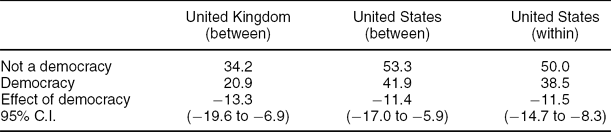
Table 1 summarizes the overall effect of democracy on support for military strikes. We generated between-subject estimates for the United Kingdom and the United States by comparing the average responses among people who read about a democracy to those who read about an autocracy. We also generated within-subject estimates for the United States, where people completed two questionnaires, by noting how each person's preferences changed when we switched the adversary from democracy to autocracy and vice versa.Footnote 10
The Effect of Democracy on Willingness to Strike

Note: The table gives the percentage of respondents who supported military strikes when the target was a democracy and when it was not. The difference is the estimated effect of democracy. In the United Kingdom, we obtained between-subject estimates by comparing 364 cases in which the target was a democracy, versus 398 cases in which it was not a democracy. In the United States, we obtained between-subject estimates by comparing 639 cases in which the target was a democracy, versus 634 in which it was not. The United States within-subject estimates were based on 972 respondents, each of whom assessed two scenarios, one in which the target was a democracy and another in which the target was not a democracy. 95% confidence intervals appear in parentheses.
As Table 1 shows, citizens in both countries were much less willing to attack another democracy than to attack an otherwise equivalent autocracy. Approximately 34.2% of respondents in the U.K. supported a military strike when the country was not a democracy versus 20.9% when the country was a democracy. Thus, democracy reduced support for a military strike by more than 13 percentage points, with a 95% confidence interval of −19.6 to −6.9. The baseline level of militarism was much higher in the United States, where at least half the respondents wanted to strike an autocracy. Nonetheless, democracy exerted a similarly large effect in the United States: The between-subject and within-subject estimates concurred that democracy reduced enthusiasm for a military strike by about 11.5 percentage points. In both countries, democracy produced substantively large and statistically significant effects on preferences.
It bears emphasizing that, because of randomization, the political regime of the target in our experiment was independent of alliances, power, and trade. Thus, the effects in Table 1 were not spurious. Our experiments revealed the independent contribution of democracy, above and beyond the effects of alliances, power, and trade.
Democracy reduced support for strikes not only on average but also for each combination of alliances, power, and trade. However, one must tread carefully here, because subdividing the data in this way results in small cell sizes. In the United Kingdom, for example, we had 762 observations in total, implying fewer than 100 cases of democracy on average (and fewer than 100 cases of autocracy on average) for each combination of power and alliances. Nevertheless, the estimated effect of democracy always exceeded 8 percentage points, regardless of whether the target was militarily strong or weak and whether it had or had not signed an alliance with Britain.Footnote 11 In the United States, democracy always reduced support for military strikes by at least 6 percentage points, no matter the combination of alliances and trade.Footnote 12
In our experiment we did not name the country that was developing nuclear weapons, nor did we identify its location. We intentionally omitted this information in order to test general hypotheses about the effects of democracy, rather than claims about specific leaders, nations, or regions. Nonetheless, one might wonder whether participants reacted strongly because they assumed the autocracy in our study was either Iran or North Korea. In January 2002, President George W. Bush claimed that both countries were sponsoring terrorism and pursuing weapons of mass destruction, and he dubbed them—along with Iraq—as the “axis of evil.” If respondents thought we were asking about Iran or North Korea when we described a nondemocratic proliferator, they might have been especially inclined to strike.
This possibility seems unlikely for three reasons. First, we told respondents that our scenario was “not about a specific country in the news today.” Second, most respondents received additional information that distinguished the target from Iran or North Korea. In the U.S. study, for example, three-quarters of participants read that the country had a military alliance and/or high trade with the United States. The effect of democracy was at least as large given those scenarios as when the target was, like Iran or North Korea, neither an ally nor a major trading partner.
Third, the effect of democracy did not weaken when, in a follow-up experiment, we located the country that was pursuing nuclear weapons on a different continent from Iran or North Korea. For this follow-up study, we recruited 2,393 U.S. adults via an online service called Amazon Mechanical Turk (MTurk) and interviewed them between October 2010 and November 2011. MTurk subscribers are younger, more likely to be female, and more liberal than the national population. Nevertheless, Berinsky, Huber, and Lenz (Reference Berinsky, Huber and Lenz2012) show that experiments on MTurk produce roughly the same treatment effects as experiments on nationally representative samples.
Some participants in our MTurk experiment received no information about the country's location; others were told that the country was in Africa. When we did not specify the location of the target, democracy reduced support for a military strike by 11.7 percentage points, essentially the same as the 11.5-point effect in our nationally representative sample. When we told respondents that the country was in Africa, the effect of democracy was 15 percentage points, somewhat larger than the effect for a generic country but not statistically different at conventional confidence levels. Thus, using MTurk, we replicated the core findings in Table 1 and confirmed that our conclusions did not change when we specified a location for the target that excluded countries such as Iran or North Korea.Footnote 13
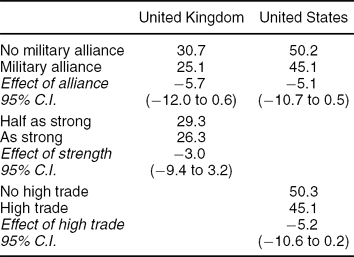
In addition to showing the importance of democracy, our experiments revealed the effects of alliances, power, and trade (Table 2). As expected, respondents were less willing to strike allies than non-allies, but the existence of an alliance reduced support for military action by only 5.7% in Britain and 5.1% in the United States, effects that were not distinguishable from zero with 95% confidence.
The Effect of Alliances, Power, and Trade
Note: The table gives the estimated effects (with 95% confidence intervals) of alliances, power, and trade on support for a military strike. In the United Kingdom, the sample sizes were 371 for no alliance, 391 for alliance, 382 for half as strong as British conventional forces, and 380 for as strong as British conventional forces. In the United States the sample sizes were 634 for no alliance, 639 for alliance, 612 for no high trade, and 661 for high trade.
There was also relatively scant evidence that the respondents took the conventional military power of the adversary into account. In the United Kingdom, where we varied military power, 29% of the public wanted to strike a country half as strong as Britain, whereas 26% stood ready to attack when the target was at conventional parity with Britain. The effect, therefore, was 3 percentage points. In summary, enthusiasm for attacking was lower against strong adversaries than against weak ones, but the difference was small and not statistically significant.
Finally, our experiments provided micro-level evidence about the commercial peace. In the United States, where our vignette included information about trade, 45% of the public endorsed preventive strikes against major trading partners. In contrast, 50% approved of attacking targets that did not trade extensively with the United States. The swing in public opinion was, therefore, 5 percentage points—less than half the effect of democracy—and not statistically significant at the .05 level. In short, our studies provided experimental evidence for the democratic peace, while also estimating the influence of alliances, power, and trade on attitudes toward military intervention.
EVIDENCE ABOUT CAUSAL MECHANISMS
We designed the U.S. survey to shed light not only on the effect of democracy but also on the mechanisms through which it operates. Earlier, we identified four pathways through which the target's regime type could affect the inclination to strike: by changing perceptions of threat, costs, success, and/or morality. We refer to these perceptions as mediators, because they could mediate the relationship between the treatment variable (democracy) and the final outcome (support for a military strike).
To facilitate the analysis of causal mechanisms, we ran a panel study in which people were interviewed twice. For every individual who completed both waves of the panel, we observed the final outcome and the mediators not only when the adversary was a democracy but also when it was an autocracy. Had we run a purely cross-sectional study, with each individual randomly assigned to either a democracy or an autocracy, half the measures of outcomes and mediators would have been missing. By eliminating problems of missing data and allowing within-subject comparisons, our unique panel design made it easier to uncover causal mechanisms.
Our investigation proceeded in three steps. First, we estimated the effect of democracy on each of the mediators. This step required no elaborate statistical modeling. We simply computed how each person's perceptions of threat, costs, success, and morality changed when we switched the adversary from democracy to autocracy. Second, we estimated the effect of each mediator on support for a military strike. This step was more intricate because we observed the mediators instead of randomizing them. We used probit regressions to estimate the contribution of each mediator, controlling not only for other mediators but also for variables that could confound the estimated relationship between the mediators and the outcome. Finally, we combined the findings from these two steps to infer how much of the total effect of democracy (given in Table 1) was transmitted via each of the mediators.
The Effect of Democracy on Each of the Mediators
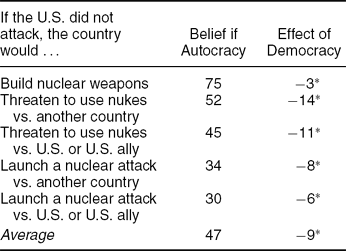
We begin by discussing how democracy affected each of the four mediators. Table 3 summarizes the impact of democracy on the first mediator, perceptions of threat. We asked what would happen if the United States did not strike. The first column shows what participants expected when the scenario involved an autocracy; the second column tells how expectations changed given an identical scenario involving a democracy. An asterisk indicates that the effect was statistically significant at the .05 level.
The Effect of Democracy on Perceptions of Threat
Note: The first column gives the percentage of respondents who thought the event had more than a 50% chance of happening when the country was an autocracy. The second column shows how much that percentage changed when the same respondents considered an identical scenario involving a democracy. Each row is based on 972 respondents. Asterisks denote effects that were significant at the .05 level.
The first row, labeled “build nuclear weapons,” shows that democracy did not substantially affect beliefs about whether the country would finish building nuclear weapons. Three-quarters of the mass public predicted that the autocracy would build a bomb, but the percentage who expected the democracy to go nuclear was only 3 points lower. This effect was statistically significant but substantively small. Hence, in our experiment, democracy played only a minor role in allaying fears that the country would build nuclear weapons.
This weak result may have stemmed from the information we provided. Respondents read that the country had already refused all requests to cancel its nuclear program, perhaps encouraging respondents to conclude that both types of countries were equally likely to cross the nuclear threshold. Future surveys could introduce more uncertainty about the country's intentions and test whether, given those conditions, people think nuclearization is more likely under autocratic regimes than under democratic ones.
The next two lines in Table 3 summarize beliefs about nuclear threats. In the sample as a whole, 52% thought that the autocracy would not only build the bomb but would also threaten to use it against another country. When those same respondents considered an equivalent democracy, anticipation of nuclear threats was 14 points lower. Similarly, 45% predicted that an autocracy would issue nuclear threats against the United States or its allies; those fears dropped by 11 percentage points when the country was a democracy.
Moving further down the table, we see that democracy also reduced fears of an actual nuclear attack. Around one-third of respondents thought the autocracy would not only obtain nuclear weapons but would also launch them against a foreign target. Substantially fewer thought that the democracy would use its nuclear arsenal. Here, the effect of democracy was 6–8 percentage points. The bottom row of Table 3 gives the mean of the five items. On average, democracy reduced perceptions of threat by 9 points. In summary, democracy mattered not by lowering the expected probability of building nuclear weapons, but by changing perceptions about how the country would use them.
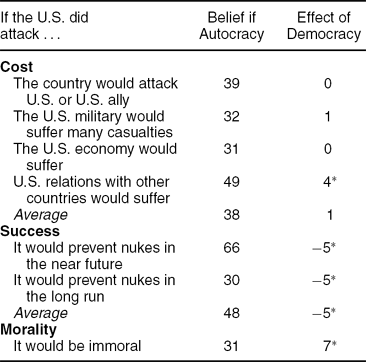
Although democracy reduced perceptions of threat, it had surprisingly little effect on the second causal pathway: expectations about the costs of fighting (Table 4). We asked what would happen if the United States struck the country's nuclear facilities. Thirty-nine percent of the public thought that the autocracy would retaliate against the United States or a U.S. ally, but they did not think a democratic target would behave much differently. Similarly, around a third of respondents said that the U.S. military would suffer many casualties and that the U.S. economy would decline as a result of the strike. These perceptions did not depend on whether the target was a democracy or an autocracy.
The Effect of Democracy on Perceptions of Cost, Success, and Morality
Note: For our measures of cost and success, the first column gives the percentage of respondents who thought the event had more than a 50% chance of happening when the country was an autocracy. The second column shows how much that percentage changed when the same respondents considered an identical scenario involving a democracy. Each row is based on 972 respondents. Asterisks denote effects that were significant at the .05 level.
Democracy did affect forecasts about the cordiality of U.S. relations with other countries, however. Roughly half of the respondents thought that striking an autocracy would hurt U.S. relations with other nations. That prediction was 4 percentage points more common in scenarios involving democratic targets. In general, however, the effect of democracy on the predicted cost of fighting was weak: only 1 point on average. These findings suggest that U.S. citizens do not oppose attacking democracies because they expect democracies to fight more effectively.
Next, we studied how democracy affected a third mediator: beliefs about the probability of success of military action (bottom half of Table 4). Given an autocracy, around two-thirds of respondents thought a U.S. strike would prevent nuclear proliferation in the near future, and roughly a third thought the strike would stop proliferation over the long run. Respondents were somewhat less sanguine about striking democracies: Expectations of success were around 5 points lower against democratic targets than against autocratic ones.
Finally, democracy had a pronounced effect on the fourth mediator: the moral intuitions of respondents. About a third deemed it immoral to strike an autocracy, but when respondents read about a democracy, the moral reluctance to strike grew by 7 points. Thus, our survey provides micro-level evidence that democracy affects the moral calculation for war. Other factors equal, people have more moral reservations about attacking a democracy than about attacking an autocracy.
In summary, democracy affected some but not all of the hypothesized mediators. Democracy substantially reduced perceptions of threat, but had almost no effect on the expected cost of launching a preventive military strike. Respondents were a bit less optimistic about their chances of success against a democracy, and they were more likely to regard attacking as immoral when the adversary was a democracy than when it was an autocracy.
The Effect of the Mediators on Support for a Military Strike
Next, we estimated the effect of each mediator on support for military strikes. Having observed the mediators instead of randomizing them, we needed a statistical model with control variables. Given the binary nature of our dependent variable—1 if the respondent supported a strike and 0 otherwise—we used probit regression.
The key independent variables for these analyses were the four mediators: threat, cost, success, and immorality. To summarize perceptions of threat, we counted the number of adverse events (listed in Table 3) that respondents marked as probable if the United States did not strike the country's nuclear facilities. Threat ranged from 0 to 5, with a mean of 2.1. Similarly, we summarized perceptions of cost by counting the number of negative consequences—military retaliation, high casualties, economic damage, and deteriorating relations—that the respondent anticipated if the United States carried out the operation. Cost ranged from 0 to 4, with a mean of 1.5. To gauge perceptions of success, we asked whether respondents thought the mission would stop the country from building nuclear weapons. Success was 2 if respondents thought the mission would succeed both in the short and in the long run, 1 if it would prove efficacious only in the short run, and 0 if it had less than a 50–50 chance of working even in the near term: The mean was 0.9. Finally, Immorality was coded 1 if respondents thought it would be morally wrong to strike (35%) and 0 otherwise.
We then added dummy variables for each of the randomized treatments: Democracy, Ally, and Trade. Finally, we included demographic and attitudinal control variables that, if omitted, could confound the relationship between the mediators and support for the use of force. For example, we controlled for whether the respondent was Male (50%) and White (78%). We also controlled for the respondent's Age in years (mean of 53) and level of Education. Finally, to control for baseline attitudes toward the use of military force, we included indices of Militarism, Internationalism, Religiosity, Ethnocentrism, and identification with the Republican Party. Each of these indices had a mean of 0 and a standard deviation of about 0.8; details on the construction of these variables are available in the Online Appendix.
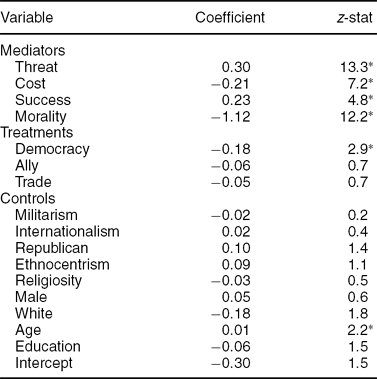
Table 5 confirms that, when deciding whether to use military force, people weighed the threat the adversary posed, the expected cost of taking military action, the perceived likelihood of success, and the morality of employing violence. Threat, Cost, Success, and Immorality all worked in the hypothesized directions and were statistically significant at the .05 level.
The Effect of Mediators on Support for a Military Strike
Note: The table gives the estimated coefficients and z-statistics from a probit regression. The dependent variable is coded 1 if the respondent supported a military strike and 0 otherwise. Each of the 972 respondents appears in the sample twice, once when treated with democracy and once when treated with autocracy. Z-statistics are computed from standard errors that were clustered by respondent. An asterisk indicates that the estimated coefficient is statistically significant at the .05 level.
To judge the importance of these four variables, we simulated how support for a strike would change if we shifted each mediator from its minimum to its maximum, while holding the other variables at their means. The effects were massive. If perceptions of threat rose from low to high, support for military action would increase by 54 points. Similarly, a groundswell of optimism about the chances of success would boost support by 18 points. Conversely, if the expected cost changed from low to high, the popularity of military action would decline by 30 points. Finally, if people came to view the operation as immoral, enthusiasm would drop by 39 points.
Overall Estimates of Causal Mechanisms
We have now estimated the effect of democracy on each mediator and the effect of each mediator on support for military strikes. By joining these parts of the causal chain, we can see how perceptions of threat, cost, success, and morality mediate the relationship between democracy and strikes (Imai et al. Reference Imai, Keele, Tingley and Yamamoto2011; Imai, Keele, and Yamamoto Reference Imai, Keele and Yamamoto2010) and thereby assess the mechanisms linking democracy and public support for war.
Recall that every individual received two scenarios, one in which the target was a democracy and another in which the target was an autocracy. The role of any particular mediator can be quantified by measuring a person's willingness to strike when the mediator takes on its democracy value, and subtracting that same person's willingness to strike when the mediator takes on its autocracy value, with all other factors held constant.
More precisely, for each individual i who completed both waves of the survey, let Ti be a treatment indicator that takes a value of 1 when i was asked about a democracy, and 0 when i was asked about an identical scenario involving an autocracy. Use Yi(t) to denote i's support for a military strike under treatment condition Ti=t. Because each panelist considered both a democracy and an autocracy, we observed both Yi(1) and Yi(0) for every i.
Our analysis focused on four mediators, which we index as k={1, 2, 3, 4}. For each person in our panel, let Mki(1) represent the value of mediator k when the target is a democracy, and let Mki(0) represent the value of that same mediator when the country is an autocracy. Because of the special design of our survey, we observed both Mki(1) and Mki(0) for every i and every k.
For any given individual, the effect of democracy transmitted via mediator k is
 \begin{eqnarray}
\nu _i^k = Y_i \left( {1,M_i^k \left( 1 \right),M_i^{ - k} \left( 1 \right)} \right) - Y_i \left( {1,M_i^k \left( 0 \right),M_i^{ - k} \left( 1 \right)}\right)\!.\nonumber\\
\end{eqnarray}
The first term on the right-hand side is i's support for a military strike when the target is a democracy, mediator k takes on its democracy value, and all the other mediators (−k, meaning “not k”) take on their democracy values. The second term is identical, except that mediator k takes on its autocracy value.
νki is the difference between an observable quantity and a counterfactual one. The minuend, Yi(1, Mki(1), M −ki(1)), simplifies to Yi(1), which we measured for every person in our panel. The subtrahend, Yi(1, Mki(0), M −ki(1)), in contrast, is hypothetical. It represents the preference i would have expressed if he or she were considering a democracy but perceived mediator k as if the country had been an autocracy. Because the subtrahend is a counterfactual, νki is not directly observable.
Fortunately, one can estimate νki and the sample-wide average, 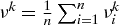 $\nu ^k = \frac{1}{n}\mathop \sum_{i = 1}^n \nu _i^k $, by applying the following algorithm:
1. Using all 2n cases (because each of the n respondents received both the democracy and the autocracy treatment), estimate a probit model of support for a military strike. In this model, Yi~Bernoulli(πi) and πi=Φ(αTi+βMi+γXi), where Φ is the cumulative normal distribution, Ti is the treatment indicator with coefficient α, Mi is a vector of mediators with coefficients β, and Xi is a vector of control variables with coefficients γ. Xi includes not only demographic and attitudinal variables but also indicator variables for ally and trade. We estimated this model in Table 5.
2. For each i,
a. Use the parameter estimates from the probit model to predict the probability of supporting a military strike, given Ti=1; Mi=Mki(0), M −ki(1); and Xi, where Mki(0) is the observed value of mediator k when i read about an autocracy, and M −ki(1) are the observed values of the other mediators when i read about a democracy. Denote this prediction as
 $\hat \pi _i $.
b. Draw
$\skew5\tilde Y_i\sim Bernoulli(\hat \pi _i )$.c. Compute
$\tilde \nu _i^k = Y_i \left( 1 \right) - \skew5\tilde Y_i $.
3. Compute the sample-wide average,
$\tilde \nu ^k = \frac{1}{n}\mathop \sum_{i = 1}^n \tilde \nu _i^k $.



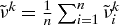
This algorithm produces one sample-wide estimate for each of the four mediators. One can approximate the sampling distributions of the  $\tilde \nu ^k $'s by repeating the algorithm many times, with each iteration based on a different bootstrap resample of the original data.Footnote 14
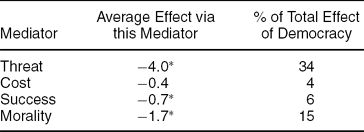
Using this algorithm, we estimated how much of the total effect of democracy (from Table 1) was transmitted via each of the four mediators. Recall that, in our panel study, democracy reduced support for a military strike by 11.5 percentage points. Table 6 shows that democracy exerted about 34% of this effect by changing perceptions of threat and an additional 15% by altering perceptions of morality. The mediatory roles of cost and success were much weaker; cost in particular was not statistically significant.
Estimates of Causal Mechanisms
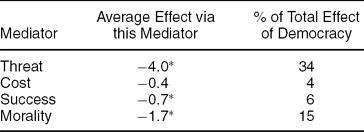
Note: The table decomposes the total effect of democracy into various pathways or mechanisms. It shows the percentage of the total effect that was transmitted by threat, cost, success, and immorality. Estimates are based on data from 972 respondents. Asterisks indicate effects that are statistically significant at the .05 level.
We found little evidence that democracy promotes peace by changing perceptions of cost and success. This does not mean that citizens disregarded the expected cost of fighting and the probability of success. On the contrary, Table 5 showed that respondents were much less enthusiastic about military action when they thought strikes would be costly or unsuccessful. Rather, the reason that cost and success did not mediate the effect of democracy is because democracy had relatively small effects on perceptions of costs and success (Table 4).
Morality proved to be a far more important mediator. But did people regard preventive strikes as morally wrong because they thought the target posed little threat, the attack would involve significant costs, and/or military action would fail? To answer this question, we carried out a more complicated analysis in which we modeled morality not only as an independent force but also as a potential consequence of the other mediators. Having estimated this more complicated model, we credited morality as a mediator only to the extent that democracy changed perceptions of morality directly. Where democracy influenced morality indirectly—by altering other mediators that, in turn, affected morality—we allocated credit to the other mediators and not to morality itself.Footnote 15 Even with this conservative method of scoring, morality mediated more than 10% of the total effect of democracy on support for war.
IMPLICATIONS FOR THE DEMOCRATIC PEACE
Using survey experiments, we found clear micro-level evidence of a democratic peace. Individuals in the United States and United Kingdom were substantially less willing to attack democracies than to attack otherwise equivalent autocracies. Moreover, the target's regime type mattered mainly by altering perceptions of threat and morality, rather than by raising expectations of costs or failure. Thus, our data showed a strong causal relationship between democracy and peace in public opinion, while also illuminating several mechanisms that drive this relationship. We now consider several questions about the interpretation of our findings.
Generalizability
First, critics might wonder whether our experiments exaggerated the importance of democracy by making the regime of the adversary salient. We believe that this concern is misplaced. In actual crises, politicians and the media make information about democracy significant to voters. Before the U.S. invasion of Iraq in 2003, for example, Saddam Hussein was constantly portrayed as the dictator—not the elected leader—of Iraq. Policy makers and newscasters often use evocative language (“tyrant,” “dictator”) to describe regime type, whereas our experiments deliberately used neutral terms (“not a democracy”). Moreover, we explicitly invited respondents to disregard any facts they regarded as unimportant. Indeed, respondents did not seize on every piece of information we supplied; the conventional military power of the adversary, for example, did not significantly influence attitudes toward war. We suspect that the effect of democracy on opinion may be stronger, rather than weaker, in real-life crises, where the stakes are higher and individuals are repeatedly exposed to information about regime type.Footnote 16
A second question is whether, in actual crises, leaders could shape public opinion by spreading false information about the regime type of the potential adversary. Proponents of war might try to mischaracterize a democratic target as an autocratic state, whereas opponents of war might speak about an autocracy as if it were a democracy. If leaders could easily manipulate beliefs about regimes in foreign countries, this would weaken the link between a country's true regime type and public support for a strike. However, free speech and freedom of the press limit the extent to which policy makers can make fallacious claims about political systems in other nations. Although elites may be able to influence public perceptions of regime type, especially when foreign regimes fall into a “gray area” between democracy and autocracy, they probably cannot dupe the public into thinking that highly democratic leaders are tyrants and vice versa.
Third, skeptics might wonder whether people responded differently to our hypothetical scenarios than they would have responded to specific countries. We consciously avoided naming countries because we wanted to learn about the general effects of democracy, rather than specific countries or leaders. We also worried that, by asking respondents to compare a named autocracy with a named democracy, we would lose experimental control, because countries differ on many dimensions other than regime type. Nevertheless, to make our vignette more concrete, recall that we ran a follow-up experiment that located the target in Africa; it confirmed that the effect of democracy remained the same. This discovery corroborates previous research, which found little difference in public reactions to hypothetical versus real scenarios and to generic versus actual countries (Berinsky Reference Berinsky2009, 124; Herrmann, Tetlock, and Visser Reference Herrmann, Tetlock and Visser1999; Horowitz and Levendusky Reference Horowitz and Levendusky2011, 531–32).
Fourth, can we extrapolate from surveys in the United States and Britain to draw more general conclusions about the democratic peace? It bears noting that the effects of democracy were similar among U.K. and U.S. respondents, despite large differences in the militarism of the British and American electorates. This suggests that our findings generalize to countries with varying attitudes about military action. Moreover, as two of the most influential democracies in the world, the United Kingdom and United States are important in and of themselves. Their willingness to use force against autocracies and their comparative reticence to use force against democracies have profound effects on international relations in general. Nevertheless, it would be useful to replicate our experiments in a wider range of countries and regions to see how our findings extend to other cultural, political, economic, and security contexts.
Fifth, contemporary surveys do not tell us whether citizens held similar views in earlier time periods. Have citizens of democracies always had pacific beliefs about other democracies, or did those views develop over time? Modern-day surveys cannot answer this question, but future research could trace when and how pacific beliefs about fellow democracies emerged (Kahl Reference Kahl1998; Owen Reference Owen1997; Williams Reference Williams2001). Indeed, such research might shed light on why the democratic peace is stronger now than it was in the nineteenth and early twentieth centuries (Gowa Reference Gowa1999; McDonald Reference McDonald2009). At a minimum, our experiments show that the democratic peace is alive and well in two of the most important democratic military powers in the world, and they shed light on the mechanisms through which democracy contributes to a preference for peace in the contemporary era.
Finally, it is worth considering whether our choice of a scenario involving nuclear proliferation affected our conclusions about how and why democracy affects the willingness to strike. One possibility is that regime type matters when the stakes are low, but not when the stakes are high, because in high-threat situations one must always assume the worst about the intentions of other countries (Mearsheimer Reference Mearsheimer2003). From that perspective, we chose a hard test of democratic peace theory. If democracy matters even in a situation of existential threat, it might matter even more when the stakes are lower. An alternative view is that, by choosing a high-stakes issue, we created more room for democracy to decrease perceptions of threat, and hence willingness to strike. If we had instead chosen an issue in which the baseline threat was minimal, there would have been little opportunity for democracy to further reduce threat, and the role of other mediators might have been more prominent. Future research could investigate these questions by applying our experimental template to other types of issues.
Political Consequences
A different set of questions involves the political significance of the effects uncovered in our experiments. First, were the effects we observed large enough to be politically consequential? We believe so. In our experiments, democracy reduced willingness to strike by about 11–13 percentage points. Shifts of that magnitude would change the nature of political debate. They could also make the difference between a majority and a minority. In the United States, for example, a majority of the mass public favored a preventive strike when the target was an autocracy, but only a minority wanted to strike the democracy. This is important because democracies typically do not go to war in the face of public opposition (Reiter and Stam 2002).
Importantly, the swing was even larger among the most politically engaged segments of the population. We examined the opinions of politically attentive U.S. citizens, who follow government and public affairs most of the time (63% of the sample). Within this politically attentive group, democracy reduced enthusiasm for war by 14.5 percentage points versus 5.0 points among citizens who were less politically aware. A similar pattern emerged in the United Kingdom. There, people somewhat or very interested in politics (71% of the sample) were 17.4 points less willing to strike a democratic opponent than an autocratic one. By contrast, the democracy effect was 3.4 points among respondents who were “not much” or “not at all” interested in politics.Footnote 17 Thus, the regime type of the adversary exerted a large effect on the people most likely to follow politics.
Regime type also mattered greatly for voters. In the United States, the pacifying effect of democracy was 12.1 points among respondents who said they voted in the 2008 election (85% of the sample), versus 5.7 points among respondents who did not. In the United Kingdom, respondents were asked whether they intended to vote in the future. Among people who said they were very likely to vote if a general election were held tomorrow (80% of the sample), democracy depressed support for war by 15.3 points, versus 6.7 points among people less likely to vote.Footnote 18
Moreover, democracy had a large effect on citizens who went beyond voting to participate more actively in politics. Building on the work of Verba, Schlozman, Brady, and Nie (Reference Verba, Schlozman, Brady and Nie1993), we classified someone in the United States as a political activist if, in the past year, he or she had worked for a political campaign, donated money to a campaign, put up a political sign such as a lawn sign or a bumper sticker, or attended local political meetings. The effect of democracy on these activists (46% of the sample) averaged 16.5 points, compared with 11.5 points among those who were not as active.Footnote 19
The British survey contained different measures of political activism, but our overall conclusion was similar. We coded British respondents as highly active if, in the previous day, they had worn a badge or sticker for a candidate, discussed a candidate with someone else, gone to hear a candidate speak, visited the website of a candidate or political party, or watched a video of a candidate on the internet (24% of the sample). Members of this highly energized subgroup were 26.7 points more reluctant to attack a democracy than to attack an autocracy. The effect among more typical citizens was 8.9 percentage points.Footnote 20 Thus, in both the United States and the United Kingdom, the regime type of the adversary not only affected public opinion in the aggregate but also had a particularly profound effect on the most politically active segments of the population.
A second issue is how to interpret the finding that a sizable number of our American respondents—around 42%—indicated that they would support an attack on a fellow democracy in order to stop it from acquiring nuclear weapons. This evidence might be interpreted as disconfirming the democratic peace, by showing that a large percentage of U.S. citizens are willing to attack a democracy. We think this would be a mistaken interpretation for two main reasons. First, our experiments presented respondents with a highly threatening scenario: a country that refused to stop its nuclear program. Our analysis confirms that high levels of threat increase support for military strikes (Table 5); support for war would be much lower in a less threatening scenario. Second, critics of the democratic peace rightly point out that democracy coincides with other pacifying factors, such as alliances, trade, and power. The combination of those forces can lead to major swings in preferences. In the United States, around 55% of respondents wanted to strike an autocracy that was neither an ally nor a major trading partner. In contrast, only 30% were willing to attack a democracy that was also an ally and a trading partner. Thus, if the United States typically entered alliances with other democracies and traded extensively with them, while forgoing alliances and trade with autocracies, respondents would be 25 points less willing to attack democracies than to attack autocracies.Footnote 21 In the United Kingdom, around 43% of respondents supported attacking a militarily weak, autocratic non-ally, whereas less than 17% supported attacking a militarily powerful democratic ally, a swing of 26 points. These are consequential differences indeed.
CONCLUSION
The fact that democracies almost never fight each other is one of the most striking findings in political science. Yet scholars continue to debate whether the relationship between democracy and peace is causal and what mechanisms explain it. This article uses experiments, embedded in public opinion polls, to shed new light on the democratic peace.
Our research supports the hypothesis that peace among democracies could be due, at least in part, to public opinion. Countless studies have shown that democratic leaders are responsive to public opinion on matters of foreign policy; we demonstrate that the public discriminates between democratic and autocratic targets. Public opinion may therefore foster a special zone of peace among democracies.
Moreover, our experimental approach allows us to conclude with confidence that the effect of democracy is genuinely causal. Democracy affects preferences independent of confounders such as alliances, power, and trade. Although our experiments confirm the intuition of skeptics that at least part of the peace among democracies is due to shared interests, military power, and economic ties, we nonetheless find clear evidence that democracy has an independent effect on support for war.
Our experiments also reveal the mechanisms through which democracy dampens support for war. The finding that democracies view other democracies as less threatening, which in turn reduces support for using force, accords with major works on the democratic peace that emphasize threat perception (Risse-Kappen Reference Risse-Kappen1995; Russett Reference Russett1993). Understanding how and why democracies trust fellow democracies, but not autocracies, is an important avenue for future research (Kahl Reference Kahl1998; Williams Reference Williams2001). We also found that perceptions of cost do not explain the public aversion to fighting democracies, and that expectations about success explain only a small amount of the effect.
Finally, we found that morality plays an important role in the democratic peace. The regime type of the target affects moral calculations, which in turn change preferences about the use of force. Surprisingly few scholars have explored morality as a potential source of the democratic peace. This should be a major topic for future research.
There are numerous opportunities for follow-up studies. For example, the experiments in this article cannot distinguish between “normative” and “structural” theories, both of which predict that democracy reduces threat perception. Do democracies seem less threatening because people think democracies will externalize their domestic values of peaceful coexistence, because they believe democratic institutions will slow or prevent the march to war, or both? Researchers could address this question by randomizing information about the normative and structural attributes of regimes. One could also test whether the perceived credibility of threats and promises varies by regime type (Fearon Reference Fearon1994; Schultz Reference Schultz2001; Slantchev Reference Slantchev2005; Reference Slantchev2011), whether people think democracies would be more willing to make peaceful bargains (Debs and Goemans Reference Debs and Goemans2010), and whether democracy leads to perceptions of shared preferences (Oneal and Russett Reference Oneal and Russett1999).
Moreover, our study provides a template for research on issues other than nuclear proliferation. Historically, no issue has driven countries toward war more often than national boundaries (Ghosn, Palmer, and Bremer Reference Ghosn, Palmer and Bremer2004). Although shared democracy may prevent territorial disputes from escalating, some have claimed that the militarization of territorial disputes should not vary by regime type (Gibler Reference Gibler2007). Countries also spar over domestic policies such as respect for human rights and cracking down on terrorism. Democracy may contribute to peace in these instances, but because changing the domestic policies of another country involves interference in that country's internal affairs, democracy could matter mainly by affecting beliefs about the morality of intervention, rather than by reducing perceptions of threat. Researchers could design experiments to assess these predictions.
Future studies could also explore policy responses other than military force. Countries can deal with international disputes in a variety of ways, including diplomacy and mediation (Dixon Reference Dixon1994), appealing to international law and organizations (Russett and Oneal Reference Russett and Oneal2001), or applying economic sanctions. New surveys could ask respondents to evaluate a wide range of military and nonmilitary options, thereby revealing how democracy affects not only decisions about war but also the use of nonviolent foreign policy tools and the willingness to escalate from peaceful measures to violent ones.
Finally, our study focused on the public in the United Kingdom and the United States. Researchers could replicate our experiments in other countries to see how our findings generalize to other parts of the world. Additionally, researchers could interview government officials and other policy elites to assess how democracy affects the preferences and perceptions of the people who ultimately decide whether to go to war. Some scholars have found that elites and the public have similar beliefs about foreign policy issues,Footnote 22 whereas others have concluded that elites and masses respond differently to international cues, with elites demonstrating more complex strategic thinking.Footnote 23 Future studies could assess whether policy makers respond to democracy differently than the masses.
For decades, U.S. and foreign leaders have cited the democratic peace when analyzing foreign affairs and justifying efforts to spread democracy around the globe. This topic remains critical today, given the tremendous pressure for democracy around the world. By providing micro-level evidence about the democratic peace and its causes, this article has important implications for policy makers as well. For example, policy makers who want to cooperate with autocracies must recognize that citizens in democracies distrust dictators and have fewer moral reservations about using force against them. On the flip side, our findings suggest that democratization may have security benefits. When a democracy and an autocracy take identical actions, the democracy receives the benefit of the doubt from citizens in fellow democracies, whereas the autocracy is viewed with much greater suspicion. Advocates of democracy promotion could therefore cite our findings as evidence that joining the club of democracies confers significant benefits not only at home but also abroad.



Comments
No Comments have been published for this article.