

Introduction
Obtaining baseline data on the status of threatened species across their range is essential for identifying conservation-priority landscapes and developing evidence-based interventions. These data are typically obtained through direct field surveys, with standardised methods widely available for birds (e.g. Gilbert et al. Reference Gilbert, Gibbons and Evans2011). However, systematically collected field data remain unavailable for many species, especially in biodiverse tropical regions, for reasons including limited access to key habitats and restricted research capacity and funding (Wilson et al. Reference Wilson, Auerbach, Sam, Magini, Moss, Langhans, Budiharta, Terzano and Meijaard2016). Status assessments are thus often restricted to opportunistic data collected in an unstructured manner (Maes et al. Reference Maes, Isaac, Harrower, Collen, van Strien and Roy2015).
One alternative information source for poorly known species is the rich body of knowledge about biodiversity available from traditional (Indigenous and/or rural) communities (Newing Reference Newing2011, Berkes Reference Berkes2012), which are often closely reliant upon natural resources within interconnected ‘biocultural’ or social-ecological systems (Liu et al. Reference Liu, Hull, Yang, Viña, Chen, Ouyang and Zhang2016). This knowledge can be subdivided into two categories: local ecological knowledge (LEK), representing experiential knowledge from lived interactions with local environments; and traditional ecological knowledge (TEK), the cumulative body of knowledge, beliefs, values, and traditions passed down between generations (Berkes et al. Reference Berkes, Colding and Folke2000). LEK in particular is recognized as potentially valuable for conservation, as it can contain unique information on species presence/absence, abundance, trends, and human-wildlife interactions (Johannes et al. Reference Johannes, Freeman and Hamilton2000, Newing Reference Newing2011, Turvey et al. Reference Turvey, Trung, Quyet, Nhu, Thoai, Tuan, Hoa, Kacha, Sysomphone, Wallate, Hai, Thanh and Wilkinson2015). However, there is considerable potential for error and bias in LEK collection and interpretation (McKelvey et al. Reference McKelvey, Aubry and Schwartz2008), and it typically provides only indirect, relative indices across species and landscapes rather than absolute population estimates (Turvey et al. Reference Turvey, Trung, Quyet, Nhu, Thoai, Tuan, Hoa, Kacha, Sysomphone, Wallate, Hai, Thanh and Wilkinson2015). It is thus important to assess LEK’s potential usefulness for informing conservation of poorly-known species, and to validate it against other data sources (Anadón et al. Reference Anadón, Giménez, Ballestar and Pérez2009, Sáenz-Arroyo and Revollo-Fernández Reference Sáenz-Arroyo and Revollo-Fernández2016).
Hainan, China’s southernmost province, is a 33,920-km2 subtropical-tropical island with considerable endemic biodiversity. It supports a diverse galliform fauna, comprising three species present in mainland China and South-east Asia (Chinese Francolin Francolinus pintadeanus, Red Junglefowl Gallus gallus, Silver Pheasant Lophura nycthemera), and two endemics, the Hainan Partridge Arborophila ardens and Hainan Peacock-pheasant Polyplectron katsumatae; MacKinnon Reference MacKinnon2022). The Hainan Peacock-pheasant was formerly regarded as a subspecies of Grey Peacock-pheasant P. bicalcaratum, but genetic and morphological analyses support species-level differentiation (Chang et al. Reference Chang, Wang, Zhang, Liu, Liang, Wang, Shi, Su and Zhang2008). It has declined rapidly since the 1950s due to habitat loss and hunting (Gao and Yang Reference Gao, Yang, Lu, Liu and He1991, Gao Reference Gao1998, Liang and Zhang Reference Liang and Zhang2011), with an estimated decline from ~2,775 individuals in 1990 (Gao Reference Gao1998) to possibly as few as 300 individuals in 2000 (Chang et al. Reference Chang, Wang, Zhang, Liu, Liang, Wang, Shi, Su and Zhang2008, IUCN 2021). The surviving population consists of isolated subpopulations within discrete forest patches (IUCN 2021). It is listed as Endangered by IUCN (2021) and Critically Endangered on China’s national Red List (Jiang et al. Reference Jiang2016), and is a Category I Protected Species and national conservation priority in China (Guan et al. Reference Guan, Zhou and He2020).
Field investigations from the 1980s have recorded the species (through direct observations or unconfirmed reports) from primary and well-developed secondary forests at 100–1,300 m elevation, including protected and unprotected areas (Baimaling, Baishuiling, Baolong, Baomei, Bawangling, Datian, Diaoluoshan, Ganshiling, Houmiling, Huishan, Jianfengling, Jiaxi, Jiaxin, Kafaling, Limushan, Liulianling, Maorui, Nanweiling, Panjia, Renxing, Xinglong, Wuzhishan, Yinggeling; Gao Reference Gao1998, Chan et al. Reference Chan, Lee, Zhang and Su2005, Shing et al. Reference Shing, Lau, Fellowes and Chan2006, Liang and Zhang Reference Liang and Zhang2011, Wang et al. Reference Wang, Leader-Williams and Turvey2021). However, habitat loss (Wang et al. Reference Wang, Pechacek, Zhang, Xiao, Zhu and Li2013, Zhai et al. Reference Zhai, Cannon, Dai, Zhang and Xu2015) and illegal hunting of galliforms (Liang and Zhang Reference Liang and Zhang2011, Liang et al. Reference Liang, Cai and Yang2013, Xu et al. Reference Xu, Lin, He, Xin, Zhang, Jiang and Li2016) continue on Hainan, with recent hunting of Peacock-pheasants documented within several protected areas (Liang and Zhang Reference Liang and Zhang2011, Wang et al. Reference Wang, Leader-Williams and Turvey2021). Peacock-pheasant survival across its known range is therefore uncertain in the absence of new surveys.
Observations from fixed bait points suggest Peacock-pheasants occur at lower density than Hainan Partridges and Silver Pheasants at Bawangling (Gao Reference Gao1998). However, most research has only aimed to determine local occurrence, rather than abundance trends across different sites or against comparative species (Gao Reference Gao1998, Chan et al. Reference Chan, Lee, Zhang and Su2005, Shing et al. Reference Shing, Lau, Fellowes and Chan2006, Liang and Zhang Reference Liang and Zhang2011). Investigation of the information content of LEK is limited, with conflicting evidence on its potential usefulness for assessing Peacock-pheasant status. Surveys in 1987–1994 included interviews with an unreported number of respondents to investigate local Peacock-pheasant presence, providing records from four sites where birds were not detected by researchers (Gao Reference Gao1998). However, interviews in 2006 with 105 respondents in six communities near Bawangling and Yinggeling reserves determined that Peacock-pheasants had a lower average recognition score and lower perceived abundance compared to other locally occurring galliforms (Gao Reference Gao2006).
To expand the limited evidence-base on Peacock-pheasant status across Hainan, we conducted new interview surveys to collect novel LEK data about Peacock-pheasants and other galliforms. We then validated these data by conducting camera trapping in one of the same landscapes. Our study reveals the extent to which LEK can contribute conservation evidence to guide management of this threatened galliform by determining relative abundance patterns and identifying conservation-priority landscapes, and we assess its limitations and novel insights with wider implications for other avian conservation programmes.
Methods
LEK data collection
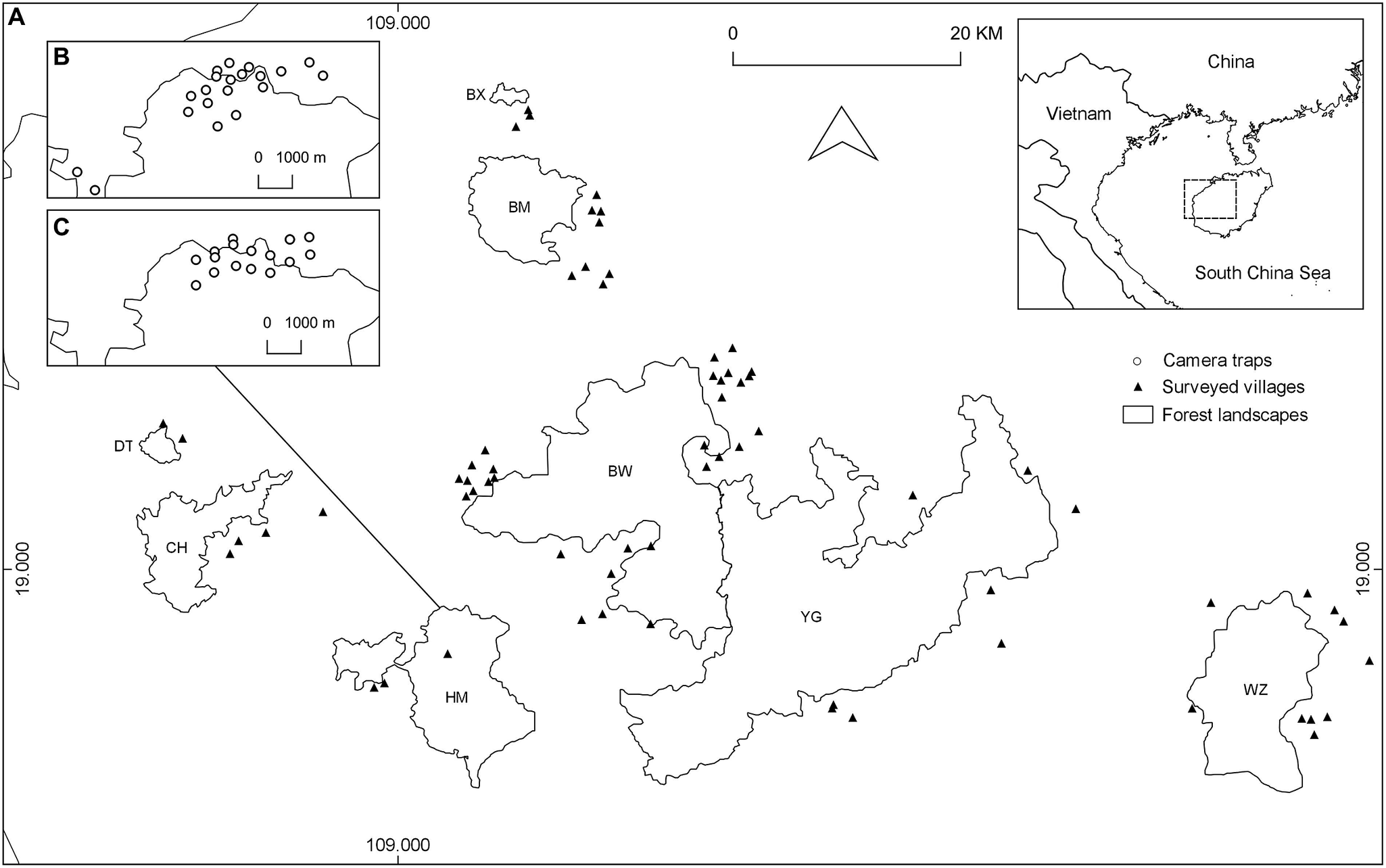
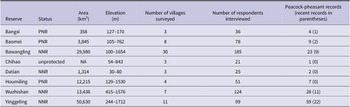
Three interview surveys were conducted in 2019–2020 within rural communities around eight landscapes in Hainan, including seven protected areas (four national nature reserves, three provincial nature reserves) and one unprotected area (Figure 1; Table 1). These landscapes cover an elevational range of 30–1,712 m, and all contain >70% forest cover (Wang et al. Reference Wang, Pechacek, Zhang, Xiao, Zhu and Li2013, Zhai et al. Reference Zhai, Cannon, Dai, Zhang and Xu2015, Yu et al. Reference Yu, Wu, Gong and Li2021). Numerous low-income villages with primarily agricultural-based economies are situated close to each forested area. Local communities are predominantly of Li ethnicity, with some villages comprised of people of Miao and Han ethnicity. These communities have long histories of using local forest resources for food, housing, and cultural and spiritual uses (Fauna & Flora International China Programme 2005, Davies and Wismer Reference Davies and Wismer2007); previous studies have demonstrated they possess abundant knowledge about regional biodiversity (Turvey et al. Reference Turvey, Bryant, Duncan, Wong, Guan, Fei, Ma, Hong, Nash, Chan, Yang and Fan2017, Wang et al. Reference Wang, Leader-Williams and Turvey2021). Each survey aimed to collect Indigenous knowledge on different conservation-relevant topics (with other results to be published elsewhere), but also included questions about Peacock-pheasants and other galliforms, allowing assessment of local species status and across-landscape comparisons.
A, Locations of eight Hainan survey landscapes, showing surveyed villages. BM, Baomei; BW, Bawangling; BX, Bangxi; CH, Chihao; DT, Datian; HM, Houmiling; WZ, Wuzhishan; YG, Yinggeling. B , Locations of opportunistically deployed cameras at Houmiling. C , Locations of systematically deployed cameras at Houmiling.

Details of eight Hainan survey landscapes. Data from Wang et al. (Reference Wang, Pechacek, Zhang, Xiao, Zhu and Li2013), Yan et al. (Reference Yan, Zeng, Pan, Wang, Zhang, Fu, Lin and Song2013) and USGS (2018). NNR, National Nature Reserve; PNR, Provincial Nature Reserve.

(1) Interviews were conducted by five interviewers between 27 February and 1 April 2019 around Bawangling National Nature Reserve, in all 30 villages situated within 3 km of the reserve boundary. The primary aim was to collect LEK on several local wildlife species (Ma et al. Reference Ma, Papworth, Ge, Wu, Yu, Zhang and Turvey2021; Appendix S1 in the online supplementary material).
(2) Interviews were conducted by 15 interviewers between 22 August and 5 October 2020 around Wuzhishan and Yinggeling National Nature Reserves. Villages within 4 km of each reserve boundary were selected at random. The primary aim was to collect LEK on awareness of threatened biodiversity and attitudes about conservation (Appendix S2).
(3) Interviews were conducted by 10 interviewers between 21 and 30 August 2020 around Datian National Nature Reserve, Bangxi, Baomei and Houmiling Provincial Nature Reserves, and Chihao (unprotected forest landscape). Villages within 4 km of each reserve/forest boundary were selected at random. The primary aim was to collect LEK on awareness and attitudes towards Eld’s Deer Panolia eldii (Appendix S3).
Each survey consisted of one-on-one interviews with local respondents, who were selected opportunistically through a combination of going door-to-door or walking through villages and asking anyone encountered whether they were happy to be interviewed. Participation was voluntary; respondents were informed about study aims, that interviews were anonymous, and that they could withdraw at any time or choose not to answer any question, and interviews were only then conducted following verbal consent. Only people aged 18 or above were interviewed, and only one person was interviewed per household; respondents were not selected or excluded on the basis of any other socio-demographic parameters. Interviews were conducted in Mandarin, Hainanese, or local dialects (question structure/meaning and species differentiation did not vary between languages). Data were stored in anonymized electronic format that conformed to UK General Data Protection Regulations. Study design was approved by the College of Forestry, Hainan University, and the Research Ethics Committee at Royal Holloway University of London (ID 535).
Different standardized questionnaires including closed and open questions were used for each survey, which took 25-40 minutes to complete (Appendices S1-S3). Information was first collected on respondents’ demographic characteristics (age, sex, ethnicity, highest education level, how long they had lived in their village). In addition to other questions relating to each survey’s main aims, respondents were then asked questions about their knowledge and experience of locally occurring galliforms, using photographs sourced from www.arkive.org or local conservation organisations. All respondents were shown diagnostic photographs of Hainan Peacock-pheasant and Silver Pheasant and were asked to identify them; if they could do so, they were asked whether they had seen either species within their nearby reserve, including details of their most recent sighting (date, location). Respondents at Bawangling were also asked about their perception of the local status of each species (many/henduo, not many/buduo, rare/henshao, none/meiyou). Respondents at Wuzhishan and Yinggeling were also asked about Hainan Partridge and Red Junglefowl (specified as ‘wild chicken’ to differentiate it from domestic fowl), and what they thought the rarest species was in their local reserve, whether they knew of any species that had disappeared from the reserve, and whether they knew of local hunting of galliforms. In this survey, a photograph of a Green Peafowl Pavo muticus was shown alongside the Peacock-pheasant, and photographs of Taiwan Partridge Arborophila crudigularis and Bar-backed Partridge A. brunneopectus were shown alongside the Hainan Partridge, to further test respondent identification; none of these additional species occur on Hainan. Respondents in the Eld’s Deer survey were also asked about Hainan Partridge and Chinese Francolin.
LEK data analysis
Statistical analyses were performed in R version 3.3.3 (R Core Team 2017). Chi-squared tests or Fisher’s exact tests (if count data were <5) were used to investigate differences in relative proportions of respondents who reported sightings of Peacock-pheasants versus other galliforms, and in perceived abundance of Peacock-pheasants and Silver Pheasants at Bawangling. Data were also analyzed using generalized linear models (GLMs) to investigate across-landscape differences in galliform sightings while incorporating local variation in respondent demographic characteristics. Data from all three surveys were combined to investigate which predictors were associated with whether respondents had seen Peacock-pheasants or Silver Pheasants or had seen either species recently. Additional GLMs were conducted to determine which predictors were associated with whether respondents in the Eld’s Deer survey had seen or recently seen Chinese Francolin, whether respondents at Wuzhishan and Yinggeling had seen or recently seen Red Junglefowl, and whether respondents from both surveys had seen or recently seen Hainan Partridge.
All response variables in GLMs were binary (yes/no), and models used binomial error distributions and logit link functions, or quasibinomial error distributions if the data showed overdispersion. Model predictors included reserve (categorical), age (continuous), sex (categorical), ethnicity (categorical), and education level (continuous: 1, none; 2, primary school; 3, middle school; 4, high school; 5, above). These predictor variables were selected a priori, as we were interested in investigating spatial variation in galliform sightings, and the other predictors are all known to influence knowledge and awareness of local biodiversity within rural communities across Hainan (Turvey et al. Reference Turvey, Bryant, Duncan, Wong, Guan, Fei, Ma, Hong, Nash, Chan, Yang and Fan2017, Ma et al. Reference Ma, Papworth, Ge, Wu, Yu, Zhang and Turvey2021, Wang et al. Reference Wang, Leader-Williams and Turvey2021); a full-model approach rather than a model-selection approach was therefore used (Zuur et al. Reference Zuur, Ieno and Elphick2010). Ethnicity was compared against Li, the most widely represented ethnic group in our dataset. Species sighting data were compared against the landscape with the highest level of sightings for the target species in each analysis.
Sightings were considered ‘recent’ if they dated from within the previous five years, or if they were reported ‘a few years ago’ or ‘all the time’; other less precise reports (e.g., ‘occasionally’, ‘sometimes’) were not considered to reflect recent sightings. Reports from respondents who said they had heard but never seen each species were discounted due to possibility of confusion with other species. Most respondents (76.1%) had lived in their village for >10 years; however, data from respondents who had only lived locally for a shorter period were retained for analysis, because several of these respondents reported recent sightings.
Camera trapping
Infrared cameras (Oriental Red Eagle E1B infrared detectors) were deployed within Houmiling Provincial Nature Reserve from May 2020 to May 2021, as part of a wildlife survey that collected data on local occurrence of galliforms and other species. Twenty cameras were initially deployed from 4 May to 4 October 2020, with batteries and SD cards replaced in July 2020 (3,060 camera trap nights [CTN]). Seventeen cameras were then deployed at different locations from 4 October 2020 to 31 May 2021 (4,063 CTN) (Figure 1). During the first deployment, cameras were positioned opportunistically at relatively open forest locations considered suitable for detecting Eld’s Deer (e.g. open trails, water sources), and spaced >150 m apart across a total area of ~8 km2. During the second deployment, they were repositioned systematically in a 0.5×0.5 km grid across the same area. Spacing of cameras in both deployments was equal or greater than the estimated male Hainan Peacock-pheasant home range (radius: 85.9–165.3 m; Liang and Zhang Reference Liang and Zhang2011). Cameras were installed at a height of 80–120 cm, angled toward the ground, and set on a shooting time interval of 0 seconds.
Images taken less than one hour apart on the same camera that showed the same species were interpreted as representing the same individual and coded as the same detection. Relative abundance indices (RAIs; frequency of detections per 100 CTN) were calculated for each species in each deployment. A chi-squared test was used to investigate differences in observed numbers of detections between species across the entire dataset, against the null hypothesis of no expected differences in detections between species (i.e. no a priori assumptions about whether any particular species might be more or less abundant). A Fisher’s exact test was used to investigate relative differences in numbers of detections for different species between opportunistic and systematic deployments.
Results
LEK dataset
In total, 619 respondents were interviewed, although not all respondents answered all questions (Table 1, Table S1). Mean age was 43 (range: 18–90), and 73.0% of respondents were men and 27.0% were women. Respondents of Li ethnicity comprised 77.0% of the sample, with 13.5% of Han ethnicity and 9.5% of Miao ethnicity. Most respondents had only received either middle school education (39.2%) or primary school education (28.1%), with 13.9% having no formal education.
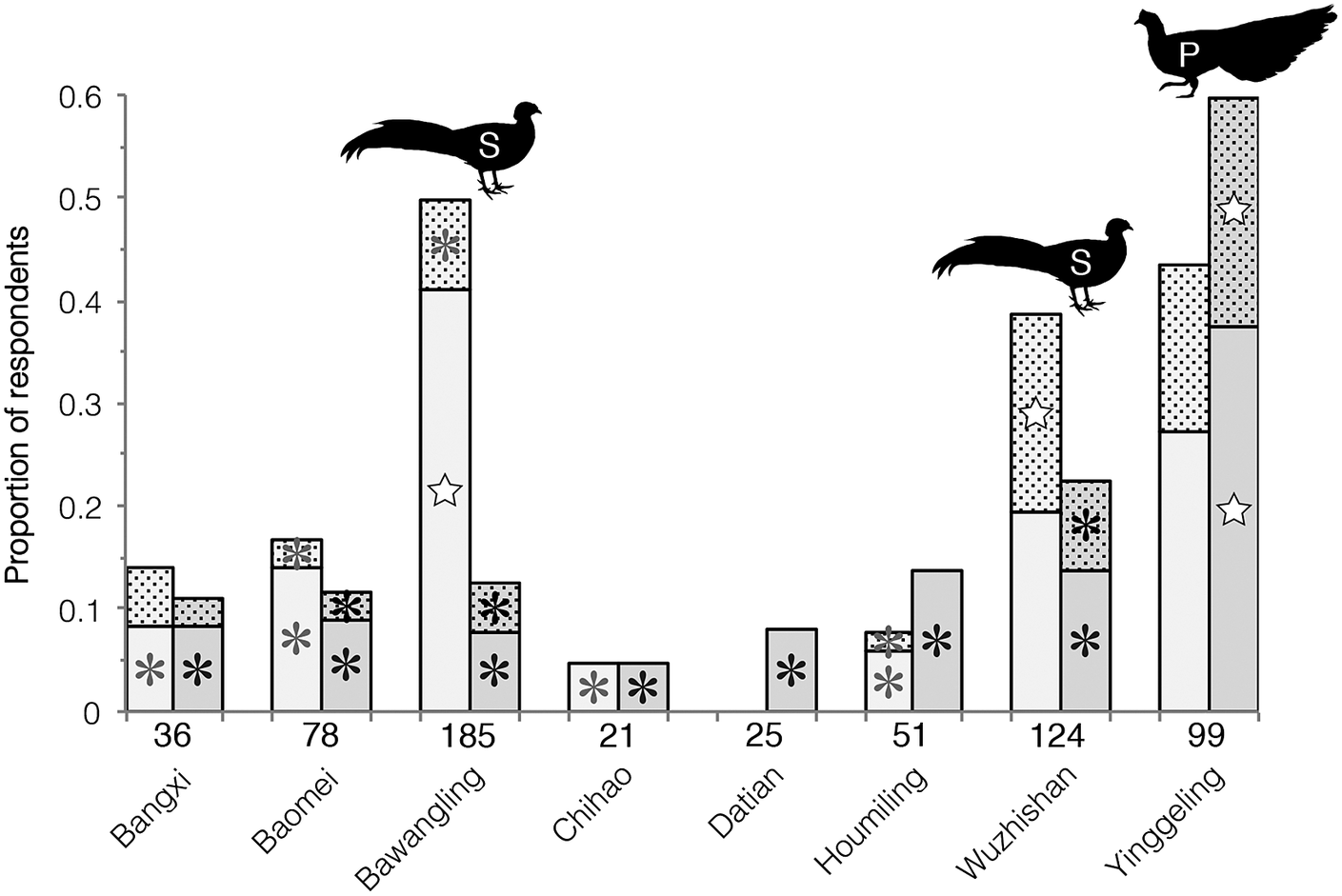
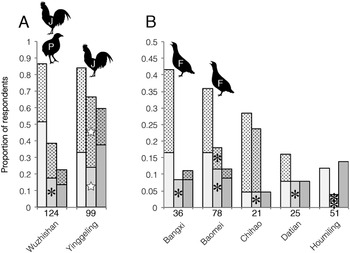
Across the overall dataset, 21.5% (n = 133/619, recent = 45) of respondents reported Peacock-pheasant sightings, with sightings documented across all landscapes, and 33.3% (n = 206/619, recent = 61) reported Silver Pheasant sightings, with sightings documented across all landscapes except Datian. Across the subsets of landscapes where data for other species were collected, 85.2% (n = 190/223 across two landscapes, recent = 76) of respondents reported Junglefowl sightings, 32.3% (n = 140/434 across six landscapes, recent = 60) reported Partridge sightings, and 28.0% (n = 59/211 across five landscapes, recent = 31) reported Francolin sightings (Figures 2–3, Table 1).
Proportions of respondents who had seen Silver Pheasants (pale grey, S) and Hainan Peacock-pheasants (dark grey, P) across survey landscapes. Stippled regions indicate recent sightings. Within-landscape comparisons: species seen by significantly higher proportions of respondents compared to Peacock-pheasant sightings indicated with labelled silhouettes. Across-landscape comparisons: landscapes with higher proportions of overall sightings and recent sightings for each species indicated with stars; landscapes with significantly lower sighting proportions in each category indicated with asterisks.

Proportions of respondents who had seen: A , Red Junglefowl (pale grey, J), Hainan Partridges (medium grey, P), and Hainan Peacock-pheasants (dark grey) at Wuzhishan and Yinggeling; B , Chinese Francolins (pale grey, F), Hainan Partridges (medium grey), and Hainan Peacock-pheasants (dark grey) in Eld’s Deer survey. Stippled regions indicate recent sightings. Within-landscape comparisons: species seen by significantly higher proportions of respondents compared to Peacock-pheasant sightings indicated with labelled silhouettes. Across-landscape comparisons: landscapes with higher proportions of overall sightings and recent sightings for Hainan Partridge (across seven landscapes) indicated with stars; landscapes with significantly lower sighting proportions in each category indicated with asterisks; Junglefowl or Francolin show no significant across-landscape sighting differences.

Overall, significantly fewer respondents reported Peacock-pheasant sightings compared to sightings of Silver Pheasant (χ2 = 21.058, df = 1, P < 0.0001), Red Junglefowl (χ2 = 278.78, df = 1, P < 0.0001) and Hainan Partridge (χ2 = 14.859, df = 1, P = 0.0001), and the proportion of Peacock-pheasant sightings that were recent was significantly lower than the proportion of Chinese Francolin sightings that were recent (χ2 = 5.224, df = 1, P = 0.022). For specific landscapes, significantly fewer respondents had seen Peacock-pheasants compared to Silver Pheasants at Bawangling (χ2 = 58.342, df = 1, P < 0.0001) and Wuzhishan (χ2 = 6.849, df = 1, P = 0.009), compared to Red Junglefowl at Wuzhishan (χ2 = 98.907, df = 1, P < 0.0001) and Yinggeling (χ2 = 13.172, df = 1, P = 0.0003), compared to Hainan Partridges at Wuzhishan (χ2 = 6.849, df = 1, P = 0.009), and compared to Chinese Francolins at Bangxi (Fisher’s test, P = 0.007) and Baomei (χ2 = 11.479, df = 1, P = 0.0007). Conversely, significantly more respondents had seen Peacock-pheasants compared to Silver Pheasants at Yinggeling (χ2 = 4.550, df = 1, P = 0.033) (Figures 2–3). Differences between landscapes in proportions of respondents reporting recent sightings were not investigated because of low sample sizes.
For across-landscape GLMs, respondents at Yinggeling were more likely to have seen Peacock-pheasants compared to respondents at all other landscapes (Bangxi: P = 0.0001; Baomei: P < 0.0001; Bawangling: P < 0.0001; Chihao: P = 0.002; Datian: P = 0.009; Houmiling: P = 0.0002; Wuzhishan: P < 0.0001); respondents were more likely to have seen them if they were older (P < 0.0001) and male (P = 0.0009); and Han respondents were less likely to have seen them (P = 0.043). Respondents at Bawangling were more likely to have seen Silver Pheasants compared to respondents at Bangxi (P = 0.009), Baomei (P < 0.0001), Chihao (P = 0.005) and Houmiling (P = 0.0001); respondents were more likely to have seen them if they were older (P = 0.001) and male (P < 0.0001); and Han respondents were less likely to have seen them (P = 0.006). Respondents at Yinggeling were more likely to have seen Hainan Partridges compared to respondents at all other landscapes for which data were collected on this species (Bangxi: P < 0.0001; Baomei: P < 0.0001; Chihao: P = 0.001; Datian: P = 0.002; Houmiling: P < 0.0001; Wuzhishan: P = 0.002); and respondents were more likely to have seen them if they were male (P < 0.0001) and less educated (P = 0.036). There were no between-landscape differences in Red Junglefowl sightings; respondents were more likely to have seen them if they were older (P = 0.020), and Han respondents were less likely to have seen them (P = 0.037). There were also no between-landscape differences in Chinese Francolin sightings, with respondents more likely to have seen them if they were older (P < 0.0001) and male (P = 0.012) (Figures 2–3; Table S2). Recent sightings also showed across-landscape differences: respondents at Yinggeling were more likely to have seen Peacock-pheasants recently compared to respondents at Baomei (P = 0.004), Bawangling (P < 0.0001) and Wuzhishan (P = 0.011), and to have seen Hainan Partridges recently compared to respondents at Baomei (P = 0.016) and Houmiling (P = 0.014); and respondents at Wuzhishan were more likely to have seen Silver Pheasants recently compared to respondents at Baomei (P = 0.009), Bawangling (P = 0.009) and Houmiling (P = 0.021) (Figures 2–3; full model outputs, including details of other significant predictors, are provided in Table S3).
Of the subset of respondents at Bawangling who provided opinions about local status of Peacock-pheasants and Silver Pheasants, there were no significant differences in the proportions of respondents who considered that there were “many” of both species (Peacock-pheasant, 9/21; Silver Pheasant, 16/56; χ2 = 0.845, df = 1, P = 0.358), that both were “rare” (Peacock-pheasant, 10/21; Silver Pheasant, 23/56; χ2 = 0.067, df = 1, P = 0.796), and that there were “none” of both species (Peacock-pheasant, 2/21; Silver Pheasant, 5/56; Fisher’s test, P = 1). However, significantly more respondents considered that there were “not many” Silver Pheasants (Peacock-pheasant, 0/21; Silver Pheasant, 12/56; Fisher’s test, P = 0.030), and significantly fewer provided an answer when asked about local status of Peacock-pheasants compared to Silver Pheasants (Peacock-pheasant, 21/185; Silver Pheasant, 56/185; χ2 = 18.958, df = 1, P < 0.0001).
For Wuzhishan and Yinggeling, 53.4% of respondents (119/223) named one or more animals that they regarded as the rarest wildlife in their local forest, and 22.0% (49/223) named one or more animals they thought had disappeared locally. Only 13 respondents listed any galliforms as the rarest wildlife (Peacock-pheasant, n = 8; Silver Pheasant, n = 6; Hainan Partridge, n = 3; Red Junglefowl, n = 2), and only three respondents listed any galliforms as species they thought had disappeared (Hainan Partridge, n = 2; Red Junglefowl, n = 1). For these landscapes, 9.4% of respondents (21/223) reported that galliforms were hunted, with five respondents specifically stating that it only happened in the past.
Camera trapping
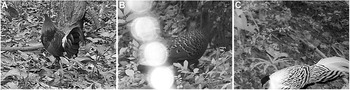
In total, 35 independent galliform detections were recorded at Houmiling, comprising 24 Red Junglefowl records (opportunistic: 19, RAI = 0.621; systematic: 5, RAI = 0.123), seven Peacock-pheasant records (opportunistic: 1, RAI = 0.033; systematic: 6, RAI = 0.148), and four Silver Pheasant records (all from systematic deployment; systematic RAI = 0.098) (Figure 4). Total observed counts across the three species differ significantly from the null hypothesis of no variation in across-species detections (χ2 = 9.183, df = 2, P = 0.010). The relative numbers of detections of each species recorded from opportunistic and systematic deployments also differ significantly (Fisher’s test, P = 0.0001).
Camera trap images from Houmiling Provincial Nature Reserve: A , Red Junglefowl; B , Hainan Peacock-pheasant; C , Silver Pheasant.

Discussion
Our study establishes a new baseline for Hainan’s poorly known galliform fauna based upon multiple data types, with conservation implications for these at-risk species. Interestingly, our findings provide conflicting suggestions about the status of Peacock-pheasants in Hainan’s remaining forests, highlighting differences in the information-content of alternative sources of conservation evidence. These findings therefore contribute new insights on the usefulness and power of LEK in understanding the status of threatened galliforms, and whether such data can be integrated easily with data from other sources.
Considerable LEK of galliforms might be expected within rural Chinese communities that rely upon forest resources, since these birds are easily identifiable, relatively large-bodied, and known targets for local exploitation (Liang et al. Reference Liang, Cai and Yang2013, Xu et al. Reference Xu, Lin, He, Xin, Zhang, Jiang and Li2016, Wang et al. Reference Wang, Leader-Williams and Turvey2021). These characteristics all increase the likelihood of local awareness (Jones et al. Reference Jones, Andriamarovololona, Hockley, Gibbons and Milner-Gulland2008, Turvey et al. Reference Turvey, Fernández-Secades, Nuñez-Miño, Hart, Martinez, Brocca and Young2014). Our analyses demonstrate that regional LEK of galliforms is influenced by demographic parameters such as age and sex, well-known predictors of environmental knowledge acquisition in social-ecological systems, which are associated with sociological factors such as shifting baseline syndrome and gendered division of outdoor activities (Turvey et al. Reference Turvey, Barrett, Hao, Zhang, Zhang, Wang, Huang, Zhou, Hart and Wang2010, Allendorf and Yang Reference Allendorf and Yang2017). We also recognise that our respondent sample is not a truly random sample of the demographic composition of our target communities, and may not have fully sampled existing LEK; for example, our dataset includes a much higher proportion of men than women, possibly because men may have higher willingness to interact with outsiders in rural China (Ratigan and Rabin Reference Ratigan and Rabin2020). However, controlling for these known sources of variation (by comparing responses from the same respondents about different species, or including demographic parameters as co-predictors within GLMs) provides a new LEK baseline containing important comparative information across different galliform species and landscapes.
Our LEK dataset raises concerns about the status of Peacock-pheasants across Hainan. A significantly lower proportion of respondents had seen Peacock-pheasants, either in total and/or recently, compared to all other galliforms in our study, with significantly fewer Peacock-pheasant sightings compared to co-occurring species also documented within most study landscapes. Furthermore, significantly fewer respondents had opinions about local Peacock-pheasant status compared to Silver Pheasants at Bawangling, suggesting limited local awareness that is indicative of reduced first-hand experience (Randler Reference Randler2010); in contrast, more respondents provided a “not many” response for perceived Silver Pheasant status. Conversely, no respondents thought Peacock-pheasants had locally disappeared; only a few regarded them as locally rarer than other species; and we recorded limited evidence for ongoing hunting of galliforms, although we recognise that hunting levels are probably underreported, with specific interview methods for collecting data on sensitive behaviours necessary to establish accurate baselines (Nuno and St John Reference Nuno and St John2014). Overall, however, these findings support the limited previous studies that suggested lower Peacock-pheasant abundances compared to co-occurring galliforms across different sites on Hainan (Gao Reference Gao1998, Gao Reference Gao2006), and indicate they are encountered less frequently than all other galliforms by local resource users living close to Hainan’s remaining forests. This pessimistic conclusion signals the need for increased conservation attention for this threatened endemic.
As well as providing worrying insights on overall status of Peacock-pheasants, LEK data provide landscape-level insights on regional variation in galliform status that can inform spatial planning. Red Junglefowl and Chinese Francolin, the two galliforms still common across southern China (MacKinnon Reference MacKinnon2022), show no across-landscape variation in sightings, suggesting their local status is similar within all landscapes. Conversely, substantially more Peacock-pheasant sightings (total and recent) were reported from Yinggeling, suggesting this region might support a relatively larger population that has experienced less recent decline, which could represent a focus for conservation attention. A similar pattern was shown for Hainan Partridge sightings at Yinggeling, consistent with past surveys that identified Yinggeling as an important site for this species (Liang et al. Reference Liang, Zhang, Zhang and Yang2006); this reserve might therefore represent a key stronghold for Hainan’s endemic galliforms. Although plantations around Yinggeling have had negative local impacts on bird diversity (Cai et al. Reference Cai, Yang and Liang2009), this is one of Hainan’s largest protected areas and retains substantial forest habitat (Zhai et al. Reference Zhai, Cannon, Dai, Zhang and Xu2015). Poaching has depleted local populations of some species at Yinggeling (Wan et al. Reference Wan, Chan, Liao, Mi, Lau, Li, Wang and Sung2015), but poaching pressure is now considered relatively low because of extensive patrolling and strict enforcement (Gaillard et al. Reference Gaillard, Lin, Shi and Luo2017). However, Silver Pheasant sighting histories show different patterns, with highest overall sightings at Bawangling and highest recent sightings at Wuzhishan. Effective galliform conservation on Hainan will therefore likely require a coordinated multi-landscape approach.
However, our camera trap data suggest a more optimistic possible status for Peacock-pheasants. Whereas relatively few respondents reported Peacock-pheasant sightings from Houmiling, with no recent sightings, several Peacock-pheasant detections were recorded from this reserve. Furthermore, whereas junglefowl were detected much more frequently overall during camera trapping, this pattern was driven by opportunistically positioned camera data; detection patterns differed significantly during systematic placement, when Peacock-pheasants had the highest RAI of all three detected galliforms. We recognize that RAIs, whilst widely used, can be affected by various biases (Sollmann et al. Reference Sollmann, Mohamed, Samejima and Wilting2013). Although observed RAI ratios during systematic placement are not biased toward more detectable species in our study, other differences might reflect both between-species ecological differences and methodological and possible seasonal biases. Local movements in Hainan’s galliforms are incompletely understood, but Silver Pheasants are known to undergo seasonal elevational migrations (Han and Wang Reference Han and Wang2017), which might explain their increased local detection during systematic placement (winter) compared to opportunistic placement (summer). Camera placement strategies in relation to small-scale landscape factors are also known to influence species detections, thus biasing RAI ratios (Sollmann et al. Reference Sollmann, Mohamed, Samejima and Wilting2013, Kolowski and Forrester Reference Kolowski and Forrester2017). Opportunistic placement of cameras targeted more open microhabitats likely to contain higher secondary forest or scrub cover, which represents optimal habitat for Red Junglefowl rather than other species, whereas systematic placement might have constrained cameras to be positioned in closed forest sites more suitable for Peacock-pheasants and Silver Pheasants (MacKinnon Reference MacKinnon2022).
How can we interpret these differences between our interview and camera trap datasets? We acknowledge that differing interview methods across landscapes might have influenced responses, and relatively small respondent sample sizes for some landscapes (including Houmiling) might elevate the risk of Type II errors. However, we consider it unlikely that our LEK baselines on comparative status of different galliforms are completely inaccurate, as they are consistent with previously available studies on relative abundances and distributions of these species (Gao Reference Gao1998, Gao Reference Gao2006, Liang et al. Reference Liang, Zhang, Zhang and Yang2006, Liang and Zhang Reference Liang and Zhang2011). Instead, we suggest that respondents may be more likely to encounter galliforms that are tolerant of more accessible disturbed habitats (e.g. Red Junglefowl), with primary forest specialist species (e.g. Peacock-pheasants, Silver Pheasants) encountered less frequently, especially as legal access to most protected forests is now largely restricted for local communities. Such species are also often shy and elusive (especially due to hunting) and are known to be under-counted by observers and challenging to detect without camera traps (Brooks et al. Reference Brooks, Buzzard, Li and Bleisch2019, Xu et al. Reference Xu, Zhang, Wang, Dou, Yang, Ran and Liu2019, Bleisch et al. Reference Bleisch, Buzzard, Souliya, Li and Brooks2019). Variation in species detectability (e.g. due to human-avoidance behaviours) is a recognised determinant of LEK content in other systems, with greater prospects for LEK to complement scientific sampling for less behaviourally cryptic species (Abrahams et al. Reference Abrahams, Peres and Costa2017, Madsen et al. Reference Madsen, Elliot, Mjingo, Masenga, Jackson, May, Røskaft and Broekhuis2020). Absolute local abundances of cryptic Peacock-pheasants might therefore be somewhat greater than expected from our limited respondent sightings. Conversely, relative across-landscape abundance patterns inferred from our LEK dataset are more likely to be valid, as similar detection biases exist across all surveyed communities, so we suggest that this tool can still be used to identify local strongholds of target species for conservation attention. Future camera trapping at Yinggeling and other landscapes might therefore be expected to yield higher Peacock-pheasant detections compared to Houmiling.
As we recorded multiple Peacock-pheasant detections even within a landscape with few sightings, we interpret our wider findings with cautious optimism, and suggest that Peacock-pheasants might still survive in some numbers across many of Hainan’s forest landscapes. However, it is crucial to test this hypothesis further, rather than risk overestimating current status, and becoming complacent towards the management requirements of a threatened species. In addition to other widely-used galliform survey methods (e.g. fixed listening posts, distance sampling; Thunhikorn et al. Reference Thunhikorn, Grainger, McGowan and Savini2016, Xu et al. Reference Xu, Zhang, Wang, Dou, Yang, Ran and Liu2019), we recommend that systematic camera trapping is conducted at Yinggeling and other landscapes with relatively high Peacock-pheasant sighting histories, to permit quantification of comparative detection probabilities. The effectiveness of other remote-sensing technologies, such as passive acoustic monitoring, should also be investigated (Dufuorq et al. Reference Dufuorq, Durbach, Hansford, Hoepfner, Ma, Bryant, Stender, Li, Liu, Chen, Zhou and Turvey2021). We also encourage feasibility assessment of community-based Peacock-pheasant monitoring across different landscapes, as part of a wider need to integrate Indigenous knowledge into conservation management in Hainan; this approach should draw upon established citizen science protocols for training and empowering non-experts for biodiversity monitoring, which have already been applied in other avian monitoring programmes in China (Zeng et al. Reference Zeng, Wei and Lei2018, Zhou et al. Reference Zhou, Chen, Ouyang, Liu, Zheng, Yang, Zhang, Wang, Jia, Jiao, Zeng and Lu2020). However, the relatively limited sightings obtained across all landscapes in this study suggest that further use of LEK in Peacock-pheasant conservation might benefit from targeting specific individuals with known expertise about local wildlife, using methods such as snowball sampling rather than opportunistic or random respondent selection (Newing Reference Newing2011). Ongoing threats to Peacock-pheasants must also be evaluated by quantifying levels and drivers of hunting and its population-level impacts, through market surveys or other interdisciplinary approaches (Kaul et al. Reference Kaul, Hilaluddin and McGowan2004, Chang et al. Reference Chang, Williams, Zhang, Levin, Wilcove and Quan2019). These complementary methods should be incorporated into management planning for Hainan’s new Tropical Rainforest National Park. More widely, we encourage the use of comparative multi-landscape LEK surveys to guide spatial conservation prioritization for other threatened galliforms, although we recognise this approach may be less effective at establishing robust species baselines within single landscapes. Our results suggest it is not too late to conserve Hainan’s endemic galliforms, and we hope this can be possible through evidence provided by a multidisciplinary approach.
Acknowledgements
Funding was provided by Arcus Foundation (G-PGM-1608-1913, G-PGM-1911-3071), Zhilan Foundation (2019100261B), National Natural Science Foundation of China (31800320), Joint Fund of the Natural Science Foundation of Hainan Province (320RC506), Hainan University Scientific Research Start-Up Fund (KYQD(ZR)20057), and Royal Holloway University of London (scholarship 100865427). We thank the Indigenous communities of Hainan for sharing their knowledge, Hainan Provincial Forestry Bureau for administrative support, and Di Zhang for technical assistance.
Supplementary Materials
To view supplementary material for this article, please visit http://doi.org/10.1017/S095927092200020X.