Catheter ablation is the curative treatment of choice for most children with supraventricular tachycardia beyond the first 3–5 years of age.Reference Van Hare, Javitz and Carmelli 1 , Reference Tanel, Walsh, Triedman, Epstein, Bergau and Saul 2 In the majority of adult and paediatric electrophysiology laboratories, fluoroscopy remains an important technology used to visualise catheters during these procedures. Fluoroscopy, however, depends on the use of ionising radiation with its intendant risks.Reference Mettler, Koenig, Wagner and Kelsey 3 – Reference Wagner, Eifel and Geise 5 For these reasons, efforts to reduce fluoroscopic dose are of great potential benefit to both patients and staff to reduce both deterministic and stochastic risk.
Efforts to reduce radiation exposure to patients have included either the introduction of additional imaging technologies to reduce the total usage of fluoroscopy (“fluoro time”), such as electroanatomical mapping or ultrasound, or adjustments in fluoroscopic technique to reduce the actual amount of ionising radiation delivered when fluoroscopy is utilised.Reference Clark, Bockoven, Lane, Patel and Smith 6 – Reference Gellis, Ceresnak, Gates, Nappo and Pass 10 In this study, three-dimensional electroanatomical mapping (CARTO® 3; Biosense Webster, Diamond Bar, California, United States of America) was added to a previously described ultra-low fluoroscopic protocol to determine whether the use of CARTO® 3 as an adjunct would result in further reductions in patient radiation dose to levels below those achieved with ultra-low fluoroscopy techniques alone.Reference Gellis, Ceresnak, Gates, Nappo and Pass 10 A secondary goal was to assess the safety and efficacy of this approach in children.
Materials and methods
Approval for this study was obtained by the Montefiore Medical Center Institutional Review Board. The study subjects underwent catheter ablation for supraventricular tachycardia at our institution between June, 2011 and March, 2013. As part of a quality improvement initiative, a novel “ALARA – As Low As Reasonably Achievable” protocol was utilised. This protocol has been previously described and the control group for this new work has been previously described.Reference Gellis, Ceresnak, Gates, Nappo and Pass 10 From June, 2011 through April, 2012, the ALARA protocol was introduced and utilised for all supraventricular tachycardia ablations, and beginning in June, 2012 through March, 2013 three-dimensional electroanatomic mapping with CARTO® 3 was added to the ALARA protocol in an effort to further reduce radiation dosage (see below). For this case–control study, inclusion criteria were a diagnosis of atrioventricular nodal reentrant tachycardia, a concealed accessory pathway or Wolff–Parkinson–White syndrome and age ⩽21 years at the time of electrophysiology study. Exclusion criteria for the study were the presence of significant CHD, the presence of intra-atrial reentrant tachycardia, or multiple supraventricular tachycardia mechanisms.
ALARA protocol
To briefly review the “ALARA” protocol, venous vascular access was obtained in the right internal jugular vein and bilateral femoral veins without the use of fluoroscopy unless a confirmatory fluoro view was deemed necessary. Access to the right internal jugular vein was obtained with the use of ultrasound guidance (Site Rite Vision; Bard Access System Inc., Salt Lake City, Utah, United States of America). The “ALARA” protocol was categorised by body weight into <20, 20–40, and >40 kg. For patients weighing <20 kg, the dosage administered was largely between 6 and 10 nGy/frame with a maximal dose of 29 nGy/frame if visualisation was not acceptable. The air gap technique was utilised for this patient subset.Reference Ubeda, Vano, Gonzalez and Miranda 11 , Reference Partridge, McGahan and Causton 12 For patients weighing 20–40 kg, the dosage used was predominantly 8–10 nGy/frame with a maximal dose of 40 nGy/frame if visualisation was not acceptable. For patients weighing >40 kg, the dosage was usually 6–10 nGy/frame with a maximal dose of 40 nGy/frame for difficulty with visualisation. Operators would begin each case at the lowest dose and escalate for improved visualisation if necessary. Of note, it was rare that the operator needed to exceed the lowest dose listed above.
In addition to the above fluoroscopic parameter changes, operators typically used very low frame rates. For vascular access confirmation, typically a 0.5-frame/second rate was utilised if necessary. For catheter placement, frame rates between 2 and 3 frames/second were used most commonly. The frame rate could be increased to as high as 30 frames/second at any time as needed, but again, it was rare that frame rates exceeded 3 frames/second during the entire study period.
In addition to the above fluoroscopic protocol changes, additional “common sense” manoeuvres were utilised to reduce the use of fluoroscopy. Catheters were advanced to the heart from the groin without fluoroscopy unless resistance was felt, at which time fluoroscopy would be used to assist advancement. Long sheaths were used to enhance ablation catheter stability and fluoroscopy was discontinued whenever cryoadhesion was achieved during cryoablation. Minimisation of straight lateral fluoroscopy was emphasised to avoid the higher doses required to penetrate the chest through the patient’s arms at the patient’s side. Thus, long axial oblique angulation was used rather than straight lateral for lateral views whenever possible. Intermittent fluoroscopic usage was used during delivery of radiofrequency current with emphasis on the right axial oblique view as the postero-anterior camera generally requires a lower dose compared with the lateral camera owing to the lower penetration requirements related to thinner postero-anterior versus lateral dimensions in most patients. Finally, avoidance of magnification and aggressive fluoroscopic beam collimation was utilised at all times.
The above protocol was utilised from June, 2011 until April, 2012 and the patients who underwent ablation during that time period were considered the control group (“ALARA” group).
ALARA+C3 protocol
From June, 2012 to March, 2013, the above protocol was modified slightly (“ALARA+C3”). Most importantly, all ablations during the aforementioned period were performed with the addition of three-dimensional electroanatomical mapping (CARTO® 3). The general technique was to first advance the NAVISTAR catheter (Biosense Webster, Diamond Bar, California, United States of America) from the groin to the heart without fluoroscopy and mark the inferior caval vein–right atrial and right atrial–superior caval vein borders anatomically. The fast anatomical mapping system was then used to create the anatomical shell of the right atrium. The catheter was then gently advanced to the coronary sinus with electrical signals from the distal catheter used to assist with confirmation of position. Once the anatomy was defined in this manner, other diagnostic catheters were advanced to the heart and into their respective positions with CARTO® 3. Fluoroscopy was used only if there was difficulty in advancing the catheter or properly positioning the catheters within the heart. Designation of the location of the bundle of His was also electro-anatomically notated (“His-cloud”).
The only other modification to the initial ALARA protocol was a slightly increased emphasis on utilisation of the lowest fluoroscopic setting to 6 nGy/frame in all protocols versus 8 nGy/frame, which was previously more commonly utilised. Of note, in the majority of cases (>90%), the setting of 6 nGy/frame was adequate for visualisation when fluoroscopy was used in any size patient.
Radiation dosage and data analysis
Fluoroscopy time and radiation exposure (measured as Kerma and Dose Area Product) were recorded by the Siemens device according to standard United States Federal law. The radiation sensors’ accuracy in the Siemens equipment was tested for accuracy biannually during the study period by the Montefiore Medical Center physicists. Patient and electrophysiologic data were collected as well as procedural times. In addition, data related to procedural success and failure as well as any untoward outcomes/complications were also collected. The variables from the two groups (“ALARA” versus “ALARA+C3”) were compared using χ2 and ANOVA, and p-values<0.05 were considered significant.
Results
Patient population and procedural data
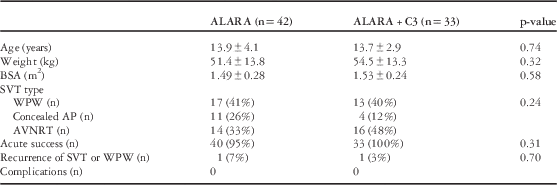
A total of 75 patients were enrolled and reviewed during the study period. The mean age was 13.8 years±3.6 with mean weight of 52.7±13.5 kg. The mean body surface area was 1.5±0.3 m2. There was a slight male predominance (41/75–55%). Of these 75 patients, 42 underwent electrophysiology study and ablation using the ALARA protocol, as noted above, and 33 underwent electrophysiology study and ablation using the ALARA+C3 protocol. The demographic and additional characteristics of each group are demonstrated in Table 1.
Patient population: comparison of ALARA and ALARA+C3 Groups.

ALARA=“As Low As Reasonably Achievable”; ALARA+C3=ALARA plus CARTO 3; AP=Accessory pathway; AVNRT=atrioventricular nodal reentrant tachycardia; SVT=supraventricular tachycardia; WPW=Wolff–Parkinson–White syndrome
There were no significant differences between the ALARA and ALARA C3 groups in terms of age, gender, supraventricular tachycardia diagnosis, acute procedural success, complication rate, or recurrence of supraventricular tachycardia (Table 1). As in most series reviewing catheter ablation in paediatrics, the majority of patients in this group had accessory pathways (45/72–60%), with the remainder having atrioventricular nodal reentrant tachycardia. The majority of accessory pathways in this study were right sided (26/45–58%). Of note, all left-sided pathways were ablated via transseptal approach in both groups.
Comparison of the tachycardia mechanism between the two subgroups showed that the distribution of atrioventricular nodal reentrant tachycardia, Wolff–Parkinson–White syndrome and concealed accessory pathways was similar between the two groups. Acute ablation success was achieved in 95% of the ALARA patients and in 100% of the ALARA+C3 subjects and there were no complications encountered in either group. In mean follow-up periods of 6 and 4 months, respectively, there was a single patient in each group who had a recurrence of their arrhythmia. Thus, there were no differences in acute or medium-term ablation success rates.
Radiation dosage
In comparing radiation doses in both groups, addition of CARTO® 3 to the ALARA protocol resulted in an important reduction in total radiation dose (Table 2). The mean air Kerma product for the ALARA patients was 93.8±112.2 mGy versus 13.1±28.3 mGy for the ALARA+C3 group (p<0.001). The dose area product was also significantly lower in the ALARA+C3 group (92.2 µGym2±179.2 versus 584.2 µGym2±687.5; p<0.001). Addition of CARTO® 3 also significantly reduced fluoroscopy time from 21.4±14.6 minutes in the ALARA group to 6.9±8.6 minutes in the ALARA+C3 group (p<0.001). Procedural time, as measured from the time vascular access was attempted until such time that the vascular sheaths were pulled at the end of the procedure, was similar in both the approaches (125.7±46.8 minutes for ALARA versus 131.4±29.3 minutes for the ALARA+C3 group; p=0.36). Although the mean air Kerma product was 13.1 mGy, the median ALARA+C3 air Kerma product was lower at 4.5 mGy (range 0–153.9). Of the 33 ALARA+C3 patients 14 (42%) received ⩽1 mGy, and 6 (18%) received 0 mGy.
Comparison of radiation dose and procedural times between ALARA and ALARA+C3 patient groups.

ALARA=“As Low As Reasonably Achievable”; ALARA+C3=ALARA plus CARTO 3
Discussion
This study has demonstrated that the addition of electroanatomical mapping to a stringent ALARA protocol resulted in a significant and important reduction in total radiation dose. As can be seen, the majority of the reduction was likely owing to a significant threefold reduction in fluoroscopy time from roughly 21 to 7 minutes. The study is also of significance in that it demonstrates that the “closed platform” CARTO® 3 system can be used in a similar manner to the St. Jude EnSite™ NavX™ system (St Jude Medical, Inc., St Paul, Minnesota, United States of America). Reference Clark, Bockoven, Lane, Patel and Smith 6 , Reference Von Bergen, Bansal, Gingerich and Law 9
There are a number of important observations or findings to the data in this work. First, as shown previously, profound dose reductions when using fluoroscopy can be achieved by simply paying attention to the fluoroscopy parameters as well as vigilance against unnecessary or inappropriate usage of fluoroscopy.Reference Gellis, Ceresnak, Gates, Nappo and Pass 10 The ALARA group dosage, without the use of electroanatomical mapping, is lower than any previously reported dosage in paediatric ablation of supraventricular tachycardia where fluoroscopy was still being utilised. Miyake et alReference Miyake, Mah and Atallah 8 reported a median dose of 110 mGy/case when they added electroanatomical mapping plus intravascular echocardiography to their routine supraventricular tachycardia protocols. However, the median dose of the first 42 non-CARTO® 3 cases in our study was actually less than half of Miyake’s group at 44 mGy, demonstrating the importance of simple adjustments to fluoroscopic technique and usage.
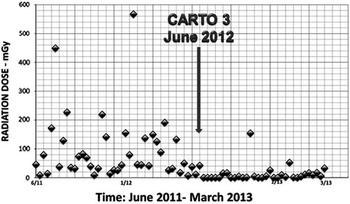
When CARTO® 3 was added to the Gellis et al protocol, we observed a nearly sevenfold drop in average dose from 93 to 13 mGy/case with marked reduction in dose variability (Fig 1). In addition, 42% of the cases were performed with ⩽1 mGy of radiation/case. Thus, it is clear that electroanatomical mapping had a profound impact on total dose. Importantly, despite profound reduction in the use of fluoroscopy in the ALARA+C3 patients, there were no complications observed, and success rates were similar to the prior group in which CARTO® 3 was not used. Although some rare centres are presently not using fluoroscopy during paediatric supraventricular tachycardia ablations, it is important to note that the majority are using some form of hybrid approach. While fluoroscopy is still utilised in these procedures, a goal of this project was to demonstrate how its use could be incorporated while still allowing for a very low total dose, perhaps blurring the lines between “fluoro-less” and “ultra-low”. Although the stochastic risks of radiation exposure are omnipresent, it may be reasonable to assume that efforts, such as this work, to reduce the dose to such low median values (4.5 mGy/case) may potentially tilt the risk/benefit ratio of using very small radiation doses during these procedures back towards minimal, though not zero usage in certain high-risk or challenging cases. It is unclear at this time if the addition of electroanatomical mapping may actually improve success rates for ablation of supraventricular tachycardia as this study was not adequately powered to assess this question, though this is certainly a question that warrants further study.
Impact of CARTO® 3 on air Kerma dose over time.

Limitations
There are a number of significant limitations to this study. First, this represents a single-centre study with only two operators who worked together on all cases. Second, no electrophysiology fellows were involved in these procedures and this may have an important impact on total dose. However, it is important to note that diagnostic catheters were placed in roughly 75% of all cases with a combination of attending and fellow participation. Third, there was a slight preponderance of right-sided supraventricular tachycardia substrates in this study, and the relative reduction in left-sided pathways in the ALARA+C3 may have had a small impact in reducing the reported dose. Finally, the impact of learning curve on CARTO® 3 cannot be assessed in this study on only 33 patients. It was the impression of the operators that reliance on fluoroscopy for certain tasks during electrophysiology study and ablation became less common as time passed.
Conclusion
This work demonstrates that the addition of CARTO® 3 to strict ALARA principles with significant fluoroscopic parameter adjustments can have a profound impact on total radiation dose to children undergoing catheter ablation for supraventricular tachycardia. Although catheter ablation without the use of ionising radiation may ultimately be the goal of all radiation reduction approaches, with the enhanced flexibility of modern fluoroscopic systems, it is the responsibility of the cardiologists to work with their fluoroscopic service engineers and hospital radiation safety personnel to reduce their usage of ionising radiation to the lowest possible dose in similar manner to this work. The values reported herein may serve as reasonable benchmarks upon which to compare future similar efforts. The profound impact on dose reduction from the addition of three-dimensional electroanatomical mapping likely justifies the increased costs associated with its use.
Acknowledgements
The authors wish to thank Gautam Natarajan for his technical support.
Financial Support
This research received no specific grant from any funding agency, commercial, or not-for-profit sectors.
Conflicts of Interest
None.
Ethical Standards
The authors assert that all procedures contributing to this work comply with the ethical standards of the relevant national guidelines on human experimentation and with the Helsinki Declaration of 1975, as revised in 2008, and has been approved by the institutional review board of the Montefiore Medical Center–Albert Einstein College of Medicine.