Introduction
The evidence of methane in the martian atmosphere (Formisano et al. Reference Formisano, Atreya, Encrenaz, Ignatiev and Giuranna2004; Mumma et al. Reference Mumma, Villanueva, Novak, Hewagama, Bonev, Disanti, Mandell and Smith2009) indicates that Mars, like Earth (Weeks et al. Reference Weeks, Currie, Bakun and Peard2004) and moons elsewhere in the Solar System (McKay et al. Reference McKay, Porco, Altheide, Davis and Kral2008), may be venting gases. This dynamic behaviour is of strong astrobiological significance. Even leaving aside the possibility that gases could have a (partly) biological origin, they are important as potential sources of energy for simple life. On Earth, much simple (prokaryotic) life is in the subsurface (Whitman et al. Reference Whitman, Coleman and Wiebe1998), and it is highly likely that if Mars supports life it will also be in a deep biosphere where temperatures are high enough to allow liquid water and the dangers of oxidation/irradiation at the surface are mitigated. If Mars has a deep biosphere, it will be focussed at places where there is an energy source (Fisk & Giovannoni Reference Fisk and Giovannoni1999) and some minimum level of permeability to allow growth, movement and recharge of nutrients. Sites of gas seepage represent both energy and permeability and are, therefore, potential windows to any deep biosphere. Methane seepages could, for example, originate at depths of several kilometres, and could help to fuel microbial sulphate reduction, as has been proposed on Mars (Mumma et al. Reference Mumma, Villanueva, Novak, Hewagama, Bonev, Disanti, Mandell and Smith2009).
Signatures of a deep biosphere
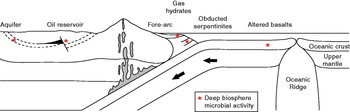
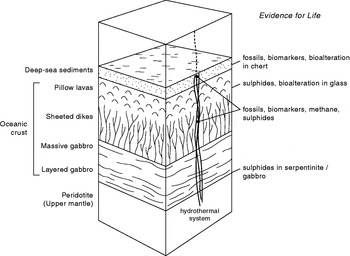
Signatures of a deep biosphere are limited, particularly when sampling can only be done at the surface, i.e., removed from the deep biosphere itself. Examples of deep biospheres on Earth (Figs. 1 and 2) include colonization of oil reservoirs and deep aquifers, colonization of buried basaltic glasses, and microbial populations related to serpentinites and gas hydrates (e.g. Parkes & Wellsbury Reference Parkes, Wellsbury and Bull2004; Jørgensen & Boetius Reference Jørgensen and Boetius2007). Identifying and confirming these components of the deep biosphere is difficult on Earth because of the ubiquity of microbial life, and the consequent possibility of contamination. Remote signatures could include the isotopic signatures of gases, and entrainment of microbes into fluids venting to the surface, but the latter is difficult to prove on Earth because of contamination.
Settings for microbial activity in the terrestrial deep biosphere. Serpentinites are encountered where obducted at continental margins, or beneath the sea floor during deep drilling. Profile through the oceanic crust and the underlying mantle is shown in detail in Fig. 2.

Profile through the oceanic crust and underlying mantle (‘ophiolite’ section), indicating where evidence for life may be encountered. Section redrawn from Monroe & Wicander 1994.

The detection of signatures from a deep biosphere in deep time on Earth poses different problems, which have not been systematically explored. Other signatures are possible, including mineral precipitates with a distinctive isotopic composition or fabric, or even with entrained microbial remains. The problems lie in proving that the microbial activity was in the deep subsurface, and that it has not been overprinted by younger activity after introduction of the rocks to the surface. Nevertheless, careful study allows the identification of examples of subsurface activity in the geological record, including microbial precipitation of carbonates and sulphides. Given the importance of gas as a source of energy, these microbial signatures are particularly likely to occur along pathways for gas seepage.
Exploration on Mars
What are the consequences of terrestrial deep biosphere studies for our exploration of a deep biosphere on Mars? As regards any current deep biosphere, contamination from the martian surface is not an issue. The measurement of the isotopic composition of venting gases has potential, but requires development of a database from which interpretations can be made. There is a possibility of entrained microbes being incorporated into mineral precipitates where fluids emerge at the surface, but as this is difficult to prove in terrestrial cases because of contamination, we have no good model to follow.
If we are to find life on Mars, it is more likely to be in the fossil record, and accordingly the emphasis in the European Space Agency's (ESA's) ExoMars mission is on the search for ancient biomarkers (Vago et al. Reference Vago, Gardini, Kminek, Baglioni, Gianfiglio, Santovincenzo, Bayon and van Winnendael2006; Parnell et al. Reference Parnell2007). The emphasis has been placed on the potential of sedimentary rocks deposited early in Mars' history, when conditions were warmer and wetter, but products of a deep biosphere are also a possibility, and could date from later in Mars' history. The products of a deep biosphere depend on the energy source. The terrestrial record shows that microbial sulphur metabolizers are widespread, including in the deep biosphere, and extend back to the earliest records of life. Microbial sulphate reduction is commonly implicated at sites of methane migration or seepage (Parkes et al. Reference Parkes2005). Sulphur species occur in both igneous and sedimentary rocks on Mars, so sulphur cycling occurs and could be the basis of metabolism. Most terrestrial sulphate reducers can also use other electron acceptors, such as Fe (III) or Mn (IV), widening the variety of potential habitats. A range of redox gradients is also expected on Mars (Fisk & Giovannoni Reference Fisk and Giovannoni1999), which could allow similar diversity. In several terrestrial examples, there is a clear link between microbial activity and the exploitation of, or generation of, methane. This is particularly evident in serpentinites, where the olivine alteration process can produce non-biological methane, while microbes feeding off co-generated hydrogen can be a biological source of methane (Sleep et al. Reference Sleep, Meibom, Fridriksson, Coleman and Bird2004; Sherwood-Lollar et al. Reference Sherwood-Lollar, Lacrampe-Couloume, Slater, Ward, Moser, Gihring, Lin and Onstott2006). Consequently, serpentinites have been highlighted as a potential niche for methanogenesis on Mars (Chapelle et al. Reference Chapelle, O'Neill, Bradley, Methé, Ciufo, Knobel and Lovley2002; Sleep et al. Reference Sleep, Meibom, Fridriksson, Coleman and Bird2004).
Serpentinites
Serpentinites, rocks rich in the mineral serpentine, are of strong interest to astrobiological exploration (Oze & Sharma Reference Oze and Sharma2005; Schulte et al. Reference Schulte, Blake, Hoehler and McCollum2006; Atreya et al. Reference Atreya, Mahaffy and Wong2007; Oze & Sharma Reference Oze and Sharma2007; Vance Reference Vance2009). The gases produced by the serpentinization process, hydrogen and methane, are potential fuels to support microbial activity in the deep biosphere. As serpentinite is produced by the aqueous alteration of olivine, which is widespread on Earth in both crust and mantle, serpentinite is also widespread. It occurs particularly at the base of ophiolite sections, representing profiles through oceanic crust and the underlying mantle (Fig. 2), and is encountered during oceanic drilling or where ancient oceanic crust/mantle has been emplaced (‘obducted’) at continental margins (Fig. 1). Terrestrial serpentinites have been shown to be associated with distinct ecosystems (Mottl et al. Reference Mottl, Komor, Fryer and Moyer2003; Sleep et al. Reference Sleep, Meibom, Fridriksson, Coleman and Bird2004; McCollum Reference McCollum2007), and could have played a role in the evolution of life on Earth (Sleep et al. Reference Sleep, Meibom, Fridriksson, Coleman and Bird2004; Kelley et al. Reference Kelley2005; Yoshida & Fujiura Reference Yoshida and Fujiura2009). Serpentinites are found throughout the geological record back to the Archean Eon, and hydrogen generation on the Archean seafloor may have been greater than today as the environment was more reducing (Hellevang Reference Hellevang2008).
The occurrence of olivine in a large proportion of meteorites, including meteorites from Mars, indicates that serpentinite is also likely to be widespread on other planetary bodies, and therefore represents a possible niche for microbial activity in extraterrestrial settings, now and throughout the history of the Solar System. Recent spectroscopic data from Mars confirms that it is olivine bearing (Hoefen et al. Reference Hoefen, Clark, Bandfield, Smith, Pearl and Christensen2003; Hamilton & Christensen Reference Hamilton and Christensen2005; Mustard et al. Reference Mustard, Ehlmann, Murchie, Poulet, Mangold, Head, Bibring and Roach2009) with associated serpentinite (Ehlmann et al. Reference Ehlmann2009; Quesnel et al. Reference Quesnel, Sotin, Langlais, Costin, Mandea, Gottschalk and Dyment2009). There is some co-occurrence of serpentine and methane, in Nili Fossae (Ehlmann et al. Reference Ehlmann2009; Mumma et al. Reference Mumma, Villanueva, Novak, Hewagama, Bonev, Disanti, Mandell and Smith2009), which is intriguing given their genetic relationship on Earth. Thermochemical modelling suggests that impact-generated hydrothermal systems on early Mars would have precipitated serpentine from altered basaltic crust (Schwenzer & Kring Reference Schwenzer and Kring2009). Further distant, serpentinization is predicted as a normal process on ice/rock planetesimals (Farrell et al. Reference Farrell, McGary and Sparks2007), and is specifically interpreted to have altered olivine on the dwarf planet Ceres in the asteroid belt (Milliken & Rivkin Reference Milliken and Rivkin2009). These observations focus attention on the potential of extraterrestrial serpentinites to hold and yield biosignatures.
Studies of terrestrial serpentinites are focussed on regions below the current sea floor, where serpentinization is an active/recent process, and there is thus a discernible flux of fluids whose chemistry reflects the formation of serpentine, particularly anomalous concentrations of hydrogen and methane (Sherwood-Lollar et al. Reference Sherwood-Lollar, Lacrampe-Couloume, Slater, Ward, Moser, Gihring, Lin and Onstott2006; Cardace & Hoehler Reference Cardace and Hoehler2009; Klein et al. Reference Klein, Bach, Jöns, McCollum, Moskowitz and Berquó2009; McCollum & Bach Reference McCollum and Bach2009). These fluids may be associated with modern/recent biota (Yamanaka et al. Reference Yamanaka, Mizota, Satake, Kouzuma, Gamo, Tsunogai, Miwa and Fujioka2003; Kelley et al. Reference Kelley2005), and leave signatures of life in the form of microbial microfossils or fabrics (Lavoie Reference Lavoie1997) or mineral precipitation (Alt & Shanks Reference Alt and Shanks1998; Blank et al. Reference Blank, Green, Blake, Valley, Kita, Treiman and Dobson2009). Relatively untested is the potential for serpentinites from deep geological time to yield clues to life that they may have supported. Yet it is ancient, ‘dormant’ serpentinites that will most likely be encountered on other planetary bodies, so our expectations for extraterrestrial serpentinites must be tested on examples from the terrestrial geological record. If we can show that useful signals can be obtained from limited samples of ancient serpentinite, such as surface detritus and short drill cores, then plans for the deployment of instruments to measure carbon isotope composition at serpentinites on Mars (Vance Reference Vance2009) will be greatly enhanced in value.
Evidence of life from remotely collected serpentinite samples would be almost certainly chemical rather than morphological. Leaving aside the possibility of organic geochemical signatures, which would be of strong interest but complicated by the potential for abiogenic hydrocarbons in such environments (Proskurowski et al. Reference Proskurowski, Lilley, Seewald, Früh-Green, Olson, Lupton, Sylva and Kelley2008), the most likely chemical indications of life would be through anomalous isotopic fractionation.
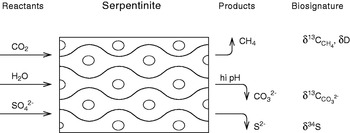
Several products from reactions in serpentinites can be analysed for isotopic fractionation (Fig. 3). The main serpentinization process, involving aqueous alteration of olivine, can be expressed in various combinations of reactions (see e.g. Sleep et al. Reference Sleep, Meibom, Fridriksson, Coleman and Bird2004; Schulte et al. Reference Schulte, Blake, Hoehler and McCollum2006; Kelemen & Matter Reference Kelemen and Matter2008), but can be summarized as

Potential isotope signatures for life in serpentinites, using mineral products from several reactions that occur during serpentinization and subsequent alteration.

This reaction describes the reaction of water with iron olivine (fayalite) to yield quartz, magnetite and hydrogen. The addition of magnesium olivine (forsterite), pyroxene and carbon dioxide describes a reaction to yield serpentine and carbonate minerals:

The carbon dioxide is also reduced by hydrogen to form methane:

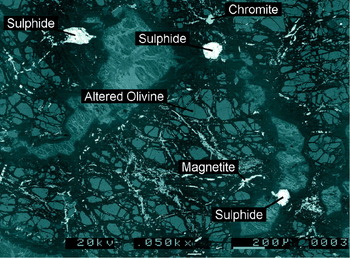
In addition, sulphate from seawater is reduced to sulphide minerals, particularly pyrite (Fig. 4). The serpentinization reactions also generate heat, and involve an increase in volume due to hydration, which causes fracturing (Iyer et al. Reference Iyer, Jamtveit, Mathiesen, Malthe-Sorenssen and Feder2008).
Scanning electron micrograph of partly serpentinized olivine-rich rock from the Ballantrae ophiolite complex, Ayrshire, Scotland, showing the occurrence of sulphides, magnetite, and olivine partially altered to serpentine. Scale bar 200 μm.

Isotopic signatures in serpentinites
Each methane, sulphide mineral and late carbonate mineral could have a signature of biological activity, expressed in degree of isotopic fractionation (Fig. 3). The methane can be analysed for carbon (δ13C) and hydrogen (δD or δ2H), while the sulphide and carbonate minerals can be analysed for sulphur (δ34S) and carbon (δ13C), respectively. All of these have been used to assess if there is biological involvement in the genesis of the respective phases.
δ13C values for methane from serpentinites are generally interpreted to indicate abiogenic processes (Abrajano et al. Reference Abrajano, Sturchio, Bohlke, Lyon, Poreda and Stevens1988), but gases emanating from serpentinite in the Mariana forearc suggest a microbial origin (Yamanaka et al. Reference Yamanaka, Mizota, Satake, Kouzuma, Gamo, Tsunogai, Miwa and Fujioka2003), and deep methane from drilling in the same region has a composition (Komor & Mottl Reference Komor, Mottl, Shinohara, Salisbury and Richter2005) consistent with other evidence for a deep archaeal community (Mottl et al. Reference Mottl, Komor, Fryer and Moyer2003). Methanogens are implicated by anomalously heavy methane in the Lost City hydrothermal field (Kelley et al. Reference Kelley2005). δD values for the hydrogen in methane from serpentinite can also distinguish thermogenic from microbial processes (Abrajano et al. Reference Abrajano, Sturchio, Bohlke, Lyon, Poreda and Stevens1988).
Huge volumes of carbonate minerals may be precipitated by serpentinization reactions, utilizing carbon dioxide from solution (Kelemen & Matter Reference Kelemen and Matter2008). δ13C values for many carbonate precipitates in serpentinites on the seafloor have indicated derivation from carbonate sediment without biological intervention (Alt & Shanks Reference Alt and Shanks2006; Da Costa et al. Reference Da Costa, Barriga and Taylor2008). However, carbonates from the Lost City hydrothermal field are 13C-enriched, consistent with derivation from methane produced by hydrogen-consuming methanogens (Kelley et al. Reference Kelley2005).
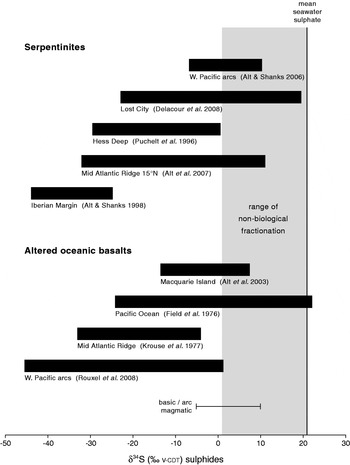
Several domains of the terrestrial deep biosphere yield evidence of microbial activity through the precipitation of sulphides where sulphur isotope composition indicates fractionation greater than that explainable by non-biological processes. These include altered basaltic glasses and serpentinites below the ocean floor (Fig. 5).
Sulphur isotopic compositions of sulphides in serpentinites and altered oceanic basalts below the modern sea floor, showing large fractionation relative to seawater sulphate composition, indicative of microbial sulphate reduction. The toned region represents fractionation from seawater that can be explained by non-biological processes. Many other serpentinites and basalts yield compositions indicative of magmatic sulphur.

The isotopic composition of carbon in methane is particularly targeted on Mars, due to the known occurrence of methane in the martian atmosphere, and instrumentation is being developed to make such measurements (Onstott et al. Reference Onstott, McGown, Kessler, Sherwood-Lollar, Lehmann and Clifford2006; Vance Reference Vance2009). The determination of sulphur isotope compositions on Mars is also a realistic prospect (Christensen et al. Reference Christensen, Brunner, Truong, Mielke, Webster and Coleman2007; Franz et al. Reference Franz, Mahaffy and Farquhar2007).
Preservation of volatiles in ancient serpentinites
In order to show that ancient serpentinites retain the methane (and also hydrogen) that can be measured for isotopic composition, several ancient serpentinites were subject to volatile analysis. Fluid inclusion volatile analysis was undertaken in vacuum using the crush-fast scan (CFS) method (Norman & Moore Reference Norman and Moore1997; Moore et al. Reference Moore, Norman and Kennedy2001). Samples were first cleaned with NaOH to remove surface organics, then dried below 100°C. Samples the size of a match head (i.e., milligram to gram scale) were crushed incrementally under a vacuum of ~10−8 Torr, yielding two to ten crushes per sample. The analyses of each individual crush were performed by means of two Pfeiffer Prisma quadrupole mass spectrometers operating in fast-scan, peak-hopping mode. Routinely, the system analyses for gaseous species includes H2, He, CH4, H2O, N2, H2S, Ar, CO2, C2H4, C2H6, SO2, C3H6, C3H8, C4H8, C4H10 and benzene. Ratios of gases are reported, as the crushing does not liberate the total amount of entrapped gas. The instrument was calibrated using commercial gas mixtures, synthetic inclusions filled with gas mixtures and three in-house fluid inclusion gas standards as described by Norman & Blamey (Reference Norman and Blamey2001). The amount of each species was calculated by proprietary software to provide a quantitative analysis.
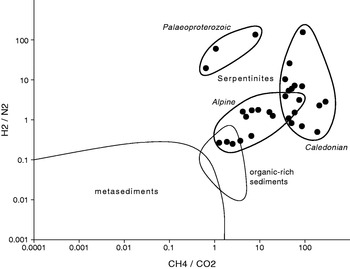
The serpentinite samples used were selected to represent a range of ages, from the Langavat Belt in South Harris, Outer Hebrides, Scotland, of probable Palaeoproterozoic age, but possibly even older (Livingstone Reference Livingstone1976; Fettes et al. Reference Fettes, Mendum, Smith and Watson1992), the Ordovician Ballantrae Complex (~475 Ma) in Ayrshire, Scotland (Bluck et al. Reference Bluck, Halliday, Aftalion and Macintyre1980) and in Tertiary Alpine eclogite facies in the Zermatt-Saas unit in the Italian Alps (Healy pers. comm.). The data obtained is summarized in a cross-plot of volatile ratios (Fig. 6). The methane/carbon dioxide ratio is a conventional measure of the redox state of carbon species, while the hydrogen/nitrogen ratio is used to indicate relative hydrogen levels. For comparison, Fig. 6 also shows data from crustal metasediments (the Proterozoic Moinian of Scotland) and organic-rich sediments (Haughton Crater, Canadian High Arctic). Organic-rich sediments are expected to yield high methane contents (Moore et al. Reference Moore, Norman and Kennedy2001).
Cross-plot of the volatile gas ratios of methane/carbon dioxide against hydrogen/nitrogen for samples analysed by the CFS method (see text). All values in mol.%. The three serpentinite populations all show elevated ratios. The crustal metasediments are Proterozoic Moinian, Scotland; the organic-rich sediments are from Haughton Impact Structure, Canadian High Arctic.

Discussion
The cross-plot of volatile ratios (Fig. 6) shows that each of the three serpentinite populations are distinctly enriched in both methane and hydrogen relative to the other samples measured. Both ratios increase with hydrogen fugacity, hence their apparent association. The hydrogen/nitrogen ratios are particularly enhanced: Many other samples that we have analysed by this technique did not yield any hydrogen, and would plot along the x-axis. Other samples from reducing environments, in particular where organic matter is present, yield high methane/carbon dioxide ratios, but do not yield high hydrogen/nitrogen ratios. A database from deep igneous rock aquifers includes methane/carbon dioxide ratios up to 1.7×10³, but hydrogen/nitrogen ratios all below 1.6×10⁻² (Haveman et al. Reference Haveman, Pedersen and Ruotsalainen1999). The combination measured in this study is consistent with the generation of methane and hydrogen during serpentinization, and is comparable with data obtained from fluids associated with serpentinization below the present sea floor (Kelley et al. Reference Kelley2005). Our data implies long-term preservation of these gases within serpentinite samples, on a geological time-scale. The gases are therefore available for extraction and analysis, and there is an implication that they would similarly be available for extraction and analysis on Mars.
The serpentinites that we have analysed are from ophiolitic or similar settings. The parent rocks contained iron-bearing olivine, which is required to generate hydrogen (Klein et al. Reference Klein, Bach, Jöns, McCollum, Moskowitz and Berquó2009). Some other serpentine-bearing rocks may be derived from rocks containing purely magnesian olivine, particularly forsterite marbles produced by the metamorphism of dolomitic limestones. The serpentinous rocks on Mars are derived from olivine-bearing rock, at least some of which is high-iron (Mustard et al. Reference Mustard, Ehlmann, Murchie, Poulet, Mangold, Head, Bibring and Roach2009), and as an analogue for forsterite marble seems very unlikely on Mars, we can assume that serpentinites on Mars involved hydrogen generation, and therefore the potential to support life that could leave a methane biosignature.
Gases formed during serpentinization can leak along the fracture systems, which are a product of the volume increase due to hydration (Iyer et al. Reference Iyer, Jamtveit, Mathiesen, Malthe-Sorenssen and Feder2008). However, the fractures can be sealed due to the soft, pliable nature of the serpentine, and serpentinites have a low permeability. Our permeability measurements are consistently less than 1 mD. This is consistent with the long-term trapping of gases within the serpentinites. Some young serpentinites on Earth support hydrogen-rich springs (Abrajano et al. Reference Abrajano, Sturchio, Bohlke, Lyon, Poreda and Stevens1988; Sleep et al. Reference Sleep, Meibom, Fridriksson, Coleman and Bird2004). These springs show that gas release can be channelled where fractures occur, but also imply that the reactions which generate gases may continue for a long time. The Zambales Ophiolite in the Philippines is leaking gases tens of millions of years after formation (Abrajano et al. Reference Abrajano, Sturchio, Bohlke, Lyon, Poreda and Stevens1988).
The interpretation of biological activity from isotopic data is not generally a straightforward matter of measuring values in the target sample. The data needs to be considered in a broad framework of other values from rock and atmospheric data, in order to infer anomalous levels of isotopic fractionation, which in terrestrial analogues would be interpreted to indicate biological activity. Even then, interpretations are often not clear-cut. In the case of the carbon isotopic composition of methane, data is commonly ambiguous (Sherwood-Lollar et al. Reference Sherwood-Lollar, Lacrampe-Couloume, Slater, Ward, Moser, Gihring, Lin and Onstott2006), and addressing the question of biogenicity needs the measurement of additional parameters, such as ratios of light hydrocarbons, or hydrogen isotopes, cross-plotted with carbon isotopes in ‘Bernard’ and ‘Schoell’ diagrams (Bernard et al. Reference Bernard, Brooks and Sackett1978; Schoell Reference Schoell1983). However, the light hydrocarbon data in particular are not difficult measurements to collect.
In the case of sulphur, on Earth sulphur isotope systematics allow the detection of microbial activity, which at low temperatures can induce high fractionation of the main sulphur isotopes (Canfield Reference Canfield2004). However, microbially induced isotope fractionation has evolved throughout Earth's history (Canfield Reference Canfield2004). The levels of fractionation observed on Earth now were not achieved during the first half of Earth's history; the microbial processing of sulphur has evolved as the oxygen content of the atmosphere and the sulphate content of the oceans have increased (Bekker et al. Reference Bekker, Holland, Wang, Rumble, Stein, Hannah, Coetzee and Beukes2004; Johnston et al. Reference Johnston, Wing, Farquhar, Kaufman, Strauss, Lyons, Kah and Canfield2005). On Mars, particularly in the early Mars record, any sulphur metabolizers that might exist may not have evolved to the point where they would induce large isotopic fractionation, although the high sulphur contents that have been measured at the surface (Banin et al. Reference Banin, Clark and Waenke1992) are conducive to them doing so. Nevertheless, if we were to observe a range of different sulphur isotopic compositions among martian surface samples, this would point to a fractionation process that required explanation, for which biological activity would be a candidate. We have demonstrated the use of sulphur isotopes to identify microbial activity in impact breccias following a moderate-sized meteorite impact event on Earth (Parnell et al. Reference Parnell2010). The successful application of the sulphur isotope life signature in a robust mineral phase (sulphides) that is known to occur on Mars suggests an approach that can be used to search for evidence of a deep biosphere on Mars. Targeting sites of gas seepage or evidence of hydrothermal activity, in turn highlighted by thermal anomalies, will optimize the search.
Conclusions
Reactions associated with serpentinites yield products that can be analysed by carbon, sulphur and hydrogen isotopes. This emphasizes their value as targets for analysis in future Mars missions, when remote measurement of isotopic ratios is intended. In particular, our demonstration of methane retention in ancient terrestrial serpentinites shows that samples of ancient methane could be obtained on Mars. There is thus a realistic prospect that serpentinites on Mars, although largely of Noachian age (Ehlmann et al. Reference Ehlmann2009; Mustard et al. Reference Mustard, Ehlmann, Murchie, Poulet, Mangold, Head, Bibring and Roach2009; Quesnel et al. Reference Quesnel, Sotin, Langlais, Costin, Mandea, Gottschalk and Dyment2009), could yield an isotopic signature that would help to assess if biological activity was involved in methane generation. The data could also be compared with values to be obtained from the methane currently in the atmosphere, to assess if and how they might be related.
Acknowledgements
We are grateful to J.B. Fulton for cartography, J. Still for electron microscopy, D. Healy for provision of the Alpine serpentinite, and P. Witulski and A. Wright for data plotting.