Implications
Farmers and integrations increasingly apply environmental enrichment with or without natural light in broiler houses, in order to stimulate natural behaviour and to promote broiler welfare. It is therefore important to evaluate the effect of enrichment programmes on behaviour and other welfare aspects, to facilitate the choice of effective environmental enrichments and to ensure that welfare indeed is improved as intended. We showed that in commercial houses with fast-growing broiler chickens, providing environmental enrichment (wood shavings bales, perches and metal chains) and natural light promoted bird activity more than providing environmental enrichment without natural light, or providing no enrichment.
Introduction
Market-based initiatives beyond regulatory animal welfare standards have emerged in several European countries, such as France, the United Kingdom and the Netherlands (de Jonge and van Trijp, Reference de Jonge and van Trijp2014). For broiler chickens, these systems may include higher welfare indoor systems with or without natural light, or systems with a covered veranda or outdoor range. In addition, producers may use standard, fast-growing broiler strains as well as slower growing strains (e.g. Bergmann et al., Reference Bergmann, Schwarzer, Wilutzky, Louton, Bachmeier, Schmidt, Erhard and Rauch2017; Mulder and Zomer, Reference Mulder and Zomer2017). A common factor in these ‘higher welfare’ systems is the use of environmental enrichment, of which most commonly applied environmental enrichments are straw or wood shavings bales, perches, platforms, pecking objects or combinations of different types of enrichments (e.g. Kells et al., Reference Kells, Dawkins and Borja2001; Bailie et al., Reference Bailie and O’Connell2013; Bailie and O’Connell, Reference Bailie, Ball and O’Connell2014 and Reference Bailie, Baxter and O’Connell2015; Bergmann et al., Reference Bergmann, Schwarzer, Wilutzky, Louton, Bachmeier, Schmidt, Erhard and Rauch2017). Because broiler chickens in conventional systems are housed in relatively barren environments with only a litter floor, feeders and drinkers, the environmental enrichments are thought to promote natural behaviour such as resting on an elevated structure, exploration or locomotor activity (Riber et al., Reference Riber, Van de Weerd, De Jong and Steenfeldt2018).
It has indeed been shown that locomotor activity could be increased by providing straw bales to standard, fast-growing broilers in a commercial setting (Kells et al., Reference Kells, Dawkins and Borja2001). Moreover, the combination of natural light and straw bales not only increased activity but also improved leg health in fast-growing broilers, as compared with flocks without natural light and straw bales and flocks with straw bales but without natural light (Bailie et al., Reference Bailie and O’Connell2013). When perches and strings were added in addition to straw bales in houses with natural light, however, there was a negative effect on broiler activity in areas away from enrichment (Bailie and O’Connell, Reference Bailie, Baxter and O’Connell2015). Others found that for resting, broilers preferred elevated platforms over perches (Norring et al., Reference Norring, Kaukonen and Valros2016; Bailie et al., Reference Bailie and O’Connell2018). Elevated platforms did not have an effect on general activity (Norring et al., Reference Norring, Kaukonen and Valros2016). Leg health was improved in fast-growing broilers housed under commercial conditions with elevated platforms (Kaukonen et al., Reference Kaukonen, Norring and Valros2017) but this could not be confirmed by Bailie et al. (Reference Bailie and O’Connell2018). Under experimental conditions, it has been shown that broilers make use of barrier perches and that these increased the behavioural repertoire (Ventura et al., Reference Ventura, Siewerdt and Estevez2012). It has also been suggested that environmental enrichment can reduce the prevalence of contact dermatitis in broilers, because of improved drying of the litter with increased litter directed activities (Riber et al., Reference Riber, Van de Weerd, De Jong and Steenfeldt2018) or less contact time of feet and hocks with litter when, for example, perches are provided (Ventura et al., Reference Ventura, Siewerdt and Estevez2010).
Commercial environmental enrichment programmes for broiler chickens are usually not only chosen because of their supposed positive effects on behaviour (increasing locomotor activity and the time spent on natural behaviours such as foraging, exploration, dustbathing and perching), but also because of the feasibility in practice (e.g. the ease of cleaning in between production cycles, hygiene and costs). For hygienic reasons and ease of cleaning, straw bales, wooden perches and platforms constructed of plastic wire may not be preferred by farmers. Sterilised hay or chopped straw bales are commercially available but relatively expensive alternatives to non-sterilised bales. Therefore, other alternatives are applied, such as wood shavings bales and metal perches. In existing non-windowed houses it involves a financial investment to install windows to provide natural light in the house. However, the effect of commercial enrichment programmes on broiler behaviour and welfare could be dependent on the type of enrichments that are provided, and whether or not natural light is present in addition to the enrichment materials (Riber et al., Reference Riber, Van de Weerd, De Jong and Steenfeldt2018). It is therefore necessary to evaluate commercial enrichment programmes, to determine whether or not the intended positive effect on broiler welfare is indeed achieved, before implementing the enrichment programmes in the production chain.
The aim of the current study was to determine the effect of a commercial environmental enrichment programme, consisting of round metal perches, bales of wood shavings and pecking objects (a metal chain), with or without the addition of natural light, on the behaviour and clinical welfare indicators (such as lameness and skin lesions) in fast-growing broiler chickens. These enrichment materials were chosen by the slaughter plant and farmer because of hygienic reasons and ease of cleaning in between production cycles. In addition, in a preceding pilot study, we found that all selected enrichments were used by the broilers. We hypothesised that these environmental enrichment materials would increase the activity of the broilers during the whole production cycle, and possibly even reduce lameness and contact dermatitis, and that these effects would be greater when natural light was provided (Bailie et al., Reference Bailie and O’Connell2013).
Material and methods
Experimental design, animals and housing
The experiment was carried out during five production cycles (between July 2015 and June 2016) on one commercial broiler farm with three identical houses of 1515 m2 (approximately 18×85 m), located next to each other. The middle house was equipped with 42 windows in the roof (Tulderhof, Eindhoven, The Netherlands) enabling entrance of natural light in the house. The two outer houses did not have windows. Three treatments were included in the experiment: control (C), that is, no enrichment and no natural light; enrichment materials (E), that is, plastic-wrapped (but partly opened) wood shavings bales, round metal perches and pecking objects (hanging metal chains), but no natural light; enrichment and natural light (EL), that is, wood shavings bales, round metal perches and metal chains, with natural light. Treatments C and E were alternately applied in the left and right house in subsequent production cycles. As only one house was equipped with windows, the EL treatment was always in the middle broiler house. Treatments could therefore not be randomly assigned to a house within a production cycle.
Environmental enrichments were provided from day 0 until slaughter age and were similar for the E and EL treatment. In total, 45 plastic-wrapped (but partly opened) wood shavings bales (1.5 bale/1000 birds, 10 kg bales) were equally distributed over a house and these were refreshed as soon as the birds had destroyed the bales. A round 2" metal perch (2.7 m/1000 birds) was provided along the length of the house, in the central area. The farmer could control the height of the perch using a winch. The height was between 5 and 35 cm dependent on the age of the chickens (5 cm at day 0, 15 cm at day 14, 20 cm at day 21, 25 cm at day 28, 35 cm from day 34 onwards). In total, 30 metal chains (link size 20×18 mm), 1/1000 birds, were provided as pecking objects and attached to the two ventilation channels along the length of the house (equally distributed). The end of the chains reached the floor. For the EL treatment, natural light was available for at least 3% of the floor space, that is, two rows of 21 windows (window area 1.25 m2) were present in the roof. A picture of the windowed house is provided in Supplementary Figure S1.
Broilers (Ross 308, as hatched), originating from the same parent stock per production cycle (parent stock age between 36 and 51 weeks), were placed at day-old and managed according to the standard procedures at the farm. Management was equal for all houses. After an initial 24-h light period during the first 2 days of rearing a lighting programme of 7 h dark to 17 h light was started, with lights off between 0000 to 0400 h and 1200 to 1500 h. During the dark period, windows in the EL house were closed using shutters. The light intensity of the artificial lighting was reduced to 20 lux at an animal height from day 11 onwards. All houses were equipped with high-frequency fluorescent tubes (Philips 36 W warm white (Philips, Eindhoven, The Netherlands), horizontally attached to the roof and equally distributed over the houses). During light periods, artificial light was used in addition to natural light in the EL house as soon as the light intensity was below 20 lux. Broilers were fed a standard three phase broiler feed (commercial diet) and water and feed were available ad libitum and similar for all treatments. In each house ±30 000 day-old chickens were placed (19.8 chickens/m2), flocks were thinned once (25% to 30% of the broilers sent to slaughter) around day 35 of age according to standard farm practice and depopulated around day 43 of age (±14 broilers/m2 at depopulation). All houses were mechanically ventilated. Wood shavings were provided as litter material (1000 g/m2). Environmental temperature was reduced from 33°C to 35°C at day 0 to 18°C to 20°C from day 30 onwards. A standard vaccination programme was applied.
Observations
Performance, litter quality, light intensity and perch height
Mortality (including culling) was registered daily by the farmer. The farmer also registered the amount of feed provided and calculated the feed conversion rate. Slaughter weights were provided by the slaughter plant at depopulation, as well as rejection figures (broilers not suitable for human consumption) per house. The farmer recorded the light intensity in the EL house twice a week by measuring it at four pre-defined locations (in between two windows and away from artificial lights on one horizontal line along the width of the house, with the measuring cell at bird height directed towards the ceiling). The farmer also noted the change in height of the perches in the E and EL houses. In addition, the farmer assessed litter quality weekly from day 7 onwards in all houses using a five-point scale (ranging from 0, completely dry and flaky to 4, sticks to boots once compacted crust is broken; Welfare Quality®, 2009), on six locations per house equidistant on the diagonal axis.
Gait score
To assess the quality of locomotion, gait scores were recorded (after the behavioural observations, see below) at days 25 and 39 of age in 25 birds/house. On five locations spread over the house (two locations near the walls and three in the centre, spread over the house), groups of five birds were randomly selected in a catching pen and gently encouraged to walk out of the pen one-by-one (by gently ticking their back or side), and their gait was assigned a score between 0 (perfect) to 5 (unable to walk) (Welfare Quality®, 2009). All observations (including behaviour and clinical scores) were performed by one trained observer.
Footpad dermatitis, hock burn, cleanliness and injuries
A sample of at least 25 birds (at least five birds per location selected in a catching pen, on five locations at equal distances over the diagonal axis of a house and different from the locations for gait scoring) were inspected for footpad dermatitis (FPD), hock burn (HB) and cleanliness according to the Welfare Quality® (2009) protocol at days 25 and 39 of age (after performing the gait score). Footpads and hocks were assigned a score between 0 (no lesions) to 4 (severe lesions). Cleanliness was scored by inspection of the breast area and assigned a score between 0 (completely clean) and 4 (very dirty). Injuries were assigned a score 0 (no scratches or wounds), 1 (single scratch or small wound ⩽0.5 cm2) or 2 (multiple scratches and/or large wounds >0.5 cm2).
Behavioural observations
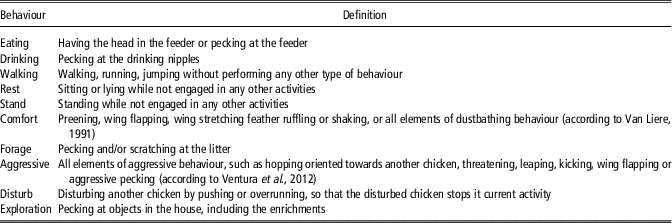
Behavioural observations were also performed at days 25 and 39 of age by one observer. Behaviour was observed in two sessions in the light period, one in the morning (starting around 0730 h) and one in the afternoon (starting around 1500 h). In each session, behaviour was scored in all houses. The observer first finished the observations in one house and then started in the next house. The sequence of houses with an observation session was switched between cycles (per age) to prevent systematic errors due to effects of time. Per session (morning and afternoon), behaviour was recorded in six virtual sections per house, of which three included enrichment and three were without enrichment. Virtual sections were defined by the feeder and drinker lines or wall segments and were about 3 m2 and the centre of the observation area was about 2.5 m from the observer. The observer performed the observations in two sections from one stand point. He slowly walked through the house to one of the pre-defined observation locations and habituated the birds for 5 min. Then he counted the number of birds engaged in one of the mutually exclusive behaviours according to the ethogram (Table 1) in five subsequent scans for one section. Then the observer turned 90°, and repeated the observations in another section. This was repeated for two other stand points, so that in total six locations per house were observed. Locations were divided over the house and included sections near walls (two sections) and in the central area in between the feeders and drinkers (four sections).
Ethogram defining the different broiler behavioural categories

Use of enrichments
To get an impression of the use of the enrichment objects, the observer counted the number of birds on perches and bales, and pecking at chains and bales. These counts were performed immediately after the behavioural observations at one stand point, and thus involved three counts in total per house per session. He counted the number of birds on 1 m perch, pecking at half a bale (only front visible) or sitting on one bale, and pecking at 1 chain close to his stand point.
Novel object test
This test was performed at three preselected locations in the house after performing the behavioural observations. The observer presented a novel object (a coloured 50 cm stick) to the chickens in a standardised procedure, that is, he walked slowly to the location, sat on his knees and presented the object in the litter, rised slowly, walked backwards for 3 m and started the observations. The number of chickens within 0.5 m of the object was recorded every 30 sec during 4 min. In addition, the latency of the first chicken within a circle of 0.5 m around the object and the latency to touch the object were recorded.
Statistical analysis
All analyses were performed using GenStat (version 17, VSN International). Differences of P<0.05 were considered statistically significant, 0.05⩽P⩽0.10 were considered a trend. The normality of the data was checked with residual plots. A flock was the experimental unit. Scores for FPD, HB, cleanliness and injuries, and gait scores were analysed with IRCLASS followed by a residual maximum likelihood (REML) procedure. Age, treatment and the interaction between these were included as fixed effects. Random effects were production cycle, cycle×age and cycle×house. This means that age was tested against the cycle×age variance (nominal degrees of freedom (ndf) and denominal degrees of freedom (ddf): 1,4), treatment against cycle×house variance (ndf, ddf: 2,8) and the age×treatment interaction is tested against cycle×age×house variance (ndf, ddf: 2,8). In case of a non-significant age×treatment interaction, the interaction was removed from the final model. Predicted means of FPD, HB, cleanliness, injury scores and gait scores were back-transformed to produce the estimated proportions per class. This was done on the interaction level to provide data per combination of age and treatment group.
Scan sampling data of the behaviour were summed for all scans per behavioural category but separately per session (morning and afternoon) and divided by the total number of observed broilers in that session. Data were analysed by generalised linear mixed model with binomial distribution and logit link, with age, treatment and observation session, and their interactions as fixed effects and cycle, cycle×age, cycle×house, cycle×age×house and cycle×session×house as random effects. In addition to the degrees of freedom as indicated for the welfare scores, the session was tested against session×cycle×house variance (ndf, ddf: 1, 8). Latency to approach the novel object and to peck the object were log+0.5 transformed before analysis and analysed by the REML procedure with age, treatment and the interaction as fixed effect and cycle, cycle×age, cycle×house, cycle×age×house and cycle×age×house×location as random effects. The number of broilers within 0.5 m of the novel object for each time point were also log+0.5 transformed and analysed with the same REML procedure. Degrees of freedom were as indicated for the welfare scores.
Results
Performance, enrichment use, contact dermatitis, cleanliness, injuries and lameness
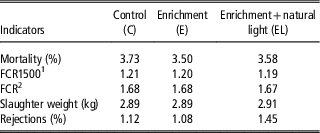
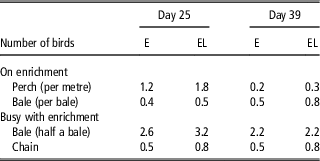
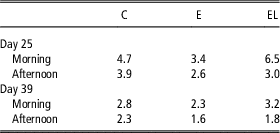
Descriptive data of performance, litter quality and enrichment use are presented in Table 2, Supplementary Table S1 and Table 3, respectively. Performance over the five production cycles was equal for all treatments (Table 2), as well as litter quality (Supplementary Table S1). All enrichments were used by the birds although the average number of birds perching was low and decreased with age, from 1.2 to 0.2 broilers/m on average for E and 1.8 to 0.3 broilers/m for the EL treatment (Table 3). No treatment effects were found for the prevalence of FPD, HB, cleanliness, injuries and lameness (predicted means not shown). Supplementary Tables S2 to S4 provide the predicted means and the cut-points resulting from the analysis, and the back-transformed percentages of birds per score class on the interaction level. Scores significantly increased (as logit values decreased) and thus became worse with increasing age. Predicted means per age (on logit scale) were as follows: FPD: day 25: −0.16, day 39: −0.72, SE=0.15, Wald statistic=14.34, P<0.001; HB: predicted means day 25: 2.70, day 39: −0.10, SE=0.61, Wald statistic=20.78, P<0.001; cleanliness: predicted means day 25: −1.57, day 39:−4.84, SE=0.72, Wald statistic =14.81, P=0.01; injury scores: predicted means day 25: 0.85, day 35: −0.99, SE=0.23, Wald statistic=24.2, P=0.006; gait score: predicted means day 25: −1.56, day 39: −3.89, SE=0.25, Wald statistic=15.08, P=0.02.
Average performance figures over the five broiler production cycles of the different treatment groups

1 Food conversion ratio (FCR) at 1500 g.
2 FCR until slaughter weight.
Descriptive data of enrichment use: average number of broilers counted on the enrichment objects (perches, bales) or pecking at the enrichments (bales, chains) at 25 and 39 days of age for the E (enrichment) and EL (enrichment and natural light) treatments

General behaviour
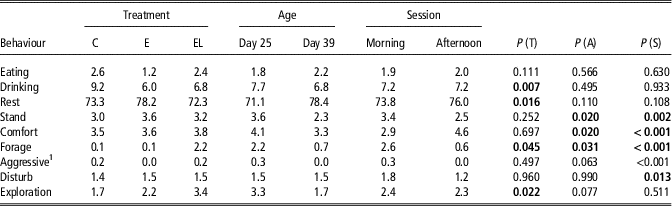
Table 4 shows the back-transformed means and P-values for all behaviours in case no significant interaction was found (all behaviours except walking). Table 5 shows the back-transformed means at an interaction level for the percentage of birds observed walking. Significant treatment effects were found for drinking, resting, foraging, exploration and walking (Tables 4 and 5). Broilers provided with enrichment only (E) were more resting as compared with the control (C) and natural light and enrichment (EL) flocks (predicted means (on logit scale) for resting: C: 1.01, E: 0.96, EL: 1.31, SED=0.11, Wald statistic=12.14, P=0.016). The percentage of broilers observed walking, exploring and foraging was higher in the EL treatment as compared with the C and E treatment (predicted means for walking: C: −3.38, EL: −3.40, E: −3.70, SED=0.14, Wald statistic=7.57, P=0.045; for exploration: C: −4.06, EL: −3.40, E: −3.77, SED=0.21, Wald statistic=14.32, P=0.022; for foraging: C: −6.91, EL: −6.13, E: −6.93, SED=0.52, Wald statistic=7, P=0.045) (see also Tables 4 and 5). The percentage of birds observed drinking was highest for the control (C) as compared to the EL and E treatments (predicted means: C: −2.29, EL: −2.62, E: −2.74, SED=0.13, Wald statistic=13.71, P=0.007). Significant age effects were found for standing, comfort behaviour and foraging, with decreasing number of birds performing these behaviours with increasing age (Table 4, predicted means not shown). Observation session effects were found for standing, foraging and disturbance (more observed in the morning as compared to the afternoon), and for comfort behaviour (more observed in the afternoon as compared to the morning) (Table 4, predicted means not shown). A significant age×session interaction was found for walking, with more walking observed in the morning than in the afternoon but the difference being smaller at day 39 than at day 25 (Table 5, predicted means not shown).
Average percentage of broilers per behavioural category, for the different treatments (T) (control (C), enriched (E) and enrichment and natural light (EL)), per age (A) and per observation session (S)

This table only includes behaviours where no interaction effects were found.
1 Values are not exactly zero for some treatments but rounded off to one decimal.
Significant differences (P<0.05) are indicated in bold.
Average percentage of broilers walking, for the different treatments (control (C), enriched (E) and natural light and enrichment (EL)), per age and per observation session

P treatment=0.046; P age×session=0.044.
Response to a novel object
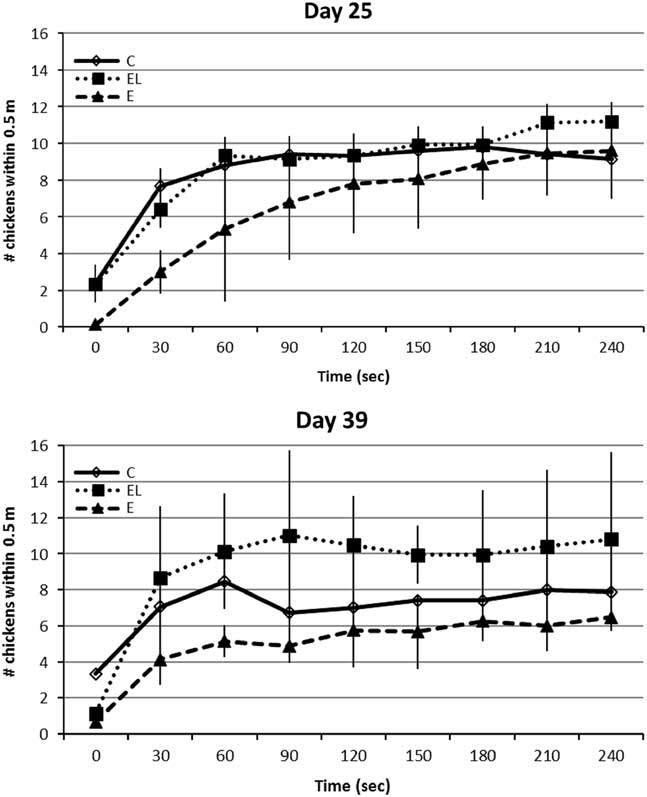
Figure 1 shows the average number of birds within 0.5 m of the novel object during the test at days 25 and 39. Only for t=90 sec a tendency for an age×treatment interaction was found (Wald statistic=5.49, P=0.088), with less E birds within 0.5 m of the object as compared with C and EL at 25 days of age, and the highest number of EL birds within 0.5 m of the novel object at 39 days of age, the lowest for E and C being intermediate (predicted means: 25 days of age: C: 2.00, E: 1.70, EL: 1.68; 39 days of age: C: 1.66, E: 1.43, EL: 2.29, SE=0.32) (Figure 1). A tendency for an age×treatment interaction was found for the latency of the first chicken to be within 0.5 m of the novel object (Wald statistic=18.72, P=0.084); at 25 days of age the highest latency was found for E, the lowest for C and EL was intermediate. At 39 days of age the highest latency was for C, the lowest for E and EL was intermediate (predicted means day 25: C: 1.73, E: 2.65, EL: 2.16; day 39: C: 1.31, E: 0.62, EL: 0.85, SE=0.56). Older birds pecked the NO less (Wald statistic=7.06, P=0.031; data not shown).
Average number of broilers within 0.5 m of the novel object at 25 and 39 days of age for the control (C), enriched (E) and enrichment + natural light (EL) flocks. Data are presented as original means±SEM. For significant differences, see text.

Discussion
The results of the present study showed that the behaviour of the broilers was affected by the treatments, whereas no treatment effect was found on other welfare indicators such as lameness. Only a few tendencies were found for treatment effects on the response to a novel object. When the natural light was provided in addition to environmental enrichment (EL), broiler activity was stimulated, whereas providing enrichment materials only (E) had the opposite effect and stimulated resting behaviour, as compared with the control flocks without enrichment (C). The few tendencies for treatment effects on the response to the novel object indicated that E broilers were slightly more reluctant to approach the object as compared with C and EL broilers. It should be noted that we could not randomly allocate treatments to the broiler houses, because windows were only present in the middle house (the other treatments were alternately allocated to the outer houses). Effects found for the EL treatment are therefore confounded with the specific broiler house. On the other hand, houses and management in each house were completely similar apart from the presence of windows in the roof, and all broilers within a cycle were from the same parent stock, indicating that the effects found on the behaviour of the broilers were likely to be caused by the treatments that were applied. Moreover, the equal litter quality for all treatments indicated that large differences in climate or management between the middle (EL) and outer houses (C or E) were absent.
Environmental enrichment is thought to stimulate broiler welfare by allowing the broilers to perform a more species-specific behavioural repertoire and by providing a large range of behavioural choices. To be effective, environmental enrichments should be of sustained interest for the animals (Riber et al., Reference Riber, Van de Weerd, De Jong and Steenfeldt2018). Studies showed that broilers use enrichments such as straw bales (Kells et al., Reference Kells, Dawkins and Borja2001; Bailie et al., Reference Bailie and O’Connell2013; Bailie and O’Connell, Reference Bailie, Ball and O’Connell2014; Baxter et al., Reference Baxter, Bailie and O’Connell2018), pecking objects (Bailie and O’Connell, Reference Bailie, Baxter and O’Connell2015), perches (Ventura et al., Reference Ventura, Siewerdt and Estevez2012) and platforms (Norring et al., Reference Norring, Kaukonen and Valros2016; Bailie et al., Reference Bailie and O’Connell2018) during the whole rearing period. We found similar results for wood shavings bales, metal perches and metal chains as pecking objects, indicating that these could be of sustained interest to the broilers and offered opportunities to perform species-specific behaviour. However, the number of birds perching was found to be low. Possibly, broilers found the material or shape of the perches unattractive or the perches were too high for the older, heavier broilers. A similar low use was found for wooden perches in commercial flocks with fast-growing broiler chickens (Norring et al., Reference Norring, Kaukonen and Valros2016; Bailie et al., Reference Bailie and O’Connell2018). A more likely explanation for the low perch occupation is that the body shape and poor leg health of fast-growing broiler chickens result in an inability to access and balance on a perch, which was also suggested by Norring et al. (Reference Norring, Kaukonen and Valros2016) and Bailie et al. (Reference Bailie and O’Connell2018). This is supported by our observation that the number of broilers perching decreased with increasing age, and by the increase in gait score between 25 and 39 days of age in the present study. The fact that fast-growing birds show good use of elevated platforms for resting indicates that they are still highly motivated to rest at an elevated place (Norring et al., Reference Norring, Kaukonen and Valros2016; Bailie et al., Reference Bailie and O’Connell2018). It is therefore advised to provide platforms instead of perches to fast-growing broilers.
We observed that broiler activity, foraging and exploration were only stimulated when natural light was provided in addition to the environmental enrichment objects. Both an increased light intensity, increased light variability and a wider range of wavelengths could have contributed to this stimulating effect of natural light. Measurements by the farmer showed a large range and high variation in light intensity between and within days, from above the minimum level of the artificial lights (>20 lux) to thousands of lux on sunny moments (data not shown). Chickens are day-active animals and vision largely determines their behaviour (Prescott et al., Reference Prescott, Wathes and Jarvis2003). Their activity increases with increasing light intensity (Rault et al., Reference Rault, Clark, Groves and Cronin2017), which explains the increased activity in the EL as compared with the C and E treatment. In addition, under natural light, with a wider spectrum as compared with artificial light, chickens may have a different perception of the environment (Prescott and Wathes, Reference Prescott and Wathes1999) which may stimulate their activity. Our results confirm the earlier study of Bailie et al. (Reference Bailie and O’Connell2013) that natural light in addition to environmental enrichment seems to stimulate broiler activity. It has also been suggested that specifically, the variation in light intensity is an important driver of the stimulating effects of natural light on broiler activity (Kristensen et al., Reference Kristensen, Perry, Prescott, Ladewig, Ersboll and Wathes2006; Bailie et al., Reference Bailie and O’Connell2013). This not only stimulates activity but is also suggested to better synchronise flock behaviour, which may lead to higher activity in the photoperiod and more uninterrupted resting in the dark period (Alvino et al., Reference Alvino, Blatchford, Archer and Mench2009).
Although we expected that locomotor activity would be increased in the E treatment as compared with the C treatment (e.g. Kells et al., Reference Kells, Dawkins and Borja2001) we found that E flocks showed more resting as compared with the control flocks. More recent studies also indicated that bales and strings may reduce broiler activity (Bailie et al., Reference Bailie and O’Connell2013; Bailie and O’Connell, Reference Bailie, Baxter and O’Connell2015; Baxter et al., Reference Baxter, Bailie and O’Connell2018). We observed that broilers in the E treatment clustered around the wood shavings bales, possibly because of these offered shelter and opportunities for undisturbed resting (which is also observed along the walls). Surprisingly, this clustering behaviour was also observed around the chains in the E treatment, especially at a young age, indicating that these could also be used to cluster for resting without providing much shelter. Enrichments may also function to better structure the environment, and possibly chains already provide such a function. In the EL treatment in our study, this clustering during daytime was probably prevented because of the general increased activity of the flock and the presence of broilers performing explorative behaviours towards the bales and chains. There were no treatment differences found for disturbance behaviour, indicating that natural light in addition to enrichment seemed not to have negative consequences for resting birds. C birds were more frequently observed drinking compared with E and EL. Possibly, this may be exploration behaviour that is directed towards the drinker in the absence of any other objects to explore.
Although it is thought that environmental enrichment increases the ability of the animal to handle behavioural and physiological challenges and may reduce fear (Riber et al., Reference Riber, Van de Weerd, De Jong and Steenfeldt2018), we did only find a few tendencies for treatment effects in the novel object test. The E broilers were most reluctant to approach the object, which does not confirm the suggestion of reduced fearfulness with environmental enrichment. It could also have been possible that the object was more attractive to EL broilers because of the higher light intensity or broader wavelengths that possibly changed the appearance and/or stimulated attractiveness of the object (Prescott and Wathes, Reference Prescott and Wathes1999). C birds could have been more motivated to explore the object as they were not used to any enrichment. The results of our study indicate that more research is needed to determine whether or not environmental enrichment may affect fear in broiler chickens.
It should be noted that the effects of the different treatments on the behaviour of the broiler chickens were relatively small. It is generally known that fast-growing broiler chicks become very inactive towards the end of the production period (e.g. Bailie et al., Reference Bailie and O’Connell2013) and this is confirmed by our observations, showing that the majority of the birds are resting and this increases with increasing age. The positive effect of natural light and enrichment materials on broiler activity, despite being significant, was numerically small compared with the C and E flocks. It has been shown that an increase in broiler activity improves walking ability (Bessei, Reference Bessei2005), but probably the effects in our study were too small to find an effect on the gait score. Our study thus did not confirm the earlier findings of Bailie et al. (Reference Bailie and O’Connell2013) that straw bales and natural light promote activity and improve gait scores as compared with unenriched control flocks or flocks with straw bales only. Possibly, the material of the bales played a role, with straw and natural light eliciting higher activity as compared with wood shavings and natural light. It remains to be further studied which (combinations of) enrichments not only stimulate activity and natural behaviour, but also improve walking ability, and whether other factors such as stocking density play a role. For example, it has recently been shown that providing a dustbathing substrate in commercial broiler flocks (metal rings containing oat hulls) improved the walking ability in the final week of production and this effect was ascribed to increased foraging and dustbathing in the rings (Baxter et al., Reference Baxter, Bailie and O’Connell2018). The lack of a large effect on broiler activity in our study is also in agreement with the lack of effect on the performance. Moreover, it may also explain why no significant treatment effects on contact dermatitis prevalence, cleanliness and injuries were found. For example, higher broiler activity decreases the contact of hocks with litter which reduces the risk for HB (de Jong et al., Reference de Jong, Hindle, Butterworth, Engel, Ferrari, Gunnink, Moya, Tuyttens and van Reenen2016) and increased litter scratching may positively affect litter quality by keeping it loose and dry, and thus reduce the risk for both HB and FPD. The prevalence of injuries, especially scratches, might be related to the activity level of a broiler flock when broilers are running over each other and disturb resting birds (Allain et al., Reference Allain, Mirabito, Arnould, Colas, Le Bouquin, Lupo and Michel2009). However, the effects of our treatments on broiler activity might have been too small to find any significant effect on these parameters. It should be noticed that the sample size for gait scoring and clinical scoring of the broilers was relatively small, and that a larger sample size should be included in a follow-up study before any firm conclusions can be drawn on the effect of enrichment and natural light on these welfare indicators.
In conclusion, the results of the present study showed that providing environmental enrichment (plastic-wrapped wood shavings bales, chains and metal perches) with natural light-stimulated broiler activity and species-specific behaviour, whereas providing enrichment only stimulated resting as compared with control flocks without enrichment. However, the effects of these commercially feasible enrichment programmes on behaviour were relatively small, which likely explains the absence of effects on other welfare indicators, such as walking ability. To improve broiler welfare, we suggest to further study combinations of environmental enrichments (including natural light) that not only promote the activity of fast-growing broiler chickens but also improve other welfare aspects such as walking ability.
Acknowledgements
This study was financially supported by Plukon Food Group. The authors wish to thank the farmer for enabling the authors to perform the experiment on their farm. Johan van Riel is acknowledged for the statistical analyses.
Declaration of interest
The authors declare no conflicts of interest.
Ethics statement
The experimental procedures were checked with the national legislation on animal experiments. Because the procedures were non-invasive, no project licence was required.
Software and data repository resources
None of the data were deposited in an official repository.
Supplementary materials
To view supplementary material for this article, please visit https://doi.org/10.1017/S1751731118001805