Hurricanes Irma and Maria made landfall as Category 5, causing major impacts to Puerto Rico, leading to the longest response to a national disaster in the history of the Federal Emergency Management Administration (FEMA). 1 Widespread impact included loss of utility and communication infrastructures, damaged roads, limited access to medical care, mass migration, and an estimated 2975 excess deaths. Reference Zorrilla2–Reference Santos-Burgoa, Sandberg and Suárez4 Persons on parole or probation (PoPP) represent the largest criminal justice group, Reference Kaeble and Cowhig5 and face multiple disparities, Reference Phelps6,Reference Winkelman, Phelps and Mitchell7 increasing their vulnerability to disaster hazards. Racial minorities under community supervision face a disparate burden of health conditions (ie, co-occurring mental illness and substance use disorders) and experience barriers to obtaining health care, employment, and housing. Reference Phelps6 Individuals with mental illnesses are at higher risk of being re-arrested and having their probation revoked, while those on probation have a higher risk of completing suicide. Reference Brooker, Sirdifield and Marples8–Reference Sirdifield, Brooker and Marples10 Their health care needs are less likely to be adequately addressed in planning local response and relief efforts. Reference Flanagan, Gregory and Hallisey11
There is evidence that extreme weather events related to climate change may have a negative cumulative effect on the general population’s mental health, including higher rates of anxiety, depression, posttraumatic stress disorder, and substance use. Reference Raker, Lowe and Arcaya12–Reference Cianconi, Betrò and Janiri15 In addition, there is an increased risk for behavioral problems, including violence and self-harm. Reference Hayes, Blashki and Wiseman14–Reference Holmstrom, Adams and Morash17 Despite the potential for PoPP to experience significant distress during hurricanes, there has been a relatively small amount of research focused on understanding the effects of these events and how to address them. Reference Raker, Lowe and Arcaya12 Health and social disparities affecting PoPP increase their vulnerability to stressors associated with the preparation and emergency phases of an extreme weather event. Reference Brooker, Sirdifield and Marples8 Despite a reduced likelihood of illegal drug use among evacuees with prior community supervision, lower-income African Americans showed increased illicit drug use after Hurricane Katrina due to resource loss and displacement from pre-hurricane evacuation. Reference Cepeda, Valdez, Kaplan and Hill16
Community correctional officers (CCOs) occupy an intermediary position that can help strengthen the social support networks of a person navigating the judicial system. Reference Holmstrom, Adams and Morash17 Evidence shows that social support decreases recidivism and substance use, while higher levels of social support are associated with higher-quality relationships with CCOs and a lower presence of mental health (MH) symptoms. Reference Holmstrom, Adams and Morash17,Reference Longmate, Lowder and Givens18 Various studies consider that officer supervision styles may significantly influence the future of individuals under community supervision. Reference DeMichele and Payne19–Reference Seiter and West22 CCOs may provide a key perspective in assessing the needs of PoPP during all phases of the disasters. Their input may inform disaster management aspects that need urgent attention to reduce disparities and support the well-being of individuals they supervise. This study aims to address a gap in the existing literature by exploring the challenges faced by PoPP during natural disasters, drawing on the experiences and perspectives of CCOs.
Methods
Design
A qualitative approach was used to explore the CCOs’ perspectives of the impacts of Hurricanes Irma and Maria on PoPP and on the Bureau of Community Programs of the Puerto Rico Department of Corrections (PR-DOC). The Bureau provides case management services and linkage to care for PoPP under the jurisdiction. Nine (9) focus groups were conducted within the community correctional programs directly affected by the eye of Hurricane Maria in September 2017.
Procedures
The study was approved by the Institutional Review Board of the Medical Sciences Campus of the University of Puerto Rico (A007218). Orientation meetings were held at each regional office between January and Febuary 2019. Potential participants were contacted in person by members of the research team followed by mailed invitation. Of the 75 CCOs invited, 58 officers (74.6%) agreed to participate. The remaining officers were out of the office the day of the focus group, due to supervisory tasks, sickness, or had a personal day off.
Participants were recruited through convenience sampling and selected according to the following inclusion criteria: (1) age 18 years or older, (2) worked as a CCO during the emergency period post-hurricane landfall, (3) directly supervised PoPP outcomes, and (4) was employed in 1 of 9 programs directly in the path of the eye of Hurricane Maria. Final focus groups consisted of 6–10 CCOs. All focus groups were held in closed rooms to ensure privacy and confidentiality. Participants were asked to refrain from giving out identifying information. Program directors were not invited to participate, to avoid undue influence. Focus groups were conducted from March to June of 2019, approximately 18 months after the hurricanes.
All focus groups followed a semi-structured interview guide (see Appendix A). Questions were open-ended to facilitate a deeper exploration of the participants’ perceptions. Reference Adams23 Focus groups were conducted by an experienced researcher and had an average duration of 55 minutes. All were audio-recorded, transcribed ad verbatim, translated from Spanish to English, and checked for accuracy by members of the research team. Focus group notes were transcribed and included in the analysis. Data saturation was reached through intercoding, indexing of quotations and categories, and redundancy of findings across groups.
Data Analysis
Given the significant gap in the literature and the complexity of a natural disaster, content analysis is an ideal tool to explore context-specific understandings of actions and meanings. Reference Elo and Kyngäs24,Reference Berg and Berg25 Inductive and deductive analyses were conducted in an iterative process according to established procedures for qualitative research. Reference Fereday and Muir-Cochrane26 The latent content, which pertains to cultural and social perceptions, and the manifested content, which relates to the explicit responses, were identified. A codebook was developed that included code definitions and delimiters.
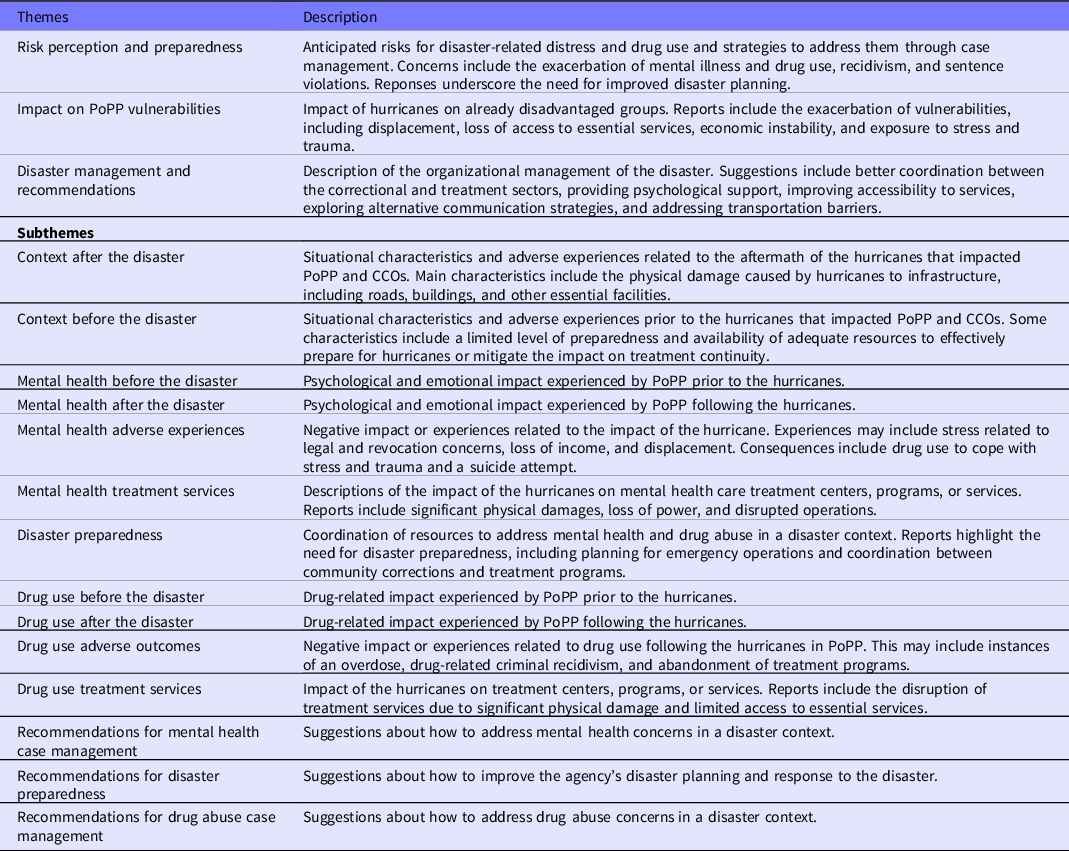
Four coders worked independently on reviewing and coding the transcripts, then compared for inter-rater consistency. Inter-coders agreed upon which code was used, where the quotes started and stopped, and the number of codes used in each transcript. This analysis resulted in 14 overlapping categories that were organized into 3 main themes. Contradictory narratives regarding hurricane implications were included. Data saturation was reached when we identified the same thematic areas regarding disaster hazards, vulnerabilities, and consequences. Direct transcript quotes have been presented to support face validity. Data management was assisted by Atlas.ti 8.
Results
Participants in the final sample were mostly females (72.4%), 37 (63.8%) have a bachelor’s degree, and 19 (32.7%) have a master’s degree. The average years of service as CCOs is 21.91 (SD = 6.42). Embedded in cultural and context layers, emerging themes were identified to enrich these descriptions. Reference Morrow27 The 3 main themes and subthemes are presented in Table 1.
Themes and subthemes

Risk Perception and Preparedness Prior to the Impact of the Hurricanes
Initially, CCOs recounted their concerns before the hurricanes’ landfall and what they thought might be the possible impact among supervised individuals. Some participants expressed not being too concerned because they were unaware of the potential severity of the hurricanes or underestimated the possible effects. Others acknowledged having an idea of the possible impact, having experienced other disasters. Focus group participants expressed concerns about the possibility that PoPP would drop out of mandatory treatment to return to their communities to help their families, since some were already enduring socioeconomic hardships:
At least [for] me, with the experience from [Hurricane] Georges, abscond cases shot up for people wanting to aid families. I understand that residential [programs] don’t have a protocol because some of them can be given a special permit […] so they can go to their families […] And then, well, it came about that, there were two or three that abandoned the residential [programs]. For what? To be with their family and protect and help them.
CCOs also expressed concerns about the safety and general well-being of the PoPP given their fragile living structures (ie, wooden houses, houses in flooding zones), precarious service infrastructure, and pre-existing health conditions. One CCO remarked, The main thing that worried me […], the housing structures. And another thing that worried me a lot was the mental health of the participants.
Anticipated risks were explored as pre-disaster concerns for signs or symptoms of MH illnesses, including depression, anxiety, and trauma. Before the hurricanes made landfall, CCOs were worried about the risk of the recurrence of drug use and community sentence violations. However, when asked about their plans to address these concerns, the majority acknowledged a gap in their organizational preparedness to address those risks before and after the disaster.
The Hurricane’s Aftermath and Its Relation to PoPP Vulnerabilities
In the aftermath, there were significant barriers to resuming community supervision visits. Barriers included the obstruction of most roads, lack of electric energy, limited communication infrastructure, and limited access to fuels for emergency backups. These supervision barriers were experienced for periods ranging from 3 weeks to 11 months. Despite severe conditions on the island, officers reported that most PoPP attended their pre-scheduled supervision visits, even when the situation was so adverse that CCOs did not expect them to. CCOs linked these difficulties to subsequent depression, stress, crime, and substance use recidivism. One CCO remarked, […] some of them, because of the stress and the back and forth, would use drugs.
The uncertainty of not knowing whether they could meet the requirements of their sentence became an additional psychological burden. The sentence requirements that caused the most concerns were reporting to the CCOs in the absence of telephone lines or functional roads, being able to remain in mandatory treatment, and passing drug tests. Although most PoPP reported to the officers, some became at risk of abscondment. Abscondment involves neglecting compliance with program requirements (ie, traveling outside the jurisdiction, abandoning treatment) and may result in incarceration. Some CCOs reported “losing supervisees” who absconded. Failure to attend supervision was often cited as a consequence of community and family displacement. Some CCOs believed that their supervisees left the country without court approval due to the despair caused by having lost everything (ie, home, job) and not having resources to assist their families. Attention to these stressors was not systematically addressed. The adaptation of institutional policies emerged as a response to the extraordinary context created by the disaster. For example, there is an account of how some PoPP left the island without a permit to return and be pardoned later:
… there was another [person on parole/probation] that came in and said: ‘Look [INTERVIEWEE], I had to, I had to leave because I really needed to help my family, my mom was alone.’ The mom lives in [an UNDERSERVED NEIGHBORHOOD] and has a house with a zinc roof. […] The lady was left bare. And the guy left. I said: ‘Look,’ I spoke to, at that moment with the judge and I told him: Look judge, this and this happened with this guy. I am going to authorize him a period of time to fix his house and deal with his situation. After he deals with that then we’ll come back.
No preparedness and response efforts were conducted to benefit PoPP, in particular. Government agencies and non-profit organizations provided food and water donations to the general population, benefiting PoPP and CCOs. Some PoPP recurred to shelters due to their living situations. One participant narrated how a PoPP experienced difficulties due to their offender status being disclosed. The individual was separated from the general community located at the shelter and felt stigmatized by others:
They had to be placed in isolated spaces, alone, away from the, the general population. This affected these clients emotionally, because while being in a shelter, everybody would identify them as offenders. […] Then I had to work with that problem […], they would tell me that they had felt bad because people would point them out, people would marginalize them. After they left the shelter and went on with their normal lives […] the rest of the population had already identified them.
Participants believed that some PoPP felt anxiety or depression as a result of the uncertainty surrounding their situation, loss of essential resources, and displacement:
There were clients that told me that they were disoriented because they hadn’t seen anything so dramatic [disastrous] in their lives. Then this [situation] got them out of control, derailed them out of their tracks.
Many of which I interviewed and had in supervision [showed] a lot of depression. Anxiety. […] They didn’t know; they didn’t have a job. They didn’t know how they were going to survive because in the municipality, where they resided, help was nowhere to be seen. So yes, there were many, [with] depression, anxiety.
Other adverse experiences, such as an overdose death, suicide, and misconduct, were observed during the aftermath. However, the accounts of the CCOs regarding changes in drug use during this period were conflicting. While some officers believed that drug use increased as a coping mechanism, others argued that it decreased due to limited illegal drug availability caused by the hurricane’s impact.
The hurricanes created challenges for individuals seeking and remaining in treatment. Residential treatment structures were significantly damaged and lacked essential services for prolonged periods, leading PoPP to abandon their programs. Some PoPP also left treatment to assist their families during the disaster recovery:
There were guys, I think like three or four, that were in a treatment center, one was in [MUNICIPALITY] and had to leave because the center was flooded with over five feet of water. […] The other one was in a [RESIDENTIAL PROGRAM] in the countryside that lost the roof. Similarly [TREATMENT CENTERS], lost their roof, half the world [almost everyone] left and what do I know.
I mean, there were guys that [told me] ‘yes, miss, I had to leave,’ there was another that came in and said: ‘Look [INTERVIEWEE], I had to, I had to leave because I really needed to help my family, my mom was alone.’ The mom lives in [UNDERSERVED NEIGHBORHOOD] and has a house with a tin roof.
CCOs reported that some PoPP abandoned treatment due to loss of income, limiting their capacity to pay for services. Although the PR-DOC offers free in-house treatment for those who qualify, they required some participants to restart the program due to delays in treatment progress caused by the hurricane aftermath:
In my case I had a lot of participants in treatment centers and what happened was, […], when he had to return, he didn’t want to. He didn’t want to go back. So, he had almost one month to finish his program. The director in the [TREAMENT PROGRAM] didn’t accept to, didn’t accept to [sic], well, to give him his [completion] letter, because he hadn’t completed the program. So, we had to write him up a report, even though during that time he was doing community labor and he helped in his municipality. But we had to write him a report, he was taken back to the penal institution and after that, well, we talked about another treatment and presently he is in that inpatient treatment.
On the other hand, some PoPP in line to initiate treatment as a sentence mandate were put on hold for months due to the collapse of criminal justice institutions and proceedings, delaying their release from prison to community supervision, and treatment initiation for those who were determined as eligible.
CCOs highlighted that the challenges faced in some residential treatment programs underscored the vulnerability of individuals experiencing housing insecurity:
To arrive to a treatment center and to find the whole gate laying on the floor, all the roof, and still with participants. They stayed there, they didn’t leave, they stayed amid that situation going through many difficulties as well in those residential programs in this area. That, that really is very strong [distressing].
Disaster Management Experience and Recommendations
CCOs experienced disaster response efforts primarily through individual and community-level initiatives. These efforts were sometimes led or supported by PoPP and included general community response activities, like restoring fences, cleaning up debris, distributing food and water, recovering corpses, and aiding in the rescue efforts. According to some CCOs, these responses served as a deterrent for drug use recidivism.
Despite a substantial proportion of PoPP under supervision being at risk of drug use, there was a notable absence of preparedness or response activities specifically aimed at addressing the needs of this vulnerable group in the face of anticipated threats. Post-disaster aid provided to PoPP included emotional and social support, with CCOs offering psychological first aid through motivational talks. CCOs also expressed that they helped mitigate emotional distress by providing relevant information about the flexible enforcement of sentence requirements:
Furthermore, that person who came that day, was given therapy since he got here, he was told, ‘you are a very responsible person,’ he was spoken to very positively to feel better, so that he would feel good about having made an effort, and that made him start to feel better. Yes, because, well, he was very frustrated, you see, because of the situation, but he was told positive things that he had done that not everybody does, and he felt much better.
On the other hand, CCOs reported that PoPP prioritized their participation in community response and recovery efforts rather than engaging in drug use:
… they were not looking to go into the ‘point’ [drug corner] looking for a fix, and for what I know, they were looking to, in the matter of helping, to get gasoline and checking if the guys had food.
Given their perspectives of how these events affected PoPP, CCOs reiterated the need to develop disaster management plans, given that the island is particularly prone to natural disasters. Owing to the trauma-inducing stressors, participants suggested that these plans should include coordinated efforts among key agencies to address anticipated mental health needs for both the PoPP and the CCOs. Recommendations included external resources for psychological support:
Not only the economical, but also there has to be a plan for when it is necessary in the psychological support area and, you know, because it would make it a little bit easier for us. And also, for the clientele. But that has to be part of that plan, of the emergency plan, […] maybe bring us psychology students, or ones that are about to start their practice, […] then we will refer to them the ones we understand could be most affected.
Contemplation narratives recommended interagency collaborations when evaluating the agency’s response to supervising PoPP with Substance Use Disorder or MH indicators. Moreover, these narratives focused on improving service accessibility and community needs. Topics about the possibility of implementing alternative communication strategies, addressing transportation barriers, and developing procedures adapted to a disaster context were discussed. CCOs showed concerns that inadequate and fragmented governmental responses could contribute to the onset of misconduct and drug use:
[…] all the agencies need to be united. If all the agencies don’t come together and they don’t make specific things more accessible… because we have some clients that live 45 minutes away from the town, with roads where three bridges fell [collapsed]. Those people were there for almost two months without being able to get out. And you go there in good and bad times, and it is horrible. Imagine [going] during a time where all on the mountain [region] fell apart, you know. All the agencies need to unite and find strategic points because those people cannot get to the towns. They can’t get to the towns. They are three or four months up there without getting to the towns. What’s gonna happen? There’s gonna be robberies, there’s gonna be drugs, there’s gonna be everything they find in those areas.
Discussion
The findings from the focus group interviews with CCOs provide insightful information regarding the needs of PoPP before and after an extreme weather event. They contribute to identify adverse conditions that require the development of strategies aimed at reducing unfavorable outcomes for PoPP. Reference Frankel28 In the aftermath of the hurricanes, CCOs were able to appraise significant challenges that hindered the ability to comply with treatment conditions. This holds particular significance in situations where inadequate access to resources and services leads to unmet health and social needs, placing individuals at risk of sentence revocation. Reference Domingo and Labid29,Reference Schneider and McKim30
CCOs play a critical role in addressing the social and health needs of their clients. They are responsible for routinely conducting needs assessments, service planning, and monitoring of their supervisees’ progress toward rehabilitation goals. The overrepresentation of chronic health conditions, substance use disorders, disabilities, and social vulnerabilities among adult US probationers Reference Winkelman, Phelps and Mitchell7 underscores the importance of exploring the CCOs’ perceptions of pre- and post-disaster challenges and their recommendations to improve preparedness. Findings contribute to identify and address conditions that potentially jeopardize the completion of sentences in the community during large-scale societal emergencies as well as the need for flexibility in assessing the circumstances that led to incurring in a violation under these exceptional situations. Reference Kaeble and Cowhig5,Reference Klingele31
Respondents expressed concern about the susceptibility of PoPP to poor mental health outcomes. Studies have documented the long-lasting effects of disaster stressors on persistent psychological distress among the general population. Reference Raker, Lowe and Arcaya12 Responsive actions to address these concerns could include:
-
1. Monitoring and managing structural factors and stressors that could trigger risk behaviors and non-compliance with sentence conditions. This may involve increasing access to evidence-based care that is affordable, while reducing reliance on abstinence-based residential treatment programs with perilous infractures.
-
2. Improving coordination between Community Corrections and Federally Qualified Health Centers (FQHCs) for post-disaster care. FQHCs are equipped to resume services in compliance with Centers for Medicare and Medicaid Services (CMS) guidelines and offer treatment for opioid use disorders. Additionally, out-of-pocket costs are based on a sliding fee scale. 32
-
3. Addressing CCOs’ attitudes toward medication-assisted treatment for opioid use disorder, which is perceived as a “last resort.” Reference Mitchell, Willet and Monico33 CCO concerns about adverse outcomes from the recurrence of drug use from post-hurricane devastation could well facilitate an opportunity to improve acceptance of this standard of care among decision makers.
-
4. Providing information about services offered by government and non-governmental organizations to address health and safety concerns in PoPP communities following natural disasters.
Strengths and Limitations
While qualitative research allows for exploring a poorly researched population, results are not generalizable. There are several potential sources of bias on this study. CCOs’ account of PoPP experience may be influenced by their own perceptions and values. However, CCOs continually assess and monitor the psychosocial needs of those they supervise, making their input about changes in mental health and substance abuse needs highly valuable. Since interviews were conducted 1.5 years after the hurricanes, their memory of the experience may be inaccurate or incomplete. Despite the potential for recall bias, this time allowed them to reflect on the major challenges experienced. Data were provided by key members of the community supervision who serve as decision makers in case management, provide expert knowledge, and help generate actionable insights that can inform policy and practice changes. We recommend interviewing supervisees, managers, and policymakers.
Conclusions
Natural disasters are increasing in frequency and severity. Reference Goldmann and Galea34–36 The absence of agency-led efforts and disjointed governmental response during all phases of an emergency adversely affect the health of underserved populations. Treatment programs have experienced significant challenges in providing services and support, while socioeconomic strains can make it difficult for individuals to remain in care. Future research should explore strategies that treatment programs can use to adapt to disasters and better support individuals at risk.
Social connectedness for resource exchange and cohesion during emergencies and recovery are essential contributors to organizational and community resilience. Reference Chandra, Acosta and Stern37 The study findings provide insights to assist community correctional programs in addressing emergency preparedness for the populations they supervise, in which personal and social vulnerabilities are overrepresented. The narratives also reveal the responsiveness and solidarity of the population under supervision participating in community clean-up efforts and procurement of resources to satisfy food, clean water, and transportation needs. These ad hoc activities could well be organized through intersectoral collaborations in emergency preparedness planning. Findings stress the need to establish joint service planning, formal interagency agreements, and staff training that provide capabilities for preparedness and emergency response to natural disasters.
Acknowledgments
The authors acknowledge the collaboration of the Puerto Rico Department of Correction and Rehabilitation.
Author contribution
Mental health and substance use after Hurricane Maria:
Dr Graciela Vega conceived and designed the analysis, led the qualitative design, collected the data, served as the focus group interviewer, contributed to data analysis, designed the analysis plan and directed the qualitative codebook development, performed the analysis, directed and conducted the analysis, and wrote the paper.
Nicole M. Rivera collected the data, served as the focus group observer, contributed to data analysis, performed the analysis, conducted the analysis, and wrote the paper.
Vilmary Camacho collected the data, served as the focus group observer, contributed to data analysis, performed the analysis, conducted the analysis, and wrote the paper.
René Marty collected the data, contributed to data analysis, performed the analysis, conducted the analysis, and wrote the paper.
Dr Carmen E. Albizu contributed to data analysis, contributed to data interpretation, wrote the paper, and “Other”—designed the main study.
The content is solely the responsibility of the authors and does not necessarily represent the official views of the National Institutes of Health, the University of Puerto Rico, or the Puerto Rico Department of Correction and Rehabilitation.
Funding statement
This study was supported by the National Institute of Drug Abuse (NIDA) under award number R21DA048394 and the National Institute of General Medical Sciences (NIGMS) under award number U54GM133807.
Appendix 1 Interview Guide
Introduction: The following questions are related to Hurricanes Irma and Maria, which passed through Puerto Rico in September 2017. We will ask you about your organization’s ability to function after the disaster, including its direct and indirect impacts, your role in the organization, and your perceptions of the procedures related to disaster planning and response. Please refrain from providing any information that could identify you or your coworkers.
Phase I: Preparation
-
1. In the face of the impending hurricanes, what caused you the greatest concern about the program participants you supervise? Why?
-
2. What preparation plans and/or procedures were established to address these concerns?
-
a. Were other units of the DOC or organizations integrated into these plans or procedures? Which ones? How were they integrated?
-
b. If you answered no, why not?
-
-
3. Which of the mentioned concerns were left unattended in the preparation before the disaster? Why?
Phase II: What happened during the emergency
-
1. What were the most notable effects on the program participants? Indicate positive and negative effects.
-
a. What conditions contributed to those effects or behaviors of the participants? (Explore for negative and positive effects)
-
b. Was any assistance destined to the program participants? What kind of assistance was provided to the program participants?
-
-
2. After the passage of the hurricanes, which services were most affected by their impact?
-
3. What factors limited the resumption of program operations? What factors facilitated the resumption of program operations?
-
4. After the program operations were re-established, what factors facilitated/limited the normal provision of community supervision services [before the hurricanes]?
-
a. What practices or procedures were conducted to continue normal operations [before the hurricane]?
-
-
5. What kind of external aid [government agencies] was required to continue their operations? Which ones did they receive? From whom?
-
a. What kind of assistance was for the program and its staff? What kind of assistance was for the supervised individuals?
-
b. With which agencies or organizations could collaborative relationships be established to improve future emergency management?
-
-
6. During the respond and recovery stages, how did the leaders of your organization respond to the new conditions they faced? Mention the leadership positions to which they refer.
-
a. Is there any other level of leadership not mentioned?
-
-
7. What needs arose that affected your performance as an employee?
-
a. What support did you receive as an employee to be able to continue your work?
-
b. What support did you require and did not receive?
-
Phase III: Reflection on what happened and future provisions
-
1. What reflection on hurricane preparations and subsequent emergency management has been carried out at the program [community] level?
-
2. What would you recommend for the management of this type of emergency in future events?
-
3. Is there anything we have not discussed that you believe should be addressed to be better prepared?