1. Introduction: The Age of Mankind
The concept of the ‘Anthropocene’Reference Crutzen and Stroemer 1 implies that we live in a new ‘human-dominated geological epoch’Reference Crutzen 2 , an age of man in which ‘human activity must now be considered a “driver” of global environmental change’.Reference Palsson, Szerszynski and Sverkeret 3 The Anthropocene, that is to replace the ‘Holocene’, is a token of the gradual but accelerating evolution from ‘a nature-dominated to a human-dominated global environmental system’.Reference Costanza, Graumlich and Will 4 This change became ever more manifest from the 1950s onwards when the rate of the human imprint on the environment increased sharply through population increase, economic growth, degradation of soils and depletion of rainforests, methane-production cattle raising, fossil fuel combustion, rise in atmospheric greenhouse gas concentrations and other environmental indicators,Reference Steffen, Sanderson, Tyson, Jäger, Matson, Moore, Oldfield, Richardson, Schellnhuber, Turner and Wasson 5 – Reference Steffen, Grinevald, Crutzen and McNeill 8 to a point where it seems that we have come to an ‘end of nature’ altogether.Reference McKibben 9
Yet, although the idea of an Anthropocene has taken the academic and political world (as well as the media) by storm, a matter of debate is the exact moment when the Anthropocene started.Reference Smith and Zeder 10 One approach is to argue that the beginning is to be found in ‘the latter part of the eighteenth century, when analysis of or air trapped in polar ice showed the beginning of growing global concentrations of carbon dioxide and methane’ (Ref. 2, p. 23). Others highlight the first test of an atomic bomb in 1945,Reference Zalasiewicz 11 the discovery of the Americas or the beginning of Neolithic agriculture.Reference Ruddiman 12 , Reference Balter 13 However, all these approaches are based on some physically measurable indicator. This makes sense since the definition of a ‘geological time unit’ requires measurable physical criteria. But in order to fully understand the nature of the Anthropocene, or better, the evolution of the relationship between mankind and the environment, it is of paramount importance to understand the cultural and cognitive – that is, psychological – prerequisites that enabled humans to evolve into a dominating force on the globe by believing that it was humankind that could control and dominate nature.
Searching for these prerequisites, I argue that the invention of linear perspective in Renaissance Italy played a decisive role. Needless to say, there is no single explanation why humanity came to leave a lasting imprint on Earth. But I would hold that this imprint was not coincidental either. It was the result of a cognitive pre-disposition that lastingly changed how humanity viewed nature and its own role on earth. And linear perspective obviously played an important role in this process. Not limited to art alone, perspective fostered a general anthropocentric worldview that seemingly placed humans in control of their physical environment, allowed the confidence to investigate nature by means of scientific methods and ultimately, disenchant and control it. Linear perspective marks the beginning of what could be named the ‘Anthroposeen’, a human-centred way to view the world and mankind’s place in it, without which the physically measurable Anthropocene probably would not have been able to manifest itself the way it has. At first, of course, perspective was merely an artistic method – but later it surpassed the boundaries of the visual arts and became a general a way of ‘seeing’ the world.Reference Lepenies 14 As will become clear, there exists a direct link between the artistic method of perspective and the nascent scientific approaches of Modernity in the figure of Galileo – whose idea that the universe was written in the language of geometry and was thus open for inquiry, understanding and, ultimately, domination was directly inspired by perspective.
In this article, I will recall the story of the invention of perspective and highlight why perspective was more than just the discovery of a method with the help of which one could seemingly draw in a ‘realistic’ manner. It will become clear that perspective marked the beginning of a decisive cultural shift with lasting consequences that changed our thinking, our behaviour and our approach to the physical world. In the concluding part, I will underline that the specific conceptualization of an Anthroposeen is useful for a holistic understanding of the Anthropocene.
2. Linear Perspective
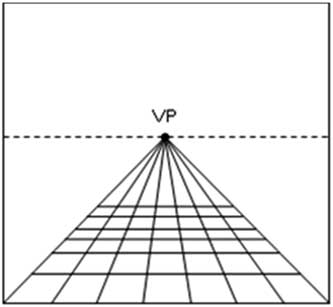
Linear perspective is an artistic device that emerged in Renaissance Italy. It allows drawing three-dimensional objects with geometrical exactitude on a flat two-dimensional surface and permits the visualization of depth. In its simplest form, pictures produced with the method of linear perspective draw the eye to a single vanishing point on the horizon, towards which all orthogonal or receding lines have to converge (Figure 1). This tool not only had a lasting influence on Western art. Ultimately, it monopolized global visual perception.
Linear or vanishing-point perspective. All orthogonal lines converge at the vanishing point (VP) on the horizon.

Before the invention of perspective, European painting was limited to a two-dimensional depiction of religious scenes and figures, usually on a uniform golden background. The elements painted were not seen as faithful renderings of existing items but merely as recognizable tokens of them. Paintings served educational purposes and were often objects of worship, as is still the case with icons in the Orthodox Church. Objects were painted onto the surface with little or no sense of depth or perspective. Differing sizes of figures were not defined by their physical appearance in reality but by the role that theology attributed to them. ‘Scientific naturalism’ was not the goal. Art was ‘the expression of spiritual power’.Reference Field 15
At first, the term perspective (‘perspectiva’) was merely the Latin translation of the Greek word for optics. As such, it appeared in a number of rediscovered Renaissance publications such as the works of Euclid or Ptolemy.
Perspicere, the verbalized form of ‘perspectiva’, has two meanings: ‘to see clearly’ and ‘to see through’. A theory attempting to describe how ‘to see clearly’, i.e. optics, describes the functioning of the eyes and is usually a theory of light. A theory describing how to ‘see through’, however gives a clear spatial dimension and direction to human sight. It is concerned with what one sees and where one sees it. To ‘see through’ is thus ultimately the same as to ‘look at’ something as the gaze is not an end in itself, but a means to an end. That the notion of perspective changed its meaning over time from optics to an artistic method that allowed to ‘look at’ was, according to Hans Belting,Reference Belting 16 not a scientific, but a cultural decision.
In antiquity, it was believed that the eyes emitted visual rays that touched the objects one was looking at (‘extramission’). Visual rays proceeded as rectilinear lines from the eye to the object. The Muslim mathematician and natural philosopher Ibn al-Haytam, known as Alhazen, however, proposed the novel hypothesis that rays of light were emitted instead from all points of an object toward the eye in the form of an inverted pyramid. Alhazen’s hypothesis suddenly relegated the eye to a passive recipient of rays (‘intromission’). His theory of optics made ample use of Euclidean geometry and was also translated as ‘perspective’.
In medieval times, ‘seeing was doing’ – contemplating a holy site or some other object of worship was more than merely looking at it. Pictorial renderings of religious scenes were thus geared at the inner, not the outer senses. But out of the Arab teachings inspired by Alhazen rose the question of whether visual perception could actually lead to knowledge generation about the objects that one saw.
Opinion on that matter divided the perspectivists (John Pecham, Witelo, Roger Bacon), who argued in favour of knowledge generation through sensual perception, and the nominalists (such as Ockham) who argued that the human mind could understand the physical world only intuitively and that the senses could be deceived. The perspectivists’ teachings shattered the theological monopoly on images. Images and their resulting pictures were no longer representations of the church’s teachings, but expressions of how the individual sensed and experienced the physical world. Ultimately, this would allow individuals to create an image of the world themselves – without the powerful filter of the church. This was an important ‘anthropological shift’ even before the technique of perspective was invented. The secularization of knowledge was associated with individual knowledge generation through seeing.Reference Guillén 17
However, these theories were not yet concerned with images as facsimiles of the real world (i.e. pictures) but with the idea of a congruence between how our senses observe an object and the ‘real’ form that such an object has. It paved the way to a more empirical approach to the representation of the physical world that found its way from philosophy to art. It called for a more truthful artistic rendering of what the eyes really perceived. Only through this combination of Alhazen’s work and scholastic philosophy could the medieval notion of ‘seeing is doing’ turn into the belief that ‘seeing is knowing’.
Consequently, the traditional background of paintings increasingly became filled with objects, landscapes and figures whose smaller size indicated that the artists were trying to give visibility to the notion of depth – but without any theoretical or empirical base. This naturalistic approach was in line with the teachings of St. Francis of Assisi who saw ‘the study of the natural world as leading to the soul of God’ (Ref. 15, p. 9). For artists and observers alike, it became clear that objects were no longer simply painted on a surface, but that they were actually placed in the spatial dimension behind the surface. The invention of perspective lead to the discovery and later to the ‘conquest of spatial depth’,Reference Panofsky 18 probably one of the most important cognitive effects to come out of perspective.
The idea of a vanishing point was experimented with little by little, but there was no unifying codification of this method, no full understanding of how the vanishing point perspective functioned and no coherent geometrical or other theoretical explanation for it. The first attempts, if compared to ‘reality’, seemed awkward and somehow ‘wrong’.
Perspective was thus formally discovered the moment that a method was found allowing depth and the objects placed within it to be consistently drawn. It was based on the fundamental teachings of Arab optics and the subsequent belief that the human eye can see the world as it is – and that these images of the ‘real’ are translatable into pictures.
3. The Invention of Perspective
The more or less coincidental invention of perspective around 1425 is generally attributed to the Florentine engineer, architect and goldsmith Filippo Brunelleschi (1377–1446) who had risen to fame by constructing the massive dome of the Florentine cathedral.Reference Edgerton 19 Yet, his technique of perspectivist drawing was only codified and fully explained in Leon Alberti’s ‘De Pictura’ from 1435, which marks the first theoretical description and definition of one-point perspective. Alberti was a true Renaissance humanist: a poet, sculptor, architect, engineer and mathematician. He was not a painter. His was ‘the first book to treat the visual arts as an appropriate humanist subject’.Reference Edgerton 20 Alberti wrote that ‘the function of the painter is to draw with lines and paint in colors on a surface any given bodies in such a way that … what you see represented appears to be in relief and just like those bodies.’Reference Alberti 21 For him, it was clear that one could and should paint as one saw things, in other words that pictures represented reality.Reference Damisch 22 – Reference Kubovy 24
Theoretically, the picture was considered a plane that cut through the visual pyramid (i.e. the pyramid of light rays that an object emitted towards the eye). It was an ‘intercisione della piramide visiva’. Onto this plane, the object to be painted was projected. This was done by fixing a horizon together with a vanishing point toward which all orthogonal lines were to converge.
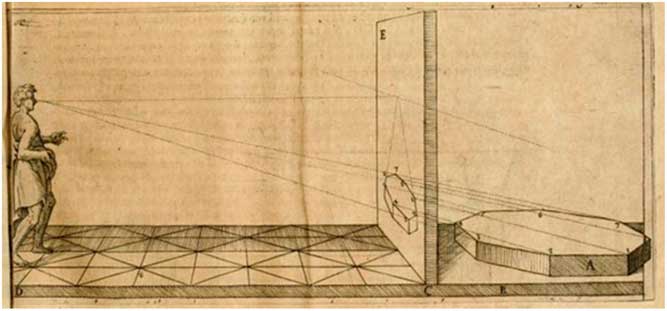
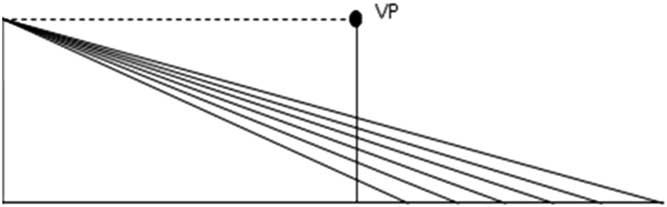
The famous woodcut by Giacomo da Vignola from 1583 exemplifies this (Figure 2). The visual pyramid is highlighted by the imagined straight lines (light rays) that go from the corners of the octagon on the floor to the eye of the observer. This is shown schematically in Figure 3.
Giacomo da Vignola. Le Due Regole della Prospettiva Pratica. 1583.

The visual pyramid: light rays from an imagined object on the ground converge towards the eye of the imagined observer on the upper left corner

The plane, that is, the ‘intercisione’ cutting through the visual pyramid is depicted in the woodcut by the panel onto which the picture of the octagon is projected. In Figure 3, the ‘intercisione’ is illustrated by the vertical line that cuts through the rays.
To draw the octagon in a correct optical and geometrical way onto the panel so that the illusion was upheld of seeing through a transparent ‘intercisione’ to an object lying at a measurable distance behind the plane, the picture of the octagon had to be drawn using linear or one-point perspective.
This means that a point on the panel had to be fixed toward which all orthogonal lines – that is, all lines starting at an angle of 90 degrees from the surface of the picture – were seemingly to converge. The vanishing point (VP in the figures) was to be fixed on a horizon that was defined by the point at which the so-called centric ray lay. In Vignola’s illustration, this centric ray is drawn as the straight line that extends from the eye of the human figure onto the picture plane. The centric ray marks the horizon on which the vanishing point lies. The shape of the octagon was to be constructed by letting the orthogonals converge in the vanishing point. The horizon itself was not the ‘real’ or geographical horizon, but the illusionary horizon that depended on the eye level of the artist or the observer. Other figures would have other horizons. In this sense, the horizon was sensible.Reference Edgerton 20 In Figure 3, the centric ray is shown by the dotted line.
Figure 4 exemplifies the viewpoint of the observer and the general rule of perspective. The dotted line marks the horizon, it is the line onto which the centric ray would hit the panel. The vanishing point is a point on the horizon and all orthogonal lines lead to it.
The construction of a perspective painting from the viewpoint of the observer. It shows how he or she ‘looks’.

With its theoretical assumptions and the idea of the ‘intercisione’, perspective deliberately gave the illusion of looking through a window.Reference Alberti 21 Alberti explicitly used the term window when describing how painters were to implement the new method: ‘Let me tell you what I do when I am painting. First of all, on the surface on which I am going to paint, I draw a rectangle of whatever size I want, which I regard as an open window through which the subject to be painted is seen’ (Ref. 21, p. 54).
The idea of the painting being a window explains why the Latin term perspicere in the sense of ‘looking through’ was subsequently adopted to designate this new pictorial method. Alberti, however, did not yet use the word perspective.
The window was a clear metaphor for what the method tried to produce: a facsimile of what was observable outside (Ref. Reference Belting16, p. 104), in other words, a truthful rendering of observable reality. Artists could thus claim to ‘imitate nature’,Reference Krautheimer and Krautheimer-Hess 25 a way of speaking and thinking unimaginable a few generations before. The belief that pictures could display reality was exacerbated by the theoretical assumption that, as in the case of da Vignola’s woodcut, looking at the painted octagon would – in terms of visual perception – generate the same impression as looking at the ‘real’ octagon on the ground behind the picture plane. The painted and the real octagon were optically identical.
As perspective was based on the combination of Euclidean geometry and Arab teachings on optics, perspective was ‘amenable to systematic description’ and thus ‘unequivocally mathematical’.Reference Kemp 26 From Alberti’s publication onwards, the ever more refined rules of perspective were codified in numerous books and treatises. For humanists, perspective was no simple ‘drawing method’. It was applied mathematics. Alberti had described the first three parts of De Pictura as ‘entirely mathematical’ (Ref. 21, p. 35). The painter Piero della Francesca played another vital role. A trained mathematician himself who had published a number of books on mathematics, he was also the first full-fledged artist to write a book on perspective. For Piero, perspective was all about measurement. Measurement was to correct the fallacies inherent in human visual perception. It enabled certainty. And perspective allowed translating the physical world in exactly measured proportions onto the painted picture. Perspective was thus not an artistic, but a scientific paradigm based on mathematical foundations.Reference Panofsky 27 Pictures were constructed according to clear mathematical rules.Reference Panofsky 28 – Reference Edgerton 30
The reason that many architects and engineers were engaged in the invention and codification of linear perspective had a lot to do with the dominant role played by mathematics in Renaissance society and education.Reference Baxandall 31 In Italy, the syllabus of cinquecento secondary schools consisted mainly of mathematics. Mathematics was a necessary practical tool for almost everyone. A profound knowledge of it was not only an economic necessity in city states of global commerce (characterized by the need to calculate and compare the weight, volume or value of un-normed packaged goods sorted by different weight scales and currencies). Knowledge of maths was a cultural trait. To paint objects and their proportions in a geometrically correct way by measurement, as linear perspective suddenly permitted, was intuitively comprehensible to contemporary observers. At the same time, perspective served practical purposes too – in architecture, sculpture, design and construction. It was a method with practical consequences, derived by practitioners for practitioners. But the consequences of its triumph and acceptance were even more far-reaching than anyone had imagined.
4. A New View on the World: The Anthroposeen
For Hans Belting, perspective is an expression of a specific approach to representing the outside world in pictures or images. It is a cultural technique (Ref. Reference Belting16, p. 25). Ernst Gombrich pointed out that a visual image is never a faithful representation of reality but a symbolic system understandable only to those familiar with the times in which it originated.Reference Gombrich 32 In line with this argument, Michael Ann Holly writes that
the system of perspective is not just a form of representation, a representational device, but is rather a representational device that possesses a thematic content. It is part, or a symptom, or a cause, of a particular visual culture. It affects other cultural products as much as it is affected by them. … Perspective exemplifies not just the physics of the eye, but the metaphysics of Renaissance culture, for it is an expression of the desire to order the world in a certain way: to make incoherencies coherent, to objectify subjective points of view, to turn the flickering world of visual experience into a richly fixated construct.Reference Holly 33
According to Erwin Panofsky,Reference Belting 16 , Reference Panofsky 27 every epoch had its specific form of pictorial representation that was based on specific assumptions about space, which in turn differed in accordance with the various Weltanschauungen of their specific times. It is in this sense that Panofsky’s essay ‘Die Perspektive als “Symbolische Form”’ speaks of linear perspective as being a symbolic form, a specific optical representation of a new current of thought. He takes up the idea of symbolic form that Ernst Cassirer developed in his Die Philosophie der Symbolischen Formen.Reference Cassirer 34 – Reference Cassirer 36 Cassirer spoke of language, myth, art, science and religion as symbolic forms. He believed that they represented specific cultural mental models with which the physical world is understood and cognitively constructed. Panofsky added perspective to that list: ‘Indeed, it [perspective] may even be characterized as (to extend Ernst Cassirer’s felicitous term to the history of art) one of those “symbolic forms” in which “spiritual meaning is attached to a concrete, material sign”’ (Ref. Reference Panofsky18, pp. 40–41; Ref. 27, p. 268).
In any case, perspective had long-lasting serendipitous effects because it cognitively implied much more than just painting ‘as one saw’ with the help of mathematics. However, it was only later that these ‘metaphorical’ effects of perspective were fully and consciously recognized and took hold.
A major spark was the concept of ‘space’. The theoretical approach underlying perspective held that ‘space’ was not limited to the picture itself. Instead,
the beginning of space no longer coincides with the border of the picture: rather, the picture plane cuts through the middle of the space. Space thus seems to extend forward across the picture plane. … The picture has become a mere ‘slice’ of reality, to the extent and in the sense that imagined space now reaches out in all directions beyond represented space, that precisely the finiteness of the picture makes perceptible the infiniteness and continuity of space. (Ref. Reference Panofsky18, p. 61)
The invention of the vanishing point and the concept of orthogonal lines that in principle have no beginning and no end established a novel notion of infinity. Although the idea of infinity of numbers was known for centuries, the idea of an infinite space was not. For Judith Field, Renaissance art constituted the true ‘invention of infinity’ if not its first discovery.Reference Field 37 But this infinite space was far from chaotic. Space as defined by the depth of the picture and by the area surrounding it became a ‘systemic space’ (Ref. Reference Panofsky18, p. 42). It was, in principle, completely measurable and ordered (Ref. 26, p. 21).
Next to its novel approach to space, perspective gave visual expression to the gaze of the individual observer. It constituted an ‘iconic gaze’ (Ref. Reference Belting16, p. 28). A picture painted according to the rules of perspective was dependent on the existence and presence of a real-life individual viewer. Perspective hinges on the idea that the individual spectator is an integral part of the perception and the construction of ‘reality’ – just as the woodcut of da Vignola shows.
Consequently, perspective constituted a ‘cognitive revolution’ (Boehm quoted in Ref. Reference Belting16, p. 28). It symbolized a shift from the theocentric worldview of medieval religiosity to the anthropocentric worldview of modernity, or to an ‘anthropocracy’ as Panofsky (Ref. Reference Panofsky18, p. 72) termed it, in which the individual was placed centre-stage. The spectator was the protagonist. He was granted a privileged ‘view of the world’, or better, a ‘view on the world’ (Ref. Reference Belting16, pp. 23–24) especially through the idea that perspective one allowed to look outside a window onto reality. It was the beginning of the ‘Anthroposeen’, a specific way of looking at the world from a privileged, human position with the confidence that what one saw was how things were.
The task of the artist was the geometrical construction of reality (Ref. 26, p. 21) by uncovering the ‘underlying geometry in nature’.Reference Edgerton 38 ‘The result was a translation of psychological space into mathematical space; in other words, an objectification of the subjective’ (Ref. Reference Panofsky18, p. 66). A useful tool in this act of geometrical construction was the integration of tiled floors in perspectivist paintings – a feature that became something of a leitmotif in perspective art. The floor not only resembled a chessboard. In fact, it was a scale of coordinates long before Descartes would introduce such an idea in mathematics. On this scale, objects could be deliberately placed in accordance to their real (i.e. mathematical) distance and proportion. It also illustrated that all of space was measurable.
Renaissance artists did not attempt to reconstruct or reproduce reality in a picture as if it were a modern photograph. This was not the role expected from art and artists at the time. But what was expected was that the paintings display such a mastery in the use of the method of perspective that one could believe them to represent something ‘as if’ it were real. Artists, in other words, did not re-construct reality, they created it.
The use of words is important here. The idea of ‘creation’, hitherto reserved to the divine, came to describe the work of an artist who ‘created’ objects as well as the space and depth surrounding them by the use of perspective. For the first time, and revolutionarily, the term ‘to create’ was used outside of its theological context when describing artists’ use of perspective.Reference Panofsky 39
Of course, it is the prerogative of an artist to invent and to create his or her own world. But through perspective and its underlying theoretical foundations, artists created the world by means of meticulous calculation and measurement. Paradoxically, it was a rational construction of a world as if, while maintaining that this ‘as if’ was in fact ‘as is’ – due to the belief that perspective actually enabled artists to paint objects as they appeared to the eye.
Another turning point in the cultural history of the Renaissance had to do with the notion of the horizon. The privileged position of the observer contrasted with the medieval idea that only the divine gaze onto earth from above allowed a view of the world. But in perspective, the horizon was irrevocably linked to the earthly artist or the viewer. The horizon limited the measurable space. But once this space is believed to recede into infinity, everything became measurable in principle, even the whole universe. The more the horizon withdrew, the less room was left to religion, the more was God ‘forced to emigrate’Reference Belting 40 (see also Ref. Reference Belting41). Perspective facilitated secularization.
Perspective paintings conditioned ‘the observer to see the world as a picture or to make the world into one’ (Ref. Reference Belting16, p. 40; see also Ref. Reference Belting42). The boundaries between artwork and reality became blurred. It was only a small step from here to perceive the entire physical environment as measurable and thus intelligible by mankind and to believe that one could ‘create’ the world and thus dominate nature. The passive eye was transformed into an ‘active gaze’ (Ref. Reference Belting16, p. 39). Free from metaphysics, the individual began to look at nature and the physical world optimistically from his or her privileged position like a commander observing lands to be discovered and conquered.
5. The Disenchantment of the World: How Art Shaped Early Science
In the centuries following the Renaissance, the physical world gradually ceased to be mystical and inexplicable. Humankind acquired the confidence to be able to control it, just as Renaissance painters were in full control of the mathematically explicable and rationally constructible virtual world of their pictures. The disenchantment of the physical world did not come as the result of the work of one particular thinker or of one theory or at one specific moment in time. It was a gradual process in which the physical universe had to be conquered step by step. But in its earliest stage, linear perspective played a decisive role in this metamorphosis.
Perspective can be directly linked to Galileo Galilei. His findings and his scientific approach – a stepping stone for so many other thinkers of Modernity – would not have been possible without the role that linear perspective had come to play in Italy and his personal life. Art – the visual arts, to be precise – and science were inseparable at the outset of Modernity. In the process of further scientific discoveries, however, this cohabitation was lost.
Galileo, born in 1564, studied mathematics in Florence. After its invention of perspective, the teaching of it had become part and parcel of the education of mathematicians in Italy and soon – due to Albrecht Dürer – also north of the Alps.Reference Panofsky 43 Perspective fascinated the learned elites all over Europe and was one of the most successful concepts to be exported from the Renaissance City States. The prominent position held by perspective was mirrored by the publication and wide international circulation of ever more elaborate mathematical treatises on perspective, many of whose authors were closely acquainted with Galileo.
Galileo had always been interested in the visual arts and is remembered as having remarked that, given the power to choose his profession at a young age, he would have chosen to be a painter. He aspired to become the official court artist of the Medici, was a sought after as an expert on painting and drawing throughout his whole life and, at age 24, he unsuccessfully applied for the position of a professor of perspective at the Accademia del Disegno in Florence, a post that naturally was to be filled by a mathematician.Reference Bredekamp 44
Edgerton holds that Galileo’s ‘profound understanding of perspective drawing, especially the rendering of shades and shadows … helped mightily to open his eyes to new revelations about nature that had escaped understanding everywhere in the world since the beginning of the human race’ (Ref. 19, p. 152). Galileo was able to construct his own telescopes (known at the time as a ‘perspective tube’) due to his in-depth knowledge of the theory of light and perspective. And it was his artistic experience that allowed him to conclude that the spots on the moon that he observed through his ‘perspective tubes’ must result from the moon’s surface irregularity, characterized by protruding mountains. This was a simple idea, but one that no one had come up with before. As the moon had been believed to be perfectly even and smooth, Galileo’s observations made obvious that ‘seeing’ enabled an understanding of physical reality.Reference Edgerton 38 , Reference Drake 45 , Reference Drake 46
Galileo, of course, is mostly remembered as the philosopher who opened science to quantitative analysis. Until the middle of the sixteenth century, mathematics had not obtained its modern place in scientific research. Galileo set the path to limit science to measurement, to mathematics, working on data supplied by observation, checked by experiment.Reference Baron 47
In his book Il Saggiatore from 1623, Galileo famously wrote:
Philosophy is written in this grand book, I mean the universe – which stands continuously open to our gaze, but it cannot be understood unless one first comprehends the language and interprets the characters in which it is written. It is written in the language of mathematics, and its characters are triangles, circles and other geometrical figures, without which it is humanly impossible to understand a single word of it; without these one is wandering in a dark labyrinth.Reference Machamer 48
What does perspective have to do with this? The clue is the use of the word ‘gaze’. Not only had Galileo made his discovery of the moon’s surface by gazing at it; he apparently placed great importance on the visual senses – an importance that can be explained only by the juxtaposition of mathematics and the gaze that was the main characteristics of perspective. Perspective, the method of the iconic gaze together with the perspectivist philosophy that had facilitated the belief that seeing is knowing had ennobled the role of the observer. In the quotation, it becomes clear that gazing and mathematical analysis have to go together. Neither is useful without the other if nature is to be understood. Both, however, enlighten and direct humankind out of ‘the dark labyrinth’ that Galileo helped illuminate. Galileo not only saw the world as a perspectivist painting himself, he normatively held that this is how the world should be seen by everyone.
Galileo knew the limits of mathematical analysis by geometry. These limits were extended and surpassed later by Descartes, Leibniz and Newton. But his was the necessary first step toward the ‘domination of the physical universe’.Reference Karpinski 49 The mathematization of space, which Cassirer regards as a major element of Modernity,Reference Cassirer 50 had by now become a cognitive reality and it was mankind, if not the individual, that could regard his surroundings as something disenchanted, open to inquiry and, ultimately, domination.
In the seventeenth century, the first philosophers of progress saw a major reason for the technical and scientific advancements of humanity in the application of geometry to the physical world. Bernard de Fontenelle spoke of the paramount importance of the ‘esprit de géometrie’ and later Anne Robert Turgot highlighted how this ‘esprit’ had been instrumental to unearth necessary ‘truths’ beginning with Galileo. Even the Marquis de Condorcet, the secular prophet and inventor of the modern concept of progress in the late eighteenth century, saw humanity’s bright future closely linked to the use of ‘mathématique sociale’, i.e. the application of mathematics to all realms, the physical and the social. In his essay, Wissenschaft als Beruf Max Weber claimed that the mathematization of the world had brought forth an infinite optimism about being able to understand the workings of nature – by means of mathematical formulas instead of magic powers, divinity or other irrational forces.Reference Weber 51 For Weber, this process led to the disenchantment of the world, by which he meant that there was no phenomenon that cannot be explained rationally with the help of science. Subsequently, the optimistic view prevailed that everything could be not only understood but also controlled and planned. This is what Weber expressed by the term ‘durch berechnen beherrschen’ (‘to dominate by calculation) (Ref. Reference Weber51, pp. 86–87). For Weber, this was a cornerstone of the mindset of modern mankind and its relation to nature. It is nothing less than the universal application of perspectivist thinking to the world. During Modernity, the application of mathematics and the use of scientific methods led to an unprecedented acceleration in knowledge, a knowledge that manifested itself in technological and ultimately societal progress. What the history of perspective teaches us, however, is that at the beginning of this ‘acceleration’ of knowledge that preceded but would later also cause the devastating acceleration of harmful human behaviour on earth lay the visual conditioning through perspective.
6. The Legacy of Perspective
Due to its practical usefulness, knowledge of perspective was deemed necessary for technical advancement. In fact, perspective was considered a pinnacle of Western civilization. In the seventeenth century, Jesuit priests deliberately attempted to teach perspective in Japan and China in order to make ‘modern’ scientific knowledge available to Asian elites and thus allow them to copy and invent machines that could foster development.Reference Edgerton 38 In the nineteenth century, courses on perspective were part of the British colonial curriculum. For colonial administrators, perspective was seen as an important element in the efforts to re-educate the locals along Western standards. According to Sir Robert Temple, a colonial official in India, perspective was ‘to rectify some of their [meaning the Indian population, P.L.] mental faults, to intensify their powers of observation, and to make them understand analytically those glories of nature which they love so well (Ref. Reference Belting16, pp. 56–57).Reference Mitter 52 , Reference Lycett 53 Perspective was the blueprint to acquire the necessary ‘view’ and scientific approach to nature. To represent ‘natural facts’ as perspective allowed was a necessary part of civilizing, as the philosopher John Ruskin argued in a famous speech.Reference Ruskin 54
For others, perspective posed a threat. This was especially so for Muslim sages. For them, Christian images were blasphemous. Observing an image and recognizing the depicted objects, animals or human figures meant that one accepted them as living creatures – which they were not. This placed the observer and the artist of a picture in the position of a creator, but this position was reserved for God. Pictures that ‘imitate nature’ meant plagiarizing God’s work. The same goes for the depiction of the human gaze which perspective attempted. If the pictorial representation of all things living was forbidden, the human gaze was nothing else than a reminder of life itself. Muslim texts were to exclude pictures that ‘presume to represent the human gaze, or that invite [the spectator] to gaze. They were not allowed to invite the viewer to exchange gazes as one could do only with living creatures’ (Ref. Reference Belting16, p. 77; see also Ref. Reference Belting55). For Muslims, sticking to Alhazen’s original teachings on optics, the eye was a passive recipient of light rays. Images were merely mental images, the idea of translating them into a physical picture was impossible and preposterous. Pictures, thus could not assume to depict the ‘world as it is’. In the Western understanding however, individuals were believed to perceive the world through the images they made of it. For Western culture, optics was a means to an end – for Arab culture, it was an end it itself. God’s perfection and divine laws were revealed in geometry and mathematics, but these were not tools with which the individual was allowed to imitate and master the World.
But even in seventeenth-century France, the ‘Roi Soleil’, Louis XIV, was at odds with perspective. Perspective meant that he, too, would have to be subject to the rules of mathematics when depicted in pictures. For an absolutist king that perceived himself to stand above everything else, both metaphorically and figuratively, adhering to perspective and thus relegating the king to a position within a space defined by mathematics, was an act of lèse-majesté. As the application of perspective carried with it the idea of creation, it allowed for a hitherto unthinkable degree of political emancipation shattering the omnipotent position of the ‘Sun King’. In a world of rational mathematics, there was no room for the supernatural or extraordinary. What had threatened theology a few centuries before was now seen as a threat to royal power. During the so-called ‘perspective wars’, the adherents of mathematical perspective clashed with the royalist defenders of an alternative concept of ‘grand gout’, which claimed to be based on ‘beauty’ instead of geometry.Reference Kemp 56 , Reference Schneider 57 In the course of the fierce quarrel, the most prominent professor of perspective lost his post at the prestigious academy of art. The French controversy exemplifies just how far the idea that the whole world was made up of mathematics and geometry had already left the canvasses. It had entered the hearts and minds of many – even of those who saw in it a threat to their own existence.
Linear perspective changed the way humans came to perceive the physical world and their role in it. It fostered an anthropocentric worldview in which the individual believed he could understand, dominate and control the physical environment by assuming that everything could be ‘dominated by calculation’. Perspective allowed mankind to begin to see the real world as if it were a perspectivist picture – with a dominating position granted to the observer. This ‘Anthroposeen’ was a cultural prerequisite of modern science and technological development and an expression of a worldview that placed humans at the centre of the known universe. Consequently, linear perspective implied that humans and the natural environment were separate, with the environment subjugated to the human gaze, to human understanding, control and domination. In this mindset, no idea of an ‘earth system’ in which humanity was one interconnected part amongst others could develop, no notion of living in harmony with nature. The gaze onto the world of the perspectivist was instrumental. By translating nature into geometry and by believing one was able to assume the role of a creator, no room was left for reflecting on the possible unsustainable interaction between humans and nature.
Linear perspective is certainly not the only cause for the human-dominated and depleted earth of our times. But it gives us a hint as to just how much cultural and cognitive processes have helped in justifying and fostering human behaviour that has led to catastrophic consequences – and it teaches us that one of the clues behind modern human reasoning and acting is the way we literally look at the world and define our place in it. If the challenges of the Anthropocene are to be met, it is of paramount importance to find explanations for how mankind came to assume such a dominant role on the planet. Insights from Social Science and the Humanities can help, in line with the pleas from Palsson et al.Reference Palsson, Szerszynski and Sverkeret 3 Even if these insights only provide one piece of the puzzle, it is nevertheless a piece that is needed to get the whole picture of how complex the Anthropocene really is – and when it could have possibly started.
Philipp Lepenies is visiting professor for Political Science at Freie Universität Berlin. An economist by training, his research focuses on the concepts and policies of development and sustainability. He worked for more than 10 years as a project manager at the German Development Bank KfW. His recent publications include The Power of a Single Number. A Political History of GDP (Columbia, 2016) and Art, Politics, and Development. How Linear Perspective Shaped Policies in the Western World (Temple, 2014).