In Egypt, during the late 19th and early 20th centuries, older, fragmented, and more localized forms of identity were replaced with new, alternative concepts of community, which for the first time had the capacity to collectively encompass the majority of Egyptians. The activism of Mustafa Kamil (1874–1908) and the populist message of the Watani Party began the process of defining and popularizing urban Egyptian nationalism. After Kamil's premature death in 1908, there was more of an “urgent need,” as described by Zachary Lockman, for “tapping into and mobilizing new domestic constituencies in order to build a more broadly based independence movement.”Footnote 1 This article argues that the eventual mobilization of the Egyptian urban masses, and their “incorporation into the Egyptian nation,” was due in large part to the materialization of a variety of mass media catering to a growing national audience.Footnote 2 To be more specific, I will examine early Egyptian nationalism through the lens of previously neglected audiovisual colloquial Egyptian sources. This, I argue, is crucial to any attempt at capturing the voice of “ordinary” Egyptians. Finally, the article documents the role of early colloquial Egyptian mass culture as a vehicle and forum through which, among other things, “hidden transcripts” of resistance and critiques of colonial and elite authority took place.Footnote 3
The increasing availability and popularity of nonprint media, such as the music produced by the profit-driven recording industry and the emerging theater industry, contributed as much as, if not more than, any print media to the molding of national tastes, leading to the formation of an increasingly national community. Print-capitalism, as elaborated upon by Benedict Anderson in his Imagined Communities, was an important component in establishing national identity. However, in a nation like Egypt, where literacy rates were low, nonprint media also played an important role in shaping identities.Footnote 4 Anderson's emphasis on “print-capitalism” not only minimizes the relationship between the written and spoken word—especially in a society where texts were often read aloud—but it also misses the disseminating efficacy of performance and sound media, which unlike print media have the advantage of directly reaching illiterate and semiliterate people. These recorded and publicly performed media, just like the novels and newspapers described by Anderson, “provided the technical means for ‘re-presenting’ the kind of imagined community that is the nation.”Footnote 5
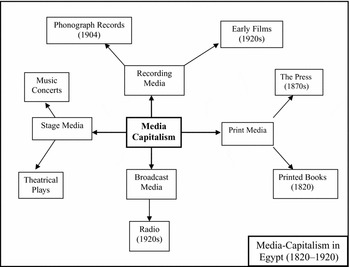
For this reason, I believe that the term “media-capitalism” is more appropriate for examining the cultural processes taking place; it is expansive enough to incorporate all forms of mass media including print, performance, recording, and broadcast media, and it explains more comprehensively the potential inclusion and participation of everyone regardless of education or literacy level in the developing nationalist narrative. Like “print-capitalism,” media-capitalism describes the commodification of mass media, including print, and their function as part of a media market. As this article will demonstrate, the demand for colloquial Egyptian cultural expressions drove the record companies and theater troupes to fill an exponentially bigger vernacular market, largely at the expense of the fuṣḥā media championed by many in the intelligentsia. In the Egyptian case, and I suspect in other cases as well, a synergetic combination of all available media, including print, simultaneously helped shape the “modern” identities of Egypt's new cultural consumers (see Figure 1).
Media-capitalism in Egypt (1820–1920).

Benedict Anderson's theory also does not take into account the diglossia of Arabic, which effectively created a “split vernacular” between nationally and regionally unique colloquial variations of Arabic and fuṣḥā (Modern Standard Arabic), the official language of all Arab countries today.Footnote 6 For example, Egyptian Arabic is the exclusive language of daily communication, songs, jokes, cartoons, movies, television series, and most other nonprint media in Egypt today. Fuṣḥā is not an everyday spoken language; it is more formalized and largely the domain of print media, school textbooks, official speeches, and television news.Footnote 7 It is important to note, however, that this “split” in the language is not rigidly fixed; it is flexibly defined along a linguistic continuum with ʿammiyya and fuṣḥā continually “bleeding” into each other.Footnote 8 The knowledge of fuṣḥā by the Egyptian masses was, and to a great degree still is, far from universal. Though virtually all Egyptians are competent speakers of Egyptian Arabic, in 1907 only 5.4 percent of the population could read fuṣḥā (in 1917 literacy rates increased to 6.8%).Footnote 9 Even this small literate population communicated in almost all of their daily interactions in various forms of colloquial Egyptian. Thus, relying almost exclusively on print, and hence primarily on fuṣḥā cultural production, will at best give a partial understanding of Egyptian society.
An important component of Anderson's theory is an emphasis on the vernacularization of the liturgical language, which with the help of print technology and mass education is transformed into the unifying secular language of the nation. According to Anderson, the demotion of Latin in favor of the various European vernaculars “exemplified a larger process in which the sacred communities integrated by old sacred languages were gradually fragmented, pluralized, and territorialized.” This shift from sacred language to profane vernacular(s) was indispensable for the development of territorial nationalism, and “print-capitalism” was the primary catalyst for this transformation.Footnote 10 However, this “larger process” has not occurred in the same way in the Arab world, where the “sacred language”—albeit in its modern standard form(s)—still officially reigns supreme as the written language of most Arab intellectuals and is the primary language of most print culture today. As Niloofar Haeri notes, fuṣḥā “continues to separate the sacred from the profane, writing from speaking, and prescribed religious rituals from personal communication with God.”Footnote 11
If Anderson is correct about the necessity of vernacularizing and hence secularizing the liturgical language—and Arabic print media is predominantly in fuṣḥā—then how could territorial nationalism exist in Egypt or, for that matter, anywhere in the Arab world? To answer this question, one simply needs to look elsewhere. Instead of focusing solely on the classical Arabic texts of most novels, newspapers, and other print media, we must also examine zajal (colloquial poetry), the colloquial texts of late 19th- and early 20th-century satirical periodicals, and, most importantly perhaps, the predominantly colloquial Egyptian domain of the nonprint mass media.Footnote 12 There one finds the secular, universally understood, vernacular cultural expressions of which the theorists of nationalism speak, amply providing the “necessary shared medium” required for territorial nationalism to develop.Footnote 13
Until quite recently, however, historians focused solely on the role of intellectuals in the formation of modern Egyptian identity, taking little notice of colloquial Egyptian culture. Jamal Mohammed Ahmed, Albert Hourani, Nadav Safran, Ibrahim Ghali, Charles Wendell, and Charles D. Smith investigate the roots of Egyptian nationalism by examining the cultural influences of European ideas on key Egyptian nationalists.Footnote 14 In their seminal work on early Egyptian nationalism, Israel Gershoni and James Jankowski discuss important new sources, yet like the above studies, their analysis remains in the realm of elites and intellectuals, ignoring the important role of colloquial mass culture.Footnote 15 Indeed, the authors acknowledge in the preface that their book “does not deal with the popular attitudes and opinions of the uneducated Egyptian masses.”Footnote 16 To be certain, intellectual conceptions of nationhood and the state had an important impact on the formulation of a “modern” Egyptian identity. However, to be effective, these “ideas” had to be reworked and reconstructed into a form that was meaningful to the Egyptian masses, and they had to be in a language that everyone understood. Writing a history of modern Egypt without taking into account colloquial Egyptian sources at best provides only a partial understanding of Egyptian society.
More recently, a number of scholars have examined colloquial Egyptian culture, especially zajal. Kamal Abdel-Malek and Marilyn Booth examine the written colloquial prose of Ahmad Fuʾad Nijm and Bayram al-Tunisi, two of Egypt's most important 20th-century colloquial poets. Walter Armbrust analyzes the “split vernacular” between colloquial and fuṣḥā and discusses the impact of modern colloquial Egyptian cultural production, especially film. Niloofar Haeri offers an important analysis of colloquial Egyptian culture in modern Egypt, examining the sociopolitical ramifications of the split between fuṣḥā and ʿammiyya cultures. Eve Troutt Powell has examined the racial and nationalist implications of the colloquial comedic theater of ʿAli al-Kassar, and Beth Baron, Lisa Pollard, and most recently Michael Ezekial Gasper have made use of the colloquial Egyptian press. Through their pioneering use of colloquial Egyptian sources, these scholars have begun the process of incorporating more non-elite voices into the historical narrative.Footnote 17
This article expands on these recent efforts by highlighting the importance of colloquial Egyptian culture, examining the first two decades of the 20th century strictly from a popular mass-culture perspective. During World War I, Egyptians experienced many political and economic hardships, while resistance to the British took on more restrained forms due to the wartime application of martial law. Satirical periodicals with colloquial Egyptian content, vaudeville, burlesque comedy plays, and recorded ṭaqāṭiq (colloquial songs/ditties; sing. ṭaqṭūqa), well suited to the times because they permitted coded forms of discourse, became extremely popular, providing both a safety valve and an entertaining, dynamic forum where identities were negotiated.Footnote 18 In the process, the article will introduce some of the key players in Egypt's early 20th-century entertainment industry. These men and women played a more important role in directly influencing the cultural tastes and ideologies of the Egyptian masses than the luminary intellectuals, whose fuṣḥā writings were read by a select few.Footnote 19
To be sure, most of the people who worked on the frontlines of the Egyptian entertainment industry were literate, and the writers of these songs, plays, and azjāl (colloquial poems; sing. zajal) were certainly exposed to and influenced by the discourses of the nationalist intelligentsia. At the same time, the form, content, and language of most vernacular media was inspired by, and to a large extent reflected, the concerns and the diversity of everyday Egyptian life. The demand from below was for media products that were entertaining, accessible, socially relevant, and culturally and linguistically comprehensible. Indeed, the economic success of these media depended to a large extent on their accessibility and relevance to the greatest number of consumers possible. With illiteracy rates near 93 percent in 1917, the market potential for recording and performance media was exponentially greater than any print media.Footnote 20
Finally, the article will discuss the inevitable cultural tensions that occurred when these new media were introduced. The cultural and intellectual elite, the traditional backers of fuṣḥā, were incensed that colloquial Egyptian had become the language of choice for music and performance media. This view contrasted with the interests of the owners and workers of the growing mass-media industries, who were primarily interested in maximizing their profit and consequently catered to the overwhelming demand for colloquial productions.Footnote 21
ṬAQĀṬIQ AND THE “CULTURE-MARKET”
The primary motivating drive for music writing today is commercial. I am not exaggerating when I say that the record companies often ask us to write over one hundred pieces at a time . . . and they only demand the types of songs that increase their profits and attract large audiences, which undoubtedly is of the ṭaqṭūqa varietyFootnote 22—Yunis al-Qadi (b. 1888)
From their very beginning at the turn of the 20th century, the Egyptian culture industries were primarily concerned with profit and hence catered to the tastes of the mass consumers of culture. This meant not only that the de facto language choice of most cultural productions had to be colloquial Egyptian but also that the subject matter needed to be light enough to be palatable to the masses. Thus, because of media-capitalism, the songs and plays that were most in demand, and hence most profitable, were reproduced in greater numbers and listened to by more people. As Pierre Bourdieu has shown, “taste classifies,” and it seems that by the 1910s and 1920s a sort of mass taste shared by the majority of Egyptian culture consumers was developing.Footnote 23
For the first time, cultural production was being driven by the needs of mass consumers whose continual demand was for colloquial songs and plays. The record industry in particular was aware of the needs of the market and was always scouting for new talent. Record sales were increasing, because mass-scale manufacturing of phonographs and disks made them cheaper and more accessible to a greater number of Egyptians. For example, an American-made phonograph, which sold for three pounds in 1904, cost only two pounds in 1906 and included five free disks and a five-year warranty. These prices made it possible for some urban coffee shops to buy phonographs, especially if they could not afford live entertainment. There were even “mobile phonographs” carried by their operators, who charged a small fee for playing songs on demand.Footnote 24 As Virginia Danielson has shown, even some villagers in the Egyptian countryside—in this case a young Umm Kulthum—had access to recorded music by listening at the house of the village ʿumda.Footnote 25
With the notable exception of the records made by Mechian, an entirely Egyptian-based corporation, most of these Arabic records were recorded in Egypt and later mass produced in Europe or the United States.Footnote 26 Though we do not have exact figures for how many records were imported into Egypt during the first quarter of the 20th century, we can reasonably piece together a picture of an active and profitable industry. From 1900 to 1910 the Gramophone Corporation alone marketed 1,192 different records in Egypt.Footnote 27 The 1913–14 Egyptian catalogue for the Odeon Corporation lists a total of 458 records for the Egyptian domestic market.Footnote 28 It is unfortunate that we do not have any official figures for the Polyphon, Baidaphon, Pathé, and Mechian corporations, which were also very active during this period.Footnote 29 In 1912, Germany exported 65,000 records to Egypt; these were most likely for the German Odeon Corporation. By 1929 the estimated number of records imported by Egypt from the United States, the United Kingdom, Germany, and France was 728,000. This figure does not include the records that were produced locally.Footnote 30
The increasing exposure of Egyptians to recorded music created the beginnings of a democratization and, to a certain degree, a homogenization of popular music culture. As more Egyptian men and women from all social classes were exposed to the same music, an increasingly national taste was forming. Many of the different forms of colloquial mass culture were produced by the same colloquial writers, who were valued for their mastery of colloquial Egyptian and hence their ability to convey ideas to all Egyptians regardless of class or education. Because of these new market demands, the price a writer could receive for a zajal increased dramatically during the first quarter of the 20th century, for dozens of satirical periodicals needed colloquial writers for their printed azjāl, and the burgeoning theater and music industries began contracting these same writers to write theatrical monologues, comedic sketches, plays, and ṭaqāṭiq.Footnote 31 For instance, as Marilyn Booth has shown, the colloquial writer Bayram al-Tunisi “left a textual legacy that encompasses a range of genres and media: poetry, short stories, essays, verse and prose parody, serial dialogues, musical-comedy theater, film scripts, songs, and radio serials.”Footnote 32 This was also true for other colloquial writers, including Amin Sidqi, Badiʿ Khayri, and Yunis al-Qadi, who were vital in the growth and development of these new media.Footnote 33
In this growing market, competition among record companies was fierce because demand for recorded colloquial music rapidly increased and good colloquial writers, especially composers, were in short supply. According to Yunis al-Qadi, one of the most prominent colloquial song and play writers of the early 20th century, the Gramophone record company had exclusive deals with the zajjāl Ahmad ʿAshur and the musician Dawud Husni to write the words and music of their ṭaqāṭiq.Footnote 34 Odeon, which started recording Egyptian artists as early as 1905, soon built up its reputation by signing a contract with the legendary Salama Hijazi and several popular female singers, including Asmah al-Kumsariyya and Bahiyya al-Mahalawiyya.Footnote 35 According to Pekka Gronow, in 1906 there was such an “extraordinary demand for Arab records in Egypt” that the Odeon corporation had contracted a famous Egyptian singer (most likely Salama Hijazi) for the unprecedented sum of 10,000 francs. In order to “recoup this investment, it was claimed that the company would have to sell at least 100,000 records.”Footnote 36 By 1908, the majority of the well-known Egyptian performers were contractually bound to either Gramophone or Odeon.Footnote 37 For instance, Gramophone paid the singer Ibrahim al-Qabbani (1852–1927) 200 pounds a year for exclusive rights to his recordings.Footnote 38
Not to be outdone, the Baidaphon Corporation, owned by the Lebanese Bayda brothers, signed an exclusive contract with Munira al-Mahdiyya (1884–1965), the most famous singer in Egypt at the time.Footnote 39 The artistic and economic power she held within the Baidaphon Company was significant and testifies to her popularity and nationwide appeal. Though the company had Ahmad Ghunayma as its exclusive composer, al-Mahdiyya often composed her own songs and according to Yunis al-Qadi made some executive decisions within the Baidaphon Corporation.Footnote 40 Before al-Qadi could be hired by Baidaphon, for example, the owner Butrus Bayda had to acquire al-Mahdiyya's approval:
At seven o'clock, he brought me to his office and sat me next to a lady who was wearing the traditional black Egyptian milaya laf [wrapping sheet] and veil. He then told her that this is the [prospective] writer of the company. I began to wonder, who was this Egyptian woman? And why does she care who the writer of the company is? Is she one of the owners of the company? And is she merely a consultant or does she have an executive privilege? . . . The owner [al-khawāga] declared, “This lady is Munira al-Mahdiyya,” and I soon realized that she has executive-privilege and as the brightest star, is the be-all and end-all [al-kul fil-kul] of the company.Footnote 41
Munira al-Mahdiyya's ability to draw thousands of listeners to both her live and recorded performances allowed her unprecedented control over her finances and her artistic career.Footnote 42 Al-Mahdiyya was only one among dozens of female actresses and singers who played an important role in these thriving productions. Singing ṭaqāṭiq was predominantly a female art form, and record companies scoured Cairene and Alexandrian coffeehouses to find talented female singers to fill their recordings, transforming some of them into national stars.Footnote 43 Moreover, al-Mahdiyya was not the only Egyptian female artist with music-writing experience. Naʿima al-Misriyya (d. 1937), who was famous in her own right, was known to write some of her own music. According to al-Qadi, Sayyid Darwish (1892–1923), who was to revolutionize music composition in 20th-century Egypt, used to frequent the house of Naʿima al-Misriyya in order to solicit her musical opinion. According to Darwish, al-Misriyya was among “the best singers and song critics and knew more about music composition than most composers.” Al-Qadi stressed that if al-Misriyya approvingly selected one of Darwish's songs, he was certain that it would become a hit.Footnote 44
Sayyid Darwish was arguably the single most important figure in early 20th-century Egyptian musical production. His revolutionary compositions were instrumental in the creation of “modern” songs that were in high demand, and record companies competed for his services.Footnote 45 He played an important role in transforming traditional “oriental” music, with its stuffy Ottoman classicism, into a distinctly Egyptian and “modern” compositional style that was catchy and short, perfectly suited to the needs of record companies and their overwhelming demand for new ṭaqāṭiq.Footnote 46 Most ṭaqāṭiq were of the “light” variety, with sexually suggestive and flirtatious themes, although a growing number of these songs were nationalist in content or addressed current social and economic concerns. One of the earliest example of this type of ṭaqṭūqa is Darwish's 1914 ʾIstaʿgibu ya ʾAfandiyya (Isn't it Shocking, Oh Gentlemen), which describes the kerosene/gasoline shortage and the subsequent rise in prices on the eve of World War I. After commiserating that one liter of kerosene is now the price of a five-liter tin (ṣafīḥa),Footnote 47 the singer then angrily continues, “Who would have imagined that this would happen . . . even matches are now just a memory and gas lamps are almost legendary . . . costing more than a franc and a half.”Footnote 48 Another Sayyid Darwish song, ironically titled al-Kutra (Abundance), takes an even more direct approach to critiquing Egypt's deteriorating wartime economic condition. The general feeling of disenfranchisement, the unavailability of essential goods, and the increasing poverty were subtly blamed on British wartime rationing and foreign-owned capital:
Many of these songs became instant hits and were sung and played on gramophones throughout the country. The economic difficulties experienced by Egyptians during the war were also reflected in zajal and in the colloquial satirical press.Footnote 50
Basara Barraja (The Fortune Teller),Footnote 51 one of Darwish's early songs, was written specifically for Munira al-Mahdiyya, and its original version had subtle nationalistic overtones, with the fortune teller declaring to her client: “It is apparent you are Egyptian. . . . and that you have countless enemies and almost no bakht [fortune/luck].” In an obvious allusion to the British, the fortune teller continues “may God punish your enemies . . . for they are enslaving your people!” This reference, however, was not enough for al-Mahdiyya, who added another “improvised” line to the song in her recorded (and probably her live) version: “I am Munira al-Mahdiyya and for me the love of my nation is a passion. . . . For freedom and for my country I would sacrifice my life . . . and what does fortune have to do with that?”Footnote 52
In what would arguably become his most popular song, Darwish composed the music for a zajal by Badiʿ Khayri celebrating the return of hundreds of thousands of Egyptian laborers, recruited (often under coercion) by the British for the war effort. Many were sent to foreign lands, including France, Malta, Syria, and Palestine. Salma ya Salama (Welcome Back to Safety), with its nationalistic theme of yearning for the homeland, seemed to have struck a chord with most Egyptians; it was widely sung throughout Egypt:
The speed with which this song turned into a national hit was unprecedented.Footnote 54 This would not have been possible without the phonograph and the recording industry. With the transformation of songs into a mass medium, discourse and praxis often converged in the sense that unlike books, novels, and newspapers, listeners often participated in the experience of discourse dissemination by the simple act of singing along. While periodicals, especially colloquial satirical newspapers, were often read out loud in coffee shops—dramatically increasing their reach—songs were directly consumed by their listeners without intermediaries or translators. Of more importance, because of simple melodies and lyrics, literate and illiterate alike could easily memorize and redisseminate songs, reaching a much larger audience.
The Egyptian music industry also encouraged listeners to participate in the process of music dissemination. Thousands of music sheets with the music and lyrics were printed and distributed by record and theater companies for consumption by their viewers and listeners.Footnote 55 Because of the accessibility of songs to a much greater number of people and the previously mentioned ease of transmission from person to person, recording media played an important complementary role to print media in the development of national identity. During World War I, the importance of the music and theater industries was enhanced even further as a result of the enforcement of martial law, which vigorously imposed a censorship of the press.Footnote 56 Censorship of songs and plays was less stringent and much harder to enforce, allowing a great deal of flexibility for writers who took advantage of this gap and filled the need for cultural and political expression.
THE EVOLUTION AND CULTURAL INFLUENCE OF VAUDEVILLE DURING THE WAR (1914–18)
Because of the war, European theater companies could no longer travel to Egypt, leaving a large entertainment vacuum filled by a growing number of indigenous vaudeville theater troupes, which in the first couple years of the war performed Franco-Arab plays.Footnote 57 In addition, despite the application of martial law and the overall repression imposed by the British during World War I, the budding Egyptian entertainment industry, and especially the comedic theater, was allowed to continue to operate with only limited censorship. Ibrahim Ramzi (1884–1949), who wrote some of these early vaudeville plays, described how “because the war was raging, in 1916, theatrical companies were especially performing comedic and satirical plays in order to alleviate the cloud of fear and worry that lingered in every heart and mind.”Footnote 58 Indeed, it is possible that the British authorities allowed these sources of entertainment to continue as a safety valve for those who were feeling economic and political repression during the war.
According to newspaper advertisements, during the second decade of the 20th century the price of general admission for most plays presented by the professional theater companies in Cairo and Alexandria—including the theaters of al-Rihani, al-Kassar, al-Mahdiyya, and Salama Hijazi—was five piasters.Footnote 59 Najib al-Rihani mentions in his diary that in his theater in late 1917, there was also a ten-piaster second-class section and a fifteen-piaster first-class section.Footnote 60 All of these plays were open to female audiences, and many of the advertisements specifically mentioned the fact that admission was for both men and women. In addition, to maximize the number of women attending the theater, Tuesday afternoons were often designated exclusively for women and Sundays for families.Footnote 61
ʿAziz ʿId was the first theater manager to have a professional theater company entirely devoted to colloquial vaudeville comedies. The Arabic Comedy Troupe (al-Juq al-Kumidi al-ʿArabi), which he established in 1907, performed a variety of plays in some of the mainstream theaters of Cairo.Footnote 62 ʿId regularly performed these plays until the end of 1909, when he virtually disappeared from the pages of the Egyptian press.Footnote 63 After the start of the war, ʿId reconstituted his troupe and reappeared more regularly on the Egyptian theater scene with a number of comedic plays.Footnote 64 ʿAziz ʿId, however, was soon entirely eclipsed by the comedic troupes of Najib al-Rihani (1891–1949). Al-Rihani, who specialized in playing the role of Kishkish Bey, an ʿumda (village chief) from the countryside lured to the city with its many temptations, became the undisputed king of the stage by the end of the war. All of the comedic plays, including al-Rihani's, included a great deal of music, mostly ṭaqāṭiq. The popularity of these plays and songs was unprecedented and created, for the first time, the beginnings of a national community of listeners who “collectively” heard and sang the same songs.
Badiʿ Khayri, who wrote most of al-Rihani's songs and plays, recalls in his memoirs that many of the fans of Kishkish Bey would “exit the theater memorizing his songs, and the music would spread everywhere.”Footnote 65 This is corroborated by many contemporary newspaper accounts. A November 1919 article in al-Shabab newspaper confirms that “you see today the Egyptian masses singing in the streets the songs of Kishkish Bey and others like it from the theater. And you see girls memorizing these songs and singing them at home.”Footnote 66 The playwright Muhammad Taymur declares in an editorial in al-Manbar newspaper that “al-Rihani has become the most famous actor on stage” and that his “songs are sung by women in private, repeated by children in the streets and alleys, and chanted everywhere by all classes, from the highest to the lowest.”Footnote 67 In another article, a cultural critic declares in frustration that Kishkish's songs are “now the songs of the masses.” These songs, the critic continues, “have penetrated every house door and knocked down the walls of every inner sanctum.”Footnote 68
Though many of the intellectual and cultural elite, especially theater and literary critics, publicly attacked these colloquial productions and considered them vulgar, they were consumed by all Egyptians regardless of class or education. For example, in his diary entry dated 4 September 1918, Saʿd Zaghlul Pasha describes a visit to his farm by the family of Ismaʿil Sidqi Pasha (minister of agriculture from 1914 to 1917 and future prime minister). During the visit, Sidqi Pasha's children performed sketches and songs from the vaudeville plays of Kishkish Bey for the adults.Footnote 69 According to Najib al-Rihani, Saʿd Zaghlul also frequented his theater.Footnote 70
Songs that were successful on stage were often recorded by the record companies. Indeed, the theater and the music industry were inexorably linked. The writers, musicians, and composers who worked for the record companies were frequently hired by the theater companies as well.Footnote 71 This synergetic relationship proved equally useful for both industries, because they complemented one another and both benefited from bigger sales. Najib al-Rihani's ʾUluluh (Tell Him), for instance, produced at least nine musical hits, which were recorded almost immediately by the Mechian and Odeon record companies and were heard and sung all over Egypt.Footnote 72 Yunis al-Qadi, who wrote the words of many of Darwish's nontheatrical ṭaqāṭiq, proclaimed in a 1927 article that “the best thing about [Darwish's] plays was undoubtedly the music, which was swiftly and astonishingly spreading from the mouths of the singers to the mouths of the masses [al-shaʿb], from one corner of the nation to the other, literally overnight.”Footnote 73 It seems natural that Sayyid Darwish's music was in high demand by theater companies because it almost guaranteed a successful and profitable play. Darwish caught the attention of Najib al-Rihani and was offered a lucrative contract to compose the music for many of his plays, including Wa-Law (Even So), ʾIsh (Wow), ʾUluluh (Tell Him), Rin (Ring/Buzz), and many others of the Kishkish Bey series.Footnote 74
Many of these vaudeville plays shared similar themes and storylines with other colloquial Egyptian cultural expressions, including street theater, puppet theater (arājuz), the satirical press, and politicized zajal.Footnote 75 Perceived declines in morality because of Western influence, economic exploitation of native Egyptians by “conniving” khawāgat (foreigners), and the need to increase national solidarity were themes featured in many of the plays. There was also continuity in the comedic methods employed, with much of the humor achieved through language play and the satirizing of non-Egyptian foreign accents. It is intriguing that classical Arabic was satirized, along with elite culture. The play ʾIsh (Wow), which debuted in January 1919, contains all of these elements.Footnote 76 The main plot centers on Kishkish Bey (played by al-Rihani) losing all of his money and land after gambling with the Greek khawāga Kharalambo.Footnote 77 The play's theme song, a duet sung by al-Rihani and the up-and-coming singer Fathia Ahmad, begins by censuring Kishkish for his moral depravity. Kishkish responds by blaming his moral failings on the conniving khawāga:
The song, however, ends on a hopeful and nationalistic note when Kishkish promises his audience that “tomorrow I will be respectable again and will serve my country and nation. To love the nation is something to be proud of and I am repentant of my past failings.”Footnote 79 This song, titled Abu al-Kashakish, proved successful outside of the theater as well and, like many other theatrical ṭaqāṭiq, was recorded multiple times and sold by Mechian and Pathé records.Footnote 80
For comedic effect, Kharalambo and the other foreigners in the play speak in the typical khawāga accent employed by all forms of Egyptian mass media. This formulaic foreign accent typically mixes the verb tenses, confuses masculine with feminine nouns, and pronounces the letter ḥah (hard H) as khah and the letter ʿayn as an alif. This accent also serves the purpose of defining foreigners as “the other” and contrasting the khawāga character with the sympathetic ibn or bint al-balad (literally, son or daughter of the country) characters who speak flawless Egyptian Arabic. Those attempting to speak in fuṣḥā are viewed with similar skepticism and are typically satirized as haughty cultural outsiders.
One of the techniques used to satirize fuṣḥā is the exaggerated use of the letter qāf, a prominent letter in fuṣḥā but pronounced as a hamza (a glottal stop) in Egyptian Arabic. Such songs or sketches would inappropriately replace all alifs and hamzas, even those letters supposed to be hamzas in fuṣḥā, with the letter qāf. For example, in the song ʾIqraʾ ya Shaykh Qufaʿa, (Read, oh Sheikh Qufaʿa) the words ʾustādh (professor or mister) and ʾabadan (never), which are pronounced the same in fuṣḥā and the colloquial, are articulated instead as qustādh and qabadan by the sheikhs. The colloquial Egyptian word ʾayh (what), which does not exist in fuṣḥā, is pronounced qayh by the sheikhs. Even when the sheikhs are laughing in the song, they say “haq haq” instead of “ha ha.”Footnote 81 Thus, just like foreigners who speak heavily accented Egyptian Arabic, those who unnecessarily made use of fuṣḥā were viewed as elitists and incomprehensibly distant from everyday Egyptian life.
The disconnect between the Egyptian government, which uses written fuṣḥā in its bureaucracy, and the average Egyptian is portrayed in a sketch about an illiterate person named ʿAtiyya, who asks a professional writer to write a letter in fuṣḥā to the government demanding an exemption from military service. As the professional writer reads the supposed “classical Arabic” prose, primarily composed of repeating nonsensical fuṣḥā-sounding phrases, the chorus girls declare: “By God, what classical clarity!”Footnote 82 Thus, according to the discourse of Egypt's new vernacular mass culture, the primary prerequisite of Egyptian identity or Egyptian-ness was speaking flawless Cairene Egyptian Arabic. This message of equating linguistic facility with Egyptian national authenticity permeated all forms of colloquial Egyptian cultural expression and is vital to understanding the growth of Egyptian national identity.
Aside from the nationalistic language play, many of the plays contained more direct references to the importance of Egyptian nationalism. Najib al- Rihani's plays, especially, often end with short, nationalistic messages directed at their audience. For example, Lahn al-Siyyas (The Song of the Stable Boys), featured in the play ʾIsh, speaks directly about the need for national unity: “If you really wanted to serve the advancement of Egypt, the mother of the world. . . . Don't tell me you're Christian, Muslim, or Jewish, oh why don't you learn, oh, brother . . . Those who are united through their nation . . . religion can never separate them.”Footnote 83 After the 1910 assassination of Butrus Ghali and the subsequent divisions among Muslims and Copts, Egyptian nationalists emphasized national unity. Vaudeville was at the forefront of this issue with repeated references of the primacy of Egyptian national identity over sectarian identity. Solidifying its commitment to Egyptian nationalism, ʾIsh ends with the following song:
Exposure to the theater and its accompanying music was not just a Cairene phenomenon. In fact, most of the professional troupes performed in Alexandria, especially during the summer, and occasionally they toured the Egyptian countryside.Footnote 85 Of more importance, there were a number of semiprofessional traveling troupes crisscrossing the Egyptian countryside “from Aswan to Bani Suwayf to the Delta and the coastal towns.”Footnote 86 The most famous of these included the troupes of Ahmad al-Shami, ʿAbd al-ʿAziz al-Jahili, Mikhaʾil Jirjis, ʿAwad Farid, Ibrahim Hijazi, and Husayn al-Kafuri.Footnote 87 In fact, early in his career al-Rihani worked as an actor in the traveling troupe of Ahmad al-Shami, and in his memoirs he recounts the hardships of constantly traveling from the Mediterranean coast to Aswan.Footnote 88 Many of these traveling troupes copied the colloquial Cairene songs and plays that were popular in Cairo and Alexandria. Al-Rihani's character of Kishkish Bey and al-Kassar's Nubian character even had several specialized impersonators:
The Barbari (Nubian) character was impersonated by Ahmad al-Misiri, Zaki Saʿd, Mustafa al-Tawam, and ʿAli Lawz, among others. And the impersonators of Kishkish Bey included Muhammad Yusif, Ahmad Farid, Riyad al-Qusbaji, and Ahmad al-Bayumi, among others. They performed in parties set up by the ticket distributors in the countryside and in some of the cafés throughout Upper and Lower Egypt. They performed the plays of Najib al-Rihani, ʿAli al-Kassar, and some of the plays written by Amin Sidqi for the actor Muhamad Bahjat . . . The music and dialogue of these plays were almost completely memorized by them.Footnote 89
The increasing popularity of colloquial Egyptian plays and songs, and their diffusion not just in the northern urban centers but also in the national periphery, helped transform the Egyptian theatre into an influential mass medium. However, precisely for these reasons, the emerging media were viewed with a great deal of skepticism and perhaps fear by some of the Egyptian cultural and political elite.
CULTURE WARS? THE VULGARIZATION OF VAUDEVILLE AND COLLOQUIAL SONGS
Pierre Bourdieu's study of cultural taste speaks to what was happening in Egypt during the first quarter of the 20th century. From the very beginning of the development of colloquial mass media in Egypt, with the 1877 publication of Abu Nazzara Zarqaʾ, the Egyptian cultural elite aggressively attacked colloquial mass discourse. Colloquial songs and colloquial theater incurred the same sort of indignation and were deemed vulgar and dangerous to the nation.Footnote 90 This dichotomy between the more official fuṣḥā culture and the increasingly commercial colloquial Egyptian mass culture perpetuated social distinctions between the cultural elites and the vast majority of cultural consumers in Egypt. This was not solely a matter of aesthetics, cultural taste, or reinforcement of class distinction but also a reflection of the cultural elites’ fear of these new forms of media, which had an unprecedented influence on an increasing number of Egyptians and allowed for regular political mobilization and mass politics.
Although the attacks by many of Egypt's cultural critics were multifaceted, the primary critique was a disparagement of the “low” artistic expressions of colloquial Egyptian, which, they argued, led directly to the decline of culture and morality in Egypt. With the overwhelming popularity of vaudeville, the pages of the press were filled with such attacks. On 8 June 1915, in an article titled “Arabic Acting: A Dangerous Trend,” the al-Ahram theater critic explains the definitions and parameters of the vaudeville theater and characterizes most of its plays as inappropriate for Egyptian audiences. The critic is as incensed over the use of colloquial as he is about the “inappropriately vulgar” subject matter of the plays.Footnote 91 Some press condemnations called for the government to interfere and ban all vaudeville plays. A March 1916 article in al-Manbar newspaper goes so far as to label vaudeville as “morally dangerous” and accuses it of “leading minds astray and corrupting souls.” The critic ends his article by questioning why the government is so eager to censor for political reasons and not moral reasons.Footnote 92 Throughout this period, there were many articles with alarmist titles, such as “Countering Pernicious Acting” and “The Case (Against) Comedic Acting.”Footnote 93 Many of these critiques are laden with class references, describing the “vulgarity” of the lower classes and opposing their representation on the stage. For example, in a review of the colloquial play ʾAmina Hanim, performed by the traveling troupe of Ahmad al-Shami, the theater critic is disappointed that the contractor, one of the major characters in the play, is portrayed as a “low-class man who speaks with words only spoken by those who wear blue jalabiyyat . . .”Footnote 94 Another critic declares that “these plays . . . are nothing but a collection of revolting pedestrian scenes encountered by ordinary folks in the streets, alleys, and cafés, and witnessed by those who frequent taverns and brothels.”Footnote 95
In contrast, as Marilyn Booth has shown, Bayram al-Tunsi—and I would add most other colloquial writers—used and celebrated this distinction through their “opposition to the society's ‘learned culture’ and would express this celebration from within that community's own experience, outlook, and modes of articulation.”Footnote 96 Also, the colloquial writers of the emergent vaudeville and music industries had the implicit backing of hundreds of thousands of viewers and listeners and could afford to respond aggressively to their critics. Amin Sidqi, who would later write most of the plays of ʿAli al-Kassar, vigorously defended vaudeville and colloquial songs on the pages of the press. He responded to the previously mentioned al-Ahram rebuke of vaudeville with a forceful letter to the editor. Sidqi explains that an essential component of all comedies is to exaggerate social behavior, especially what is thought of as immoral. This, according to Sidqi, not only creates laughter but also indirectly counters the socially or morally corrupt behavior and does not condone it, as his critics claim:
As for those who claim that this type of storytelling [i.e., vaudeville] is inappropriate for this day and age, I strongly disagree; for I am one who is never fooled by mere sloganeering. Egyptian audiences, and most especially those who attend my plays and laugh uncontrollably, are the ones who more than ever need moral education [tarbiyya] . . . Acting was not specially created for the likes of the honorable critic, who can't even express his own opinion. The theater was created for the masses and the majority (of Egyptians) who are illiterate or barely literate, and for this reason I never hesitated when I was asked by the director of the theater company (ʿAziz ʿId) to retranslate these plays in colloquial Egyptian. A joke is not humorous unless it is completely understood by everyone, and since the majority of people (in Egypt) are as I have described above, the Arabic language [i.e., fuṣḥā], as it stands today, makes jokes and comedic speech impossible . . .Footnote 97
Yunis al-Qadi, who wrote the lyrics for many of Sayyid Darwish's and Munira al-Mahdiyya's ṭaqāṭiq, was regularly accosted for writing “low and trivial” songs. Like Sidqi, he was not afraid to fire back at his critics.Footnote 98 Al-Qadi defends modern ṭaqāṭiq in a series of articles titled “Between the Old and the Modern.”Footnote 99 The main thesis of these articles, which al-Qadi amply supports, is that there is no difference in content and subject matter between most of the sexualized “modern” ṭaqāṭiq and the ones sung by earlier generations, making a mockery of the alarmists’ claims that modern ṭaqāṭiq are causing cultural decay: “I want to emphasize once again that those ignoramuses that are writing for al-Ahram, the largest daily newspaper, are falsifying history by declaring that the older traditional songs were not like the modern ṭaqāṭiq [in their sexualized subject matter]. This is entirely false and demonstrates complete historical ignorance.” To make his case, al-Qadi methodically lists sixty-three traditional colloquial songs filled with sexual innuendo.Footnote 100
Sometimes colloquial-music lyricists and playwrights used their songs and plays to respond to and satirize culturally conservative critics. ʿAli al-Kassar's Wi-Lissa (More to Come), which debuted in February 1919, simultaneously satirized the inaccessibility of fuṣḥā and the attempts of the Egyptian cultural elites to “enlighten” the Egyptian masses through literal adaptation of “high culture” European plays.Footnote 101 A musical sketch titled “The Actors” sets up a dialogue between two groups of actors, comedic vaudeville actors who perform in colloquial and drama actors who typically perform Western tragedies in fuṣḥā. When the classically trained actors complained to the colloquial actors that vaudeville is destroying their livelihood, the vaudeville actors respond:
As this comedic dialogue indicates, when it came to mass entertainment at least, the Egyptian people of all classes and persuasions played the decisive role in this debate by voting with their wallets. In just seven years, ʿAli al-Kassar's theater earned an estimated 47,000 Egyptian pounds, and during the 1918 season alone Najib al-Rihani's theater earned an unprecedented 28,500 pounds.Footnote 103 Colloquial-music records and vaudeville tickets were selling in high numbers, whereas no one seemed to be attending the “culturally superior” fuṣḥā plays.Footnote 104 A theater critic writing for al-Manbar newspaper in the fall of 1918 corroborates this by blaming “Egyptian audiences for not appreciating the genius of a great actor like [George] Abyad and turning away from his theater and towards the (irritating) comedic theater.” The critic disappointingly describes how the “theaters that are playing vaudeville and the like are overstuffed with men and women, who are exposed to [lessons in] lewdness and public indecency. Meanwhile, a small theater like Abyad's is often barren, with few spectators.”Footnote 105
CONCLUSION
Modern Egyptian mass media, from its beginnings with privately owned newspapers in the 1870s to vaudeville and the recording industry, became powerful cultural vehicles in the first two decades of the 20th century and had a tremendous influence on the majority of Egyptians. These media, especially vaudeville and the music industry, which transcended the bounds of literacy, gave room for Cairene colloquial Egyptian culture to develop an increasingly national forum of comprehensible, universally accessible, and socially relevant public discussions about political community, class, national identity, and British imperialism. It is the totality of these new media, working together to entertain and inform, that in the process produced new shared discourses about nationhood and identity, creating a virtual community acted out on the pages, stages, and phonograph records of Egypt's burgeoning national culture.
Although studies of early Egyptian nationalism have examined this change, they have largely ignored colloquial Egyptian sources, consequently conceptualizing the growth of Egyptian nationalism as an exclusively top-down enterprise. The reality, however, as this article has argued, was quite different: most Egyptians did not read nor were they directly exposed to the nationalist intellectual writings of Taha Husayn, Lutfi al-Sayyid, or Salama Musa nor even the novels of Muhammad Husayn Haykal and Tawfiq al-Hakim. As Booth describes in her analysis of zajal and the satirical press, colloquial mass culture—and I expand this to include all forms of colloquial media—“articulated a cultural and psychological gap between the thin stratum of Egyptians forming the leadership of the inceptive bourgeois nationalist movement and the masses whose support was needed to challenge European encroachment.”Footnote 106 The most effective and direct agent for the diffusion of Egyptian collective identity was the newly formed performance and recording mass media, which bridged this gap by mediating between the written fuṣḥā discourses of the “bourgeois nationalists” and the Egyptian urban masses.
The key driving force in this emerging colloquial media-capitalism was monetary gain, which called for the almost exclusive use of colloquial Egyptian as opposed to fuṣḥā and for an overall catering to the cultural tastes of the majority of Egyptians. In turn, the mass-culture industry simultaneously shaped mass taste through its unprecedented standardization of cultural production. The result was a virtual dialogue between the consumers and producers of mass culture, strengthening the authenticity and insuring the popularity of these new productions.Footnote 107 Achieving success as a colloquial writer was predicated on having just such a “dialogue” with everyday Egyptians. Indeed, many colloquial Egyptian writers preferred to write in coffee shops, where they were daily exposed to the latest news and jokes and where their command of Egyptian street language and the accents and mannerisms of Egypt's diverse foreign communities was honed and perfected.Footnote 108
The market-driven forces fueling the commercial production of theatrical and recording hits had important social implications. Not only because they increased the level of homogeneity of national taste but also because they had greater accessibility and contemporaneity, they trumped the competing fuṣḥā cultural model pushed by some of the intellectual elite. Thus in the first quarter of the 20th century, mass-cultural production, which followed the dictates of the developing cultures market, was counterhegemonic, primarily because it was independent of the Egyptian state and it competed with, and in many ways mocked, the classicist traditions of the cultural and political elite.
Music and the recording industry arguably played the biggest role in the formation of this new Egyptian mass culture because mass-scale manufacturing of phonographs and disks made them accessible to a greater number of Egyptians. Most of these records featured colloquial Egyptian songs, enhancing their popularity and accessibility and allowing them to rapidly become national hits. This was only the beginning of a growing, and constantly changing, repertoire of Egyptian songs—a sort of national anthology of songs heard and, more importantly, sung by most Egyptians. The laws of the market shaped the content and form of these new cultural products. The Egyptian public's appetite for plays and songs performed in fuṣḥā was virtually nonexistent. In contrast, colloquial vaudeville plays and music sold exponentially more tickets and records, fueling the growth of popular entertainment as a big business. Thus, it was not just print-capitalism as expressed by Benedict Anderson but also media-capitalism, and the resulting professionalization and commercialization of Egyptian popular entertainment, that exposed more and more Egyptians to the same colloquial “mass culture” and in the process created the beginnings of a nationally influential mass media. These colloquial media were instrumental in the collective identification of Egypt as an “imagined political community” with “deep, horizontal comradeship.”Footnote 109