Essential hypertension (EHP), which is defined as a rise in blood pressure, accounts for more than 90 % of all hypertension types(Reference Messerli, Williams and Ritz1). As reported by the WHO reports, hypertension affects more than one billion people worldwide(2). The failure to effectively control EHP has contributed to the rising prevalence of CVD, such as myocardial infarction and stroke, and has led to increasing mortality(2,Reference Wang, Yuan and Zheng3) . Therefore, it is essential to elucidate the aetiology of EHP and to identify effective strategies for its prevention and management.
It has been suggested that genetic factors, overweight, less physical activity, etc., may increase the risk of hypertension(2), whereas plant-based diets, especially those rich in fruits, vegetables and whole grains, may play a protective role in hypertension prevention(Reference Hu4). Several potential components have been related to hypertension, such as vitamins, carotenoids and polyphenol(Reference Hu4). Dietary fibre is a key component in fruits, vegetables and grains, and it is related to a reduced risk of metabolic syndrome, colorectal cancers and other diseases(Reference Dhingra, Michael and Rajput5,Reference Stephen, Champ and Cloran6) . Total dietary grain fibre (TGF) (primarily derived from breakfast cereals and breads) accounts for approximately 40 % of overall in western diet(Reference Stephen, Champ and Cloran6,Reference Peña-Bautista, Hernandez-Espinosa and Jones7) . Due to differences in processing of the bran and germ components, grain-derived fibre is classified into two main subtypes: whole-grain fibre (WGF) and refined grain fibre (RGF)(8,Reference Gemen, de Vries and Slavin9) .
Previous studies have investigated the link between grain fibre and hypertension or blood pressure levels, while they primarily focused on a single source of total grain fibre, such as cereals(Reference Alonso, Beunza and Bes-Rastrollo10–Reference Barrett, Batterham and Beck14), oats(Reference Bouchard, Valookaran and Aloud15,Reference Yuan, Lingling and Jindan16) , barley(Reference Farag, Xiao and Abdallah17) or wheat bread(Reference Tripkovic, Muirhead and Hart18). The association between overall TGF and blood pressure levels was only reported in a cohort of 2519 females(Reference Du, Luo and Wang19). Moreover, only one prospective study of youth investigated the effect of WGF on hypertension(Reference Fulgoni, Brauchla and Fleige20). Few research focused on the relationship between RGF and EHP. One cohort study found no association between RGF and hypertension(Reference Ye, Wu and Yang21), but it just focused on the insoluble portion and did not consider the overall RGF. Therefore, the associations of TGF and its two subtypes (WGF and RGF) with EHP have not been sufficiently studied, particularly in large prospective studies based on the general population.
Components of dietary grain fibre, such as β-glucan and cellulose, may improve insulin resistance (IR) and systemic immune-inflammatory responses(Reference Dhingra, Michael and Rajput5). Both IR and systemic inflammation are recognised as important pathogenesis in the development of EHP(Reference Perticone, Sciacqua and Maio22). The triglyceride-glucose (TyG) index serves as a dependable alternative biomarker of IR(Reference Tao, Xu and Wang23), and inflammatory index score (INFLA-score) is regarded as a well-established marker of systemic immune inflammation responses, separately(Reference Pounis, Bonaccio and Di Castelnuovo24). Hence, we speculated that the TyG index and INFLA-score may play important roles in the association of dietary grain fibre with EHP(Reference VP and Joye25). However, no research has investigated the potential mediating roles of TyG index and INFLA-score in this association.
In the present study, using data from 60 315 participants in the UK Biobank (UKB), we aimed to (1) estimate the associations of TGF and its two main subtypes: WGF and RGF with EHP risk in a large-scale prospective cohort study; (2) investigate the dose–response relationships of TGF and its important subtypes with EHP risk; and (3) further explore the mediating roles of TyG index and INFLA-score in these associations.
Methods
Study population and data collection
The UKB is a population-based prospective cohort study, which recruited more than 500 000 individuals aged 35–70 years from 2006 to 2010(Reference Sudlow, Gallacher and Allen26). Participants completed a comprehensive baseline assessment about biological samples, touchscreen questionnaires and underwent physical examination in one of twenty-two assessment centres(Reference Sudlow, Gallacher and Allen26). Medication use was assessed through a nurse-led verbal interview. All participants provided written informed consent, and the UKB was approved by the North West Multicenter Research Ethics Committee (reference number 21/NW/0157)(Reference Sudlow, Gallacher and Allen26). Additional information regarding this study is available online (https://www.ukbiobank.ac.uk/learn-more-about-uk-biobank). This study adhered to the Strengthening the Reporting of Observational Studies in Epidemiology guidelines, ensuring comprehensive reporting of the study design, participants, data collection, statistical analysis and key findings.
In current study, the participants with prior hypertension at baseline were excluded (n 321 421). Prior hypertension was defined as a clinical diagnosis or self-reported hypertension, use of antihypertensive medication or elevated baseline blood pressure in two consecutive measurements (systolic blood pressure≥140 mmHg and/or diastolic blood pressure ≥ 90 mmHg)(Reference Crim, Yoon and Ortiz27). In addition, the participants with a prior non-insulin-dependent diabetes diagnosis (n 10 065), uncompleted data on exposures and covariates at baseline (n 107 683) and implausible values for extremely energy (n 2886) (energy intake of < 600 or > 3500 kcal/d for females and < 800 or > 4200 kcal/d for males) were also excluded(Reference Orliacq, Pérez-Cornago and Parry28). The participants who completed dietary questionnaires about grains’ portions and types at least once were included in this study. Ultimately, 60 315 eligible participants were encompassed (Figure 1).
Screening process and criteria of eligible participants in the study.

Exposure assessment
The exposures of interest were the TGF and its two main subtypes: WGF and RGF. Total grains included whole grains, refined grains and other undefined grain types, which were primarily derived from breakfast cereals and breads. The intake portions (slices or bowls/week) and specific sources of grains were collected based on a touchscreen FFQ(Reference Carter, Lewington and Piernas29). Participants who completed dietary questionnaire about grains’ portions and sources at least once were included in this study. For participants with multiple dietary assessments, the measure closest to baseline was used.
The TGF was defined as the sum from WGF, RGF and partly fibre from unknown grain types. The WGF was defined as the fibre from wholemeal or whole-grain bread, muesli, oat cereal and bran cereal, and RGF was defined as the fibre from brown bread, white bread, other bread, biscuit cereal and other cereals(Reference Liu, Wang and Zhu30). The fibre intake from each specific grain was estimated by multiplying the fibre content per portion of specific grain by the weekly frequency of consumption (‘less than one’ was coded as 0·5), and the results were converted into a daily average(Reference Parra-Soto, Araya and Knight31,Reference Bradbury, Young and Guo32) . Participants who selected ‘do not know’ or ‘prefer not to answer’ for bread and breakfast cereal but reported their frequency of consumption of these food items were assigned the average fibre content of these items. For bread frequency and breakfast cereal frequency, if participants selected ‘do not know’ or ‘prefer not to answer’, they were coded as missing for the estimated fibre. The long-term repeatability of the dietary questions on the touchscreen questionnaire(Reference Carter, Lewington and Piernas29) as well as the partial fibre content of each specific grain has been validated(Reference Bradbury, Young and Guo32). Therefore, the intake of specific grain portions and fibre content of every portion were available. According to the specific grain type was whole or refined(Reference Liu, Wang and Zhu30), the WGF and RGF were also calculated through multiplying the fibre content per portion by the frequency of consumption for specific grain and then summed. Further details on exposure are shown in online Supplementary Method S1, Table S1 and Table S2.
Other baseline covariates
A range of factors were considered as covariates, including age, sex, energy (kcal), sodium (g), BMI (kg/m2), smoking and drinking status, education, physical activity and income(2,Reference Nepali, Suresh and Pikale33) . Energy and sodium were obtained from 24-hour dietary recall questionnaires. Smoking and drinking status were categorised as never, previous and current. Education was classified as low (combining ‘None’, ‘CSE/Equivalent’, ‘NVQ/HND/HNC/Equivalent’ and ‘Other professional qualifications’), intermediate (combining ‘O levels/GCSE/Equivalent’ and ‘A/AS levels Equivalent’) and high (defined as ‘College/University’.)(Reference Chadeau-Hyam, Bodinier and Vermeulen34). Physical activity was categorised as low (< 10 metabolic equivalent of task h/week), moderate (10–50 metabolic equivalent of task h/week) and high (> 50 metabolic equivalent of task h/week)(Reference Fry, Littlejohns and Sudlow35). Income was grouped as < £18 000, £18 000 to £29 999, £30 000 to £51 999, £52 000 to £100 000 and > £100 000. More details about these covariates are provided in online Supplementary Table S3.
Potential mediators
Based on previous studies, both IR and systemic inflammation were independently associated with dietary grain fibre and EHP(Reference Dhingra, Michael and Rajput5,Reference Perticone, Sciacqua and Maio22) . Therefore, the TyG index and INFLA-score, as representative markers of IR and systemic inflammation, respectively, may serve as potential mediators in the association between TGF, its important subtypes and EHP. The TyG index was calculated using the formula: ln (TAG (mg/dl) × glucose (mg/dl)/2)(Reference Tao, Xu and Wang23). The INFLA-score was calculated as the equally weighted sum of platelet (Plt), leucocytes, neutrophil:lymphocyte ratio and C-reactive protein(Reference Liu, Yang and Zuo36). The TyG index and INFLA-score were conducted on baseline blood sample. Details of biological data processing can be found on the UKB website (https://biobank.ndph.ox.ac.UK/showcase/showcase/docs/haematology.pdf).
Outcome measure
The primary outcome of this study was EHP, defined by the International Statistical Classification of Diseases, Tenth Revision code I10 (Field ID: 131287). This diagnosis was ascertained from first occurrence records, including death register, hospital admissions, primary care, self-report and other sources. The follow-up period in this study extended from the last dietary questionnaire to the first diagnosis date of EHP, date of death or the end of follow-up (1 Feb 2023), whichever came first.
Statistical analyses
Baseline characteristics of participants were analysed according to the presence or absence of new-onset EHP. Continuous variables were expressed as mean with sd or median with interquartile range, and comparisons between the two groups were performed using an independent two-sample t test or the Mann–Whitney U test. Categorical variables were expressed as frequencies with proportions and analysed using the χ 2 test.
Cox proportional hazards model was employed to investigate the relationships of TGF, WGF and RGF with EHP incidence. When exposures were viewed as continuous variables, the impacts of each unit and each sd change in TGF and its two main subtypes on the incidence of EHP were explored. Furthermore, TGF and WGF were also divided into quartiles and the first quartile served as the reference group. Considering the high proportion of individuals who don’t consume RGF, the participants without RGF intake were used as the reference group, while the remaining participants with non-zero RGF intake were divided into tertiles. The proportional hazard assumptions were tested using Schoenfeld residuals and were found to be satisfied with the independent variables and global Schoenfeld test (P = 0·075) (online Supplementary Figure S1). Three models were fitted, and detailed information is provided in online Supplementary Method S2. The results were presented as adjusted hazard ratios (HR) and 95 % CI. The restricted cubic splines were utilised to estimate the dose–response relationships of TGF as well as its important subtypes with EHP. The lowest Akaike Information Criterion value was selected for restricted cubic splines with the model featuring, ultimately utilising 3 knots (online Supplementary Table S4).
Furthermore, parallel mediation was conducted using the PROCESS 4.1 macro within SPSS 24.0 (model 4), with the TyG index and INFLA-score included as continuous variables to examine their individual and overall mediating effects on the associations between TGF as well as its important subtypes and EHP. The covariates identical to those in Cox regression Model 3 were adjusted for. The total effect, direct effect and indirect effects were estimated by bootstrap method with 1000 resamples, and the 95 % CI of mediating effects and test of significance were provided in models. If zero was not included in the 95 % CI, it indicated that the mediating effect was significant.
Additionally, analyses of several subgroups were also performed to explore whether the relationships of baseline TGF, WGF and RGF on the new-onset EHP remained consistent across participants with different sex (male, female), BMI categories (< 18·5, ≥ 18·5 and < 25, ≥ 25 and < 30 and ≥ 30 kg/m2) and age categories (< 45, 45–60 and ≥ 60 years).
Moreover, to evaluate the reliability of the results, two separate sensitivity analyses were also performed. First, considering the competitive risk of death during the follow-up period, the analysis was conducted through Competing Risks model adjusting for confounders that were identical to those in the Cox regression. Second, repeated analysis was applied after excluding the participants with a diagnosis of heart attack or stroke at baseline under stringent exclusion criteria.
All statistical analyses were performed with Stata version 15, SPSS 24.0, and R version 4.3.0. Statistical significance was set at a two-sided α of 0·05.
Results
Baseline characteristics of participants
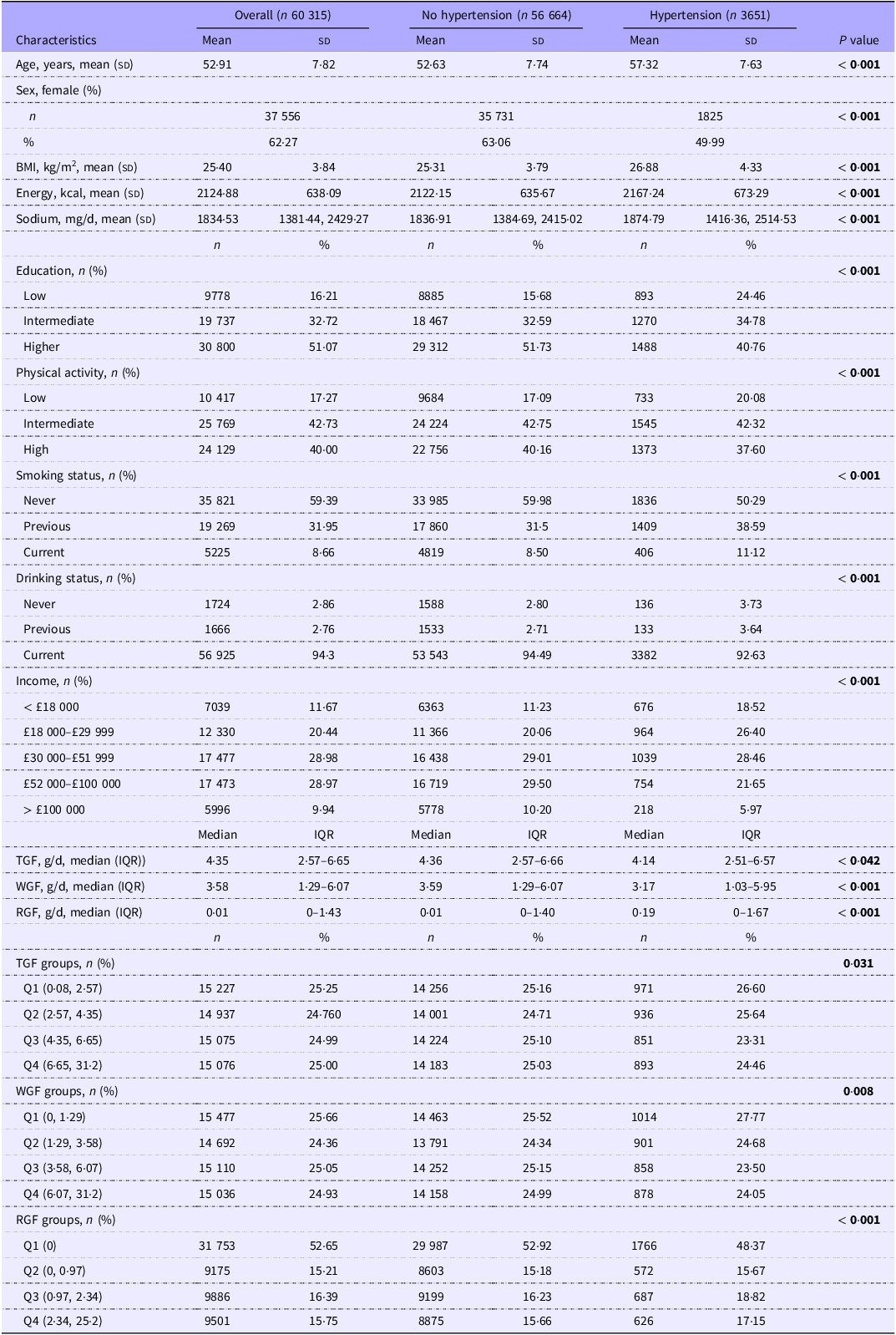
The participants’ baseline characteristics are shown in Table 1. We included 60 315 participants in the current study, of whom 3651 (6·05 %) developed incident EHP during follow-up over a median follow-up of 10·3 years, with an incidence density of 6·08 per 1000 person-years. The mean age of the participants was 52·91 (7·82) years, and 62·27 % were female. Compared with the participants without EHP, those with EHP had lower intake of TGF and WGF but a higher intake of RGF. Additionally, participants with EHP were more likely to be older, overweight, smokers, former drinkers, less educated and they had higher intake of energy and sodium but lower levels of income and physical activity.
Baseline characteristics of EHP participants and non-EHP participants in UK Biobank

Table 1 Long description
A table comparing baseline characteristics of participants with and without hypertension in a study. The table has 18 rows and 11 columns, including overall statistics, data for participants without hypertension, and data for participants with hypertension. Column headers are Characteristics, Overall (n 60 315) Mean, Overall (n 60 315) SD, No hypertension (n 56 664) Mean, No hypertension (n 56 664) SD, Hypertension (n 3651) Mean, Hypertension (n 3651) SD, and P value. Row labels include Age, Sex, BMI, Energy, Sodium, Education, Physical activity, Smoking status, Drinking status, Income, TGF, WGF, RGF, and TGF groups. Each row provides mean values, standard deviations, and percentages for the respective characteristics. Notable trends include higher age, BMI, energy intake, and sodium intake in participants with hypertension compared to those without. Participants with hypertension also have lower levels of education, physical activity, and income. The table also shows differences in smoking status, drinking status, and intake of TGF, WGF, and RGF between the two groups.
Abbreviations: TGF, total dietary grain fibre; WGF, whole-grain fibre; RGF, refined grain fibre; EHP, essential hypertension; IQR, interquartile range.
Note: Data were expressed as mean (sd), median (Q25, Q75) or numbers (percentage %). The P values less than 0·05 were highlighted with bold font.
Associations of total dietary grain fibre and its subtypes with new-onset essential hypertension
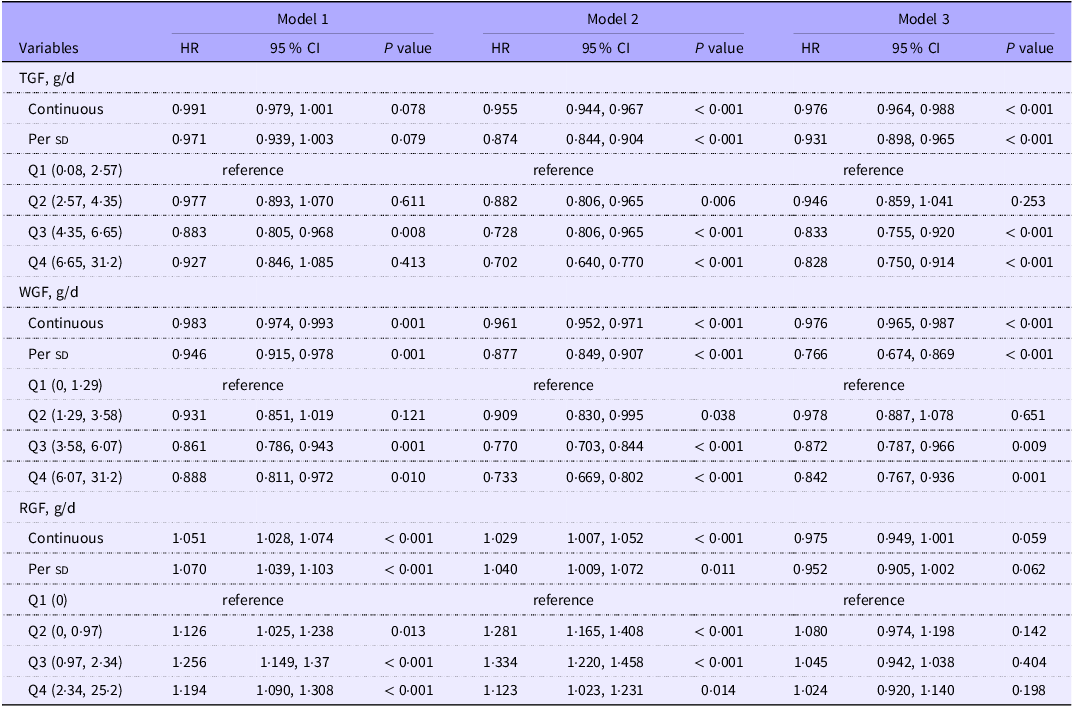
The results of the associations of TGF and its subtypes with new-onset EHP risk are shown in Table 2. In model 3, when TGF and WGF were regarded as continuous variables, the intake of TGF and WGF was inversely associated with EHP risk, with HR of 0·976 (95 % CI: 0·964, 0·988) for TGF and 0·976 (95 % CI: 0·965, 0·987) for WGF, respectively. For each sd increased in TGF and WGF, the risk of EHP decreased by approximately 7 % and 24 %, with HR of 0·931 (95 % CI: 0·898, 0·965) for TGF and 0·766 (95 % CI: 0·674, 0·869) for WGF. When TGF and WGF were evaluated as quartiles, compared with Q1, the HR for Q2, Q3 and Q4 were 0·946 (95 % CI: 0·859, 1·041), 0·833 (95 % CI: 0·755, 0·920) and 0·828 (95 % CI: 0·750, 0·914) for TGF, and 0·978 (95 % CI: 0·887, 1·078), 0·872 (95 % CI: 0·787, 0·966) and 0·842 (95 % CI: 0·767, 0·936) for WGF, respectively.
The associations of TGF, WGF and RGF with new-onset EHP

Table 2 Long description
A table comparing the associations of TGF, WGF, and RGF with new-onset EHP across different models. The table has 15 rows and 12 columns. The columns are labeled as Variables, HR, 95 % CI, P value for Model 1, HR, 95 % CI, P value for Model 2, and HR, 95 % CI, P value for Model 3. The rows are labeled as TGF, g/d Continuous, TGF, g/d Per sd, TGF, g/d Q1 (0.08, 2.57), TGF, g/d Q2 (2.57, 4.35), TGF, g/d Q3 (4.35, 6.65), TGF, g/d Q4 (6.65, 31.2), WGF, g/d Continuous, WGF, g/d Per sd, WGF, g/d Q1 (0, 1.29), WGF, g/d Q2 (1.29, 3.58), WGF, g/d Q3 (3.58, 6.07), WGF, g/d Q4 (6.07, 31.2), RGF, g/d Continuous, RGF, g/d Per sd, RGF, g/d Q1 (0), RGF, g/d Q2 (0, 0.97), RGF, g/d Q3 (0.97, 2.34), RGF, g/d Q4 (2.34, 25.2). The table presents hazard ratios (HR), 95% confidence intervals (CI), and P values for the associations of TGF, WGF, and RGF with new-onset EHP across three models. Notable trends include inverse associations of TGF and WGF with EHP risk when regarded as continuous variables in Model 3, with HR of 0.976 for TGF and 0.976 for WGF. For each standard deviation increase in TGF and WGF, the risk of EHP decreased by approximately 7% and 24%, respectively. When evaluated as quartiles, compared with Q1, the HR for Q2, Q3, and Q4 were 0.946, 0.833, and 0.828 for TGF, and 0.978, 0.872, and 0.842 for WGF, respectively.
Abbreviations: TGF, total dietary grain fibre; WGF, whole-grain fibre; RGF, refined grain fibre; EHP, essential hypertension; HR, hazard ratios.
Note: Model l, crude; Model 2, adjusted sex, age and energy; Model 3, further adjusted sodium, BMI, physical activity, smoking status, drinking status, income and education for TGF, and mutually adjusted WGF or RGF for RGF or WGF.
However, the intake of RGF was not associated with EHP risk in multivariable model. The HR of EHP was 0·975 (95 % CI: 0·949, 1·001) for continuous variable. With one sd increased in RGF, the HR was 0·952 (95 % CI: 0·905, 1·002). When the participants without RGF intake were regarded as the reference, the HR of 1st, 2nd and the highest tertiles were 1·080 (95 % CI: 0·974, 1·198), 1·045 (95 % CI: 0·942, 1·038) and 1·024 (95 % CI: 0·920, 1·140), respectively.
Dose–response analyses of the total dietary grain fibre, whole-grain fibre and essential hypertension
After adjusting for multiple covariates as previously adjusted in model 3, there were linear associations between TGF, WGF and the risk of EHP in restricted cubic spline analyses (P for overall < 0·001, P for non-linear = 0·064 on TGF and P for overall < 0·001, P for non-linear = 0·440 on WGF, respectively) (Figure 2). It was shown that as the intake of TGF and WGF increased, the risk of EHP decreased.
The associations between TGF, WGF and new-onset EHP. (a). The association between TGF and new-onset EHP. Adjusted for sex, age, BMI, smoking status, drinking status, energy, education, income, physical activity and sodium. (b). The association between WGF and new-onset EHP. Adjusted for sex, age, BMI, smoking status, drinking status, energy, education, income, physical activity, sodium and RGF. Abbreviations: TGF, total dietary grain fibre; WGF, whole-grain fibre.

Mediation analyses
The mediating effects of the TyG index and INFLA-score in the associations between TGF, WGF and EHP are present in Figure 3. The TyG index and INFLA-score acted as significant partial mediators in the associations between TGF, WGF and EHP, with intermediate proportions of 4·2 % and 3·3 % for TGF, and 4·9 % and 5·2 % for WGF, respectively. Furthermore, in the parallel multiple mediation models, the mediation effects of TyG index and INFLA-score together accounted for 5·6 % and 7·4 % in the associations of TGF and WGF with EHP, respectively (Figure 3(e) and (f)).
The mediation effects of TyG index and INFLA-score on associations of TGF and WGF with EHP. Model adjusted age, sex, energy, sodium, BMI, physical activity, drinking status, smoking status, income, education and RGF for WGF. (a). The mediation effect of INFLA-score on association of TGF with EHP. (b). The mediation effect of INFLA-score on association of WGF with EHP. (c). The mediation effect of TyG index on association of TGF with EHP. (d). The mediation effect of TyG index on association of WGF with EHP. (e). In parallel mediation analysis, the overall mediation effect of TyG index and INFLA-score on association of TGF with EHP. (f). In parallel mediation analysis, the overall mediation effect of TyG index and INFLA-score on association of WGF with EHP. Abbreviations: INFLA, inflammatory index score; EHP, essential hypertension; TGF, total dietary grain fibre; WGF, whole-grain fibre.

Stratified analyses and sensitivity analyses
In the stratified analyses, the results still remained statistically significant. The protective effect of higher TGF against the occurrence of EHP was still significant in females, those aged 45 years and older, and those with BMI of ≥ 18·5–< 25 kg/m2 and ≥ 25–< 30 kg/m2. The effects of WGF on EHP were consistent with those of TGF, except in the subgroup with a BMI of 25–30 kg/m² (online Supplementary Table S5).
In the sensitivity analyses, the results were consistent with the primary results after considering competing risk of death (online Supplementary Table S6) and excluding participants with a history of heart attack or stroke (online Supplementary Table S7).
Discussion
In this large prospective cohort study, we found that TGF and WGF were inversely associated with EHP risk in multivariate Cox analysis, and the consistent results were observed in the dose–response analyses. However, no association was observed between RGF and EHP risk. In the stratified analyses, the protective effects of TGF and WGF on EHP were found in females, participants over 45 years and with a BMI of >= 18·5–< 25 kg/m2, while no association was observed for RGF and EHP in all subgroups. Notably, in the sensitivity analyses that considering competing risk of death and applying stricter exclusion criteria, TGF and WGF still exhibited protective effects on EHP, which were in line with the primary analyses. Additionally, we also found that the TyG index and INFLA-score partially mediated the associations between TGF, WGF and EHP, and the associations remained statistically significant.
Some single sources of TGF, such as cereals, oats and barley, have been confirmed to have protective effect on hypertension or blood pressure levels(Reference Alonso, Beunza and Bes-Rastrollo10–Reference Farag, Xiao and Abdallah17). However, fewer studies have investigated the relationship of overall TGF and EHP based on large sample size in general population. A cohort study of females found an opposite association between TGF and EHP, which aligns with our results(Reference Fulgoni, Brauchla and Fleige20). More importantly, our research revealed that only WGF exhibits a protective effect against EHP, whereas RGF showed no significant association. This difference can be attributed to variations in processing methods, which affect fibre structure and bioavailability(Reference Dhingra, Michael and Rajput5). RGF may lose many beneficial ingredients that are rich in WGF(Reference Dhingra, Michael and Rajput5). Supporting our findings, a prospective study noted an inverse relationship between WGF and hypertension, although it was conducted among adolescents(Reference Fulgoni, Brauchla and Fleige20). Furthermore, results from single source of WGF or RGF also verified our results. For example, oat fibre, a source of WGF, has been demonstrated to have a protective effect against hypertension(Reference Bouchard, Valookaran and Aloud15,Reference Yuan, Lingling and Jindan16) , while source of RGF, wheat bread fibre, was not significantly associated with blood pressure levels(Reference Tripkovic, Muirhead and Hart18).
TyG index mediated the association between dietary grain fibre and EHP, explaining 4·6 % of the effect for TGF and 4·9 % for WGF in our study, respectively. The results from one meta-analysis of cohort studies indicated that high intake of fibre-rich grains might reduce IR and type 2 diabetes risk by 20–30 %(Reference Schwingshackl, Hoffmann and Lampousi37). The exact mechanisms connecting IR to hypertension are not fully elucidated but may involve the activation of the renin-angiotensin system and promotion of endothelial dysfunction(Reference Janus, Szahidewicz-Krupska and Mazur38,Reference Fonseca39) . Additionally, we found that systemic inflammation may also mediate the relationship between dietary grain fibre and EHP, with INFLA-score potentially explaining 3·6 % and 5·2 % of the associations between TGF, WGF and EHP, separately. An ongoing USA cohort study observed that higher intake of cereal fibre was associated with lower systemic inflammation, possibly due to inhibiting inflammasome activation, monocyte or macrophage activation, and lowering levels of markers of C-reactive protein(Reference Shivakoti, Biggs and Djoussé40). Dauphinot et al. found that for every 1 mg/L increase in C-reactive protein, there was an 18 % increase in the two-year risk of developing new-onset hypertension(Reference Dauphinot, Roche and Kossovsky41). Earlier research indicated that reducing inflammation may help lower hypertension risk by down-regulating angiotensin receptor expression, decreasing the release of plasminogen activator inhibitor-1, inhibiting vascular smooth muscle activation, enhancing vascular endothelial cell responses to vasodilatory substances and improving nitric oxide bioavailability(Reference Savoia and Schiffrin42). Furthermore, we also found that the total mediating proportions of the TyG index and INFLA-score were 6·8 % between TGF and EHP, and 7·4 % between WGF and EHP. This suggests that the effects of TGF and WGF on EHP are channelled through various pathways, each contributing to the overall effect. Our results clarified the degree to which IR and systemic inflammation can mediate the associations between TGF, WGF and EHP. However, the mediating proportions of the TyG index and INFLA-score were small in our results. Therefore, further research is needed to be validated in the associations of dietary grain fibre and its main subtypes with EHP(Reference Mann, Lam and Uhlig43).
Our study has three strengths. First, we utilised the data from UKB, a large cohort study with long-term follow-up(Reference Sudlow, Gallacher and Allen26), which further confirmed the protective effects of TGF and WGF on EHP. Second, we presented an opportunity to evaluate the dose–response relationships between TGF, WGF and EHP among the general population. Our results found that TGF was associated with a lower risk of developing EHP, especially at < 7 g/d. Furthermore, the risk of EHP continued to decrease with increasing WGF. Third, we found the TyG index and INFLA-score mediated these associations, which provided a basis for exploring the potential mechanisms linking TGF, WGF and EHP.
Nonetheless, several limitations exist. First, dietary data were collected using baseline touchscreen FFQ based on self-report, which may introduce retrospective bias. Second, despite extensive adjustment for potential confounders considered in our study, bias due to unmeasured confounding factors may still exist. Third, due to data limitations, we were unable to explore the association between soluble fibre from WGF and RGF and the risk of EHP. Additionally, further research is required to evaluate the association of other grain fibre sources, such as rice and beans, with the risk of EHP.
Conclusions
This study found that a higher intake of TGF and WGF is significantly associated with a reduced risk of EHP. Our findings indicated that the higher intake of TGF, especially WGF, may reduce the risk of EHP, and this protective effect was only partly mediated by systemic inflammation and IR.
Given the widespread insufficiency of total dietary fibre intake, many countries have established intake standards for total dietary fibre and recommended increasing grain fibre consumption. Dietary grain fibre is the largest source of total dietary fibre in all countries, while none proposed specific standards for it. More reliable and powerful evidence is still needed to clarify the role of TGF, particularly WGF in EHP, and to establish intake recommendations through community intervention programmes. Our findings may inform future research and the development of dietary guidelines.
Supplementary material
For supplementary material/s referred to in this article, please visit https://doi.org/10.1017/S0007114526106618
Acknowledgements
This research was conducted using the UK Biobank study under Application Number 95715. We extend our sincere gratitude to all the UK Biobank participants, the investigators and the management team for their invaluable contributions.
This research received no specific grant from any funding agency, commercial or not-for-profit sectors.
Conceptualisation, Data curation and Formal analysis, J. Z.; Methodology, J. Z. and W. W.; Resource, W. W. and D. Z.; Software, J. L.; Visualisation, J. Z. and Y. K. All authors have read and agreed to the published version of the manuscript.
The authors declare no competing interests.