I. INTRODUCTION
Melting of crystalline solids is a topological order-to-disorder transition in which a solid phase with long-range translational symmetry becomes a liquid with topological disorder. Melting is a first-order phase transition that involves discontinuous change in latent heat and volume at melting point.Reference Ubbelhode1 Born,Reference Born2 on the one hand, described melting as a mechanical instability of solid phase associated with the loss of shear rigidity, which implies that melting is a continuous transition without nucleation and growth of the melt.Reference Born3, Reference Born4 Lindemann,Reference Lindemann5, Reference Gilvarry6 on the other hand, related melting to thermal vibrations of atoms: melting occurs when the atomic mean square displacement (MSD) reaches a critical value. Both models are one-phase theory without consideration of the liquid phase and do not take into account the discontinuous character of first-order phase transition. Experimentally, elastic shear moduli of solids decrease with increasing temperature but do not reach zero at melting point. The MSD, on the other hand, does show increase in magnitude as melting point is approached. TallonReference Tallon, Robinson and Smedley7–Reference Tallon9 modified Born’s criterion by stating that the shear modulus of a cubic crystal could reach zero at a higher melting temperature if the volume of the crystal is extrapolated smoothly across the gap at melting to that of the liquid phase. To induce the Born–Tallon instability, large volume expansion is needed by introducing a large number of point defects, such as vacanciesReference Gorecki10, Reference Gorecki11 and interstitials,Reference Lennard and Devonshire12, Reference Nordlund and Averback13 and sometimes line defects.Reference Ninomiya14 For thermal melting, these scenarios may seem farfetched as it is impossible to achieve such high defect densities (a few percent) in either experiment or computer simulation.Reference Kanigel, Adler and Polturak15, Reference Bai and Li16 In practice, melting is always found as a heterogeneous process that nucleates at exterior surfaces, grain boundaries, or other internal imperfections.Reference Uhlmann17, Reference Cahn18 Because one cannot reach such a high density of defects uniformly in equilibrium melting, the question of whether melting is intrinsically continuous remains unanswered.
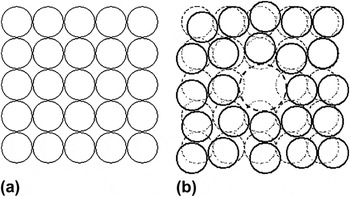
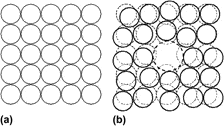
Here we examine this question from a different perspective in alloy systems. In alloys, a solute atom can be considered as another type of “point defect” to the host crystalline phase because different elements have different physical and chemical properties. Mixing different alloy elements introduces certain incompatibility, which in turn, results in various disorders in a host crystal. One of the outcomes is the strain field: because of the atomic size mismatch or varying interatomic integrations, adding a solute atom into a perfect crystal causes displacements of the host atoms from their equilibrium positions, creating internal strain (see Fig. 1). The static disorder caused by solute atoms can be measured as in Debye–Waller factor.Reference Krivogla19, Reference Kuhs20 The disorder results in increasing anharmonicity in lattice vibrations and softening in elastic constants, which in turn, give rise to additional thermal disorder. Therefore, in alloy systems, melting is the result of both thermal agitation (as a function of temperature T) and solute-induced static disorderReference Voronel, Rabinovich, Kisliuk, Steinburg and Sverbilov21–Reference Lam, Okamoto and Li23 (as a function of solute concentration x). It is generally found that the melting point in alloy systems is depressed as the concentration of solutes increases. Unlike other point defects, solute concentration can be made much higher,Reference Porter and Easterling24 and besides, they can be distributed uniformly. So we may have an opportunity to examine the nature of melting that is impossible in pure systems. In this study, we elucidated the roles played by the solute atom and its induced static displacement in thermal melting.
Schematic illustration of solute-induced local atomic configuration change or disorder that causes strain field in the sample. (a) The solvent atoms arranged in a crystal of a square lattice. (b) Introduction of a larger solute atom to the crystalline lattice causes local distortions. The circle with solid line is the new position of the solvent atoms after displaced by the solute and the ones with dashed line are the solvent atoms on the perfect crystal lattice as in (a).

In equilibrium melting of alloys, the solute concentration in the crystalline phase redistributes or partitions into liquid, resulting in the co-existing region bounded by a solidus line (melting) and a liquidus line (freezing) with different solute concentrations.Reference Porter and Easterling24 With appropriate heating rate, however, the solute redistribution can be prevented. Crystal-to-liquid transition under such constraint is called polymorphic melting. In other words, a crystalline solid of a specific solute concentration melts to a liquid of the same concentration,Reference Kamenatskaya and Shefta25–Reference Lee, West, Smith, Aziz and Knapp27 which provides an ideal scenario for studying melting that can be compared directly to single-component systems. In other words, one can focus exclusively on topological disorder without being distracted by the chemical disorder. However, fast kinetics makes polymorphic constraint difficult to realize fully at high temperatures, especially for metals.Reference Johnson28 By contrast, polymorphous melting in some semimetals and covalent systems, such as Si–As alloy, could be achieved because As atom has limited diffusivity in solid Si.Reference Allen, Fecht and Perepezko26, Reference Lee, West, Smith, Aziz and Knapp27 In this study, therefore, we used the experimental results from Si–As to test and validate our theory.
To develop a theory for polymorphic melting, we need to take into account two unique features that are not present in perfect, pure systems. The first is the static disorder. Under polymorphic constraint, the defects created are localized for the lack of mobility on the time scale compared with the observation time.Reference Johnson28 So the disorder associated with the solute is static. The second is the elastic energy associated with the strain field around these static defects. Figure 1 illustrates schematically how strain is created around such a defect associated with a solute atom. The presence of strain field then causes the softening of elastic constants, which makes the thermal vibration–induced atomic displacement easier and the crystal becomes more anharmonic. The combined effects will eventually lead to melting. The chief purpose of this work was to establish the link between these causes and cast the above scenario into a formal theory of thermal melting in alloy systems. Note that various thermodynamic models such as regular solution model can be used to “model” polymorphic melting. In general, however, they do not provide the connection to the underlying microscopic mechanisms. To this end, we propose a simple Landau theory.Reference Li, Johnson and Goddard29–Reference Löwen and Lipowsky32 The primary order parameter in this model is the mean atomic displacement as defined by Lindemann, and the secondary order parameter is the defect-induced strain. The identification of these two quantities as order parameters allows us to construct a two-phase theory to describe the transition between crystalline and liquid phases. Moreover, we let the internal strain couple with the atomic displacement to mimic the interaction between the two. This coupling is the key to melting. The interaction between the two order parameters becomes more intensified as more defects are created. Eventually, the system reaches a point where the free energy of the solid equals that of a liquid phase, resulting in melting.
II. PHENOMENOLOGICAL MODEL
Melting of a crystal to a liquid phase is characterized by the disappearance of the Bragg diffraction in scattering experiments at melting point, which signals the emergence of a topologically disordered phase. The reason for this structural change is the disorder in position caused by random displacement of atoms from their equilibrium lattice positions under thermal agitation. LindemannReference Lindemann5 and later GilvaryReference Gilvarry6 proposed that melting occurs when the root-mean-square displacement (RMSD) of the vibrating atoms reaches some critical value, or 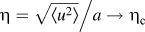 , where a is the equilibrium nearest-neighbor atomic distance and η c is the Lindemann constant. In general, 〈u 2〉 consists of two parts,
 , where
 is the dynamic MSD directly related to thermal vibration and
 is the static component from the position disorder caused by the solutes (Fig. 1). In alloys, both are important to melting. Therefore, we use the MSD as an order parameter in the Landau theory. Melting occurs when 〈u 2〉 reaches a critical value. In polymorphic melting,
 is well-behaved in both the solid and the liquid phases. Although
 diverges in liquid because of diffusion, it is valid to include
 for melting.
For a one-component crystalline phase subject to thermal agitation, we can write the free energy density asReference Li, Johnson and Goddard29–Reference Löwen and Lipowsky32

Unlike the usual definition of an order parameter, in this work, η → 0 is for the ordered state and η → 1 is for disordered state. a, b, and c are coefficients with a = a 0 (T 0 − T), a 0 > 0, and T 0 is a reference temperature, b ≥ 0, and c > 0. F 0 (T) = F (η = 0, T) is the free energy of the defect-free crystal. The choice of this expression by including only even terms in F(η,T) is from the consideration that only 〈u 2〉 is physically meaningful, where 〈…〉 stands for thermal and configuration average. This choice also allows us to include the bilinear coupling between the displacement and the strain (see below).
In alloys, additional terms are needed to describe the contributions from the strain energy and the coupling between the MSD, η, and the solute-induced strain, ε′ (Fig. 1). Here we shall use only the shear or deviatoric strain, ε = ε′ − 1/3tr(ε′), which is based on the consideration that shear softening is the dominant mode in melting. The Landau model, therefore, has two-order parameters, the primary one, η, and the secondary one, ε. The free energy density is expressed as

ΔF(η,T) is given in Eq. (1a). The strain energy contribution is given by
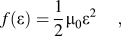
where μ 0 is the bare shear elastic constant of the solvent.

is the bilinear coupling term between the position disorder η and the shear strain ε with coefficient γ.
A. Melting of pure elements
In pure systems, Eqs. (1c) and (1d) do not show up. Thermal melting can be described well as a first-order transition with Eq. (1a). When approaching melting, the coexistence of the solid and liquid phases requires that  and the thermodynamic stability condition
 . From these conditions, along with the condition for equilibrium coexistence, F (η,T) = F 0(T), at melting, we obtain the melting point
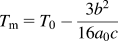 and the relation among the coefficients
 at melting point. The MSD changes as
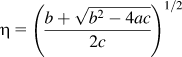 toward the melting point. At T = Tm, there is a finite jump
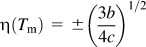 from crystal to liquid phase. The change in heat capacity is
 . The susceptibility associated with the order parameter is
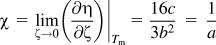 , where ζ is the conjugate field to η. In addition, the energy barrier at melting is
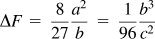 , which is determined by the constants b and c. By fitting experimental values from MSD, Δc, latent heat, ΔS, etc. at melting, we could obtain the coefficients (a 0, b, and c) for a specific material system (see Section III).
B. Melting of binary solid solutions under polymorphic constraint
Equations (1b)–(1d) describe polymorphic melting in alloy systems. Since there is no external applied stress, under static equilibrium condition, the internal stress should be zero, or 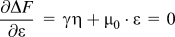 , from which we obtain
 . Substituting this relation in Eq. (1), we obtain the effective free energy in terms of η only:

where
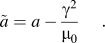
Equation (2) is the free energy that is used to describe thermal melting of alloys.
To take into account the alloying effect, we consider the Landau free energy in Eq. (2) with the coefficients

where T and x stand for temperature and the alloy or impurity concentration of a binary alloy.
Following the protocols in Landau theory, we consider the choice of the functional form for the coefficients. For thermal melting of a single component system, we take a = a 0(T 0 − T), b(x) = constant, and c = constant, which led to the results in the previous section. For binary alloy under polymorphic constraint, we can rewrite Eq. (3) as

where 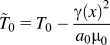 .
As done routinely in the Landau theory, we shall choose the functional form for γ(x) and b(x) by keeping the lower order dependence of the impurity concentration x, which allows for easy treatment of the problem. For γ(x), we have


where γ (x) ≥ 0 with appropriate choice of coefficients γn (n = 1, 2, 3,…) such that the coupling of the MSD to the strain becomes stronger as x increases. xc is the critical solute concentration where the coupling is expected to disappear in liquid phase because internal stress relaxes very fast. For b(x), we choose

such that b(x) ≥ 0 always with the appropriate choice of the coefficients bn (n = 0, 1, 2, 3,…). The trend shown in b(x) is inspired by the experimental observation that anharmonicity induced by the solvent atoms increases with solute addition.Reference Krill, Li, Garland, Ettl, Samwer, Yelon and Johnson33 Such a choice for b(x) may not hold in high solute concentration where different interactions among solutes and local atomic configuration and chemical ordering may occur. We shall discuss this point further in Section IV.
III. RESULTS
The free energy defined in Eq. (2) with the coefficients specified above leads immediately to several interesting, although not entirely unexpected, results. One is the depression of the melting point with increasing solute concentration. Since the system is kept under polymorphic constraint, the chemical equilibrium  is not satisfied (otherwise, solute atoms would partition into solid and liquid phases). However, the topological order-to-disorder transition described in Eq. (2) is still determined by the conditions ΔF eff = 0 and
 . Same as in pure system, the relation
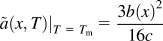 still holds, from which we can obtain the melting line, that is, melting temperature vs. solute concentration:

Equation (8) shows that the melting point is depressed by two factors, the internal strains represented by increasing γ (x) and the anharmonic effects represented by b(x). The slope of the melting line with respect to x is described by

As γ (x) and b(x) increase with x, the larger the amount of solute or impurity is added, the lower the melting point becomes, which agrees with the results in the majority of binary systems.Reference Massalski and Okamoto34
Other thermodynamic properties can also be derived. For example, the MSD at melting is 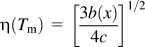 , the entropy change
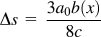 , the heat capacity change
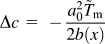 , and the activation energy barrier
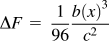 . More importantly, the effective elastic constant in the disordered system can be obtained as

where the order parameter susceptibility is 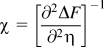 . Since μ 0 is the elastic shear modulus in the pure system at x = 0, Eq. (10) shows that addition of solute to the host lattice indeed causes softening of the elastic modulus. The softening is caused by two factors, the solute-induced strain field via γ and temperature through the relation χ =
 . At a given temperature, as more solute is added, the softening becomes more significant and the system becomes more susceptive to the static disordering. Since
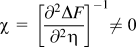 and γ (x) is finite at melting, the shear modulus at the polymorphic melting point still remains finite, which is different from Born’s prediction.Reference Born2
IV. COMPARISON WITH EXPERIMENT
Under high heating rate, the polymorphic condition could be achieved but the time window available is short, which makes experimental measurement difficult. However, some relatively reliable data sets are available in covalent bond alloys or semimetal systems,Reference Allen, Fecht and Perepezko26, Reference Lee, West, Smith, Aziz and Knapp27, Reference Kittz, Reitano, Aziz, Brunco and Thompson35–Reference Baeri, Reitano, Malvezzi and Borghesi37 including several measurements for Si–As alloy by pulsed laserReference Kittz, Reitano, Aziz, Brunco and Thompson35 or line source electron beamReference Peercy, Thompson and Tsao36, Reference Baeri, Reitano, Malvezzi and Borghesi37 heating technique. Droplet emulsion technique is also used for Sn–Bi alloy.Reference Allen, Fecht and Perepezko26, Reference Lee, West, Smith, Aziz and Knapp27 Since the results are consistent from direct temperature measurement with several independent methods in Si–As by Kittz et al,Reference Kittz, Reitano, Aziz, Brunco and Thompson35 we fit the reported data to obtain the coefficients in our model.
To simplify the fitting process, we normalize the measured polymorphic melting points with the melting temperature of crystalline silicon. We also rescale the variables and coefficients, and so c = 1, T 0 = 1, and μ 0 = 1. And the rest of the variables and coefficients are as the following: 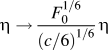 ,
 ,
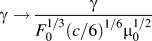 ,
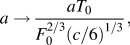 and
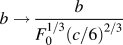 (F 0 is the reference free energy).
With the chosen forms for γ (x) and b(x) [Eqs. (6) and (7)], we have γ 1 > 0, b 0 > 0, b 1 > 0, and γn = 0 for n > 1, bn = 0 for n > 2,



With these relations, the melting point is expressed as

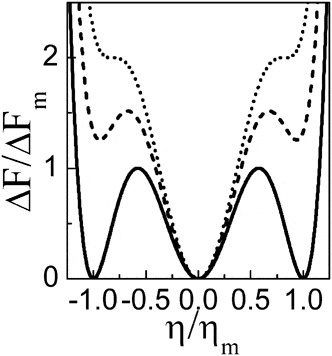
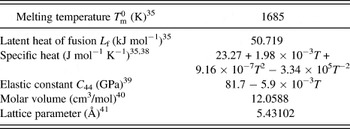
with 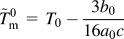 being the melting point of crystal silicon. From this relation and the experimental data for pure Si (Table I),Reference Kittz, Reitano, Aziz, Brunco and Thompson35, Reference Gurvich and Veyts38–Reference Hull41 we have a 0 = 0.100 and b 0 = 0.150 (and c = 1 as shown above). Fitting the melting line with available experimental data on Si–As (inset in Fig. 2), we have b 1 = 0.500 and γ 1 = 0.0569. Using these parameters, we can see the variation of the Landau free energies expressed in Eq. (2) with temperature for Si–As in Fig. 2.
The Landau free energy at different temperatures at x = 0.045 for Si–As alloy; the dotted line, dashed line, and solid line are for T = 1303 K, T = 1407 K , and T = 1556 K , respectively. The parameters used are a 0 = 0.100, b 0 = 0.150, b 1 = 0.500, and γ 1 = 0.0569. The Landau free energy and the primary order parameter are renormalized separately by the energy barrier 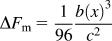 and
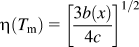 at the melting point.

Thermodynamic and elastic properties of crystal silicon.

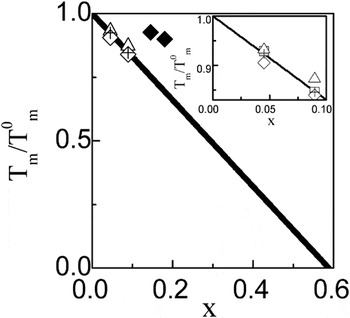
From the results, we can see that the melting point decreases with the increase in the solute concentration. Since the experimental data are available only in dilute solute concentration, the fitting appears in good agreement with the experiment. We can extrapolate the fitted melting line to higher solute concentration where few experimental data are available (Fig. 3).
The polymorphic melting diagram for Si–As solid solution. Solid line is the polymorphic melting line determined by this model and normalized by the melting temperature of crystalline silicon. Δ, ▫, ◊, and + indicate the measured data by Kittz et alReference Kittz, Reitano, Aziz, Brunco and Thompson35, and ♦ indicate the data by Lee et al.Reference Allen, Fecht and Perepezko26, Reference Lee, West, Smith, Aziz and Knapp27 The inset is the measured melting points within the dilute limit and our predicted melting line within this regime. The relevant parameters used are a 0 = 0.100, b 0 = 0.150, b 1 = 0.500, and γ 1 = 0.0569.

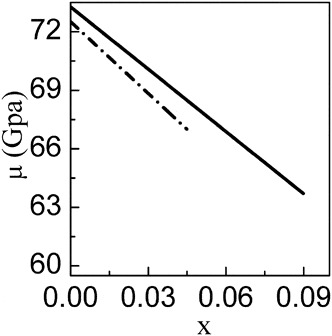
Although there was no direct measurement for the change of elastic constants in polymorphic melting of Si–As, from the coefficients obtained above and experimental data of pure Si, we can predict the change that might happen. As the variation of elastic constant C 44 of pure silicon is a (linear) function of temperatureReference Nikanorov, Burenkov and Stepanov39 between 150 and 1000 K from experiments (Table I), we can obtain the shear modulus of pure silicon at different temperatures, μ 0(T). So we can use them to estimate the shear modulus of the alloy system at different concentration x at the same temperatures through the relation μ (x,T) = μ 0 (T) − χγ (x)2. For example, C 44 = 72.5 GPa at T = 1556 K and C 44 = 73.3 GPa at T = 1427 K for pure Si. These values correspond to the melting points at x = 0.045 and x = 0.09 for Si–As alloy as seen from Fig. 3. Specifically, at a given temperature, the predicted elastic constant for the alloy is  , where the values for γ 1, a(T), and C 44(Si)(T) are known. So we have the elastic constants of the alloy at different As concentrations. Elastic softening is seen in Fig. 4 as a linear function of the solute concentration. For instance, at the above two temperatures, the shear modulus for Si–As alloy at melting points is C 44 = 67.7 GPa at x = 0.045 (T = 1556 K) and C 44 = 63.7 GPa at x = 0.09 (T = 1427 K).
The shear elastic constants of Si–As solid solution as a function of the solute (As) concentration. The solid line is the elastic shear modulus at T = 1427 K and dotted line is at T = 1556 K. The end of each line corresponds to melting point in the alloy where the shear elastic constants are still finite: x = 0.045 (T = 1556 K) and x = 0.09 (T = 1427 K).

The latent heat of fusion is defined as  with L f (Si) = 50.719 kJ mol−1 for pure crystalline silicon,Reference Peercy, Thompson and Tsao36, Reference Baeri, Reitano, Malvezzi and Borghesi37 and the calculated entropy change is 30.100 J K−1 mol−1 at the melting point T m(Si) = 1685 K. For alloy systems going through polymorphic melting, the predicted entropy change is
 (J K−1 mol−1), which is a function of the solute concentration x. Similarly, the predicted latent heat is
 (kJ mol−1). The heat capacity change at melting for pure crystalline silicon is Δc(Si) = −1.89 J mol−1 K−1, which is obtained by using the formula for crystal silicon and the data for liquid Si (Table I). The heat capacity of the alloy system is a decreasing function of the concentration as
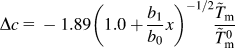 (J mol−1 K−1). Note that the heat capacity for pure Si is negative at melting.Reference Kittz, Reitano, Aziz, Brunco and Thompson35, Reference Gurvich and Veyts38 The same trend is observed in the alloys. Both free energy barrier
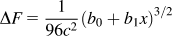 and the MSD
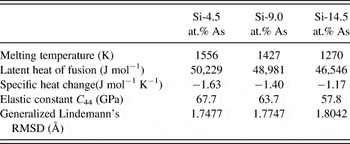
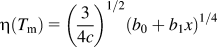 are a monotonic increasing function of the As concentration. Both quantities show explicit dependence on the choice of the coefficient b(x). We should mention in passing that the choice of a monotonic increasing function for b(x), and γ (x) as well, is based on the experimental results in dilute solute limit. This assumption, that is, linear dependence of b 2(x) on x, may break down at high solute concentrations, which will render a more complex form for b(x). A summary of some specific predicted properties at melting at some specific As concentrations and temperatures is listed in Table II.
Fitted thermodynamic properties for Si–As alloy at the melting point.

V. DISCUSSIONS
A. Role of solute-induced static position disorder in polymorphic melting
The concept of polymorphic melting was originally proposed as a stability limit of undercooled liquids by partitionless solidification.Reference Cahn and Haasen42 Its application to homogeneous, diffusionless crystal melting is limited by experimental difficulties mentioned earlier. Exact determination of polymorphic melting temperatures needs both reliable thermodynamic data and accurate modeling and calculation of the free energies of both the stable and metastable phases involved. Systematic measurements have been made in systems like Si–As and Sn–Bi, although there are still large differences among the reported results with various methods. Several thermodynamic models have been constructed that provide reasonable fits for the dilute solutions, including the regular solution model, but with significant differences in the metastable region.Reference Murray43
To establish the connection of polymorphic melting to atomic mechanisms, which is missing in the modeling effort mentioned earlier, the role of the solute-induced static disorder played in melting has been explored.Reference Johnson28, Reference Krill, Li, Garland, Ettl, Samwer, Yelon and Johnson33, Reference Li and Johnson44–Reference Lee, Cagain, Johnson and Goddard49 The atomic size difference and the size-mismatch–induced elastic strain energy have been the initial focus.Reference Krill, Li, Garland, Ettl, Samwer, Yelon and Johnson33, Reference Johnson, Li and Krill45–Reference Egami51 We included this crucial part into a Landau free energy. The strain couples to the atomic displacement, eventually causing melting [Eq. (8)]. We can illustrate this connection via a simpler argument using Lindemann criterionReference Voronel, Rabinovich, Kisliuk, Steinburg and Sverbilov21–Reference Lam, Okamoto and Li23: as 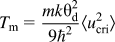 , where
 is the total critical MSD. The effective Debye temperature θ d for the disordered crystal is
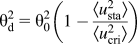 , where θ 0 is the Debye temperature of the defect-free crystal, and the average shear modulus is
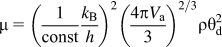 , where V a is the atomic volume and ρ is the density. From these relations, we have
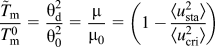 , where the ratio
 defines the contribution from the static disorder. From
 [Eq. (12)], we obtain the ratio,
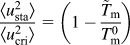 along the melting line. We can see that the solute-induced static MSD increases with the increasing solute concentration x. However, there are circumstances where melting point increases with solute addition.Reference Massalski and Okamoto34 Such case is mostly related to the increased interatomic bonding energy due to the solutes that have higher melting point. The enhanced bonding strength may override the effect caused by the strain, leading to increased melting line for the solid solutions made of low melting point elements. We shall deal with this case in a separate work.
Another link between polymorphic melting in alloy systems and the solute-induced disordering is through the softening of the shear elastic modulus, μ = μ 0 − γ 2χ. As we mentioned in the Introduction, the presence of static disorder introduces local strain that couples to the thermally induced disordering, the dynamic MSD, causing decrease in the shear modulus. In other words, the decrease in shear modulus is a precursor of static disordering. The depression of the melting line in alloy systems is the result of the combined effects.
B. T 0-curve, glass formability, and glass transition
The melting line  obtained above represents the thermodynamic stability limit of a metastable crystalline phase that goes through a diffusionless melting to a metastable liquid. The metastability lies in the polymorphic restriction on the concentration fluctuation, that is,
 . Conversely, the liquid would follow the same stability limit if it is cooled to the crystal under the same constraint. For this reason, the polymorphic melting line, also called T 0-curve, was used to estimate whether a liquid made of certain alloy composition could be a glass former.Reference Cahn and Haasen42
An alloy system with a large slope in the melting line indicates strong disordering induced by the solute [Eq. (9)]. So the crystalline phase has a low stability: when heated up, it will melt at low  polymorphically. Conversely, one can argue that the liquid with the same composition has a high stability: when cooled down, it can remain liquid till low temperature at
 . Such a system, therefore, has a strong tendency to form glass: the lower the polymorphic melting line of a crystalline alloy is, the better a glass former it is, which explains why eutectic system is usually a good glass former. If the melting line is so severely depressed that it plunges steeply at low temperature, or when
 , the melting line will cease to exist at a solute concentration beyond which the polymorphic melting/freezing transition does not exist anymore. The alloy systems outside the solubility limit, therefore, have the strongest tendency to form glass because there is no competing metastable crystalline phase any more. This concentration region defines the good glass-forming range.Reference Cahn and Haasen42
Practically, the glass formability is measured quantitatively by the critical cooling rate, which is the lowest cooling rate needed to make a glassReference Jalali and Li48 (since higher cooling rates can certainly result in glass formation anyway). From our theory, we can see that the critical cooling rate for the glass-forming systems beyond the solubility limit is the cooling rate required to maintain the polymorphic constraint—if lower cooling rate are applied, the liquid will turn into crystalline phases of different kinds, such as eutectic mixtures or other transient crystalline phases. Therefore, the T 0-curve gives the tendency of the best possible glass formability from thermodynamics. Unfortunately, our thermodynamic theory cannot predict the critical cooling rate directly. To do so, we need to consider kinetics and various rates associated with imposing the polymorphic constraint on different possible crystallizations. The same can be said in predicting the glass transition temperature T g. To do so, one has to formulate a (kinetic) theory involving the liquid and glass, a frozen liquid itself. The actual T g is determined by the kinetics of how one freezes a liquid to a glass.
C. Effect of high solute concentration
The Landau theory for polymorphic melting in binary solid solutions is tested using the experimental input from a Si–As system. The calculated results show good agreement in dilute solute region. Extrapolation into high concentration region gives various thermodynamic properties that can be compared with a few reported dataReference Kittz, Reitano, Aziz, Brunco and Thompson35–Reference Baeri, Reitano, Malvezzi and Borghesi37 (Table II). For example, the predictions at the two calculated melting temperatures corresponding to the concentration at x = 0.045 and x = 0.09 are very close to the measured data.Reference Kittz, Reitano, Aziz, Brunco and Thompson35 The obtained values of the latent heat of fusion show slight dependence on the concentration in the dilute region, whereas the measured data are independent of the composition.Reference Kittz, Reitano, Aziz, Brunco and Thompson35–Reference Baeri, Reitano, Malvezzi and Borghesi37 The values from our fitting decrease strongly with the concentration of solute atoms in high composition region. The predicted melting temperatures at high solute concentration, say x = 0.145 and x = 0.181, are 1270 K and 1165 K, respectively, which are lower than the experimental result reported by Lee et al.,Reference Allen, Fecht and Perepezko26, Reference Lee, West, Smith, Aziz and Knapp27 who argued that Asn-vacancy complexes might cause the higher melting point with the slower heating rate (Fig. 3). The disagreement may also stem from other causes. But we believe that if enough data from more systematic measurement are available, we should be able to capture these subtle variations. One way is to reselect the functional form for the two coefficients, γ (x) and b(x). In general, they should not be the simple (linear) functions of alloy composition.
VI. CONCLUSION
In this work, we report a simple, two-order parameter Landau theory to describe polymorphic melting in binary solid solutions. The two order parameters, the mean square atomic displacement η and shear strain ε, represent the two basic processes underlying the polymorphic melting. η measures the topological order-to-disorder transition and ε represents the strain caused by atomic size difference and limiting the partition or diffusion of solutes in alloys. To demonstrate the idea, we took the simplest form for the Landau free energy, where only one component of the strain tensor is taken and the coupling of the two-order parameters is bilinear. We obtained the melting temperature as a function of alloy concentration  and other thermodynamic properties at and around the melting line. From the model, we fitted the polymorphic melting line as a function of concentration in Si–As alloy using the measured and estimated thermodynamic data. The calculated melting point and other thermodynamic properties such as latent heat of fusion are consistent in trend with the reported data in dilute solutions. Extrapolation into high concentration region is also made and found to be reasonable. We also show the elastic softening caused by alloying. The result is consistent with the nature of the first-order transition, that is, there is a finite drop in elastic modulus at melting, which is different from Born’s theory.
The validity of the prediction at high alloy concentration needs further validation from experimental results. Although the thermodynamic theory cannot be used to predict the critical cooling rate, it shows that the glass formability is determined by a kinetic theory that should consider the rates of various kinetic processes of crystallization at the T 0-curve. Moreover, the glass transition should also be treated by a (kinetic) theory involving a glass-forming liquid and a glass.
ACKNOWLEDGMENTS
The authors acknowledge the financial support to this work provided partially by the National Science Foundation under Grant No. NSF-0907320. M.L. is also grateful for the partial support by the National Science Foundation under Grant No. PHY05-51164 at Kavli Institute for Theoretical Physics in University of California, Santa Barbara, where a part of this work was done.