Introduction
Village chickens can be found in all developing countries and play a vital role in the livelihood strategies of many poor rural households (Alders, Reference ALDERS2004; Alexander et al., Reference ALEXANDER, BELL and ALDERS2004; Spradbrow, Reference SPRADBROW1993/94). They provide much needed animal protein in the form of meat and eggs and can be sold or bartered to meet essential family needs, such as medicine, clothes and school fees. Village chickens are active in pest control, provide manure which can be used as a fertiliser, are required for special festivals and are essential for many traditional ceremonies. The production of village chickens is lower than that of intensively raised birds but it is obtained with a minimum input in terms of housing, disease control, management and supplementary feeding (Alders and Pym, Reference ALDERS and PYM2009). They are generally owned and managed by women and children and are often essential elements of female-headed households (Bagnol, Reference BAGNOL2001; Guèye, Reference GUÈYE2000). Village chickens place few or no additional burdens on women as, apart from the provision of household food scraps, the birds find their own feed and require little supervision.
As women are the main care-givers in the family, chickens can play an important role providing them with additional resources to carry out their vital task of supporting people living with HIV/AIDS (Alders et al., Reference ALDERS, BAGNOL, HARUN and YOUNG2005b). In households where there is a lack of able-bodied workers, such as households affected by HIV/AIDS (du Guerny, Reference DU GUERNY2002) or those that have a disabled family member, village poultry provide a source of high quality nutrition and income without requiring much in the way of labour or financial inputs. Eggs, in particular, are one of the best sources of highly digestible protein and offer an important source of nutrition containing approximately 315 kilojoules of digestible energy (DE) per egg. Eggs are rich in vitamins A, B12, and K (a bone-boosting nutrient), and also provide choline, a B vitamin that plays a role in brain development. In addition, eggs can be stored for several days under village conditions and require very little energy or time to cook.
In many countries, social goodwill is created by offering guests a meal containing meat, more often than not, poultry. Honoured guests may be given a live bird to take home, and so poultry enables families to participate fully in community activities. Improved village poultry productivity can also contribute to reducing poaching of wild animals for bushmeat.
Poultry have many advantages in mixed farming systems; they are small, reproduce easily, do not need large investments and can scavenge for food. They thrive on kitchen waste, broken grains, earthworms, snails, insects and vegetation. The rationale for incorporating village poultry production in a pro-poor livestock development policy is logical as such production is closely correlated with the poorest household. The identification of farmers whose only livestock is poultry can, in many cases, be a tool for targeting very poor farming households. Impact studies have demonstrated that income from the sale of eggs in South Asia is used to educate children and begin the process of asset accumulation (Dolberg, Reference DOLBERG2003). In addition, the sale of poultry products allows investment in other livestock such as goats, cattle, expanded poultry production and other business enterprises (Alders, Reference ALDERS2004). Village poultry are one of the few household assets over which women have authority enabling them a greater say in when the birds are disposed of and how any proceeds from sale are used.
Many village poultry based projects have demonstrated that it is possible to build on the scavenging system and to organise interventions that have an impact on poor households. Exactly what these interventions should be and how they should be organised vary according to local conditions. Reductions in mortality through Newcastle disease (ND) vaccination conducted by trained community vaccinators (Alexander et al., Reference ALEXANDER, BELL and ALDERS2004; GRM International, Reference GRM INTERNATIONAL2005) and improved management that protects young chicks for the first six to eight weeks, are high on the list (Dolberg, Reference DOLBERG2003). If the intervention is to be sustainable, increased production must be matched by a market for the sale of eggs, live birds or meat so that producers are able to pay for production inputs.
This paper focuses on lessons learnt in Africa and Asia over the past 15 years during the implementation of ND control activities as a first step to improving village chicken production in countries where this disease is endemic.
Village chicken production systems and major constraints
Village chicken production systems usually fall into two categories: extensive and semi-intensive (Alders and Pym, Reference ALDERS and PYM2009). In general, when compared with commercial production, there is less movement of products and inputs with village poultry production since, for instance, birds produce and hatch their own replacement stock and source their own feed.
Research in villages in different countries has revealed that the genetic potential of village chickens is generally not the major constraint to their productivity (Dolberg, Reference DOLBERG2003). In fact, in situations where there is limited supplementary feed, housing and veterinary medications, village chickens are often much more likely to survive and reproduce than commercial breeds. The heavier commercial breeds often have difficulty in escaping predators, are poor scavengers for feed and do not attain broodiness. Replacement stock must therefore be purchased rather than raised in the village.
Output of village poultry in terms of weight gain and number of eggs per hen per year is often low, but there is minimal input in terms of housing, disease control, management and supplementary feeding. Improving poultry production in a cost-effective manner requires the introduction of appropriate management skills, together with supplementary feed, disease control, shelter, improved flock management and development of effective marketing strategies. Improving village poultry management, including biosecurity practices, will make an important contribution to the prevention and control of highly pathogenic avian influenza (HPAI).
The profile of chicken farmers is an important component of production systems. Many people who raise village poultry have had limited or no access to formal education (Alders and Bagnol, Reference ALDERS and BAGNOL2007). Preparing effective information, education and communication (IEC) material for low-literate target groups requires special attention. IEC material, dealing with disease prevention and control, is especially challenging because of the wide range of perceptions about the origin of disease. Communities that have had limited access to formal education and are unfamiliar with the concept that disease is caused by pathogens will find most conventional recommendations on disease prevention and control difficult to comprehend.
Village poultry producers frequently lack confidence in or access to veterinary services (Alders and Spradbrow, Reference ALDERS and SPRADBROW2001). Historically, livestock services in many developing countries have focussed on large ruminant species owned and cared for by men and so have much less experience in reaching and effectively communicating with poor female village chicken producers. Consequently, high mortality in village poultry, especially in densely settled areas with continuous road traffic, has occurred regularly for many decades without effective intervention by government veterinary services.
A lack of effective coordination between the Ministries of Agriculture, Education and Health contributes to inadequate links with maternal and child nutrition programmes and school curricula that often include information on commercial, intensive poultry production only.
Major constraints to village poultry production include: high mortality due to disease and predation; lack of market access; and lack of support by animal health services.
Newcastle disease control in village poultry: options and lessons learnt
One of the major constraints to production of village chickens is ND (Alders et al., Reference ALDERS, DOS ANJOS, BAGNOL, FRINGE, LOBO, MATA and YOUNG2005a; Alders and Spradbrow, Reference ALDERS and SPRADBROW2001; Alexander, Reference ALEXANDER1991; Copland and Alders, Reference COPLAND and ALDERS2005). In countries where ND is endemic, outbreaks of this disease in susceptible flocks regularly result in mortalities of 50 to 100%.
HPAI was first reported in Italy in 1878 (Stubbs, Reference STUBBS1926). As recently as the 1950s it was known as Fowl Plague, a term which included Newcastle disease, because the clinical signs were so similar. The number of recorded outbreaks of HPAI worldwide has increased over the past 10 years culminating in early 2004 with unprecedented and almost simultaneous outbreaks of the virulent H5N1 sub-type of HPAI involving at least ten countries in East and South East Asia (Capua and Alexander, Reference CAPUA and ALEXANDER2006). The rapid spread of the H5N1 sub-type has been due to a combination of spread by wild birds and trade (both legal and illegal) in poultry and poultry products. Even in areas free from HPAI, it is important that all key stakeholders have a good understanding of HPAI preparedness and prevention.
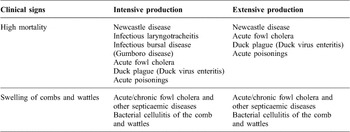
As poultry mortality due to ND and other diseases has been a relatively common occurrence, village poultry owners have developed a range of ways of salvaging some benefit from sick or dead birds. Consequently, the consumption and sale of sick birds remains a common practice among resource-poor farmers. Improved village poultry husbandry practices that include vaccination against killer diseases such as ND, fowl cholera and duck plague are essential to facilitate the early detection of HPAI (Table 1).
Differential diagnosis for HPAI (adapted from Alders, Reference ALDERS2006).

For these interventions to be sustainable, they must be cost-efficient and accompanied by appropriate training of (including preparation of standard operating procedures; Alders et al., Reference ALDERS, DOS ANJOS, BAGNOL, FUMO, MATA and YOUNG2003) and communication with all key stakeholders. Enabling farmers and the veterinary services to participate in visioning exercises and monitoring and evaluation activities contributes significantly to the design and implementation of sustainable ND vaccination campaigns.
Investigations into the control of ND in South East Asia and Africa have employed a range of different vaccines:
• Thermotolerant, live ND vaccines; NDV4-HR (Ideris et al., Reference IDERIS, IBRAHIM, SPRADBROW and HUNG SENG1987; Dias et al., Reference DIAS, ALDERS, FRINGE and MATA2001) and I-2 (Bensink and Spradbrow, Reference BENSINK and SPRADBROW1999; Dias et al., Reference DIAS, ALDERS, FRINGE and MATA2001);
• Partially thermotolerant live ND vaccine – Nobilis ND Inkukhu (Alders and Spradbrow, Reference ALDERS and SPRADBROW2001)
• Inactivated ND vaccines (Alders and Spradbrow, Reference ALDERS and SPRADBROW2001)
Experience gained during the implementation of ND control activities involving live, thermotolerant ND vaccines has shown that a sustainable programme is composed of five essential elements:
1. an appropriate vaccine, vaccine technology and vaccine distribution mechanisms;
2. effective extension materials and methodologies that target veterinary and extension staff as well as community vaccinators and farmers;
3. simple evaluation and monitoring systems of both technical and socio-economic indicators;
4. economic sustainability based on the commercialisation of the vaccine and vaccination services and the marketing of surplus chickens and eggs; and
5. support and coordination by relevant government agencies for the promotion and implementation of vaccination programmes (Copland and Alders, Reference COPLAND and ALDERS2005).
The AusAID Southern Africa Newcastle Disease Control Project, which followed earlier ACIAR-funded research activities, came to a successful conclusion in October 2005. The key lessons learnt during this project were:
• Liquid thermotolerant I-2 ND vaccine administered by community vaccinators protects against outbreaks of ND when administered every four months;
• Improved village chicken production is of particular benefit to female-headed households;
• Female community vaccinators are more likely to remain working in their home areas than their male counterparts;
• Training in administration at all levels is an essential component of an effective cost-recovery programme; and
• Village chicken producers are willing to pay for ND vaccination services when these services are effectively administered (GRM International, Reference GRM INTERNATIONAL2005; Alders et al., 2009).
The use of inactivated ND vaccines administered by community vaccinators in rural areas of two central provinces of Mozambique every six to nine months yielded disappointing results. The need to inject inactivated vaccines increased the cost of delivery and introduced risks associated with needle-stick injury and disposal (IRPC, Reference IRPC2006).
The highest mortality rate due to the H5N1 strain of HPAI in humans occurred in poor families, many of whom had been handling sick or dead birds. It is essential that people in remote areas are aware of the new threat posed by close contact with sick or dead birds and how to contain the disease should an outbreak occur. Adoption of HPAI prevention and control recommendations, including the rapid detection of outbreaks, will be easier in communities where the control of endemic killer diseases such as ND is working well and frequent high mortality of birds has become a rare event. A reduction of overall mortality in village poultry by vaccination against endemic killer diseases such as ND, fowl cholera and duck plague with rapid and effective disposal of dead birds is likely to be the most cost-effective approach to the long-term prevention and control of HPAI. It is essential that trust is developed between farmers and veterinary services as a basis for the development of mechanisms for the rapid reporting of bird mortalities. Special attention is required to ensure that female farmers are involved in improved poultry husbandry activities, so that effective and open communication is achieved between the farmers and veterinarians, extension workers and community vaccinators or community animal health workers.
When considering ND control, the decision to produce vaccine locally or to import it requires a thorough assessment of capacity and benefits, as both options have inherent advantages and disadvantages. Some issues that require consideration include:
• Sustainable use of imported vaccine may be distorted due to the payment of commission, sale of short shelf-life and out of date products to countries without a strong regulatory environment;
• The importance of building national capacity for quality control and quality assurance of veterinary pharmaceuticals to ensure good quality vaccines are used irrespective of whether vaccines are produced locally or imported;
• Promoting standards to ensure product details and instructions are available in local languages;
• Thoroughly defining and explaining the limitations and dangers of the vaccine in use in terms of thermotolerance, duration of immunity, safety for different age groups, etc;
• Developing a mechanism to ensure availability of vaccine in rural areas;
• Profiling the cold chain and developing strategies for appropriate conservation to ensure the administration of efficacious vaccine;
• Ensuring that freeze-dried vaccines are correctly diluted and administered; and
• Ease of ready-to-use liquid ND vaccines especially in areas where farmers and vaccinators have had little formal education and limited familiarity with the use of needles, syringes and sterile technique.
Conclusions and recommendations
The implementation of effective village poultry production programmes in Asia, Africa and Latin America has resulted in increased poultry numbers, increased household purchasing power, increased home consumption of poultry products and increased decision-making power for women (Alders, Reference ALDERS2004; Alders et al., Reference ALDERS, DOS ANJOS, BAGNOL, FRINGE, LOBO, MATA and YOUNG2005a; Dolberg, Reference DOLBERG2003; GRM International, Reference GRM INTERNATIONAL2005; Alders et al., 2009).
The rapid and wide geographical spread of HPAI H5N1 has drawn attention to the neglect of village poultry health. However, this crisis presents an opportunity to invest in improved village poultry husbandry that can make a positive contribution to human development in rural areas across a range of endeavours, including:
• Empowerment of women (increased productivity, increased knowledge, increased participation in community life as vaccinators, etc);
• HIV/AIDS mitigation;
• Wildlife conservation through reduced bushmeat consumption;
• Improved understanding of disease transmission, prevention and control, human nutrition and human hygiene; and, most importantly
• Building trust between communities and government agencies.
Key recommendations to support technically sound and sustainable ND control programmes in village chickens include:
• Veterinary pharmaceutical companies should be encouraged to develop and observe a code of conduct that supports the supply of appropriate vaccine with an adequate shelf life, instructions in local languages, the use of temperature indicators in the vaccine containers and discourages the payment of commission on the purchase of vaccine;
• Quality assurance activities should be built into all vaccination programmes to improve cost-efficiency. These activities should include post-vaccination serological monitoring on a representative sample of birds especially when a new vaccine or new disease control programme is introduced;
• Participation of farmers (male and female) in the monitoring and evaluation of the effectiveness of vaccination campaigns; and
• Active collaboration with the Ministries of Agriculture, Health and Education in village poultry improvement programmes.
Acknowledgements
The authors would like to acknowledge the support given to village poultry research and development by the Australian Centre for International Agricultural Research (ACIAR) and the Australian Agency for International Development (AusAID). Thank you also to our colleagues at the Food and Agriculture Organization of the United Nations (FAO), the International Livestock Research Institute and the International Rural Poultry Centre of the KYEEMA Foundation. Furthermore, our gratitude is extended to the veterinarians, extensionists, researchers, traders and farmers in many parts of the world who have given freely of their time and expertise over the years. Particular gratitude goes to the following donors to FAO's HPAI Prevention and Control programme: the Japan Official Development Assistance, the Asian Development Bank and the US Agency for International Development. The authors have worked under HPAI projects funded by these donors and their experiences and knowledge have contributed to the development of this paper.
This paper is based on a presentation given at the World's Poultry Science Association Asian Pacific Federation Working Group on Small-scale Family Poultry Farming held in Bangkok, Thailand, in March 2007.