


1. Introduction
The English article system is challenging for second language (L2) learners. English articles (the, a/an) morphologically encode definite and indefinite meanings.Footnote 1 L2 learners often struggle with the correct suppliance and appropriate usage of articles in obligatory contexts, resulting in article omission or misuse in L2 performance (Ionin et al. Reference Ionin, Heejeong and Wexler2004, Snape Reference Snape2008, Sarko Reference Sarko, García Mayo and Hawkins2009, among others). Some researchers have recently investigated the Morphological Congruency Hypothesis (MCH) (Jiang et al. Reference Jiang, Novokshanova, Masuda and Wang2011, Jiang et al. Reference Jiang, Guiling, Chrabaszcz and Lijuan2017) by examining how L2 learners process English articles in real time (e.g., Ionin et al. Reference Ionin, Choi and Liu2021, Cho Reference Cho2022, Snape et al. Reference Snape, Hosoi and Umeda2023). The MCH attributes these difficulties to morphological differences between the learner’s first language (L1) and L2, suggesting that morphological incongruency hinders the processing of new grammatical morphemes. Morphological congruency is defined in terms of grammaticalization and morphological marking of meaning (e.g., plural, tense, and definiteness). A grammatical L2 morpheme is considered incongruent if the associated meaning is not grammaticalized in the L1 grammar and, hence, is not activated in processing; however, it is congruent when both languages morphologically grammaticalize the associated meaning.
The MCH predicts that L2 learners are less sensitive to grammaticality during real-time processing when their L1 lacks a congruent grammatical morpheme (Jiang et al. Reference Jiang, Novokshanova, Masuda and Wang2011). This hypothesis was tested by measuring reaction times (RTs) to ungrammaticality in psycholinguistic tasks, such as self-paced reading (SPR). For congruent morphemes, slower RTs indicate an online sensitivity to ungrammaticality. A prolonged RT suggests that a grammatical rule is being violated, causing the brain to process information more slowly. For incongruent morphemes, rapid RTs indicate a lack of sensitivity, suggesting that the brain fails to detect violations, resulting in no processing delay. Jiang and colleagues examined plural marking in L2 English by Russian, Japanese, and Chinese speakers (Jiang Reference Jiang2004, Reference Jiang2007; Jiang et al. Reference Jiang, Novokshanova, Masuda and Wang2011; Jiang et al. Reference Jiang, Guiling, Chrabaszcz and Lijuan2017). Russian and English are morphologically congruent in plural marking, as both have obligatory plural morphemes, whereas Japanese and Chinese are incongruent with English because plural marking in these languages is optional and highly restricted.Footnote 2 In an SPR task, Russian speakers were sensitive to the omission of plural -s when required, while Japanese and Chinese speakers were not (Jiang Reference Jiang2004, Reference Jiang2007; Jiang et al. Reference Jiang, Novokshanova, Masuda and Wang2011). In a sentence-picture matching task, Russian speakers also showed slower RTs when presented with sentences that did not match in number with the referent in the corresponding picture. Conversely, Chinese speakers did not show the same effect (Jiang et al. Reference Jiang, Guiling, Chrabaszcz and Lijuan2017). These findings were argued to support the MCH. Jiang et al. (Reference Jiang, Guiling, Chrabaszcz and Lijuan2017: 84) attribute difficulty with incongruent morphemes to learners’ inability to “automatically activate” the associated meaning, which is not regularly activated in L1 processing.
The predictions of the MCH have been tested in the processing of English articles by L2 speakers both from article-less L1s (Mandarin Chinese, Korean, and Japanese) and from others with articles (Spanish) (Ionin et al. Reference Ionin, Choi and Liu2021, Cho Reference Cho2022, Snape et al. Reference Snape, Hosoi and Umeda2023). Unlike English, Mandarin Chinese, Korean, and Japanese lack articles, and hence do not grammaticalize (in)definiteness. In other words, they are morphologically incongruent with English. In contrast, Spanish is morphologically congruent with English because it uses definite and indefinite articles that morphologically express (in)definiteness. Ionin et al. (Reference Ionin, Choi and Liu2021) tested Mandarin speakers’ sensitivity to article violations in indefinite contexts, while Cho (Reference Cho2022) examined Korean speakers’ sensitivity to violations in definite contexts. Despite morphological incongruency, both Mandarin and Korean L2 speakers were sensitive to grammatical violations of English article use in an SPR task. Snape et al. (Reference Snape, Hosoi and Umeda2023) found counterevidence to the MCH regarding how Spanish and Japanese L2 speakers process definite English nominals. In the SPR task, Spanish speakers, despite having articles in their L1 (congruent), showed no sensitivity to inappropriate use of indefinite articles in definite contexts. Conversely, Japanese speakers, whose L1 lacks articles (incongruent), demonstrated some sensitivity. It should be pointed out here that the findings of Snape et al. are largely related to proficiency differences between the Spanish group and the Japanese group. Overall, the predictions of the MCH were not borne out in the language processing of L2 speakers whose L1s have articles or lack articles.
Arabic, a language with only a definite article, offers a unique perspective for testing the predictions of the MCH. Although both Arabic and English grammaticalize the semantic contrast of (in)definiteness, they mark indefiniteness differently. Unlike English, Arabic marks indefiniteness without an article (Lyons Reference Lyons1999, Fassi Fehri Reference Fassi Fehri2012). As in (1), Arabic uses bare singulars to indicate indefinite nouns (in bold), whereas English requires the use of an overt indefinite article. Spoken Arabic, however, can use the numeral wa:ħid ‘one’ to express a referential/specific indefinite (see section 2 for a detailed description).

This cross-linguistic difference raises the question of how Arabic L2 speakers would process English articles in an indefinite context. The MCH posits that Arabic and English are morphologically congruent because the semantic distinction between definite and indefinite nouns is grammaticalized, yet the contrast in meaning is differently marked. According to the MCH:
[…] a learner faces two very different tasks while learning a congruent versus an incongruent L2 morpheme. In learning a congruent morpheme, the related meaning is already part of routinely activated meanings as a result of learning the L1, so the task is to link the meaning to a new morphological marker. However, in learning an incongruent morpheme, a learner has to first learn to automatically activate a meaning that is not automatically activated in his or her L1. We suggest that this is where the difficulty lies. (Jiang et al. Reference Jiang, Guiling, Chrabaszcz and Lijuan2017: 84, emphasis added)
Taking Arabic as congruent with English, the learner’s task is to associate the new forms (the and a/an) with the already activated meanings of definite/indefinite in the L1. Learners need to associate the with ʔal- before definite nouns, and a/an with ‘zero’ before indefinite nouns. According to the MCH, this learning task should not be difficult because it lies at the level of linking meaning to a new form. However, it is unclear how this prediction can be applied to learners of L1s with single article equivalence (as in Arabic). Unlike in their L1, Arabic speakers must first learn that the use of some form of article is required before indefinite count nouns in English, and that singular count nouns without an article do not express indefiniteness. Arabic speakers then need to associate the definite meaning with the, and the indefinite with a/an. The mapping of the definite and indefinite meanings onto the two article forms is challenging, as it requires attention to contextual cues in the input (Calloway and Perfetti Reference Calloway and Perfetti2020). The learnability problem is assumed to be at the morpheme-encoding level. Form-meaning mapping is predicted to cause article misuse in indefinite contexts, particularly referential conditions. The article misuse pattern is predicted to interact with referentiality because of L1 transfer (optional use of wa:ħid ‘one’). Article omission is not predicted because definite/indefinite meanings are already activated in the L1.
In an approximate replication of Ionin et al. (Reference Ionin, Choi and Liu2021), the present study investigated Arabic speakers’ sensitivity to grammatical violations of English articles in referential and non-referential indefinite contexts.Footnote 3 The concept of referentiality is used to distinguish between indefinite nouns that do or do not exist in the actual world. Some languages optionally mark referential indefinites using the numeral ‘one’, such as Mandarin Chinese (yi + classifier) and Hejazi Arabic (wa:ħid). This study examined the effect of the presence of an optional indefinite referential marker in Arabic on the L2 acquisition of English indefinite article. The study employed an online SPR task and an offline Grammaticality Judgment (GJ) task in two experiments that investigated article omission (exp. 1) and article misuse (exp. 2) before indefinite singular count nouns, using the target items from Ionin et al. (Reference Ionin, Choi and Liu2021).
The article is structured as follows. Section 2 provides a cross-linguistic description of articles in English and Arabic, focusing on definiteness and referentiality. Section 3 reviews previous research on articles that have employed online and offline tasks. Section 4 presents the current study, followed by the method (section 5) and results (section 6) of the two experiments. The article concludes with a discussion of the research questions by considering the predictions of the MCH.
2. Articles in Arabic and English
2.1 Definiteness and referentiality in English
English grammaticalizes definiteness using two articles, the (definite) and a/an (indefinite). Definiteness is discourse dependent and reflects the state of knowledge shared between speakers and listeners (Ionin et al. Reference Ionin, Heejeong and Wexler2004). A definite article presupposes the existence of a unique referent in a set of possible nouns, whereas an indefinite article does not. A unique referent arises from general knowledge or previous discourse. This definite/indefinite distinction is illustrated in (2):

In (2), an indefinite article a is used to introduce cat into the discourse, followed by use of the definite article the to refer to the same cat. In the first appearance of the noun cat, the listener is not expected to identify a specific, unique cat, and its existence is not general knowledge; therefore, an indefinite article is used. Once shared knowledge about the noun cat has been established between the speaker and listener, the definite article is used.
English distinguishes between two types of indefinite nouns, referential and non-referential, based on the existence of a referent in the real world (Ionin et al. Reference Ionin, Choi and Liu2021). These referential categories denote meanings similar to [+/−Specific Referent]. Referential indefinite (+SR) refers to a particular individual whose existence is asserted in the real world, as in (3). In contrast, a non-referential indefinite (-SR) refers to an individual whose existence has not yet been established in the real world, as in (4)–(5). A non-referential reading occurs when the indefinite noun is within the scope of an intensional operator, as in (4), or modal operator, as in (5). (All three examples are from Ionin et al. Reference Ionin, Choi and Liu2021: 125.)


Although the semantics of referentiality entails a particular referent, as in (3), this referent need not be important from the speaker’s perspective. This definition of referentiality contrasts with specificity as defined by Ionin et al. (Reference Ionin, Heejeong and Wexler2004). In an earlier account (Ionin et al. Reference Ionin, Heejeong and Wexler2004), a cat is a specific indefinite only if the context indicates a noteworthy property deemed important by the speaker. In the latest account (Ionin et al. Reference Ionin, Choi and Liu2021), this noteworthy property is not involved in the interpretation of referential indefinites. Referentiality differs from specificity in that it entails the existence of a particular referent without a noteworthy property.
Regarding article distribution, English requires the use of definite or indefinite articles before singular count nouns. The omission of articles before these nouns is ungrammatical (*φ cat). The use of the indefinite article a/an is restricted to singular count nouns (a cat vs. *a cats) and abstract nouns (an understanding). The null article is used before indefinite plural nouns (φ cats are cute). The definite article the can co-occur with all types of nouns: count (the cat and the cats), mass (the porridge), and abstract (the truth) (Hawkins Reference Hawkins2001: 232–233). This study tested articles before singular count nouns.
2.2 Definiteness and referentiality in Arabic
Unlike English, Arabic has one definite article, ʔal- ‘the’, and no indefinite article (Lyons Reference Lyons1999, Fassi Fehri Reference Fassi Fehri2012).Footnote 4 In most Arabic varieties, indefiniteness is typically expressed by using nouns without articles; however, some varieties employ nominal markers, such as wa:ħid ‘one’, to express a particular type of indefinite meaning (Fassi Fehri Reference Fassi Fehri2012: 160–162). In Hejazi Arabic, definite nouns appear with a definite article (ʔal-kita:b ‘the book’), whereas indefinite nouns appear in the form of a ‘superficial’ bare noun (φ kita:b ‘a book’).Footnote 5 When the indefinite noun is human, it can be preceded by an optional referential/specific marker (wa:ħid riʒʒa:l ‘one man’). The indefinite noun is described as ‘superficially’ bare, assuming that the underlying Determiner category is represented by a null phonological element with an indefinite feature (Bardeas Reference Bardeas2009). Indefinite nouns appear in singular and plural forms (φ kita:b ‘a book’ vs. φ kutub ‘books’) and mass (φ milħ ‘salt’), with the exception of abstract nouns (ʔal-ħub ‘love’), which require the use of the definite article because they are generally definite (Brustad Reference Brustad2000).
The distinction between definite and indefinite nouns in Hejazi Arabic is illustrated in (6), which is a translation of (2). At the first mention of bissa ‘cat’, the noun is interpreted as indefinite because a unique referent has not yet been established, and it is thus preceded by a null article. However, the second time the cat is mentioned, the prefix ʔal- must be used to express a definite interpretation.Footnote 6

Another form of indefinite noun in Hejazi Arabic involves the use of wa:ħid ‘one’ before the noun at its first mention.Footnote 7 According to Brustad (Reference Brustad2000: 42–43), this marker functions as an article for “a new topic” and is commonly used in spoken Arabic varieties to mark nouns that fall within definite and indefinite categories, “in an indefinite specific range”. Its usage is subject to various restrictions that differ between varieties of Arabic. In Egyptian, Syrian, and Kuwaiti varieties, the usage of wa:ħid ‘one’ is restricted to “textually prominent, highly individuated, and specifically human nouns” (Brustad Reference Brustad2000: 33). These restrictions apply to Hejazi Arabic, as shown in (7) and (8). When the noun is non-human, the usage of wa:ħid ‘one’ is not allowed, as in (8).


In examples (7)–(8), the indefinite noun refers to an identifiable individual who exists in the real world of the speaker (the garden). From the speaker’s perspective, this individual is textually prominent, and the speaker can provide further information. The usage of wa:ħid ‘one’ is optional and limited to nouns referring to humans (e.g., wa:ħid walad ‘one/a boy’ but not *wa:ħid kalb ‘one/a dog’), and it inflects for gender agreement with the noun (wa:ħid walad ‘one/a boy’ vs. waħda bɛnt ‘one/a girl’). The usage of wa:ħid ‘one’ reduces the degree of indefiniteness from a general individual (non-referential indefinite) to a specified individual whose existence is asserted in the real world of the speaker (specific referential indefinite).
In a non-referential indefinite context, the use of wa:ħid ‘one’ is not permitted because the existence of the referent is not asserted in the real world of the speaker, as in (9). In this example, the speaker wants to see a doctor without having one in mind. Example (9) contrasts with (7), where the speaker in (7) refers to a particular individual who exists in the real world of the speaker.

In summary, Hejazi Arabic does not have an overt indefinite article, unlike English. Typically, indefiniteness is marked by omitting the article in referential or non-referential contexts. However, the numeral wa:ħid ‘one’ can be used as an optional marker for a referential/specific meaning, but only with human indefinite nouns. Table 1 summarizes the morphological encoding of articles in English and Hejazi Arabic.
Cross-linguistic differences between English and Hejazi Arabic

Table 1 Long description
The table compares how English and Hejazi Arabic mark definiteness and referentiality in noun phrases. It separates definite forms from two kinds of indefinite forms: referential and non-referential. In English, the definite form is ‘the,’ and both referential and non-referential indefinites use ‘a’ or ‘an.’ In Hejazi Arabic, the definite form is the prefix “ʔal-.’ For referential indefinites in Hejazi Arabic, there is often no overt marker, but ‘wa:ħid’ meaning ‘one’ can be used with human nouns. For non-referential indefinites in Hejazi Arabic, there is typically no overt marker. The main contrast is that English consistently uses an article for indefinites, while Hejazi Arabic commonly leaves indefinites unmarked, with an optional human-specific strategy for referential uses.
3. Prior studies on L2 English articles
3.1 Offline studies
Early research employed offline tasks (e.g., forced-choice elicitation, acceptability judgments, truth-value judgments, and written/oral production) to investigate L1 influence on L2 English article acquisition (White Reference White2003, Ionin et al. Reference Ionin, Heejeong and Wexler2004, Hawkins et al. Reference Hawkins, Al-Eid, Almahboob, Athanasopoulos, Chaengchenkit, James, Rezai, Jaensch, Jeon, Jiang, Leung, Matsunaga, Ortega, Sarko, Snape, Velasco-Zárate, Foster-Cohen, Krajnovic and Djigunović2006, Ionin et al. Reference Ionin, Zubizarreta and Maldonado2008, Snape Reference Snape2008, García Mayo Reference Mayo, del Pilar, García Mayo and Hawkins2009, Sarko Reference Sarko, García Mayo and Hawkins2009, Ionin and Montrul Reference Ionin and Montrul2010, among others). These studies revealed that L2 learners from article-less L1s often diverge from target-like performance by omitting or misusing articles in obligatory contexts. Article omission in production was primarily linked to a mapping problem between the underlying feature and the phonological component (Prévost and White Reference Prévost and White2000). However, if L2 learners are not sensitive to article omission on a comprehension type task, then perhaps they have not acquired the underlying (in)definite feature on the noun (Hawkins and Chan Reference Hawkins and Chan1997, Hawkins and Hattori Reference Hawkins and Hattori2006). Article misuse is more challenging than omission because correct usage requires attention to contextual cues. The Fluctuation Hypothesis (Ionin et al. Reference Ionin, Heejeong and Wexler2004) explains article misuse, suggesting that learners from L1s without articles alternate between using articles to express definiteness or specificity. On the other hand, L2 learners of L1s with articles, such as Spanish and Greek, do not exhibit omission or fluctuation (Hawkins et al. Reference Hawkins, Al-Eid, Almahboob, Athanasopoulos, Chaengchenkit, James, Rezai, Jaensch, Jeon, Jiang, Leung, Matsunaga, Ortega, Sarko, Snape, Velasco-Zárate, Foster-Cohen, Krajnovic and Djigunović2006, Ionin et al. Reference Ionin, Zubizarreta and Maldonado2008, Snape Reference Snape2008, García Mayo Reference Mayo, del Pilar, García Mayo and Hawkins2009). However, when L1 and L2 article systems differ, learners experience L1 transfer, which can be successfully recovered from with increasing proficiency (Ionin and Montrul Reference Ionin and Montrul2010).
Research on the L2 acquisition of English articles by Arabic speakers generally shows target-like performance in definite contexts, but non-target-like performance in indefinite contexts (Almahboob Reference Almahboob2009, Sarko Reference Sarko, García Mayo and Hawkins2009, Alsowiliem Reference Alsowiliem2015, Sabir Reference Sabir2015, Alzamil Reference Alzamil2016). According to Alzamil (Reference Alzamil2016), Arabic speakers at varying proficiency levels often do not omit articles in indefinite singular contexts (specific and non-specific). The typical rate of article omission in an indefinite context is 4–7%. Studies have revealed three patterns of article misuse in indefinite contexts: (a) the with specific indefinite nouns (Almahboob Reference Almahboob2009, Sabir Reference Sabir2015), (b) the with relative clauses in specific indefinite contexts (Sarko Reference Sarko, García Mayo and Hawkins2009), and (c) the with non-specific indefinite mass nouns (Alzamil Reference Alzamil2016). While some studies (Almahboob Reference Almahboob2009, Sabir Reference Sabir2015) argued that misuse is due to fluctuations between the and a in specific indefinite contexts, Sarko (Reference Sarko, García Mayo and Hawkins2009) argued for L1 transfer of a particular type of definiteness. Conversely, Alzamil (Reference Alzamil2016: 1) described the way Arabic speakers misused articles as “unexpected”. They correctly used the indefinite article before singular nouns in specific indefinite contexts but fluctuated in the use of the and a in non-specific indefinite contexts. The fluctuation pattern was limited to mass nouns. This pattern differs from that observed in other studies (Almahboob Reference Almahboob2009, Sabir Reference Sabir2015).
Research on Arabic speakers’ use of English articles has yielded inconclusive findings. It is unclear whether their L2 performance exhibits L1 transfer from Arabic, fluctuation, or both. This study contributes to the ongoing discussion by employing psycholinguistic tasks to examine Arabic speakers’ implicit knowledge of article use and omission in indefinite contexts. As discussed in the next section, a few L2 studies have employed psycholinguistic tasks, though only one examined Arabic speakers.
3.2 Online studies
A few L2 studies have employed psycholinguistic methods, such as SPR or eye tracking, to investigate English articles in real-time processing (Kim and Lakshmanan Reference Kim, Lakshmanan, García Mayo and Hawkins2009, Trenkic et al. Reference Trenkic, Mirkovic and Altmann2014, Ahn Reference Ahn2021, Ionin et al. Reference Ionin, Choi and Liu2021, Cho Reference Cho2022, Sabir and Melebari Reference Sabir and Melebari2023, Snape et al. Reference Snape, Hosoi and Umeda2023). Research has indicated that Chinese and Korean speakers can process English articles even when they are absent from their L1 grammar (Trenkic et al. Reference Trenkic, Mirkovic and Altmann2014, Ionin et al. Reference Ionin, Choi and Liu2021, Cho Reference Cho2022), and that proficiency may influence target-like processing (Ahn Reference Ahn2021, Snape et al. Reference Snape, Hosoi and Umeda2023). Ahn (Reference Ahn2021) argued that in early L2 grammar development, learners initially process English articles based on their L1 grammar but later adjust to L2 grammar. This conclusion was reached by studying the online processing of intermediate and advanced Korean speakers of English, with the advanced group exhibiting target-like processing.
Studies employing both SPR and GJ tasks with identical materials found a discrepancy in L2 performance between online processing and offline judgment (Ionin et al. Reference Ionin, Choi and Liu2021, Cho Reference Cho2022). Ionin et al. (Reference Ionin, Choi and Liu2021) observed that Mandarin speakers of English identified article violations, including misuse and omission, more effectively in online processing than in grammaticality judgments. Similarly, Cho (Reference Cho2022) demonstrated that Korean speakers could detect grammatical violations of English articles during online processing despite their non-target-like grammaticality judgments. Both studies argued that the online results did not support the predictions of the MCH.
Regarding grammaticality judgments, Ionin et al. (Reference Ionin, Choi and Liu2021) argued that simplifying the GJ task by requiring participants to judge an underlined region in a sentence makes it easier to identify grammatical violations. They tested this methodology on article misuse. The simplified GJ task for article misuse underlined the violation region, including the article and noun, while the non-simplified GJ task for article omission required judgment of the entire sentence. The L2 judgments of Mandarin speakers were more target-like in the simplified GJ (article misuse) than in the non-simplified GJ (article omission). These results were attributed to cognitive demands during task performance. Judging a single region is less demanding than judging the entire sentence. Ionin et al. (Reference Ionin, Choi and Liu2021) argued that their GJ results support the idea that non-target-like performance in GJs is due to the nature of the task rather than learners’ lack of knowledge, as suggested by Orfitelli and Polinsky (Reference Orfitelli, Polinsky, Kopotev, Lyashevskaya and Mustajoki2017).
Ionin et al.’s (Reference Ionin, Choi and Liu2021) results suggest that online processing aligns with offline judgments when cognitive demand is controlled for. Sabir and Melebari (Reference Sabir and Melebari2023) also demonstrated that L2 performance is consistent between online and offline tasks. They examined Hejazi Arabic speakers’ use of English articles through an offline fill-in-the-blank task and an online SPR task using the same material. Their online and offline results showed that Arabic speakers overused the in specific indefinite contexts, suggesting a match between online processing and offline article selection.
In summary, online studies offer new insights into the representation of English articles in L2 grammar, particularly when comparing online processing patterns to offline performance. The current study, described in the next section, examined Arabic speakers’ online processing and offline judgment of English articles in the context of the predictions of the MCH.
4. The current study
The present study is an approximate replication of Ionin et al.’s (Reference Ionin, Choi and Liu2021) study, examining Saudi Arabian EFL learners. The participants spoke the Hejazi Arabic variety (henceforth Arabic). As in Ionin et al. (Reference Ionin, Choi and Liu2021), this study employed online SPR and offline GJ tasks in two experiments investigating (1) article omission and (2) article misuse before indefinite singular count nouns. The SPR task engaged participants in real-time reading and comprehension, whereas the GJ task assessed grammatical knowledge by having participants judge sentences without time constraints. The use of online and offline tasks aimed to test whether L2 learners would perform better in comprehension than grammaticality judgments (Orfitelli and Polinsky Reference Orfitelli, Polinsky, Kopotev, Lyashevskaya and Mustajoki2017). Unlike Ionin et al. (Reference Ionin, Choi and Liu2021), this study ensured that the L2 participants in both experiments had comparable English proficiency; it tested their grammaticality judgments for the entire sentence in both omission and misuse. These modifications were critical for evaluating Arabic speakers’ knowledge of article violations at the same developmental stage, under identical task conditions. The research questions were as follows:
RQ1. Do Arabic EFL learners identify grammatical violations of English article use in indefinite contexts and distinguish between (un)grammatical conditions?
RQ2. Do Arabic EFL learners show a similar sensitivity to article omission and misuse before singular count nouns?
RQ3. Does referentiality affect Arabic EFL learners’ sensitivity to article violations?
The present study tested the predictions of the MCH on the online sensitivity of Arabic speakers to article violations (omission and misuse) in indefinite contexts. As described earlier, Arabic and English grammaticalize definite and indefinite meanings, but mark them differently. English marks indefiniteness with an overt article a/an, while Arabic marks it by lack of article, and has an optional indefinite referential marker, wa:ħid ‘one’. The MCH predicts online sensitivity to ungrammaticality when both languages grammaticalize the same meaning, but it does not offer specific predictions regarding the absence of a congruent morpheme in the case of a shared grammaticalized meaning (such as the lack of an indefinite article in Arabic). If the learnability problem is at the morpheme-encoding level, article misuse is predicted because of the difficulty in associating meaning with the two article forms (the and a/an). As definite/indefinite meanings are discourse-dependent, form-meaning mapping requires attention to contextual cues in the input (Calloway and Perfetti Reference Calloway and Perfetti2020). This process requires sufficient exposure to English input outside the classroom, which is not typically available in non-English-speaking countries. Arabic EFL learners will not show online sensitivity to the inappropriate use of the with indefinite nouns. Since Arabic has an optional indefinite referential marker (wa:ħid ‘one’), their misuse pattern is predicted to interact with referentiality showing L1 transfer. In contrast, they will successfully show online sensitivity to article omission because the indefinite meaning is already grammaticalized and activated in their L1 grammar.
5. Method
5.1 Participants
The study involved 64 Saudi Arabian EFL learners, divided into two groups of 32 participants each (see Table 2). The participants were female undergraduate English majors at a Saudi public university, and native speakers of Hejazi Arabic. None of the participants had studied abroad, although they had varying lengths of summer visits to English-speaking countries, ranging from none to several months, with one participant reporting a cumulative 48 months (multiple visits). Ionin et al. (Reference Ionin, Choi and Liu2021) included native English speakers as a control group, providing a benchmark for target-like performance in the present study.
L2 participants’ background information and cloze test scores

Table 2 Long description
The table summarizes participant background and English cloze test performance for two groups of 32 learners in separate experiments. Cloze scores are very similar: Experiment 1 averages 32.5 out of 40 and Experiment 2 averages 32.25 out of 40, with comparable spread and overlapping ranges. Percent scores also closely match, averaging about 81 percent in Experiment 1 and about 81 percent in Experiment 2. Participants are in their early 20s at testing, averaging 21.88 years in Experiment 1 and 22.22 years in Experiment 2, with ranges extending from 18 into the late 20s or 30. Age of starting second-language learning is similar across groups, averaging about 11 years old in both experiments. Reported years spent learning English are also close, averaging about 11 years in each group, though Experiment 2 shows a wider range. Overall, the two samples appear well matched on proficiency and background, so differences in outcomes are less likely to be driven by these measured characteristics.
‘Years of study’ = number of years learners spent learning English
5.2 The cloze test
This study used the same cloze test used by Ionin et al. (Reference Ionin, Choi and Liu2021). The test was developed by Ionin and Montrul (Reference Ionin and Montrul2010), and consists of 40 gaps appearing in every seventh word. Participants had to select the most appropriate word that made sense in the context from a list of three options. To be eligible for participation, students had to obtain a score of at least 65% (i.e., 26 out of 40) on the cloze test.Footnote 8 The minimum score was estimated from the score range reported for Mandarin speakers by Ionin et al. (Reference Ionin, Choi and Liu2021), who noted an average of 80% (28–95%) for the first group and 88% (70–98%) for the second group (Ionin et al. Reference Ionin, Choi and Liu2021: 127, 139). The varying proficiency levels in their study made it difficult to compare the L2 performance between the two experiments. The present study ensured that the participants in both experiments had similar English proficiency (t (62) = 0.295, p = 0.769).
5.3 SPR and GJ materials
The same materials were used for the SPR and GJ tasks. The materials included 32 target items from Ionin et al. (Reference Ionin, Choi and Liu2021). Each target item appeared in four versions, as shown in (10). The complete list is provided in the Supplementary Material.

The target items tested four conditions: (a) referential grammatical, (b) referential ungrammatical, (c) non-referential grammatical, and (d) non-referential ungrammatical. Each item had two sentences, with the first sentence establishing the context and the second sentence testing the article’s use (grammatically correct or incorrect/infelicitous). The tested segments are underlined in (10). The two experiments used identical grammatical conditions but different ungrammatical conditions. Ungrammatical items either omitted an indefinite article before a singular count noun (exp. 1, article omission) or had #the in the same position (exp. 2, article misuse).
The tense and modality of the target items were varied to distinguish between referential and non-referential indefinites. Referential items were in the past tense (got a cat), while non-referential items were in the present tense, with the noun within the scope of a modal (may get a cat). These constructions convey different interpretations of the indefinite nouns. For example, a referential indefinite implies that a specific cat exists, and Mary has already acquired it from a shelter. Conversely, a non-referential indefinite within the scope of a modal does not assert the existence of a specific cat at the moment of speech.
The materials included 64 fillers constructed for this study. Each filler item appeared in two versions: grammatical and ungrammatical (or infelicitous), as illustrated in (11) and (12). Similar to the target items, these fillers consisted of two sentences, with the second sentence being either grammatically correct or incorrect/infelicitous. In the second experiment (article misuse), the ungrammatical version of some filler items was modified to be infelicitous in the context of the first sentence. For example, in (11b), the context requires the present progressive tense, but the incorrect version omits the progressive -ing (*is play), while the infelicitous version uses the simple present (#plays), which is contextually inappropriate. The fillers were balanced for grammaticality and designed to test linguistic structures other than the articles, such as the present progressive, simple past, third-person singular agreement, plural marking, prepositions, VP-ellipsis, adjectives, and adverbs. The fillers comprised 66.6% of the total items, which is an acceptable proportion (Jegerski Reference Jegerski, Jegerski and VanPatten2014).


Using a Latin square design, the four versions of the target items were distributed in four presentation lists so that participants could not see the same version in related conditions. Each list contained 32 target items and 64 fillers that were pseudorandomized and balanced for grammaticality.
5.4 Procedure
The Gorilla Experiment Builder (www.gorilla.sc) was used to create and host the SPR and GJ tasks. Participants were individually tested on the same computer in a quiet office after providing consent and completing a background questionnaire. The SPR task was conducted before the GJ task to prevent the explicit task from influencing the performance on the implicit task (Keating and Jegerski Reference Keating and Jegerski2015, Ionin et al. Reference Ionin, Choi and Liu2021). To minimize the practice effects of using identical materials, the GJ task was administered two weeks later.
Participants’ RTs for the SPR task were recorded in milliseconds as they progressed through the text by pressing a space bar. A fixation point appeared in the centre of the screen, after which the first sentence was shown in full, and the second sentence was presented one word at a time (in a non-cumulative manner). This centred presentation paradigm promotes “immediate processing”, as participants cannot predict the number of words that will follow (Rah and Adone Reference Rah and Adone2010: 91). Each item (target and filler) was followed by a yes/no comprehension question to ensure the participants’ attention. To ensure that both sentences were read, half of the questions were about the first sentence, and the other half about the second sentence. For the target items, the comprehension question never asked about the critical NP, and instead targeted other sentence elements. Participants read the instructions and completed six practice trials before the task. The instructions described their task as a reading comprehension exercise involving two related sentences followed by a yes/no question. In the instructions, participants were informed about the sentence display and how to respond. They were asked to read both sentences carefully but as quickly as possible, knowing that they could be asked about either sentence. The participants were given an optional five-minute break halfway through the task, which took approximately 30 minutes to complete.
In the GJ task in both experiments, participants judged the grammaticality of the second sentence based on the context of the first sentence. The participants completed the GJ task under no time pressure, indicating their judgments by choosing ‘Yes’ for grammatical or ‘No’ for ungrammatical. Unlike the SPR task, the two sentences were presented together and were not followed by a comprehension question.
6. Results
The data analysis and results for article omission (exp. 1) and article misuse (exp. 2) are presented in sections 6.1 and 6.2, respectively. Both experiments include SPR and GJ datasets collected from two groups of Arabic-speaking EFL learners.
6.1 Article omission (exp. 1)
6.1.1 SPR data treatment and analysis
Participants had to achieve a comprehension accuracy of at least 70% for inclusion in the analysis (as in Ionin et al. Reference Ionin, Choi and Liu2021). Thirty-two participants were included after excluding two who did not meet this threshold. Their comprehension accuracy was 92.8% (87.5–99%) for all items, and 89.7% (78.1–100%) for the target items. These results suggest that participants read and understood the sentences carefully.
RTs were log-transformed to correct for left-skewing of the data. Analyses were conducted on the residuals of log-transformed RT to account for differences in word length and reading rates. To trim the RT data and calculate the residuals, extreme values were first removed to avoid negatively affecting the regression equation (Keating and Jegerski Reference Keating and Jegerski2015: 30). RTs shorter than 100 ms and longer than 4000 ms were removed from all regions, reducing the overall data by 0.09%.Footnote 9 Residuals were then calculated by inputting log-RTs into a linear mixed-effects regression model, which included a main effect of region length, a random intercept for participants, and a random slope for length by participants (see Roberts and Liszka Reference Roberts and Liszka2021). The predicted log-RTs from the model were subtracted from the actual log-RTs to obtain the residuals. Afterwards, log-RT residuals exceeding three standard deviations from the mean for each region were removed, affecting 1.32% of the overall data.
Statistical analyses were performed on the four regions following article suppliance and omission. The regions of interest are referred to as critical (r6/noun), post-critical (r7/spillover), and wrap-up (r8, r9) (see Table 3). The processing of the critical region is expected to spill over onto words that come immediately after it, demonstrating a spillover effect in the post-critical (r7) region or a delayed effect in the wrap-up (r8, r9) regions. As shown in Table 3, because of article omission, the critical region was preceded by a verb in region 4 in the ungrammatical condition, but by an article in region 5 in the grammatical condition. Log-RT residuals accounted for the influence of varying word lengths immediately preceding the regions of interest. Slower log-RT residuals in the critical, post-critical, and wrap-up regions in the ungrammatical conditions suggest sensitivity to article omission. Differences in the log-RT residuals between the grammaticality conditions were considered significant at p < 0.05.
SPR exp. 1: Division of target items by word regions

Table 3 Long description
The table breaks each stimulus sentence into nine word regions across four conditions: referential versus nonreferential, each in grammatical and ungrammatical form. Regions one through four set up the subject and verb phrase: ‘so she finally got’ for referential items and ‘so she may get’ for nonreferential items. The pre-critical region is region five, which is the article ‘a’ in grammatical sentences. In the critical region at region five for ungrammatical sentences, the article is missing, and region six is ‘cat’ in all conditions. Regions seven through nine are identical across all conditions: ‘from a shelter’. The main contrast is therefore localized to the presence versus absence of the article immediately before ‘cat’, while the rest of the sentence remains matched across conditions.
g = grammatical; ug = ungrammatical.
As log-RT residuals are a continuous dependent measure, linear mixed effects (LME) were conducted on four regions of interest in R (R Core Team 2022). The lmer () function was used from the packages lme4 (version 1.1-31) (Bates et al. Reference Bates, Mächler, Bolker and Walker2015) and lmerTest (version 3.1-3) (Kuznetsova et al. Reference Kuznetsova, Brockhoff and Christensen2017). The effects of grammaticality and referentiality on the log-RT residuals were tested using four LME models, one for each region. The models included sum-coded fixed effects for grammaticality (1 = grammatical, -1 = ungrammatical) and referentiality (1 = non-referential, -1 = referential) in a 2 × 2 factorial design. The intercept of the models represents the grand mean of the dependent variable (i.e., residuals of log-RT). Sum coding was used to obtain ANOVA-style results for the main effects and interactions (Cunnings and Finlayson Reference Cunnings, Finlayson and Plonsky2015). The random effects were participants (N = 32) and items (k = 32). The models included by-participant and by-item random intercepts, and by-participant random slope for grammaticality. The models included a random slope for repeated-measure fixed effects (grammaticality) based on the study’s primary theoretical interest (Cunnings Reference Cunnings2012), which seeks to assess sensitivity to grammatical violations.
6.1.2 SPR results
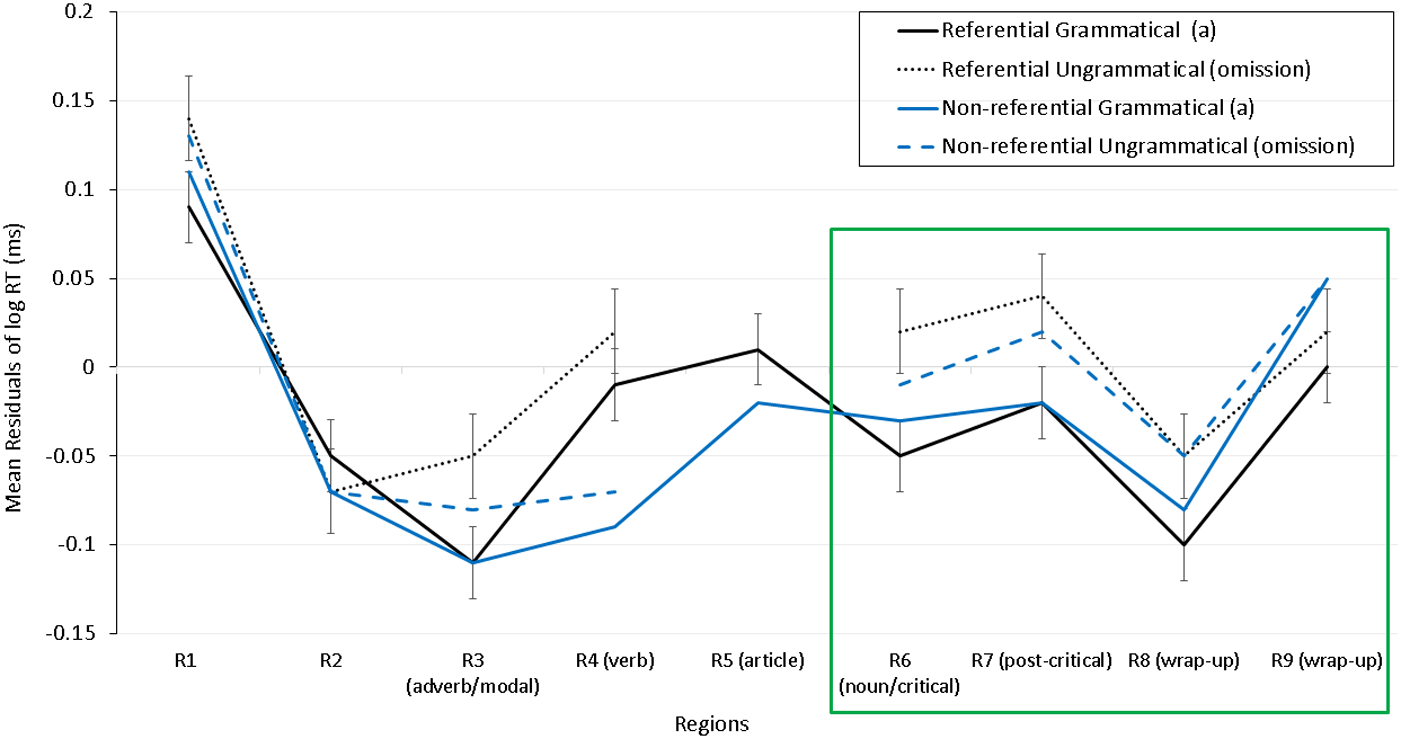
Figure 1 shows the log-RT residuals of Arabic EFL learners for the target items by region across the four conditions (regions of interest are within the rectangular frame). See Supplementary Material for descriptive statistics for the raw and log-RT residuals. As shown in Figure 1, the residuals begin to diverge in region 3, where referentiality is manipulated using an adverb for a referential indefinite and a modal auxiliary for a non-referential indefinite. The regions of interest started to show slower log-RT residuals for ungrammatical conditions (dotted lines) than for grammatical conditions (solid lines), with the non-referential condition being the slowest in the wrap-up regions. The outputs of the four LME models are summarized by region in Table 4a (fixed effects) and Table 4b (random effects).
SPR exp. 1: Residuals of log-RT by region.

Figure 1 Long description
The x-axis label is Regions. The x-axis categories are R1, R2, R3 (adverb or modal), R4 (verb), R5 (article), R6 (noun), R7 (post-critical), R8 (wrap-up) and R9 (same cell). The y-axis label is Mean residual log reaction time. The y-axis range is from minus 0.15 to 0.2. A legend lists four line entries: Referential grammatical (solid), Referential ungrammatical (dotted), Non-referential grammatical (solid) and Non-referential ungrammatical (dotted). Four lines are plotted across the nine regions. The plotted values are not labeled with exact numbers at each region. Referential grammatical (solid) line: starts above 0.1 at R1, drops to near 0 at R2, reaches a low near minus 0.1 at R3, rises to around 0 at R4, rises above 0 at R5, stays above 0 at R6, drops to around 0 at R7, drops below 0 at R8, then rises above 0 at R9. Referential ungrammatical (dotted) line: starts above 0.1 at R1, drops to near 0 at R2, reaches a low near minus 0.1 at R3, rises to around 0 at R4, rises above 0 at R5, rises further above 0 at R6, drops to around 0 at R7, drops below 0 at R8, then rises above 0 at R9. Non-referential grammatical (solid) line: starts above 0.1 at R1, drops to near 0 at R2, reaches a low near minus 0.1 at R3, rises to around 0 at R4, stays near 0 at R5, stays near 0 at R6, stays near 0 at R7, drops below 0 at R8, then rises above 0 at R9. Non-referential ungrammatical (dotted) line: starts above 0.1 at R1, drops to near 0 at R2, reaches a low near minus 0.1 at R3, rises to around 0 at R4, stays near 0 at R5, rises above 0 at R6, stays above 0 at R7, drops below 0 at R8, then rises above 0 at R9.
SPR exp. 1: Fixed effects for grammaticality and referentiality in four regions

Table 4a Long description
The table reports fixed-effect model results for residual log reading times across four sentence regions (6 through 9), listing estimates, standard errors, t values, and p values for grammaticality, referentiality, and their interaction. Grammaticality shows a small negative estimate and is statistically significant in region 6 (p 0.038), region 7 (p 0.0095), and region 8 (p 0.016), indicating faster reading times for the grammatical condition in those regions. Referentiality is not significant in regions 6 to 8 (p values 0.856, 0.547, and 0.629). In region 9, grammaticality is not significant (p 0.767), but referentiality has a positive estimate and is significant (p 0.022), indicating slower reading times for the referentiality effect there. The grammaticality by referentiality interaction is not significant in any region (all p-values above 0.19), suggesting no reliable combined effect beyond the main effects. Intercepts vary by region, with a notably negative intercept in region 8 (p less than 0.001), reflecting baseline differences across regions. Results should be interpreted as model-based associations; statistical significance varies by region and effect size is small.
Formula: logRT_resid ∼ Grammaticality * Referentiality + (1+ Grammaticality |Participant) + (1|Item).
* p<0.05.
** p<0.01.
*** p<0.001.
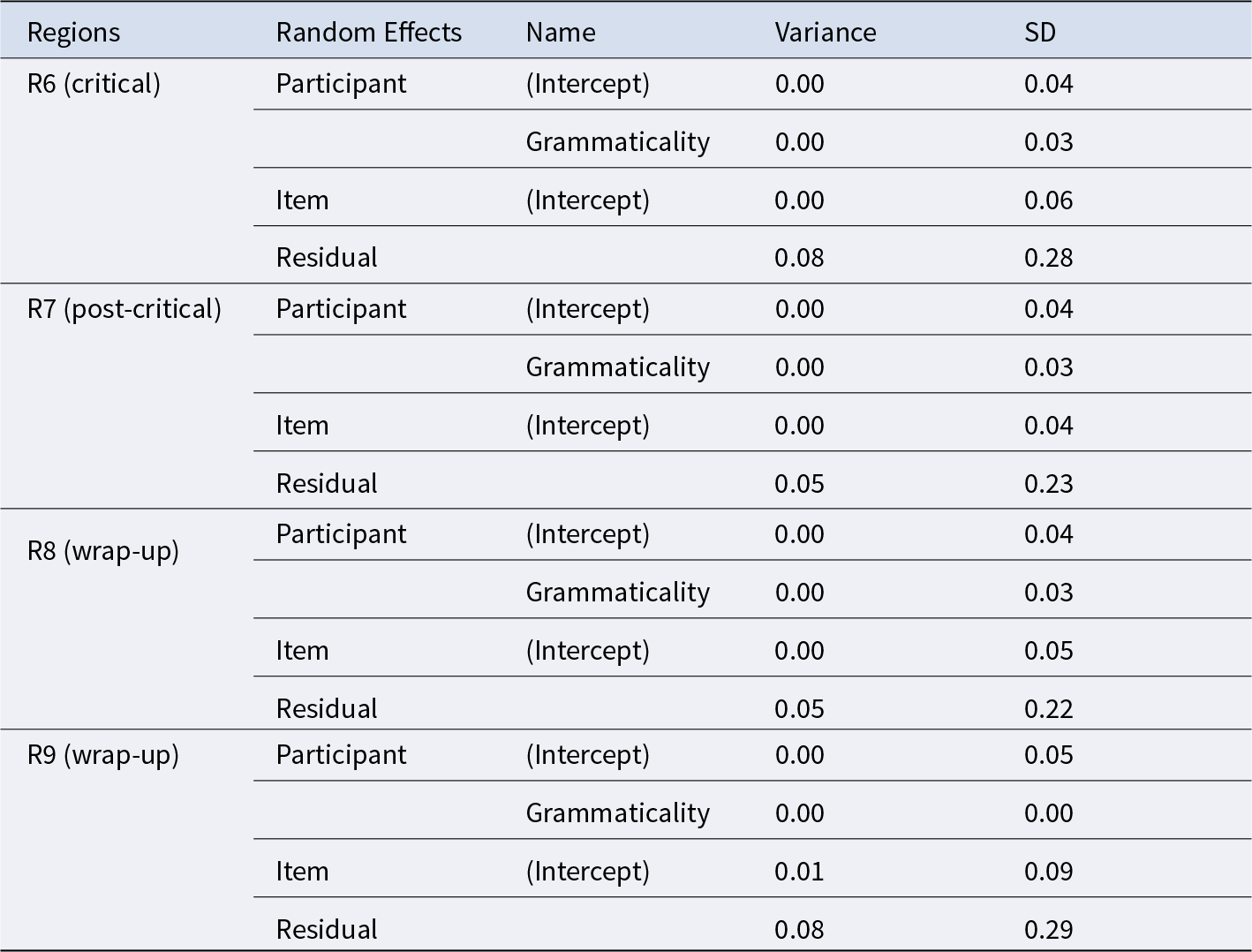
SPR exp. 1: Random effects for participants and items in four regions

Table 4b Long description
The table reports random-effects variance and standard deviation for mixed-effects models across four reading regions, separating participant effects, item effects, and residual error. In regions R6, R7, and R8, participant intercept variance is essentially zero with a small standard deviation around 0.04, and the participant grammaticality slope variance is also essentially zero with a standard deviation around 0.03. Item intercept variance is also near zero in R6 to R8, with standard deviations ranging from about 0.04 to 0.06. Residual variance is the dominant component in every region, about 0.08 in R6, about 0.05 in R7 and R8, and about 0.08 in R9, with residual standard deviations around 0.22 to 0.29. Region R9 differs slightly because the item intercept variance is higher than in earlier regions, around 0.01 with a standard deviation around 0.09, while the participant grammaticality slope shows no variability. Overall, the pattern suggests little between-participant or between-item variability captured by these random effects compared with unexplained residual variation, and very small variance estimates may reflect limited detectable variability rather than true absence.
Number of Observations: R6 (1009), R7 (1011), R8 (1010), and R9 (1011); number of participants: 32; number of items: 32; Marginal R2/Conditional R2: R6 = 0.007/0.084; R7 = 0.011/0.070; R8 = 0.010/0.102; R9 = 0.005/NA.
The results confirm the slowdown observed with the ungrammatical conditions in Figure 1. In three regions (critical, post-critical, and wrap-up/r8), the results showed a significant effect of grammaticality, no significant effect of referentiality, and no interaction effect between referentiality and grammaticality (see Table 4a). These results demonstrate the Arabic EFL learners’ sensitivity to omissions. In both referentiality conditions, learners read the ungrammatical condition significantly slower than the grammatical condition. In the final wrap-up region (r9), the results showed a significant referentiality effect, no grammaticality effect, and no significant interaction effect between the two factors (see Table 4a). These results suggest that learners read referential indefinites (both grammatical and ungrammatical) significantly faster than non-referential indefinites (see Figure 1).
Additional analyses were performed with proficiency (cloze test scores) included as a covariate in the four LME models (the complete output is provided in the Supplementary Material). The models with proficiency as a covariate produced comparable results to those in Table 4a and Table 4b with respect to the effects of grammaticality, referentiality, and their interaction on the residuals. In other words, the results showed no significant effect of cloze test scores on the log-RT residuals in any of the four regions.
6.1.3 GJ data analysis and results
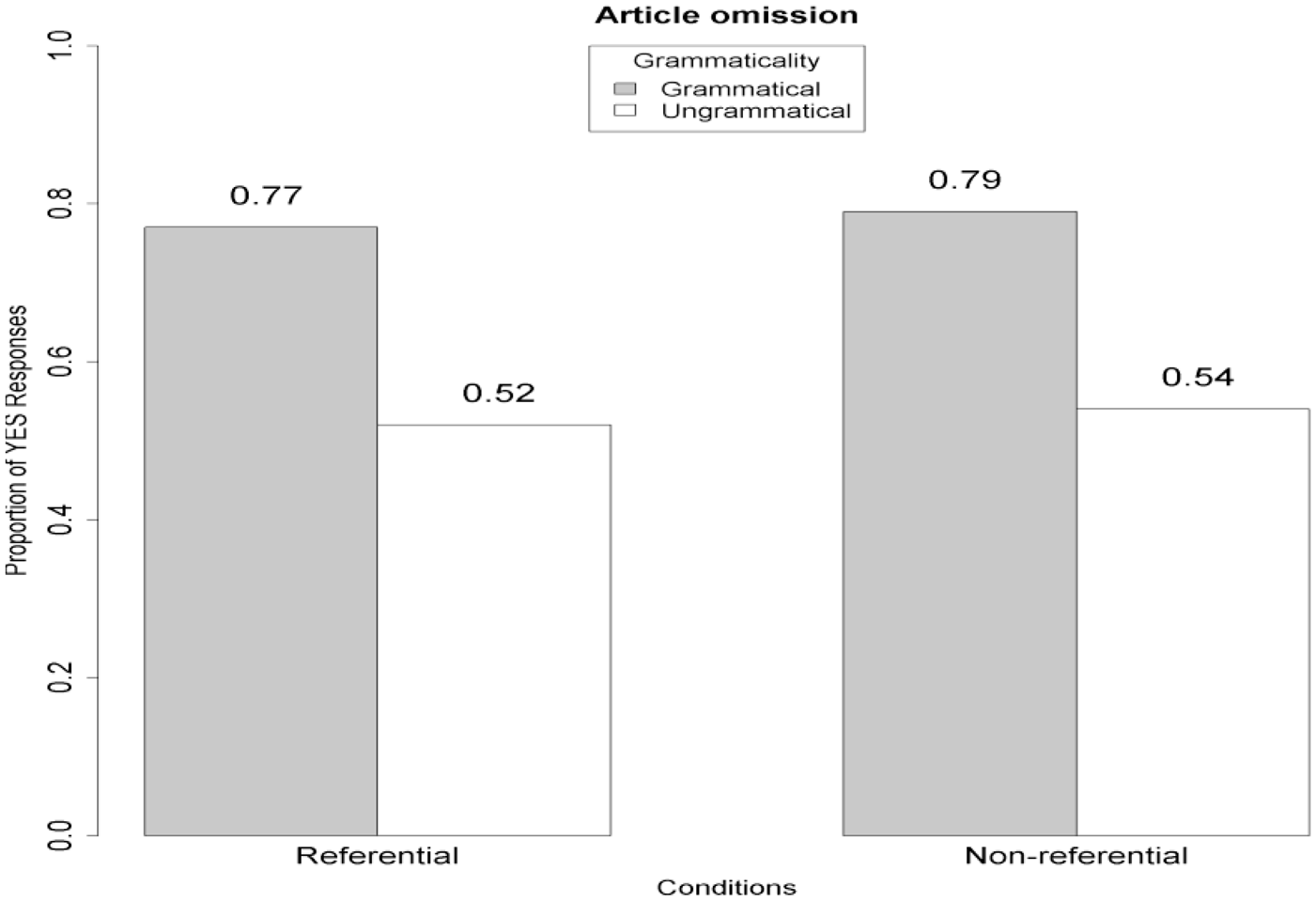
For the GJ data, yes/no responses were coded (Yes = 1 and No = 0) and analyzed as acceptance ratings. This approach makes it possible to evaluate sensitivity to ungrammaticality in both SPR and GJ tasks on parallel grounds (Ionin et al. Reference Ionin, Choi and Liu2021: 130). Fewer ‘yes’ responses and slower RTs in ungrammatical conditions indicate sensitivity to violations of grammaticality. Figure 2 displays the proportion of ‘yes’ responses according to grammaticality and referentiality conditions.
GJ exp. 1: Proportion of ‘Yes’ responses by condition.

As acceptance ratings are a binary-dependent measure, logit generalized linear mixed-effects (GLM) analyses were conducted in R with the function glmer () using the lme4 package (version 1.1-31) (Bates et al. Reference Bates, Mächler, Bolker and Walker2015). The GLM included sum-coded fixed effects for grammaticality (1 = grammatical, -1 = ungrammatical) and referentiality (1 = non-referential, -1 = referential) in a 2 × 2 factorial design. Additionally, the model included random effects for participants (N = 32) and items (k = 32), with by-participant and by-item random intercepts, and by-participant random slope for grammaticality.
The output of the GLM model in Table 5 confirms the descriptive results shown in Figure 2. The model showed a significant grammaticality effect and no significant referentiality main or interaction effects with grammaticality. In both referential and non-referential conditions, the learners gave more ‘yes’ responses to grammatical than ungrammatical sentences. To address the proficiency effect, another model was built using the cloze test scores as a covariate factor. The model did not show any effect of proficiency (estimate = 0.03, SE = 0.07, z value = 0.45, p = 0.655). The model produced a significant grammaticality effect (estimate = 0.67, SE = 0.14, z value = 4.82, p<0.001), with no significant effect for referentiality (estimate = 0.05, SE = 0.08, z value = 0.65, p = 0.515) or an interaction effect between grammaticality and referentiality (estimate = -0.01, SE = 0.08, z value = -0.16, p = 0.870). The two GLM models yielded consistent results.
GJ exp. 1: GLM results for ‘Yes’ responses (observations = 1024)

Table 5 Long description
The table reports a mixed-effects logistic regression predicting the likelihood of a “Yes” response from grammaticality, referentiality, and their combined effect. Grammaticality is a strong positive predictor, with an estimate of 0.68, standard error 0.14, z 4.94, odds ratio about 1.97, and a p-value below 0.001. Referentiality shows a small, non-significant effect (estimate 0.05, odds ratio about 1.05, p 0.516). The combined effect of grammaticality and referentiality is essentially zero and not significant (estimate negative 0.01, odds ratio about 0.99, p-0.872), suggesting no evidence that referentiality changes the grammaticality effect. The intercept is positive (estimate 0.89, odds ratio about 2.43, p-below 0.001), indicating a baseline tendency toward “Yes” responses. Random-effects variability is larger across participants than items: participant intercept variance 1.18 with standard deviation 1.09, participant grammaticality slope variance 0.36 with standard deviation 0.60, and item intercept variance 0.41 with standard deviation 0.64. Overall, the main reliable pattern is higher “Yes” responding for grammatical items, with substantial individual differences across participants.
Formula: Response ∼ Grammaticality * Referentiality + (1+ Grammaticality | Participant) + (1 | Item); OR = Odds Ratios; Marginal R2/Conditional R2 = 0.08/0.42.
*** p<0.001.
6.1.4 Summary of the results on article omission
Both SPR and GJ results show significant grammaticality effects. In SPR, the log-RT residuals were significantly slower in the ungrammatical condition in the critical (r6), post-critical (r7), and wrap-up (r8) regions. Similarly, GJs had significantly lower acceptance ratings for ungrammatical conditions. For referentiality, SPR revealed a significant effect in the wrap-up region (r9), whereas the GJ task showed no effect. However, the referentiality effect in the wrap-up region did not affect sensitivity to article omission because it did not interact with grammaticality. Overall, findings indicate sensitivity to article omission in both online processing and offline judgments.
6.2 Article misuse (exp. 2)
6.2.1 SPR data treatment and analysis
The second experiment used the same inclusion criteria and data treatment as exp. 1. All 32 participants had a comprehension accuracy of at least 70%, with an average of 92.90% (80.21–98.96%) for all items and 89.45% (71.88–100%) for the target items. Their accuracy suggests that they read and understood the sentences appropriately. The RTs were log-transformed and then residuals of log-RTs were calculated following the same method in exp. 1. Data trimming resulted in a minimal data reduction of 1.24%.
The same four regions analyzed in exp. 1 were analyzed in exp. 2 (see Table 6). Unlike exp. 1, the regions of interest occurred following article suppliance and misuse (a vs. #the). The regions of interest were the critical (r6/noun), post-critical (r7/spillover), and wrap-up (r8, r9) regions. One item from version a, item 18a, was removed because of an experimental error in the segmentation (So/he/recently/bought/a/computer/for her/use). The underlined post-critical region contained an extra word. The other three versions of the item (18b, 18c, 18d) were perfectly segmented and thus retained in the analysis.
SPR exp. 2: Division of target items by word regions

Table 6 Long description
The table breaks four sentence conditions into nine word regions, grouped into pre-critical, critical, post-critical, and wrap-up segments. In every condition, regions one to four set up the subject and verb phrase: ‘so she’ plus either ‘finally got’ for referential items or ‘may get’ for nonreferential items. The critical region is region five, where grammatical versions use the article ‘a’, while ungrammatical versions use ‘the’, flagged as incorrect. Regions six to nine are identical across all conditions: ‘cat from a shelter’. The main comparison is that grammaticality is manipulated only by the article choice at region five, while referential versus nonreferential wording differs earlier at regions three and four. Because the table lists stimuli rather than outcomes, it supports interpretation of where the manipulation occurs but does not provide performance or reading-time results.
g = grammatical; ug = ungrammatical.
The effect of grammaticality was tested in the critical, post-critical, and wrap-up regions. Unlike exp. 1, the grammaticality effect measures sensitivity to article misuse before indefinite nouns. This task is predicted to be more demanding than article omission, because it involves attention to contextual cues. In all target items, the noun in the critical region is the first mention, and thus requires an indefinite article rather than a definite article. As in exp. 1, four LME models were built to test the effects of grammaticality and referentiality on the log-RT residuals in the four regions (critical/r6, post-critical/r7, and wrap-ups/r8-r9). The models followed 2 x 2 factorial design and included sum-coded fixed effects for grammaticality, referentiality, and their interactions. The random effects were participants (N = 32) and items (k = 32). The models included by-participant and by-item random intercepts, and by-participant random slope for grammaticality.
6.2.2 SPR results
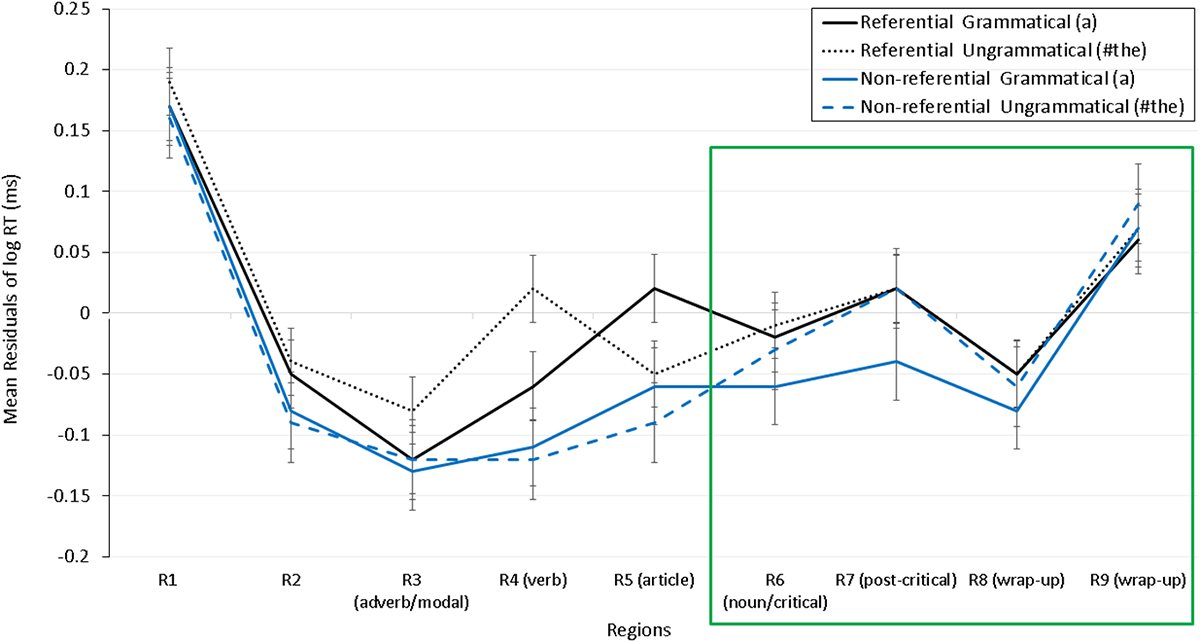
Figure 3 shows the log-RT residuals of Arabic EFL learners for the target items under the four conditions (regions of interest are within the rectangular frame). See Supplementary Material for descriptive statistics for raw and log-RT residuals. As in the SPR in exp. 1, residuals began to diverge in region 3, where referentiality was marked differently. In the regions of interest, the referential conditions (grammatical and ungrammatical) were read at almost the same speed as the non-referential ungrammatical condition. The residuals suggest a grammaticality effect that differs according to referentiality.
SPR exp. 2: Residuals of log-RT by region.

Figure 3 Long description
The graph shows mean residuals of log dash RT across regions R1 to R9. The horizontal axis represents regions, labeled R1 to R9, with specific names like article and noun. The vertical axis represents mean residuals of log dash RT, ranging from negative 0.2 to 0.25. Four lines are plotted: Referential Grammatical, Referential Ungrammatical, Non-referential Grammatical and Non-referential Ungrammatical. Solid lines represent referential conditions, while dashed lines represent non-referential conditions. Black lines indicate grammatical conditions and blue lines indicate ungrammatical conditions. All lines show a sharp drop after R1, reaching the lowest point around R3 to R4 and then rise towards R9. The Referential Grammatical condition is generally higher, while the Non-referential Ungrammatical condition is lower at key regions. The graph highlights differences in reading speed across conditions, with notable divergence and convergence points.
The outputs of the four LME models are summarized by region in Table 7a (fixed effects) and Table 7b (random effects). The results confirm the referentiality effect observed with the ungrammatical conditions in Figure 3. Of the four regions of interest, only the model for the post-critical region showed a significant grammaticality effect and a significant interaction effect between referentiality and grammaticality (see Table 7a). The fact that learners showed significantly slower log-RT residuals in ungrammatical conditions in the post-critical region suggests that they were sensitive to article misuse. However, the interaction effect between grammaticality and referentiality indicates non-sensitivity to article misuse in referential conditions (see the black lines in Figure 3). Follow-up pairwise comparisons were conducted using the function emmeans() (Lenth Reference Lenth2024) on (un)grammatical conditions within the referential and non-referential conditions. The results confirmed that learners’ log-RT residuals were comparable for (un)grammatical items in the referential condition, suggesting tolerance for both article forms before indefinite nouns (i.e., article misuse) (estimate = 0.00, SE = 0.02, t. ratio = 0.07, p = 0.945). In contrast, in the non-referential condition, their residuals were significantly slower on the ungrammatical than on the grammatical, suggesting sensitivity to article misuse before non-referential indefinites (estimate = -0.06, SE = 0.02, t. ratio = -3.05, p = 0.0029).
Additional analyses were performed with proficiency (cloze test scores) as a covariate in the LME models (the complete output is provided in the Supplementary Material). The results showed no significant effect of proficiency on the log-RT residuals in any of the four regions. The models with proficiency as a covariate produced comparable results to those in Table 7a and Table 7b with respect to the effects of grammaticality, referentiality, and their interaction on residuals.
SPR exp. 2: Fixed effects for grammaticality and referentiality in four regions

Table 7a Long description
The table reports mixed-effects model fixed-effect estimates for residual log reading time across four regions (R6 to R9), testing grammaticality, referentiality, and their interaction. In the critical region (R6), only the intercept is significant (estimate minus 0.03, p-0.037), while grammaticality, referentiality, and their interaction are not significant. In the post-critical region (R7), grammaticality is significant and negative (estimate minus 0.01, p-0.037), and the grammaticality by referentiality interaction is also significant and negative (estimate minus 0.02, p-0.028); the intercept and referentiality main effect are not significant. In the first wrap-up region (R8), the intercept is strongly negative and significant (estimate minus 0.06, p less than 0.001), with no significant effects of grammaticality, referentiality, or their interaction. In the second wrap-up region (R9), the intercept is positive and significant (estimate 0.07, p-0.008), and all other effects are not significant. Overall, evidence for an effect of grammaticality and its interaction with referentiality appears only in region 7, while other regions mainly show baseline shifts captured by the intercept. Statistical significance is based on the reported p-values and does not by itself indicate effect size or practical importance.
Formula: logRT_resid ∼ Grammaticality * Referentiality + (1+ Grammaticality |Participant) + (1|Item).
* p<0.05.
** p<0.01.
*** p<0.001.
SPR exp. 2: Random effects for participants and items in four regions

Table 7b Long description
The table reports mixed-model random-effect variance and standard deviation estimates for participants, items, and residual error across four reading regions (R6 critical, R7 post-critical, R8 wrap-up, R9 wrap-up). Participant intercept variance is essentially zero in R6 to R8 and slightly higher in R9 (variance 0.01, SD 0.12). Participant variability for the grammaticality slope is zero in R6 to R8 and remains very small in R9 (variance 0.00, SD 0.01). Item intercept variance is near zero in all regions, with SD around 0.06 in R6 to R8 and 0.07 in R9. Residual variance is the dominant source of variability in every region, lowest in R7 and R8 (variance 0.05, SD 0.22), higher in R6 (variance 0.08, SD 0.29), and highest in R9 (variance 0.09, SD 0.30). Overall, the estimates suggest minimal between-participant and between-item differences relative to unexplained within-region variability, and several values are effectively at the boundary of zero so small differences should be interpreted cautiously.
Number of observations: R6 (1004), R7 (1005), R8(1002), and R9(1007); number of participants: 32; number of items: 32; Marginal R2/Conditional R2: R6 = 0.003/NA; R7 = 0.011/NA; R8 = 0.003/NA; R9 = 0.001/NA.
6.2.3 GJ data analysis and results
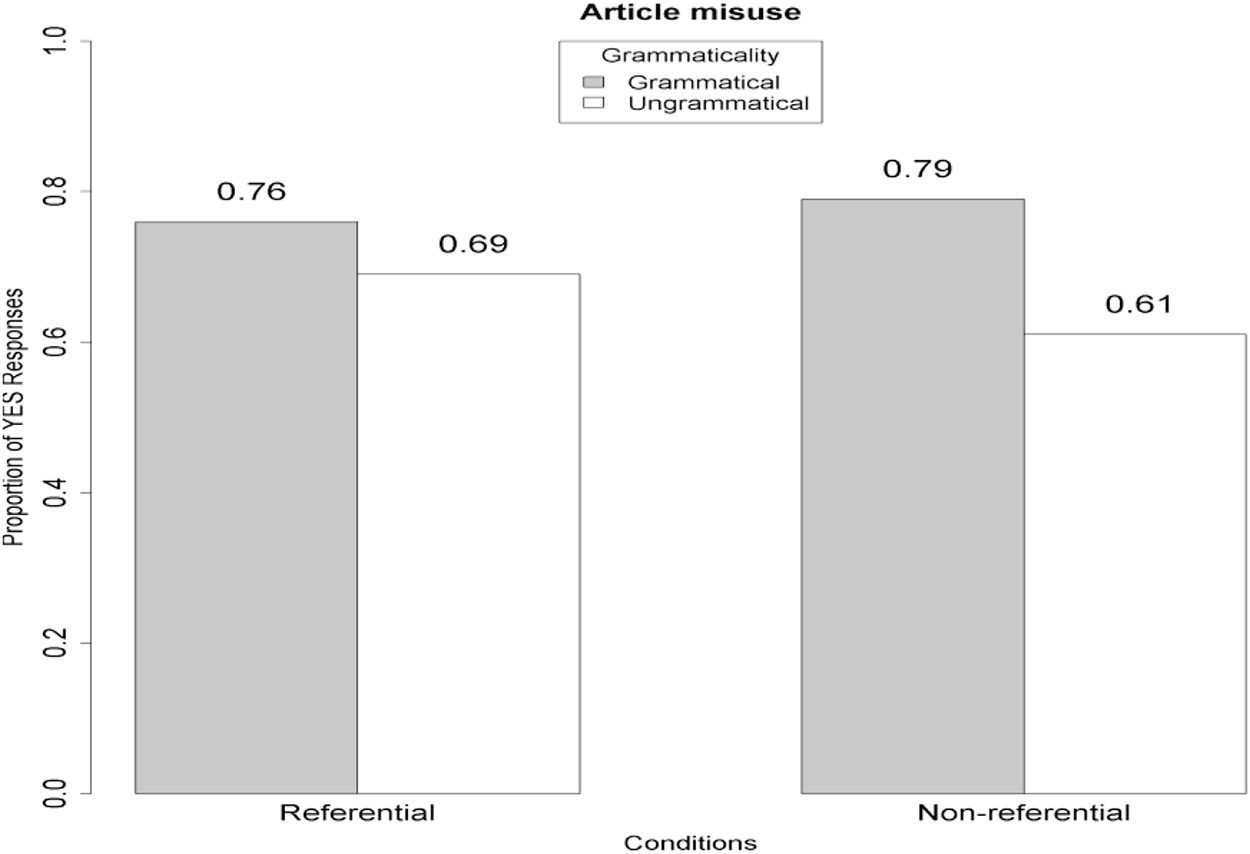
Figure 4 presents the descriptive results for the ‘yes’ responses by grammaticality and referentiality conditions. The ‘yes’ responses were analyzed in a logit GLM with grammaticality and referentiality as fixed effects in a 2 x 2 factorial design. The model had random effects for participants (N = 32) and items (k = 32) and included by-participant and by-item random intercepts and by-participant random slope for grammaticality.
GJ exp. 2: Proportion of ‘Yes’ responses by condition.

The results of the GLM in Table 8 indicate a significant effect of grammaticality and a significant interaction effect between grammaticality and referentiality. The interaction effect indicates that acceptance ratings for grammaticality vary depending on whether the indefinite context is referential or non-referential (as shown in Figure 4). Pairwise comparisons were conducted using the emmeans() function for (un)grammatical conditions by referentiality. The results showed that learners gave comparable acceptance ratings to grammatical and ungrammatical items in the referential condition, suggesting lack of sensitivity to article misuse before referential nouns (estimate = 0.33, SE = 0.25, z. ratio = 1.28, p = 0.200). In contrast, they gave higher acceptance ratings for grammatical than ungrammatical items in the non-referential condition, suggesting a sensitivity to article misuse before non-referential nouns (estimate = 0.94, SE = 0.26, z. ratio = 3.69, p < 0.001).
GJ exp. 2: GLM results for ‘Yes’ responses (observations = 1024)

Table 8 Long description
The table reports a mixed-effects logistic regression predicting the likelihood of a “Yes” response from grammaticality, referentiality, and their combined effect, using 1024 observations. Grammaticality shows a reliable positive effect: estimate 0.32 with standard error 0.10, z 3.09, odds ratio 1.37, p 0.002. Referentiality alone is not a reliable predictor: estimate minus 0.06 with standard error 0.08, z minus 0.77, odds ratio 0.94, p 0.442. The combined effect of grammaticality and referentiality is positive and statistically significant: estimate 0.15 with standard error 0.08, z 2.03, odds ratio 1.17, p 0.042, indicating the grammaticality effect is somewhat stronger when referentiality is higher. The intercept is positive (estimate 1.12, odds ratio 3.05, p less than 0.001), suggesting a baseline tendency toward “Yes” responses. Random effects indicate notable between-participant variability (intercept variance 0.61, standard deviation 0.78) and smaller variability in the grammaticality slope by participant (variance 0.12, standard deviation 0.35), plus item-level intercept variability (variance 0.32, standard deviation 0.56). Interpret results as associations within this model; statistical significance does not by itself indicate practical importance.
Formula: Response ∼ Grammaticality * Referentiality + (1+ Grammaticality | Participant) + (1 | Item); OR = Odds Ratios; Marginal R2/Conditional R2 = 0.029/0.263.
* p<0.05.
** p<0.01.
*** p<0.001.
To address the effect of proficiency, another model was built using the cloze test scores as a covariate factor. The model showed a significant proficiency effect (estimate = 0.10, SE = 0.04, z value = 2.18, p = 0.029), suggesting that learners gave more ‘yes’ responses as their scores increased on the cloze test. This result indicates the acceptance of both forms even among higher-proficiency learners. The acceptance of both articles was confirmed by checking individual participants’ responses to (un)grammatical conditions (individual results are provided in the Supplementary Material). The model produced similar results to the GLM model with no cloze test with respect to the effects of grammaticality (estimate = 0.32, SE = 0.10, z value = 3.14, p = 0.002), referentiality (estimate = -0.06, SE = 0.08, z value = -0.77, p = 0.442), and their interactions (estimate = 0.15, SE = 0.08, z value = 2.02, p = 0.043).
6.2.4 Summary of the results on article misuse
The SPR and GJ results show a significant interaction between grammaticality and referentiality. In referential conditions, acceptance ratings and log-RT residuals were statistically comparable on grammatical and ungrammatical conditions. In the non-referential conditions, acceptance rates were significantly lower, and log-RT residuals were slower for ungrammatical than for grammatical conditions. These findings suggest that referentiality affects Arabic EFL learners’ sensitivity to article misuse in both online processing and offline judgments.
7. Discussion
This study examined Arabic EFL learners’ online processing and offline judgments of grammatical violations (omission and misuse) involving English articles in referential and non-referential indefinite contexts. The results of the study argue against the MCH, which suggests that target-like processing is predicted when L1 and L2 both grammaticalize a given meaning, such as definiteness, and thus is regularly activated in language processing (i.e., congruent morphology). In contrast, non-target-like processing is predicted when the target meaning is not activated in L1 processing because of the lack of grammaticalization (i.e., incongruent morphology). Although Arabic, like English, grammaticalizes definite and indefinite meanings, it differs from English in the grammatical encoding of the indefinite meaning. Arabic marks indefiniteness with a null article, whereas English marks it with an indefinite article. Additionally, the Hejazi Arabic variety optionally uses the numeral wa:ħid ‘one’ to mark a referential indefinite meaning. According to the MCH, Arabic EFL learners should be able to automatically activate definite/indefinite meanings in L2 processing because they are already grammaticalized and activated in the L1 grammar. In an SPR task, online sensitivity to grammatical violations, reflected by slow RTs, is predicted when meaning is grammaticalized in the L1 and L2, but such sensitivity is not predicted when the meaning is not grammaticalized in both languages. As we have seen, results from two experiments on article omission (exp. 1) and article misuse (exp. 2) showed that Arabic EFL learners, during real-time processing, were sensitive to article omissions before indefinite singular count nouns, but less sensitive to article misuse in the same environment, indicating a referentiality effect. They slowed down for article misuse in non-referential conditions but not in referential conditions. Their offline judgments of the same material conformed to their performance in online processing. These results indicate that, although Arabic marks indefiniteness by omitting the article, Arabic EFL learners successfully recognized the need for an article before an indefinite singular count noun. However, they struggled with the use of the correct form in language processing.
It could be argued that results from article omission do not truly reflect online sensitivity to grammatical violations, but rather prediction effects. In the ungrammatical condition of article omission, the verb preceded the noun in the critical region. In processing, the critical noun likely takes longer due to its unpredictability, as the verb can be followed by determiners, adverbs, or prepositions, not just nouns (Ionin et al. Reference Ionin, Choi and Liu2021). In contrast, the results from article misuse do not involve the possibility of a prediction effect because the critical noun follows an article (#the or a). Thus, online processing of the critical noun after article misuse reliably indicates the status of indefinite articles in the L2 grammar. Arabic EFL learners exhibited online sensitivity to article misuse, but this was influenced by a referentiality effect. Ionin et al. (Reference Ionin, Choi and Liu2021) observed a similar referentiality effect in the processing of English native speakers but not of the L2 learners. Mandarin speakers in their study showed no referentiality effect on their online sensitivity to article misuse. The English speakers showed a tendency to read article misuse more slowly in non-referential conditions than in referential ones, showing a similar pattern to that of Arabic speakers. Ionin et al. (Reference Ionin, Choi and Liu2021) suggested that in the referential condition (e.g., … finally got #the cat …) the English speakers could be “accommodating the existence of a particular cat in the shared discourse, and hence allowing use of the” (Ionin et al. Reference Ionin, Choi and Liu2021: 145). However, Ionin et al. (Reference Ionin, Choi and Liu2021) had no explanation for the unexpected outperformance of L2 learners compared to the English speakers.
It is important to note that referentiality affected online sensitivity to article misuse, but not to article omission. Tested on the same material as Ionin et al. (Reference Ionin, Choi and Liu2021), the online sensitivity of Arabic speakers differs from that of Mandarin speakers. Mandarin Chinese optionally marks referential indefinites using the numeral yi ‘one’ + classifier, yet they showed no transfer effect of referentiality in their online processing of article misuse. Arabic EFL learners were predicted to show a referentiality effect due to the presence of wa:ħid ‘one’ in Arabic as an optional indefinite referential marker. As we have seen, the results from the article misuse experiment showed that they read the noun following #the and a at the same speed in the referential condition (… finally got #the/a cat…), indicating the acceptance of both article forms with indefinite singular count nouns in referential conditions. In contrast, they slowed on the noun following #the in the non-referential condition (… may get #the cat…), indicating sensitivity to inappropriate use of the definite article in the non-referential condition. Their pattern of online sensitivity to article misuse suggests that referentiality is computed and marked differently in the L2 grammar. We cannot assert that the referentiality effect in indefinite conditions results from L1 transfer, because the use of the referential marker in Hejazi Arabic is optional and restricted to human nouns. This factor was not considered in the design of the target items, as most nouns were non-human. However, research on L2 acquisition of English articles by Arabic speakers has revealed that article misuse is mainly found in specific indefinite conditions (Almahboob Reference Almahboob2009, Sabir Reference Sabir2015, Sabir and Melebari Reference Sabir and Melebari2023). Therefore, article misuse seems to be regulated by other factors such as referentiality or specificity. In spoken Arabic varieties, “definite and indefinite marking represent two ends of a continuum of definiteness, which includes an indefinite-specific range that may be expressed syntactically by one of several strategies” (Brustad Reference Brustad2000: 42, emphasis added). These strategies include the numeral wa:ħid ‘one.’ In the processing of ‘… finally got #the cat…’, Arabic EFL learners may be referring to a specific cat in the actual world, treating the as a referential/specific indefinite marker. Based on their L1 grammar, these subtle interpretations of indefiniteness can be marked in some way, resulting in the transfer of this strategy into L2 English.
Another possible explanation of the referentiality effect is that it is a developmental feature of L2 grammar. The learners may be associating the referential meaning with definiteness, especially since definite nouns are “uniquely identifiable” and thus only entail referential meanings (Hedberg et al. Reference Hedberg, Gundel, Borthen, Gundel and Abbott2019: 105). As a result, the referential meaning is misinterpreted as definite rather than indefinite. There is some evidence for this in the early work of Thomas (Reference Thomas1989), who found that English-speaking children and L2 learners (irrespective of their L1) make an initial assumption linking the with referential indefinite nouns. However, against this possibility, Arabic EFL learners also tolerate the use of an indefinite article in the same referential indefinite condition. If referentiality was misinterpreted as definiteness, they should have slowed down on the noun following the indefinite article (… finally got a cat…) in a referential indefinite condition, but they did not. They processed the critical noun following the two articles at the same speed, suggesting tolerance of both forms.
The complexity of article misuse in online processing is reflected in the offline judgments. L2 performance was not affected by task type, showing compatible evidence of Arabic speakers’ underlying grammatical knowledge of article omission and misuse. In the SPR and GJ tasks, Arabic EFL learners were target-like on article omission, but non-target-like on article misuse. Article omissions (referential and non-referential) exhibited slower RTs in three regions and a lower acceptance rate in offline judgments. In contrast, the online processing and offline judgments of article misuse were influenced by referentiality. While learners did not detect article misuse in the referential condition, they did so successfully in the non-referential condition. These results contrast with Mandarin and Korean speakers, who were both more target-like in online processing than in offline judgments (Ionin et al. Reference Ionin, Choi and Liu2021, Cho Reference Cho2022). The GJ and SPR results suggest that ungrammatical violations (article omission) are easier to distinguish than inappropriate violations (article misuse). The present study argues that article omission is easier because the definite/indefinite contrast is already grammaticalized in Arabic, whereas article misuse is more challenging because the morphological encoding of (in)definiteness is different in Arabic and English. The form-meaning mapping requires attention to contextual cues in the L2 input. Whether article misuse is a temporary characteristic of the Arabic speakers’ L2 grammar is an empirical question for future research. Ahn (Reference Ahn2021) argues that target-like processing is possible at advanced levels; thus, we can expect that higher proficiency may increase Arabic speakers’ sensitivity to article misuse.
In conclusion, the learnability problem for Arabic speakers in the L2 acquisition of English articles appears to be related to referentiality/specificity, which influences article misuse in indefinite contexts. Arabic-speaking learners are at a stage in their interlanguage where (in)definiteness is not correctly mapped onto the corresponding morphological form (the or a). They recognize a as an indefinite article before singular count nouns but wrongly associate the with referential (i.e., specific) indefinites. When meaning is grammaticalized in L1 and L2 grammar, the MCH implies that the linking of form to meaning is straightforward. However, this implication is challenged by the complexity of this process, which is characterized by learners’ inability to detect inappropriate forms during language processing. The Arabic speakers in the present study failed to detect article misuse in indefinite contexts, showing a referentiality effect. In a study by Snape et al. (Reference Snape, Hosoi and Umeda2023), Spanish speakers also did not show online sensitivity to the inappropriate use of indefinite articles in definite contexts. Although proficiency was the major factor in the Spanish L2 learners’ processing of definite NPs, a lack of sensitivity occurred despite the congruence between Spanish and English in how they encode (in)definiteness with two distinct articles. The activation of grammaticalized meaning in both L1 and L2 does not seem to be sufficient to facilitate target-like processing of L2 grammatical morphemes.
8. Conclusion
The present study provides new L2 processing data for an understudied language combination (L1-Arabic L2-English). The main finding of this study is that article use is challenging in an indefinite context for Arabic-speaking learners of English. I acknowledge the limitation that this study did not include items involving a definite context to counterbalance context types. Although the lack of L2 processing data on the definite context may not have affected the interpretation of the overall results, it limits our ability to draw broader conclusions about Arabic-speaking learners’ processing of English articles. This limitation is addressed in an ongoing study by the author investigating Arabic speakers’ use of definite and indefinite articles in two context types to provide a complete picture of L2 article processing and stronger evidence for or against the MCH. An online study by Ahn (Reference Ahn2021) reported a greater increase in RT when a definite article was used in indefinite conditions than when an indefinite article was used in definite conditions. My ongoing study aims to examine the different processing loads of English articles by Arabic speakers.
Another main finding of the present study is the referential effect observed in Arabic speakers’ article misuse, contrasting with the Mandarin speakers in Ionin et al. (Reference Ionin, Choi and Liu2021). Both L1s have an optional referential indefinite marker, raising the question of why only Arabic speakers show this effect. It remains unclear whether the referentiality effect is attributable to L1 transfer or a developmental property. Future studies should consider cross-linguistic differences in the semantics of referentiality/specificity markers in L2 article acquisition.
Supplementary material
The supplementary material for this article can be found at https://doi.org/10.1017/cnj.2026.10033.
Acknowledgements
I owe a great deal of thanks to Ionin, Choi, and Liu for providing me with their target items and cloze test, as well as to the participants in this study. I am deeply appreciative of the Associate Editor, Dr Lydia White, and the three anonymous CJL reviewers, whose valuable feedback helped me improve this article in many ways, particularly in enhancing my understanding of the congruency effect between Arabic and English. I also extend my thanks to the audience at the following conferences for their valuable comments on earlier versions of this work: ISTAL-26 (2024, Aristotle University of Thessaloniki) and GASLA-17 (2024, University of Illinois at Urbana-Champaign). I am also grateful to Kevin McManus for clarifying the specific type of replication employed in this study.