Introduction
Successful conservation programmes are built on a broad range of knowledge about an aimed target and its major threats to set assertive conservation measurements (Godley et al., Reference Godley, Lima, Åkesson, Broderick, Glen, Godfrey, Luschi and Hays2003; Flint et al, Reference Flint, Flint, Limpus and Mills2017). However, such programmes are particularly challenging for sea turtles because they spend most of their lives underwater (Godley et al., Reference Godley, Broderick, Colman, Formia, Godfrey, Hamann, Nuno, Omeyer, Patrício and Phillott2020; Machovsky-Capuskaa et al., Reference Machovsky-Capuskaa, Andrades and Santos2020). Therefore, even after long-term efforts, there is still a lack of information following the turtles' complete life cycle (Gibons & Lovich, Reference Gibbons and Lovich2019; Godley et al., Reference Godley, Broderick, Colman, Formia, Godfrey, Hamann, Nuno, Omeyer, Patrício and Phillott2020). This framework of difficult-to-assess habitat coupled with biological features such as long migration periods, late reproductive maturation, and low offspring success make sea turtle conservation a pressing and challenging matter (Marcovaldi et al., Reference Marcovaldi, Lopez, Soares and López-Mendilaharsu2012; Poli et al., Reference Poli, Lopez, Mesquita, Saska and Mascarenhas2014; Gibons & Lovich, Reference Gibbons and Lovich2019). Six of the seven known sea turtle species are considered vulnerable (N = 3), endangered (N = 1) or critically endangered (N = 2) by the International Red List of the IUCN (Seminoff, Reference Seminoff2004; Abreu-Grobois & Plotkin, Reference Abreu-Grobois and Plotkin2008; Mortimer & Donnelly, Reference Mortimer and Donnelly2008; Wallace et al., Reference Wallace, Tiwari and Girondot2013; Casale & Tucker, Reference Casale and Tucker2017). Fishery and bycatch are the major threats for sea turtles worldwide, significantly decreasing populations (Snape et al., Reference Snape, Beton, Broderick, Çiçek, Fuller, Özden and Godley2013). In addition, rubbish in the oceans, diseases and disasters also negatively impact sea turtle populations globally (Poli et al., Reference Poli, Lopez, Mesquita, Saska and Mascarenhas2014).
Several approaches to characterize these threats and obtain information concerning sea turtle ecological and life-history patterns are available, including beach monitoring. Beach monitoring programmes (BMPs) are widely used to study sea turtle populations (Poli et al., Reference Poli, Lopez, Mesquita, Saska and Mascarenhas2014), improving not only the available data on possible threats but also the size of the local population, nesting incubation periods, anthropogenic interactions, spatial distribution, species use of an area, and other valuable parameters for determining conservation priorities. However, data obtained through BMPs represent only a fraction of what is effectively happening to any given population (Hart et al., Reference Hart, Mooreside and Crowder2006; Wallace et al., Reference Wallace, Lewison, Mcdonald, Mcdonald, Kot, Kelez, Bjorkland, Finkbeiner, Helmbrecht and Crowder2010). Despite this limitation, BPMs are an important research tool once they can be performed from land and adapted for different personnel realities and availability of low- to high-cost tools. In Brazil, companies often sponsor long-term BMPs as a form of compensation demanded by law due to polluting activities.
The Brazilian coastal zone and oceanic islands are well-known habitats for sea turtles. These animals can be found foraging, reproducing or passing through the migration corridors. Five species occur in the area: the green turtle (Chelonia mydas Linnaeus, 1758), the olive turtle (Lepidochelys olivacea Eschscholtz, 1829), the hawksbill turtle (Eretmochelys imbricata Linnaeus, 1766), the loggerhead turtle (Caretta caretta Linnaeus, 1758) and the leatherback turtle (Dermochelys coriacea Vandelli, 1761) (Marcovaldi & Marcovaldi, Reference Marcovaldi and Marcovaldi1999). Sea turtles have been nationally protected in Brazil since the 1980s with measures implemented by law alongside projects such as the TAMAR national project (Marcovaldi & Marcovaldi, Reference Marcovaldi and Marcovaldi1999) and many others acting locally. However, despite best efforts, all five species occurring in Brazilian waters are still considered endangered by Brazilian law (MMA, 2014).
Sea turtle strandings were recently described for an easternmost stretch of north-eastern Brazil's semiarid coast in the western equatorial Atlantic (Farias et al., Reference Farias, Alencar, Bonfim, Fragoso, Rossi, Moura, Gavilan and Silva2019). However, the sea turtles stranding west of this point (Ceará coastline) is still poorly documented, even though the region is considered a migration corridor and foraging ground for sea turtles (Lima et al., Reference Lima, Melo, Godfrey and Barata2013). Within this context, the present study aimed to identify the species and the relative abundance of sea turtle strandings alongside the coast; to determine the maturation stage of these turtles; to test if stranding patterns follow a seasonal or geographic pattern; and to characterize any sign of fibropapillomatosis (FB) or anthropogenic interaction.
Materials and methods
Study area
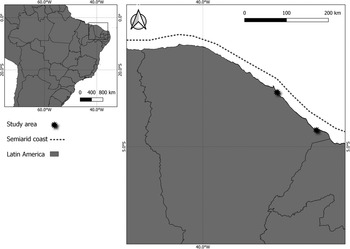
A total of 151 beach surveys were conducted on the east coast of Ceará, north-eastern Brazil, from February 2010 to July 2019 by the Associação de Pesquisa e Preservação de Ecossistemas Aquáticos (NGO Aquasis; under licence ABIO number 1080/2019), through their BMP (Figure 1). The route started from the east side of Pacoti River in Aquiraz and ended in Aracati, both in Ceará (Figure 1). The coastline route was ~130 km long. The monitoring team was composed of at least two people. A 4 × 4 pickup truck was used during surveys, which usually lasted around 8 h. The interval between surveys was 20 days, on average. During a survey, when a high tide precluded the route, a ferry was used, or the team waited for the low tide to continue the survey. In cases where none of these options was available, the team would continue the survey the following day. Another alternative used was to split the team in two, where the first group was driving on the road while the second would walk the shore.
Map of Brazil showing the location of Ceará state and the beach survey route used for monitoring sea turtle strandings between 2010 and 2019 along a semiarid coast in the western equatorial Atlantic, eastern Ceará state (from Aquiraz to Aracati), north-eastern Brazil.

Ceará has semiarid weather characterized by two main seasons: rainy (first semester) and windy (second semester). The first semester concentrates almost 91% of yearly rain, with low-speed winds; on the other hand, the second semester is dry and with relatively high-speed winds (Morais et al., Reference Morais, Freire, Pinheiro, Souza, Carvalho, Pessoa and Oliveira2006). For this work, we considered only the two main seasons of the study area. Its coastline presents 573 km and suffers significantly from erosion due to anthropogenic and natural causes (Morais et al., Reference Morais, Freire, Pinheiro, Souza, Carvalho, Pessoa and Oliveira2006). The state's economy is strongly associated with tourism. It was the fifth capital of Brazil in the number of international tourists between January and April 2019, presenting a strong relationship with artisanal fishing linked with economic implications. The Brazilian northern and north-east regions represent Brazil's most substantial producers of marine fish (Neto et al., Reference Neto, Goyanna, Feitosa and Soares2021).
Individuals
Species identification followed Reis & Goldberg (Reference Reis and Goldberg2017). One character considered for species identification was the number of coastal scutes. The shape of scutes and colour nuances were used to confirm green and hawksbill turtles because they present no differences in the number of scutes. Animals without carapace (removed) or in an advanced state of decomposition were recorded as ‘not identified’, and the turtle's head was not used for identification.
The curved carapace length (CCL) was measured with flexible tape. The CCL was taken from the nuchal notch mid-line to the supracaudals tip (Bolten, Reference Bolten1999). The following additional data were recorded: (1) date; (2) geolocation and municipality; (3) external evidence of disease; and (4) external evidence of negative anthropic interaction. Each individual was photographed.
Data analysis
The CCL was used to determine the maturation stage for each individual according to values established in the literature for sea turtles in Brazil. Sea turtles with the following CCL values were considered adults: (1) green turtle, CCL ≥ 90 cm (Almeida et al., Reference Almeida, Moreira, Bruno, Thomé, Martins, Bolten and Bjorndal2011); (2) olive turtle, ≥ 65.3 cm (Da Silva et al., Reference Da Silva, De Castilhos, Lopez and Barata2007); (3) hawksbill turtle, ≥ 83 cm (Santos et al., Reference Santos, Freire, Bellini and Corso2010); (4) loggerhead turtle, ≥ 86.5 cm (Lima et al., Reference Lima, Wanderlinde, De Almeida, Lopez and Goldberg2012). Individuals with smaller CCL values were considered juveniles.
We used Generalized Linear Mixed Models (GLMM) to quantify the changes between the turtle strandings as a function of the season (first and second semester), size of the coast (considering the length of the four study area's municipalities), species (loggerhead, olive, hawksbill and green) and age (juveniles and adults). GLMMs combine the mixed linear models' properties, which incorporate random effects to quantify the variation between sample units, and generalized linear models, which use ‘link’ functions and exponential distributions families to deal with non-normally distributed data (Bolker et al., Reference Bolker, Brooks and Clark2009). Because we were analysing non-negative metrics, we considered a Gaussian distribution with a logarithmic link function to generate the models.
We considered the year and municipality as added random effects. We compared results in terms of small sample Akaike's Information Criterion (AICc) for each metric. AICc accommodates the sample size influence to measure the quality of the model fit (Sugiura, Reference Sugiura1978; Hurvich & Tsai, Reference Hurvich and Tsai1991). We examined all models to understand the influence and significance of model factors on turtle strandings and calculated the relative weights for the preferred models. GLMM calculations were performed in the software R (R Core Team, 2020) through the packages lme4 (Bates et al., Reference Bates, Mächler, Bolker and Walker2015) and AICcmodavg (Mazerolle, Reference Mazerolle2020).
Results
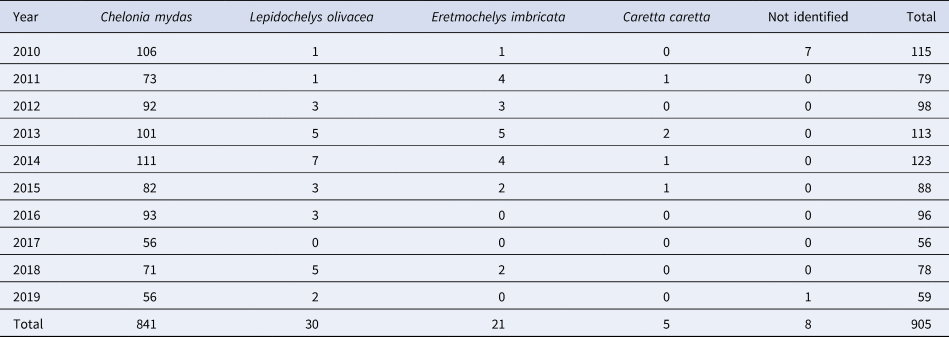
We recorded 905 stranded sea turtles belonging to four species. The most stranded species was the green turtle, C. mydas (93%of recorded individuals), followed by the olive turtle, L. olivacea (3%), hawksbill turtle, E. imbricata (2%), and loggerhead turtle, C.caretta (0.6%). Another eight sea turtles recorded were not identified at the species level due to damaged carapace (Table 1).
Records of sea turtle strandings between 2010 and 2019 along a semiarid coast in the Western equatorial Atlantic, eastern Ceará state, north-eastern Brazil

The green turtle was the only species recorded throughout all years. The olive turtle was recorded in nine years, and hawksbill in seven years. Finally, the loggerhead was recorded in four years (Table 1). As for the sea turtle life stage, juveniles stranded significantly more than adults (N = 762; P < 0.01) compared with adults and were present in all species recorded (Table 2).
Maturation stage and size of sea turtle strandings between 2010 and 2019 along a semiarid coast in the Western Equatorial Atlantic, eastern Ceará state, north-eastern Brazil

CCL, curved carapace length.
*Four individuals without CCL measured. **One individual without CCL measured.
Sea turtle strandings differed by season (P < 0.01), considering the local division of rain (first semester) and wind (second semester) seasons, with the higher number of strandings during the wind season. Only green, olive and hawksbill turtles were recorded throughout the year. Strandings were significantly higher in more extensive coastlines (P < 0.01). Thus, it is likely that the number of sea turtles stranding fluctuates according to the available area.
Stranded sea turtles showed external evidence of disease and negative anthropogenic interaction. First, tumours commonly associated with FB were found in 17 individuals (1.8%). Second, entangled flippers with fishing nets, amputation and turtles trapped in a lobster device (manzuá) were recorded for 37 individuals (4%). Unfortunately, no information on internal injuries of anthropogenic origin, for example, foreign body ingestion, was obtained because necropsies were not performed.
Discussion
This study represents the most comprehensive dataset on sea turtle strandings in north-eastern Brazil (a decade-length). Sea turtles have been primarily studied in the western (Projeto TAMAR) and central (Instituto Verdeluz) coastal portion of the Ceará state. Thepresent study fills this gap by bringing comprehensive information for a larger extension of the state and building a profile of the stranding sea turtles in the region.
Ceará's coastal zone is an important site of sea turtle feeding (Lima et al., Reference Lima, Melo, Godfrey and Barata2013) and a migration path (Naro-Maciel et al., Reference Naro-Maciel, Becker, Lima, Marcovaldi and Desalle2006) for the five species occurring on the Brazilian coast. The green turtle was the most recorded species (93%) in the present study, corroborating the pattern observed in other studies alongside the Brazilian coast. Chelonia mydas strandings represent 81% of the occurrences in the Brazilian north-east (Farias et al., Reference Farias, Alencar, Bonfim, Fragoso, Rossi, Moura, Gavilan and Silva2019) and 89.9% in the Brazilian south-east (Tagliolatto et al., Reference Tagliolatto, Goldberg, Godfrey and Monteiro-Neto2019). The highest number of strandings for the green turtle also occur in other parts of the world, including the Mediterranean (Sönmez, Reference Sönmez2018) and Oceania (Flint et al., Reference Flint, Flint, Limpus and Mills2017). Overall, the largest record of C. mydas is perhaps due to the species' foraging strategy, which is mainly concentrated in shallow waters (Campos & Cadorna, Reference Campos and Cardona2020).
The other species' strandings in the area presented considerably lower frequencies than C. mydas. The second most abundant species in strandings was the olive turtle, L. olivacea, which uses Ceará as a foraging area (juveniles and adults) and a migratory corridor for reproduction (adult females) in French Guiana and Surinam (Da Silva et al., Reference Da Silva, Dos Santos, De Castilhos, Oliveira, Weber, Batista and Serafini2011). The hawksbill turtle, E. imbricata, was the third species in strandings. It migrates to Ceará after the nesting season in Bahia (north-eastern Brazil; Marcovaldi et al., Reference Marcovaldi, Lopez, Soares and López-Mendilaharsu2012) and also uses Ceará's coast as a feeding ground (Lima et al., Reference Lima, Melo, Godfrey and Barata2013). At last, the loggerhead turtle, C. caretta, was the less frequently stranded species, although it also uses Ceará as a foraging area (Lima et al., Reference Lima, Melo, Godfrey and Barata2013). This species is abundant in the northernmost part of its distribution range in the western Atlantic (USA; Lamont et al., Reference Lamont, Fujisaki and Carthy2014), potentially explaining its relatively rare occurrence in the region. The leatherback turtle (D. coriacea) is Brazil's only sea turtle species with no strand recorded in the studied area.
The sea turtles' juvenile individuals represented 84% of the recorded strandings. The species found in the present study complete their ontogeny in neritic environments with higher food availability, justifying the high incidence of juvenile turtle strandings (Bolten, Reference Bolten, Lutz, Musick and Wyneken2003; Poli et al., Reference Poli, Lopez, Mesquita, Saska and Mascarenhas2014).
The strandings trend for the second semester, during the strongest winds, may be explained by the increased chance of the carcass landing on the shore. Also, for a sea turtle to run aground onshore, it usually dies close by; otherwise, it would simply decompose in the sea. Hart et al. (Reference Hart, Mooreside and Crowder2006) estimate a 20 km approximate distance from a beach line for sea turtles dying to shore, and the wind is a considered factor. Similar findings were obtained in the following Brazilian states: Rio Grande do Norte (Farias et al., Reference Farias, Alencar, Bonfim, Fragoso, Rossi, Moura, Gavilan and Silva2019), Rio de Janeiro (Tagliolatto et al., Reference Tagliolatto, Goldberg, Godfrey and Monteiro-Neto2019) and Rio Grande do Sul (Monteiro et al., Reference Monteiro, Estima, Gandra, Silva, Bugoni, Swimmer, Seminoff and Secchi2016). The relationship between the coastal size and the number of strands indicates another important management pattern, suggesting that the second half of the year and longer beaches should be the primary choice for monitoring and mitigation efforts. However, as sea turtles could easily move a few kilometres on each side, the efforts should consider the whole length and, if possible, the whole year.
Furthermore, coastal areas are heavily affected by human impacts such as fishing, pollution and contamination, exposing sea turtles and other marine animals to these threats. The presence of anthropogenic interaction related to fishing (e.g. sea turtles trapped in manzuás) is a sensitive topic to the region. North-east Brazil is one of the country's leading producers of marine fishing, and most of it is artisanal fishing (Neto et al., Reference Neto, Goyanna, Feitosa and Soares2021). Creating awareness programmes for local fishermen and their community is essential in this context, considering their role in sea turtle conservation and economic importance (Awabdi et al., Reference Awabdi, Tavares, Bondioli, Zappes and Di Beneditto2018).
In addition to the dangers caused by fishing activities, we highlight in this study the general health conditions of sea turtles prior to dying and stranding. The presence of fibropapillomatosis in 17 of 905 turtles examined indicates that these animals were already debilitated before death. Tumours can appear during periods of stress and impair sea turtles' vision, swimming and feeding skills (Herbest, Reference Herbst1994; Zwarg et al., Reference Zwarg, Rossi, Sanches, Cesar, Werneck and Matushima2014; Jones et al., Reference Jones, Ariel, Burgess and Read2015). Other Brazilian states from the east semiarid coast held similar investigations. In Rio Grande do Norte, 22.7% of the sea turtles stranded had tumours associated with FB (Silva-Junior et al., Reference Silva-Júnior, De Farias, Costa Bomfim, Boaviagem Freire, Revorêdo, Rossi, Matushima, Grisi-Filho, De Lima Silva and Gavilan2019), and in Paraíba, this presence was seen in 28.5% of the cases (Poli et al., Reference Poli, Lopez, Mesquita, Saska and Mascarenhas2014).
Furthermore, the presence of this disease may be indicative of overall poor water quality in the marine ecosystem (Herbest, Reference Herbst1994; Jones et al., Reference Jones, Ariel, Burgess and Read2015). Its occurrence has been increasing in tourist sites (e.g. in the USA; Foley et al., Reference Foley, Schroeder, Redlow, Fick-Chil and Teas2005) as well as in environments with bad quality indexes (e.g. Espírito Santo, Brazil; Santos et al., Reference Santos, Freire, Bellini and Corso2010).
In conclusion, our results provide relevant data on sea turtle strandings from the Ceará coast for the last decade, with juvenile C. mydas as the group with the greatest strandings. We also indicate a seasonal and geographic pattern in strandings. We described the anthropogenic interactions found and the presence of tumours in some individuals. Finally, since the coast of Ceará is an important feeding area and migration route for sea turtles, this study can contribute to mitigating measurements and encourage marine ecosystem conservation with a focus on environmental education.
Acknowledgements
The present work would not be possible without the partnership with the NGO AQUASIS and the extensive work of the field researchers represented here by Antônio Carlos Amancio, Ana Carolina Meirelles, Cristine Negrão, Diego Ramires, Artur Barbosa and Caroline Castro. We also thank the statistical work done by PhD Luisa Diele-Viegas and the thoughtful suggestions made by Professor Caroline Feitosa. Least, we would like to dedicate this work to Gabriel Chagas (in memoriam) and his work with sea turtles and environmental education.
Financial support
We would like to underline that part of this work was done under a volunteer scholarship from the PIBIC initiative, a scholarship from Fundação Cearense de Apoio ao Desenvolvimento Científico e Tecnológico – (FUNCAP) and from Coordenação de Aperfeiçoamento de Pessoal de Nível Superior – Brasil (CAPES) – Finance Code 001.