Introduction
Arapaima gigas (Teleostei: Osteoglossidae) is an Amazonian fish species with high cultivation potential due its fast growth and tolerance to low oxygen concentrations (Imbiriba, Reference Imbiriba2001). Nevertheless, production is limited by the low availability and high cost of fingerlings, mainly due to reproductive and sanitary problems (Lima et al., Reference Lima2015). Monogeneans are the primary ectoparasitic cause of fingerling mortality in Amazonian aquaculture (Delgado et al., Reference Delgado2007; Rebellato-Junior et al., Reference Rebellato-Junior Junior2015) and in aquariums worldwide (Buchmann et al., Reference Buchmann, Uldal and Mellergaard1994). Three Dactylogyridae monogenean species have been described as parasites of A. gigas: Dawestrema cycloancistrium Price & Nowlin, 1967, D. cycloancistrioides Kritsky, Boeger & Thatcher, 1985 and D. punctatum Kritsky, Boeger & Thatcher, 1985 (Kritsky et al., Reference Kritsky, Boeger and Thatcher1985; Cohen et al., Reference Cohen, Justo and Kohn2013), with D. cycloancistrium being the most prevalent in aquaculture systems, including in coinfections with D. cycloancistrioides (Araújo et al., Reference Araújo2009; Delgado et al., Reference Delgado2007).
Monogenean parasites can proliferate quickly and easily in cultures, resulting in high rates of fish mortality; therefore, they are economically important pathogens in aquaculture (Gracenea et al., Reference Gracenea2016). This rapid proliferation occurs because monogeneans are hermaphroditic parasites that have direct life cycles and can thus rapidly infest breeding systems (Whittington and Kearn, Reference Whittington and Kearn2011). The economic costs associated with monogeneans can be reduced by implementation of parasite management strategies, which rely on a good understanding of parasite and host biology (Mooney et al., Reference Mooney, Ernst and Whittington2008).
The first egg morphology description for the three species of Dawestrema was presented by Kritsky et al. (Reference Kritsky, Boeger and Thatcher1985). Later, D. cycloancistrium eggs and oncomiracidia were described in more detail by Maciel et al. (Reference Maciel, Muniz and Alves2017). The authors observed that the eggs are elongated ovals with a single long appendage at one pole measuring more than 11 times the length of the egg. The eggs have small elliptical structures in the polar filament that have adhesive function. Four developmental stages of D. cycloancistrium eggs before hatching were characterized; the eggs were found isolated in the gill filaments, grouped in clusters anchored in a gill filament, grouped in clusters and entangled in a part of a dead adult monogenean, or grouped in clusters in the environment, either entangled or fixed to a substrate. Egg eclosion occurs after 72–96 h, with faster development at 29°C and 32°C than at 24°C. Oncomiracidia lifespan is 50 h and 58 h at 24°C and 27°C, respectively. Dawestrema cycloancistrium oncomiracidia access the skin of their hosts and larva can be seen in the mucus (Maciel et al., Reference Maciel, Muniz and Alves2017).
Although a health control strategy is important, no information exists on D. cycloancistrium oviposition rates (number of eggs produced per adult per day), and this is considered one of the most important parameters for understanding the parasite's reinfestation capacity. Therefore, the main objective of this study was to determine the oviposition rate of D. cycloancistrium.
Materials and methods
Fish and acclimation
Fifty A. gigas fingerlings (13.7 ± 1.2 cm total length and 14.8 ± 3.8 g) naturally parasitized by monogeneans were collected on a fish farm (11°07′11.28″ S 48°59′54.67″W)) in the state of Tocantins, Brazil. After collection, fish were transported in plastic bags with oxygen and maintained in a 200 l polyethylene tank with constant water flow and water discharge by an overflow pipe. Fish were fed twice per day with an extruded commercial ration containing 45% crude protein (Aquaxcel®) at 8% of the estimated total biomass per day. This corresponds to the environmental conditions under which the fingerlings are maintained during the weaning phase in commercial production hatcheries. During a 15-day acclimation period, the temperature was 28 ± 1.02°C; dissolved oxygen, 4.2 ± 1.08 mg/l; pH, 7.5 ± 0.10; ammonia, 2.0 ± 0.02 mg/l; toxic ammonia, 0.034 ± 0.02 mg/l; and conductivity, 91 ± 1.10 μs.cm3.
Quantification of D. cycloancistrium eggs and calculation of oviposition rate
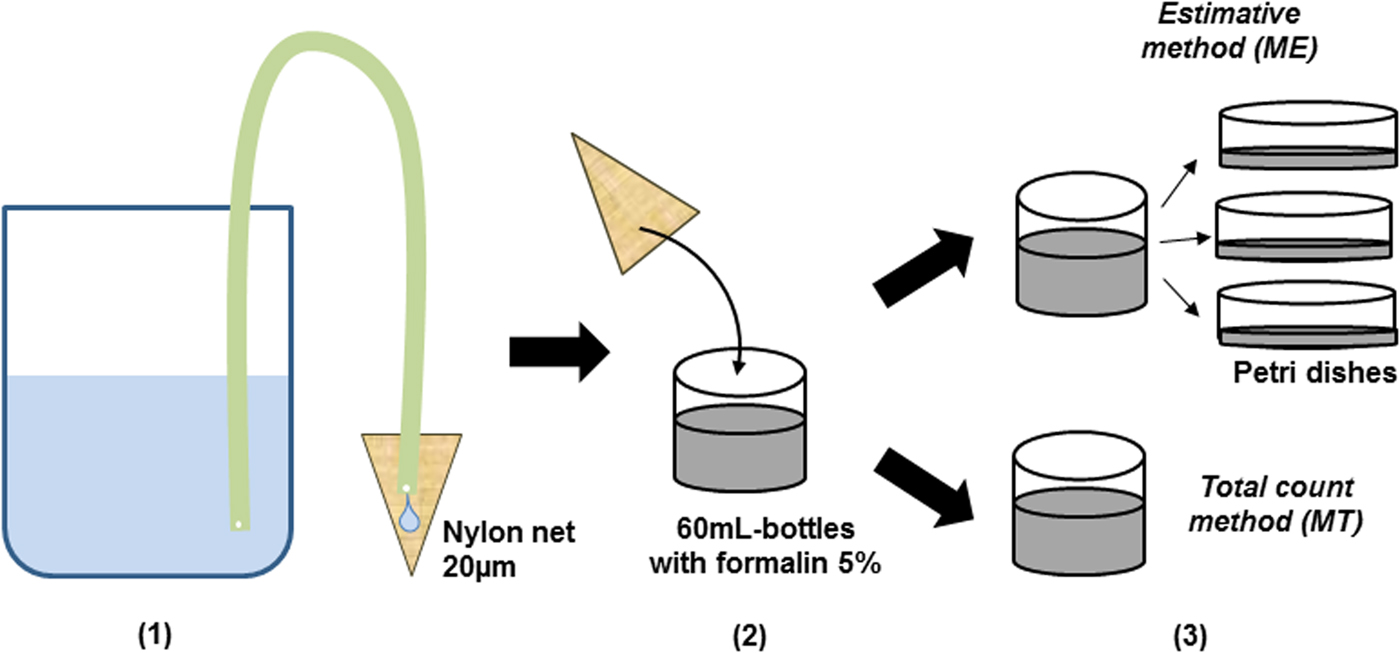
A method slightly modified from Buchmann (Reference Buchmann1988) was used to collect D. cycloancistrium eggs and calculate the oviposition rate. This method consisted of completely filtering water from a container where only one fish was treated, using a nylon net to retain the parasite eggs (fig. 1). Buchmann (Reference Buchmann1988) kept one fish inside a small nylon mesh bag immersed in a water container so that filtering the water was unnecessary, but our modification was required because A. gigas is an obligate air-breathing species.
A method slightly modified from Buchmann (Reference Buchmann1988) for Dawestrema cycloancistrium egg collection: (1) to calculate the oviposition rate, egg fixation (2) and egg counting methods tested (ME and MT) (3).

Twelve A. gigas were collected and distributed randomly in 12 containers (repetitions) with 5 l of water in a static system and maintained under natural 12 : 12 light–dark cycles. The physicochemical water parameters inside the containers during the trial were maintained at a mean temperature of 27.4 ± 0.6°C; dissolved oxygen, 3.8 ± 1.51 mg/l; pH, 7.48 ± 0.20; and zero total ammonia and toxic ammonia. For 3 consecutive days (according to Mooney et al., Reference Mooney, Ernst and Whittington2008; Dinh Hoai and Hutson, Reference Dinh Hoai and Hutson2014), every 24 h each fish was transferred to another container to filter the total water volume. A separate nylon net was used for water filtration and egg retention in each container. The mesh size of the nylon net was 20 μm, tested to guarantee the collection of all D. cycloancistrium eggs that measure 144.13 ± 13.62 μm in length and 40.40 ± 2.53 μm in width (Maciel et al., Reference Maciel, Muniz and Alves2017). At the end of each filtration, each nylon net was washed, and the contents were transferred to 60-ml bottles with 5% formalin to preserve the eggs for subsequent sample processing. The eggs are sticky due to the small elliptical and adhesive structures in the polar filament (Maciel et al., Reference Maciel, Muniz and Alves2017), so the quantity of eggs retained in each nylon net was recorded by stereomicroscope immediately after collection.
With the samples in the 60-ml bottles, two egg quantification methods were tested: the estimative method (ME) and the total counting method (MT). In the ME, the number of eggs was counted in three 1-ml subsamples, and the average value of the three subsamples was estimated for 60 ml, similar to the method used for protozoan quantification, especially for trichodinids (Maciel et al., Reference Maciel2018). To obtain the subsamples, each 60-ml bottle with 5% formalin was homogenized by manual centrifugal stirring. The 1-ml subsamples were collected with a 1000-μl pipette and counted in Petri dishes, using a stereomicroscope. In the MT, the total number of eggs in the 60-ml bottles was counted (fig. 1). The number of eggs attached to each nylon net was added to the total egg numbers for both ME and MT.
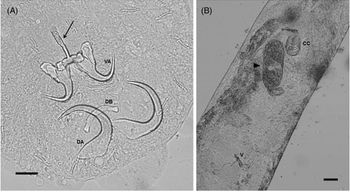
At the end of the experimental trial, all fish were euthanized, the gills were collected and maintained in Petri dishes with tank rearing water, and the adult parasite intensity and prevalence was calculated (Bush et al., Reference Bush1997). Parasites were counted fresh, with no fixation of either gills or parasites. The adult parasite counting was done under a stereomicroscope immediately after euthanasia from fresh unfixed gills, using needles to detach the parasites from the gills. To differentiate adult worms and guarantee the counting of only mature parasites, the parasite total length (average of 2.180 μm for D. cycloancistrium adults, according to Kritsky et al., Reference Kritsky, Boeger and Thatcher1985), the presence of reproductive system in the fresh preparations, the presence of eggs laid by the parasite and the presence of eggs inside the uterus were all taken into account. Monogenean specimens were separated for fresh preparations in blades with coverslip for identification under optical microscope based on haptor morphology and to view the reproductive system (fig. 2). The D. cycloancistrium were identified by the presence of the plate-like ventral bar in the haptor, with an anterior medial projection arising near the posterior margin (Kritsky et al., Reference Kritsky, Boeger and Thatcher1985). In addition, egg morphology was used to identify D. cycloancistrium. Dawestrema cycloancistrium eggs are elongated ovals with a single long appendage at one pole; D. cycloancistrioides eggs are elongated ovals but with a proximal short polar filament; and D. punctatum eggs have an elongated shape with a terminal short filament at each pole (Kritsky et al., Reference Kritsky, Boeger and Thatcher1985; Maciel et al., Reference Maciel, Muniz and Alves2017).
Dawestrema cycloancistrium in fresh preparation. (A) Haptor, with arrow indicating the ventral bar, with an anterior medial projection arising near the posterior margin, the taxonomic feature used for the identification of this monogenean species. (B) Reproductive system and an egg inside the uterus (arrowhead). DB: dorsal bar; VA: ventral anchor; DA: dorsal anchor; cc: copulatory complex; v: vagina. Scale bar = 30 μm.

Based on parasite intensity, the oviposition rate was estimated for both methods, according to Buchmann (Reference Buchmann1988): number of eggs counted within 24 hours divided by number of adult parasites in the gills. The mean oviposition rate per day was calculated based on 12 animals. All fish maintenance and euthanasia procedures were undertaken in accordance with the ethical principles of the Ethics Committee of Embrapa Fisheries and Aquaculture, Palmas, Tocantins, Brazil (# 04-A/2015).
Quantifying the eggs using an estimative approach was attempted because the number of eggs produced in monogenean infections is high when considering the average number of eggs produced by the group as well as the mean infection intensities described in the literature for D. cycloancistrium, ranging from 200 ± 13 (Maciel et al., Reference Maciel, Muniz and Alves2017) to 298.0 ± 10.0 (Araújo et al., Reference Araújo2009). Statistical analyses were performed to assess the reliability of the ME compared with that of the MT. To evaluate the difference between the number of eggs every 24 hours, a generalized mixed linear model with Poisson distribution (P < 0.05) was fitted for both counting methods (ME and MT). After model fitting, analysis of deviance was performed, followed by a means test (P < 0.05). For oviposition rate, a mixed linear model was fitted, followed by analysis of variance and a means test (Tukey's test, P < 0.05). The analyses were performed using R 3.4.4 (R Core Team, 2018). The following packages were used: lme4 (Bates et al., Reference Bates2016) was used for model fitting, and lsmeans (Lenth, Reference Lenth2016) was used for the means test.
Results
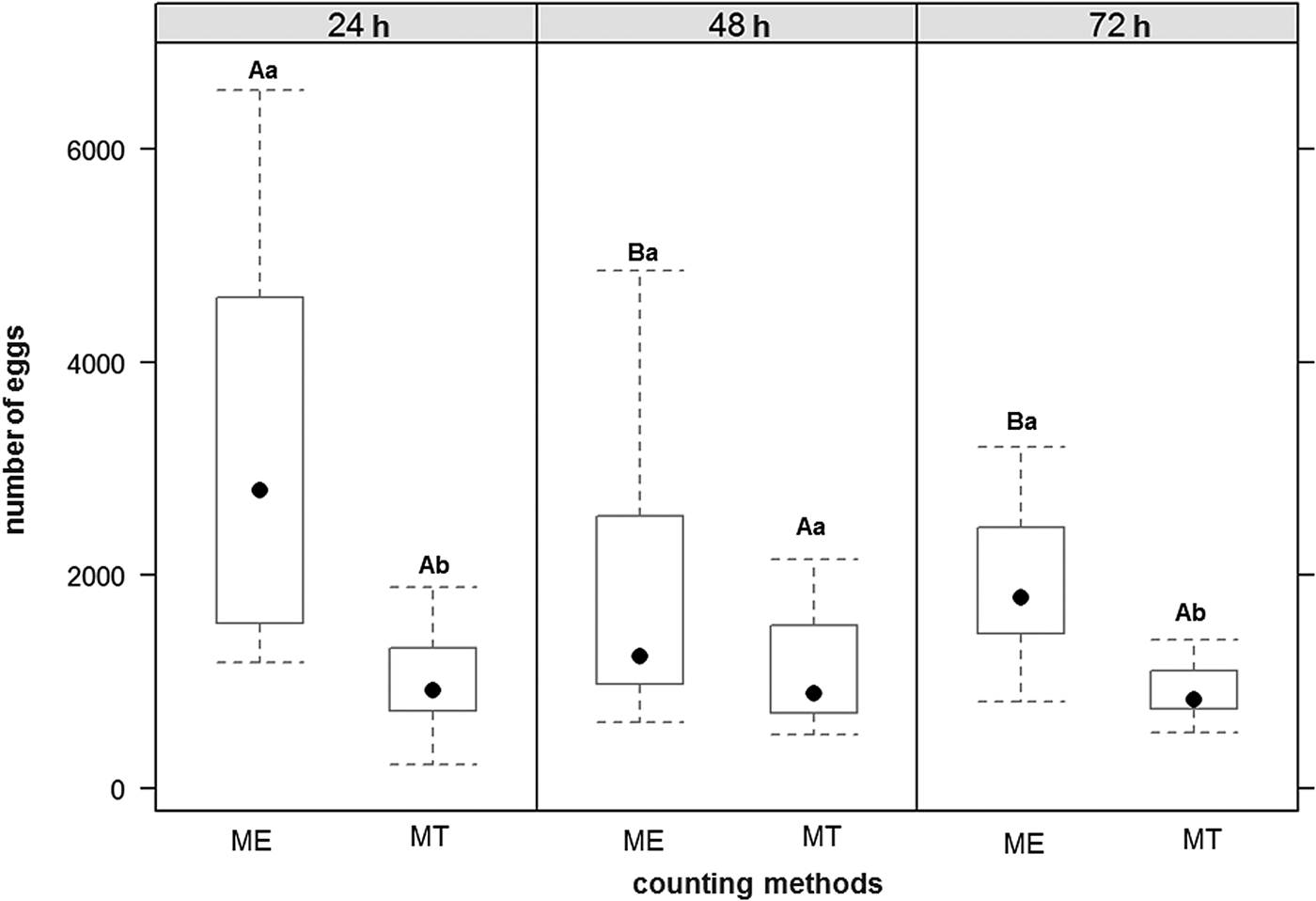
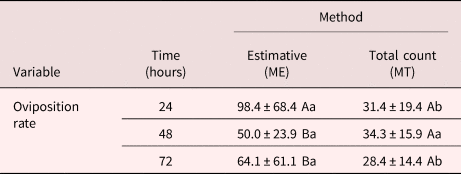
Over the three collection days, 2943.5 ± 2840.6 eggs were quantified using the ME, and 1041.5 ± 533.0 eggs were quantified using the MT. The percentage of eggs in the nylon net in relation to the number of eggs quantified in each method was 23.4 ± 8.5% and 43.2 ± 9.5% for the ME and MT, respectively. The prevalence of D. cycloancistrium parasites in A. gigas gills was 100%, and the mean intensity was 26.7 ± 21.4 parasites per fish. The mean oviposition rates for the three days analysed were 80.1 ± 58.7 and 31.4 ± 16.4 for the ME and MT, respectively. For the ME, the number of eggs quantified and the oviposition rate were higher in the first 24 hours (P < 0.05) (fig. 3; table 1). For the MT, no significant differences were seen in egg number or oviposition rates at the time points analysed. Both the egg number and the oviposition rate increased significantly using the ME compared with the MT (P < 0.05), except for the oviposition rate at 48 hours (P > 0.05).
Number of Dawestrema cycloancistrium eggs quantified over 3 collection days (24, 48 and 72 hours) using estimative (ME) and total counting (MT) methods. Upper case letters indicate differences between collection times (hours) within the same method. Lowercase letters indicate differences between collection methods within collection times (hours).

Dawestrema cycloancistrium oviposition rate at three collection times, using two quantification methods (mean ± standard deviation).

Upper case letters indicate differences between collection times (hours) within the same method. Lowercase letters indicate differences between collection methods within collection times (hours).
The results indicated that quantifying D. cycloancistrium eggs by ME gave an overestimate of the number of eggs in the sample; thus, we considered MT values to determine the oviposition rate of D. cycloancistrium, which was 31.4 ± 16.4 eggs/adult parasite/day. The number of eggs and the oviposition rate determined by the MT indicated no fluctuation in egg production over the three full days.
Discussion
The oviposition rate of D. cycloancistrium has been determined in naturally parasitized A. gigas under in vivo conditions. Two egg quantification methods were compared to determine which was the more reliable method. The ME failed to correctly quantify the number of eggs in the samples, compared with the MT, and is therefore not recommended. The overestimation of eggs observed using the ME can be explained by the characteristics of D. cycloancistrium eggs. These eggs often become entangled due to the length and adhesive structures of their polar filaments, facilitating egg clustering (Maciel et al., Reference Maciel, Muniz and Alves2017). We observed that due to cluster formation, the egg distribution in the samples was not homogeneous. Homogeneity of samples is a condition required for quantifying the eggs by estimative methods, as observed for protozoa, and this generated the difference in counts. Considering these sorts of possibilities for error, Gracenea et al. (Reference Gracenea2016) proposed an estimative quantification method for tetrahedral and fusiform eggs of Epinephelus marginatus monogeneans that is based on egg sedimentation and complemented by a statistical analysis to adjust the count (according to the authors, these monogenean species could not be identified by the morphology of the eggs). Similarly, to reduce the effort for total Neobenedenia girellae egg count, Ohno et al. (Reference Ohno, Kawano and Hirazawa2008) proposed to estimate the number of eggs in a sample by their weight. There was a mean number of 205 eggs in 0.1 mg of total egg mass, and 4.8 cm2 of nylon net used to collect the eggs was used as a tare. The addition of surfactants that could dissolve either the filaments themselves or the adhesive structures on the filaments has also been applied in methods for monogenean egg determination (Gracenea et al., Reference Gracenea2016). Using some of these principles, new methods could be proposed to quantify D. cycloancistrium eggs.
Considering the MT data, the D. cycloancistrium (Dactylogyridae) oviposition rate was 31.4 ± 16.4 eggs/adult parasite/day at 27.4 ± 0.6°C. Another Dactylogyridae, Aphanoblastella mastigatus, a monogenean parasite from Rhamdia quelen, produces 5.04 and 6.66 eggs per parasite per day at 24°C and 28°C, respectively (Marchiori et al., Reference Marchiori2015). Pseudodactylogyrus anguillae (Pseudodactylogyridae) releases an average of 1.2 to 7.7 eggs in accordance with temperature (Buchmann et al., Reference Buchmann, Mellergaard and Køie1987). Although Kearn (Reference Kearn1986) described that most monogeneans typically deposit fewer than 100 eggs per parasite per day and many deposit fewer than 25, recent studies have shown much higher egg yields within this group. The oviposition rates of Heteraxine heterocerca (Heteraxinidae) and Benedenia seriolae (Capsalidae), monogeneans from Seriola quinqueradiata, were recorded as 403.2 and 1399.2 eggs/parasite/day, respectively (Mooney et al., Reference Mooney, Ernst and Whittington2008). Specimens of Zeuxapta seriolae (Heteraxinidae) produce on average 518.4 eggs/worm/day (Mooney et al., Reference Mooney, Ernst and Whittington2006). A live adult Heterobothrium okamotoi (Diclidophoridae) was found to accumulate 1583 eggs in the uterus (Ogawa, Reference Ogawa2002). Taken together, these results show that monogenean egg production rates can be variable and may depend on several exogenous and endogenous factors. The oviposition rate may vary with factors such as environmental conditions (water temperature and amount or timing of light), between-worm differences (age, maturity or size) and host parameters, including age, sex and immune status, or even depending on whether or not the parasite is attached to the host (Kearn, Reference Kearn1986; Buchmann, Reference Buchmann1988; Marchiori et al., Reference Marchiori2015).
Few studies have been conducted on eggs or reproductive rates of tropical monogenean species. The present study demonstrates the egg production capacity of a monogenean parasite of A. gigas, providing basic biological data for D. cycloancistrium that could be useful for further studies that aim to control infections by this parasite.
Acknowledgements
We thank Pollyana Alves de Araújo for laboratory assistance.
Financial support
This study was supported by the Brazilian Ministry of Agriculture, Livestock and Supply through the National Council of Technological and Scientific Development (CNPq grant no. 457465/2012-3 and 434400/2016-5); and by the Brazilian Micro and Small Business Support Service (SEBRAE) through the Tocantins Research Foundation (FAPTO agreement 9/2012, grant no. 2538/2012).
Conflict of interest
None.
Ethical standards
All fish maintenance and euthanasia procedures were undertaken in accordance with the ethical principles of the Ethics Committee of Embrapa Fisheries and Aquaculture, Palmas, Tocantins, Brazil (# 04-A/2015).