Introduction
A growing number of countries internationalise their curriculum by switching to English-medium Instruction (EMI). This strategy is particularly popular in China, where more and more universities offer English-medium courses to raise their international profile (Macaro et al., Reference Macaro, Curle, Pun, An and Dearden2018). Sociolinguistic accounts have been reported on how EMI is perceived and enacted in China as a whole (Hu & Lei, Reference Hu and Lei2014; Fang, Reference Fang2018), or in particular disciplines, such as the humanities, business (Botha, Reference Botha2014), medicine and surgery (Botha, Reference Botha2016). However, relatively little attention has been given to EMI in China's music education, where English is used differently from the educational settings previously studied. In music education, instructors invariably use both verbal and non-verbal communication to explain and demonstrate a musical technique (Long et al., Reference Long, Hallam, Creech, Gaunt and Robertson2012). Students are thus exposed to a wide range of multimodal resources such as languages, sounds, visual aids, and body movements. Given the highly multimodal nature of the learning environment, it is important to understand how English is used and perceived in a multimodal learning environment. To these ends, we conducted a mixed-method study on EMI music master classes and attempted to address the following questions:
a) How are musical terms explained in English-medium master classes?
b) What are students’ perceived difficulties and coping strategies in English-medium music master classes?
c) What language support is expected to facilitate students’ understanding in English-medium music master classes?
The Study
Context and participants
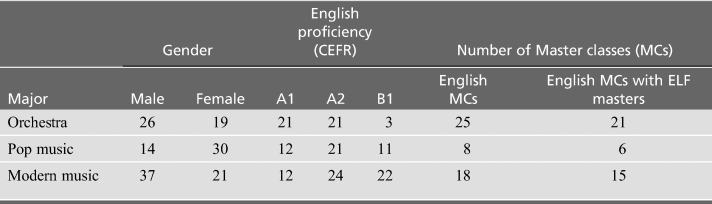
We focused on music master classes in three majors (orchestra, pop music, and modern music) at one of the top conservatoires in China. The master classes are an integral and mandatory component of the curricula. As part of the conservatoires’ endeavours to internationalise the curriculum, music masters are pooled internationally and many of them speak English as a lingua franca (ELF). However, this internationalisation policy has one vexing issue: students’ English proficiency. Based on the scores of China's National Matriculation English Test, about three-quarters of the students in our study can be placed at an A1 or A2 level of CEFR (see Table 1). Despite this linguistic reality, eight to 25 English-medium master classes are scheduled in an academic year (see Table 1). To address the English proficiency issue, the conservatoire provides two types of language support: translation and ESP sessions. About 70% of the English-medium master classes come with full or partial translation (i.e. the instruction is translated in full or in a summary form; or only PowerPoints/handouts are translated). As a second form of language support, an ESP course (Music English) is offered to all students. In a typical Music English session, students are exposed to input materials containing musical terms and lexico-grammatical structures. They then practice these language points in a communicative task (e.g. an oral presentation introducing a music genre).
Profile of the participants and the master classes

Data collection and analysis
We adopted a mixed-method design and collected data in two rounds. First, we distributed questionnaires to the students in their regular ESP sessions. Participation was voluntary and 147 (out of 232) students took the survey. The questionnaires were composed of four parts: (a) the perceived difficulties in EMI music master classes; (b) the frequency of using certain coping strategies; and (c) their expectations of language support.
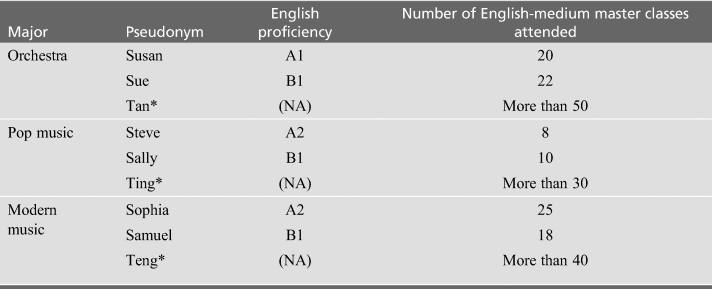
As a second round of data collection, we obtained permission to videotape three master classes (one in each major). After each master class, we conducted a semi-structured interview with two students and one content specialist. Table 2 summarizes the profiles of the interviewees. In the interviews, the students were asked to (a) describe communication problems in the English-medium master classes, (b) report what strategies they adopted to solve the problems, and (c) explain what kinds of language support are needed. The interviews with the content specialists were composed of two parts. They were asked to (a) report the major communication issues in English-medium music master classes, and (b) share their views on improving the language support. After the interview, we jointly conducted video analysis of the music terminologies in the English instruction (see ‘Video analysis’ below for details). All the interviews were conducted in Chinese. The interview quotes below were first translated by the second author and then checked by the first author.
Profile of the interviewees

* The names with an asterisk indicate that the interviewees are the content specialists
NA: Not Available
Results
Video analysis
To address the first research question (i.e. how musical terms were explained in the music master classes), the authors and the content specialists analysed the videotaped classes by focusing on music terminologies. We played the video and paused for every instance when the master explained a specific musical term. We then discussed whether the terminology was explained through mainly linguistic or multimodal instruction. In the case of disagreement, the video was replayed and discussed iteratively until agreement was reached. As presented below, ‘subjectivity’ was an example of mainly linguistic instruction, while ‘dynamics’ was an example of multimodal instruction.
First example
Master: This piece is full of intense subjectivity, an emotional outpour of the composer's unease. On the contrary, the next piece is …
Second example
Master: and dynamics too, because it was a bit too flat
[Stretching the left hand back and forth horizontally; tapping the beat with the left foot]
[Sing] We don't talk anymore; we don't talk anymore
It's
[Swaying the body left and right, up and down; tapping the beat with both feet]
[Beatboxing; singing] {B-ts-ts} We don't talk anymore
[Beatboxing; singing] {t-k} We don't talk anymore
Based on our calculation, 88 of the 115 terminologies were explained in multimodal instruction. With the help of the content specialists, we also grouped these terminologies into the following categories: a) musical techniques and effects (e.g. ‘dynamics’ and ‘vibrato’), b) body parts (e.g. ‘formation of lips’ and ‘diaphragm’), c) instrument parts (e.g. ‘mouthpiece’ and ‘plectrum’), and d) musical interpretations (e.g. ‘subjectivity’ and ‘sarcastic’). 73.33% of the terms in the first two categories were explained in multimodal instruction, compared with only 27.5% in the last two categories.
Perceived difficulties
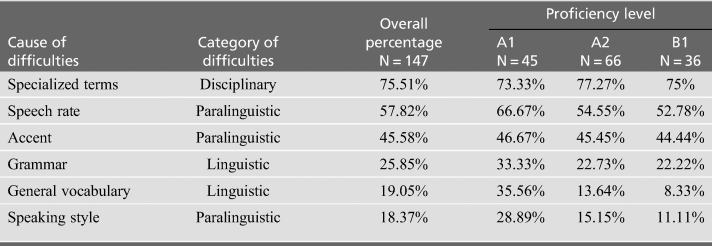
In the survey, we asked the students to choose the causes of communication difficulties in the English-medium master classes. The list of causes was based on the previous studies reporting students’ perceived challenges in ESP/EAP settings (e.g. Evans & Morrison, Reference Evans and Morrison2011; Thøgersen & Airey, Reference Thøgersen and Airey2011; Kuteeva, Reference Kuteeva2014). We grouped these causes into three categories: disciplinary, linguistic, and paralinguistic. Table 3 reports the overall percentage and the percentage in each proficiency group.
Perceived difficulties in MCs

It was found that specialized terms, speech rate, and accent were the top three sources of difficulties, regardless of students’ proficiency level. In line with previous research (Evans & Morrison, Reference Evans and Morrison2011), specialized terms were reported as the most significant challenge for the students. This was further corroborated by the interview data: ‘musical terms are the most difficult part of the English instruction’ (Sophia); ‘the biggest communication problems are technical language and abstract concepts’ (Tan).
Somewhat surprisingly, linguistic issues were not reported as a major source of difficulties in that 25.85% of the students were concerned about grammar and 19.05% of them worried about general vocabulary. In the interviews, the content specialists further confirmed that ‘correct English grammar is not that important’ (Ting); ‘the masters can understand the students even though they speak in incomplete or clumsy sentences’ (Teng).
In addition to the disciplinary, linguistic and paralinguistic factors surveyed in the questionnaire, an extra-linguistic factor emerged in the interview: the master's instruction method. If the masters spoke incessantly, the students might have trouble understanding them: ‘[T]he master kept talking and talking … my mind went blank’ (Steve). If the masters combined English instruction with multimodal demonstration, the instruction was easier to understand. That was why the masters were advised to ‘show more and talk less when translation was not available’ (Teng), as corroborated in the videotaped sessions where the masters explained the majority of terminologies through multimodal instruction.
Coping strategies
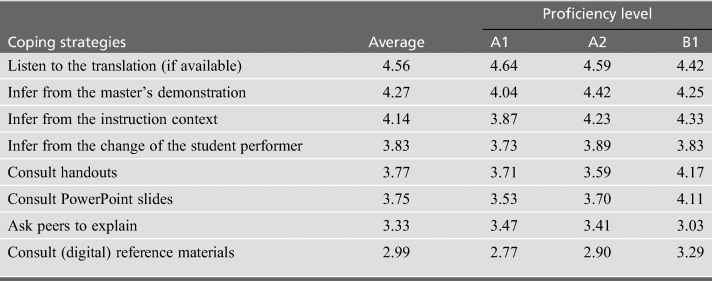
The second part of the questionnaire asked the students to rate how frequently they adopted coping strategies in the English-medium master classes on a scale from 1 (‘never use’) to 5 (‘always use’). The list of strategies was developed from a pilot study asking 60 students from the previous year to report the strategies they used when communication and/or comprehension problems arose in music master classes. We then conducted thematic analysis on the reports and identified eight strategies. As evident in Table 4, listening to the translation and inferring from the master's demonstration were the top two strategies reported by the students, regardless of their English proficiency. Of particular interest was the master's multimodal instruction, which provided cues for the students to understand the English instruction. For instance, Sue recounted how she resorted to the master's demonstration to comprehend a musical term: ‘The master said you needed to practice with m-something. I didn't get the m-word … The master uttered the sound “da-da-da.” I immediately realized she meant “metronome”.’ Similarly, Samuel described how he triangulated the meaning of a technical word with the help of non-linguistic communication: ‘The master said, “You are missing a note.” I thought I missed a written message, but when he hummed the tune, I realized I missed a musical note.’
Frequency of coping strategies

Scrutiny of Table 4 reveals that students with better English tended to frequently use a larger number of strategies. Specifically, A1 students usually used two strategies (indicated by the average rating of over 4), while A2 students usually used three strategies and B1 students five. In the interviews, a more interesting picture emerged: the students with better English seemed more self-regulated in selecting coping strategies. For instance, Samuel reported that ‘the translator got everything wrong … My solution was to listen to the master's English instruction and simultaneously consult English Wiki.’ By contrast, and as suggested in previous research (Evans & Green, Reference Evans and Green2007), students with limited English seemed reluctant and unable to consult reference materials: ‘Listening to the instruction and simultaneously looking up words are overwhelming’ (Susan); ‘I tried to look up a new word but gave up because I didn't know its spelling’ (Sophia). Taken together, the questionnaire and interview data seem to suggest that the quantity and quality of coping strategies correlate with the students’ English proficiency.
Expectations of language support
As noted earlier, the conservatoire provided two types of language support: on-site translation and ESP sessions. In the survey, 91.84% of the students believed that it was necessary to provide on-site translation. However, some students suggested that full translation was not necessary: ‘the [translators] don't have to translate every sentence, just the technical parts will do’ (Samuel). This advice was echoed by the content specialists: ‘given the time constraint, only the gist or the most important part of the instruction was translated … to save time for the master's instruction’ (Tan). Interestingly, as many as 93.88% of the students reported that they still listened to the English instruction, even though the translation was provided. They believed that the translation could not replace the English instruction. In fact, the two complemented each other: ‘you have an initial understanding of the English instruction; then you compare it against the translation to verify or update your understanding’ (Sally).
In the survey, the students rated the ESP course (Music English) at 3.34 on a 5-point scale (with 5 meaning ‘very helpful’). In the interviews, they highlighted one particular problem. The language instructors and the music masters used very different styles of English: ‘the language instructors speak formal and correct English, but the international masters speak informal and even accented English’ (Steve). Sally further explained that
The international masters usually use English in a different way. For example, one master said ‘medium-full’ and ‘medium-empty’. I didn't quite understand what he meant, but later, through his hand gestures, I thought he wanted to say ‘half-full’ and ‘half-empty’.
As for the expectations of the ESP course, 89.12% of the students wanted to focus on specialized terms. About half of the students wanted to focus on pronunciation, grammar, and lexis (46.94%, 44.9%, and 44.9% respectively). In the interviews, two possible ways were suggested to link the ESP sessions with the master classes. First, content specialists and language instructors can collaborate and design the ESP content: ‘[M]usical terms can be prepared by masters or content specialists, and introduced to students by language instructors’ (Sally). Another suggestion is to simulate how English is used in the master classes: ‘We can do role play or mock dialogue exercises in the ESP sessions to familiarize ourselves with the communication scenarios in master classes’ (Samuel); ‘Language instructors can make students speak and listen as if they are in a master class’ (Ting).
Discussion
In line with previous research in other educational settings (e.g. Evans & Morrison, Reference Evans and Morrison2011), our study found that specialised terms were the principal source of difficulty in English-medium music master classes, while linguistic factors (i.e. grammar and general vocabulary) were perceived to be less of a problem. However, unlike previous research, our study showed that the English instruction in music master classes was primarily multimodal, with humming, gestures and body movements. Consequently, the students usually resorted to multimodal resources to fill the comprehension gap. We also found that the majority of the students, despite their low English proficiency, had a positively high level of engagement. Many of them still listened to the English instruction (even though the translation was available) and made use of various coping strategies to comprehend the instruction. Our findings raise two possibilities to address the potential conflict between students’ low English proficiency and the EMI policy in music education.
First, students can be trained to use English as a linguistic leverage to mobilise multiple meaning-making resources. We acknowledge that it is important to improve students’ English proficiency in the ESP sessions, because our survey revealed that the students with better English frequently used a wider range of coping strategies. However, to enact ‘a more discipline-focused approach’ (Evans & Morrison, Reference Evans and Morrison2011: 206), language instructors need to simulate the communicative scenarios and guide learners to practise using English to access and navigate other meaning-making resources. To illustrate, language instructors can teach some sentence patterns to request the master's multimodal instruction. A sentence as simple as ‘Can you show me?’ will prompt the master to demonstrate the musical technique, thereby enhancing the understanding of the English instruction. Additionally, students can be trained to capture the pronunciation of a new (musical) term in fuzzy spelling and then use their smartphones to consult online materials. This skill is particularly useful for the student audience in a master class.
Second, as many music masters are ELF speakers, language instructors need to develop students’ communicative repertoire for ELF interactions. Although the students’ English proficiency was found to correlate with the quantity and quality of coping strategies, our survey results about the perceived difficulties and the expectations of the ESP sessions did not flag the standard use of English as a top priority. In the interviews, some students further pointed out that the music masters used English styles different from the ‘standard’ English featured in the ESP sessions. These seemingly paradoxical findings highlight the need to adopt a product-process ELF framework to design the ESP sessions. From the product perspective, as the music students have relatively low English proficiency, a ‘lingua-franca core’ (Jenkins, Reference Jenkins2000) needs to be part of the pedagogical contents. That is, students need to be taught about the phonological and lexico-grammatical features of ‘standard’ English that are essential to avoid miscommunication in ELF interactions (Widdowson, Reference Widdowson, Jenkins, Baker and Dewey2018) and improve the agency and efficacy of deploying coping strategies. Building on the ‘lingua-franca core’, students need to develop their sensitivity to different English styles and their ability to accommodate differences from the process perspective. In ESP sessions, students can be trained to become reflective communicators who are able to deploy pragmatic strategies to pre-empt or solve non-communication and miscommunication (Murray, Reference Murray2012). One particularly relevant activity is to have students analyse the videos of previous master classes and reflect on the reasons of and possible solutions to communication breakdowns. Language instructors can also enhance students’ communicative repertoire by showing them some effective accommodation strategies, such as requesting the music master to repeat an unclear word or paraphrase an unknown word, and the ‘let it pass’ strategy that allows students to focus on the message rather than the form (see Kirkpatrick, Reference Kirkpatrick2010 for more possible strategies). In this way, students can enhance their communicative repertoires to develop contingent, appropriate strategies to accommodate the particularities of ELF music masters from diverse lingua-cultural backgrounds.
Conclusion
While limited by its sample size, our study extends previous research on ‘disciplinary differences in English use’ (Bolton & Kuteeva, Reference Bolton and Kuteeva2012: 444). Our findings point to the need for future research that examines the relation between language use and language requirements in English-medium music education. Specifically, should there be a minimum English level for students to engage in music education? In some educational settings (see e.g. Hu & Lei, Reference Hu and Lei2014), students are required to reach a certain English level before being admitted into an EMI course, while in some others (see e.g. Fang, Reference Fang2018), a minimum English level is not required. Do we need to impose a proficiency threshold in EMI music education? If the answer is affirmative, can we and should we use standardized test such as IELTS and TOEFL to measure students’ proficiency? Or should we introduce more multimodal and ELF elements to test students’ readiness for accommodating music masters’ instruction? If no proficiency threshold is imposed, what language support should be provided for those low English proficiency students?
The answers to these questions will inform language instructors and policy-makers to better prepare students for English-medium music education.
Acknowledgements
This study was supported by a grant from the Department of Education of Guangdong Province, China (Project Title: An application study of Music literature English-Chinese parallel corpora).
 DR. YUANJUN DAI is a post-doctoral fellow at Jinan University and a lecturer at Xinghai Conservatory of Music. He was an academic visitor at University of Birmingham (2015). His research interests include a metaphor-oriented approach to lexicography and English for specific purposes. Email: douglasengine@hotmail.com
 DR. ZHIWEI WU is an assistant professor at Hong Kong Polytechnic University. He was an academic visitor at Lancaster University (2014) and a visiting scholar at Pennsylvania State University (2016–2017). His research interests include translation and interpreting studies and English for specific purposes. Email: patrickwzw@hotmail.com