Introduction
The double-crested cormorant (Phalacrocorax auritus) is a large-bodied piscivorous waterbird ubiquitous in North America. In the population east of the Rocky Mountains, P. auritus breeds in the interior and Atlantic coasts of the United States and Canada. Eastern populations of P. auritus winter along the Gulf of Mexico and southern Atlantic coast to the Caribbean (Wires & Cuthbert, Reference Wires and Cuthbert2006; Dorr et al., Reference Dorr, Hatch, Weseloh and Poole2014a). These opportunistic pursuit-diving birds forage on the most abundant fishes between 2 and 25 cm in length (Campo et al., Reference Campo, Thompson, Barron, Telfair, Durocher and Gutreuter1993; Kirsch, Reference Kirsch1995; Fenech et al., Reference Fenech, Lochman and Radomski2004). In natural systems, the most abundant fishes can vary seasonally (Gido & Matthews, Reference Gido and Matthews2000; Anderson et al., Reference Anderson, Roby and Collis2004; Coleman & Richmond, Reference Coleman and Richmond2007; Dorr et al., Reference Dorr, Hanson-Dorr, DeVault, Barras and Guillaumet2014b) and fish assemblages and their parasites can vary among water bodies. Consequently, cormorants eat an assortment of fishes and parasites as they move from one foraging ground to another. Thus, the diversity of a host's infracommunity offers an integrative estimate of the habitats that a bird has encountered (Sheehan et al., Reference Sheehan, Tonkyn, Yarrow and Johnson2016). Cormorants can be problematic to stocked ponds and aquaculture facilities, where predatory birds consume cultivated fishes (Jackson & Jackson, Reference Jackson and Jackson1995; Overstreet & Curran, Reference Overstreet and Curran2004; Dorr et al., Reference Dorr, Burger, Barras and Godwin2012; King et al., Reference King, Strickland and Radomski2012). Of particular concern in aquaculture is the echinostomatid trematode Drepanocephalus auritus (Kudlai et al., Reference Kudlai, Kostadinova, Pulis and Tkach2015: previously reported as D. spathans), which infects P. auritus and causes mortality in juvenile farmed catfish that serve as intermediate hosts (Griffin et al., Reference Griffin, Khoo, Steadman, Ware, Quinou, Mischke, Greenway and Wise2014). During the breeding season, adult cormorants split their time between foraging and nesting activities.
Parental care of young is shared between the sexes in P. auritus (Anderson et al., Reference Anderson, Roby and Collis2004) and, because birds must remain close to their nests during the breeding season, cormorants can be restricted to a relatively small foraging radius (e.g. 2.9–14.1 km; Custer & Bunck, Reference Custer and Bunck1992; Coleman et al., Reference Coleman, Richmond, Rudstam and Mattison2005; Dorr et al., Reference Dorr, Burger, Barras and Godwin2012). A small foraging area can limit the variety of habitats and food types encountered and, thus, can limit the diversity of parasites acquired while foraging. On the other hand, in winter, the foraging range of P. auritus has been reported to exceed 300 km (King, Reference King1996), suggesting that the variety of food items (and parasites) available to wintering birds could be greater. We note, however, that birds foraging around aquaculture facilities have smaller home ranges in winter compared to birds not affiliated with aquaculture (Dorr et al., Reference Dorr, Burger, Barras and Godwin2012).
The aim of this study was to determine whether parasite community dynamics reflect differences in host demography and seasonal behaviour. Infracommunity diversity within hosts can be used to indicate the richness of prey types that a host has encountered (Bush et al., Reference Bush, Heard and Overstreet1993, Reference Bush, Lafferty, Lotz and Shostak1997; Sures & Streit, Reference Sures and Streit2001; Thieltges & Poulin, Reference Thieltges and Poulin2016), and we hypothesize that birds collected during the breeding season, when their foraging radius is restricted, will have a lower diversity of intestinal helminths compared to birds collected during the winter non-breeding season. A subset of our collections include non-breeding immature birds (no nest guarding or brood provisioning), and we expect to find higher diversities of parasites in these birds during the breeding season compared to mature breeding adults. Because parental care is shared between male and female P. auritus, we expect similar infracommunities during the breeding season, and lower richness and diversity in wintering males, which forage more frequently in aquaculture facilities than females (Craig et al., Reference Craig, King, Sparks and Curtis2016).
Materials and methods
Collection and examination of cormorants
The US Department of Agriculture, Animal Plant Health Inspection Service, Wildlife Services (USDA/APHIS/WS) of Minnesota; the USDA/APHIS/WS National Wildlife Research Center; and the Band of Ojibwe, Division of Resource Management shipped the intestines or entire carcasses of P. auritus to Clemson University. Collections originated from 11 distinct geographic sites (see tables 1 and 2 for site descriptions and location). Bird carcasses or digestive tracts were frozen immediately after harvest and, in some cases, 70% ethanol was poured down the oesophagus to preserve stomach and intestinal contents prior to freezing (Reeder, Reference Reeder1951).
Intestines were processed in wildlife laboratories at Clemson University. Gastrointestinal tracts were defatted (solid fat bodies removed from exterior of intestine) prior to emptying of the contents by stripping the lining of the intestine by hand (manual scraping of the lining and mucosa: Rae, Reference Rae2003). The intestinal lumen and contents were then washed with water in a 64-μm sieve, and fixed in 10% buffered formalin for morphological assessment. Contents were viewed under 3–70 × magnification (AmScope model ZM6745TN; AmScope, Irvine, California, USA) and all parasites were removed for identification and enumeration. Parasites were stored in 80% ethanol prior to identification (Yamaguti, Reference Yamaguti1958; Skriabin, Reference Skriabin1964; McDonald, Reference McDonald1988; Gibson et al., Reference Gibson, Jones and Bray2002, Reference Gibson, Bray and Jones2005, Reference Gibson, Bray and Jones2008; Forrester & Spalding, Reference Forrester and Spalding2003) and a representative sample (up to five parasites) of most species from each locality was stained with acetocarmine, mounted in Canada balsam (Gower, Reference Gower1939) and deposited at the US National Parasite Collection (accession numbers 108209–108247), Smithsonian National Museum of Natural History Department of Invertebrate Zoology, Washington, DC.
Data analysis
Measures of parasite diversity can be highly sensitive to rare species (e.g. species richness; Hanski, Reference Hanski1982) or reflect the evenness of abundance among the species present in an infracommunity (e.g. Shannon–Weiner entropy: Whittaker, Reference Whittaker1972). Observed species richness within a host (S) is a relatively simple measure. Diversity indices [e.g. exponential Shannon entropy (exp(Shannon))] estimate richness while accounting for evenness, but require abundance data for their calculation (Whittaker, Reference Whittaker1972; Spellerberg & Fedor, Reference Spellerberg and Fedor2003). We chose to use exp-(Shannon) because once in the exponent form, Shannon–Weiner entropy provides a diversity estimate comparable to S, but declines based on the degree of dominant species present in an infracommunity (Jost, Reference Jost2006). Thus, the difference between S and exp(Shannon) can be used to estimate the frequency of dominant vs. rare species (Leinster & Cobbold, Reference Leinster and Cobbold2012).
We calculated (S) and exp(Shannon) for the intestinal infracommunity of each host. Birds collected from the same locality at the same time comprise a sample group (see tables 1 and 2). Each sample group was categorized by season based on information provided from the source agency: the date of collection (breeding collections = May–August, table 1; winter collections = November–February, table 2), the approximate geographic location (latitude and longitude), sex and, when available, the reproductive age (immature vs. breeding adult).
Generalized mixed models are robust to non-normal data and are appropriate for tests where random effects must be accounted for (Bolker et al., Reference Bolker, Brooks, Clark, Geange, Poulsen, Stevens and White2008). Values of S and exp(Shannon) were compared between reproductive age groups (immature and adult) of birds collected during the breeding season with a Generalized Linear Model (GZM with Poisson distribution – appropriate for count data estimated by S and exp(Shannon), and an over-dispersion correction: Gardner et al., Reference Gardner, Mulvey and Shaw1995) using JMP 12.1 Pro© (SAS Institute Inc., Cary, North Carolina, USA), and included sample group as a random variable. This tested whether there were significant infracommunity differences between breeding and non-breeding birds on the breeding grounds. After confirming no difference in parasite richness and diversity among age groups during the breeding season, we performed a second set of GZMs to test whether birds during the breeding season had higher parasite richness and diversity when compared to birds collected on the wintering grounds. A third set of GZMs tested for differences in parasite infracommunities between host sexes on breeding and wintering grounds. For this model, sample group was a random variable; first-order effects of sex and season and an interaction term for sex and season were used.
Results
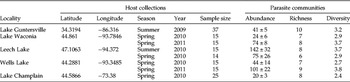
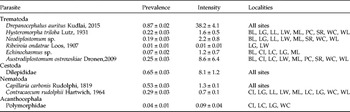
The mean infracommunity intensity of the 218 P. auritus assessed was 63 worms. One bird had a singleton infection (one individual), and the highest intensity of infection was in a bird carrying 1488 parasites. The mean parasite richness was 3.7 species, with the highest richness found in birds from Bee Lake, Mississippi (MS); Lake Guntersville, Alabama (AL); and Wells Lake, Minnesota (MN) (tables 1 and 2). We observed 10 helminths from P. auritus (table 3) but identification to species was not possible for some. Thus, our results likely underestimate the species richness of intestinal parasites of P. auritus. In all sample groups, the diversity estimate derived from exp(Shannon) was lower than the observed S, suggesting that dominant parasites were consistent among component communities (tables 1 and 2). As such, further reference to diversity encompasses both S and exp-(Shannon).
Host collection information and mean parasite community estimates for P. auritus collected from their breeding grounds in Alabama (Lake Guntersville), Minnesota (Lakes Waconia, Leech and Wells) and Vermont (Lake Champlain).

Host collection information and mean parasite community estimates in P. auritus collected from their wintering grounds in Alabama (Cat Island) and Mississippi (all other sites).

Mean prevalence and intensity of the ten parasite groups recovered from the intestines of P. auritus. Abbreviations for localities: Bee Lake (BL), Cat Island (CI), Lake Champlain (LC), Lake Guntersville (LG), Leech Lake (LL), Lake Waconia (LW), Mossy Lake (ML), Port of Columbus (PC), Swamp Roost (SR), Whittington Channel (WC) and Wells Lake (WL).

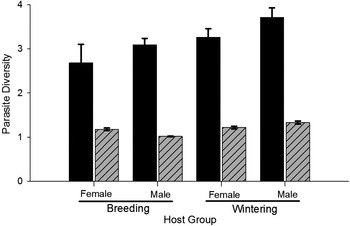
No differences in parasite infracommunity diversity were detected between mature (breeding birds) and immature (non-breeding) P. auritus at nesting sites where both age groups were present (n = 72: all localities in MN and Lake Guntersville, AL, table 3). The Generalized Linear Models comparing parasite abundance and diversity between breeding (collected on the breeding grounds; n = 121) and wintering birds (collected outside the breeding season; n = 66) revealed significant differences (table 4). Infracommunities of male P. auritus were consistently more diverse than females during the breeding season and in winter (parasite richness: −LogLikelihood = 7.2, χ2 = 14.4, P < 0.01; Shannon Diversity: −LogLikelihood = 6.4, χ2 = 12.8, P < 0.01; fig. 1), but infection intensities were similar between the sexes (−LogLikelihood = 0.7, χ2 = 1.4, P = 0.70).
Species richness (filled bars) and diversity (hatched bars) of intestinal helminths from female and male P. auritus collected on breeding and wintering grounds. The models for species richness (P < 0.01, χ2 = 14.4, Overdispersion = 0.45) and Shannon Diversity (P < 0.01, χ2 = 12.8, Overdispersion = 0.03) indicated significant differences between breeding and wintering birds and between sexes, but not the interaction of season and sex.

Model output from generalized linear models (GZMs) testing for differences in age and breeding status, where sample group is a random variable in both mixed models. Three GZMs tested for differences in parasite intensity (abundance), species richness and diversity (exp(Shannon) for both predictor groups. The two right-hand columns show the mean and standard error for the groups tested in each model.

Discussion
Many studies have documented the intestinal parasites of P. auritus at single locations or within a narrow region of its distribution, often focusing on a particular parasite taxon (Hutton, Reference Hutton1964; Threlfall, Reference Threlfall1982; Flowers et al., Reference Flowers, Poore, Mullen and Levy2004; Dronen, Reference Dronen2009; Wagner et al., Reference Wagner, Hoberg, Somers, Soos, Fenton and Jenkins2012). This is the first study to document the intestinal parasite infracommunities of P. auritus collected from multiple localities within the eastern US. We report infections as previously observed in P. auritus and other cormorant species near sampling regions in this study (Dubois & Mahon, Reference Dubois and Mahon1959; Hutton & Sogandares-Bernal, Reference Hutton and Sogandares-Bernal1960; Hutton, Reference Hutton1964; Threlfall, Reference Threlfall1982; Chandler & Rausch, Reference Chandler and Rausch1984; Kuiken et al., Reference Kuiken, Leighton, Wobeser and Wagner1999; Overstreet & Curran, Reference Overstreet and Curran2004, Robinson et al., Reference Robinson, Forbes, Hebert and McLaughlin2008, Reference Robinson, Forbes and Hebert2009; Doffitt et al., Reference Doffitt, Pote and King2009; Dronen, Reference Dronen2009; Violante-Gonzalez et al., Reference Violante-Gonzalez, Monks, Gil-Guerrero, Rojas-Herrera, Flores-Garza and Larumbe-Moran2011; Garcia-Varela et al., Reference Garcia-Varela, Aznar, Rodriguez and Perez-Ponce de Leon2012; Wagner et al., Reference Wagner, Hoberg, Somers, Soos, Fenton and Jenkins2012; O'Hear et al., Reference O'Hear, Pote, Yost, Doffitt, King and Panuska2014; Kudlai et al., Reference Kudlai, Kostadinova, Pulis and Tkach2015) and confirm the widespread distribution of many parasites of this host. In particular, D. auritus occurred in all locations sampled in this study, consistent with high prevalence values reported in Robinson et al. (Reference Robinson, Forbes, Hebert and McLaughlin2010) and Wagner et al. (Reference Wagner, Hoberg, Somers, Soos, Fenton and Jenkins2012). This is also the first report of Echinochasmus sp. in P. auritus in the United States. Additionally, the widespread frequency (present at 100% of localities sampled) of tapeworm infections of P. auritus is revealed. Although identification of cestodes to species from frozen P. auritus was unsuccessful, we suggest that this is a previously underrepresented parasite group in cormorants and additional studies on unfrozen host samples could help elucidate their identities and distributions.
The high variety of parasites found in P. auritus confirms the generalist feeding habits of this waterbird, with over 250 fish species documented in its range (Dorr et al., Reference Dorr, Hanson-Dorr, DeVault, Barras and Guillaumet2014b). Shared parasites among sampling localities and between seasons suggest that the life cycles of many parasites of P. auritus persist throughout the range of their definitive host. This could result from a lack of intermediate host specificity or from infections in widely distributed intermediate hosts, such as the bullhead (Ameiurus sp.), gizzard shad (Dorosoma cepedianum) and yellow perch (Perca flavescens), and first intermediate hosts, such as mollusc and arthropod congeners (Holl, Reference Holl1932; Arnold, Reference Arnold1934; Thomas, Reference Thomas1937; Krueger, Reference Krueger1954; Carney & Dick, Reference Carney and Dick2000; Poulin & Dick, Reference Poulin and Dick2007). Alternatively, infection durations that persist through multiple seasons could explain the similarities between wintering and breeding parasite communities. This possibility is particularly intriguing because interspecific interactions among parasites could exclude (competition) or promote (facilitation) parasites that are expanding in range (Lello et al., Reference Lello, Boag, Fenton, Stevenson and Hudson2004; Johnson & Buller, Reference Johnson and Buller2011) through changes in definitive host distribution. Despite overall similarities in parasite infracommunity composition, we were able to detect significant differences of host sex and seasonality using parasite richness and diversity metrics.
We expected parasite diversity to be higher in immature birds collected on the breeding grounds and found instead that their parasite infracommunity diversities were no different from those of breeding adults. Rather than expanding their foraging territory, it appears that immature birds forage with groups of breeding adults and remain close to nest sites, despite their ability to spend a larger proportion of their time travelling to and acquiring food. This hypothesis is supported by the findings of Dorr et al. (Reference Dorr, Hanson-Dorr, Barras and DeVault2016), who reported that about 20% of cormorants collected from foraging flocks near breeding colonies were non-breeding birds. Consequently, future parasitological studies of P. auritus need not focus on particular age classes of this host.
There were differences in parasite assemblages between male and female P. auritus during the breeding and wintering seasons. Despite shared brooding and provisioning responsibilities, it appears that foraging behaviour and diets of breeding male and female P. auritus differ. Differences in foraging behaviour between sexes has been documented on the breeding and wintering grounds. Anderson et al. (Reference Anderson, Roby and Collis2004) reported that males were more likely to forage at night and encounter a distinct prey/parasite assemblage. Additionally, foraging depth and duration can differ between the sexes of foraging waterbirds (Casaux et al., Reference Casaux, Favero, Silva and Baroni2001). We observed provisioning of P. auritus partners during incubation (K.L. Sheehan, Clemson University, pers. obs.), suggesting that foraging and feeding between parents could be more asymmetrical than previously reported. Similarly, Dorr et al. (Reference Dorr, Hanson-Dorr, DeVault, Barras and Guillaumet2014b) reported geographic segregation of sexes on the wintering grounds in cormorants, presumably influenced by sex-specific prey and habitat preferences. Differences in parasite communities among cormorants on the wintering grounds, where males forage more frequently at aquaculture facilities than females (Craig et al., Reference Craig, King, Sparks and Curtis2016), were expected. Despite increased use of catfish aquaculture, the results here suggest that male P. auritus feed on a similar diversity of food items as female cormorants, and that supplemental feeding on farmed fish increases cormorant parasite infracommunity richness. Future studies of culled cormorants should make a similar effort to obtain large sample sizes of both sexes, a difficult task as morphological differences are not consistent between male and female cormorants.
Distinct diversities of parasites between breeding and wintering birds were detected even when locality and temporal replications were accounted for. This pattern of increased diversity in wintering birds could indicate that birds in winter forage in habitats with higher diversities of intermediate host species. If true, parasite infracommunity diversity within definitive hosts could be a useful indicator for targeted biodiversity sampling of intermediate host communities. Alternatively, the differences in parasite diversity between breeding and wintering birds could represent the variety of habitats where hosts forage. Other researchers have documented vast foraging ranges of P. auritus on the wintering grounds compared to those of breeding birds (King, Reference King1996; Custer & Bunck, Reference Custer and Bunck1992; Coleman et al., Reference Coleman, Richmond, Rudstam and Mattison2005; Dorr et al., Reference Dorr, Burger, Barras and Godwin2012). Although further verification of foraging habits should be conducted on tagged birds, our data suggest that as foraging range increases, parasite richness and diversity also increase.
Here we have successfully identified differences in the composition of intestinal parasite infracommunities, despite limitations in identifying some parasite groups because of frozen specimen preservation. Richness and diversity of parasites in P. auritus differ between male and female hosts and between seasons. Although differences in host maturity are not represented in their parasite infracommunities, a more complete representation of richness with identification of cestode species could change these results. We suggest that parasites are an integrative indicator of not only temporal diet, but also of foraging range (Dorr et al., Reference Dorr, Burger, Barras and Godwin2012). The parasites infecting P. auritus are acquired when birds forage on fish prey, and can indicate dominant food sources of piscivorous birds in the wild. The parasites of cormorants can help identify colonies that are a nuisance to aquaculture, habitats where predator deterrence should be employed to manage natural resources, and foraging grounds where they are less likely to compete with humans for fisheries resources. Consequently, parasites should be considered as ecological indicators of host behaviour and distribution, particularly for species that are subject to management as a consequence of human–wildlife conflicts.
Acknowledgements
This research was done in partial completion of K.L.S.’s dissertation and would not have been possible without the support of the faculty at Clemson University. Special thanks to Patrick Jodice at Clemson University and William Bowerman at the University of Maryland for inspiration and guidance. Gary Nohrenberg (US Department of Agriculture, Animal Plant Health Inspection Service, Wildlife Services – Minnesota) was kind enough to provide us with whole birds and intestines from birds in Minnesota, and Steve Mortensen (Leech Lake Band of Ojibwa, Division of Resource Management) allowed us to process birds collected for his diet assessments of cormorants. We appreciate the use of facilities and equipment at Clemson University, appropriated in part through funds provided by the Clemson Creative Inquiry program.
Financial support
This research received no specific grant from any funding agency, commercial or not-for-profit sectors.
Conflict of interest
None.