INTRODUCTION
Little information about caprellid amphipods of the Great Caribbean is available due to a lack of extensive research (Baldinger, Reference Baldinger2000; Escobar-Briones & Winfield, Reference Escobar-Briones and Winfield2003). Nevertheless, some remarkable advances have been accomplished to improve the knowledge about caprellids in that area, leading thus to the report of new records (Ortiz & Lalana, Reference Ortiz and Lalana1998; Foster et al., Reference Foster, Heard and Knott2004a; Winfield et al., Reference Winfield, Escobar-Briones and Morrone2006, Reference Winfield, Abarca-Arenas and Cházaro-Olvera2007a; Ahrens & Grubbs, Reference Ahrens and Grubbs2012) as well as to description of new species (Guerra-García, Reference Guerra-García2003a; Guerra-García et al., Reference Guerra-García, Krapp-Schickel and Müller2006; Ortiz et al., Reference Ortiz, Guerra-García and Lalana2009). Particularly, the study of caprellids from the Gulf of Mexico has provided some continuity (Steinberg & Dougherty, Reference Steinberg and Dougherty1957; McCain, Reference McCain1968; Ortiz et al., Reference Ortiz, Álvarez and Winfield2002; Escobar-Briones & Winfield, Reference Escobar-Briones and Winfield2003; Foster et al., Reference Foster, Thomas and Heard2004b; Winfield et al., Reference Winfield, Escobar-Briones and Morrone2006, Reference Winfield, Escobar-Briones and Álvarez2007b), leading LeCroy et al. (Reference LeCroy, Gasca, Winfield, Ortiz, Escobar-Briones, Felder and Camp2009) to state that this basin harbours 13 species, even though the amphipods from the south-east Gulf of Mexico have scarcely been studied.
The genus Mayerella has five recognized species: Mayerella limicola Huntsman, Reference Huntsman1915 and Mayerella redunca McCain, 1968, both from the western North Atlantic, Mayerella acanthopoda Benedict, Reference Benedict1977 and Mayerella banksia Laubitz, Reference Laubitz1970 from the eastern Pacific, and Mayerella magellanica McCain & Gray, Reference McCain and Gray1971 from the Subantarctic and south-eastern Pacific (Guerra-García, Reference Guerra-García2003b).
Mayerella redunca was first described by McCain (Reference McCain1968), establishing its type locality at the north of Coche Island, Nueva Esparta State, Venezuela, 10°50′N 63°54′W, 15 April 1939. After that, M. redunca was reported in more localities along the coast of Venezuela by Díaz et al. (Reference Díaz, Guerra-García and Martín2005) and Miloslavich et al. (Reference Miloslavich, Díaz, Klein, Alvarado, Díaz, Gobin, Escobar-Briones, Cruz-Motta, Weil, Cortés, Bastidas, Robertson, Zapata, Martín, Castillo, Kazandjian and Ortiz2010). Regarding the reports of M. redunca in the Gulf of Mexico, three records coming from a study carried out in the northern Gulf of Mexico by LGL Ecological Research Associates Inc., and Texas A&M University (1986) were overlooked in the caprellid taxonomic literature until they were displayed by Lowry (Reference Lowry2010) through the World Register of Marine Species (WoRMS); these records were sustained by material deposited at the National Museum of Natural History (NMNH), Smithsonian Institution, Washington DC.
In order to contribute to the knowledge about caprellids from the south-east Gulf of Mexico, this paper documents the first record of M. redunca McCain, Reference McCain1968 in the continental shelf of the northern Yucatan peninsula. In it the main morphological features of taxonomic value are provided, along with information about the habitat of the species. The paper also briefly discusses the dispersal mechanisms known in caprellids.
MATERIALS AND METHODS
Sampling was carried out by the Mexican Navy (Secretaría de Marina, Armada de México) during an oceanographic cruise (Yucatan-2004A, 5–16 April 2004) on-board the RV ‘Onjuko'. Sixteen sites were sampled in triplicate with a Ponar grab (0.023 m2): one sample was used for sediment analysis while the two others were used for sorting the benthic fauna (Paz-Ríos, Reference Paz-Ríos2006). Caprellids were found only in two of the samples. The material was fixed in 10% formalin buffered with seawater. Then it was washed in freshwater, sorted and preserved in 70% ethanol. This record followed the classification of Myers & Lowry (Reference Myers and Lowry2003). The examined material was deposited in the ‘Colección de Invertebrados Bentónicos de Yucatán (CYMX)’, Laboratorio de Bentos, Cinvestav.
RESULTS
SYSTEMATICS
Order AMPHIPODA Latreille, 1816
Suborder COROPHIIDEA Latreille, 1803
Family CAPRELLIDAE Leach, 1814
Genus Mayerella Huntsman, Reference Huntsman1915
Mayerella redunca McCain, Reference McCain1968
(Figure 1)
Mayerella redunca McCain, Reference McCain1968, 75–78, figures 37–38. McCain & Steinberg, Reference McCain, Steinberg, Gruner and Holthuis1970, 53. Guerra-García, Reference Guerra-García2003b, 189, 191, 194, figures 8 & 11. Díaz et al., Reference Díaz, Guerra-García and Martín2005, 3, 6, figures 10–11.
MATERIAL EXAMINED
One male (Figure 1A), one female (Figure 1B), 22°17′N 88°00′W, medium sand, poorly sorted, 40.9 m, identified by C.E. Paz-Ríos, 10 April 2004, CYMX-76-PY; one male, one female, 22°06′N 88°59′W, coarse sand, moderately sorted, 31.4 m, identified by C.E. Paz-Ríos, 10 April 2004, CYMX-75-PY.
Mayerella redunca McCain, Reference McCain1968, male: (A) lateral view; (E) gnathopod 2; (G) lateral view of the abdomen; (H) dorsal view of the abdomen; female: (B) lateral view; (C) dactylus of gnathopod 1; (D) palm of gnathopod 1; (F) pereopod 5. Scale bars: A–B, 1 mm; C–H, 0.1 mm.

ADDITIONAL MATERIAL
Two specimens, 28°03′N 90°14′W, 320 m, identified by L.D. McKinney, 26 November 1983, USNM 1003603.
DIAGNOSIS
Body smooth. Antennae 2 without swimming setae and flagellum with two articles. Pereonites 1 and 2 elongate, subequal. Pereopods 3 and 4 with two articles. Pereopod 5 with three articles. Gills on pereonites 3 and 4. Abdominal appendages elongate and curved apically. Gnathopod 1 propodus triangular, with 1 proximal grasping spine; grasping margins of dactylus and propodus serrate. Gnathopod 2 inserted on the posterior half of pereonite 2; propodus elongate, palm provided with 1 grasping spine proximally and notch distally; dactylus slightly curved, shorter than propodus and not serrate.
GEOGRAPHICAL DISTRIBUTION
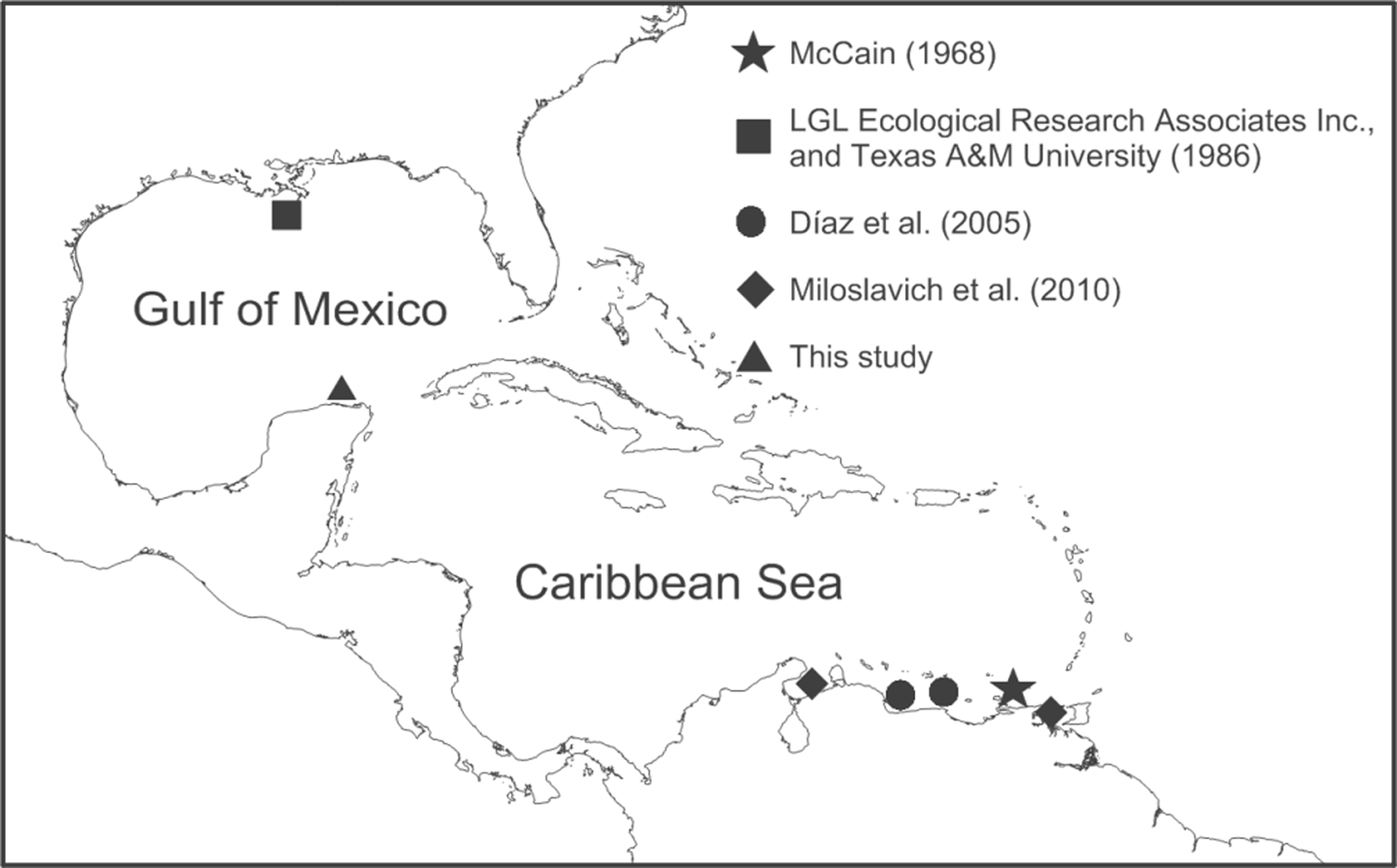
Coche Island, Venezuela (McCain, Reference McCain1968); off Louisiana, USA (LGL Ecological Research Associates Inc., and Texas A&M University, 1986); Caiman Beach and Planta Centro, Venezuela (Díaz et al., Reference Díaz, Guerra-García and Martín2005); Golfo de Venezuela and Golfo de Paria, Venezuela (Miloslavich et al., Reference Miloslavich, Díaz, Klein, Alvarado, Díaz, Gobin, Escobar-Briones, Cruz-Motta, Weil, Cortés, Bastidas, Robertson, Zapata, Martín, Castillo, Kazandjian and Ortiz2010); off Yucatan, Mexico (present study) (Figure 2).
Geographical distribution of Mayerella redunca McCain, Reference McCain1968.

ECOLOGICAL NOTES
The recorded material in the Gulf of Mexico has extended the depth-range established by McCain (Reference McCain1968) and Díaz et al. (Reference Díaz, Guerra-García and Martín2005) in the Caribbean; the new depth-range stretches from the intertidal to 320 m. The material examined was found on the same substratum as Díaz et al. (Reference Díaz, Guerra-García and Martín2005) did, sandy sediment; that material corresponded to both sexes and coexisted with another caprellid, Phtisica marina Slabber, Reference Slabber1769.
REMARKS
Although the specimens of Mayerella redunca deposited in the Smithsonian have not yet been examined by a caprellid specialist, its occurrence in the northern Gulf of Mexico is adopted here provisionally as valid for one of the three records displayed by Lowry (Reference Lowry2010). There are still two likely records by LGL Ecological Research Associates Inc., and Texas A&M University (1986) (USNM 1003069 and USNM 1003602) for M. redunca which were not included here given its uncertain identity; the specimens are identified as Mayerella cf. redunca in the online Smithsonian museum database.
The main morphological features for the M. redunca regional taxonomic determination thereby separating it from the other species of the same genus are observed in the pereonites, gnathopods and abdomen. In the male the head together with the pereonite 1 is long (Figure 1A), the propodus of gnathopod 2 is slender and elongate (Figure 1E), and the penes are short and rounded (Figure 1G); in the female the palmar margin of gnathopod 1 is serrate (Figure 1D). These morphological features are sufficient to separate M. redunca from Mayerella limicola, the other species found in the western North Atlantic. According to the key of Guerra-García (Reference Guerra-García2003b), the other species most closely related to M. redunca are Mayerella acanthopoda and Mayerella banksia from the Eastern Pacific. However, M. redunca is distinguished from M. acanthopoda by: (i) dactylus of gnathopod 1 of the female, serrate on the inner margin (Figure 1C); (ii) dactylus of gnathopod 2 in the male, slightly curved and shorter than the propodus (Figure 1E); and (iii) the abdominal appendages in the male, elongate, as well as curved and not setose apically (Figure 1G, H); in addition, both sexes in M. redunca exhibit three articles in the pereopod 5 (Figure 1F). Mayerella redunca can also be distinguished from the male of M. banksia by pereonite 1 longer than pereonite 3 and abdominal appendages curved apically.
DISCUSSION
Geographical extension
The new record extends the geographical range of Mayerella redunca from the northern (Louisiana) to the southern (Yucatan) Gulf of Mexico, representing a distance of about 700 km, and constitutes the first record in Mexico. In turn, the first record of M. redunca in the Gulf of Mexico represents a geographical extension of about 3300 km from the southern Caribbean. Another species showing a considerable geographical extension is Caprella scaura Templeton, Reference Templeton1836, from the northern Caribbean to the northern Gulf of Mexico, representing a distance of about 2500 km (Foster et al., Reference Foster, Heard and Knott2004a).
The scattered records reflect a scarce knowledge about caprellids of the Gulf of Mexico and Caribbean due in part to the lack of sampling surveys of these habitats, as shown by Foster et al. (Reference Foster, Heard and Knott2004a) from the jetties of St Andrew Bay, Winfield et al. (Reference Winfield, Abarca-Arenas and Cházaro-Olvera2007a) from the Veracruz coral reef system, and Ortiz et al. (Reference Ortiz, Guerra-García and Lalana2009) from a marine cave of southern Cuba.
Dispersal
The distribution of caprellids is closely related to their lifestyle for they are often associated with fouling assemblages living on floating objects, which have a high dispersal potential (Thiel et al., Reference Thiel, Guerra-García, Lancellotti and Vázquez2003). Caprellids are considered to be rafting organisms, having morphological adaptations for attaching themselves to a variety of substrata, e.g. macroalgae, seeds, wood, plant propagules or carapace of turtles (Caine, Reference Caine1978, Reference Caine1986; Thiel et al., Reference Thiel, Guerra-García, Lancellotti and Vázquez2003; Thiel & Gutow, Reference Thiel and Gutow2005). In addition, it is theorized that its direct development allows them to complete their life cycle on the substratum during the rafting voyages. Thus, these features allow caprellids to be suitable for long-distance dispersal (Thiel & Vázquez, Reference Thiel and Vázquez2000; Thiel et al., Reference Thiel, Guerra-García, Lancellotti and Vázquez2003; Thiel & Gutow, Reference Thiel and Gutow2005). Another potential mechanism of dispersal could be passive transport by pathways associated with ocean-going vessels (e.g. ballast water, ballast sediment and hull fouling) (Godwin, Reference Godwin2003); it has been determined that this is an excellent vector for long-distance dispersal of crustaceans, including caprellids (Ashton et al., Reference Ashton, Willis and Cook2007; Montelli, Reference Montelli2010).
So far, the biogeographical affinity of Mayerella redunca appears to be Caribbean although it has a disjoint distribution (as opposed to gradual range expansion over continuous suitable habitats), which is a result of jump-dispersal much like that of some gammarids (Myers, Reference Myers1993). More records are necessary before making any final statement about the biogeographical affinity of this species.
ACKNOWLEDGEMENTS
The first author thanks Gildardo Alarcón (SEMAR, México) for support in the oceanographic cruise, Yusbelly Díaz (Universidad Simón Bolívar, Venezuela) for her comments on the manuscript and advice for proper identification, and María Teresa Herrera-Dorantes (Cinvestav, Mexico) for sorting the benthic material. The authors thank the anonymous referees who helped to improve the manuscript.