1. Introduction
Policy makers have become more concerned about the effect of environmental regulations on investment flows as globalization has increased. As barriers to international trade continue to fall, a country's environmental regulations may become an important influence on its comparative advantage. Assuming that firms are responsive to inter-jurisdictional differences in the degrees of regulatory stringency, the pollution haven hypothesis (PHH) posits that pollution-intensive production activities move to lenient countries either through foreign direct investment (FDI) or by lax countries' exporters increasing their market shares. Accordingly, PHH has for decades served as a rallying call for an assortment of constituencies involved in the trade-versus-environment debate. It focuses on the cost effect of environmental regulations on firms and presumes that production cost differentials are a sufficient stimulus for firms to relocate their production facilities. Rationalizations for this view generally come from the notion that a stricter regulatory regime for environmental standards will add to the costs of production. Such costs may arise from the requirements for new equipment and the need to find alternative methods for disposal of waste due to rules against landfill or restrictions on particular inputs and outputs. In the absence of any other factors, it is in firms' interest to relocate their production activities to countries with less stringent environmental regulations.Footnote 1
The number of empirical studies of the PHH has expanded steadily since the beginning of the 2000s. While the economic rationale behind the hypothesis has been well established (see, for instance, McGuire, Reference McGuire1982; Rauscher, Reference Rauscher, Mäler and Vincent2005), the empirical literature has yet to reach a robust consensus about the link between FDI and environmental regulation, mainly due to the numerous complexities confronted and the compromises made by researchers. Evidence that supports both sides of the argument, based on a wide range of factors, including the unique characters of the different data sets used in each study, the models employed to control for unobserved heterogeneity, and the proxies chosen to represent the stringency of environmental regulations, can easily be found. This present paper aims to fill the gap in the literature by reviewing previous empirical studies on the said topic and using a meta-analysis to test whether the findings are sensitive to the various modeling approaches employed.
Glass (Reference Glass1976: 3) states that a meta-analysis is ‘the statistical analysis of a large collection of analysis results from individual studies for the purpose of integrating the findings’. A meta-analysis thus employs the regression parameters extracted from each study as the dependent variables, and the characteristics of the same studies as the independent ones. Since its first application in economics by Stanley and Jarrell (Reference Stanley and Jarrell1989), an increasing number of economics studies have used the meta-analysis approach. A summary of 130 meta-analysis papers by Nelson and Kennedy (Reference Nelson and Kennedy2009) shows that a properly performed meta-analysis has the capability to explain what determines the wide study-to-study variation in findings. As best as can be ascertained, this is the first application of a meta-analysis to the FDI and pollution haven literature.
Our study is similar in spirit to Mulatu et al. (Reference Mulatu, Florax, Withagen and Löschl2004) and Jeppesen et al. (Reference Jeppesen, List and Folmer2002). The former employs meta-analysis to review the relationship between environmental regulations and trade flows among countries. The latter uses a meta-analysis to synthesize 11 studies analyzing the link between environmental regulations and new plant location decisions in the United States. It pools all new plants, mixing those that are built with domestic resources with those that are partially or fully financed by FDI. Naturally, as its focus is only on new plants, the study by Jeppesen et al. (Reference Jeppesen, List and Folmer2002) disregards studies that analyze the effect of environmental regulations on plants that already existed.
Our study, however, takes a different perspective by reviewing the empirical literature of environmental regulations and FDI. We cover nearly all the published definitions of FDI, from new plant establishment to the stock and flow of capital. We went through 26 studies that contain 679 estimates, undertaken between 1994 and 2011. The data comprise FDI by firms (industries) from a number of countries, including the US, the UK, France, Germany and Japan. In addition, the data include FDI hosted by various countries in different stages of economic development.
In summary, we offer possible explanations for the mixed findings reported in the literature. Our analysis suggests that certain aspects of research design are crucial in explaining the significance of these findings. Among the many definitions of FDI, the decision to build a new plant is most affected by the stringency of environmental regulations. Our results also indicate that a government's environmental spending as a proxy for the stringency of environmental regulations gives the highest probability of obtaining results that support the PHH. We highlight the findings of Ederington et al. (Reference Ederington, Levinson and Minier2005) and Cole et al. (Reference Cole, Elliott and Okubo2010), who point out that focusing the investigation on the pollution-intensive industries does not increase the likelihood of achieving results that support the PHH. Contrary to common belief, the same also holds true for studies that focus their investigations on developing countries.
We offer some possible reasons behind the findings. To begin with, the favorable effects of lenient environmental regulations in developing countries may be cancelled out by the typical deficient characteristics that these countries have. It is also likely that the flows of capital in the pollution-intensive industries undergo diverging experiences in line with both factor endowment and the PHH (Antweiler et al., Reference Antweiler, Copeland and Taylor2001; Cole and Elliott, Reference Cole and Elliott2005). Importantly, previous studies are unable to differentiate between market-seeking FDIs and efficiency-seeking ones. While the PHH may explain the motive for the latter type of FDI, the preponderance of the evidence suggests that the market access motive is more important in explaining the bulk of FDI. Therefore, we recommend that future studies should make more use of available disaggregated FDI data. Additionally, to the extent possible, bilateral trade data should be used to better control for the aforementioned heterogeneity.
The remainder of this paper is organized as follows. Section 2 discusses the determinants of the elasticity of FDI with respect to the stringency of environmental regulations and introduces our empirical strategies. Section 3 discusses the data selection. Section 4 explains the selection of our meta-regression's explanatory variables. Section 5 discusses the results and section 6 concludes.
2. Estimation strategies
Previous empirical studies on the PHH have investigated whether the stringency of environmental regulations affects the flow of FDI across jurisdictions. The common specification is to run the following regression:
 $$FDI_{i\comma j} = \theta E S_{j} + x_{j}^{\prime}\comma \; \beta + z_{i}^{\prime} \lambda + \eta_{i\comma j}$$
The dependent variable, FDI i, j , is a measure of the operations performed by a multinational firm or industry i in jurisdiction j; regulatory stringency is represented by E S i ; x j is a vector of the time-varying attributes of jurisdiction j; z i is a vector of the time-varying attributes of the firm or industry; and η i, j is an idiosyncratic disturbance that varies with jurisdiction and firm.
Although previous empirical studies that had estimated equation (1) have stated that this is a test of the PHH, they vary in how they frame the hypothesis. Based on this framing, studies of FDI and the PHH can be categorized in two groups. The first group of studies tests whether jurisdictions that have less stringent environmental regulations attract more FDI. The procedure is straightforward: after controlling for differences in firms' (industries') and jurisdictions' characteristics, jurisdictions that have weaker environmental regulations receive more FDI. In equation (1), the PHH is supported if the estimates of θ are found to be negative. Alternatively, the second group of studies investigates the PHH by testing whether more pollution-intensive firms or industries shift their production activities to countries that have lenient environmental regulations. To do this, they employ firms' (industries') degrees of pollution intensity in place of ES i . Contrary to the first group of studies, the PHH is supported if the estimates of θ are positive.
This paper aims to investigate the determinants of the variation in the estimates of how the stringency of environmental regulations influences FDI. Generally, the specification of the meta-regression model is determined by the nature of the data available for the analysis and the assumptions made by the researchers about the regression error characteristics. The present study adopts the multiple-estimate-per-study approach for three reasons: (i) it is wasteful to discard information; (ii) there is no clear rule about choosing the estimate; and (iii) progress has been made in addressing issues in multiple-estimate-per-study meta-analyses (see Rosenberger and Loomis, Reference Rosenberger and Loomis2000; Nelson and Kennedy, Reference Nelson and Kennedy2009). We begin our analysis by estimating the following probit model:
 $$prob [ Y_{g} = 1 \vert C] = \Phi \lpar \delta_{0} + C^{\prime} \delta\rpar$$
Equation (2) investigates the factors that determine whether estimates have a sign favoring the PHH and whether it is statistically significant. The dependent Y g variable takes on the value of 1 if the estimate is statistically significant and supports the PHH, and 0 otherwise. δ0 is an intercept. The δs are estimated response coefficients and accounts for the differences between and within studies, thereby representing factors that presumably affect the likelihood of supporting the PHH.
We further extend equation (2) in order to differentiate among (i) the estimates that support the PHH, (ii) those that are statistically insignificant, and (iii) those that corroborate the Porter (Reference Porter1991) hypothesis using a categorical effect size indicator as the dependent variable. The categories are labeled 1, 0 and −1, respectively, and a 10 per cent significance level is applied. This arrangement means that the evidence of the PHH is represented under Y g = 1. We use the ordered probit model, which is generally applied in meta-analyses that have a categorical effect size with more than two ordered categories. Because both the probit and ordered probit regressions show the direction of the changes in effect in one of the categories, we transform the probit and ordered probit coefficients into marginal effects.
Since our analysis gathers multiple estimates from a single study, the meta-regression may not be efficient statistically because this approach disregards the fact that some estimates are estimated with relatively more precision than are others. As suggested by Lipsey and Wilson (Reference Lipsey and Wilson2001), we obtain the maximum statistical efficiency of the meta-regression by weighting each estimate by the inverse of its variance. The rationale behind this procedure is that estimates that have smaller degrees of variance are generally more reliable and thereby should have more weight in the regression. Because relatively few of the sampled studies report a variance, we weight each observation according to its sample size. Meta-analysis studies in environmental economics that have used this approach include Brons et al. (Reference Brons, Nijkamp, Pels and Rietveld2005) and Van Houtven et al. (Reference Van Houtven, Powers and Pattanayak2007).
Further, because estimates from the same study's characteristics can be viewed as clusters or pseudo-panels, we exploit the estimation procedure from the clustering literature. In particular, our multiple-estimate-per-study approach is likely to produce biased standard errors for regression coefficients because of within-study error correlations. We approach this issue by stratifying the estimates according to the study they are taken from. Correspondingly, we compute adjusted and robust standard error estimates.
3. Studies considered
Of the 26 sampled papers from the FDI and pollution haven literature analyzed herein, 21 were published in academic journals and five were working papers.Footnote 2 We built our base sample from English language papers listed in EconLit. We excluded studies about the PHH that did not investigate the relationship between environmental regulations and FDI (see, for instance, Dam and Scholtens, Reference Dam and Scholtens2008). We also searched recent issues of relevant journals and conducted Internet searches using the keywords ‘FDI’ and ‘pollution haven’ in Google Scholar. It is likely that our searches missed further published and unpublished papers, especially theses or dissertations, which were therefore not taken into account in this study.
Of the sampled papers, six investigated the PHH in the US, while the remaining papers dealt with various countries in Africa, Asia or Europe or with a particular group of countries (e.g., developing or OECD countries). In terms of research design, earlier studies employed cross-sectional data, whereas later ones mostly employed panel data. The study by Mıhçı et al. (Reference Mıhçı, Cagatay and Koska2005) contributed the least estimates (1), while the study by Javorcik and Wei (Reference Javorcik and Wei2004) contributed the most (104). With regard to the type of hypothesis tested, most studies (18) followed the first strand of investigation, namely examining whether less stringent jurisdictions attract more FDI. Three studies followed the second strand, namely investigating whether pollution-intensive firms (or industries) are more likely to undertake outward FDI. Six studies accommodated the two strands. The majority of studies (18) used only one proxy to represent environmental regulations, four studies used more than one proxy, and five used both.
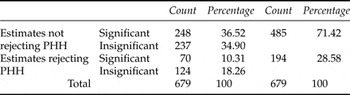
We constructed a data set containing 679 estimates, of which 248 supported the PHH. A more detailed assessment of the 431 estimates that rejected the PHH showed that 68 endorsed the Porter hypothesis, which states that more stringent environmental regulations bolster firm (industry) efficiency and consequently attract more inflows of FDI. Of the 679 estimates gathered, 425 were obtained through regressions employing a proxy for environmental regulation. Table 1 presents the signs and statistical significances of each estimate in the final data set.
Direction and statistical significance of sampled estimates

4. Selection of explanatory variables
We inspected the sampled studies in order to generate explanatory variables for equation (2) that represent these studies' reported design parameters. Because these groupings can be further sub-grouped, we accordingly established dummy variables. These eight dimensions are described in detail below.
4.1. Stringency of environmental regulations
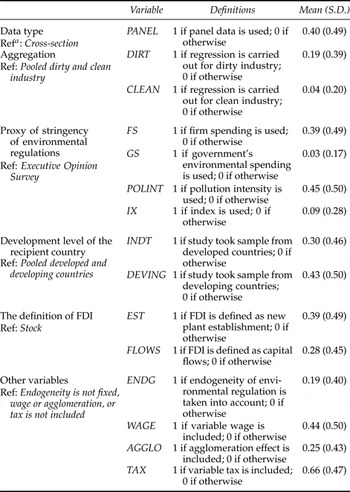
Although it is intuitive that enforced adherence to stricter environmental regulations could lead to increased production costs, it is unclear how researchers should quantify this change for a firm. We organize the various definitions in this category into five subcategories, using the Executive Opinion Survey as the reference category, and establish four dummy variables as follows:
-
(1) Firms' pollution abatement spending (FS). Examples include additional environmental tax expenses or additional investment costs for acquiring particular environmentally friendly equipment.
-
(2) Government's environmental spending (GS). Examples include costs incurred by the government to abate pollution or to enforce its environmental regulations.
-
(3) Pollution intensity (POLINT). Examples include the level of a particular emission (CO2, NOx, SOx, etc.) in the air or water.Footnote 3
-
(4) Index (IX). This subcategory covers any proxy that at a minimum combines two of the three earlier subcategories. Examples include the index created by List and Co (Reference List and Co2000).
-
(5) Executive Opinion Survey. It is taken from the Global Competitiveness Report and it measures the overall stringency of environmental regulations on a scale from 1 (countries that have the most lax regulations) to 7. This construct is used by Wagner and Timmins (Reference Wagner and Timmins2009) and Spatareanu (Reference Spatareanu2007).
Each of these subcategories has its own deficiencies. For example, pollution abatement spending and index data are not available annually for every country. Moreover, in some countries the stringency of environmental regulations is determined at a local level. Thus, an identical firm located in the same country and operating in the same pollution-intensive industry could end up spending different amounts on abatement costs.
The use of government spending is deficient when regulatory economies of scale are ignored. Jurisdictions that attract polluting industries might also have higher abatement expenditures than do jurisdictions that have cleaner industrial compositions, even if the regulatory stringency faced by individual firms is the same. Additionally, the use of pollution intensity as a proxy is problematic because emissions data cannot be directly observed. High levels of pollution could be symptomatic of lax regulations or could imply that the regulator should implement more stringent environmental regulations. As for the participation in international environmental treaties, the use of this proxy hinges on a strong assumption that, once treaties are ratified, they will be well enforced. Lastly, the Executive Opinion Survey obtained from the Global Competitiveness Report may be biased in terms of survey methodology or sample selection.
4.2. Number of proxies used
One might argue that studies that included more proxies for environmental regulations in their regressions are potentially superior, at least in capturing the said effect of regulations on the flows of foreign investment. Although uncommon, a few of the studies at our disposal do follow that approach. We assess to what extent this variation affects the outcomes of the primary studies. We thus create two variables, NPROX and DPROX, which later are used interchangeably. The first is a continuous variable that measures the number of proxies for environmental regulations used in the regression. The latter is a dummy variable equal to 1 if the estimates obtained from the regression used more than one proxy, or 0 if otherwise.
4.3. Definition of FDI
Earlier studies of the PHH (for instance Friedman et al., Reference Friedman, Gerlowski and Silberman1992; List and Co, Reference List and Co2000; List, Reference List2001) used ‘new plant establishment’ to define FDI. However, recent studies have adopted ‘flow of capital’, ‘stock of capital’, or ‘employment’ instead. Because the considerations to undertake FDI are defined differently, we would expect different responses from firms when changes in the stringency of environmental regulations take place. Two dummy variables are generated under this grouping: EST for studies using new plant establishment and FLOWS for studies using the flow of capital to define FDI. Those using stock of capital or employment as a definition are therefore the reference categories.
As pollution abatement costs are typically a small proportion of the total costs of firms or industries, we posit that evidence of a pollution haven is more likely to be found in a study that uses ‘new plant establishment’ as a definition of FDI.
4.4. Firms' pollution level
Everything else being equal, firms operating in pollution-intensive sectors are usually more sensitive to changes in environmental regulations compared with firms operating in non-pollution-intensive ones. Some of the studies intentionally focused merely on polluting sectors, while others just simply pooled all the firms together. We group them according to these dimensions to evaluate how disentangling the firms according to their pollution level influences the reported estimates. For that reason, two dummies, DIRT and CLEAN, are generated. Studies that mix both types of firms or industries are grouped under the omitted category.
4.5. Development level of the recipient country
It has been well documented that FDI mostly originates from industrialized countries which are richer and presumably more stringent in terms of their environmental regulations. Moreover, the development level of a country is related to aspects that could also explain how environmental regulations are formed and enforced. Developed countries generally have strong environmental regulations and enforcement, while it is commonly the opposite for developing ones (Elliott and Shimamoto, Reference Elliott and Shimamoto2008). It is thus likely that we will find less evidence of the PHH in industrialized countries.
We segregate the sampled studies based on the FDI host country's level of development in order to understand how this factor influences the reported estimates. For this, we follow the classification used by the International Monetary Fund.Footnote 4 More importantly, this distinction allows us to test the assumption that developing countries are more lenient in enforcing their environmental regulations and that pollution havens largely occur in developing countries.
We generate two dummies: DEVING for studies focusing on developing countries and INDT for studies focusing on industrialized/developed countries. As before, studies that make no distinction between the two are used as a reference category.
4.6. Data type
The two types of data used in empirical studies of the PHH are panel data and cross-sectional data. Panel data refer to records that are collected by observing many subjects across multiple time periods. Cross-sectional data are collected by observing many subjects at the same point in time. Methodologically, regressions using panel data are preferable to cross-sectional ones since the former allow the researcher to control for unobservable variables that are time-invariant.Footnote 5 Accordingly, we hypothesize that the use of panel data provides statistically (or even reasonably sized) significant evidence of pollution haven. We generate a dummy variable named PANEL for studies using panel data. In this setting, those employing cross-sectional data are grouped in the reference category.
4.7. Endogeneity
An important econometrics issue for estimating equation (1) is that FDI i and ES i may be determined simultaneously. If FDI inflows increase countries' incomes and environmental quality is a normal good, incoming FDI could foster voters' demand for stricter environmental regulations. Alternatively, the endogeneity problem may also exist if environmental regulations are set strategically to attract inflows of FDI (see, for instance, Fredriksson et al., Reference Fredriksson, List and Millimet2003; Cole and Fredriksson, Reference Cole and Fredriksson2009). Another nice example of endogeneity is succinctly presented by Keller and Levinson (Reference Keller and Levinson2002: 695): ‘Those states that do not attract a lot of polluting manufacturing probably do not enact stringent regulation – there simply is less need to worry about industrial pollution in states with less industrial activity, and those states that do attract polluting manufacturing may respond by enacting more regulation.’
In our meta-regression, we distinguish the sampled studies based on whether or not the endogeneity between and was controlled for using a dummy variable, ENDG.Footnote 6
4.8. Other controls
Given that some previous studies have incorporated characteristics of the jurisdictions, such as rates of wage, tax or the effects of agglomeration, we investigate whether the omission of these particular variables affects the probability that the study will support the PHH. The primary concern here is that tax and wages may pick up the effect of the stringency of environmental regulations. Their inclusion in the regression of equation (1), therefore, may influence the significance level of the effect of environmental regulations on the flows of FDI. Thus, the dummy variables TAX, WAGE and AGGLO are created under this grouping.
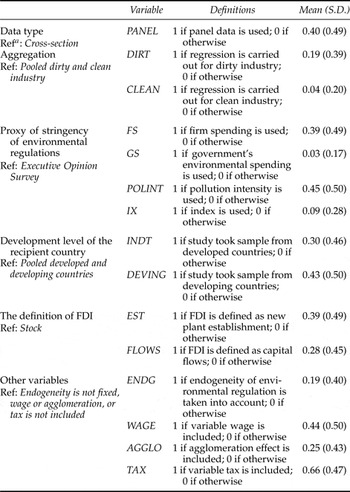
Table 2 describes the explanatory variables.
Definitions, means and standard deviation of explanatory variables
Notes: a Ref: Reference category to which we compare the other category(ies).
5. Regression results
As mentioned earlier, a handful of the resulting estimates were produced using more than one proxy of environmental stringency. Before proceeding further in our main analysis, we examine whether the use of more than one proxy to represent environmental stringency in the regression systematically influences the likelihood of supporting the PHH. To do so, we regress equation (2) without dummy variables under the ‘stringency of environmental regulations’ grouping. Our results (not shown for brevity) indicate that the number of proxies used does not have a statistically significant influence on the probability of supporting or rejecting the PHH. Following this result, we exclude sampled studies that employed more than one proxy for environmental regulations. This exclusion, while unfortunate, is necessary because now we are able to incorporate all variables under the ‘proxy of environmental stringency’ category, making comparisons between different proxies of environmental regulations possible.
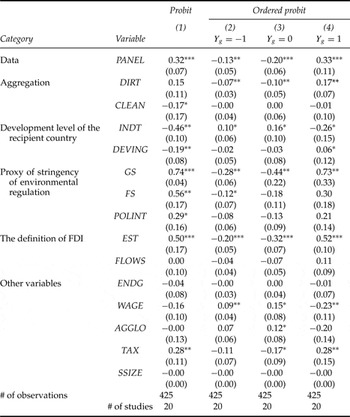
We commence our analysis from the probit and ordered probit regressions. Column 1 in table 3 presents the results of the probit model with robust standard errors from clustering. The results are provided as a marginal effect of the means of the estimation sample. Columns 2, 3 and 4 evaluate the application of the ordered probit model. Note that when ordered probit regressions were run, a total of 13 estimates using index (IX) as a proxy for stringency were dropped because they all predict pollution haven perfectly. Six of the 13 dropped estimates come from all the estimates contributed by Mıhçı et al. (Reference Mıhçı, Cagatay and Koska2005) and Kheder and Zugravu (Reference Kheder and Zugravu2008). The other seven dropped observations are part of the estimates contributed by List and Co (Reference List and Co2000) and Spatareanu (Reference Spatareanu2007). The issue about excluded proxy (and studies) will be touched upon shortly when we discuss the robustness checks.
Marginal effect from probit and ordered probit regressiona,b

Notes: *, **, *** denote statistical significance at the 0.1, 0.05 and 0.01 levels, respectively. Standard errors are given in parentheses.
a The marginal effects are evaluated at the sample mean of independent variables. For ordered probit setting, the evidence of PHH is represented in column 4, under ***. Regressions are run with the cluster options (by study).
b Variable index (IX) was automatically dropped because it predicts the pollution haven perfectly. Subsequently, 13 observations from different groups were dropped. All estimates from two studies, undertaken by Mıhçı et al. (Reference Mıhçı, Cagatay and Koska2005) and Kheder and Zugravu (Reference Kheder and Zugravu2008), which only use index (IX) as a proxy of environmental stringency, are part of the 13 dropped ones.
Table 3 suggests that the empirical results are generally consistent across approaches. Nearly all coefficients of the identical explanatory variables predicting the identical outcome have similar signs. A positive coefficient shown in table 3 indicates that the probability of finding results that are significant and that support a particular outcome increases with the use of that particular variable.
We observe that at least one variable within each of the broad groupings is significantly different from zero at conventional levels. In particular, the likelihood of gaining results that support pollution haven increase by: (i) defining FDI as the establishment of a new plant(s); (ii) employing panel data on the regressions; (iii) not taking into account the effect of wages; and, albeit less robust, (iv) employing a government's environmental spending as a proxy for the stringency of environmental regulations. Indeed the coefficients of PANEL, EST, WAGE and GS are statistically significant and robust across both models.
Concerning the definition of the stringency of environmental regulations, the baseline category is the Executive Opinion Survey. Our findings from probit regression suggest that the use of pollution intensity (POLINT) or firms' spending (FS) to approximate the stringency of environmental regulations has a barely significant effect on the likelihood that the result supports the PHH. This notion is reinforced by results from ordered probit regression that reveal a statistically insignificant effect of these two proxies. Based on the magnitude of the coefficients as well as robustness concerns, we thus claim that using government expenditure (GS) as a proxy for the stringency of environmental regulations gives the highest probability of finding evidence for the PHH. However, one should exercise caution in interpreting it further as there are only two studies using government expenditure (GS) as a proxy for stringency, contributing just 3 per cent of the total estimates in the regressions. We also suggest future studies to carefully pay attention to each proxy's shortcomings.
With respect to the FDI definition, it has been argued that the level of data aggregation is a relevant issue to the PHH (Levinson and Taylor, Reference Levinson and Taylor2008). As reflected by the positive coefficient of EST, we find that studies that used new plant establishment as a definition of FDI are more likely to obtain results that support the PHH relative to those that used a stock definition. This is in line with our hypothesis that, because the effect of environmental regulations on FDI is mostly a microeconomic phenomenon, the results from studies that use sector- or firm-level data are preferable to those that use aggregate- and/or country-level data.
Our findings also suggest that relying on the regressions using cross-sectional data generates less evidence of a pollution haven than when using panel data. The coefficients of PANEL are positive and statistically significant too, meaning that exploiting the time-invariant effects across jurisdictions – which are not captured in the explanatory variables but are correlated with environmental regulations – provides significantly different estimates than does a model that depends purely on between-unit variations. Our results hence suggest that there tends to be more evidence of a pollution haven when regressions are run using panel data.
We show that focusing an investigation on pollution-intensive industries may not increase the likeliness of finding results that support the PHH. This is ascertained by the coefficients of DIRT, which are not statistically significant in the probit and barely significant in ordered probit models. This finding agrees with those of Ederington et al. (Reference Ederington, Levinson and Minier2005) and Cole et al. (Reference Cole, Elliott and Okubo2010), who claim that PHH research has focused on the most capital-intensive industries, which are presumed also to be the most pollution intensive. However, these types of firms (industries) may not be geographically mobile because of transportation or plant fixed costs. It is therefore not surprising that they are insensitive to differences in the degree of regulatory stringency between countries.
Further, while it is not surprising to find the negative and statistically significant coefficients of INDT, the remarkable result is the lack of statistical support to assert that focusing an investigation on developing countries increases the likeliness of supporting the PHH. The coefficients of DEVING in table 3 are mostly insignificant statistically across specifications, and barely significant when used to estimate the likelihood of obtained results that are in favor of PHH in ordered probit settings. We thus principally cannot reject the null hypothesis that this coefficient is equal to zero, even at the 10 per cent level. Because developing countries are at the center of the PHH debate, as proven by almost half of the sampled studies that observed the PHH from the viewpoint of a developing country, this finding implies that pollution havens might just be, as Javorcik and Wei (Reference Javorcik and Wei2004) state, a popular myth. Yet, the characteristics of developing countries may render this finding less surprising. Although lenient regulations in developing countries may mean that firms incur lower compliance costs, the countries themselves often lack a developed infrastructure, have an inadequate availability of well-qualified human capital, and suffer from corruption and incapacity in their institutions. Most of the developing countries are also located relatively far from the majority of countries where the FDI come from, implying a greater cost of transportation and coordination between a parent company and its subsidiaries. Unless well controlled, these attributes may outweigh the favoring effect of lenient environmental regulations for attracting investment in developing countries.
We also find that controlling for the issue of endogeneity does not seem to change the probability of finding results that support the PHH. Regardless, the endogeneity problem should be fixed as fully as possible or else the regression parameter is biased. With respect to the other dummy variables, none of the additional explanatory variables, except for wages, was found to be significantly influencing the probabilities of gaining a particular result regarding the PHH. Additionally, the inclusion of tax or agglomeration has no significant effect on the direction of the estimate.
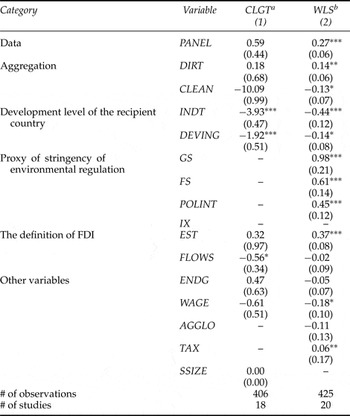
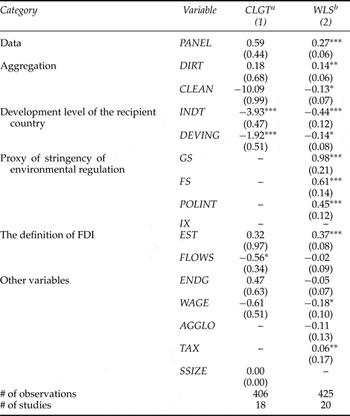
We end this section by performing various robustness checks with the results presented in Appendix tables A2 and A3. The first check aims to address the concern that the number of significant and insignificant coefficients reported across the studies naturally varies and, therefore, may not be able to be treated as exogenous.Footnote 7 If, for instance, the authors or the editors of the journal that published study x with characteristics X decided to report only statistically significant specifications, this will induce a correlation between the outcomes and the X variables. To address this concern, we run a conditional logit regression that allows for fixed unobserved effects for each study. Results are presented in column 1 of table A2. Unfortunately, the setting of conditional logit regression does not allow the inclusion of variables that do not vary within the study. For this reason, all variables under the proxy for environmental stringency, such as pollution intensity (POLINT), government spending (GS), and firm spending (FS), together with agglomeration (AGGLO) and TAX, are dropped. Moreover, three studies containing 43 observations are dropped because there are no variations in their outcomes variable. Of the remaining variables, two variables indicating whether the primary studies focused their analysis on a particular group of countries – INDT and DEVING – are found to be negative and statistically significant. While this finding is not surprising for the former variable, it is somewhat counterintuitive for the latter. The rest of the variables that are statistically significant – PANEL, DIRT, CLEAN and EST – have signs that are in line with our previous regression. Our conditional logit regression analysis also revealed that defining FDI as the flow of capital relative to the use of capital stock will decrease the likelihood of obtaining results that accept the PHH, as shown by the negative sign of FLOWS.
The second check is performed using a weighted, least-squares regression with sample size employed as the weight. The results, presented in column 2 of table A2, are largely identical to that of the probit regression.
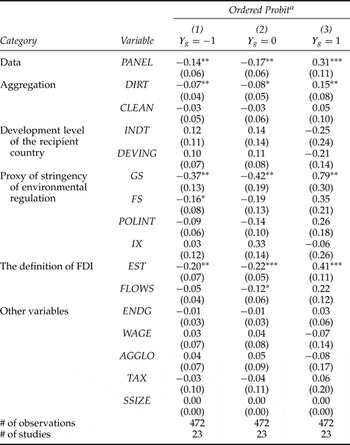
In the next check, we address the issue of the exclusion of IX because all single-proxy studies employing this proxy for the stringency of environmental regulations ended up predicting the PHH successfully and, therefore, were excluded in the results presented in columns 2–4 of table 3. Since it has previously been found that the number of proxies employed does not affect the likelihood of supporting or rejecting the PHH, we went through our database again to identify estimates that were produced by any regression employing index as a proxy, even if more than one proxy was used to run the regression. Using this approach, 34 estimates rejecting the PHH from the studies undertaken by Javorcik and Wei (Reference Javorcik and Wei2004) are added to our sample. Consequently, our newest data set contains 23 studies with a total of 472 estimates. The figures are contributed by all the studies (and estimates) included in the regressions results in columns 2–4 of table 3, 13 estimates using index (IX) as a proxy for stringency that were previously dropped, and the latest 34 estimates mentioned earlier. The results from the ordered probit regression, presented in columns 1–3 of table A3, are again generally in line with the same type of regression run and presented in table 3, with regard to both statistical significance and the magnitude of the marginal effects. Nevertheless, the 34 additional samples now allow the regression to estimate the marginal effects of IX, which were found to be statistically insignificant across columns 3 and 4.
6. Discussion and concluding remarks
In the present study, a meta-analysis is employed to statistically investigate the impact of modeling approaches on the estimates reported in the literature. Our systematic analysis of the estimates of FDI from 26 studies with respect to environmental regulations shows that certain aspects of research design are crucial to explaining the magnitude and significance of the obtained estimates. Our first finding reveals that the use of more than one proxy to represent stringency in the regression does not systematically influence the likelihood of finding results that support the PHH. One could empirically examine the PHH by testing whether a relatively less stringent jurisdiction attracts more FDI or whether pollution-intensive firms (industries) are more likely to undertake FDI abroad and yet our analysis maintains that neither angle could statistically bring the results favoring a particular conclusion.
Of the many definitions of FDI, the decision to build a new plant is the most prone to change in light of the stringency of environmental regulations. It follows from this finding that the influence of environmental regulations on FDI should be investigated at the micro-level. The support of this hypothesis at the lowest level of aggregation may also warrant the support at the higher level.
Our results also suggest that a government's environmental spending, as a proxy for the stringency of environmental regulations, gives the highest probability of obtaining results favoring the PHH. Contrary to common belief, we could not obtain robust statistical support to claim that focusing the investigation on pollution-intensive industries or developing countries increases the likelihood of finding results that support the PHH. We argue that the flows of capital in the pollution-intensive industries may be undergoing diverging experiences in line with factor endowment and the PHH (Antweiler et al., Reference Antweiler, Copeland and Taylor2001; Cole and Elliott, Reference Cole and Elliott2005). According to the former, trade liberalization will result in patterns of trade that are consistent with the Heckscher–Ohlin–Samuelson (HOS) theory of comparative advantage; because developed countries are typically capital-abundant, they would specialize in the production of capital-intensive industries that are presumably also pollution intensive. However, the PHH predicts that the production of pollution-intensive goods would relocate to developing countries where the costs of complying with environmental regulations are lower. These two conflicting hypotheses could result in competing pressures that may cancel each other out. Further, according to our results, addressing the problem of endogeneity does not change the probability of finding results that support the PHH. Yet, one should carefully fix the endogeneity problem to obtain unbiased regression parameters.
Future research might consider that, firstly, previous studies have been unable to decompose the flows of FDI according to the underlying motives. A multinational corporation undertakes market-seeking or horizontal FDI in order to gain an advantage when supplying the local market. Alternatively, efficiency-seeking or vertical FDI occurs between dissimilar countries in order to take advantage of factor-price differences when trade costs are low. These imply that the sensitivity of FDI to the host countries' characteristics will vary according to the destination of production. Consistent with the theory of comparative advantage, the PHH is most likely to be relevant in the context of vertical FDI. The sampled studies, however, made no attempt to distinguish between these two types of FDI. As more disaggregate FDI data become available, it will be possible in the future to control for the vertical integration of the production process.
Second, FDI is by definition a bilateral phenomenon. Most of the sampled studies do not seem to have investigated the issue of FDI and the PHH using bilateral data. Although bilateral FDI data are difficult to acquire, their use allows more information to be gleaned about underlying causes than is possible from considering only an aggregate series. This is particularly true if the sample period for the analysis is relatively short.
Lastly, although previous studies of FDI and the PHH have been illuminating, most have been merely positive or descriptive rather than normative. Future studies may consider incorporating the welfare implications of such a situation.
Appendix: Characteristics of the papers included and robustness checks
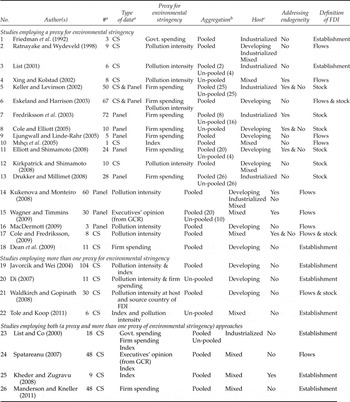
Papers included in the meta-analysis

Robustness check with conditional logit and weighted least square
Robustness check with ordered probit regression