

INTRODUCTION
Arbuscular mycorrhizal fungi (AMF) are mutualistic symbiotic soil fungi colonizing roots of most crop plants. These fungi are mainly responsible for phosphorus (P) uptake and have proven potential to enhance growth, water relations and disease resistance (Smith and Read, Reference Smith and Read1997). There are many reports dealing with the nutritional benefits that plants derive from mycorrhizal associations (Douds and Reider, Reference Douds and Reider2003; Sharma and Adholeya, Reference Sharma and Adholeya2000, Reference Sharma and Adholeya2004).
Since AMF are obligate symbionts, they require host plants to sporulate and must colonize roots to complete their life cycles. Currently, AMF are produced by various methods like monoxenic/in vitro culture (Fortin et al. Reference Fortin, Becard, Declerck, Dalpe, St Arnaud, Coughlan and Piche2002), conventional pot culturing/greenhouse (Saito and Marumoto, Reference Saito and Marumoto2002), the aeroponic system and nutrient film techniques (Hung and Sylvia, Reference Hung and Sylvia1988). Traditionally, an inoculum of AMF is produced in pot cultures using suitable trap plants and substrate amended with organic matter (Baby and Manibhushanrao, Reference Baby and Manibhushanrao1996; Gaur and Adholeya Reference Gaur and Adholeya2000). However, the most suitable and cost-effective method of inoculum production is often a soil- or sand-based system in which inocula can be produced on site (on-farm) so the farmer is not required to pay the cost for isolation, mass culturing and transportation of the inoculum. The on-farm production of AMF is simple since it involves the indigenous AMF already adapted to that site/environment and increases the acceptability to farmers (Douds et al. Reference Douds, Nagahashi, Pfeffer, Kayser and Reider2005, Reference Douds, Nagahashi, Pfeffer, Reider and Kayser2006). In the on-farm system, AMF inoculation can be efficiently achieved by vegetable farmers while growing seedlings at the same site for later transplant to the field (Douds et al. Reference Douds, Nagahashi, Reider and Hepperly2008). Arbuscular mycorrhizal fungi can be simultaneously produced in the same nursery beds (Douds and Reider, Reference Douds and Reider2003). Thus, this system would be most appropriate for plant improvement programmes that involve a transplantation phase. On-farm production of AM inocula appears promising as up to 5000 l soil inocula can be produced from a 25 m2 plot (Sieverding, Reference Sieverding1991). Trap plants such as maize, sorghum and bahia grass have been suggested as suitable hosts for inoculum production (Douds et al. Reference Douds, Adholeya, Gadkar, Mukerji, Chamola and Singh2000). Rao and Tarafdar (Reference Rao and Tarafdar1999) demonstrated enhanced AMF fungus production in soil-solarized plots. They indicated the possibility of adopting the soil solarization method for large-scale multiplication of AMF by nursery/farm managers. So far, in all the on-farm/field production trials (Douds et al. Reference Douds, Nagahashi, Pfeffer, Reider and Kayser2006, Reference Douds, Nagahashi, Reider and Hepperly2008; Gaur et al. Reference Gaur, Adholeya and Mukerji2000; Sieverding, Reference Sieverding1991), either starter culture in the form of spores, crude inoculum (soil-based containing hyphae and infected root bits) or pre-colonized nursery plants were used, or plants were left uninoculated. However, studies are necessary on how to standardize the time required to achieve potential yield of propagules of a particular inoculum to be used as starter culture.
The aim of the present work was to compare three AM inocula on the formation of infectious propagules (IP) in different fractions of inocula and to develop prediction equations for producing maximum propagules in the shortest span of time under on-farm conditions in a marginally sandy loam Alfisol amended with farmyard manure (FYM).
MATERIALS AND METHODS
Experimental soil
The soil used for on-farm production of AMF was sandy loam (0–30 cm depth) Hyperthermic Typic Haplustalf collected from a wasteland site in a semi-arid area located at Gual Pahari, Haryana, India (lat. 28°35′N; long. 77°12′) at 255 m amsl. The soil samples collected at random from the site were air-dried, crushed, passed through a 5-mm mesh sieve, and analysed for chemical properties (pH: 7.42; electrical conductivity (EC): 0.14 dS/m; organic carbon (C): 0.31%; nitrogen (N): 0.021%; Olsen P: 3.34 ppm). The AMF spore density was 3.60 spores/10 g soil. The soil pH and electrical conductivity were measured (in a 1:2.5 soil to water suspension) using a digital pH and EC meter. Available P in the soil was determined by extraction with sodium bicarbonate for 30 minutes (Olsen et al. Reference Olsen, Cole, Watanabe and Dean1954). Organic C was estimated calorimetrically (Datta et al. Reference Datta, Khera and Saini1962).
AM fungus inoculum
Three AMF inocula were used: a mixed AMF (AM-1209) containing native Glomus, Gigaspora and Scutellospora spp. (in the proportions 60%, 30% and 10%, respectively); one exotic origin isolate of Glomus intraradices (AM-1004) (DAOM181602, Biosystematics Research Centre, Ottawa, Canada) and one commercial AM inoculum G. intraradices (AM-1207) (Mycorise; Premier Tech., Rivière-du-Loup, Quebec, Canada). The cultures were obtained from the Centre for Mycorrhizal Culture Collection of The Energy and Resources Institute. These cultures were initially multiplied on carrots in earthen pots (35 kg capacity) containing sterilized sandy loam soil and FYM (10:1) and used as starter cultures for on-farm production.
Preparation of nursery beds, AM fungus inoculation and experimental set-up
A nursery area of 1.2 m × 9.0 m was selected for multiplication of the different AM isolates. The vegetation/weeds were removed and the soil was ploughed to get a fine tilth. A soil mixture (20:1:1; soil: sand: FYM (FYM, chemical and nutrient status: pH: 7.6; EC: 3.82 dS/m; total N: 0.95%; organic C: 4.22%; available P: 14.6 mg/kg)) was prepared and sterilized by covering the area with white translucent polyethylene sheets (200 μ thick). Raised beds of 60 cm × 60 cm × 20 cm and separated by a distance of 60 cm were prepared. Each bed was inoculated with a single AM fungus inoculum. About 5 kg of soil-based inoculum containing 12.5 infectious propagules (IP) /g substrate (starter culture multiplied in pots) was mixed in each bed. Seeds of carrot (Daucus carota), procured from the NSC seeds sale counter, Indian Agricultural Research Institute, New Delhi, India, were sterilized with 10% H2O2 and sown directly in furrows in each bed. The beds were laid out in a completely randomized design with three replicates for each combination/isolate. The beds were irrigated at regular intervals.
Measurements and statistical analyses
Core samples (soil and roots) were drawn from a quarter of the bed at 40, 60, 80 and 105 days after sowing. Samples from each bed were processed, and the root colonization and IP from roots, soil and soil–roots mixture were examined. The root length colonization (mycorrhizal colonization percentage, MCP) was measured after clearing and staining (Phillips and Hayman Reference Phillips and Hayman1970). Assessment of colonization in roots (including fine roots of soil fractions) of all fractions was done by the method of Biermann and Lindermann (Reference Biermann and Linderman1981). The infectivity potential in terms of number of IP was determined by the method of Gaur et al. (Reference Gaur, Adholeya and Mukerji1998).
To determine the production of propagules from the three AMF inocula, IP production (maximum) was correlated with days of multiplication using a modified Mitscherlish-Bray non-linear regression equation (Payton et al. Reference Payton, Rhue and Hensel1989) (Y = a – b*exp (–cD) where D is the time of multiplication (days) or the corresponding time of multiplication (days), c is the response curvature or slope parameter, a is the maximum propagules production and b is the difference between a and the IP at a particular time reflecting the responsiveness of that time. The observed data was analysed using the analysis of variance (SAS Institute Inc., 1991) in two way ANOVA factorial fashion. The least significant differences were calculated to compare the treatment means using Costat statistical software (Cohort Berkeley, CA, USA).
RESULTS AND DISCUSSION
The study revealed that AMF production was enhanced many fold over the initial inoculum in a sandy-loam Alfisol under tropical conditions. This confirms the work of Mosse and Hayman (Reference Mosse and Hayman1971), which shows that the endomycorrhizal fungi are not host specific. The IP of all three AMF tested were found to vary with AM type and time of harvest.
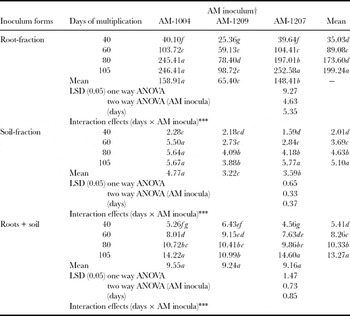
The number of IP in G. intraradices (AM-1004) analysed in the experiment consistently increased as compared to propagules observed in indigenous (AM-1209) inocula. However, based on the prediction equations, inocula AM-1209 was found at par with AM-1004. At 80 days, the propagule count (245.41 IP/g roots) was significantly higher in AM-1004 roots. Although, AM-1207 showed higher propagule counts in roots at 105 days the difference was non-significant (Table 1). Similar responses were observed in other fractions of AM-1004 inocula (soil and soil + roots). However, IP production in soil + roots of AM-1209 (mixed indigenous AMF) was more than other fractions of the same inoculum.
Production of infectious propagules (IP g−1 substrate) of three AM inocula grown on carrot under on-farm conditions.

†The means are average of three replications; means followed by same letter did not differ significantly by Duncans multiple range test (p = 0.05).
LSD, least significant difference by ANOVA.
***significant at 5% level.
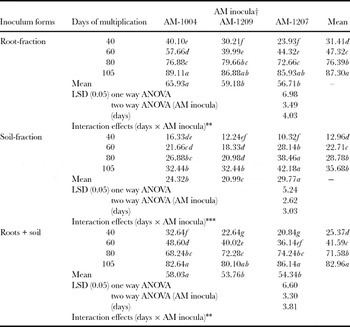
Based on two-way factorial analysis, irrespective of time, AM-1004 root fractions showed significantly higher IP and per cent root length colonization (MCP) (Tables 1 and 2). Irrespective of AM inoculum, significantly higher IP and MCP were observed at 105 days. A similar trend was observed in soil fractions. In the soil + roots fraction, irrespective of the type of inoculum, IP production and MCP increased significantly over time but were similar when compared to the AM inocula (irrespective of time). The MCP in roots and mixture of soil + roots fractions beyond 80 days for all AMF inocula did not increase significantly (Table 2).
Percentage root length colonized by three AM fungal inocula in carrot grown under on-farm conditions.

†The means are average of three replications; means followed by same letter did not differ significantly by Duncans multiple range test (p = 0.05).
LSD, least significant difference by ANOVA.
** and *** significant at 5% and 1% level respectively.
On the other hand, MCP in soil fractions of all inocula (except AM-1207) increased linearly with time. The MCP in the soil fraction of AM-1207 did not increase beyond 80 days. The variation in IP production could not explained by MCP (Brundrett et al. Reference Brundrett, Abbot and Jasper1999a). The MCP value for a single species of AMF on a host plant is not necessarily correlated with the spore number on the same host (Gazey et al. Reference Gazey, Abbott and Robson1992). Sporulation may be further influenced by the presence of other species. Thus, in the present study, G. intraradices (AM-1004, AM-1207), despite its exotic origin produced higher numbers of IP than indigenous inocula. This could be due to continuous multiplication of AMF in indigenous substrate to which G. intraradices is well adapted. This may also be due to the sporulation pattern of G. intraradices (Gaur et al. Reference Gaur, Adholeya and Mukerji1998), in which a root-based inoculum is superior to soil-based inoculum.
The appreciable increase in IP number in root fractions could be due to a more rapid development of the symbiosis than for other forms of inoculum (Abbott and Robson, Reference Abbott and Robson1981; Biermann and Lindermann, Reference Biermann and Linderman1983). Several authors have demonstrated reliable methods to produce colonized roots for use as an inoculum (Menge, Reference Menge1983; Plenchette et al. Reference Plenchette, Furlan and Fortin1982).
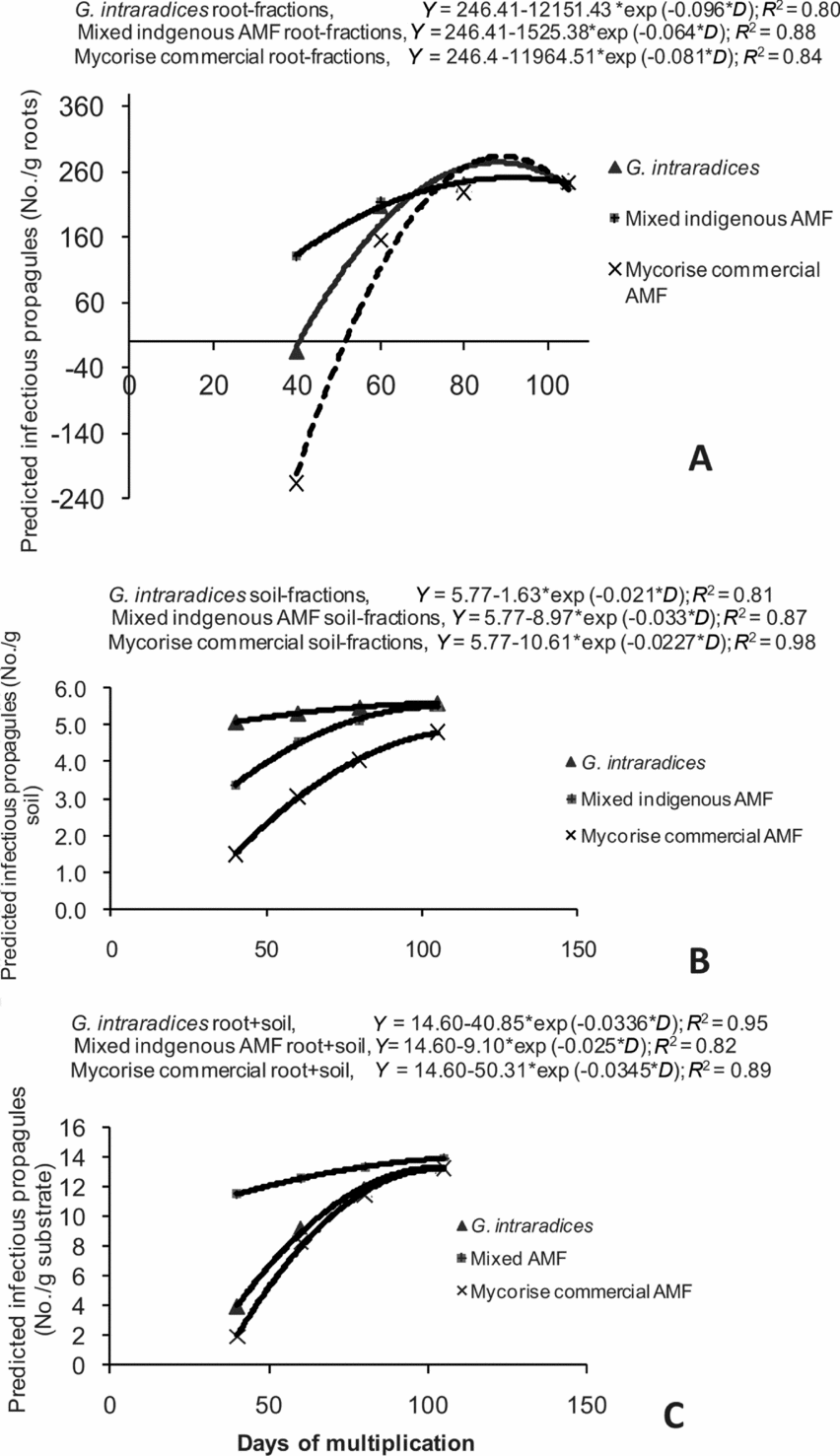
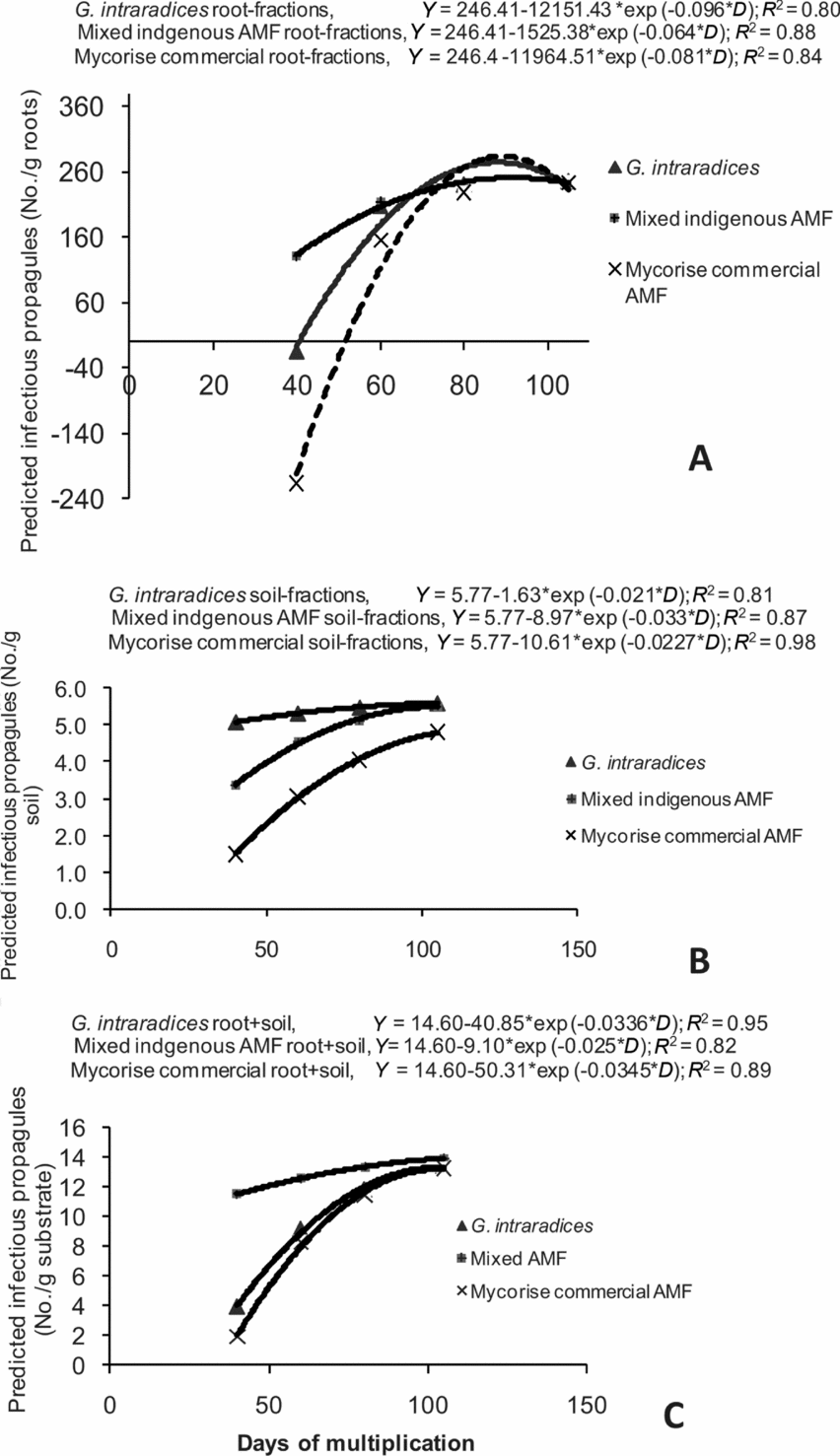
Interestingly, all three isolates tested under nursery conditions produced high levels of IP in root fractions in a short span of time. In contrast to the above, the prediction equations (Mitscherlish-Bray analysis) showed a distinct profile (Figure 1). Root fractions of AM-1004 and AM-1209 were found to be more efficient in producing higher propagule counts (90% of maximum IP in roots in 65 days) than AM-1207 (commercial inocula; 90% of maximum IP in roots in 76 days). Similarly, in soil and roots + soil fractions, AM-1209 (indigenously mixed AM) was found to be more efficient in producing higher IP than AM-1004 and AM-1207. Based on prediction equations derived for all inoculum fractions (Figure 1), it was observed that indigenous AM-1209 would be expected to be a better candidate in terms of sustaining higher production of AMF than AM-1207 which was otherwise found superior on the basis of observed IP values in the experiment (Table 1). While taking into account the predicted values of AM-1209 crude inoculum, about 12 IP g−1 substrate can be achieved in 72 days. Therefore, if a farmer uses crude inocula (with start time IP of about 0.8/g substrate) of AM 1209, a total production of about 12.12 million IP m−3 can be achieved in 72 days.
Relationship between the infectious propagules (IP) of roots (1a), soil (1b) and mixture of both (1c) fractions of three AMF inocula and the multiplication time (days). Time for producing maximum IP for all three fractions were mathematically derived from the Mitscherlish equation (see Materials and Methods) fitted to plots of the IP production and the time of multiplication (days) for all fractions
In conclusion, G. intraradices (AM-1004), root based, and the indigenous mixture (AM-1209), as crude inoculum, can be used as starter cultures for on-farm production of these AM fungal inocula.
Acknowledgements
The authors wish to acknowledge the Department of Biotechnology, Government of India, for funding the present project. The authors would like to thank Dr R. K. Pachauri, Director-General, The Energy and Resources Institute, for providing infrastructural facilities to carry out the project. Technical assistance from Mr Kanchan Kumar and Mr Het Ram in conducting the experiments and subsequent analyses work is also duly acknowledged.