Introduction
Geese belong to the Family Anatidae and the Genus Anser, they were one of the first animals to be domesticated (Buckland and Guy, Reference Buckland and Guy2002). The Egyptian goose (Alopochen aegyptiacus) was tamed and possibly domesticated in Egypt in the 3rd millennium BC, but no domestic specimens of this species seem to have survived to modern days (Boessneck, Reference Boessneck1960; MacDonald & Bench, Reference MacDonald, Bench, Kiple and Coneè Ornelas2000). Kear (Reference Kear1990) suggests that the disappearance of the Egyptian goose as a farm bird coincides with the Persian conquest of Egypt in the sixth century BC. The common domestic goose, nowadays found across the world, derives from the greylag goose (Anser anser), and, due to its pink beak, more likely from its eastern (Anser anser rubirostris) than western (Anser anser anser) subspecies (Harper, Reference Harper1972; Crawford, Reference Crawford and Mason1984; Kear, Reference Kear1990). In general, domestic breeds are much larger than their wild ancestors, although they have in many cases retained their ability to fly. There are two main types of domestic geese. The first are thought to have their origins in Europe, descendants of the wild Greylag goose (A. anser) and the second are thought to have their origins in Asia, descendants of the wild Swan goose (Anser cygnoides). Crosses between the domestic breeds, which have originated from these two species of wild geese are fertile and finally, these crosses have resulted in a number of recognized breeds (Buckland and Guy, Reference Buckland and Guy2002).
Geese can be raised effectively in integrated production systems especially in the humid tropics. The climate of Bangladesh is of tropical monsoon-type with a hot and rainy summer and a dry winter. In Bengali, the geese are known as “Raj Hash” (Sarker, Reference Sarker2015) due to their large size in comparison with other breeds of duck. Geese are usually found in the rural areas of tropical and sub-tropical countries where they are reared generally by the rural poor. Indigenous geese of Bangladesh are naturally very enduring, adaptive to rural surroundings. They can survive on little or no inputs, and adjust to variations in feed accessibility. Geese are among the fastest-growing avian species commonly raised for meat, large edible eggs and valuable products such as feather and down (National Research Council, 1991). Globally the ducks contribute 11 percent and geese 9 percent of the commercial poultry sector (Besbes, Reference Besbes2009). Though the contribution of the indigenous duck and geese is significant in the socio-economic development of the people especially of the coastal region of Bangladesh, research and pragmatic efforts for the preservation and amelioration of this species is at the elementary stage.
Characterization and inventory of poultry genetic resources are needed in countries where clearly defined poultry breeds are yet to be identified; hence properly designed scientific studies on indigenous duck and geese breeds need to be prioritized (Tixier-Boichard, Ayalew and Jianlin, Reference Tixier-Boichard, Ayalew and Jianlin2008). Bangladesh are becoming seriously vulnerable due to the increasing rate of genetic loss resulting from numerous diseases such asaspergillosis, chlamydiosis, coccidiosis. Besides, lots of indigenous breeds are, however, on the margin of extinction because of their gradual dilution, as driven by market demands and incompatible apply of new breeding technology (Köhler-Rollefson, Rathore and Mathias, Reference Köhler-Rollefson, Rathore and Mathias2009). Inadequate awareness of the adaptive characteristics of indigenous livestock breeds due to insufficient scientific documentation is one of the key reasons for such dilution (Hassen et al., Reference Hassen, Bekele, Ayalew and Dessie2007; Köhler-Rollefson, Rathore and Mathias, Reference Köhler-Rollefson, Rathore and Mathias2009). There are many indigenous livestock breeds that still need to be scientifically documented and characterized to make possible their conservation (Bhatia & Arora, Reference Bhatia and Arora2005). To conserve these local breeds and ensure sustainable use of their genetic diversity, it is important to evaluate their phenotypic characteristics and performance in their home tracts and under traditional management conditions (Zarate, Reference Zarate1996).Phenotypic characterization of goose is very important in the way forward of preventing this valuable germplasm erosion. .In Bangladesh, most of these goose populations are non-descriptive types. Limited work has been done by some investigators on limited geese in specific region (Chittagong). But regrettably in Bangladesh, no remarkable effort has yet been taken to characterize goose. Considering the above facts and circumstances, the present study was designed to identify, characterize and describe the phenotypic variation of indigenous goose populations in Bangladesh.
Materials and methods
The experiment was conducted from February 2013 to December 2013 at Sylhet Sadar Upazilla in Sylhet district under the Department of Genetics and Animal Breeding, Sylhet Agricultural University, Sylhet. The study area was selected on the basis of the availability of goose, favourable environment, easy communication facility and research interest of the university. In study area, there were about 100 households who reared goose. Majority of the respondents reported mating between that two type geese. Thus, the data for this research were collected directly from 40 households reared only pure brown and white type geese. The number of reared geese in selected areas varied from household to household. The geese were reared in free range system at farmer's home. There were no differences in feeding and management system of goose. In the absence of genuine practical and technical knowledge, geese are generally fed with rice grain according to traditional practice. The geese with goslings are provided with extra foods, which are usually kitchen leavings, i.e. rice leftover and rice bran. The feed supplements are generally served in earthen pottery, which are rarely cleaned and left without care. The geese are kept in backyards around the farmers’ homes, which are often in marshy and damp areas with little protection. Geese are hardly provided water, as they obtain this from different natural sources such as ponds and water bodies. The houses used as night shelter are commonly made of locally available materials such as mud and wood/bamboo/corrugated sheet, while very few of the respondents had the night accommodation for their geese built with mortar and bricks.
In the study area, farmers do not use artificial incubation for the hatching of eggs, but depend on the natural way of hatching by the broody goose. After hatching, the goslings are allowed to the nearby ponds or any other water bodies to forage and roam freely with their mothers. A goose farmer may lose about twenty-five percent of his young stock during the brooding and the budding periods due to improper management system.
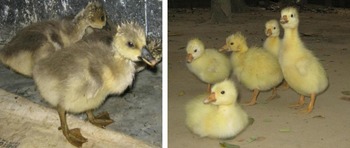
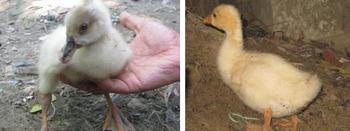
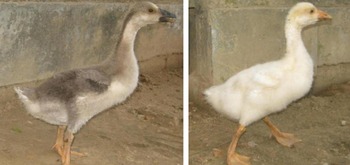
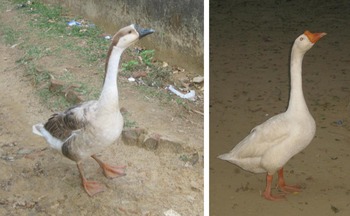
The morphological characteristics were measured from 42 geese (22 brown and 20 white types). The body weight of goose was measured with digital balance at day old, 2-week, 1-month, 2-month and 10-month of age. There were total 59-day old geese (32 brown and 27 white types) in 20 households. These geese were repeated at different ages for body weight trait. External marks were used to identify the goose. However, there were missed about 18 geese up to 10-month of age due to diseases and predators. The geese at different age group are shown in Figure 1, 2, 3, 4 and 5. The reproductive traits were collected from 40 geese (20 brown and 20 white types). Body length, wing span, beak length, head length, shank length and egg size (length and width) were measured with measuring scale and slide calipers. Egg weight was measured with digital balance. Incubation period was calculated from the duration of laying of last eggs of a clutch to the egg hatched. The colour of the body, feather at different regions, beak, skin, shank, eye, eyelid, eggs and shape of the body, beak and eggs were recorded carefully. For each goose under study, different record sheets with full details of each parameter were maintained. The data generated from this experiment were entered in Microsoft Excel worksheet, organized and processed for further analysis. Mean, standard errors (SE) and correlations were estimated with the help of Statistical Analysis System (SAS, 1998).
Day old gosling (left = brown type and right = white type).

Gosling at 2 week of age (left = brown type and right = white type).

Gosling at 1 month of age (left = brown type and right = white type).

Gosling at 2 month of age (left = brown type and right = white type).

Goose at 10 month of age (left = brown type and right = white type).

Results
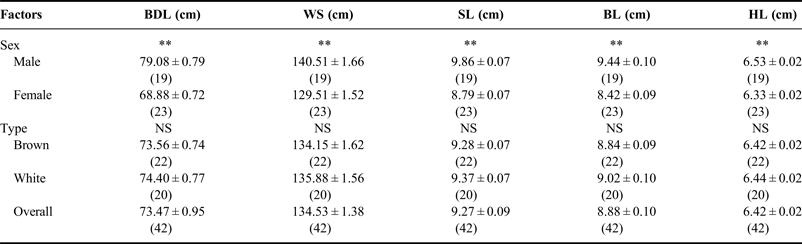
Least-squares means with standard errors (LSMean ± SE) of body length, wing span, shank length, beak length and head length of mature indigenous goose are presented in Table 1. Males were significantly higher (p < 0.01) compared with their female counterparts in all body measurement parameters. No significant difference was found in white type and brown type goose.
LSMean ± SE of morphometric characteristics of mature indigenous goose according to sex and colour type.

NS, not significant; Figures in the parentheses indicate number of observations; BDL, body length; WS, wing span; SL, shank length; BL, beak length; HL, head length.
**, p < 0.01.
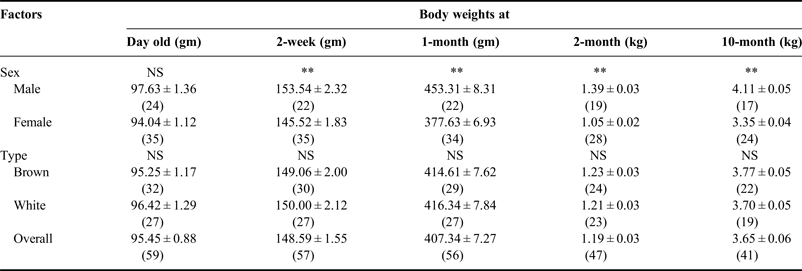
LSMean ± SE of body weight of day old, 2-week, 1-month, 2-month and 10-month (mature weight) old goose are shown in Table 2. Males were significantly heavier (p < 0.01) than females in all age groups except day old gosling. No significant difference was found in all age groups in brown and white type goose.
LSMean ± SE of body weights of indigenous goose according to sex and colour type.

NS, not significant; Figures in the parentheses indicate number of observations.
**, p < 0.01.
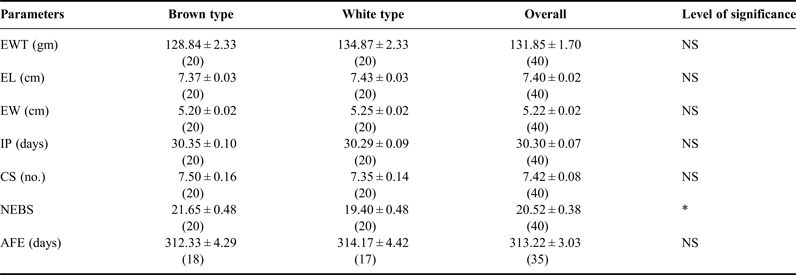
LSMean ± SE of egg weight, egg length, egg width, incubation period, clutch size, number of eggs in a breeding season and age at first egg of indigenous goose are given in Table 3.
LSMean ± SE of reproductive characteristics of indigenous goose according to colour type.

NS, not significant; Figures in the parentheses indicate number of observations; EWT, egg weight; EL, egg length; EW, egg width; IP, incubation period; CS, clutch size; NEBS, no. of eggs in a breeding season; AFE, age at first egg.
*, p < 0.05.
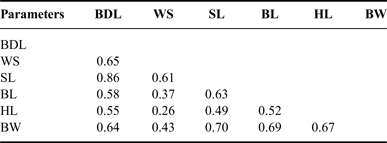
The phenotypic correlation among body length, wing span, shank length, beak length, head length and body weight of mature indigenous goose are provided in Table 4. The highest correlation was found between body length and shank length. The lowest correlation was found between wing span and head length. All of the correlations were positive and low to high in magnitude.
Phenotypic correlation among body length, wing span, shank length, beak length, head length and body weight of mature indigenous goose.

BDL, body length; WS, wing span; SL, shank length; BL, beak length; HL, head length.
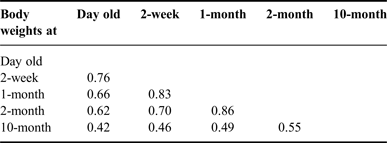
The phenotypic correlation among body weights at different ages of indigenous goose are set out in Table 5. Phenotypic correlations among body weights at different ages ranged were positive and moderate to high in magnitude. The larger relationships were found between chronologically adjacent weights. The phenotypic correlation of body weight of day old gosling with the body weights at subsequent ages ranged from medium to high positive. The magnitude of this correlation declined with age. The phenotypic correlation of body weight at 2-week of age with the body weights at subsequent ages ranged from medium to high positive.
Phenotypic correlation among body weights at different ages of indigenous goose.

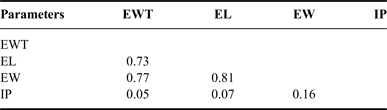
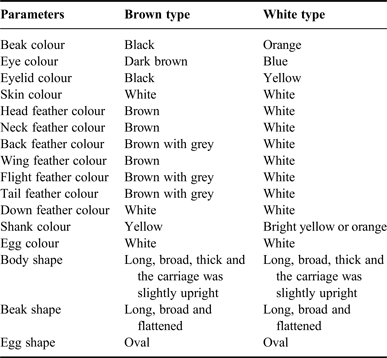
The phenotypic correlation among egg weight, egg length, egg width and incubation period of indigenous goose are summarized in Table 6. The phenotypic correlation among egg weight, egg length, egg width and incubation period ranged from slightly positive to high positive. Lowest negligible correlation was found between egg weight and incubation period. Very high phenotypic correlations were observed among: egg length and egg width, egg weight and egg width, and egg weight and egg length. The colour and shape of different body parts of the goose are presented in Table 7.
Phenotypic correlation among egg weight, egg length, egg width and incubation period of indigenous goose.

EWT, egg weight; EL, egg length; EW, egg width; IP, incubation period.
Colour and shape of different body parts of indigenous goose.

Discussion
The body length of goose obtained in this study was lower than the findings of Madge and Burn (Reference Madge and Burn1987) and Dunning (Reference Dunning1992). This may be due to the differences in breed and agro ecological area of goose rearing. The wing span of goose obtained in this study was lower than that reported by Ogilvie and Young (Reference Ogilvie and Young2004) for Graylag and Swan goose. There are a number of biological factors influencing wing span which will also influence the feather length, e.g. sex, age, population, abrasion of the feathers, moult and differences between years (Pienkowski and Minton, Reference Pienkowski and Minton1973; Visser, Reference Visser1976). The shank and beak length of goose obtained in this study was in accordance with the findings of Madge and Burn (Reference Madge and Burn1987) and Carboneras (Reference Carboneras, Delhoyo, Elliott and Sargatal1992). However, the beak length of goose obtained in this study was higher than the value reported by Ogilvie and Young (Reference Ogilvie and Young2004). The present findings for body weight of day old gosling of lower than that reported by Wu (Reference Wu2014). Banerjee (Reference Banerjee2013) reported that the body weight of brown feathered goose and white feathered goose ranged from 2.97 to 4.4 kg, which is more or less similar to the present study. But the mature body weight of goose in this study was lower than the results of Sheikh (Reference Sheikh2013) who reported that the weight of mature Embden gander fell around 8–9 kg and the weight usually fell around 8 kg in Embden goose. The body weight of 3, 6, 9, 12 and 14-week old white Chinese geese were 1.68, 4.20, 5.74, 6.71 and 7.10 kg and those of Embden geese were 1.59, 3.80, 4.8, 5.80 and 5.95 kg, respectively (Leeson and Summers, Reference Leeson and Summers1991). Buckland and Guy (Reference Buckland and Guy2002) found that the Chinese goose was relatively small in body size with mature males averaging 4.5 kg and females 4.0 kg. Diets with low nutrition supplied to geese in study area are most likely the cause for lower body weight found in present findings. In poultry, the weight of the newly hatched depends primarily on the weight of the egg from which it is hatched, a trait greatly determined by the genotype of the female; females that lay larger eggs may possess superior genetic profiles for size, growth or aggressiveness in competing for feed. Thus their offspring would receive a similar superior genetic endowment for these traits (Skogland and Seagar, Reference Skogland and Seagar1952).
The egg weight of goose in this study was in agreement with the value reported by Mazanowski and Bernacki (Reference Mazanowski and Bernacki2003) and Hugo (Reference Hugo1995) but lower than that reported by Rosinski (Reference Rosinski2000); Willin (Reference Willin1995); Sidadolog (Reference Sidadolog1999) and Leskanich and Noble (Reference Leskanich and Noble1997). Egg weight is influenced by the total egg production per year, sequence of egg in the clutch, level of protein in ration, feed and drinking water, ambient temperature, stable type and disease (Darwati et al., Reference Darwati, Martojo, Sumantri, Sihombing and Mardiastuti2010). Egg weight is also influenced by breed, body weight and sex (Ensminger, Reference Ensminger1992). Individual egg weight is closely associated with the intake of nutrient such as methionine (Petersen et al., Reference Petersen, Sauter, Steele and Parkinson1983), protein (Summers and Leeson, Reference Summers and Leeson1985) and linoleic acid (Scragg, Logan and Geddes, Reference Scragg, Logan and Geddes1987). The egg length and egg width are higher than the values reported by Upadhyaya and Saikia (Reference Upadhyaya and Saikia2012). They also found a strong positive and significant relationship existed between egg length and width. Egg size varies with female age (Desrochers and Mcgrath, Reference Desrochers and Mcgrath1993), year (Perrins, Reference Perrins1970), seasonal variations (Coulson, Reference Coulson1963) and laying order (Murphy, Reference Murphy1994). Petersen, Chima and Horst (Reference Petersen, Chima and Horst1976) and Kohne and Jones (Reference Kohne and Jones1975) reported that high temperature and humidity lowers the egg weight and also egg production in geese.
The incubation period of goose obtained in this study was in agreement with the observations of Ralph (Reference Ralph1969); Yuwanta (Reference Yuwanta1999); Buckland and Guy (Reference Buckland and Guy2002); and Melvin (Reference Melvin2008). However, the present finding for the incubation of the goose is higher than the value that reported by Madge and Burn (Reference Madge and Burn1987). Several factors influence the length of the incubation period, e.g. breed, gender, age of eggs, the size of eggs and shell quality (Bell and Weaver, Reference Bell and Weaver2002).Clutch size varies widely both among and within bird species (Klomp, Reference Klomp1970). Different ecological factors can potentially determine inter-specific differences in clutch size in waterfowl (Anseriformes) and other birds (Rohwer, Reference Rohwer1992 and Monaghan and Nager, Reference Monaghan and Nager1997). The overall clutch size of goose in this study was similar to the findings of Lamon and Slocum (Reference Lamon and Slocum1922) for Canadian and Egyptian geese, but lower than the results of Upadhyaya and Saikia (Reference Upadhyaya and Saikia2012) for Cotton Pygmy-goose. The number of eggs in a breeding season was in agreement with that of Embden goose reported by Wright (Reference Wright2010) while it was lower than those reported by Mazanowski, Dziadek and Adamski (Reference Mazanowski, Dziadek and Adamski2002). Banerjee (Reference Banerjee2013) reported that the less egg production in goose might be attributed to the breed, nutrition and most of all the high-temperature and humidity prevailing in the region. High temperature and humidity lowers the egg weight and also egg production in geese (Petersen, Chima and Horst (Reference Petersen, Chima and Horst1976) and Kohne and Jones, Reference Kohne and Jones1975). The age at first egg of geese assessed in this study was similar to the values reported by Banerjee (Reference Banerjee2013). Lamon and Slocum (Reference Lamon and Slocum1922) found that Canadian and Egyptian geese did not lie until they were 3 years old. Buckland and Guy (Reference Buckland and Guy2002) reported that Huoyan geese began to lay at approximately 240 days of age.
The positive and significant correlation between body weight with body length, wing span, shank length and head length suggests that selection for any of these body parameters will cause direct improvement in body weight (Bhowmik, Mia and Rahman, Reference Bhowmik, Mia and Rahman2014). Many of the phenotypic correlations between body measurements were positive and high, which was also reported by Mancha (Reference Mancha2004). If the positive phenotypic correlations translate into positive genetic correlations thus, selection for one will improve the other as a correlated response (Muhiuddin, Reference Muhiuddin1993). Egg weight was positively correlated with egg length, egg width. Size of the hatching egg of broilers (and probably other chickens) influences body weight of chicks up to slaughter (Proudfoot and Hulan, Reference Proudfoot and Hulan1981).
The present finding for beak colour of brown type goose was in agreement with that of brown Chinese goose reported by Buckland and Guy (Reference Buckland and Guy2002) and Swan goose found by Madge and Burn (Reference Madge and Burn1987). The beak colour of white type goose was orange, which supports the results of Buckland and Guy (Reference Buckland and Guy2002) for white Chinese goose and Banerjee (Reference Banerjee2013) for white feathered goose. Hill (Reference Hill2010) reported that more than a dozen types of carotenoids are responsible for the colouration of orange and yellow beaks and phaeomelanin produced various shades of brown. Beak colour depends on a combination of the bird's hormonal state and diet. Colours are typically bright as the breeding season approaches and palest after breeding (Howell and Dunn, Reference Howell and Dunn2007). The colour of a bird's beak results from concentrations of pigments primarily melanins and carotenoids in the epidermal layers, including the rhamphotheca (Ralph, Reference Ralph1969). The eye colour of white type goose observed in this study was in agreement with that of a white Asian goose reported by Yuwanta (Reference Yuwanta1999). The colour of shank, skin, and head, neck, back, wing, flight, tail and down feather of brown type and white type was in accordance with the finding of Banerjee (Reference Banerjee2013). The feather colour of white type goose supports the findings of Wright (Reference Wright2010). Gadow (Reference Gadow1891) stated that shank colour became orange or yellow due to the presence of orange-yellow lipochrome pigment which, in concentrated form, gave an orange-yellow colour and in a more diluted form a light-yellow, even to an almost whitish colour. Upadhyaya and Saikia (Reference Upadhyaya and Saikia2012) found that the Cotton Pygmy-goose eggs were light creamy white or light ivory white in colour, which partially supports the present findings. Lamon and Slocum (Reference Lamon and Slocum1922) reported that goose eggs were whitish in colour but may shade to a grey or buff tinge.
Conclusion
To conclude, this study provides a bench mark for the morphometric characteristics and performance of goose in Bangladesh. Consequently, as a genetic resource, it is imperative for the researchers, entrepreneurs and farmers should come forward for the conservation of this poultry species. Detailed information of different genres of geese needs to be amassed and evaluated to avert their possible degeneration and to uphold their prospect. Intensive and elaborate country wide studies should put emphasis on the genetic characterization of geese.
Acknowledgements
We are grateful to the Chairman, Department of Genetics and Animal Breeding, Sylhet Agricultural University, Bangladesh for providing all necessary instruments to carry out the study.
Statement of interest
Authors have no such conflict of interests.