


In 1975, most civil wars were located in Asia, and all but two were guerrilla wars—contests entailing an asymmetric rebel challenge launched from the country's rural periphery. In 1993, in contrast, most internal conflicts were located in sub-Saharan Africa, and guerrilla wars comprised less than half of them. Much more common were conventional wars using heavy armor and artillery in a landscape dominated by siege warfare and trenches, or “primitive” wars between poorly armed and trained militias. We argue that this dual geographic and military shift is symptomatic of a broader transformation of internal conflict—the result of a major structural change in the international system: the end of the Cold War.
This transformation has been overlooked for three reasons: (1) the literature has stressed the determinants of civil war onset over the way in which civil wars are fought, (2) it has treated civil wars as a homogeneous phenomenon over time and space, and (3) it has emphasized the impact of domestic factors compared to international ones. We show instead that incorporating the international system into the analysis of civil wars is critical for understanding the evolution and transformation of internal conflict.
We identify the “technology of rebellion” as the dimension best capturing the ways in which the international system has affected civil wars. A central assumption in the literature is that civil war onset is a function of structural factors that facilitate insurgency, a technology that can be deployed to serve all kinds of political ends (Fearon and Laitin Reference Fearon and Laitin2003, 75). We show that insurgency (“guerrilla” or “irregular war”) is neither the only technology available to rebels nor is it as time invariant as assumed. In addition to irregular warfare, we identify two overlooked technologies of rebellion: conventional warfare and symmetric nonconventional (SNC) warfare. Although insurgency is an instance of asymmetric warfare, conventional and SNC wars are both forms of symmetric warfare—the former militarily more sophisticated than the latter. We find that although irregular warfare is the dominant technology of rebellion between 1944 and 2004, it is just barely so: it was used only in 54% of all civil wars.Footnote 1 Furthermore, we find a major, but hitherto concealed, transformation of civil wars: 66% of all civil wars fought during the Cold War were irregular wars compared to only 26% of those fought after 1991. Why?
During the Cold War, the two superpowers raised the military capacity of both states and rebels worldwide. This mutual improvement in military capacity nevertheless favored the rebels, a result of the rise and diffusion of a particularly robust version of the technology of insurgency. The end of the Cold War spelled the decline of this technology. Of the states that had been vulnerable to insurgency during the Cold War, many experienced civil peace, whereas others became vulnerable to a different form of internal conflict, SNC war. On top of it, the dissolution of multinational empires and states that accompanied the end of the Cold War resulted in a steep increase in conventional civil wars. We explain these diverging outcomes by pointing to the impact of the international system on the underlying military capacity of states and rebels.
Our contribution is fourfold. First, we bring the international system back into the study of internal conflict by specifying its impact. We show that it shapes the military dimension of civil wars through its impact on the relative power of the contestants. Civil wars that began during the Cold War were predominantly fought as insurgencies; since its end, however, insurgencies no longer dominate. We demonstrate that insurgency is not a “modular” technology available to anyone, anywhere, and anytime; rather, its availability is determined to an important degree by the properties of system polarity and the characteristics of the Cold War.
Second, we identify a key source of heterogeneity in civil wars: their technology of rebellion. We provide a theoretical account of its variation and adduce additional implications about their temporal and spatial distribution. The focus on technologies of rebellion has several advantages. It allows the study of civil wars as an evolving and dynamic historical phenomenon rather than one that remains constant over time. We show that the relative balance of power between contending forces determines the war-fighting strategies of the respective sides. We also indicate that the three technologies of rebellion reflect distinct military, social, and political dynamics, and affect differentially the strategic logic of conflicts, including their tactics, ideology, recruitment practices, and relations with the civilian population, among others. Our preliminary research suggests that technologies of rebellion also have a significant effect on civil war duration and outcomes, and perhaps on patterns of violence as well (Kalyvas and Balcells Reference Kalyvas and Balcells2009). Irregular wars last longer compared to conventional or SNC ones; they are also more likely to be won by incumbents compared to the other two forms of warfare, whose outcomes are likely to be more balanced between incumbents and rebels. As for SNC wars, they are more likely to be associated with higher levels of battle deaths, controlling for duration. These differences are consequential, both from an analytical and policy perspective.
Third, we suggest that a proper analysis of civil war onset and dynamics requires a focus on the interaction of rebel and state strategies (and their underlying capacities), rather than state capacity alone. Last, we confirm the importance of theoretical and empirical disaggregation as a way of uncovering causal mechanisms that are likely to be obscured in highly aggregate research designs.
In the next section, we present the main empirical findings of the literature and stress the inconclusive and contradictory views about the effect of the end of the Cold War on internal conflict. In the subsequent sections, we discuss the three technologies of rebellion, show how the Cold War is connected to civil war onset via these technologies of rebellion, and derive empirical predictions about the impact of the end of the Cold War—which we proceed to test in the penultimate section. We conclude with a brief discussion of theoretical and policy implications.
THE PUZZLE OF THE COLD WAR
The Cold War dominated international politics from the end of World War II until the collapse of the USSR in 1989–91 (Gaddis Reference Gaddis1997; Hironaka Reference Hironaka2005; Westad Reference Westad2005).Footnote 2 The theorization of the post–Cold War world was undertaken primarily by scholars of international relations. In contrast to students of civil wars, who focused on domestic structural characteristics,Footnote 3 these scholars were primarily concerned about interstate rather than intrastate conflict—either trying to understand the effects of shifts in system polarity on interstate conflict and global power relations (Goldgeier and McFaul Reference Goldgeier and McFaul1992; Mearsheimer Reference Mearsheimer1990) or their implications for theories of international relations (Lebow Reference Lebow1994). At the same time, several scholars turned their attention to domestic ethnic conflict (Brown Reference Brown and Brown1996; Lake and Rothchild Reference Lake and Rothchild1996); some connected the resurgence of nationalism to the end of the Cold War (Ellingsen Reference Ellingsen2000; Laidi Reference Laidi1994), whereas others challenged this connection (Ayres Reference Ayres2000). Overall, this literature displayed two distinct tendencies. The first one was optimistic and predicted a more peaceful world following the end of the Cold War, whereas the second one was pessimistic and forecasted global mayhem. Nevertheless, both agreed that the end of the Cold War was bound to have important effects, although they differed about their direction (Stein and Lobell Reference Stein, Lobell, Lake and Morgan1997, 102).
Civil wars during the Cold War are commonly understood as “proxy wars.” The impossibly high stakes of a direct clash between the United States and the USSR turned conflicts in the developing world into the hot frontline of the Cold War (Gaddis Reference Gaddis1997; Mott Reference Mott2001; Westad Reference Westad1992). Although it was possible to expect the number of civil wars to decrease with the end of the superpower competition, it was equally likely to predict that it would remain unchanged, or even increase, absent the “disciplining” effect of the two superpowers.Footnote 4 To complicate matters, the end of the Cold War spawned multiple, simultaneous processes: the dissolution of multiethnic empires and states, and the emergence of new states with contested boundaries; the end of a global ideological struggle; the proliferation of cheap weapons from the former Soviet Republics; and the weakening of client states following the reduction or withdrawal of superpower support (Stein and Lobell Reference Stein, Lobell, Lake and Morgan1997; Wallensteen and Axell Reference Wallensteen and Axell1993). Stein and Lobell (Reference Stein, Lobell, Lake and Morgan1997) highlighted a variety of possible outcomes across geographic regions, depending on the interaction of factors such as the role of superpowers in stoking or reducing conflict during the Cold War; the depth of the Cold War competition; and the regional penetration of superpowers. The complex and simultaneous occurrence of multiple, even contradictory, processes led seasoned observers to suspect that the end of the Cold War could have indeterminate effects and recommend caution in formulating predictions (Huntington Reference Huntington1993, 187; Jervis Reference Jervis1994, 769–70).
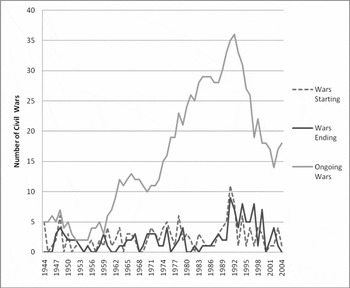
What happened? Figure 1 tracks the total number of civil war onsets, terminations, and ongoing civil wars per year from 1944 to 2004.Footnote 5 Ongoing civil wars increased steadily after the late 1950s and peaked in the early 1990s; civil war onsets also peaked in 1991. Immediately after 1991, the number of civil war onsets declined, whereas terminations went up. These two trends converged to produce a decline in the number of ongoing civil wars in the post–Cold War period.Footnote 6
Civil Wars Starting, Ending, and Ongoing (1944–2004)

Two interpretations emerged. On the one hand, the spike of civil wars following the end of the Cold War ended the “euphoria of the early 1990s” and gave way to “frustration” and “disillusionment in the mid-1990s” (Brown Reference Brown and Brown1996, 11); it also popularized the view that the new era spelled a “coming anarchy” through the eruption of “new wars” (Kaldor Reference Kaldor1999; Kaplan Reference Kaplan1994). On the other hand, the subsequent emergence of a downward trend in both civil war onsets and ongoing civil wars led scholars to speak of an “extraordinary and counterintuitive improvement in global security,” arguing that the end of the Cold War was the single most critical factor in this decline (Human Security Centre 2005). The divergence between these two interpretations suggests the danger of extrapolating from short-term trends, an atheoretical exercise that hinges on the timing of the observations: the post−Cold War era appeared to be a disaster in 1992, but struck observers as a clear improvement by 2005.
In contrast, the cross-national literature on civil war onset incorporated the Cold War into the mix of variables examined and reached the conclusion that its end had no impact on the likelihood of civil war onset (Collier et al. Reference Collier, Elliott, Hegre, Hoeffler, Reynal-Querol and Sambanis2003; Fearon and Laitin Reference Fearon and Laitin2003; Jung, Schlichte, and Seigelberg Reference Jung, Schlichte, Seigelberg, Gantzel and Schwinghammer2000; Sambanis Reference Sambanis2004). In Fearon and Laitin's (Reference Fearon and Laitin2003, 77–78) words, “the prevalence of civil war in the 1990s was not due to the end of the Cold War and associated changes in the international system.” Unlike other findings that generated considerable controversy, such as the effects of natural resources or ethnic fragmentation, the Cold War “noneffect” was not discussed, let alone questioned.
Yet, this finding raises more questions than it answers: we know that the end of the Cold War had some clear effects: (1) it fundamentally changed the role of external actors in civil wars (Byman et al. Reference Byman, Chalk, Hoffman, Rosenau and Brannan2001, xix); (2) it coincided with a regional outbreak of civil wars, especially in Eurasia (Evangelista Reference Evangelista and Brown1996; Zürcher Reference Zürcher2007) and sub-Saharan Africa (Stedman Reference Stedman and Brown1996; Young Reference Young2006); (3) it also coincided with a surprising reduction of civil wars in Latin America (Castañeda Reference Castañeda1993; Chernick Reference Chernick and Brown1996) and Southeast Asia (Findlay Reference Findlay and Brown1996); and (4) many seemingly intractable civil wars terminated with the end of the Cold War (Hironaka Reference Hironaka2005; Kanet Reference Kanet2006). We argue that an exclusive and highly aggregated focus on civil war onset has prevented us from realizing how the end of the Cold War affected civil wars, and we suggest that the best way to grasp this effect is by examining how civil wars are actually fought.
TECHNOLOGIES OF REBELLION
The Cold War raised the capacity of states worldwide, but it had a similar impact on rebel capacity. The two superpowers infused enormous military and economic assistance into allied states (Westad Reference Westad2005); at the same time, they also supported a wide range of rebel movements throughout the developing world. Although the United States supported rebels, such as the UNITA in Angola or the Contras in Nicaragua, it was much more common for the USSR to enter into alliances with Third World rebels who followed some version of a Marxist political agenda (Westad Reference Westad1992, 461).
On average, rebels benefited more than states from this parallel rise of state and rebel capacity. This imbalance was reflected in the proliferation of civil wars that relied on the technology of irregular war or insurgency. More specifically, radical entrepreneurs who enjoyed the support of the USSR and its allies transformed the time-honored practice of guerrilla warfare into a much more powerful form of warfare we call “robust insurgency.”
Contrary to widespread belief, not all civil wars are insurgencies. When most people in the United States speak of “civil war,” they automatically think of the American Civil War. This brings up images of well-organized, uniformed armies marching in close formation in the midst of exploding shells. This image obviously is very different from depictions of conflicts in Vietnam, Iraq, or Afghanistan. Veterans of these conflicts are likely to evoke an invisible foe avoiding direct contact, while constantly ambushing them or poker-faced civilians with inscrutable loyalties. At the same time, many journalists, development workers, and humanitarian volunteers working in Africa today are likely to think of an altogether different experience of civil conflict, one populated by predatory militias preying on a defenseless civilian population in a context characterized by state collapse. That these three vignettes are not mutually exclusive suggests that there is considerable heterogeneity in civil wars.
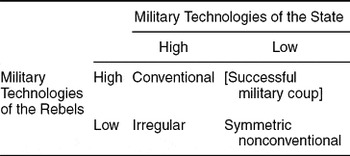
Following this intuition, we disaggregate civil wars based on their technology of rebellion, which we conceptualize as the joint military technologies of states and rebels engaged in armed conflict. Drawing on a typology by Kalyvas (Reference Kalyvas, Duyvesteyn and Angstrom2005), we distinguish between three technologies of rebellion emerging at the outset of a civil war (Table 1).Footnote 7 Conventional civil war takes place when the military technologies of states and rebels are matched at a high level; irregular civil war emerges when the military technologies of the rebels lag vis-à-vis those of the state; and SNC war is observed when the military technologies of states and rebels are matched at a low level. The fourth cell, where the military technologies of the rebels outstrip the state's, describes successful military coups rather than civil wars.
Technologies of Rebellion in Civil War

Irregular or guerrilla warfare is a technology of rebellion whereby the rebels privilege small, lightly armed bands operating in rural areas (Fearon and Laitin Reference Fearon and Laitin2003, 75)Footnote 8; it is an expression of relative asymmetry between states and rebels.Footnote 9 Rebels have the military capacity to challenge and harass the state, but lack the capacity to confront it in a direct and frontal way. Put otherwise, states can mount a devastating response to a direct armed challenge such that the rebels’ only option is to fight asymmetrically. Think of civil wars in El Salvador (1979–92), Peru (1980–96), and Nepal (1996–2006). In those wars, rebels tend to “hover just below the military horizon,” hiding and relying on harassment and surprise, stealth, and raiding (Simons Reference Simons1999); yet, they are frequently able to establish territorial control in peripheral areas. Ideally, and following Mao's recommendation, the rebels aim at launching a major conventional attack after they have managed to grind down the state's strength. In practice, irregular wars frequently turn into wars of attrition.
Conventional warfare emerges when rebels are able to militarily confront states using heavy weaponry such as field artillery and armor. In conventional wars, military confrontation is direct, either across well-defined front lines or between armed columns; clashes often take the form of set battles, trench warfare, and town sieges (Balcells Reference Balcells2010). There is a clear distinction between offensive and defensive actions and the emphasis on territory is alluded to in the use of the term “positional warfare” (Lockyer Reference Lockyer2008, 62).Footnote 10 Classic cases include the American Civil War (1861–65) and the Spanish Civil War (1936–39). More recent examples include the Biafra conflict in Nigeria (1967–70), the Abkhazia conflict in Georgia (1992–94), the Nagorno Karabach conflict in Azerbaijan (1991–94), and the Croatian and Bosnian wars in the former Yugoslavia (1992–95). These conflicts saw the deployment of artillery and tanks in a landscape often dominated by trenches. The battle of Cuito Cuanavale, which took place in Angola in September 1987 between the pro-Soviet MPLA government and South African–backed UNITA rebels, entailed clashes between heavily armored columns and has been called the largest conventional land battle in Africa since World War II (Chester Reference Chester1992). Likewise, in Bosnia, “virtually all of the fighting was done by professionally led, relatively well-organized citizen armies, and the contrary view is largely the product of mirror-imaging by Western officers who regularly disparaged the appearance, discipline, and professionalism of the armies involved. The myth of the so-called ‘paramilitaries’ has persisted, although few, if any, major paramilitary units operated after 1992” (U.S. Central Intelligence Agency 2002, xii–v).
Last, some conflicts do not fit well into the irregular war/conventional war dichotomy. They diverge from irregular wars because there is no asymmetry between state and rebels; they also diverge from conventional wars because the two sides are militarily “low tech.”Footnote 11 This is the case when states are unable (or, in a few cases, unwilling) to deploy an organized military against poorly equipped insurgents. This mutual weakness produces a type of warfare often described as “pre-modern” (Earle Reference Earle1997, 108) or “primitive” (Mueller Reference Mueller2004), lending itself to comparisons with such conflicts as the Thirty Years’ War (Münkler Reference Münkler2005, 2; Prunier Reference Prunier2009, 336). Often mistakenly described as guerrilla wars, SNC wars tend to arise in contexts characterized by extremely weak or collapsed states. Consider the civil war in Congo-Brazzaville (1993–97): the elections that followed the end of the single-party, Soviet-type regime produced inconclusive and contested results. The military effectively collapsed in 1992 and party militias (with names such as Ninjas, Cobras, Zoulous, etc.) assumed control of distinct areas of the capital city that were clearly delineated by checkpoints (called bouchons). Even the president of the country relied on two militias alongside the scattered remnants of the old national army. By 1997, the armed actors involved in this conflict included the leftovers of the old military, a new but very weak military, several militias with unclear chains of command, foreign mercenaries, the remnants of former president Mobutu's presidential guard from neighboring Zaire, elements of the Rwandan Interhamwe, and Angolan soldiers. The fighting was conducted primarily with small arms (Yengo Reference Yengo2006). Likewise, the United Nations described the conflict in Somalia as a situation where “armed clashes tended to take the form of wild, chaotic exchanges of fire, featuring front-lines which could shift fifty or one hundred kilometers in a day as lines of defense disintegrated and regrouped. Supply lines were ad hoc to nonexistent, relying mostly on looting” (United Nations Development Office for Somalia 1998, 75).
COLD WAR AND CIVIL WARS: THE EMERGENCE OF ROBUST INSURGENCY
Although the term “guerrilla” (small war) was originally coined to describe the Spanish resistance against the Napoleonic armies that invaded Spain in 1807, irregular war is as old as human history. In fact, much of what is described as guerrilla warfare before the twentieth century consists of instances of indigenous resistance against imperial encroachment, frequently taking the form of a frontal clash between vastly unequal armies and often ending in slaughter. Robust insurgency, however, is intertwined with the Cold War.
What became known as “people's war” or “revolutionary guerrilla warfare” first emerged in the 1930s. It was honed by Mao Zedong in interwar China, “test driven” by communist resistance movements in Europe and Asia during World War II, and reached its apex during the Cold War throughout the developing world. Although sharing the same moniker with traditional guerrilla war, this was a very different kind of war (Leites and Wolf Reference Leites and Wolf1970), a fact fully recognized by counterinsurgency theorists (Galula Reference Galula1964; Trinquier Reference Trinquier1964). As Beckett (Reference Beckett2001, viii) explains, traditional guerrilla warfare was generally understood as a purely military form of fighting using classic tactics of “hit and run” and employed by indigenous groups where a conventional army either had been defeated or had never existed. Rarely, he argues, did its primarily unsophisticated practitioners display any wider comprehension of the potential of irregular models of conflict in the way that became commonplace after 1945, when guerrilla warfare became “revolutionary” and was termed “insurgency.” In fact, this shift coincides with a remarkable reversal in the outcomes of irregular wars: although states routinely defeated irregular armies before World War II, this pattern was reversed afterward, with insurgents increasingly more likely to force a “draw” or defeat their stronger foes (Arreguín-Toft Reference Arreguín-Toft2005; Lyall and Wilson Reference Lyall and Wilson2009).
We argue that robust insurgency is linked to the Cold War through three channels: material support, revolutionary beliefs, and military doctrine. First, whereas traditional guerrilla warfare depended on the mobilization of local resources with the occasional support of a neighboring state, robust insurgency benefited from extensive and multifaceted superpower support. A central aim of Soviet foreign policy was to train and motivate, directly or through surrogates, insurgents throughout the developing world (Mott Reference Mott2001; Westad Reference Westad2005). The initial beneficiaries included the Chinese and Greek Communists and the Third World became a foreign policy priority in the early 1950s (Kanet Reference Kanet2006, 334). China, Cuba, Libya, and the Palestinian Liberation Organization (PLO), among others, played an important role in providing training and support.Footnote 12 The concept of “proxy war” is a poor description of Soviet policy because it only stresses the mechanical infusion of material resources into rebel movements; often, it implies a purely instrumental relationship between opportunistic rebels who pretended to believe in socialism in order to receive Soviet weapons. Although opportunism was certainly present, it did not exhaust the range of motivations, and although material support typically included the supply of weapons and advisers, it extended to multiple forms of assistance, including political training and indoctrination (Dzhirkvelov Reference Dzhirkvelov, Shultz, Pfaltzgraff, Ra'anan, Olson and Lukes1989, 271). Most important, assistance and support were channeled through transnational social movements. Thousands of radical activists built supraregional and even global contacts and networks while training in Soviet-funded military camps and universities, the most famous of which was the “Patrice Lumumba Friendship University” in Moscow.Footnote 13 The key role played by this transnational social movement clearly distinguishes robust insurgency from traditional guerrilla warfare. Whereas the latter was based on the mobilization of primarily conservative, local sentiments and/or local patronage tribal and kin networks, the former mobilized transnational revolutionary networks often composed of educated and cosmopolitan individuals; these would link up with traditional rural networks but assume the leadership.Footnote 14
Transnational networks were fed from, and in turn propagated, revolutionary beliefs that constitute the second critical component of robust insurgency. After all, the Cold War was an ideological contest on a global level (Stein and Lobell Reference Stein, Lobell, Lake and Morgan1997, 109), with cognitive frames and ideologies that “aroused passionate ideological commitments among combatants, both domestically and internationally” (Hironaka Reference Hironaka2005, 123).Footnote 15 The power of these beliefs was well understood by counterinsurgents (Kirkpatrick Reference Kirkpatrick, Shultz, Pfaltzgraff, Ra'anan, Olson and Lukes1989, 7; Olson Reference Olson, Shultz, Pfaltzgraff, Ra'anan, Olson and Lukes1989, 19) and is worth stressing because recent research has tended to disregard the ideological Che Guevaras in favor of the predatory Charles Taylors (Collier Reference Collier2007; Hirshleifer Reference Hirshleifer2001).Footnote 16 Beliefs are relevant in three ways. First, the broad availability of a credible counterhegemonic model of political and social organization captured the imagination of millions. Specific ideas and labels varied, but the faith in the possibility, indeed inevitability, of radical political transformation did not. Second, beliefs are important as sources of motivation for the crucial “first movers” willing to undertake high levels of risk and suffer enormous deprivation for the cause of revolution. Last, beliefs matter because they shape perceptions about the feasibility of radical change via the specific path of armed struggle: subordinate or weak actors could successfully take on stronger actors provided they learned how to deploy the technology of robust insurgency. Wolin (Reference Wolin1973, 354) remarked how “the military mode of thinking has all but supplanted the political mode in revolutionary circles. Wherever one turns. . .one finds sophisticated discussions of tactic, firepower, guerrilla warfare, and combat techniques.” Indeed, leftist guerrilla movements used to host hundreds of activists and journalists from across the world, thus socializing them in the ways of armed struggle.
The last component of robust insurgency was military doctrine. What became known as “revolutionary” or “peoples’ war” was an innovation whose global breakthrough came about with the success of the Cuban Revolution, “which put the guerrilla strategy on the world's front pages” (Hobsbawm Reference Hobsbawm1996, 438). The writings of Mao Zedong, Che Guevara, Régis Debray, and Amilcar Cabral, among others, were widely disseminated and read by thousands of activists and sympathizers in the developing world, especially among the educated urban youth. They provided a model of revolution taking off in the rural periphery and waged by peasant armies.Footnote 17 The examples of China, Cuba, and Vietnam appeared to confirm that, despite occasional setbacks, guerrilla warfare correctly waged was both a feasible and successful path to political and social change. From this perspective, irregular war was never a mere military tactic, akin to insurgent “special forces” storming their way to power. Instead, rebel entrepreneurs learned that the key to success lay in the patient construction of a highly structured political organization, typically a party in firm control of a disciplined armed wing whose objective was to acquire (“liberate”) and govern territory. On the one hand, organization guaranteed discipline in the absence of which rebels could never hope to stand against the state's military superiority. On the other hand, territory constituted a key resource for armed struggle. Effective administration, mass mobilization, and sustained indoctrination in liberated areas (Eck Reference Eck2010) were essential foundations for the development of armed struggle under conditions of military inferiority. Revolutionary state building (Kalyvas Reference Kalyvas2006) was absent, of course, in traditional guerrilla warfare.
In sum, massive material support—combined with the spread of revolutionary beliefs and the military doctrine of revolutionary war during the Cold War—transformed irregular war into robust insurgency, a credible and much more effective technology of rebellion. The application of the military doctrine required highly motivated individuals, their beliefs were sustained and disseminated by examples of successful wars that relied on this doctrine, and both the dissemination of beliefs and the implementation of the doctrine required material assistance. Although it was possible for each factor to operate alone (e.g., some leftist insurgencies succeeded in the absence of external support), the combination of all three contributed to raise rebel quality during the Cold War. In contrast, although the United States assisted rebels challenging pro-Soviet regimes, it primarily directed its support toward governments professing anticommunism. U.S. military assistance to friendly regimes boomed, and the United States invested in the development of a counterinsurgency doctrine closely tailored to match revolutionary guerrilla war (Leites and Wolf Reference Leites and Wolf1970). Military personnel from many countries trained in the United States, and the School of the Americas in Fort Benning, Georgia, acquired a notorious reputation.Footnote 18
Because the Cold War raised the capacity of both states and rebels, the asymmetry characterizing the relation of governments and rebels remained fundamentally in place: states were still militarily superior to rebels. However, the Cold War benefited rebels more than governments because it turned their “deep weakness,” which had prevented many budding rebellions from reaching the stage of civil war, into “relative weakness,” which allowed them to mount an effective military challenge against a stronger state, via robust insurgency.
THE IMPACT OF THE END OF THE COLD WAR
The end of the Cold War is associated with (1) the decline of rebel capacity, (2) the decline of state capacity, and (3) the emergence of new postcommunist states. These processes had distinct implications for the technologies of rebellion used in civil wars.
First, the end of the Cold War hurt rebels in a decisive way; it put an end to superpower competition, the USSR itself, and the abundant provision of material support to rebel forces across the world. Byman et al. (Reference Byman, Chalk, Hoffman, Rosenau and Brannan2001) document a dramatic shift in the sources of insurgent support during the post–Cold War era toward diasporas, refugees, and neighboring states, most of which were as poor as the states facing insurgencies and contributed little training—all in all, a poor substitute for superpower support. Among rebels, the end of the Cold War hurt disproportionally the revolutionary types because it destroyed the belief in radical political change (Przeworski Reference Przeworski1991, 100) and the transnational social movement that sustained it. Radical activists across the developing world awoke in a new world with their ideology shattered. This development favored states.
But, second, the end of the Cold War also hurt states. With the Soviet threat gone, the United States lost interest in propping up client states in the developing world and divested itself from many weak states, thus weakening them further (Hale and Kienle Reference Hale, Kienle, Hale and Kienle1997, 5). Obviously, things became really bad for Soviet client states that, on top of losing massive aid, also saw their legitimizing principles melt away (Kanet Reference Kanet2006, 343).Footnote 19 With superpower support reduced or gone, states had to rely primarily on their domestic capacity. This was a serious problem for several states whose domestic capacity was notoriously wanting and had required enormous efforts to prop up in the first place, especially those located in sub-Saharan Africa (Clapham 1966; Herbst Reference Herbst2000, Reference Herbst2004; Reno Reference Reno1999; Stedman Reference Stedman and Brown1996).Footnote 20 These low-capacity states faced daunting prospects as they became vulnerable to equally low-capacity rebels who were able to challenge them by foregoing the painstaking process of organization, mobilization, and state building required by robust insurgency. Thus, our analysis suggests that the level of domestic capacity on the eve of the post–Cold War period differentiates states that became less vulnerable to civil war onset from those that were more likely to experience civil war, particularly in the form of symmetric nonconventional civil war.
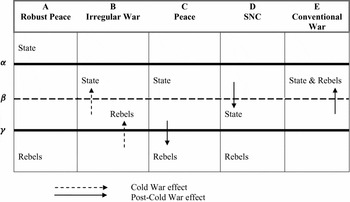
Third, the end of the Cold War resulted in the dissolution of states such as the USSR and Yugoslavia; this process was accompanied by the division of existing armies into competing factions that could fight against each other conventionally. Hence, our expectation of a rise in conventional civil wars in new postcommunist states. Figure 2 illustrates how the three processes activated by end of the Cold War are associated with distinct outcomes.Footnote 21
Impact of the Cold War on Civil Wars

Consider three capacity thresholds affecting both states and rebels. The first threshold α marks a superior level of state capacity (roughly corresponding to that of advanced industrial societies): above this level, civil peace is robust (outcome A). The end of the Cold War makes no difference for these countries. The second threshold β marks the level above which states or rebels are able to field a conventional army with heavy artillery and armor. Below that threshold, states or rebels cannot field such an army: rebels are organized irregularly, and states are considered to have “failed.” Last, γ marks the threshold of rebel capacity below which armed nonstate actors are too weak to mount a sustained military challenge against a state; usually, this is the realm of “bandits,” mafias, and terrorists.
Civil war only takes place in the area below threshold α, but its form varies depending on the military technologies available to states and rebels. As discussed previously, the Cold War lifted rebel capacity above γ, thus raising the likelihood of irregular war (outcome B). In contrast, the end of the Cold War pushed many potential rebels below threshold γ, thus sheltering many states from insurgency that had been previously vulnerable to it (outcome C). Note here that our argument identifies similar capacity states facing a higher likelihood of either civil peace or civil conflict (outcomes B and C): this variation is driven exclusively by rebel capacity. At the same time, the end of the Cold War caused states whose residual capacity was low (and had been previously propped up by superpower assistance) to fall below β. Rebels located below γ were now able to challenge these weakened states by means of a SNC war (outcome D). Last, the dissolution of some states following the end of the Cold War allowed rebels to move above threshold β and made a conventional challenge possible (outcome E).
In short, our analysis produces a clear set of empirical predictions about the impact of the Cold War and its end on civil war, while acknowledging multiple pathways. Next, we incorporate these theoretical insights into a cross-national analysis.
EMPIRICS
Our first empirical task is to ascertain whether there has been a significant shift in technologies of rebellion following the end of the Cold War. In line with our theoretical conceptualization, we operationalize these technologies with the type of weaponry used by the contending armed actors during the first year of the conflict. We use a data set of 147 civil wars between 1944 and 2004. We coded as conventional wars those conflicts where both incumbents and insurgents used heavy weaponry (artillery and armor); as irregular wars, the conflicts where incumbents deployed heavy weaponry but insurgents relied on light weapons; and as SNC wars, the conflicts where neither incumbents nor insurgents used heavy weaponry.Footnote 22
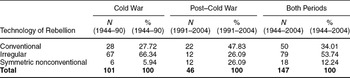
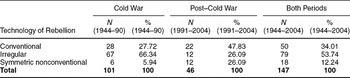
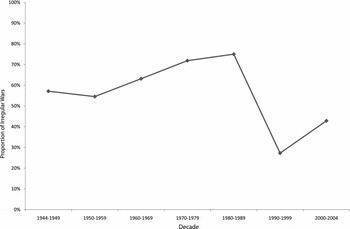
In Table 2, we can observe that irregular war is the dominant technology of rebellion during the entire period 1944–2004, thus justifying the scholarly attention it has received so far. However, it accounts for just more than half of all civil wars (53.74%): conventional wars are much more common than generally thought (34%), and SNC wars account for slightly more than 12% of the total. When we partition the data in two distinct periods, the Cold War (1944–90) and the post–Cold War (1991–2004),Footnote 23 we find that the end of the Cold War is associated with an important shift: although irregular war dominates the Cold War period (66.34%), it is much less frequent after its end (26.09%). Conventional war becomes the dominant type of civil war after 1990 (47.83%), and SNC wars experience considerable growth, rising to the level of irregular war (26.09%).Footnote 24 The decline of irregular war following the end of the Cold War is striking (Fig. 3), a trend that is robust to normalization (i.e., onsets by year).
Civil War Onsets, by Technology of Rebellion (1944–2004)
Irregular Civil Wars as a Proportion of All Civil Wars, by Decade

Geographic and temporal patterns appear consistent with our argument. With the end of the Cold War, civil wars shifted away from Asia and Latin America and toward Eurasia, sub-Saharan Africa, and, to a lesser degree, the Middle East and North Africa (MENA). After 1990, irregular war declined steeply in both Asia and Latin America.Footnote 25 In contrast, Eurasia experienced a rise of conventional civil wars linked to processes of state dissolution and new state formation. In sub-Saharan Africa, the most remarkable post–Cold War trend is the explosion of SNC wars; the abrupt interruption of superpower assistance to low-capacity states degraded their ability to deter even poorly organized rebels.Footnote 26 Last, the MENA region diverges from these trends in that both conventional and irregular wars experienced a rise in the post–Cold War period, despite the relatively high capacity of states there. The resilience of irregular war in that region can be traced to the emergence of militant Islamism and the U.S. invasions of Iraq and Afghanistan.
We now turn to the determinants of each of the three technologies of rebellion, using a multinomial logit estimation to examine the likelihood that a specific technology of rebellion is used in a civil war, given its onset. The dependent variable is categorical (Technology of Rebellion), taking the value of 1 for conventional wars, 2 for irregular wars, and 3 for SNC wars. Our main explanatory variable is a dummy differentiating the two periods under consideration (Post 1990), which we expect to be positively associated with conventional and SNC civil wars, and negatively associated with irregular civil wars.Footnote 27 We also use two additional specifications of the explanatory variable to better capture the mechanisms at work: the first is a dummy variable marking new countries emerging from a former communist state (New Postcommunist);Footnote 28 we expect it to be positively associated with conventional civil wars because these processes of state partition tended to bequeath large military arsenals to rival factions. The second one is a dummy variable indicating whether a major rebel actor claimed to be guided by a Marxist-leaning agenda (Marxist Rebels); civil wars featuring such rebels were naturally much more common during the Cold War, but were far from the only ones in that period.Footnote 29 This variable should be associated with irregular war given our posited link between Marxist inclinations and robust insurgency. We use these three variables in separate models to avoid collinearity issues.
We also include an additional set of independent and control variables. Gross domestic product (GDP) per Capita is a general proxy of state capacity that should be positively associated with conventional and irregular wars, and negatively associated with SNC wars.Footnote 30 GDP per capita is a problematic proxy for state capacity (Collier et al. Reference Collier, Elliott, Hegre, Hoeffler, Reynal-Querol and Sambanis2003; Hegre et al. Reference Hegre, Ellingsen, Gates and Gleditsch2001), but it is standard practice to include it in civil war models. As a way to correct for this problem, we include Military Personnel, a much better proxy for the capacity of a state's military, taken from COW 3.02 (Singer, Bremer, and Stuckey Reference Singer, Bremer, Stuckey and Russett1972), in thousands, lagged 1 year. Again, we expect this variable to be positively associated with conventional and irregular wars, and negatively associated with SNC wars. We also include Rough Terrain, which should have a positive effect on irregular war compared to the other two types because mountainous terrain has been claimed to favor this technology of warfare (Fearon and Laitin Reference Fearon and Laitin2003).Footnote 31 Ethnic War is included to account for potential differences in warfare driven by ethnic motivations, following Kaufmann's (Reference Kaufmann1996) argument that ethnic civil wars are more likely to be fought conventionally compared to nonethnic civil wars, and Kaldor's (Reference Kaldor1999) conjecture that post–Cold War civil wars are both more likely to be motivated by ethnic animosities and display features characteristic of SNC wars. Our theoretical prior is that technologies of rebellion should be independent of ethnic motivations.Footnote 32
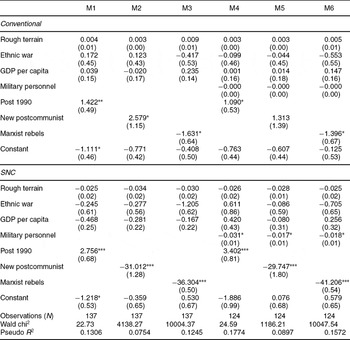
The results of the multinomial regressions are presented in Table 3, which displays the estimated coefficients for conventional and SNC wars; the reference category is irregular war. We also ran a second set of models that add Military Personnel to the first three models.Footnote 33
Multinomial Logit Regressions on Technology of Rebellion (1944–2004)

*p < .05; **p < .01; ***p < .001.
The results of model 1 reveal a strong and significant robust effect of the end of the Cold War (proxied with Post 1990) on technologies of rebellion, in the expected direction—showing that the descriptive patterns are robust to a multivariate regression specification.Footnote 34 According to this model, and holding all other variables at their sample mean, the probability that a civil war is fought conventionally increases from 30.17% during the Cold War to 51.13% after it; the probability that a civil war is fought irregularly decreases from 66.45% to 27.15%; and the probability that a civil war is SNC increases from 3.38% to 21.72%.Footnote 35 In model 2, and consistent with our expectations, New Postcommunist is highly significant, substantively and statistically, in accounting for the likelihood of conventional vis-à-vis irregular civil wars. Everything else equal, the probability of a civil war being fought conventionally is 87.63% if it takes place in a new postcommunist state; this probability is quite lower (32.57%) if the civil war takes place in any other country. This variable also displays a strong negative effect on the likelihood of SNC wars.Footnote 36 In model 5, this variable loses statistical significance because of missing cases.Footnote 37 Last, in model 3, Marxist Rebels displays a significant negative effect on both conventional and SNC wars.Footnote 38 With all other variables at their sample mean, the probability of a civil war being irregular if the insurgents have a Marxist-leaning agenda is 84%, almost twice as high compared to insurgents who lack a Marxist agenda (46%). This result is consistent with our argument that a key mechanism explaining the dominance of irregular wars during the Cold War is the Marxist character of rebels.Footnote 39
GDP per capita remains not statistically significant across all specifications. Contrary to our expectations, irregular civil wars are no more likely in wealthier countries. We have already mentioned the problems associated with using GDP per capita as proxy for state capacity; moreover, given the robust correlation between GDP per capita and civil war onset, our data set contains primarily poor states. However, we find instead that Military Personnel has a negative and significant effect on SNC wars, confirming that these wars entail states with lower military capacity. The nonsignificance of this variable for conventional civil wars is consistent with our conjecture that states fighting conventional wars have a military capacity comparable to those fighting irregular wars. Finally, Rough Terrain and Ethnic War are not significant in any of the models. This suggests that terrain and ethnic conflict are not associated with a particular technology of rebellion.
Overall, the empirical analysis supports our theoretical expectations. The descriptive data show clearly that the end of the Cold War was a key turning point for civil wars: it is then that irregular war ceased to be the dominant technology of rebellion. In turn, this shift was accompanied by a change in the geographic distribution of civil war. Our interpretation stresses the degree to which many states were able to withstand the reduction of foreign assistance that accompanied the end of the Cold War by drawing on their own resources. Sub-Saharan African states were clearly the most affected in this respect, as indicated by the rise of SNC wars in that region. The overall significance of the coefficients of our three measures capturing the shift in the international system (Post 1990, New Postcommunist, and Marxist Rebels) points to the pathways through which the end of the Cold War affected internal conflict. The multivariate regression specification allows us to confirm that the descriptive trends are robust to the inclusion of control variables.Footnote 40
Finally, although our primary focus is on civil war onsets, we also examined the evolution of all irregular civil wars that were going on when the Cold War ended. We find that most of these wars were affected by the end of the Cold War. First, four irregular civil wars terminated as a direct result of the end of the Cold War (the Marxist insurgencies in El Salvador and Guatemala and the anti-Marxist insurgencies in Nicaragua and Mozambique). With ideological utopias over and foreign subsidies gone, both sides found it more beneficial to bring these conflicts to a negotiated ending (Hironaka Reference Hironaka2005, 126). Second, three conflicts survived the end of the Cold War, but switched away from irregular war and toward either conventional or SNC warfare (Afghanistan, Angola, and Somalia).Footnote 41 Third, three irregular wars persisted. These were all Marxist insurgencies that relied primarily on domestic resources, in Cambodia, Peru, and Colombia. Because of their autonomy from the international system, these rebels were able to withstand the shock of the end of the Cold War, at least for some time (they were eventually defeated in Peru and Cambodia). The Colombian FARC is the exceptional case that corroborates our theoretical argument: a unique Marxist group that survived the end of the Cold War having been independent from it in the first place. Because of its autonomy from the international system, the FARC managed to maintain its ideological identity, type of recruitment, and technology of rebellion. Despite having to resort to narco-trafficking for its financing, it still does not pay its soldiers a salary, relying instead on political indoctrination (Gutiérrez Sanín Reference Gutiérrez Sanín2004).
Although irregular war is no longer dominant, it has not disappeared. An examination of post–Cold War irregular conflicts suggests that they come in two major types. The first one consists of minor, peripheral wars, which Fearon (Reference Fearon2004) describes as “sons of the soil” insurgencies (e.g., Aceh in Indonesia, southern Thailand, Cabinda in Angola); these rebellions do not threaten power at the center and seem to be contained or resolved without major international repercussions. The end of the Cold War has certainly affected the ability of insurgent entrepreneurs to escalate them by linking them to global politics. The second type consists of insurgencies with a radical Islamist outlook (e.g., Egypt, Algeria, Iraq, Chechnya, Tajikistan, Afghanistan), which cluster in the Middle East, Central Asia, and North Africa. These insurgencies display some interesting parallels with the Marxist insurgencies of the Cold War that require further exploration. Both these types of irregular war, however, fail to fill the gap left by the decline of robust insurgency.
CONCLUSION
Our analysis demonstrates that the end of the Cold War has had a transformative impact on the way civil wars are fought. We show that despite being domestic conflicts, civil wars are shaped in nonobvious, yet decisive ways by the international system. In focusing on how civil wars are fought, we also illustrate the importance of moving beyond a single-minded focus on civil war onset and taking the logic of warfare seriously. We point to a source of systematic heterogeneity in civil wars, specify three distinct technologies of rebellion, and identify a striking decline in one of them, irregular war, following the end of the Cold War. Possibly, this implies the future prevalence of civil wars that are not only shorter, but also more intense and more open ended in terms of their outcome.
Civil wars are military contests where each side's military capacity shapes the type of military interaction and, therefore, the nature of the conflict. Both insurgent and counterinsurgent strategies vary accordingly, and yet their “lessons” are conditional on the prevailing technology of rebellion. For example, the combined experience of Iraq and Afghanistan has led the U.S. military to focus single mindedly on irregular war. However, the lessons from Afghanistan are not necessarily transferable to an SNC conflict such as the Somali one. Our analysis also implies that, as they consider peacekeeping and peace building operations, policy makers must be aware of the variation in technologies of rebellion, as well as the transformation of internal conflict after the end of the Cold War. For instance, neither conventional nor SNC civil wars correspond to the popular image of quagmire associated with irregular wars, which have deterred international intervention in the past.
This article helps bridge the current gap in the civil war literature between two distinct research programs: one focusing on the macro, cross-national level, and another one privileging the micro, subnational level. We show how insights generated at the micro-level can fertilize cross-national, macro-level models. Our findings reinforce the call for theoretical and empirical disaggregation (Wimmer, Cederman, and Min Reference Wimmer, Cederman and Min2009), place scope conditions on existing theories of rebellion that emphasize exclusively state capacity or generalize insights drawn from a single technology of warfare (most commonly Sub-Saharan SNC wars), challenge the equation of civil war with insurgency—a central assumption in a major theory of civil war onset—and redirect the theoretical focus on the role of multidimensional external support (as opposed to mere financing), beliefs, and military doctrine and practice. We suggest that a fuller understanding of both civil war onset and dynamics calls for a more refined theorizing of warfare, including the relationship between state and rebel capacity.
Finally, we stress the importance of the international system, suggesting that just as domestic economies are closely interacting with global processes, a similar logic holds for domestic security dynamics. Although research on civil wars has recently turned its sight to the international dimension of civil wars, including the role of neighborhood contagion (Buhaug and Gleditsch Reference Buhaug and Gleditsch2008; Hegre and Sambanis Reference Hegre and Sambanis2006), refugee movements (Salehyan and Gleditsch Reference Salehyan and Gleditsch2006), and transnational diasporas (Collier and Hoeffler Reference Collier and Hoeffler2004), it has been surprisingly neglectful of the international system. By specifying three distinct technologies of rebellion and by identifying a major and overlooked process of transformation of civil wars, we are able to theorize the link between system polarity, the Cold War, and internal conflict, as well as provide empirical support for it. The way in which civil wars are waged turns out to be clearly related to the international system in ways that are more obvious (e.g., superpower interference) or less (e.g., the decline of irregular war). The prevalence of irregular war as a means of waging civil wars turns out to be a phenomenon closely associated with the Cold War. Conversely, SNC wars are associated with processes of superpower withdrawal from weak states following the end of the Cold War, whereas conventional war are associated with processes of imperial collapse and state formation.
Overall, our article stresses the need to connect the complex conflict processes taking place at the subnational, national, transnational, and international-systemic level. Students of internal conflict can profitably recognize that just because they are domestic conflicts, civil wars are no less immune to the effects of the international system than interstate wars.




Comments
No Comments have been published for this article.