


Introduction
A widespread dissemination of cognitive behaviour therapy (CBT) has taken place in Norway based on extensive training carried out by the Norwegian Association for Cognitive and Behavioural Therapy (NACBT). NACBT is the largest training organization of CBT in Norway and receives economic support from the Norwegian Directorate of Health. NACBT offers both general training programmes adapted to the participants’ occupational background, and programmes that target specific client groups, for example clients with eating disorders or psychosis. Feedback to NACBT indicated that trained therapists struggled with some obstacles to the clinical use of CBT. This may have led to underuse of the approach in the treatment of eligible clients. This notion is supported by research indicating that CBT is often delivered suboptimally (Young et al. Reference Young, Klap, Sherbourne and Wells2001; Shafran et al. Reference Shafran, Clark, Fairburn, Arntz, Barlow, Ehlers and Wilson2009; Kauth et al. Reference Kauth, Greer, Blevins, Cully, Landes, Said and Teasdale2010). In order to identify potential barriers to the implementation of CBT, a survey study targeting members of the NACBT who were participating in or had gone through training was carried out.
Implementation research
While approximately 1000 Norwegian health workers receive training in CBT at any point in time, feedback to the board of NACBT indicated that training alone was not sufficient in order to promote sustained change of practice. This feedback was compatible with Fixsen and colleagues’ (Reference Fixsen, Naoom, Blase, Friedman and Wallace2005) conclusions based on a synthesis of the literature on implementation research: ‘training by itself does not result in positive implementation outcomes (changes in practitioner behaviour in the clinical setting) or intervention outcomes (benefits to consumers)’ (pp. 40–41). Implementation is the process of integrating evidence-based treatments into clinical practice and the field of implementation has shifted its focus from the passive processes of ‘diffusion of innovation’ (Ogden & Fixsen, 2014; Rogers, Reference Rogers1995) and dissemination, to the current view of implementation as an active process in which knowledge is systematically transferred from research to practice. Several meta-analyses have been conducted to identify factors that promote or inhibit successful implementation, e.g. the quality of the intervention, organizational aspects and external factors (Greenhalgh et al. Reference Greenhalgh, Robert, MacFarlane, Bate and Kyriakidou2004; Fixsen et al. Reference Fixsen, Naoom, Blase, Friedman and Wallace2005; Durlak & Dupre, Reference Durlak and Dupre2008). The intervention should both be effective and easily manageable, adaptable to clinical practice and relevant to the target audience. The intervention should also be consistent with the goals and values of the organization, and thoroughly implemented. External factors may be political directives or networks that may influence the organization's willingness to implement the intervention. In the current study, characteristics of the CBT training (the intervention) the supervision and support at the workplace (organizational factors) as perceived by the trained therapists were of particular interest.
Previous research on the implementation of CBT
Several studies have addressed outcomes of training and supervision in CBT, including factors that promote or inhibit the implementation of CBT into clinical practice. Sholomskas et al. (Reference Sholomskas, Syracuse-Siewert, Rounsaville, Ball, Nuro and Caroll2005) assigned 78 community-based volunteer clinicians to three conditions and found statistically significant differences favouring CBT training and didactic seminar plus supervised casework over the CBT manual-only condition. This study indicated that supervision was needed to increase the clinicians’ ability to implement CBT, as assessed by independent ratings of adherence and skills. These findings were supported by Dorsey et al. (Reference Dorsey, Pullmann, Deblinger, Berliner, Kerns, Thompson, Unützer, Weisz and Garland2013) and Mannix et al. (Reference Mannix, Blackburn, Garland, Gracie, Moorey and Scott2006) in studies which showed that training alone was not sufficient in order to change provider behaviour, and that ongoing intervention-specific supervision or consultation was required in order to improve therapist performance in cognitive behavioural treatment (see also Schoenwald et al. Reference Schoenwald, Mehta, Frazier and Shernoff2013). In a Norwegian survey of 257 therapists who had received training by NACBT, Juklestad (Reference Juklestad2010) found that supervision and the therapists’ relationship with their managers had the greatest impact on the use of CBT in everyday clinical practice. General reviews of CBT include Herschell et al. (Reference Herschell, Kolko, Baumann and Davis2010) who reviewed 55 studies evaluating six training methods and concluded that multi-component training demonstrated the most positive training outcomes compared to other training methods. In their study, barriers to implementation included the lack of time, support and opportunities for learning new skills (Herschell et al. Reference Herschell, Kolko, Baumann and Davis2010). Beidas & Kendall (Reference Beidas and Kendall2010) reviewed research on the dissemination and implementation of evidence-based programmes into clinical practice and argued that successful implementation required that most, if not all of the variables related to the therapist, the client, organizational support, and training had to be addressed. In their review, criticism of treatment manuals, inadequate training, and unsupportive organizational climate were mentioned among the obstacles. Moreover, McHugh & Barlow (Reference McHugh and Barlow2010) conducted a review of the implementation of evidence-based psychological treatments, and concluded that didactic training alone seemed to be insufficient in order to obtain sustainable change in clinical practice. A balance of didactic training (written material and workshops) and competence training (learning skills, which are needed in order to administer a treatment with skill and fidelity) characterized successful efforts at integrating evidence-based interventions into service delivery settings.
Newton & Yardley (Reference Newton and Yardley2007) found that lack of qualified practitioners to provide training, insufficient training programmes, lack of support from managers to implement training programmes, financial constraints, limited time available for training and a change-averse culture were barriers to implementation or service provision. In a small pilot study of CBT for depression, Lewis & Simons (Reference Lewis and Simons2011) found that lack of time, lack of supervision and the cognitive abilities of the clients were perceived as the main barriers by the therapists. In another study, 23 therapists received coaching after training in CBT in order to help them identify and solve problems that occurred when they started using CBT in their clinical practice (Kauth et al. Reference Kauth, Greer, Blevins, Cully, Landes, Said and Teasdale2010). Even if coaching increased the use of CBT, four important barriers to the use of CBT were identified: lack of control over clinical time, the rejection of CBT as preferred treatment by some clients, interfering therapist assignments, and poor communication between the therapist and his/her manager.
A summary of the obstacles relevant to the current survey comprised factors related to the therapist, the training, the client and the workplace. Of particular interest, was the situation after training as perceived by the participants, and potential obstacles to feeling competent, and supported when they tried to implement CBT into regular practice. Relevant to the survey were also questions related to the therapist such as lack of skills, job pressure and too little time to practice CBT. Obstacles related to the training included too short or inadequate training, and the lack of supervision or coaching. Among obstacles at the client level, the lack of eligibility and lack of interest and motivation for receiving CBT were included. Among the barriers at the organization level, the lack of supervision, support and interest for CBT among colleagues and management were added, and also perceptions of negative attitudes and a change-aversive culture. On the positive side, favourable attitudes towards CBT on behalf of the therapist, their colleagues and managers were considered relevant. Also important were the respondents’ positive evaluation of the clinical treatment outcomes, and their intentions of continued training and use of cognitive behavioural treatment. Taken together, previous research identified several implementation obstacles relevant to the current study. In order to investigate to what extent the obstacles mentioned in the research literature were also perceived as important by trained CBT therapists in Norway, a survey was carried out among the members of the NACBT.
Aims of the study
In the present study the research questions were:
-
(1) What do therapists perceive as the main barriers when they try to implement CBT training outcomes into practice?
-
(2) Are there any systematic differences between therapist groups in their subjective experiences of barriers in everyday clinical practice?
-
(3) What is the relationship between the number of barriers and the general evaluation of CBT by the therapists?
Method
Participants and procedures
The participants in this study are NACBT members who have completed one or more training programmes, or are currently in training. As of November 2011, the NACBT had 1265 members (858 women, 407 men). The majority of the members are psychologists, psychiatrists, physicians, nurses, social workers, child welfare workers or physical therapists, and most of them work in the mental health services. The study was email based, and therefore, those who had not reported their email address (n = 98) were excluded from the study. The questionnaire was emailed by Questback to 1167 of the members in December 2011, and these participants were also informed by regular post. The questionnaire was also made available on the NACBT's website. After two reminders, the survey was completed by the end of the year. Answers were received from 562 respondents, which is a modest response rate of 48% [64% women (n = 359), 36% men (n = 195)]. Most of the participants were in the 50–59 years (36%) and 40–49 years (28%) age groups, with fewer in the 30–39 years (20%) and ≥60 years (13%) age groups. Among the participants, 109 (19%) were currently participating in CBT courses, and 397 (70.6%) had completed one or more training programmes offered by NACBT.
Training programmes
In the different NACBT education programmes, therapists get an understanding of the theoretical basis of cognitive and behavioural therapies and their application across a range of problem areas, and they receive skills training (general training). The training methods consist of a combination of passive learning (didactic presentation, case discussion groups, use of manuals and treatment protocols to supplement the didactic presentation, curriculum for self-directed study) and active learning (role-play, experiential learning, small group exercises). The therapists receive supervision by a NACB-accredited supervisor, consisting of discussion of casework and feedback on specific techniques by audio- or video-recordings. Supervised practice is subjected to formal assessment, and all therapists have to pass an examination. There are specified requirements for the kind of clinical practice therapists should be involved in during training, i.e. the possibility of conducting therapy according to treatment protocols of CBT. The specific programmes are: (1) 2 years’ education programme for clinical psychologists and psychiatrists/doctors in psychiatric residency programmes, which consists of ten 2-day seminars (160 hours of structured teaching), 50 hours of group supervision, and 20 hours of peer supervision; (2) 2 years’ training in CBT with children and adolescents which has mostly the same elements; (3) an education programme for psychiatric nurses and other professions with a minimum of 3 years’ education in health and social sciences (Bachelor level), which is divided in two parts [part 1: a 1-year course with 80 hours integrated education and supervision; part 2: a 1-year course with five 2-day seminars (80 hours of structured teaching), 50 hours of group supervision and 20 hours of peer supervision]; (4) 1 year's education for general practitioners which consists of 44 hours of education and 16 hours of group supervision. Moreover, many of the therapists who have completed one or more of the education programmes do take part in the education programme for supervisors, consisting of seven 2-day seminars (120 hours of structured teaching and workshops with supervision on supervision).
Measure
The questionnaire developed for this study, was developed at the Regional Centre for Early Psychosis Intervention together with NACBT in a survey that targeted participants in a CBT education programme for psychosis. The questionnaire which measured potential obstacles in the therapists’ future work (Grande et al. Reference Grande, Røssberg, Gjermundsen, Taraldsen and Berge2012) was revised in the current study in order to reflect a more general use of CBT.
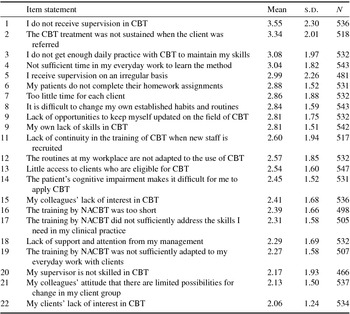
The CBT implementation obstacles survey measures 22 statements describing potential barriers to the successful implementation of CBT into clinical practice (see Table 1). The barriers could thematically be categorized as (1) therapists’ acquisition of skills (e.g. ‘My own lack of skills in CBT’); (2) characteristics of (a) training (e.g. ‘The training by NACBT was too short’), (b) supervision (e.g. ‘I do not receive supervision in CBT’); (c) the workplace (e.g. ‘My colleagues’ lack of interest in CBT’) and (d) clients (e.g. ‘My clients’ lack of interest in CBT’). The response alternatives were based on a Likert scale ranging from 1 to 7, describing the degree to which a statement indicated a barrier in the everyday work of the respondent. Thus, 1 indicated that the statement was in no way perceived as a barrier, while 7 indicated that the statement was perceived as a barrier to a great extent. Five additional items reflecting the therapists’ global evaluation of CBT both personally (satisfied with client outcomes, intentions of sustained use and further training) and in relation to the workplace context (a positive attitude towards CBT by manager and colleagues) were added. The same scale was used for these items, in which 1 indicated no support for the statement and 7 high support.
Perceived barriers to the treatment of CBT – Mean item scores (range 1–7)

NACBT, Norwegian Association for Cognitive and Behavioural Therapy.
Therapists’ global evaluation of CBT. The five questions included in this scale were: ‘I intend to continue my use of CBT’, ‘The attitudes towards CBT at my workplace are positive’, ‘My manager has a positive attitude to the use of CBT’, ‘I would like follow-up courses in CBT’ and ‘I am generally happy with my clients’ outcome with CBT’.
A pilot study was performed to make sure that the questionnaire was understood by the respondents. It was also distributed to the members of the board of NACBT to ensure that the questions addressed relevant aspects of the training programmes. Several professionals contributed to the construction of the questionnaire in order to ensure a high degree of construct validity, but none of them participated in the main study.
Analysis
An exploratory factor analysis was conducted to examine if the statements in the questionnaire reflected the underlying dimensions of earlier implementation research. Furthermore, a one-way analysis of variance was performed to examine possible group differences in perceived barriers based on therapist characteristics (profession, workplace) and training programmes. Finally, a multiple regression analysis was performed to examine how the various barriers predicted the therapists’ global assessment of CBT.
Results
Initially, the respondents’ answers were analysed to identify statements with the highest and lowest mean scores, respectively. Inspection of mean item scores in Table 1 indicates that according to the respondents, the main obstacles to the implementation of CBT were related to daily challenges at their workplace. Obstacles included were lack of regular supervision, time pressure and the problem of sustainability of CBT treatment when clients were referred to other therapists or services.
Perceived barriers with the lowest mean scores indicated that minor problems in the process of implementing CBT into practice were related to negative attitudes among clients and colleagues, the supervisor's skills in CBT (if they had one) and the applicability of the training to the participant's clinical work.
Among the respondents, 109 were currently in training at the time of the survey, while 440 were not (13 missing). A t test was run on the implementation obstacle scales, but with one exception, these demonstrated no differences between the two groups. The only difference was detected on the supervision subscale, where those under training perceived significantly fewer obstacles than those who had completed training (t 1,533 = 2.79, p = 0.01).
Exploratory factor analysis
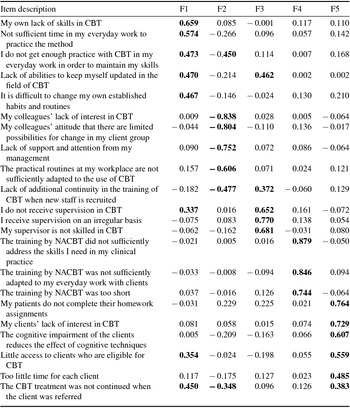
The pattern matrix of the exploratory factor analysis showed that the questionnaire statements reflected five underlying dimensions of perceived barriers. Five theoretical meaningful factors were extracted with items loading above 0.30. If cross-loadings occurred, the item was included in the factor with the highest score (Table 2). One of the items (i.e. ‘The CBT treatment was not continued when the client was referred’) cross-loaded on three of the factors, and also reduced the internal consistency if added to the client factor scale. The item was therefore excluded. The remaining 21 items made up five factor-based subscales, which were named clients, training, supervision, aspects of the workplace, and skills. In addition, the factor analysis indicated a separate factor for the therapists’ general satisfaction with CBT (not given in the Table). A sum score was calculated for the 21-item obstacles questionnaire, and one for each of the factor-based subscales.
Factor loadings and factor structure in exploratory factor analysis of perceived implementation barriers

NACBT, Norwegian Association for Cognitive and Behavioural Therapy.
Table shows factor loadings from the oblimin solution.
Factor loadings >0.30 are in bold face.
Skills. Five items describe how therapists use and maintain CBT techniques at their workplace (Table 2). The loadings ranged from 0.47 to 0.66. The Skills factor accounted for 33.33% of the total variance and the reliability of the scale was satisfactory with α = 0.79.
Workplace. Five items describe the therapists’ perceptions of different aspects of the workplace, such as administration, leadership and colleagues (Table 2). All items loaded satisfactorily on the workplace factor (from 0.48 to 0.84) with a reliability of α = 0.82.
Supervision. Three items describe whether the therapist receives supervision or not, if the supervision is received on a regular basis and the competency of the supervisor (Table 2). All items loaded satisfactorily on the supervision scale (from 0.65 to 0.77) and reliability for the scale was α = 0.70.
Training. Three items concern the training offered by NACBT (Table 2). All items loaded satisfactory on the training scale (from 0.65 to 0.77). Reliability for the scale was α = 0.77.
Clients. Five items tap into different characteristics of the clients receiving CBT (Table 2). All items loaded satisfactorily on this scale (from 0.49 to 0.76), and the reliability was α = 0.74.
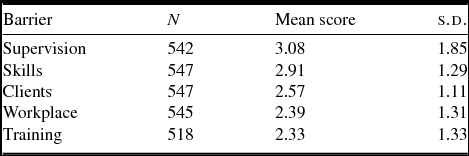
Two of the subscales had only three items each, which may be considered a small number to constitute a subscale. Still they were retained due to their thematic consistency and convincingly high internal consistency. Based on the factor analysis, sum scores and mean values were calculated for the total scale and for each of the factors. These findings are presented in Table 3. Even if the differences between the mean score on the subscales were moderate, they confirmed the findings from the single item ratings. The transfer of CBT from training to practice was perceived as the largest challenge, while some problems were related to client characteristics and only a few to attitudes and support at the workplace and training. It was interesting to note the difference in assessments between practical constraints at the workplace (e.g. time and supervision) and the (positive) attitudes from management, colleagues and clients. Practical constraints were among the largest barriers while attitudes and support were among the smallest.
Obstacle subscales, mean scores and standard deviations

Therapists’ global evaluation of CBT. An additional factor capturing the therapists’ assessment of CBT was extracted in a separate factor analysis, and the loadings ranged from 0.63 to 0.84 with α = 0.81 (data not shown). The factor accounted for 58% of the total item variance. The mean item score for the therapists’ global evaluation of CBT was in the upper range at 5.6 (s.d. = 1.26) on a scale from 1 to 7. There were no significant differences in ratings when professional groups, workplaces and training programmes were compared. Among the respondents, 83% had plans for continued use of cognitive therapy and 73% wanted a follow-up course in cognitive therapy (item scores of 6 or 7).
Professional groups
The study identified several statistically significant differences between the professional groups’ perceptions of barriers. First, we analysed main group differences in one-way ANOVA analyses, and then we examined differences between groups in terms of results from each of the five subscales on the questionnaire. Seven professional groups were used as independent variables and these were (number of participants in parentheses): psychologists (n = 182), psychiatrists (n = 54), general practitioners (n = 44), nurses (n = 115), social workers (n = 46), other therapists with a minimum of 3 years’ education in health and social sciences (n = 66) and others (n = 55). A one-way ANOVA analysis showed that there was a significant statistical group difference when obstacles sum scores were compared (F 6,357 = 3.71, p = 0.001). The post-hoc analyses showed that psychologists (mean = 2.44) perceived significantly fewer obstacles than nurses (mean = 2.88) and social workers (mean = 2.87). In the analysis of Skills, nurses reported a statistically significantly higher degree of barriers (mean = 3.15) than psychologists (mean = 2.65) (F 6,426 = 3.37, p = 0.004). Regarding Training, nurses (mean = 2.71) experienced significantly more barriers than the psychologists (mean = 2.10) (F 6,412 = 2.19, p = 0.004). The same was found for Supervision; nurses (mean = 3.49) perceived this as a greater barrier than psychologists (mean = 2.71) (F 5,412 = 2.19, p = 0.043). Nurses (mean = 2.74) also experienced a statistically significantly greater degree of barriers related to Aspects of the workplace compared to psychiatrists (F 6,424 = 3.03, p = 0.002). There was no statistically significant difference between the groups in Client-related barriers. In sum, the psychologists reported the fewest obstacles among the professional groups, particularly compared to nurses, but also to social workers.
Workplace. A total of six categories were used in the analysis. These were (number of respondents in parentheses): psychiatric wards (n = 78), outpatient clinics (n = 165), general hospitals (n = 61), private practices (n = 64), NAV (labour and welfare administration) (n = 16) and others (n = 126). The one-way ANOVA analysis showed a significant difference between the groups on the obstacles sum score (F 5,332 = 8.69, p = 0.00). The post-hoc analysis further revealed that respondents who worked at a psychiatric ward (mean = 3.10) perceived significantly more obstacles than those working in outpatient clinics (mean = 2.44), private practice (mean = 2.05), NAV (mean = 1.84) or ‘other workplaces’ (mean = 2.46).
The greatest differences were found among barriers that described Aspects of the workplace (F 5,394 = 12.58, p = 0.000). Practitioners working in psychiatric wards (mean = 3.25) experienced these aspects as significantly more difficult than those working with outpatients (mean = 2.23), those working at NAV (mean = 1.64), those working in private practice (mean = 1.58) and ‘others’ (mean = 2.46). Regarding Supervision (F 5,393 = 2.88, p = 0.014), those working in psychiatric wards (mean = 3.62) experienced statistically significantly more barriers than those working in private practice (mean = 2.52). Regarding Training (F 5,383 = 2.26, p = 0.047), those who worked in psychiatric wards (mean = 3.62) experienced significantly more barriers than those working in private practice (mean = 2.10). The analysis of group differences in terms of Skills (F 5,396 = 4.71, p = 0.000) showed that those working in psychiatric wards (mean = 3.37) experienced their skill level as a significantly greater barrier than those working with outpatients (mean = 2.79) and those working in private practice (mean = 2.59). Finally, those working in psychiatric wards (mean = 3.19) considered Clients (F 5,396 = 8.87, p = 0.000) as a significantly greater barrier than those working with outpatients (mean = 2.57), those working at NAV (mean = 1.90), those working in private practice (mean = 2.16) and those who define their workplace as ‘other’. Taken together, the findings indicated that professionals working in psychiatric wards consistently experienced and reported more barriers, particularly compared to those working in outpatient clinics, but also in relation to those working in other non-hospital settings.
Training. A total of six independent training programmes were compared by one-way analyses of variance (ANOVA). These were (number of participants in parentheses): (1) 2 years’ training for psychologists and physicians (n = 179); (2) 1 year's training for therapists with 3 years’ education in health and social sciences (step 1) (n = 199); (3) 1 year's training for therapists with 3 years’ education in health and social sciences (step 2) (n = 66); (4) 2 years’ training in CBT with children and adolescents (n = 31); (5) 1 year's training for physicians (n = 16); and (6) training for supervisors (n = 118).
When the total scores on implementation obstacles were compared between groups, there was a significant main effect (F 5,221 = 3.82, p = 0.002). According to the post-hoc analyses, those who had participated in 2 years’ training for psychologists and physicians (mean = 2.41) reported significantly fewer obstacles than those who had participated in 1 year's training for physicians (mean = 2.79). Moreover, those who had participated in training for therapists with 3 years’ education in health and social sciences (step 1) reported significantly more obstacles (mean = 2.91) than those who were trained in the step 2 part of the same programme (mean = 2.14) and those who had participated in the supervisor training (mean = 1.81). There was also a significant group difference in favour of those who had taken part in the CBT supervision training (mean = 1.81) compared to those who had undergone 1 year's training for physicians (mean = 2.79). In terms of Skills (F 5,326 = 4.59, p = 0.000), those who had completed 1 year's training for therapists with 3 years’ education in health and social sciences (step 1) (mean = 3.33), reported a statistically significantly greater amount of barriers than those who had completed 2 years’ training for psychologists and physicians (mean = 2.70). Barriers related to Aspects of the workplace (F 5,324 = 3.67, p = 0.003), showed statistically significant differences between those who had completed 1 year's training for therapists with 3 years’ education in health and social sciences step 1 (mean = 2.79) and those therapists who had completed 2 years’ training for psychologists and physicians (mean = 2.18). In terms of Training (F 5,315 = 6.89, p = 0.000), there were statistically significant differences between several of the groups. Those who had completed 1 year's training for therapists with 3 years’ education in health and social sciences (step 1) (mean = 2.84) reported a greater degree of barriers than those therapists who had completed 2 years’ training for psychologists and physicians (mean = 2.16) and those who had completed 2 years’ training in CBT with children and adolescents (mean = 1.08). In addition, those who had completed 1 year's training for physicians (mean = 2.66) experienced a greater degree of barriers than those who had completed 2 years’ training in CBT with children and adolescents. No statistically significant differences were found between the groups in terms of Supervision or Clients. To summarize, those who had completed 2 years’ training for psychologists and general practitioners reported significantly fewer obstacles than other groups, particularly compared to those who participated in the 1 year's training for therapists with a Bachelor's degree in health and social sciences.
Gender. There were no significant gender differences in the number of obstacles reported. But using gender as an independent variable, a statistically significant difference was found in terms of Skills, in which women (mean = 3.01) reported their lack of skills as a greater barrier than men (mean = 2.75, t 1,507 = 1.00, p = 0.031). There was also a significant gender difference in the perceptions of obstacles to training, where women (mean = 2.43) reported more obstacles than men (mean = 2.15, t 1,477 = 0.90, p = 0.36). No other statistically significant differences were found between the groups.
Relationship between perceived barriers and treatment satisfaction
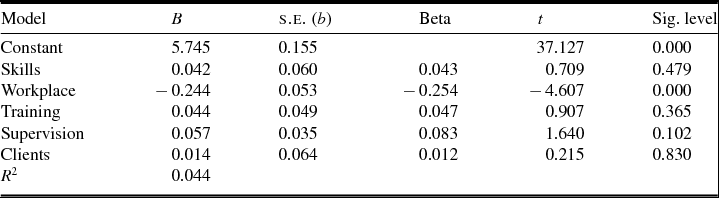
The next question dealt with, was whether the perceived barriers impacted therapist evaluation of CBT. In order to examine which barriers best predicted the positive evaluation of CBT, a multiple regression analysis with therapist global evaluation of CBT as the dependent variable and the five subscales as independent variables was conducted.
The analysis described in Table 4 estimates the relative importance of each of the variables when the others are controlled.
Multiple regression analysis – obstacle subscales predicting global therapist satisfaction

It turned out that the regression model explained only a small part of the variation in the dependent variable (4.4%). The only variable that significantly predicted therapist satisfaction with treatment was the factor-based subscale of Workplace. This indicates that for the most part, influences other than perceived barriers were important when it came to explaining variations in therapists’ evaluation of CBT.
Discussion
There are three main findings in this study. First, five factors representing barriers in the practice of CBT were identified: Skills, Aspects of the workplace, Supervision, Training, and Clients. These barriers reflect the competency drivers in Fixsen and colleagues’ (Reference Fixsen, Naoom, Blase, Friedman and Wallace2009) implementation model and have also been identified in previous research on implementation (Greenhalgh et al. Reference Greenhalgh, Robert, MacFarlane, Bate and Kyriakidou2004; Fixsen et al. Reference Fixsen, Naoom, Blase, Friedman and Wallace2005; Durlak & Dupre, Reference Durlak and Dupre2008; Herschell et al. Reference Herschell, Kolko, Baumann and Davis2010; Juklestad, Reference Juklestad2010; McHugh & Barlow, Reference McHugh and Barlow2010; Dorsey et al. Reference Dorsey, Pullmann, Deblinger, Berliner, Kerns, Thompson, Unützer, Weisz and Garland2013). In line with earlier research, most of the obstacles in the process of implementing CBT into clinical practice were related to workplace conditions. For instance, supervision was less of a problem when the respondents were in training, compared to their situation at work after the training (Mannix et al. Reference Mannix, Blackburn, Garland, Gracie, Moorey and Scott2006; Newton & Yardley, Reference Newton and Yardley2007; Kauth et al. Reference Kauth, Greer, Blevins, Cully, Landes, Said and Teasdale2010; Lewis & Simons, Reference Lewis and Simons2011; Schoenwald et al. Reference Schoenwald, Mehta, Frazier and Shernoff2013). Many of the therapists also reported that they were not sufficiently supported in the transition from training to practice. In other words, and as was clear from the multiple regression analysis, conditions at the therapists’ workplace were of great importance both during and after training. The most important obstacles were workplace-related, e.g. lack of regular supervision, lack of routines and opportunities to maintain skills, not enough time to learn the method, too little time for each client, difficulties in keeping up to date on CBT, and lack of continuity in CBT training when new staff are recruited. The findings from the current study reflect the emphasis on the therapist perspective, with many items describing barriers at the individual clinical level rather than at the organizational level. The relatively high correlation between the various barriers, gives support to the hypothesis of interaction between the components and their combined importance (Beidas & Kendall, Reference Beidas and Kendall2010).
Second, statistically significant differences in the reported number of barriers were found between professions, workplaces and training programmes. Psychologists reported the fewest barriers among the professional groups, particularly in comparison with nurses. According to self-report, psychologists perceived their training programme to be better adapted to their competence and tasks than the other professional groups. The nurses reported a higher degree of barriers, particularly related to Supervision and Skills, which may reflect a lack of specialization in mental health work in their basic education. Comparing the workplace, professionals working in psychiatric wards reported more barriers than professionals from other workplaces. This may be an indication of more favourable conditions for practising CBT in outpatient settings than in hospitals, and psychiatric wards seemed to be particularly difficult when moving CBT from training to practice. There is little previous research concerning the relationship between training of therapists and the outcome of therapy (Beutler et al. Reference Beutler, Malik, Alimohamed, Harwood, Talebi, Noble, Wong and Lambert2004). Still, some researchers highlight the fact that nurses working in psychiatric wards may have a somewhat different work structure than other health workers (Skagen & Piros, Reference Skagen and Piros2002). This may be the result of working in an interdisciplinary environment that represents different perspectives on treatment (Steffensen, Reference Steffensen2007). Moreover, clients in psychiatric wards often have more serious psychological disorders that sometimes require a high degree of flexibility.
Even if training programmes were adapted to different professions, clients and workplaces, they had, to a large extent, the same structure, content and learning activities. The study was therefore not well suited to compare the differences between programmes. Still, we identified some differences in obstacles between them, which may be an indication of how well the different courses were adapted to their target group. The fewest obstacles were reported by those had completed 2 years’ training for psychologists and general practitioners, particularly compared to the training for therapists with a Bachelor's degree in health and social sciences. The difference was evident on both the total scale and most of the subscales. It should also be noted, that with the exception of supervision barriers, there were no differences in the perception of barriers between those currently in training and those who had completed training. An explanation for this may be that most of those who were in training were also holding a part-time or full-time position in practice, and therefore experienced the same barriers as those who had completed their training.
Third, the participants were rather positive in their global perceptions of CBT, both in terms of clinical outcomes, attitudes among colleagues and managers, and in expressed intentions of acquiring more training and to continue to use this therapeutic approach. Although the perceived barriers explained a modest amount of variance in the global evaluation of CBT, there was a significant impact of workplace conditions. Other factors than perceived barriers may be important in the prediction of the global evaluation of CBT, and a strong candidate is probably the extent to which the therapists experience positive client clinical outcomes. Even if there was no overall gender differences in reports of obstacles, two differences appeared in the analyses; women reported significantly more obstacles than men when it came to clinical skills and training. In other words, the male trainees found the training programmes to be better adapted to their qualifications and needs than the female trainees did.
Limitations of the study
Some limitations of the study should be mentioned. When findings from the current study emphasize the therapist perspective on competency drivers, this is partly a reflection of the fact that many of items in the survey describe barriers at the individual clinical level rather than at the organizational level. The questionnaire was distributed electronically, which may have excluded some respondents due to varying degree of computer skills. We had little information about characteristics of the participants prior to the survey, and could therefore not examine the importance of previous competence and experiences with CBT. Inadequate operationalization of the items, social desirability issues, and the lack of some categories may have influenced the responses. Subjects participating in the study were members of the NACBT. They may have allegiance to CBT, which may have influenced their answers in a positive direction, as may the fact that the informants reported on their own clinical practice. Further, the participation rate was low (48%) and some respondents did not answer all the questions. This is much lower than the expected response rate of ≥70% (Haraldsen, Reference Haraldsen1999) and generalization of the outcomes should therefore be made with caution. Still, a broad range of informants answered the survey, and all the groups known to participate in CBT training were represented. Moreover, even if direct comparison was not feasible, there were no indications of systematic differences between responders and non-responders.
Implications for CBT training programmes in Norway
From the point of view of the NACBT, the survey outcomes should be considered as encouraging, because of the low scores on obstacles related to training. The main aim of this retrospective evaluation survey was to assess the number and type of obstacles to implementing CBT into clinical practice, irrespective of the type of training, profession, and workplace. It turned out that the mean item scores were restricted and in the lower range, with a total mean score of 2.54 (s.d. = 1.00) on a scale from 1 to 7, and a maximum mean of 3.55 and a minimum of 2.06 on the subscales. This relates to Beidas & Kendall's (Reference Beidas and Kendall2010) review, which concluded that most variables related to the therapist, client, organization, and training were important for the successful implementation of evidence-based practice.
Taken together, this may indicate that the multicomponent training model of NACBT, including supervision, was positively evaluated by the trainees. However, the outcomes indicated that there were training programmes which were not optimally adapted to the needs of their professional target groups or to the conditions at their workplaces. These results may indicate the need for adjustment of some of the training programmes and/or for follow-up courses from NACBT. Given the state of affairs, the NACBT could, possibly supported by the Directorate of Health, advocate more extensively for training programmes in order to increase the commitment from the management in various services to invest more in training and in ongoing supervision after training (Newton & Yardley, Reference Newton and Yardley2007). The NACBT may also encourage more people to follow their supervision-training programme. The results from this study also suggest that the NACBT should include information about the importance of active implementation in their training programmes. Learning about the importance of implementation, may motivate trainees to apply for more supervision and skills training in their own practice.
Summary of the main points
-
• The study identified five factors representing barriers in the practice of CBT: Skills, Aspects of the workplace, Supervision, Training, and Clients.
-
• Problems related to supervision and therapeutic skills were reported to be the most important obstacles.
-
• The study supports the notion that training is not sufficient to implement CBT in clinical practice.
Declaration of Interest
None.
-
(1) Therapists' perception of main barriers when they try to implement CBT training outcomes into practice.
-
(2) Exploration of systematic differences between therapist groups in their subjective experiences of barriers in everyday clinical practice.
-
(3) Exploration of the relationship between the number of barriers and satisfaction with practising CBT.



Comments
No Comments have been published for this article.