Severe fever with thrombocytopenia syndrome (SFTS) was an emerging infectious disease identified in 2009 in China caused by SFTS virus (SFTSV).Reference Yu, Liang and Zhang1 SFTSV belongs to the genus Banyangvirus of the Phenuiviridae family, which is a single-stranded negative-sense RNA virus with 3 genomic segments: L, M, and S.Reference Yu, Liang and Zhang1,Reference Maes, Adkins and Alkhovsky2 The L segment encodes the viral RNA-dependent RNA polymerase; the M segment encodes 2 viral envelope glycoproteins; and the S segment encodes a nucleocapsid protein and nonstructural proteins.Reference Robles, Han and Park3 SFTS was a severe hemorrhagic fever that caused gastrointestinal symptoms such as diarrhea, muscle pain, lymphadenopathy, thrombocytopenia and bleeding tendency. The disease was often lethal with case fatality rate up to 30%.Reference Li, Lu and Xing4,Reference Yu5 Since 2009, SFTS was subsequently reported in other countries including South Korea, Japan, and Vietnam. The SFTS virus (SFTSV) was primarily transmitted by Haemaphysalis longicornis tick.Reference Luo, Zhao and Wen6 Haemaphysalis longicornis tick was also found in Australia and the Pacific regions, and recently it had been identified in several US states.Reference Hutcheson, Dergousoff and Lindsay7,Reference Raghavan, Barker and Cobos8 Therefore, SFTSV may not be limited to the places where it is identified currently. Globally, most SFTS cases have been reported in China where >2,000 confirmed SFTS patients are reported annually.Reference Qi, Qin and Wang9 Not only does SFTSV spill over to humans through tick bites, it very often spreads from person to person. Person-to-person transmission causes SFTS clusters. The disease was recognized originally because of a cluster of cases in 2006 in central China. To date, >20 clusters of person-to-person transmission of SFTS have been reported in English-language literature.Reference Bao, Guo and Qi10–Reference Gong, Song and Wu24 Unlike the tick-bite route, person-to-person transmission can be more effectively prevented. Prevention measures must be preceded by an analysis of characteristics of person-to-person transmission. The infection of secondary patients was caused by transmission through personal contact.Reference Bao, Guo and Qi10,Reference Liu, Li and Hu18 The risk factors of person-to-person transmission remain unclear. Better understanding these risk factors is essential for infection control. In this study, we analyzed the risk factors of person-to-person transmission by reviewing and summarizing literature reports of cluster infections of SFTS.
Methods
Data collection
Search strategy
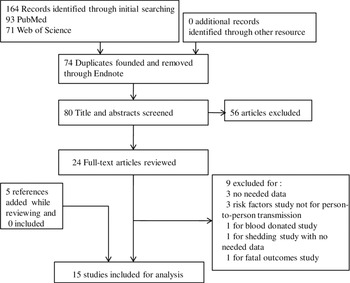
We identified and included studies published in PubMed and Web of Science before March 15, 2020, reporting the person-to-person transmission of SFTSV or clusters of SFTS. The search key words included “SFTS,” “severe fever with thrombocytopenia syndrome,” “person-to-person,” “human-to-human,” “cluster,” “outbreak,” and “risk factor.” References cited by included articles were also reviewed for selection. The detailed search process is illustrated in Figure 1.
Search process of the study.

Screen criteria
Articles reporting cluster infection of SFTS were included, and they were excluded (1) if the cluster of infection was from common tick-bite exposure rather than person-to-person transmission, (2) if patients were only clinically diagnosed rather than laboratory-based confirmation (RT-PCR, IgM detection, or IgG conversion), (3) if the cohort was a special population (eg, people living with HIV), (4) if different articles shared the same data, and (5) if the article was a review or editorial. Review articles were excluded, but their references were screened.
Data extraction
We looked for articles that reported clusters of SFTS. The principal summary data were characteristics such as outcomes of index patients and secondary cases, the data of infected and uninfected cases who had contacted with index patients and the exposure ways of all contactors. The following data were extracted from the articles (if provided): author, year of publication, country, basic information of cases (eg, age, sex, and occupation), onset and death time, and method used for laboratory diagnosis.
Examination of risk factors
To investigate the risk factors for SFTSV person-to-person transmission, characteristics of index patients who caused cluster infections and correlation between exposure history and secondary infection were analyzed. An analysis was performed to determine whether these index patients had common characteristics. The strength of association between exposure and infection was measured using relative risk (RR). The RR value is a ratio of probabilities used to compare the incidence or risk of infection among those with a specific exposure with those who were not exposed. All analysis and plots were run with R version 3.6.0 software (R Foundation for Statistical Computing, Vienna, Austria).
This study was approved by the ethics committee of Lanzhou University.
Results
To identify the risk factors related to person-to-person viral transmission, we analyzed 89 secondary cases infected by person-to-person transmission in 23 clusters of SFTS from 15 articles. The number of secondary cases in these clusters ranged from 1 to 11. Among 23 studies, 17 (74%) reported clusters that occurred in China. The case fatality rate of secondary infection cases was 6.7% (6 of 89).
Features of index patients caused SFTS person-to-person transmission
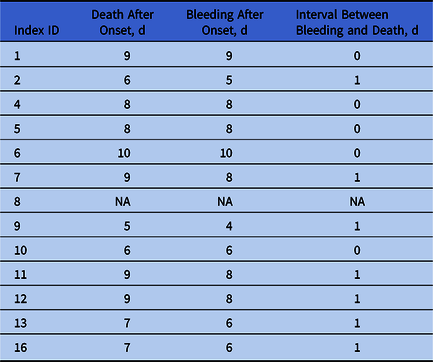
Index patients in clusters were analyzed to identify what specific features the index patients who caused person-to-person transmission had. The results showed more women than men (60.9% vs 39.1%) among the SFTS index patients. All 21 of 21 index patient outcomes were death; 2 of 23 clusters with no information about the outcomes of index patients in the study by Wang et alReference Wang, Deng, Zhang, Cui, Yao and Liu20 were not included in this calculation. In addition, all 14 of 14 index patients had massive bleeding, but 9 of 23 clusters with no information on clinical symptoms in Wang et alReference Wang, Deng, Zhang, Cui, Yao and Liu20 and Yoo et alReference Yoo, Lee and Heo22 were not included in the calculation. Symptoms of bleeding in these patients mainly included bleeding from mucosa, hematemesis, bloody respiratory secretions and oozing from catheter insertion sites. Of 14 index patients with bleeding, 13 reported that the bleeding always occurred 1 day before or on the day of death. On average, deaths occurred at day 8 (range, day 5 to day 10) after onset (Table 1).
The Time of SFTS Disease Last and When Bleeding Occurred

Note. SFTS, severe fever with thrombocytopenia syndrome.
Exposure factors for SFTS person-to-person transmission
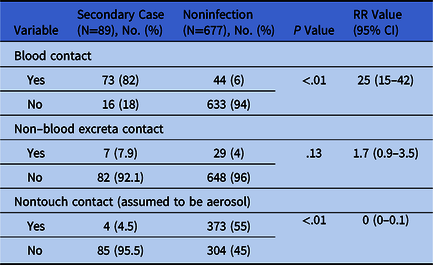
The contact histories of all the 89 secondary cases infected by person-to-person transmission were reported. As shown in Table 2, 73 cases (82%) reported that they had had contact with the index patient’s blood with their bare hands. Also, 7 cases (7.9%) reported they had had contact with excreta (feces) of the index patient but not the blood. In addition, 4 cases (4.5%) did not have a history of contact with blood or other bodily fluids from the index patient and these cases had stayed with an index patient for a short period. These cases were suspected of probable aerosol transmission in the original literature.Reference Chen, Hu, Zou and Xiao11,Reference Kim, Choi and Park17 In 5 cases (5.6%), there was no clear exposure history. Among these 5 cases, 2 had been living with an index patient but did not contact any bodily fluids and 3 had touched the index patient with limited protection equipment (eg, gloves).
Correlation of Exposure History and Secondary Infection

Note. RR, relative risk; CI, confidence interval.
In addition to patients, articles reported exposure histories of all persons who had contact with index patients, whether or not they became infected. The blood-specific secondary attack rate was up to 62.4% (73 of 117). The RR value was 25 (95% CI, 15–42); thus, the probability of a person becoming infected was 25 times more likely when they contacted blood than when they did not. Only 1 of 89 secondary cases reported that she had an entry wound on her hand; other cases did not report whether they had entry wounds when they contacted blood. Although a proportion of patients (7.9%) had only been exposed to nonblood excreta, the proportion was not significantly different from noninfection group (7.9% vs 4%; P = .13). Among the uninfected cases, 55% had had nontouch contact, which was a higher rate than the infected cases (4.5%). These 2 results suggest that exposure to nonblood excreta or nontouch contact compared with nonexposure were not statistically significant factors for SFTSV transmission person to person (Table 2).
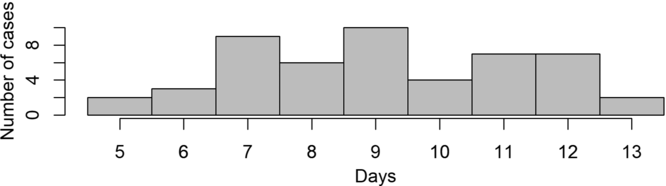
Person-to-person transmission was helpful to confirm the incubation period of disease. Of the 89 cases, 50 reported either the incubation period or accurate times of exposure and onset. The median incubation period of SFTS was 9 days (range, 5–13 days) (Fig. 2).
Distribution of incubation period of thrombocytopenia syndrome (SFTS).

Discussion
In this literature review, all index patients in the SFTS clusters had fatal outcomes. Generally, the case fatality rate of SFTS was as high as 30%,Reference Yu, Liang and Zhang1,Reference Li, Lu and Xing4 but the case fatality rate of index patients in clusters was 100%. Thus, patients with fatal outcomes were significant risk factors for person-to-person transmission. A fatal outcome implies that the patient was severely ill. In a survey based on 2,096 patients across 7 years, the case fatality rate correlated significantly with the viral load.Reference Li, Lu and Xing4 The case fatality rates were 24% and 53%, respectively, among SFTS patients with high viremia (107–108 copies/mL) and extremely high viremia (>108 copies/mL). The patients who died had significantly higher viral loads than survivors at each monitored time point, especially during the early phase of illness (from day 1 to day 6 after symptom onset).Reference Li, Lu and Xing4 In our study, index patients died on average at day 8 (range, 5–10) after onset, which means that they were in an early phase of disease. High viral load was the most fundamental condition related to cluster infection, and patients with fatal outcomes all had high viral loads. The case fatality rate of secondary cases infected person to person was 6.7%, which was much lower than for tick-bite infections. SFTSV mainly infected persons living in rural areas who generally could not go to a hospital in time. Cases infected by taking care of these index patients might have had stronger awareness of the need to seek early treatment when similar symptoms appeared. In addition, fatal cases always occurred in older patients, and caregivers are often younger.
A previous studyReference Li, Lu and Xing4 indicated that clinical features associated with death from SFTS included older age, delay in admission, presence of diarrhea or dyspnoea, neurological symptoms, and development of hemorrhagic signs or blood urea nitrogen. Hemorrhagic signs of SFTS mainly included conjunctival congestion, petechiae, hematuria, melena, and hemoptysis. All index patients in our study had massive bleeding, and this proportion was much higher than that in a previous study with >5,000 cases in which hemorrhagic symptoms presented in 5% to 33% patients with SFTS.Reference Qi, Qin and Wang9 Bleeding provided another indication for SFTS clusters: release of the virus into the environment from the host. In addition, massive bleeding occurred 1 day before or on the day of death. At this time, the pain of losing a family member might have caused relatives of patients become less conscious of the risk of close contact.
Of the secondary patients, 82% had contacted the index patient’s blood, and the blood-specific secondary attack rate was as high as 62.4%. One study reported that none of 10 contacts with the index patient before hemorrhagic manifestations was infected by SFTSV, but 5 of 15 persons who had contact with the blood of the index patient were infected.Reference Jung, Choi and Kim16 These results also suggest that person-to-person transmission of SFTSV was from blood. However, few (1 of 89) of these secondary cases had an entry wound when they contact the blood. Blood might only be a contaminant in which SFTSV spreads from one host to another in a cluster of infections. The primary route of person-to-person transmission might be fecal–oral rather than blood transmission. In addition, 4.5% of secondary patients did not have contact with blood or other bodily fluids from the index patient, and they stayed with index patient for a short time, for example, persons who attended the index patient’s funeral for a very short time. These cases were thought to be probable aerosol transmission in their original articles.Reference Gong, Gu and Zhang13,Reference Moon, Lee and Jeon19 SFTSV can be detected in excreta such as blood, urine, and feces of SFTS patients, and these excreta might have generated virus aerosols that spread SFTSV.Reference Gong, Gu and Zhang13 Although these cases did not touch the index patient or their excreta directly, except probable aerosol transmission, we could not eliminate the potential that they touched other contaminants in the surrounding environment. A study showed that SFTSV could be detected on door knobs, sink tables, and even in television monitors in patient rooms.Reference Ryu, Kim and Kim25
In conclusion, death and bleeding of index patients and blood contact were risk factors for SFTSV person-to-person transmission. To avoid clusters of SFTS, better management of the bloody excreta of SFTS patients is necessary, and contacts should use more caution with these patients as well as adequate personal protection equipment, especially when in contact with their blood or other excreta.
Acknowledgments
Financial support
No financial support was provided relevant to this article.
Conflicts of interest
All authors report no conflicts of interest relevant to this article.