Working memory (WM) is involved in the simultaneous storage and processing of information during the performance of complex cognitive tasks (Baddeley, Reference Baddeley2007). WM constrains comprehension, and this limited capacity for processing and storage varies among individuals. People who have better WM capacities could be expected to learn an L2 more efficiently. In the case of listening, the acoustic input is held briefly in echoic memory and then processed by a central executive component of WM (Buck, Reference Buck2001). According to Just and Carpenter’s (Reference Just and Carpenter1992) capacity theory, a listener’s cognitive processes compete for limited processing resources. L1 listeners will have processing capacity to spare because they can quickly process aural input, with little conscious attention to individual words. On the other hand, lower-proficiency L2 listeners who have limited linguistic knowledge devote more cognitive resources to lexico-grammatical processing (Vandergrift & Goh, Reference Vandergrift and Goh2012). They need to focus on individual words they hear, given the limitation of their WM (Lynch, Reference Lynch1998; Vandergrift, Reference Vandergrift2004, Reference Vandergrift2007). In this case, “lower-level processes will be privileged at the expense of higher-level processes” (Zwaan & Brown, Reference Zwaan and Brown1996, p. 291).
WM capacity is considered to play an important role in the component processes involved not only in L1 but also in L2 performance and development (Juffs & Harrington, Reference Juffs and Harrington2011; Miyake & Friedman, Reference Miyake, Friedman, Healy and Bourne1998). WM capacity is also related to the ability to control attention (Engle, Reference Engle2002) and the efficiency of information processing (Osaka, Reference Osaka2000). Based on the assumption that the limited capacity of WM could affect the integration of overall processing skills in L2 listening, the present study aims to examine the contribution of WM capacity to the processing of L2 listening with both higher-proficiency and lower-proficiency L2 listeners. Specifically, the study focuses on the differences in the effects of both L1 and L2 WM capacity on L2 listening comprehension as a global construct and L2 linguistic knowledge and processing sub-skills between lower-proficiency and higher-proficiency listeners.
Theoretical background
Working memory
There are a variety of definitions of WM (Miyake & Shah, Reference Miyake and Shah1999). One simple definition, offered via an example by Ortega (Reference Ortega2009), is that WM holds information (a storage function) and integrates new information with known information already encoded in long-term memory (LTM), which is a processing function. In contrast to LTM, which has a relatively unlimited capacity, WM has limited capacity, and there is evidence for individual differences in this capacity (Just & Carpenter, Reference Just and Carpenter1992).
Whether the WM mechanisms implicated in text comprehension are domain general or language specific has also been controversial (Miyake & Shah, Reference Miyake and Shah1999; Seigneuric et al., Reference Seigneuric, Ehrlich, Oakhill and Yuill2000). For example, Miyake and Friedman (Reference Miyake, Friedman, Healy and Bourne1998) stated that “WM resources implicated in adult language processing may be specific to the language and be separated from the central resources that support other nonverbal thinking processes” (p. 342). Baddeley and Logie (Reference Baddeley, Logie, Miyake and Shah1999) also argue that the effect of WM on various cognitive activities is domain specific and even that the central executive may not be a completely unitary construct. However, based on the assumption that WM capacity is distinguishable from a storage function, Engle et al. (Reference Engle, Tuholski, Laughlin and Conway1999, p. 104) defined WM as “a system consisting of those LTM traces active above the threshold, the procedure and skills necessary to achieve and maintain that activation, and limited-capacity, controlled attention.” Engle and colleagues emphasized the unitary nature of controlled attention in WM. The controlled attention theory of WM (Engle & Kane, Reference Engle, Kane and Ross2004; Kane et al., Reference Kane, Bleckley, Conway and Engle2001) suggested that there is a domain-general component of WM responsible for guiding attention and that domain-specific components of WM are responsible for temporarily retaining information. The domain-general, controlled-attention ability is related to both higher-level cognition and lower-level cognition requiring cognitive control (Colflesh & Conway, Reference Colflesh and Conway2007). According to this theory, individuals with higher WM capacity are better able to control attention to resist interference during encoding and retrieval than individuals with lower WM capacity. Kane et al. (Reference Kane, Bleckley, Conway and Engle2001) showed that low-span participants were slower and less accurate than high-span participants in attention control. Kane and Engle (Reference Kane and Engle2003) also showed that there was a significant difference in Stroop task performance between high-span participants and low-span participants only when the task demanded more attention to maintain the task goal. Colflesh and Conway (Reference Colflesh and Conway2007) further investigated the relationship between WM capacity and controlled attention using the dichotic listening task. The results of the study suggested that individuals with greater WM capacity outperformed those with lower WM capacity not only in selective attention but also in divided attention. Colflesh and Conway concluded that WM capacity significantly affected listening task performance only when the tasks placed greater demands on executive attention. In view of these results, the individual differences in WM capacity are arguably associated with the ability to focus attention and avoid distraction to meet demanding task goals.
The distinction made between WM capacity and short-term memory (STM) capacity has some parallels with the distinction made between the central executive system and storage systems such as the phonological loop (Swanston et al., Reference Swanston, Howard and Sáez2011). Conway et al. (Reference Conway, Cowan, Bunting, Therriault and Minkoff2002) claimed that STM capacity, as a simple storage buffer, is determined by practiced skills and strategies, such as rehearsal and chunking, which are domain-specific resources. In contrast, they argue that WM capacity, as a general resource, contributes to cognitive performance in any domain that demands controlled processing. In the present study, WM will refer to Engle et al.’s notion of controlled attention, reflecting the properties of the central executive component of Baddeley’s model.
Effects of language specificity and proficiency on WM
The findings of previous research suggested that the cognitive resources underlying WM capacity are shared by L1 and L2 and that the relationship is language independent (Osaka & Osaka, Reference Osaka and Osaka1992; Osaka et al., Reference Osaka, Osaka and Groner1993). L2 processing may share the same pool of WM resources as L1 processing, at least in bilingual-level L2 users (Miyake & Friedman, Reference Miyake, Friedman, Healy and Bourne1998). In this regard, Miyake et al. (Reference Miyake, Friedman, Osaka, Healy and Bourne1998) examined the influence of L1 and L2 WM capacity as measured by L1 and L2 listening span tests (LSTs) on L2 aural syntactic parsing and showed that the measured L1 WM capacity may be a mediator variable directly related to L2 WM capacity but indirectly related to L2 aural syntactic parsing.
While L1 WM capacity directly influences L1 comprehension independent of L1 linguistic knowledge (Jincho et al., Reference Jincho, Namiki and Mazuka2008; Seigneuric et al., Reference Seigneuric, Ehrlich, Oakhill and Yuill2000; Seigneuric & Ehrlich, Reference Seigneuric and Ehrlich2005), WM capacity measured in the L2 is thought to be difficult to disentangle from L2 proficiency because less proficient learners’ decoding and syntactic processing in the L2 is less automatic than in the L1 (Chun & Payne, Reference Chun and Payne2004). For less proficient L2 users, a particular task may involve greater task demand than that for skilled L2 users (Sagarra, Reference Sagarra and Han2008). For example, Ikeno (Reference Ikeno2006) found a lack of significant partial correlation between L2 WM capacity as measured by the reading span test (RST) and L2 reading comprehension after partialling out the effects of L2 processing efficiency, whereas Harrington and Sawyer (Reference Harrington and Sawyer1992) found that the correlation between L2 WM capacity and L2 comprehension remained significant even after the effects of L2 vocabulary and grammatical knowledge were removed. Ikeno argued that the resource pool for L1 processing and L2 processing could be functionally different, at least at the L2 proficiency level of the examined participants, and lexical-semantic and syntactic parsing processing efficiency drives the relationship between L2 WM capacity and L2 reading comprehension. Alptekin et al. (Reference Alptekin, Erçetin and Özemir2014) also suggested that the processing component of WM as measured by L1 (Turkish) and L2 (English) RSTs tended to yield language-sensitive results for late L2 learners. In contrast, Çeçen and Erçetin (Reference Çeçen, Erçetin, Granena, Jackson and Yilmaz2016) suggested that the variance shared by WM capacity and L2 reading comprehension is due to the general processing efficiency of verbal WM capacity as measured by an L2 RST and the operation span test for adult English learners with a B2 level of proficiency. The interpretation of domain-general factors shared by verbal WM and other WM systems, such as visuospatial WM, has been controversial (Shipstead & Yonehiro, Reference Shipstead and Yonehiro2016); however, Shipstead and Yonehiro interpret the shared processing component as central executive attention organizing information between the modalities. More evidence will be required to investigate what drives the significant relationship between WM capacity and L2 listening comprehension across different proficiency levels.
Another important issue is whether the relationship between WM capacity and L2 listening comprehension is mediated by L2 proficiency. Empirical studies by Adams and Shahnazari-Dorcheh (Reference Adams and Shahnazari-Dorcheh2014) and Walter (Reference Walter2004) revealed that WM capacity measured by an L2 RST could well predict L2 reading ability at the lower-intermediate L2 proficiency level. Walter (Reference Walter2004) suggested that the lower-intermediate French EFL participants in the study had failed to transfer the ability to build well-structured mental representations of text and that this ability was linked to L2 WM capacity. The nature of the link between WM capacity and comprehension of L2 text is thought to be influenced by the learners’ second language ability. Thus, it needs to be investigated whether WM capacity gives rise to different patterns of influence on L2 listening comprehension when proficiency levels are less than advanced.
Working memory and L2 listening comprehension
Information processing theories distinguish between automatic processing and controlled processing. Automatic processing requires few cognitive resources, and separate processing threads can run in parallel. In contrast, controlled processing requires more cognitive resources than automatic processing. Controlled processing, handled by the central executive, cannot operate in parallel (Ortega, Reference Ortega2009). From such an information-processing point of view, listening comprehension is also subject to a trade-off between the storage and processing functions of WM. Given the real-time nature of spoken language and the inability of WM to process all the information under timed conditions, less proficient listeners need to focus more strongly and consciously on what they are listening to (Field, Reference Field2008). When processing spoken language requires conscious attention due to storage and processing needs, comprehension breakdowns occur (Buck, Reference Buck2001; Vandergrift & Goh, Reference Vandergrift and Goh2012), and some partial results from WM processing may be forgotten (Just & Carpenter, Reference Just and Carpenter1992).
Some empirical studies (Andringa et al., Reference Andringa, Olsthoorn, van Beuningen, Shoonen and Hulstin2012: Brunfaut & Revesz, Reference Brunfaut and Revesz2015; Vandergrift & Baker, 2015; Reference Vandergrift and Baker2018; Wallace, Reference Wallace2020) have confirmed a very low association between L2 listening and WM capacity as measured by forward and backward digit/word span tasks or non-word recall tasks. For example, Andringa et al. (Reference Andringa, Olsthoorn, van Beuningen, Shoonen and Hulstin2012) investigated the effect of L2 linguistic knowledge and processing skills, intelligence, and working memory on listening ability in a group of 121 native and 113 non-native speakers of Dutch. The results of the study showed that the correlation of memory variables with listening ability was weak when all the other latent variables were partialled out. Wallace’s (Reference Wallace2020) study also showed that memory variables had no direct or indirect effect on L2 listening comprehension when they were examined in cooperation with other variables. These findings are in line with the current language proficiency model of Hulstijin (Reference Hulstijn2015, Reference Hulstijn2019), who argues that linguistic knowledge (e.g., vocabulary, syntax, and phonology) variables are thought to be more important for listening performance than non-linguistic variables (e.g., WM, intelligence, metacognitive strategy use, and world knowledge). Hulstijin suggests that peripheral variables such as WM are thought to exert some influence on L2 listening performance as proficiency increases but are considerably less predictive than linguistic knowledge and processing variables.
On the other hand, Vafaee and Suzuki (Reference Vafaee and Suzuki2020) argued that previous studies have failed to capture a significant role of WM capacity in L2 listening due to the use of only simple WM tasks and simple listening comprehension tasks. Vafaee and Suzuki (Reference Vafaee and Suzuki2020) examined the effect of WM on L2 listening by conducting two spatial WM tasks as complex measures that engage both the processing and storage of spatial information to avoid confounding WM with L2 proficiency. The results showed that WM capacity was a significant predictor of L2 listening ability (IELT test scores) with 263 Iranian EFL learners. The differences in types of WM tasks and L2 listening ability measures may affect the relationship between WM and L2 listening comprehension. In this regard, Masrai (Reference Masrai2020) examined the role of L2 WM as measured by an L2 LST in L2 listening comprehension with 130 EFL learners from different L1 backgrounds. The study found a strong correlation (r = .64) between L2 WM capacity and L2 listening ability. Masrai (Reference Masrai2020) argues that the LST is a domain-specific measure of WM capacity and engages processes closely related to language comprehension. Regarding the effects of differences in the types of L2 listening comprehension tasks and measures on the role of WM, Brunfaut and Revesz (Reference Brunfaut and Revesz2015) showed that WM capacity was more strongly associated with the scores of the listening tasks requiring decoding and maintaining detailed information than those mainly targeting global listening and overall listening proficiency. Further investigation is needed to clarify the nature of the links between WM capacity as measured by complex WM tasks and L2 listening comprehension.
Learner variables in L2 listening comprehension
Listening is a complex activity that involves physiological and cognitive processing at different levels (Field, Reference Field2008; Vandergrift, Reference Vandergrift2007). Integrating all of these processes involves a great deal of cognitive activity on the part of the listener (Vandergrift, Reference Vandergrift2007). Listening is also affected by individual differences in linguistic and non-linguistic knowledge (Buck, Reference Buck2001). The listener applies different types of linguistic and non-linguistic knowledge through top-down and bottom-up processes. Cognitive processing in L2 listening varies depending on the learners’ language proficiency level (Rubin, Reference Rubin1994).
Quite a few empirical studies have shown that L2 vocabulary knowledge is associated with L2 listening comprehension (Mecartty, Reference Mecartty2000; Stæhr, Reference Stӕhr2009; Van Zeeland and Schmitt, Reference Van Zeeland and Schmitt2013; Vandergrift and Baker, Reference Vandergrift and Baker2015, Reference Vandergrift and Baker2018). For example, Stæhr (Reference Stӕhr2009) showed significant correlations between L2 listening comprehension and the two dimensions of depth and breadth of vocabulary knowledge with advanced Danish learners of English. Noreillie et al. (Reference Noreillie, Kestemont, Heylen, Desmet and Peters2018) replicated Stæhr’s (Reference Stӕhr2009) study by focusing on the intermediate proficiency level and found a significant correlation between vocabulary knowledge and L2 listening comprehension. The study also suggested that learners need to know fewer words (1000–2000) for adequate listening comprehension at an intermediate proficiency level than advanced learners. Milton, Wade, and Hopkins (Reference Milton, Wade, Hopkins, Chacón-Beltrán, Abello-Contesse and Torreblanca-López2010) also examined the effect of phonological and orthographic vocabulary size on L2 listening comprehension. The results showed that phonological vocabulary size was more strongly associated with L2 listening than orthographic vocabulary size. Milton, Wade, and Hopkins emphasized the relevance of aural vocabulary measures to be used with L2 listening comprehension.
Some researchers have suggested that automatized linguistic decoding skills are a prerequisite to improving listening comprehension (Field, Reference Field2008, Vandergrift & Goh, Reference Vandergrift and Goh2012). For example, Lynch (Reference Lynch1998) suggested that phonological modification features such as reduction and assimilation in spoken English may also influence the listener’s performance of chunking and interpreting connected speech in perceptual processing. Other researchers have also emphasized the importance of lexical segmentation for successful listening comprehension (Brown, Reference Brown1990; Buck, Reference Buck2001; Norris, Reference Norris1993). Satori (Reference Satori2010) investigated the effects of reduced forms on listening comprehension with Japanese EFL learners. Participants completed the TOEIC listening test, and a partial dictation test focused on phonological modification features such as reduction, contraction, liaison, elision, deletion, assimilation, and coalescence assimilation. The correlation between the TOEIC listening scores and the dictation results was highly significant. The results suggested that phonological modification features in spoken English may affect Japanese students’ performance in the perceptual processing of L2 listening comprehension.
Previous studies have also shown that prosodic awareness has a positive effect on foreign language learners’ listening comprehension (Derwing et al., Reference Derwing, Munro and Wiebe1998; Kang, Reference Kang2014; Ma, Reference Ma2007). Buck (Reference Buck2001) stated that prosodic features are important characteristics in spoken English and are closely related to comprehension that is unique to listening and “how this works varies from language to language” (p. 35). In English sentences, for example, content words are generally more strongly stressed than function words, which should be reduced in duration, whereas Japanese is a mora-timed, pitch-accented language. Field (Reference Field2008) stated that focal stress contributes to foreground the most important piece of spoken text by providing a basis for forming hypotheses about the text when L2 listeners with limited decoding skills understand very little else. Beginner Japanese EFL learners without the ability to identify words in stressed and unstressed situations possibly fail to utilize the stressed words in spoken English as an important tip in the process of perceiving the message about what they listen to.
With regard to the relationship between L2 syntactic knowledge and L2 listening, Vafaee and Suzuki (Reference Vafaee and Suzuki2020) showed that L2 syntactic knowledge contributed to L2 listening comprehension independent of the other pertinent factors (L2 vocabulary, WM capacity, metacognitive knowledge, etc.). The relative significance of L2 syntactic knowledge in L2 listening was also confirmed by Joyce’s (Reference Joyce2008) multivariate approach that provided a balanced perspective on the impact of L2 linguistic knowledge and processing variables on L2 listening with 443 Japanese university-level EFL learners. The results indicated that L2 syntactic knowledge made the greatest independent contribution to L2 listening comprehension. L2 lexical segmentation, L2 sentence stress awareness, and metacognitive listening strategy were also statistically significant but weaker predictors. Joyce (Reference Joyce2008) suggested that less proficient listeners are highly reliant on the linguistic and psycholinguistic sub-skills closest to the surface of the message. Joyce’s study focused only on the storage aspect of WM, and the results showed that neither L1 nor L2 WM storage capacity predicted L2 listening comprehension. In light of the importance of the processing aspect of WM, the present study partially replicates this study by reflecting the effects of L1 and L2 WM measured with L1 and L2 LSTs on L2 linguistic knowledge and processing skills as well as L2 listening comprehension.
The current study
Most of the previous studies have examined the role of WM in L2 comprehension with proficient L2 users and overlooked the effect of language proficiency on the relationship between WM capacity and L2 comprehension. The research inevitably provides a limited view of the influence of WM capacity on L2 reading and listening. The present study, therefore, sought to clarify whether WM capacity influences L2 listening comprehension independent of L2 linguistic knowledge and processing skills and whether these effects operate differently across different L2 proficiency levels. To focus on the role of WM in the lexical decoding and syntactic parsing processing involved in L2 listening comprehension for less proficient listeners, the present study included a total of four explanatory L2 processing skill variables. These four sub-skills were L2 lexical segmentation, L2 syntactic knowledge, L2 vocabulary breadth, and L2 sentence stress awareness. The rationale for choosing these four variables is that they are thought to tap surface-level or text-based processing involved in L2 listening and were also statistically significant predictors of L2 listening comprehension at an intermediate proficiency level in the Japanese EFL environment in Joyce’s (Reference Joyce2008) study. Walter (Reference Walter2004) suggested that the relationship between WM capacity and comprehension of L2 text may be influenced by learners’ L1 backgrounds and their L2 proficiency, such as syntactic parsing skills. The participants in the present study were also university-level Japanese EFL learners who ranged from lower-intermediate to mid-intermediate proficiency levels. In this regard, these four variables may represent the possible L2 linguistic knowledge and processing skills that place a heavy cognitive load on WM capacity in less-skilled listeners. Thus, it may be worth investigating the relationship between WM capacity and these four variables. These variables affect L2 listening performance by interacting with each other at the different levels of processing involved in L2 listening. Lexical segmentation and sentence stress awareness tap metalinguistic processing and play a role in perceptual processing encoding of the acoustic signal. At this stage, listeners segment the continuous speech stream into phonemes and retain the aural input in the echoic memory. Vocabulary breadth and syntactic knowledge measures reflect knowledge of linguistic forms and mainly play a role in parsing. At this stage, the words recognized at the perceptual stage are converted into a mental representation of the combined message, while an utterance is segmented with the help of syntactic structures and cues to meaning. WM capacity is assumed to be involved with each L2 processing skill differently according to proficiency level. It would be contributive to examine the relationship between WM capacity and L2 processing sub-skills and the extent to which WM capacity accounts for unique variance in L2 listening comprehension after removing its variance common to these L2 sub-skill variables.
While the controlled attention component identified by Engle and colleagues (2004) is acknowledged to be language independent (Osaka & Osaka, Reference Osaka and Osaka1992; Osaka et al., Reference Osaka, Osaka and Groner1993), Chun and Payne (Reference Chun and Payne2004) argued that using a WM task in L2 makes it difficult to disentangle WM capacity as an independent resource from L2 proficiency, especially in the case of less proficient listeners. Sagarra (Reference Sagarra and Han2008) also argued that L2 WM tasks might measure a part of L2 proficiency, especially in the case of less proficient learners with limited L2 linguistic knowledge. To address this issue, the present study sought to investigate the role of both L1 and L2 WM capacity in L2 listening comprehension. The following research questions were posed.
-
RQ1: Do the effects of L1 and L2 WM capacity on L2 listening comprehension and L2 linguistic knowledge and processing skills operate differently across different L2 proficiency levels?
-
RQ2: Are the effects of WM systems on L2 listening comprehension independent of language or domain specific for language?
Methodology
Participants
The participants in this study were 150 Japanese first- and second-year students from a technical college in Japan. The majority were 19–22 years of age and homogeneous in their social and educational background. The participants had completed 6 years of compulsory English language education before entering the school. Their major was the English language, and they received on average 9 hr of English language instruction per week. Their level of English proficiency ranged from 205 to 970 on the TOEIC test (average = 444.6, SD = 149.8). Based on their performance on the TOEIC listening test, the participants were then divided into three proficiency levels by the same grouping technique as Joyce’s (Reference Joyce2008) study: higher (50 students who scored 300 and above), middle (51 students who scored between 230 and 295), and lower (49 students who scored 225 and below). Based on the TOEIC-CEFR level mapping provided by the Educational Testing Service (ETS), 30% of participants in the higher-proficiency group were at the CEFR B2 level, and the remaining 70% of participants were at the CEFR B1 level. On the other hand, all participants in the lower-proficiency group were at the CEFR A2 level.
Instruments
TOEIC listening test
The TOEIC, offered by the ETS, is a 2-hr multiple-choice test that comprises 200 questions divided into a listening section and a reading section. Each participant received scores for reading and listening comprehension on a scale from 5 to 495 points. The combined scores provide the total score on a scale from 10 to 990 points. The participants completed both listening and reading sections as part of the curriculum in their school, but only their scores on the listening section were analyzed as a measure of their L2 listening proficiency levels. The listening section comprises four parts covered by 100 questions, and each of these questions has three or four options. The questions in the listening section refer to a variety of statements, questions, conversations, and talks.
TOEIC listening test forms are designed to measure the listening comprehension sub-skills identified in four sections. Section 1 is related to the ability to infer gist, purpose, and basic context based on information that is explicitly stated in short spoken texts, and section 2 follows the same principle but with extended spoken texts. Section 3 is related to the ability to understand details in short spoken texts, and section 4 follows the same principle but with extended spoken texts.
L1 and L2 LSTs
The LST, a widely administered test of aural WM capacity, is recognized as a means of simultaneously tapping both the processing and storage functions of WM. There are several variations of this test format. In the present study, L2 WM capacity was measured with the ESL version of the LST developed by Ushiro and Sakuma (Reference Ushiro and Sakuma2000). The L1 measure of WM capacity was the Japanese version of the LST developed by Endo and Osaka (Reference Endo and Osaka2011). Both instruments were administered from the two-sentence condition through the five-sentence condition. Three sets of sentences were presented in each sentence condition. The participants listened to the set of sentences. Following each sentence, they were required to perform a sentence verification task to assess their comprehension of the material. After listening to the entire set, the participants were required to recollect the last word (L2 LST) and the first word (L1 LST) of each sentence. Recalled words were coded as correct if they were recalled exactly or with only a slight difference in the form that did not significantly change the meaning of the target word. For example, recalling “house” when the target word was “houses” would be scored as correct in accordance with this rationale for scoring permissiveness. There were 42 items in each of the two measures. Scoring was conducted based on the total number of target words recalled correctly (see Appendix A for examples of the test items). In this study, the L1 LST yielded good internal consistency (Cronbach α = .81), as did the L2 LST (Cronbach α = .82).
L1 and L2 digit span tests
The storage capacity of WM was measured through an L1 and L2 random digit span test (DST) carefully pilot tested and recorded by Joyce (Reference Joyce2008). Owing to the difference in the difficulty of the tests, the L1 DST ranged from six to nine digits, while the L2 DST ranged from five to eight digits. The order of the numbers was randomly selected. The recorded materials were uttered with a falling intonation, with a 1-s interval between each digit. The participants attempted to reproduce the sequence of numbers on the answer sheet immediately after hearing each string. To receive credit for an answer, the participants were required both to reproduce all the necessary digits and to ensure that they were in the correct order. One point was allocated for each correctly reproduced string. There were 16 items in each of the two measures (see Appendix B for examples of the test items). In this study, the L1 DST yielded acceptable internal consistency (Cronbach α = .72), as did the L2 DST (Cronbach α = 75).
L2 lexical segmentation
For this study, a partial dictation test (Fujita, Reference Fujita2003) was administered as an indicator of L2 lexical segmentation. It comprised 20 segments and focused on phonetic features: reduction, contraction, liaison, elision, deletion, assimilation, and coalescence assimilation. The words related to each sound change were deleted from 20 dictation segments. The total number of eliminated words was 76. Each phonetic feature was used a similar number of times. The students listened to the entire segment only once, and they were given 10 s, after listening to each segment, to fill in the deleted portion in the blanks on their test paper. The dictation test responses were scored on an exact-word scoring basis. However, legible spelling errors were counted as correct (see Appendix C for examples of the test items). In this study, the test scores yielded excellent internal consistency (Cronbach α = .96).
L2 vocabulary breadth
L2 vocabulary breadth was measured using an aural vocabulary test developed by Joyce (Reference Joyce2008). Joyce determined that the target construct would be an aural trait definition of L2 vocabulary breadth, and the items were delivered through the aural modality. Due to a lack of established research tools measuring this particular linguistic sub-skill, Joyce constructed a new test format by sampling lexical items from a lemmatized version of the 10 million word spoken version of the British National Corpus. Joyce carefully piloted the instruments to ensure their validity and reliability based on item response theory (IRT). Joyce started the pilot study of the test with 82 items drawn from a sample of vocabulary from the 1000, 2000, 3000, 4000, and 5000 spoken frequency levels, but they did not meet the desired difficulty or discrimination criteria. By expanding the range of accessed lexis to encompass the 8000 level, the three forms of the revised instruments each comprised 50 test items tremendously improved in their levels of validity and reliability. After additional steps to increase validity and reliability, the revised test contained 40 items drawn from the 2000, 3000, 4000, and 8000 levels (8–11 items were given per level) and yielded a Rasch person reliability estimate of .86, Rasch item reliability estimate of .90, and fairly good internal consistency (Cronbach α = .89). The test involved the participants listening to a series of isolated English lexical items. After each target word was presented twice, the participants were required to match each item to its Japanese equivalent from among five options. The test scores also yielded fairly good internal consistency (Cronbach α = .91) in this study (see Appendix D for examples of the test items).
L2 syntactic knowledge
L2 syntactic knowledge was measured with an aural grammar test, which was reformatted by Joyce (Reference Joyce2008) based on a commercially produced listening comprehension test, the English Language Institute Listening Comprehension Test published by the University of Michigan. The test contains items that assess the participants’ knowledge of 15 basic structures, with three test questions allocated to each grammatical form. Each of the short listening texts consists of a short question or statement to which the student responds on paper. After hearing the brief aural stimuli, the test taker was required to select one of the three written multiple-choice options provided. The correct response either answers the question correctly or is similar in meaning to the statement in the aural stimuli. The participant has 12 s to answer each question, and none of the test sentences are repeated. To increase the probability of the words being known to the learners, the majority of words were chosen from the 1,000 most frequent word families (Nation, Reference Nation1990, p. 20). Joyce carefully piloted this research tool to ensure its validity and reliability based on IRT. The revised 60-item test yielded a Rasch person reliability estimate of .81, Rasch item reliability estimate of .94, and good internal consistency (Cronbach α = .81). In the present study, considering the proficiency of the participants and to reduce their fatigue, this measure comprised 48 items by excluding 12 items without the item facility (IF) range of 30–70% (see Appendix E for examples of the test items). Despite the decreased number of test items, the test scores yielded good internal consistency (Cronbach α = 77).
L2 sentence stress awareness
L2 sentence stress awareness was measured with a test developed by Joyce (Reference Joyce2008). To minimize the influence of vocabulary breadth knowledge, all of the lexical items were chosen from the 1000 most frequent word families (Nation, Reference Nation1990) or from a list of core vocabulary items that are taught at all Japanese junior high schools. The word that was selected to receive the primary stress was chosen at random. While the primary stress was placed on a pre-designated word, the sentences were uttered naturally. To ensure that there was a consensus on where the primary stress had fallen, the sentences were independently validated by a group of native English speakers. The participants listened to a series of 30 decontextualized sentences recorded by their English teacher and indicated which of the lexical items carried the main stress after listening to each of the utterances. To simplify the task, the participants were asked to choose their answers from five possible choices for each sentence. Joyce carefully piloted this research tool to ensure its validity and reliability based on IRT. The revised 30-item test yielded a Rasch person reliability estimate of .85, Rasch item reliability estimate of .89, and good internal consistency (Cronbach α = .89) (see Appendix F for examples of the test items). The test scores also yielded satisfactory internal consistency (Cronbach α = 79) in this study.
Procedure
The research instruments were administered in the week following the TOEIC and split across two lessons to reduce fatigue. The data were collected at a Japanese technical college by the researcher herself. Most of the paper-based tests were group-administered as part of English language classes. Along with the participants’ identification numbers, their responses to the paper-based test items were manually entered into spreadsheet files after the data had been fully compiled and prepared using Excel.
Analyses
After the initial preparation, the statistical analyses were performed using SPSS for Windows Version 19. The present study focused on the effects of WM capacity on L2 listening comprehension and L2 linguistic knowledge and processing skills across different L2 proficiency levels (RQ1) and the effects of language specificity and proficiency on the relationship between WM and L2 listening comprehension (RQ2). The analytical procedures for addressing these questions included Pearson’s correlation analysis, t-test analysis, internal consistency analysis, and multiple regression analysis, which are established statistical methodologies for these types of RQs.
Results
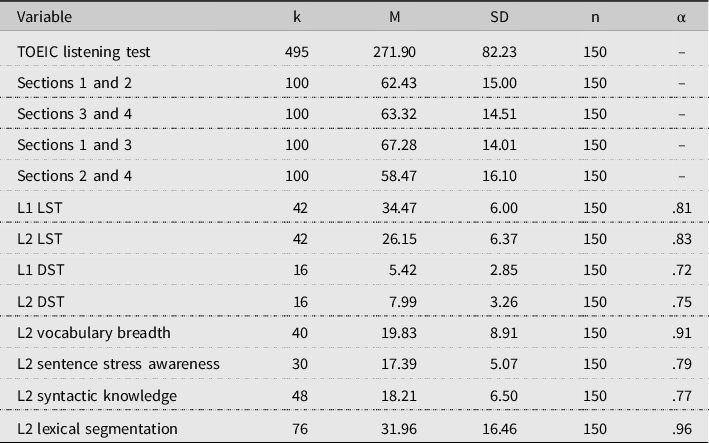
The descriptive statistics are presented in Table 1. TOEIC listening test forms are designed to measure the listening comprehension sub-skills identified in four sections. Sections 1 and 3 are associated with comprehension in shorter passages. Sections 2 and 4 are associated with comprehension in longer passages. Sections 1 and 2 are thought to reflect global comprehension in L2 listening, and sections 3 and 4 reflect literal comprehension in L2 listening. As seen in Table 1, sections 2 and 4 (comprehension in the longer passages) had the lowest percentages of correct answers. On the other hand, sections 1 and 3 (comprehension in the shorter passages) had the highest percentages of correct answers.
Descriptive statistics for scores on the variables

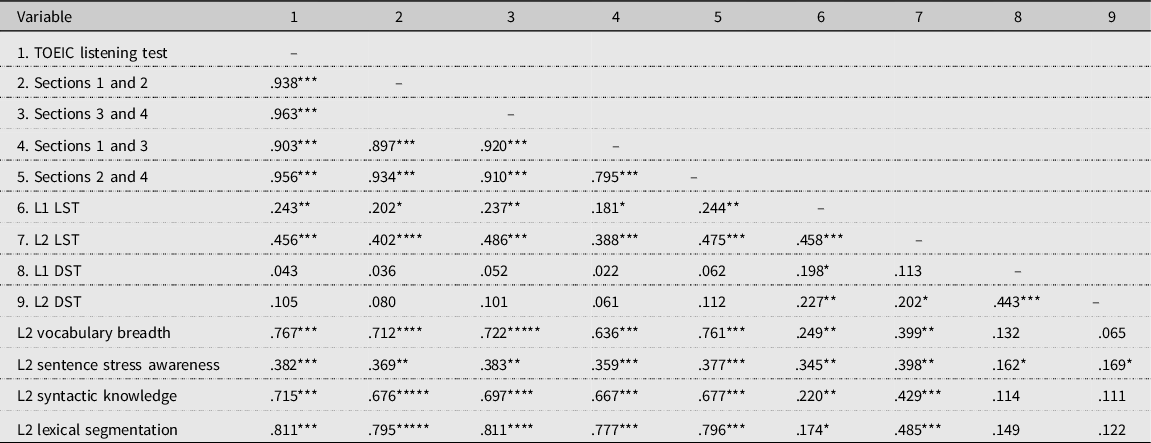
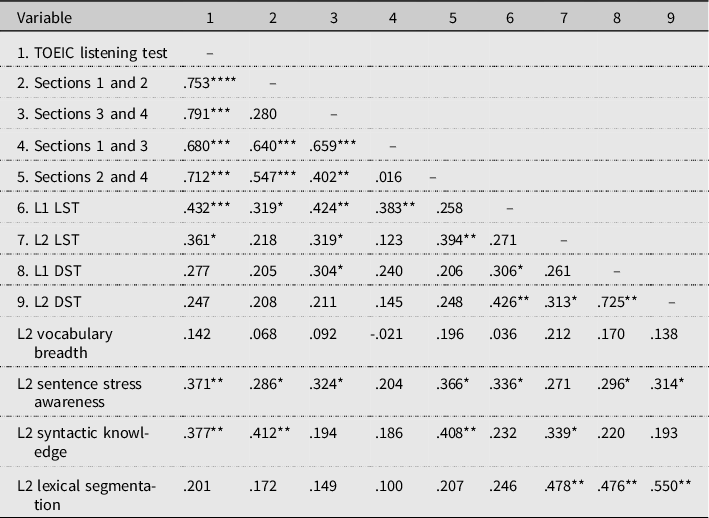
The correlations between the variables (see Table 2) indicate that scores for L1 and L2 WM capacity yielded significant correlations with scores for the TOEIC listening test performance and L2 linguistic knowledge.
Summary of correlations between the variables (n = 150)

Note. *p < .05, **p < .01, ***p < .001
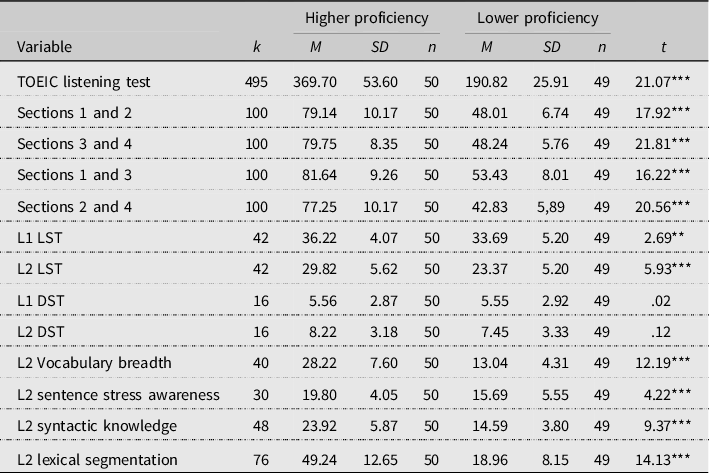
An important aspect of this study concerns the influence of L2 proficiency on the role of WM. To address this issue, based on their performance on the TOEIC listening test, the participants were then divided into three proficiency levels: higher (50 students who scored 300 and above), middle (51 students who scored between 230 and 295), and lower (49 students who scored 225 and below). In the present study, the higher group and the lower group were compared. Based on the TOEIC-CEFR level mapping provided by ETS, 30% of participants in the higher-proficiency group were at the CEFR B2 level, and the remaining 70% of participants were at the CEFR B1 level. On the other hand, all participants in the lower-proficiency group were at the CEFR A2 level. Table 3 shows the descriptive statistics for the higher-proficiency group and the lower-proficiency group. The results of t-tests showed significant differences in the mean scores of all the TOEIC listening test performances, L2 linguistic knowledge, and LSTs between the two groups. There were no significant differences in the mean DST scores between the two groups.
Descriptive statistics for scores on the variables in each proficiency group

Note. **p < .01, ***p < .001
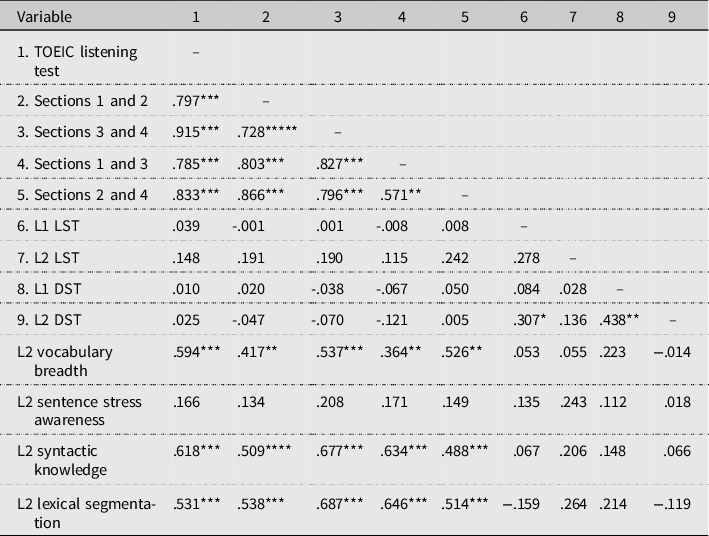
The correlations between the variables in each proficiency group are shown in Tables 4 and 5, respectively. There were some marked differences between the two sets of correlations. Most notably, the correlations between scores for L1 and L2 WM capacity and L2 listening performance in the lower-proficiency group were greater than the corresponding correlations in the higher-proficiency group. Similar patterns emerged for L2 lexical segmentation, L2 sentence stress awareness, and L2 syntactic knowledge.
Summary of correlations between the variables in the higher-proficiency group (n = 50)

Note. *p < .05, **p < .01, ***p < .001
Summary of correlations between the variables in the lower-proficiency group (n = 49)

Note. *p < .05, **p < .01, ***p < .001
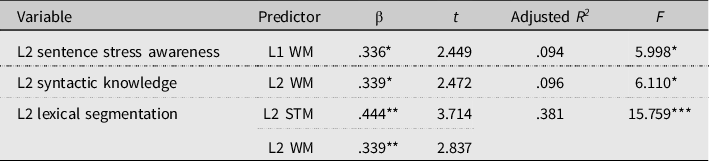
To identify the memory variables predictive of L2 linguistic knowledge in each proficiency group, multiple regression analysis was performed with scores for L2 linguistic knowledge as the dependent variables and scores for LSTs and DSTs as the independent variables in each proficiency group. Regarding the higher-proficiency group, neither LST nor DST scores were significant contributors to L2 listening comprehension and L2 linguistic knowledge. On the other hand, regarding the lower-level group, L1 LST scores accounted for 9.4% of the variance in scores for L2 sentence stress awareness. L2 LST scores accounted for 9.6% of the variance in scores for L2 syntactic knowledge. L2 DST and L2 LST scores accounted for 38.1% of the variance in scores for L2 lexical segmentation, as shown in Table 6.
Summary of regression analysis in the lower-proficiency group (n = 49)

Note. *p < .05, **p < .01, ***p < .001
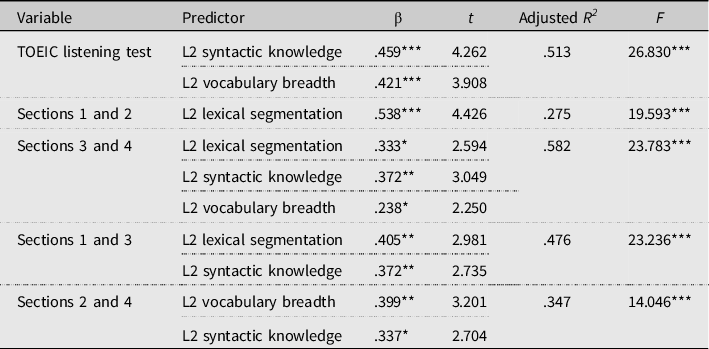
Next, multiple regression analysis was performed with scores for the TOEIC listening test performance as the dependent variables and LST scores and L2 linguistic knowledge scores as the independent variables in each group. In the higher-proficiency group, the regression results are presented in Table 7. In the lower-proficiency group, for further investigation of the role of WM in L2 listening comprehension after adjusting for the effects of L2 linguistic knowledge, a hierarchical regression analysis was performed. L2 linguistic knowledge variables were entered into the model in Step 1, and L1 and L2 WM capacity were entered in Step 2 using the stepwise method. The results are presented in Tables 8, 9, 10, 11, and 12 for the lower-proficiency group. Regarding the higher-proficiency listeners, L2 syntactic knowledge, L2 vocabulary knowledge, and L2 lexical segmentation were the significant predictors of L2 listening performance. On the other hand, L1 WM capacity was a significant predictor of TOEIC listening test scores, listening performance in sections 3 and 4 (literal comprehension), and listening performance in sections 1 and 2 (comprehension in the shorter passages), as shown in Tables 8, 10, and 11, respectively, for the lower-proficiency listeners.
Summary of regression analysis in the higher-proficiency group (n = 50)

Note. *p < .05, **p < .01, ***p < .001
Summary of hierarchical regression in the lower-proficiency group (n = 49): TOEIC listening test

Note. *p < .05, **p < .01
Summary of hierarchical regression in the lower-proficiency group (n = 49): Sections 1 and 2

Note. **p < .01
Summary of hierarchical regression in the lower-proficiency group (n = 49): Sections 3 and 4

Note. *p < .05, **p < .01
Summary of hierarchical regression in the lower-proficiency group (n = 49): Sections 1 and 3

Note. **p < .01
Summary of hierarchical regression in the lower-proficiency group (n = 49): Sections 2 and 4

Note. *p < .05, **p < .01
Discussion
RQ1 was to understand how the effects of L1 and L2 WM capacity on L2 listening comprehension and L2 linguistic knowledge operate differently across different L2 proficiency levels. The overall results of the present study showed that L2 WM capacity could be more strongly associated with L2 listening comprehension and L2 linguistic knowledge than L1 WM capacity, which is in some agreement with Miyake et al. (Reference Miyake, Friedman, Osaka, Healy and Bourne1998), who argued that L2 WM capacity is more directly related to L2 aural syntactic processing than L1 WM capacity. Furthermore, the correlations between both L1 and L2 WM capacity and L2 listening comprehension in the lower-proficiency group were greater than the corresponding correlations in the higher-proficiency group. The results lend support to Adams and Shahnazari-Dorcheh’s (Reference Adams and Shahnazari-Dorcheh2014) and Walter’s (Reference Walter2004) studies and suggest that the limited capacity of WM may affect L2 listening comprehension when their linguistic knowledge and processing skills are not efficient enough.
In the present study, L2 vocabulary knowledge, L2 syntactic knowledge, and L2 lexical segmentation were predictive variables for L2 listening comprehension in the higher-proficiency group, whereas L2 syntactic knowledge, L2 sentence stress awareness, and L1 WM capacity were significant variables in the lower-proficiency group. The results of the present study may provide some insight into how listeners at different proficiency levels process language. The relative significance of L2 vocabulary knowledge in the higher-proficiency group and that of WM capacity in the lower-proficiency group are both in line with Adams and Shahnazari-Dorcheh (2014) and suggest that L2 vocabulary knowledge may play a more important role than WM capacity in predicting L2 listening ability at higher-proficiency levels, and WM capacity can better predict L2 listening ability than L2 vocabulary knowledge at the beginner level. The finding that WM capacity may be more important for less proficient listeners than for more proficient listeners is in direct contrast to Hulstijin’s (Reference Hulstijn2015; Reference Hulstijn2019) language proficiency model and many existing studies (e.g., Andringa et al., Reference Andringa, Olsthoorn, van Beuningen, Shoonen and Hulstin2012; Vandergrift & Baker, Reference Vandergrift and Baker2015; Wallace, Reference Wallace2020) showing that linguistic knowledge is more predictive of L2 listening than WM. One explanation for the difference is the proficiency levels of the participants. In the present study, the participants in the lower-proficiency group were at the lower-intermediate level. Forming mental representations is a cognitively demanding task. Whereas more proficient listeners may automatically utilize the well-established mental representation of L2 texts, less proficient listeners are thought to focus on surface-level information and keeping it active in the phonological loop in WM due to the lack of automatized linguistic skills. They also need to devote more cognitive resources to engage in word-by-word processing of what they hear in each phase of listening than advanced-level listeners (Field, Reference Field2008; Vandergrift, Reference Vandergrift2004, Reference Vandergrift2007). In that case, WM capacity reflecting processing efficiency may affect listening performance for less proficient listeners. The WM capacity of the less proficient listeners may be taken up by controlled processes involved in L2 listening to a greater degree than that of the more proficient listeners. The difference in the role of WM capacity across proficiency levels can be understood to reflect different levels of automatization of linguistic decoding and syntactic processing involved in L2 listening comprehension. In addition, as Masrai (Reference Masrai2020) argues, WM capacity as measured by LSTs may tap measuring processing efficiency more closely related to listening comprehension than that as measured by forward and backward digit/word span task or a non-word recall task. Thus, the processing component of WM reflecting central executive attention is argued to be more important for lower-proficiency listeners when the more controlled nature of processes predominates in L2 listening comprehension.
Another explanation for the greater role of L1 and L2 WM in the lower-proficiency group than in the higher-proficiency group may partly be attributed to the nature of the L2 listening measure conducted in this study. Wallace (Reference Wallace2020) suggested that test formats that provide comprehension questions and answer options in written form require the participants to shift the attention focus from listening to reading and answering the questions. Over half of the items involved in the TOEIC listening test provide questions and answer options during the listening text, and this task characteristic may have attributed to the results that the central executive component of WM responsible for controlling attention is more important in the lower-proficiency group.
The nature of the link between L1 and L2 WM capacity and L2 listening comprehension in the lower-proficiency group may be explained by the correlations between L1 and L2 WM capacity and lower-level L2 linguistic variables in the group. The relative significance of L2 syntactic parsing skills and L2 sentence stress awareness in the lower-proficiency group is in line with Joyce (Reference Joyce2008) and Ma (Reference Ma2007) and suggests that L2 learners’ proficiency may affect the degree to which they utilized the prosodic features as well as the syntax to comprehend the spoken text in English in the Japanese and Korean EFL environment. In the present study, L2 WM capacity significantly correlated with L2 syntactic knowledge in the lower-proficiency group but not in the higher-proficiency group. Japanese and Korean are languages with an agglutinative syntactic structure in which the verb or adjectives always come at the end of the sentence. Due to the difference in the basic word order, lower-intermediate Japanese EFL learners with lower WM capacity may have shown more effects of syntactic complexity on WM capacity than those with higher WM capacity. Processing syntactically complex sentences may place a heavy load on WM systems, processing will slow down, and some linguistic information may be forgotten by less proficient listeners with lower WM capacity. This finding suggests that L2 WM capacity affects L2 syntactic parsing processing when the participants process the language less automatically due to their limited domain-specific linguistic knowledge.
Regarding the relationship between WM capacity and L2 lexical segmentation, the results of the present study showed that L2 storage capacity of WM accounted for 30% of the variance in L2 lexical segmentation, and an additional 10% was accounted for by L2 WM capacity in the lower-proficiency group. These results are not all that surprising because the measure for lexical segmentation was a partial dictation test that required the participants to listen, hold that information in their memory, and then write it down. The significant correlation between L2 WM capacity and L2 listening comprehension in the lower-proficiency group may correspond to that group experiencing higher demand on their WM systems in the process of the surface-level structure during L2 listening. A greater role of L2 WM capacity in perceptual processing in the lower-proficiency group may be attributed to the phonological difference between English and Japanese. Spoken English has much more phonological modification features than Japanese. Due to the reduction in words through elision, assimilation, or both in the spoken text, less proficient listeners can fail to recognize the word boundaries or listen for the important intonation groups in the text (Field, Reference Field2008). The significant correlation between L2 lexical segmentation and L2 WM capacity in the lower-proficiency group suggests that the less proficient listeners with lower L2 WM capacity may have shown the effects of uncertain decoding on the WM systems, then left fewer memory resources for interpreting what they heard and holding the information of what was said earlier than those with higher L2 WM capacity.
RQ 2 was concerned with whether the effects of WM systems on L2 listening comprehension were independent of language. In the present study, the results of the hierarchical regression analysis showed that L2 WM capacity was not a significant predictor of L2 listening comprehension in either group after the effects of L2 linguistic knowledge had been statistically removed. This finding was in accord with Ikeno (Reference Ikeno2006) and not in accord with Harrington and Sawyer (Reference Harrington and Sawyer1992). As Sagarra (Reference Sagarra and Han2008) argued, the L2 WM task conducted in this study might have measured a part of L2 proficiency in the case of the lower-level participants with limited L2 linguistic knowledge, or L2 WM capacity as measured by L2 LST and L2 lower-level processing skills might not be fully independent of each other. In the lower-proficiency group, the significant correlation between L2 WM capacity and L2 listening comprehension was likely to be mediated by the link between L2 WM capacity and L2 lexical segmentation. The task characteristic of the L2 phonological modification measure requires participants to process the segment of 2–6 words including specific phonetic features only once and retain the relevant portion for 10 s, where STM capacity would seem to play an important role. The L2 WM task (L2 LST) would similarly require participants to maintain the surface-level structure (the last word in each sentence) while performing the sentence verification task. The limited capacity of L2 verbal WM is assumed to be highly drawn upon for surface-level processing, with little spare capacity available for higher-level semantic and inferential processing for structure building in the lower-proficiency group (Chun & Payne, Reference Chun and Payne2004; Walter, Reference Walter2007). As Alptekin and Erçetin (Reference Alptekin and Erçetin2010) suggested, the domain-general constructs of L1 and L2 WM may share similar underlying cognitive resources for domain-general processing; however, some mechanisms of L2 WM responsible for processing surface-level structure may be domain specific or language specific.
In contrast, L1 WM capacity made the greatest contribution to the overall L2 listening comprehension, local comprehension in L2 listening, and comprehension in the shorter passages in the lower-proficiency listeners. It is a notable result that L1 WM capacity still accounted for significant variance in L2 listening comprehension even after adjusting for L2 sub-skill variables in the lower-proficiency group. The results suggest that L1 WM capacity might be related to L2 listening comprehension independent of L2 linguistic knowledge in the lower-proficiency group. The greater role of L1 WM in local comprehension in L2 listening aligns with Brunfaut and Revesz (Reference Brunfaut and Revesz2015) and suggests that local listening comprehension is more taxing for WM demands than global listening comprehension. Regarding lower-level listeners, local listening comprehension and even comprehension in the shorter passage may have been cognitively challenging and required them to allocate more WM resources to decode the surface-level information and leave fewer WM resources for integrating the information.
In this study, the correlations between the L1 (Japanese) and L2 (English) LSTs were found to be lower (r = .46) than that (r = .72) between L1 (Japanese) RST scores and L2 (English) RST scores reported in Osaka and Osaka (Reference Osaka and Osaka1992) with highly skilled L2 users. The processing of L2 is thought to share the same pool of WM resources as the processing of L1, at least in skilled or bilingual-level L2 users (Miyake et al., Reference Miyake, Just and Carpenter1994; Miyake & Friedman, Reference Miyake, Friedman, Healy and Bourne1998). However, as Sagarra (Reference Sagarra and Han2008) argued, the L2 WM task conducted in the present study may have placed a heavy task demand on the less proficient listeners because of their limited linguistic knowledge. LSTs involve syntactic and semantic processing and the retrieval of language-specific information, such as phonemes and words from the LTM, and the process is less efficient in L2 than in L1, especially for lower-level L2 users. The difference provides suggestive evidence that the WM systems used for linguistic processing and retrieving the relevant information from the LTM are language specific or domain specific. This finding is in line with the study by Alptekin et al. (Reference Alptekin, Erçetin and Özemir2014) and suggests that the relationship between WM and L2 listening may be affected by the language the task is given at the lower-intermediate level of proficiency. In the lower-proficiency group, it is likely that the high-span individuals outperformed the low-span individuals during L2 listening because of domain-general cognitive abilities rather than domain-specific linguistic knowledge. Using this line of argument, the individual differences in L1 LST performance among the lower-proficiency listeners may have reflected the domain-general processing component of WM more precisely than those in L2 LST performance.
With regard to the relationship between L1 WM capacity and L2 linguistic knowledge, the results of the study showed that L1 WM capacity accounted for 9.4% of the variance in L2 sentence stress awareness. The suprasegmental aspects of English sound systems such as rhythm, stress, and intonation are different from those of Japanese. Moreover, due to subject and/or object omissions in Japanese sentences, Japanese listeners are used to relying on the context and keywords in the spoken text to comprehend the message. Less proficient listeners are thought to devote more cognitive resources to direct attention to the stressed words in the spoken text to utilize them as an important tip in the process of perceiving the message about what they are listening to than proficient listeners (Field, Reference Field2008). In the present study, the lower-proficiency listeners with lower L1 WM capacity could have failed to allocate their attentional resources in the WM to the words that were pronounced slightly longer, louder, clearer, or higher than the other words in the sentence efficiently than those with higher WM capacity. While L2 WM capacity is highly related to language-specific processing, such as L2 perceptual or syntactic parsing processing, during L2 listening in the less proficient listeners, the independent contribution of L1 WM capacity to L2 sentence awareness as well as overall L2 listening comprehension seems to be attributable to the difference in the domain-general ability to control attention between high-span and low-span listeners when they have limited L2 linguistic knowledge. This finding fits well with the controlled attention theory of WM (Colflesh & Conway, Reference Colflesh and Conway2007; Engle & Kane, Reference Engle, Kane and Ross2004; Kane et al., Reference Kane, Bleckley, Conway and Engle2001) and suggests that the domain-general WM component associated with the ability to focus attention and resist interference to meet demanding task goals may play a greater role in listening task performance only when the tasks place greater demands on executive attention.
Considering these findings, the L1 and L2 WM systems could be functionally separate in less proficient listeners. The variance shared by L1 WM capacity and L2 listening may be different from that shared by L2 WM capacity and L2 listening for these listeners. The relationship between L1 WM capacity and L2 listening comprehension may reflect the processing efficiency reflecting central executive attention. In summary, L1 WM capacity may contribute to L2 listening comprehension as a general cognitive factor independent of L2 linguistic knowledge at the lower-intermediate level of L2 proficiency.
In the present study, WM capacity did not strongly correlate with the storage capacity of WM as measured by DSTs, even though the scores for the two DSTs were highly correlated with one another. It should be noted that L1 and L2 digit span tasks conducted in the present study may have measured the same resources that tap temporary storage of incoming input. The hybrid model of WM proposed by Baddely and Logie (Reference Baddeley, Logie, Miyake and Shah1999) may account for the obtained correlation pattern. Based on their model, Jincho et al. (Reference Jincho, Namiki and Mazuka2008) argued that the correlation between WM capacity and the storage capacity of WM reflects the shared phonological loop because DSTs involve rehearsal of digits, which is done in the phonological loop. Jincho et al. argued that the relationship between WM and the storage capacity of WM would be weak if individual differences in WM capacity mainly arise from the central executive component of WM. Jincho et al. also suggested that complex WM tasks are sensitive to individual differences in central executive functions but not to those in simple storage functions. These explanations may account for the very low correlation between the scores for LSTs and DSTs obtained in the present study. On the other hand, the scores for both L1 and L2 DSTs were significantly correlated with L2 sentence stress awareness, and the scores for L2 DST accounted for significant variance in L2 lexical segmentation in the lower-level group. The results, therefore, suggest that the storage capacity of WM plays a role in storing incoming information, such as stressed words in the spoken narrative for the lower-level group.
Limitations of the study and suggestions for future research
The present study is not without limitations. The first limitation concerns the validity of test scores generated by multiple-choice tests. Thus, the findings of the present study should be considered exploratory. Second, to further investigate the direct or indirect effects of WM capacity on L2 linguistic knowledge and L2 listening comprehension, more advanced statistical procedures such as factor analysis need to be used with a larger sample size.
The nature of the WM systems underlying L2 listening processing will be one of the important issues for future studies. It would be meaningful to investigate what specific components of WM influence L2 listening processing across different proficiency levels. Future studies might examine the relationships between WM capacity and specific cognitive abilities such as attention control, information processing efficiency, and inhibition control in relation to L2 listening comprehension.
Conclusion
The findings of the current study demonstrate that the relationship between WM and L2 listening comprehension may differ across language proficiency levels and not be fully language independent. One interesting finding is that L1 WM capacity could be associated with L2 listening comprehension only when the listening task requires conscious attention in less proficient listeners due to their less automatized linguistic knowledge. In this light, the availability of WM resources arguably influences more specific aspects of L2 processing based on the proficiency of L2 learners. In conclusion, the results of the study highlight a greater role for WM in the controlled processing rather than the automatic processing involved in L2 listening.
WM capacity for language may be one of the important components of L2 learning and use. Miyake and Friedman (Reference Miyake, Friedman, Healy and Bourne1998) argued that WM is associated with the three components of language aptitude suggested by Skehan (Reference Skehan1989), language analytic capacity, memory ability, and phonetic coding ability, and suggest that it may be the key underlying components of language learning aptitude. Examining L2 proficiency from the perspective of WM may specify the exact role of WM in different aspects of L2 learning and use.
Acknowledgements
I am grateful to the editors and the anonymous reviewers for their insightful comments and constructive feedback for improving this article.
Appendix A. Sentences used in the LST
Examples from the Japanese version of the LST
2–sentence condition
2–1 右手でチョキをり手でパーをるとられている手のは2となる (F)
2–2 電話はをにしてれた手にえるものでもある(T)
Target words: 右手、電話
Examples from the ESL version of the LST
2–sentence condition
2–1 March is the month that is the third of the year. (T)
2–2 Mathematics is a subject in which students take lessons at a gym. (F)
Target words: year, gym
Appendix B. Examples from the DST
Examples from the ESL version of the DST
Stage 1
1) 1–8–4–6–3
Examples from the Japanese version of the DST
Stage 1
1) 6–2–9–4–8–1–7
Appendix C. A passage used in the lexical segmentation test
Example from the dictation sheet
I’ll come and pick you up in a couple of hours.
How would you like to have dinner with me tonight? (p. 276)
Appendix D. L2 vocabulary breadth test
Examples of the test items

Appendix E. L2 syntactic knowledge test
Examples of test items
Example A
Cue sentence: Who brought Bill his lunch today?
Options:
-
a. His sister is.
-
b. His sister did.
-
c. To his sister.
-
d. His sister had.
Example B
Cue sentence: Laura will sing, and Kathy will sing, too.
Options:
-
a. Both of them will sing.
-
b. Only Laura will sing.
-
c. Neither of them will sing.
-
d. Only Kathy will sing.
Appendix F. L2 sentence stress awareness test
Examples of the test items
Directions: You will hear many sentences. In each sentence, one word is emphasized or stressed more than the other words. This means that the word may be pronounced slightly longer, louder, clearer, or higher than the other words. You need to choose the word with this main stress.