Introduction
Solid quantitative knowledge of temporal and spatial distribution patterns of arthropod pests and their natural enemies is a prerequisite for the development and implementation of efficient and sound control measures, whether chemical or biological (Taylor, Reference Taylor1984; Wilson et al., Reference Wilson, Sterling, Rummel, DeVay, Frisbie, El-Zik and Wilson1989; Onzo et al., Reference Onzo, Hanna, Sabelis and Yaninek2005). This should be based on the response of pest and natural enemy populations to local environments, their spatial coincidence (Greco et al., Reference Greco, Liljeström and Sánchez1999) and their natural history and habitat requirements (Murdoch and Briggs, Reference Murdoch and Briggs1996).
Eteoryctis gemoniella is a microlepidopteran species of the family Gracillariidae. It was first reported in West Bengal, India and described by Stainton in 1862 as Gracilaria gemoniella, n. sp. (De Prins and De Prins, Reference De Prins and De Prins2014). This species was reported for the first time in Benin in 2009 as the most devastating leafminer that infests cashew trees throughout the cashew growing areas of the country (Agboton et al., Reference Agboton, Onzo, Ouessou, Goergen, Vidal and Tamò2014). This record was probably also the first for the species on the African continent. Eteoryctis gemoniella leafminer attacks cashew trees throughout its vegetative growth period, especially when the tree is producing new shoots and leaves.
A congeneric species, Eteoryctis syngramma Meyrick (Syn: Acrocercops syngramma Meyrick Gracillariidae) was reported mining cashew leaves in India, Hong Kong, Indonesia and Thaïland (Abraham, Reference Abraham1958; Kuroko and Lewvanich, Reference Kuroko and Lewvanich1983; Sundararaju, Reference Sundararaju1984; Vanitha et al., Reference Vanitha, Bhat and Raviprasad2015). Eteoryctis syngramma has also been reported in several cashew orchards in other countries in West Africa (Asogwa et al., Reference Asogwa, Hammed and Ndubuaku2008; Mokwunye et al., Reference Mokwunye, Hammed, Ndubuaku and Asogwa2012). During their surveys, Agboton et al. (Reference Agboton, Onzo, Ouessou, Goergen, Vidal and Tamò2014), encountered E. gemoniella in Benin only on cashew trees, whereas in India, E. syngramma was reported to have a wider range of host-plant species in the families Anacardiaceae (such as Anacardium occidentale, Lannea coromandelica (Houtt.) Merril and Semecarpus anacardium Linn.) and Sapotaceae (such as Achras sapota L. (Chikoo) syn. Manilkara zapota (L.) P. Royen, Madhuca latifolia (L.) and Madhuca indica J. F. Gmel syn. Bassia latifolia (Roxb.)) (De Prins and De Prins, Reference De Prins and De Prins2014).
Eteoryctis gemoniella belongs to the family Gracillariidae that includes several economically important pest species (De Prins and De Prins, Reference De Prins and De Prins2014). Like other gracillariid larval stages, E. gemoniella larvae display internal feeding habits, mostly on leaf tissues under the epidermis. The adult female moth is nocturnally active and lays eggs on young and tender cashew leaves. The eggs are translucent and whitish in colour and resemble tiny water droplets. Once the eggs hatch, the young caterpillar starts boring into the epidermal layer of the upper surface of the cashew leaf. This results in the formation of mines in which the larvae feed and develop. The mine has the appearance of a blotch on the upper surface of the tender cashew leaf. Mines can vary in size and shape, and are usually greyish-white in colour and enclose dark grains of frass excreted by the feeding of the larva (C. Agboton, personal observation; Vanitha et al., Reference Vanitha, Bhat and Raviprasad2015). Affected leaves become necrotic and dry, dropping off before reaching maturity. This results in a serious reduction of the most photosynthetically active leaf area, consequently impacting overall tree productivity.
Although quantitative data on nut yield losses caused by this pest are unavailable, the serious damage inflicted on cashew trees over growing season deserves attention and calls for the need to explore efficient control strategies. Chemical control of leafminers is, in general, extremely difficult, as larvae hide inside the leaf epidermis and are therefore relatively well protected against pesticides. In such conditions, only systemic insecticides might provide effective control (MFFP, 2003). Biological control of leafminers through the activity of hymenopteran parasitoids is a much more sustainable management approach and has been successfully implemented on a range of pests and crops, such as the citrus leafminer Phyllocnistis citrella Stainton (Lepidoptera: Gracillariidae) in the USA (Legaspi et al., Reference Legaspi, French, Schauff and Woolley1999; Zhao et al., Reference Zhao, Wright and Prokopy2002; Diez et al., Reference Diez, Pena and Fidalgo2006), the oak leafminers Phyllonorycter leucocorona (Kumata), Phyllonorycter persimilis Fujihara Sato & Kumata, and Caloptilia sapporella (Matsumura) (Lepidoptera: Gracillariidae) in Asia (Nakamura et al., Reference Nakamura, Hattori, Ishida, Sato and Kimura2008), and more recently, the cashew leafminer A. syngramma in India (Vanitha, Reference Vanitha2015).
Whereas, the pest status of E. gemoniella in Benin is known (Agboton et al., Reference Agboton, Onzo, Ouessou, Goergen, Vidal and Tamò2014), quantitative data are lacking on the spatio-temporal fluctuations of its population and on the presence of local natural enemies (e.g. parasitoids) in cashew orchards. Also, data on the responses of these insect species to local environments, on the spatial coincidence of the pests and their natural enemies are lacking. In anticipation of developing a biological control approach against this leafminer, it is important to collect these baseline ecological data.
In the present study, we quantify the spatial and temporal dynamics of a microlepidopteran leafminer on cashew trees (A. occidentale L.) under different abiotic conditions in northern Benin, to improve our understanding of the population dynamics of the pest and of its indigenous natural enemies (focusing on hymenopteran parasitoids) and for developing a viable control strategy for this pest. The system explored here consists of the cashew leafminer E. gemoniella Stainton (Lepidoptera: Gracillariidae) and the parasitoid species encountered on cashew trees in northern Benin.
Materials and methods
Study sites
The most suitable area for cashew nut production in Benin is located between latitude 7°10N (i.e. Abomey area in the south) and latitude 10°25N (i.e. the Natitingou-Gogounou area in the north). The Benin cashew belt includes the provinces of Atacora, Donga, Alibori, Borgou, Collines and Zou (INRAB, 2005). The present study was conducted in three cashew orchards located: (1) near the village of Okoutaossé (8°34.173N, 1°41.759E, 269 masl) District of Bantè (Province of Collines); (2) near the village of Korou (8°54.375N, 2°33.736E, 336 masl) about 5 km northwest of Tchaourou (Province of Borgou); and (3) at about 6 km east of N'Dali (9°56.053N, 2°45.186E, 383 masl) alongside the Nikki road (Province of Borgou). The three orchards fall within the Northern Guinea Savannah (NGS) zone that is characterized by a unimodal rainfall pattern that begins in mid-May and ends in October. Long-term average precipitation in this region ranges between 900 mm and 1200 mm (INRAB, 1996). Rainfall data collected at N'Dali were used to characterize the cashew orchard in N'Dali, rainfall data collected at Tchaourou were used for the cashew orchard in Korou, and rainfall data collected at Bantè were used for the cashew orchard in Okoutaossé. The three orchards shared the same characteristics. Each orchard had 6–12 year-old trees, an area of at least one ha, and was accessible throughout the experimental period. In each orchard, cashew trees were planted at a spacing of 6–10 m, between plants and rows, with neither fertilizer nor chemical insecticide applications.
Data collection and analysis
Each orchard was divided into three blocks containing at least 30 cashew trees each. Ten trees were selected at random in each block at three-week intervals. On each tree, eight new shoots bearing at least five young leaves were collected at equal spacing all around the tree canopy. Young shoots were hand-picked and put into paper bags (one bag per tree) and brought to the laboratory. In the laboratory, shoots were examined, leaf-by-leaf, under a dissecting microscope (WILD M3B) for the presence of the leafminer (Diez et al., Reference Diez, Pena and Fidalgo2006). The numbers of mines per leaf, larvae per leaf and pupae per leaf were recorded. Sampling lasted from September 2010 to August 2011.
In addition, 50 cashew leaves containing leafminer larvae, pupae or mummies were collected per block, and kept in transparent plastic boxes (20 cm diameter, 13 cm height) lined at the bottom with moistened cotton wool. To reduce larval mortality, water was added to the cotton daily to maintain leaf turgidity and high humidity inside the boxes. Holes were cut in the lid of each plastic box and covered with fine mesh (0.1 mm) to allow air to circulate. Boxes were kept under ambient conditions (mean 27.83 °C, 79.21% RH) in the laboratory. Observations were made daily until emergence of all adult insects (adult leafminers and parasitoids). Emerged parasitoids were identified at the IITA-Benin Biodiversity Resource Centre and their number counted.
A cashew tree was considered infested by E. gemoniella when it displayed mined leaves. Infestation rates were estimated using the formula
 $$\begin{equation*}
(Ni/N) \times 100,
\end{equation*}$$
where Ni represents the number of infested trees and N the total number of cashew trees that were inspected in each block. Variables calculated for characterizing the infestation of a sampled cashew orchard included: infestation rate (which is related to the infested trees), mean number of mines per young leaf, proportion of mined young leaves (which represented the number of cashew leaves with at least one mine over the total number of leaves inspected), mean number of larvae per leaf and mean number of pupae per leaf. These data were compared among the three study sites by ANOVA. Data on proportions were transformed using the arcsine square root transformation; whereas count data were transformed using log10(x+1) before their use in the statistical analyses. When ANOVA revealed significant differences among sites, site means were separated using the Student–Newman–Keuls (SNK) multiple range test. Furthermore, to determine whether there were any relationships between mean infestation rate and mean number of mines per leaf, between infestation rate and proportion of mined leaves and between mean number of mines per leaf and proportion of mined leaves, Spearman correlation analyses were performed for each orchard.
Between-tree distribution of E. gemoniella in cashew orchards
The spatial distribution patterns of E. gemoniella were quantified using Taylor's power law (Taylor, Reference Taylor1961), a commonly used aggregation index based on the relationship between mean density and its corresponding variance, and expressed with the following mathematical relationship:
 $$\begin{equation*}
{S^2} = a{x^b}
\end{equation*}$$
where S2 is sample variance, x is sample mean and a and b are estimated coefficients of aggregation.
Both a and b are considered characteristic of a population: a is a sampling factor and depends on sample size, while b is a measure of dispersion or aggregation (Southwood, Reference Southwood1978) and is considered an intrinsic property of the organism. Values of b > 1, b = 1, and b < 1 indicate aggregated, random and regular distributions, respectively (Taylor, Reference Taylor1961). The b coefficient is species-specific and is a measure of the density dependence of aggregation (Taylor, Reference Taylor1984). Taylor's coefficients were determined by the number of mines per leaf for data from each experimental site and for pooled data from the three orchards sampled.
Effects of rainfall patterns on the population dynamics of E. gemoniella
To determine the effects of rainfall on the population dynamics of E. gemoniella in cashew orchards, the relationship between monthly rainfall and both monthly E. gemoniella infestation rates and monthly mean number of mines per leaf were determined using regression analysis. The regression between the number of rainy days per month, monthly E. gemoniella infestation rates and monthly mean number of mines per leaf were analysed. Because E. gemoniella infestation may occur after a threshold of total rainfall, the regression analysis was done between cumulative rainfall data (from 1st January until the sampling day) and monthly E. gemoniella infestation rates (as well as monthly mean number of mines per leaf).
Statistical analyses
R statistical software was used to compute Spearman's rank correlation coefficients, for time series-analysis, to identify patterns in the sequence of the infestation rates over time (R Development core team, 2008). Aggregation indexes were determined using SAS (2009; Proc Reg). All other statistical analyses were performed in SAS (SAS, 2009).
Results
Infestation of cashew orchards by E. gemoniella
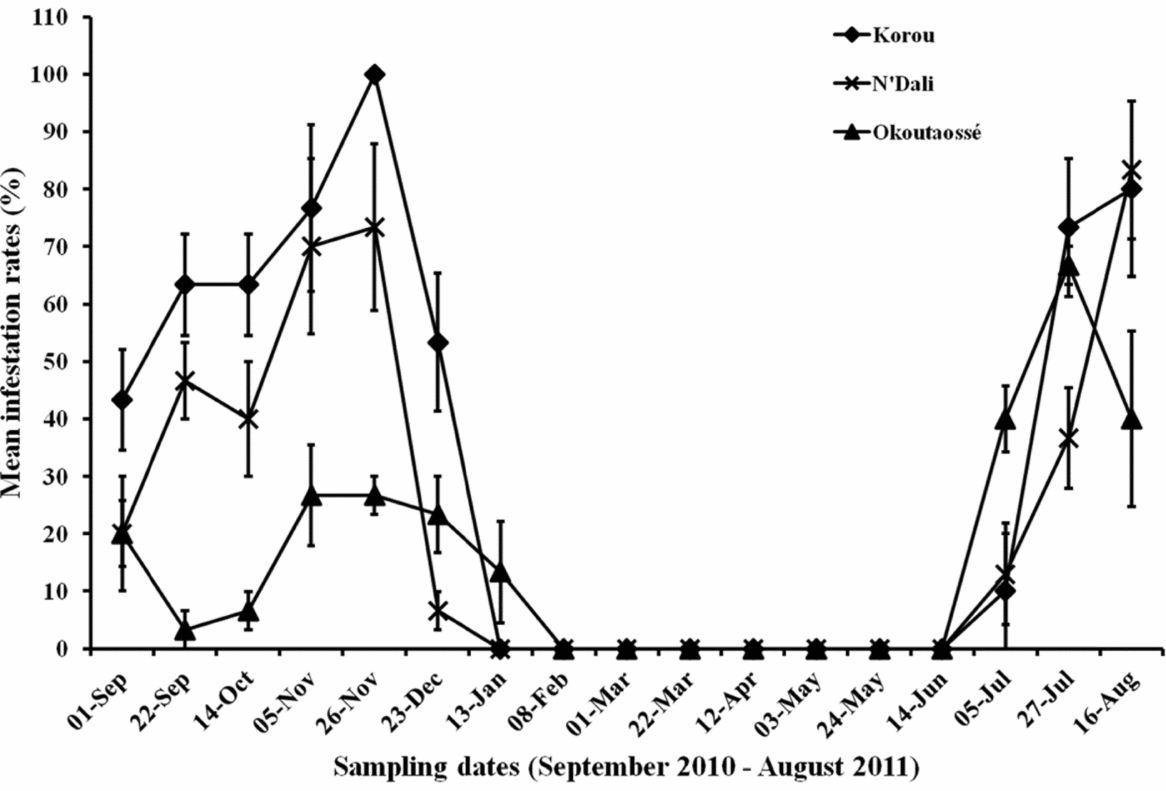
Fig. 1 shows the fluctuations of the infestation rates by E. gemoniella in the three cashew orchards. The general trend was similar for each of the sites, with an increase of the infestation rates from September to a peak in November and decreasing progressively until January. Infestation rates increased again from June onwards until the last sampling day in August.
Infestation rates of E. gemoniella differed significantly among the three study sites (df = 2, F = 5.57, P = 0.0053). The SNK multiple range test showed that the overall infestation rate was highest at Korou and lowest at Okoutaossé, with a significant difference between these two sites.
Seasonal pattern of Eteoryctis gemoniella infestation rates (mean ± standard error) in the three cashew orchards sampled

Fluctuations of E. gemoniella densities in the three cashew orchards
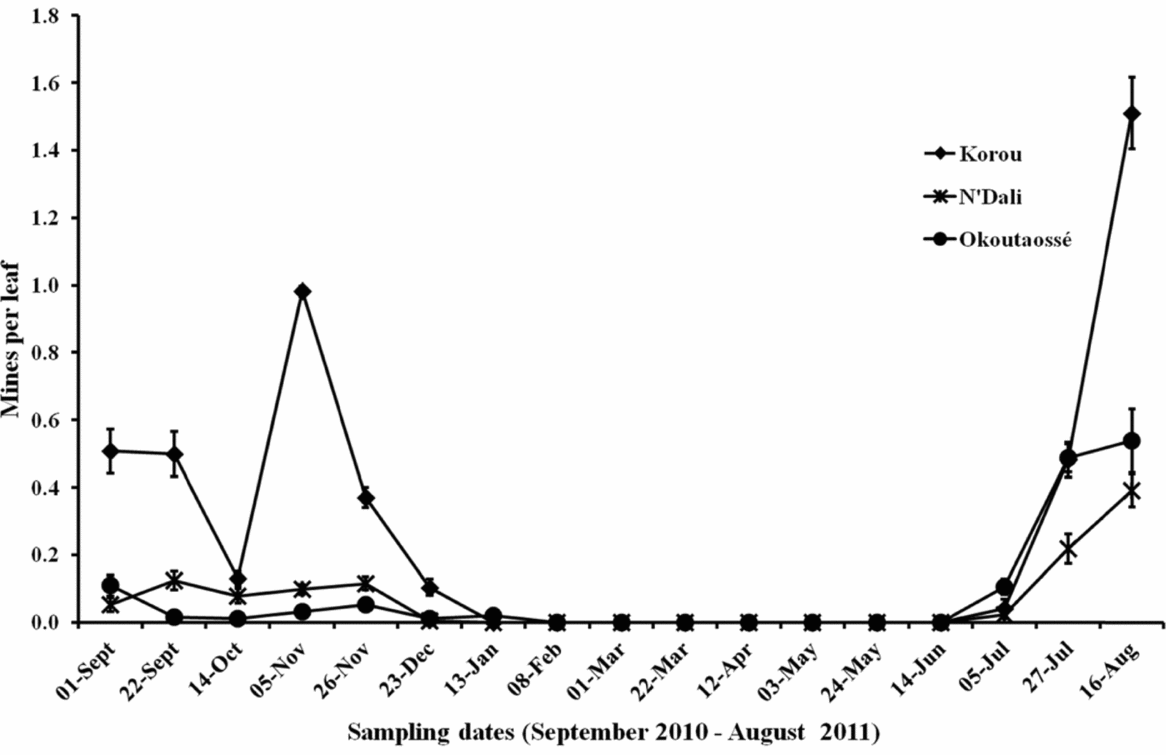
Number of mines per leaf: The spatio-temporal fluctuations of the number of mines per leaf at the three orchards sampled are presented in Fig. 2. At Korou, the number of mines per leaf decreased from September to October and increased to reach a peak in November. This number then decreased to zero from January to June. From July, the number of mines per leaf increased again until the end of the sampling period in August. At this site, the number of mines per leaf varied from 0 to 9, averaging (mean ± standard-error) 0.32 ± 0.01 mines per leaf.
Seasonal fluctuations of the number of Eteoryctis gemoniella mines per cashew leaf (mean ± standard error) in the three cashew orchards sampled

The fluctuation trend was almost similar for N'Dali and Okoutaossé with the number of mines per leaf varying from 0 to 7, averaging (mean ± standard-error) 0.10 ± 0.007 at N'Dali and from 0 to 6, averaging (mean ± standard-error) 0.10 ± 0.008 at Okoutaossé.
The number of mines per leaf differed significantly among the three sites (df = 2, F = 138.74, P<0.0001). The SNK multiple range test showed that average number of mines per leaf was significantly higher at Korou than at any of the other two sites; however, there were no significant differences between N'Dali and Okoutaossé.
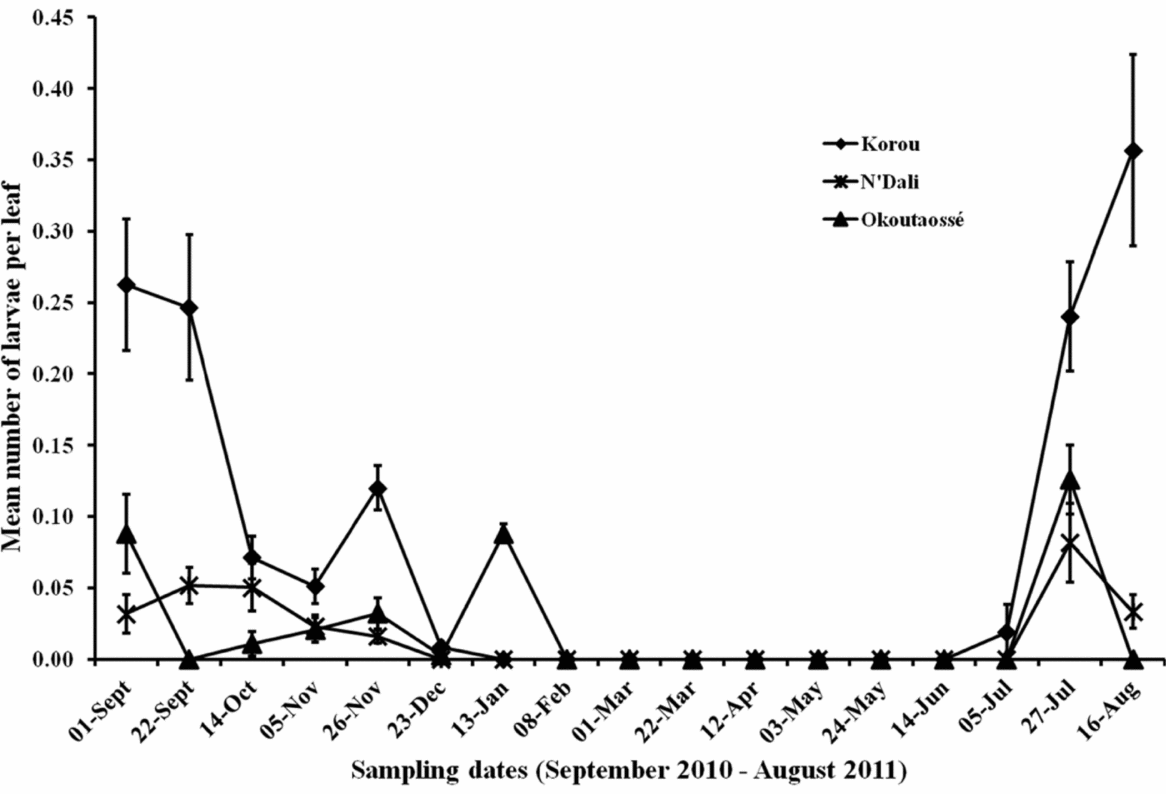
Number of larvae per leaf: The general trend of fluctuations of E. gemoniella larvae per leaf (Fig. 3) showed a progressive decrease in numbers from September to January, except for a peak late November at Korou and mid-January at Okoutaossé. The number of larvae per leaf increased at all sites from July to August, but with major intensity at Korou where it reached a peak of 0.356.
Seasonal fluctuations of the number of Eteoryctis gemoniella larvae per cashew leaf (mean ± standard error) in the three cashew orchards sampled

Number of larvae per leaf showed a significant difference among the three orchards studied (df = 2, F = 88.84, P<0.0001). The SNK multiple range test showed that the number of larvae per leaf was significantly higher at Korou than at N'Dali and Okoutaossé, whereas the number of larvae per leaf was not statistically different between N'Dali and Okoutaossé.
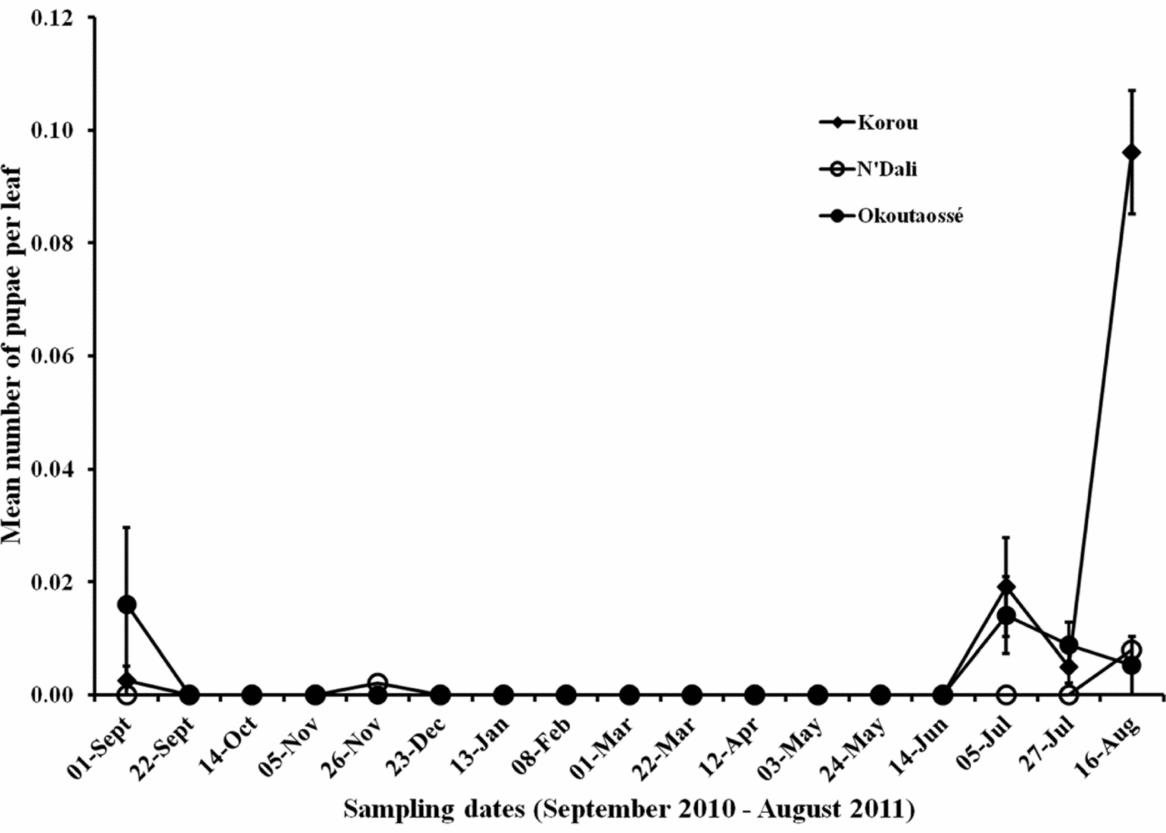
Number of pupae per leaf: The fluctuation of the number of pupae per leaf was also similar at the different sites (Fig. 4), with low occurrences in September, and rapidly decreasing to zero values until June. At N'Dali, however, we observed a slight increase at the end of November, while the highest value was observed at Korou in August at the end of the sampling period.
Seasonal fluctuations of the number of Eteoryctis gemoniella pupae per cashew leaf (mean ± standard error) in the three cashew orchards

Numbers of pupae per leaf showed significant differences among the three orchards (df = 2, F = 5.02, P = 0.0067). There were no differences between N'Dali and Okoutaossé. In contrast, the number of pupae per leaf was significantly higher at Korou compared to the other two sites.
Parasitoid species associated with E. gemoniella
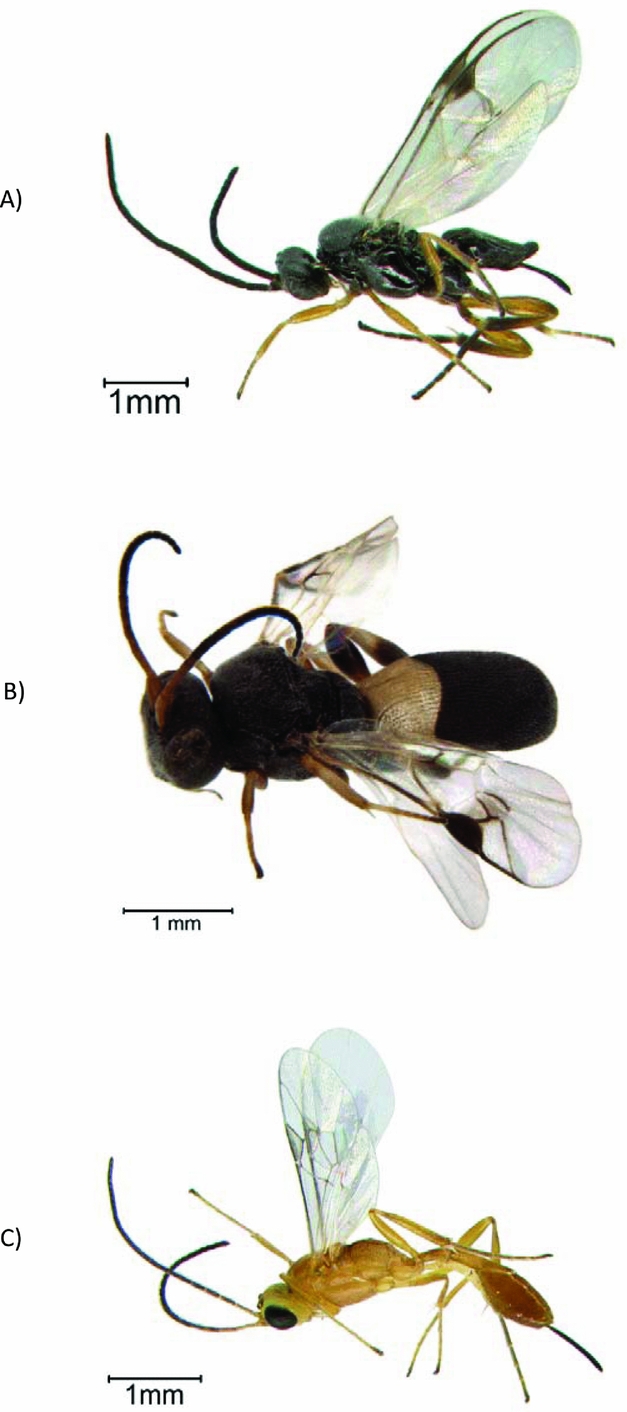
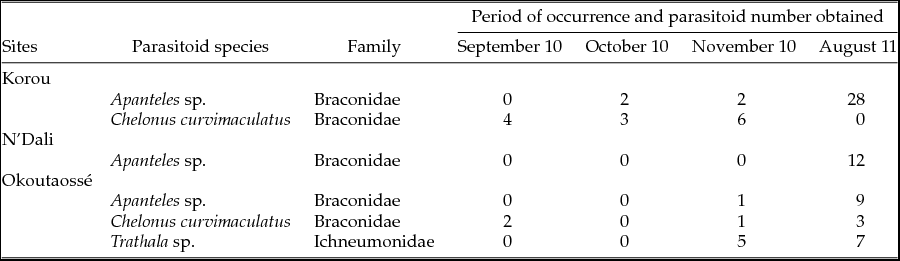
Three parasitoid species were found associated with E. gemoniella. They were: Apanteles sp. (Hymenoptera: Braconidae), Chelonus (Microchelonus) nr. curvimaculatus Cameron (Hymenoptera: Braconidae) and Trathala sp. (Hymenoptera: Ichneumonidae) (Plate 1). Only one species Apanteles sp. was observed at N'Dali, two species Apanteles sp. and C. nr. curvimaculatus were observed at Korou, while all three parasitoid species were encountered at Okoutaossé. Apanteles sp. however was collected at N'Dali on one single occurrence in August 2011. Although, observations were carried out at three-week intervals over the entire year, parasitoid species were only observed during the months of August through November (Table 1).
Photographs of parasitoid species associated with the leafminer Eteoryctis gemoniella encountered in cashew orchards in Benin: (A) Apanteles sp., (B) Chelonus (Microchelonus) nr. curvimaculatus, (C) Trathala sp.

Parasitoid species recorded on cashew leafminer in cashew orchards near three villages in the Benin cashew belt (Korou, N'Dali, Okoutaossé) and parasitoid number obtained from incubation of 50 mined leaves (September 2010 to August 2011) in Benin, West Africa.

Spatial distribution of E. gemoniella
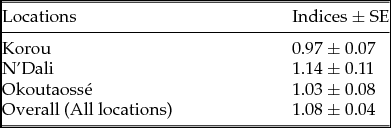
Taylor's aggregation indices calculated based on the number of mines per leaf at Korou, N'Dali and Okoutaossé were 0.97, 1.14 and 1.03, respectively (Table 2). When the three sites were pooled, the overall Taylor's aggregation index was equal to 1.08, which suggests that E. gemoniella had an almost random between-leaf distribution pattern in the cashew orchards sampled.
Taylor's aggregation indices for the number of Eteoryctis gemoniella mines in cashew orchards near three villages in the Benin cashew belt (Benin, West Africa).

Effects of rainfall patterns on the population dynamics of E. gemoniella
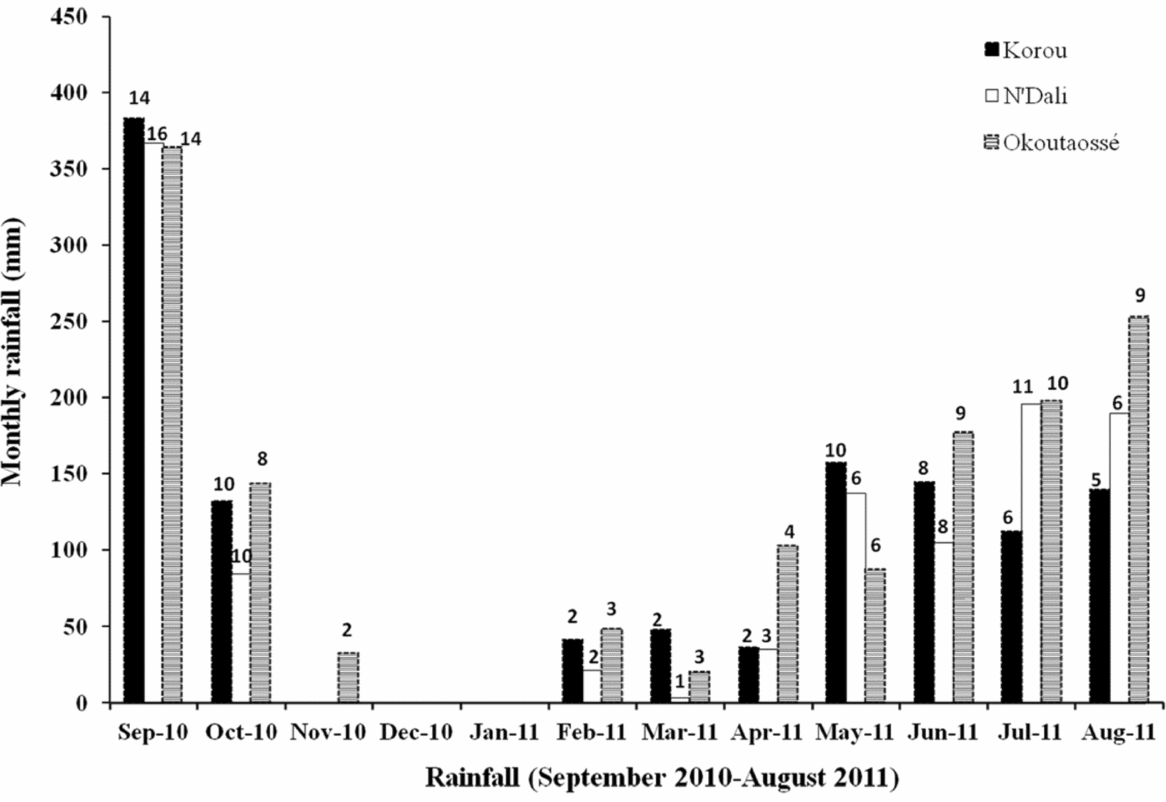
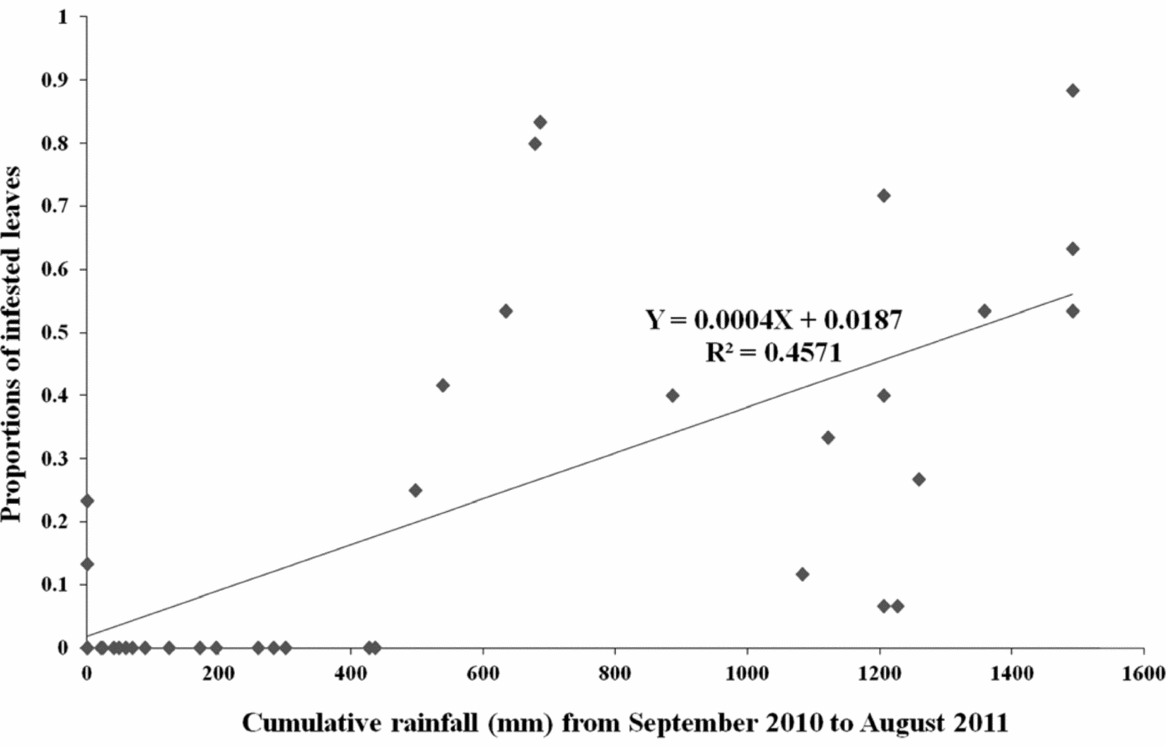
Monthly rainfall patterns at the three orchards are presented in Fig. 5. Comparisons of both rainfall and number of rainy days among the three orchards using analysis of variance failed to reveal any significant differences (P>0.50). Linear regressions between the monthly rainfall and E. gemoniella infestation rates and between the mean number of rainy days and E. gemoniella infestation rates failed to reveal any significant relationships for any of the three cashew orchards (P>0.05). With regards to total rainfall and number of rainy days (1193.5 mm and 59 days at Korou, 1137.0 mm and 63 days at N'Dali and 1426.7 mm and 68 days at Okoutaossé), cumulative rainfall had a significantly positive relationship with pooled monthly E. gemoniella infestation rates (r 2 = 0.46, slope = 0.0004, P<0.0001; Fig. 6). A significantly positive relationship was also observed separately for Korou (r 2 = 0.71, slope = 0.0005, P=0.0006) and N'Dali (r 2 = 0.41, slope = 0.0004, P=0.025) while this was not the case at Okoutaossé (r 2 = 0.13, slope = 0.0001, P=0.246). The regression between cumulative rainfall and monthly mean number of mines per leaf was not significant for any of the three orchards, even when data were pooled (P>0.05). Regressions between the number of rainy days and either E. gemoniella infestation rates or monthly number of mines per leaf also were not significant (P>0.05).
Rainfall pattern in the three cashew orchards sampled. Number on top of bar indicates number of days with rain during the month.

Relationship between cumulative rainfall and monthly Eteoryctis gemoniella infestation rates using pooled data for the three orchards. The line represents a linear regression equation with intercept = 0.019, slope = 0.004 and R 2 = 0.46 (df = 35; F = 28.62; P<0.0001).

Relationships between variables describing infestation of cashew orchards by E. gemoniella
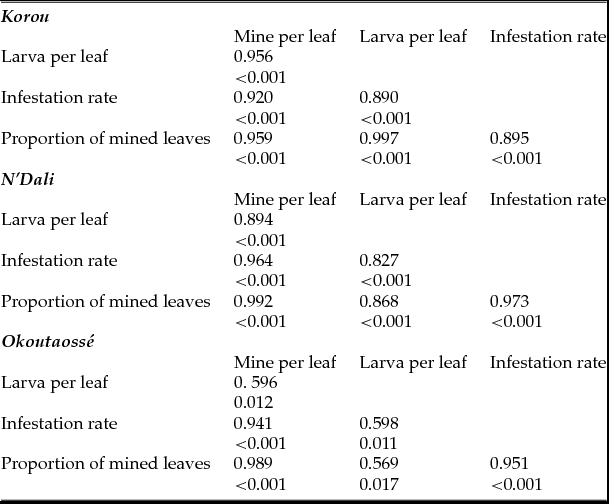
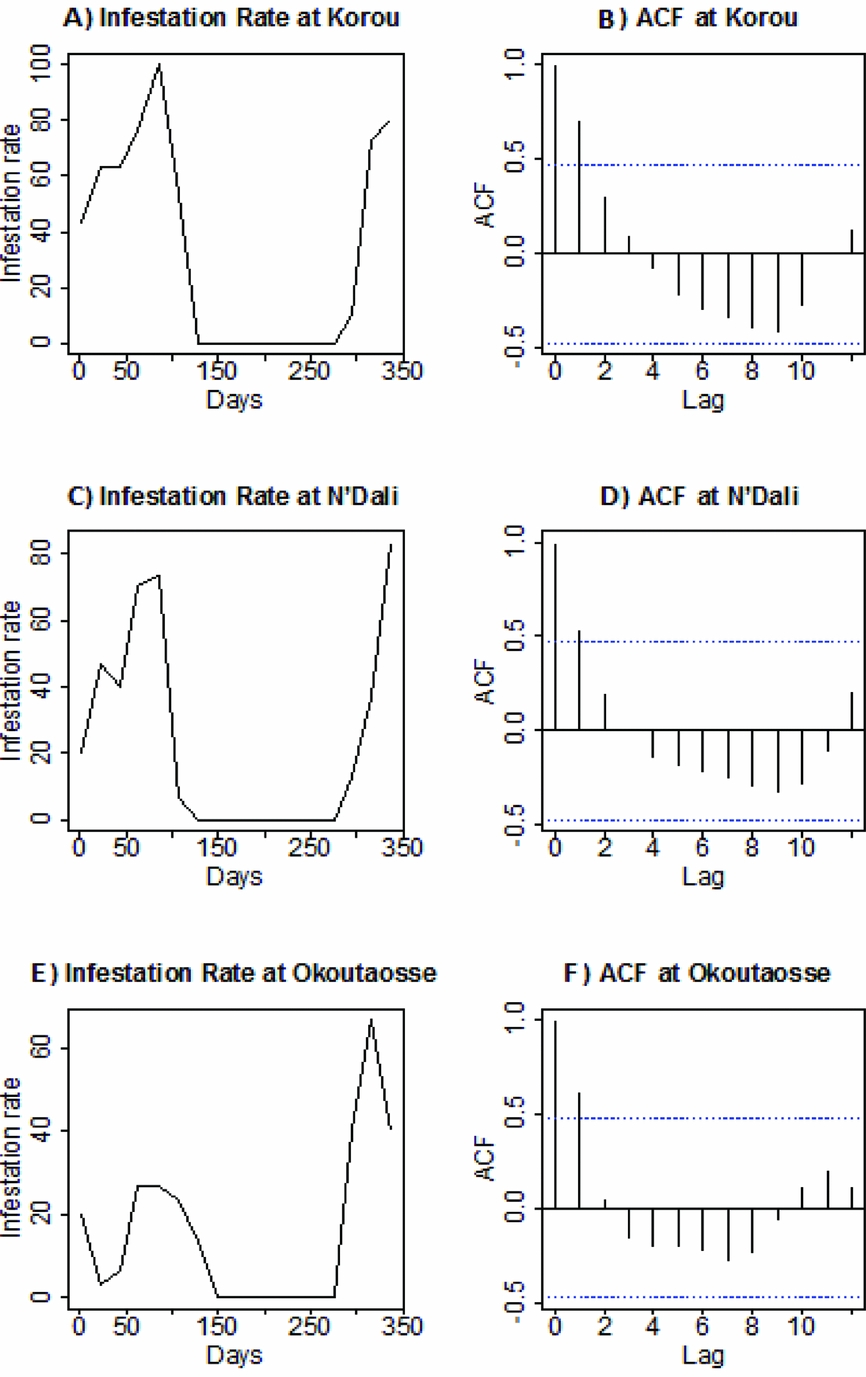
Values of the Spearman correlation coefficient between some key variables related to infestation of cashew orchards are summarized in Table 3. All correlation coefficients were higher than 0.5, with a significant probability (P<0.001), thereby indicating a strong relationship between the variables investigated. Moreover, Fig. 7 shows a significant auto-correlation between infestation rates with a time lag of three weeks at all the sampled sites, thereby indicating that infestation rate observed at time t depends on the infestation rate that prevailed three weeks earlier.
Spearman Correlation coefficients and their related probabilities for some variables describing infestation of cashew orchards by Eteoryctis gemoniella near three villages in the Benin cashew belt (Korou, N'Dali, Okoutaossé), Benin, West Africa.

All cells contain two values: the upper value is the correlation coefficient and the lower value is the P-value. Sample size (N) =17.
Relationships between variables describing infestation of cashew orchards by Eteoryctis gemoniella. Infestation rate plotted vs. days ((A), (C) and (E)) and Auto Correlation Function (ACF) ((B), (D) and (F)) with infestation rate time-series showing a significant correlation at time lags of 3 weeks (1 time lag = 3 weeks). Dotted lines in panels (B), (D) and (F) are 95% confidence bands.

Discussion
This is the first study in Benin (and in West Africa) on the population dynamics of the cashew leafminer E. gemoniella and on the inventory of its parasitoids. Although quantitative data on the impact of this pest on the productivity of cashew orchards is lacking, the kind of damage it inflicts on cashew leaves suggests the likelihood that it causes important yield losses, as has been reported by Asogwa et al. (Reference Asogwa, Hammed and Ndubuaku2008) for the congeneric species E. syngramma in neighbouring Nigeria.
Our results show that infestation rates differed among the three orchards sampled. The highest infestation rate was encountered at Korou, whereas the least infested orchard was at Okoutaossé. The mean number of E. gemoniella mines per leaf and the mean number of larvae per leaf also followed a similar pattern with highest values at Korou and the lowest at Okoutaossé. In contrast, the number of pupae per leaf corresponded among the three sites.
According to Diez et al. (Reference Diez, Pena and Fidalgo2006)—who reported similar studies on the citrus leafminer P. citrella Stainton (Lepidoptera: Gracillariidae), which is a serious pest on citrus in Argentina—variations in climatic conditions (especially rainfall) could account for the variations of infestation rates and mean densities among orchards. However, it is unlikely that rainfall pattern could explain the variation we observed in infestation rates or in cashew leafminer densities, since total rainfall and number of rainfall days during the experimental period were similar among the three orchards and peak infestation rates and peak E. gemoniella densities occurred simultaneously in all three orchards around August (when cashew trees are producing the maximum of new shoots prior to the flowering period). Cumulative rainfall from the beginning of the year to the sampling day was the only factor that showed a significantly positive relationship with infestation rate of cashew trees by E. gemoniella. One could argue, therefore, that there is a humidity threshold under which infestation of cashew trees by E. gemoniella is impossible. Unfortunately, our data did not allow us to dissociate the effect of this climatic factor from the physiological growth of the tree, because we did not collect humidity data during our study. However, other abiotic factors (such as soil composition) may affect the attractiveness or suitability of new leaves to E. gemoniella and these and other factors may vary among sites.
The biology of the leafminer could justify the relatively low number of pupae observed in most orchards (except at Korou). Adikpéto (Reference Adikpéto2011) showed that fifth instar larvae pierce the mine to pupate outside on the same infested leaf, or drop and pupate on leaves located beneath the mined leaf. Considering our sampling method, it was impossible for us to recover all the pupae, especially those that were formed on lower leaves or on leaf litter.
The significantly positive correlation between infestation rate and proportion of mined leaves is not surprising, and suggests that the higher the infestation rate the greater the proportion of mined leaves, with a subsequent increase in the level of leaf damage. Similar trends were observed with the other variables (such as the number of larvae per leaf compared to the number of mines per leaf). However, further studies are needed to determine whether the number of mines per leaf or the proportion of mined leaves is the best predictor of economic damage.
The biology of E. gemoniella and its life cycle (18–27 days) are the reasons for the significant auto-correlation between infestation rates occurring with a time lag of three weeks (Adikpéto, Reference Adikpéto2011).
One of the reasons for conducting a population dynamics study is to determine the most appropriate period for implementing control strategies against a given pest, to reduce its damage to the host plant (Yaninek et al., Reference Yaninek, Mégevand, de Moraes, Bakker, Braun and Herren1991). This applies to biological control interventions, as these should start before outbreak of the target pest. Our results show that control measures against the cashew leafminer in Benin should be implemented when infestation starts. In our case, control measures should be initiated as early as July to reduce the peak density of the pest, thereby reducing its impact on the productivity of a cashew orchard. This concurs with recommendations for the control of A. syngramma in India (Vanitha, Reference Vanitha2015). Efficient control measures should be based on a reliable sampling plan that allows the monitoring of temporal population fluctuations and evaluation of the impact of the implemented control strategy on the target pest. To elaborate a useful sampling plan for E. gemoniella, it is imperative to have a thorough knowledge of its spatial distribution in cashew orchards, as suggested by Onzo et al. (Reference Onzo, Hanna, Sabelis and Yaninek2005), for cassava systems. In our case E. gemoniella displayed a random distribution pattern, as the value of the aggregation index based on Taylor's Power Law was almost equal to 1 (b ≈ 1) suggesting that it attacks cashew trees randomly. This random distribution pattern, favoured by the high mobility of the moth within cashew orchards, implies that few samples would be enough for an unbiased estimate of the infestation and damage levels.
Didier (Reference Didier2001) has proposed chemical control of leafminers using a mixture of parathion and oil. No further information is available with regard to control of E. gemoniella in cashew orchards in Benin. Our surveys revealed the presence of three hymenopteran parasitoid species including two braconids, C. nr. curvimaculatus and Apanteles sp. and one ichneumonid Trathala sp. Whereas Apanteles sp. was recovered at all the study sites, C. nr. curvimaculatus was encountered at Korou and Okoutaossé and Trathala sp. was recovered only in the Okoutaossé orchard. Conversely, no parasitoids were recovered in the N'Dali orchard in the 2010 samples, probably influenced by the frequent insecticide applications to a nearby large cotton field. The following year, unsprayed maize fields surrounded the same orchard, and we observed the occurrence of Apanteles sp. there. The observed parasitoids might operate in a complementary manner. Apanteles sp. and Trathala sp. are larval parasitoids (Whitfield et al., Reference Whitfield, Cameron, Ramírez, Messinger, Taylor and Cole2001; FAO, 2003) and C. nr. curvimaculatus is an ovo-larval parasitoid (Bühler et al., Reference Bühler, Hanzlik and Hammock1985; Hentz et al., Reference Hentz, Ellsworth and Naranjo1997). Together they may have potential for reducing E. gemoniella populations. In a recent study in India, Vanitha (Reference Vanitha2015) reported the eulophid parasitoid Chrysocharis sp. as an efficient natural enemy of A. syngramma with a parasitism rate ranging from 37–58%. Further studies are warranted to assess the biodiversity of the parasitoid fauna associated with E. gemoniella in Benin and to evaluate its potential to control the population of this pest in cashew orchards.
Conclusion
This study reports, for the first time in Benin, the population dynamics of an emerging insect species, the cashew leafminer E. gemoniella. Infestation rates varied across time and orchards. The major contribution of this study is the new knowledge about the distribution pattern of this pest, which could guide further investigations for assessing the pest density in cashew orchards in other countries where cashew is cultivated. Also important is the identification of hymenopteran parasitoids associated with this pest, which could pave the way for the use of biological control agents to manage cashew leafminer populations. Apart from issues related to the environmental problems of insecticide use, the chemical approach is also questionable from a technical perspective. Contact of the insecticide with leafminers is problematic, because they feed beneath the leaf epidermis, which affords them a measure of protection. This factor makes biological control an appealing alternative.
Acknowledgements
The authors are grateful to F. Ouessou, M. Ahanchede and A. Adikpéto for their valuable assistance both in the field and in the laboratory and to E. Dosse for his careful driving during data collection. Also thanks to the three cashew growers who hosted our experiments in their orchards. This work was conducted with funding from the International Institute of Tropical Agriculture (IITA) and the Faculty of Agriculture of the University of Parakou through the joint icipe/IITA Cashew IPM Project - BMZ Project No.: 08.7860.3–001.00, Contract No.: 81109047.