Why do some international economic negotiations bring major policy changes while others end in deadlock? The difference between success and failure in these negotiations often amounts to billions of dollars and the seeds of economic disorder or cooperation. A successful negotiation can establish rules that open markets and promote coordination of policies. For example, the Bretton Woods conference of 1944 established the framework for postwar economic cooperation that promoted greater interdependence. Fifty years later, the Uruguay Round Agreement reduced agricultural and industrial trade barriers and expanded trade rules to regulate services and investment. On the other hand, failed negotiations often leave both sides worse off as relations between participants deteriorate. One such setback was the World Economic Conference of 1933, which ended without agreement and was followed by retaliatory trade protectionism and competitive currency devaluations. Failures on a smaller scale can also have significant consequences. For example, inability to reach agreement on wheat support policies in the Tokyo Round led to a subsidy war between the United States and Europe during the 1980s that drained their budgets and undercut the sales of developing country farmers. While the consequences of a negotiation may be far-reaching, the source of successful negotiation strategies lies in the details of the institutions that shape the negotiation process.
To explain negotiation outcomes, one must look closer at how the agenda, rules, and procedures of a negotiation influence state choices. Power and interests alone fail to account for the variation across negotiations. Strong states sometimes are unable to persuade weaker states to open their markets, and influential lobby groups are not always able to prevent their government from signing a liberalizing agreement. This article focuses on issue linkage, which is a common negotiation strategy that involves combining multiple issues to change the balance of interests in favor of a negotiated agreement. Only when the institutional context supports a linkage strategy, however, will it appear credible. Once established, the institutionalized issue linkage applies greater pressure for liberalization than threats or domestic political and financial constraints. Moreover, issue linkage can bring liberalization even when it would be least expected in sensitive sectors.
Using agricultural trade as a hard case that has been a frequent source of trade disputes, I present evidence that linking negotiations on agriculture and other sectors brings more agricultural liberalization than other strategies. Historically, agriculture stands out as a sector where countries stubbornly defend domestic programs. Farm lobbies represent the classic example of an influential pressure group (Olson 1965). Indeed, nearly all industrialized countries raise the levels of protection on farming as the sector's size in the economy shrinks (Hayami and Anderson 1986). Collective action incentives motivate farmers to organize, and both strong lobbies and electoral rules favoring rural districts guarantee that farmers wield political strength beyond their numbers. As a result, while bound tariffs on industrial goods have fallen to an average rate of 5% for OECD countries, agricultural protection has remained high, with bound tariffs averaging 60% (OECD 2002a, 22). Nontariff barriers remained common in the agricultural sector long after they were eliminated for most industrial goods. Japan and Europe stand out among those giving the most protection to agriculture.1
OECD producer subsidy estimates for 2001 show that 59% of the value of farm production resulted directly from government policies in Japan, while the corresponding figure was 35% for the EU—both above the OECD average of 31% and the U.S. levels of 21% (OECD 2002b, 160–61).
Agricultural protection brings high costs in terms of financial expenditures, lost export opportunities, and increased trade friction. Agriculture exporters, which include the United States and the developing countries, demand liberalization because protection closes off valuable markets. A study by the U.S. Department of Agriculture (2001) indicates that elimination of agricultural protection and support could increase global economic welfare by 56 billion dollars annually, which would be in addition to the direct budget savings. In Japan and Europe, on the other hand, where many producers are not competitive in world markets, liberalization threatens the welfare of rural society. Politicization and high economic stakes make for an explosive combination that threatens the stability of the trade system. Japan and Europe both have risked trade wars with the United States over food fights (Davis 2003a). Agricultural issues have nearly blocked the conclusion of successive trade rounds and generated half of all GATT trade disputes over the period 1960–89 (Hudec 1993, 327). Agriculture continues to present a central challenge for the successful conclusion of the new WTO trade round launched in November 2001 in Doha, Qatar. The large share of agriculture in the economies of developing countries makes further liberalization of agricultural trade essential if the Doha Round is to fulfill its development agenda.
Although agriculture remains protected in comparison to other sectors, liberalization has occurred. Over the past 30 years, even Japan and Europe have agreed to reduce many trade barriers, and the share of imports in total consumption has increased. According to the OECD measures of agricultural protection, the total support for agriculture as a share of GDP has declined from 2.4% for Japan and 2.6% for the EU in 1986 to 1.4% for both in 2001 (OECD 2002b, 187, 196). In specific policy changes, market price support has been reduced, Japan dismantled its system of quota restrictions one by one, and the EU replaced its trade-distorting variable levy with a more transparent tariff system. Thus, negotiations on agricultural trade policy have included both dramatic negotiation failures and negotiations that brought substantial liberalization.
FRAMEWORK FOR NEGOTIATION ANALYSIS
In negotiations that bring liberalization, what has allowed governments to overcome domestic interests that will be harmed? The literature on trade politics highlights the importance of distributional stakes for interest groups (Grossman and Helpman 1995; Hiscox 2002; Milner 1997). I emphasize how the institutional context of the international negotiation changes the aggregation of these interests. Negotiations that link issues across multiple sectors have a different impact on domestic politics than single sector negotiations. An institutionalized linkage of negotiations on multiple sectors broadens interest group lobbying and bureaucratic jurisdiction to counter the domestic bias that favors protection.
Putnam (1988) introduced the analogy of two-level games to characterize the observation that a leader negotiates simultaneously over domestic goals and the international bargain. Since then, a growing literature has attempted to explain how interest groups, domestic political institutions, or the bargaining strategies of negotiators determine the range of possible negotiation agreements (Evans, Jacobson, and Putnam 1993; Iida 1993; Odell 2000). While two-level game analysis has improved our understanding of how domestic politics affect outcomes, many studies treat the international level as an undifferentiated bargaining arena. Milner (1997, 70), for example, writes, “The international game adopted does not have a well-defined institutional structure; politics on that level are assumed to be anarchic, and international negotiations are generally conducted without a constitutionally mandated sequence of moves.” This disregards the dense network of international institutions that shapes the conduct of any given negotiation.
The institutions of the negotiation structure—the agenda, rules, and procedures that guide the interaction between states in a policy dispute—influence the negotiation outcome because they establish which alternatives are considered and how they are decided. As with other institutional constraints, such as international treaties or legislative committee rules, the institutions of the negotiation structure favor certain actors and policy options (Keohane 1984; North 1990; Shepsle and Weingast 1995). In trade negotiations, institutions change both the mobilization by interest groups and the policy track for decision making.
First, the negotiation agenda sets the negotiation stakes and policy scope. Publicly announcing the issues that are up for discussion informs domestic actors of the potential gains and losses. Interest groups are involved in the process of creating the agenda as they lobby for the inclusion or exclusion of their own issue. Few, however, lobby beyond their own issue. Governments must aggregate diverse demands from domestic interests while also trying to accommodate other governments to produce a single agenda. The final agenda reveals the full array of issues that then become important for all groups with a stake in any one issue. Likewise, the issues on the agenda determine the scope of bureaucratic and political committee jurisdictions that will address the negotiation. This matters given the importance of who initiates policy proposals and who makes the last decision (Garrett and Tsebelis 1996).
Second, the negotiation procedures guide the sequence of decisions. If there are multiple issues on the agenda, for example, the negotiation could culminate in a single decision on all the issues or separate decisions on each one. As shown by the literature on institutions in American politics, outcomes often differ according to which alternatives are presented to the legislature (Shepsle and Weingast 1995)).
Third, the nature of the rules determines the form of commitments that are reached in the negotiation. Specifically, the rule framework creates the expectation for whether a negotiated agreement will represent a binding legal commitment with a monitoring mechanism. This raises the costs of later defection from agreements. Greater legalization adds the value of the rule system and future cooperation as new incentives. Taken altogether, the institutions of the negotiation structure have a direct impact on the distributional consequences of the negotiation.
There are multiple venues for trade negotiations, and the institutional context influences the potential for effective issue linkage. The General Agreement on Tariffs and Trade (GATT) and its successor, the World Trade Organization (WTO), form the core international institution for trade policy. Within the GATT/WTO framework, negotiations consist of comprehensive trade rounds or legalistic dispute settlement procedures (DSP). The former bring together all members and are launched with an opening declaration that sets forth an agenda for discussion of liberalization across sectors. Rounds proceed as a mix of informal bargaining and consensus decisions that culminate in a multilateral agreement with binding commitments. Issue linkages are integral to producing agreement among the diverse economic interests of members. The Uruguay Round formalized more than any prior negotiation the explicit commitment to a package approach, which continues in the Doha Round.
In contrast, linkages are more difficult to sustain in other institutional contexts. The DSP negotiations resemble adjudication and begin with the filing of a legal complaint against a specific policy that leads to either plea bargaining or a negotiated settlement after a panel of judges provides a legal ruling. The narrow focus on the legal status of a trade barrier tends to exclude linkage among issues even while it raises normative pressure. Outside of the GATT/WTO framework, other types of trade negotiations include bilateral talks on either a single policy or a broad agenda of issues. In addition, meetings of regional trade associations share the comprehensive character of trade rounds, but follow different procedures. Asia-Pacific Economic Cooperation (APEC), for example, emphasizes the voluntary nature of participation in nonbinding agreements. In bilateral and regional trade negotiations, linkages are possible, but not always present.
Interests and the Choice to Link Issues
I first consider the domestic and international politics that shape negotiation structures. Since states design institutions in order to address particular policy problems, “institutions are both the objects of state choice and consequential” (Martin and Simmons 2001, 451). In addition to the anticipated functions performed by an institution, path dependency can make the initial choice of rules constrain policy choices even after it no longer serves those interests. For example, in an historical irony, the United States shaped GATT rules in 1947 to create special exceptions to fit protection programs for U.S. agriculture. Later, when U.S. agricultural interests had shifted to favor exports and other countries had developed entrenched agricultural protection, the United States could not easily change these rules (Goldstein 1993).2
The exception in Article XI:2(c) of GATT 1947 rules allowed agricultural quota restrictions when applied in conjunction with domestic supply constraints, and the exception in Article XVI:3 allowed the use of export subsidies for primary goods. These exceptions did not exclude agriculture from GATT rules, and GATT panels have strictly interpreted their applicability. Nevertheless, the regulation of agricultural trade has been problematic in part because of these exceptions. See Hudec (1993, 326–36).
The decision to establish a linkage in a negotiation agenda raises the possibility of a selection effect. Skeptics caution that international institutions cannot change state behavior on hard issues that raise distributional concerns or strong domestic interest group opposition (Downs and Rocke 1995; Mearsheimer 1994/95). From this perspective, states would only agree to link issues in a negotiation agenda when there is no strong opposition to any individual component of the agreement (Moravcsik 1998). To address these concerns empirically, I investigate whether institutional linkages promote agreements even when they involve an issue where cooperation is unlikely on that issue alone—agricultural liberalization by Japan and Europe faces opposition by strong domestic lobby groups. In order to account for variation among the agricultural negotiations, I include measures for other characteristics, such as budget and economic conditions, that could make liberalization more or less likely for a given case.
Several factors facilitate the acceptance of issue linkage even when there is strong opposition to agricultural liberalization. First, governments realize that a broad agenda encourages wider participation and greater potential gains from liberalization. Indeed, negotiations over the agendas that launched past trade rounds have consistently added more issues in order to gain the consent of all members (Steinberg 2002, 350–51). Second, protectionist interests face higher costs to mobilize early in the negotiation. The broad diplomatic coordination required for the meetings that set the negotiation agenda privileges foreign policy elites and national leaders more than sectoral representatives. Although farm lobbies and agriculture ministries in Japan and Europe are likely to resist the inclusion of agriculture on the agenda, they will find it difficult to veto agenda items because the foreign policy decisions at this stage of the negotiation lie outside of their jurisdiction. Moreover, the decisions that shape the structure of the negotiation occur amidst uncertainty about the timing and shape of the future agreement. This is particularly true for trade rounds, which bring together many countries and often last five to eight years. For politically sensitive cases, linkage in a multilateral setting will be more appealing than a bilateral negotiation or legal dispute. The longer time frame as well as the broader context avoids placing the spotlight on a single product, which makes it easier for protectionist interests and diplomats to reluctantly agree to talk about the issue (Davis 2003b). Facing strong U.S. demands, the EU and Japan may prefer to negotiate their most vulnerable products in a linkage setting rather than in a bilateral or DSP negotiation.3
Some cases may simply never be raised in any kind of negotiation. For example, this could occur when there is strong resistance by the EU or Japan and the United States is willing to forgo its demand for liberalization of the product. The key point for this study, however, is that when comparing those products that are raised in negotiations, some of the toughest negotiation topics are likely to arise in negotiations that embrace an issue linkage. Within the sample of negotiated products, the selection bias, if anything, leads to underestimating the effect of linkage because harder cases may go to a negotiation forum with issue linkage.
The Uruguay Round illustrates how these factors helped persuade governments to accept an agenda calling for liberalization across all sectors. When negotiators tried to formulate the agenda for a new trade round in 1986, developing countries such as Brazil and India were reluctant to discuss service sector liberalization and intellectual property rights as part of the Uruguay Round. Eventually, however, they agreed to participate because they expected to benefit from liberalization in other areas to be included on the agenda, namely, agricultural and textiles trade. For France and other European states, the incentives were the opposite; potential gains from service sector liberalization persuaded governments to agree to a negotiation agenda including agriculture.4
For more on the importance of linkage in getting the Uruguay Round started, see Croome 1995, 31, and Paemen and Bensch 1995, 31–48.
During EC decision making for the acceptance of the Uruguay Round agenda, the scope of jurisdiction favored foreign affairs officials over the representatives of specific sectoral interests. The Commission Directorate for External Relations produced initial proposals, and all of the important decisions were discussed in the trade committee and COREPER (the committee composed of heads of delegations) and then forwarded to the General Affairs Council for approval (Vahl
1997, 80). Nevertheless, agriculture interests were not shut out entirely. Their consent reflected that many in the Commission and national delegations believed that the final agreement would not require substantial changes of the Common Agricultural Policy (CAP) (Josling, Tangermann, and Warley
1996, 172). A Commission negotiator for the agriculture group negotiations of the Uruguay Round said, “We knew agriculture might be a problem, but this was not really clear until the mid-term review in 1988. Nobody in Europe thought there could be a negotiation that left out agriculture, but it was hoped that there might not have to be major reforms—like in the Tokyo Round.”
5 Official of the Commission, Directorate General for Agriculture. Interview by author. Brussels, 4 July 2000.
Similar logic led Japanese government officials to plead with the U.S. government to address rice market access as an issue in the Uruguay Round rather than in a bilateral negotiation.6
Asahi Shimbun, 24 October 1986, 9 April 1987.
Yet at the same time, the Diet passed a unanimous resolution against any liberalization of the ban against rice imports. An official from an agricultural interest group explained in an interview that his organization did not oppose the government promise to discuss rice liberalization in the Uruguay Round because his group hoped to get support from France and other countries and thought the talks would go better than if Japan faced the United States alone in bilateral talks.
7 Former official of Zennōrin. Interview by author. Tokyo, 26 October 1998.
Yet in the end, the Uruguay Round did bring substantial reforms in the agricultural sector as well as in the industrial and service sectors, leading to both an overhaul of CAP and the partial opening of Japan's rice market. In sum, economic interests, the costs of mobilization, and uncertainty about outcomes encourage acceptance of the issue linkage in the agenda despite resistance to liberalization of one component.
Package Negotiations: Institutionalized Cross-Sector Linkage
Issue linkage has long served as a basic tool for political bargains and diplomatic deals. Sebenius (1983, 287) provides the definition that issues are linked “when they are simultaneously discussed for joint settlement.” This definition encompasses side-payments, log-rolling bargains, or a formal agenda on a broad range of issues. The focus of this article is on tactical linkages, which combine issues that do not substantively require joint settlement.8
See Aggarwal 1998, 16–17, and Haas 1980 for discussion of different kinds of linkages.
In such cases, multiple issues are included in the final settlement in an effort to create a balance where both sides gain enough to accept the costs. Trade liberalization, in particular, has relied upon negotiating across a range of products as countries exchange reciprocal concessions. Under what conditions will issue linkage promote agreement?
One challenge for successful linkage is finding complementary issues. Sebenius (1983) points out that simply adding issues does not necessarily promote agreement. Rather, adding a nonnegotiable issue to the agenda can cause the collapse of the entire negotiation. Much of the study of issue linkage focuses on combining issues so that all participants gain from the agreement (Mayer 1992; Tollison and Willett 1979). A second challenge is the difficulty of convincing all actors to believe that agreement on one issue is conditional on agreement on the other issue. Tactical linkages can be unstable when some participants resist the linkage. Several scholars voice skepticism about issue linkage because of this added credibility problem (Aggarwal 1998; Eichengreen and Frieden 1993; Morrow 1992). Lohmann (1997) counters that it is possible for issue linkage to promote cooperation if actors care sufficiently about future interaction on one of the issue dimensions for this “credibility surplus” to spill over and increase incentives for cooperation across issues. While issue linkage can promote cooperation in some cases, either the wrong combination of issues or an inability to credibly commit to the linkage may undermine the effectiveness of a linkage strategy.
I examine how a particular kind of linkage, a package negotiation structure, addresses these two problems. Package negotiations have a formal agenda that combines distinct issues for joint approval or rejection. This resembles the bargaining tactic Raiffa (1982) refers to as a “single negotiating text” that unifies discussion of different issues. I focus on the use of package negotiation structure to institutionalize cross-sector issue linkages. These negotiations address agriculture and industry sectoral issues along with other trade topics in a single negotiation. The cross-sector scope of the agenda combines issues to produce overall gains, while the institutional context promotes the credibility of the linkage.
Cross-Sector Interests
Liberalization depends on overcoming the collective action problems and institutional biases at the domestic level that favor protection. For trade policies in general and agricultural issues in particular, those who demand protection have strong incentives and high levels of organization, while those who pay the costs are loosely organized taxpayers and consumers (Lindert 1991; Olson 1965). Protection policies also persist because policy makers with a vested interest in the status quo retain control over decision making. The closed policy communities formed by the ties among farm groups, agriculture ministries, and political committees in Japan, the EU, and France have been described as forming a corporatist relationship (Keeler 1996; Mulgan 2000; Sheingate 2001). Using issue linkage to mobilize industry groups and to broaden the policy jurisdiction helps to counter both problems.
Cross-sector issue linkage offsets the influence of farmers by engaging interests important to other powerful lobby groups. Japan and the EU must offer concessions in agriculture, while both can gain much from liberalization in the industrial and service sectors. When there is a credible cross-sector linkage, industry lobbies also advocate agricultural liberalization in order to achieve specific gains for industry from conclusion of an overall agreement. Finding domestic allies to support foreign demands has been a critical factor in explaining variation in outcomes across different U.S.–Japan bilateral negotiations (Mulgan 1997; Schoppa 1997). The importance of the expansion of actors has also been widely commented on in studies of European and American politics (Gilligan 1997; Lieber 1970). Schattschneider (1960, 40) argues that, by expanding the scope of conflict, losers try to “involve more and more people in the conflict until the balance of forces is changed.” In the case of agricultural liberalization, farmers represent the entrenched interest group, and issue expansion offers one route to dilute their influence by forcing competition with other interests.
Not only does issue linkage lead to competition among interest groups, but also among actors across jurisdictional boundaries. The framing of issues in the negotiation shifts the policy discussion from one venue to another in the domestic arena. Studies of domestic institutions have long emphasized the importance of agenda setting given the substantive impact of differences between domestic actors. Baumgartner and Jones (1993, 31) argue that “each institutional venue is home to a different image of the same question.” The view of the problem and preference for a solution will reflect the particular ministry's own bias and interests—the agriculture ministry favors farmer interests, the trade ministry favors industry interests, and the foreign ministry tries to balance national interests with concern for maintaining better foreign relations. Similar differences occur across the boundaries of political committees. To the extent that the negotiation lifts decision making outside of the corporatist ties in the agricultural policy setting, it will create new opportunities to promote agricultural liberalization.
Evidence confirms that the international setting has an impact on the domestic policy jurisdiction. With regard to Japanese trade negotiations, for example, Fukui (1978) argues that the Foreign Ministry influence was greater in the Tokyo Round, while the domestic ministries such as the Ministry of Agriculture had more influence in bilateral negotiations on narrow issues. Similarly, Japanese government decision making during the Uruguay Round brought top officials from five ministries together to coordinate policies. This enabled ministries such as the Ministry of International Trade and Industry (MITI) that typically have no voice on agricultural trade issues to play a role in agricultural policy decisions because these decisions also affected the progress of the entire negotiation.9
Ministry of Foreign Affairs Official. Interview by author. Cambridge, MA, 18 November 1999; and MITI official. Interview by author. Tokyo, 3 June 1999.
In the EU, the comparable question centers on which officials in the Council of Ministers shape the negotiation mandate. Although the agriculture ministers meeting in the Agriculture Council dominate decision making for issues directly related to CAP, broader trade policy issues related to negotiations are likely to be addressed by the foreign and trade ministers meeting in the General Affairs Council. Member states opposing agricultural reform prefer to maintain control within the Agriculture Council, while those favoring reform try to push issues into the trade committee or the General Affairs Council.10
Official of the German Federal Ministry of Food, Agriculture, and Fishery. Interview by author. Bonn, 20 July 1999.
The scope of issues in the negotiation influences which council is likely to take the lead role and which procedures are followed under EU treaty provisions.
Institutions and Credibility
Many have pointed to the role of international institutions in facilitating positive linkages that promote cooperation (Haas 1980; Keohane 1984; Martin 1992). First, as Keohane (1984, 91) writes, more quids make it easier to reach agreement in quid pro quo deal making. The institutional context of the GATT/WTO promotes the kind of cross-sector issue linkages discussed above. Equally important, the institutional context adds credibility to the decision to link issues because it makes the decision represent a commitment in an ongoing process of repeated negotiations. Martin (1993, 129) explains, “Deals cut within an institution rather than outside one gain stability because members put increased value on their reputations for living up to agreements.” The costs of backing down from a commitment to link issues are greater because such action damages their “ability to reach mutually beneficial cross-issue deals” in the future. The institutional context also endows the linkage with greater legitimacy by providing a common set of procedures and norms that justify use of the linkage strategy.
Publicizing the issue linkage as a formal agenda accomplishes two purposes: First, it creates a focal point from which negotiators are reluctant to retreat; second, it signals to domestic groups that the success of any part of the negotiation will depend upon reaching an overall agreement. The formal agenda of the negotiation establishes whether talks will address multiple sectors and whether agreement on the entire range of issues will form a single package. Considerable time and hard bargaining go behind the creation of the agenda, and this inhibits frequent renegotiation. Subsequent behavior by states reinforces the linkage. By obstructing discussions in one negotiating group to match the deadlock in another negotiating group, a state can force parallel progress on different issues. The combination of the formal agenda and the support for each agenda issue by some participating states creates a more credible cross-sector linkage. Information that liberalization for any sector is conditional on agreement on all issues provides an incentive for interest groups and officials to closely follow all parts of the negotiation rather than just the part related to their own sector. As a credible signal, the institutionalization of the issue linkage in the agenda and procedures of the negotiation strengthens the incentives for those who gain from free trade to lobby against protectionist interests.
Linkage Hypothesis
The more institutionalized the linkage among multiple sectors in a negotiation, the more likely that the negotiation will liberalize agricultural trade barriers.
Different levels of institutionalization form a weak or strong linkage among issues. The two key institutional features concern whether the agenda commits to liberalization of multiple sectors and whether procedures call for a single agreement with binding commitments on all of the agenda issues. An agenda that only calls for liberalization of one sector does not have any institutionalized cross-sector issue linkage. An agenda that includes multiple issues but provides for flexibility to reach settlements on each issue separately forms a weak linkage. In contrast, a package negotiation structure establishes a strong linkage by explicitly mandating that the negotiation will proceed in an all-or-nothing approach that ties together deals on multiple sectors and issues to culminate in signing a single agreement. Comparison of two GATT trade rounds and one APEC negotiation illustrates these differences. The agendas for the two GATT negotiations, the Tokyo Round (1973–79) and the Uruguay Round (1986–94), as well as the Kuala Lumpur APEC ministerial meeting in 1998, gave a mandate for talks on a wide range of issues including both primary and industrial sectors and other rules related to economic activities, such as investment regulations and product standards. Nevertheless, the agenda and procedures of each negotiation present observable differences in the commitment to the cross-sector linkage.
Weak institutionalization of the cross-sector linkage characterized the APEC “Early Voluntary Sectoral Liberalization” agenda. APEC trade liberalization talks jointly address trade sectors ranging from agriculture to automobiles. The principles of voluntarism and flexibility, however, explicitly allowed countries to set their own pace for the timing and scope of liberalization in any particular sector (Aggarwal and Morrison 1998, 13). Likewise, bilateral negotiations may also address multiple issues, but they often do not bind them together with a formal agenda. For both APEC and comprehensive bilateral negotiations, tradeoffs across issues in the negotiation are possible. The lack of a formal commitment to the linkage, however, makes it more difficult to signal that concessions in one area are necessary for gains in another.
There was a moderate linkage between agricultural and industrial issues in the Tokyo Round. The declaration that set the agenda for the Tokyo Round stated that the negotiation “shall cover … both industrial and agricultural products,” but also added flexibility by urging that the negotiations should “take account of the special characteristics and problems in this [agricultural] sector.”11
Text of the Tokyo Declaration issued at the ministerial meeting held in Tokyo, 12–14 September 1973, in Winham 1986, 414.
It established several negotiation groups that produced agreements from which nations could pick and choose: “GATT à la carte” (Jackson
1997, 47). The agricultural group had a particularly weak linkage with the rest of the round. Subgroups for dairy, meat, and grains discussed separate commodity agreements rather than general principles for agricultural policy. Moreover, at the U.S. initiative, which wanted to include the Soviet Union (a major purchaser on grains markets that was not a GATT member), the talks on grains were primarily conducted outside the Tokyo Round in the context of the International Wheat Council (Winham
1986, 252). These talks ultimately failed to produce a new commodity agreement on grains, and states were able choose whether to join the dairy and meat commodity agreements regardless of their position on other issues in the round (GATT
1979, 26). In sum, the agenda statement and the procedures that allowed stand-alone agreements provided only moderate institutionalization of an issue linkage.
In contrast, a strong cross-sector linkage characterized the Uruguay Round. The Punta del Este Declaration that set the agenda for the Uruguay Round called for 15 groups to negotiate issues ranging from industrial goods to agricultural goods to reform of GATT trade rules. In the declaration, the term single undertaking referred to the commitment to decide jointly on all the parts of the negotiation and supported the refrain among negotiators that “nothing is agreed until everything is agreed” (Croome 1995, 34). Two later events further strengthened the linkage credibility. First, some Latin American states walked out of the 1990 Brussels meeting, declaring that they would not negotiate anything if the United States, EU, and Japan would not agree to a substantive agricultural liberalization package. Then, at the end of 1991, the GATT Director-General Arthur Dunkel independently produced a draft agreement binding all parts of the negotiations into a single text.12
The “Draft Final Act Embodying the Results of the Uruguay Round of Multilateral Trade Negotiations” specified terms for all negotiation groups, including agriculture. Its provisions for agricultural policy changes broadly outlined the final agreement that was accepted, although some revisions were made (Croome 1995, 296).
A procedural step reinforced the concept of a single undertaking: The final agreement texts would form a single charter for a new trade organization such that accepting all agreements was a condition of membership (Hudec
1993, 193). Given this strong linkage, one would expect more liberalization in the Uruguay Round than in other negotiation fora.
On the other hand, less liberalization is expected when there is no cross-sector linkage. The U.S.–Japan talks on beef and citrus in 1983 and the U.S.–EU talks on wine in 1991 are examples of single-sector negotiations that focused exclusively on agricultural products. This observable variation in the agenda, rules, and procedures across negotiations in terms of the sectoral scope and institutionalization of the commitment to a linkage approach facilitates testing the linkage hypothesis.
ALTERNATIVE EXPLANATIONS
Many factors influence why countries liberalize policies. In order to evaluate the relative importance of a cross-sector issue linkage, I also consider the following alternative explanations.
U.S. Influence: Threats and Appeals
One way for the United States to exercise its power in economic negotiations is by threatening to close off access to U.S. markets through retaliation. It is a recurrent pattern in U.S. trade policy for the administration to pursue the goal of freer trade while threatening protectionism (Bayard and Elliott 1994; Gawande and Hansen 1999). United domestic support for the use of sanctions will increase the credibility of this strategy (Odell 2000; Zeng 2002). Public threats would be expected to increase the likelihood of liberalization because the prospect of retaliation triggers lobbying by targeted industries. Although implicit diplomatic threats and linkage with alliance relations are also important sources of leverage, they are difficult to observe in any given negotiation. Moreover, both Japan and most EU member states have been allied with the United States over the period of this study. Therefore, I focus on threats of economic retaliation.
The bilateral trade balance will also influence the effectiveness of U.S. pressure. During times of large trade deficits, political demands in the United States urge protectionism at home and push for export expansion. In response, industries in Japan and Europe dependent on exports to the U.S. market may urge their government to reduce trade friction with compromises on agricultural trade disputes. Thus a growing deficit could increase pressure for liberalization. In addition, from the perspective of balancing the U.S. trade deficit and promoting U.S. priority items, one might expect a pattern favoring liberalization of products that contribute most to U.S. agricultural export earnings.
Domestic Politics in Japan and the EU
Bargaining models that incorporate domestic politics imply that Japan and the EU will be less likely to liberalize agricultural policies when the government is in a weaker position. A negotiator whose hands are tied by domestic resistance has a smaller range of possible agreement (Schelling 1960), and this situation may force the United States to accept less liberalization. When the government has a narrow majority it can credibly argue that agricultural liberalization is politically impossible because politicians must appeal to the important farm vote. Political strength at home, therefore, can translate into weakness at the bargaining table.
Japan provides an interesting case for testing whether a stronger majority will make liberalization more likely even when the ruling party favors farm protection. Farmers have long formed one of the key support bases for the conservative Liberal Democratic Party (LDP). Although the LDP maintained ruling party status from its formation in 1955 until 1993, there has been intense competition over district seats and a continued majority has not always been a certainty. When the LDP majority is slim, the party leadership finds it difficult to persuade party members to consent to an agreement that would inflict pain on an important constituency like farmers (George 1990, 133). Consequently, liberalization will be more likely when the LDP has a stronger majority in the Japanese Diet.
In the case of the EU, domestic politics and intergovernmental politics between member nations calls for playing a three-level game (Patterson 1997). For the sake of the aggregate analysis, however, I only examine two levels by considering politics in the Council of Ministers as representing the domestic politics of the EU. National governments in the Council approve the mandate to give negotiating authority to the European Commission. Thereafter, the Commission acts as the sole negotiating authority. Since the final negotiation agreement must also gain Council approval, however, the Council continues to play a role setting limits on negotiation agreements (Meunier and Nicolaidis 1999). The rotating office of the president of the Council of Ministers offers a proxy for variation in Council politics. Although any member can try to build a coalition against an agreement, the government that holds the Council presidency has a stronger role as agenda-setter (Sherrington 2000). When France, the strongest opponent of agricultural liberalization, holds the influential post of Council president during the key initial or final years of a negotiation, Commission negotiators can more credibly argue that their hands are tied so that they cannot accept any liberalization.
Budget Constraints
Liberalization may occur because a government decides it no longer can afford the costs of protection in terms of budget expenditures and inefficient use of economic resources. Studies of EU and U.S. agricultural reforms cite cost-cutting as a major motivation for lowering agricultural trade barriers and subsidies (Moyer and Josling 1990; Paarlberg 1997; Orden, Paarlberg, and Roe 1999). The EU devotes more than half of its total budget expenditures to agricultural programs, and European officials openly discuss the need to reform agricultural policies in order to reduce expenditures.13
The European Agricultural Guidance and Guarantee Fund expenditures on agricultural policies were 89% of the 1970 total EC budget and 51% of the 1999 budget (EC 1999).
If budget constraints are the force behind liberalization, then one would expect liberalization to occur during periods of belt-tightening when there is a reduction in agricultural budget expenditures. Conversely, one could also argue that rising expenditures will make governments want to start cutting programs so they would be more likely to liberalize agricultural policies when agricultural budgets grow rapidly. The role of commodity prices further complicates the budget dynamic because low commodity prices increase both agricultural budget expenditures and farmer demand for protection. This article provides one test of the role of agricultural budget growth, but further analysis is necessary to explain the connections between prices, spending, and trade protection.
Number of Participants
Another important characteristic of many international negotiations is multilateralism. The term multilateralism often refers to both multiple countries negotiating and the kind of institutions that are established to facilitate such negotiations. This tendency to conflate the institutional features of the negotiation structure with the number of participants can interfere with analysis of the sources of cooperation. I evaluate whether it is the number of participants per se or the need for linkage that accompanies negotiations with many participants that provides the leverage of multilateralism.
Studies about whether more is better have concluded that it depends on the issue and the nature of the cooperation problem (Kahler 1992; Martin 1992; Sebenius 1983). On the one hand, more participants promote cooperation because there are more opportunities to find agreements with mutual gains. Multiple countries making the same demand as the United States could increase the pressure for liberalization. On the other hand, the problem of free-riding and the difficulty of bargaining increase with large numbers (Oye 1985). One could also argue that the lack of counterbalancing by a coalition would make it easier for the United States to maximize its leverage in a bilateral negotiation. Therefore, the number of participants represents an important feature of the negotiation context.
AGRICULTURAL TRADE NEGOTIATION DATA
I analyze an original dataset of 267 cases of agricultural commodities that were the subject of U.S. negotiations with Japan or the EU during the period between 1970 and 1999. The dataset includes both trade rounds and dispute adjudication cases as well as negotiations outside of the GATT/WTO institutional framework, such as bilateral talks and the 1998 Kuala Lumpur meeting of APEC (Table 1).14
In Table 1, a case is categorized as dispute adjudication if a formal complaint was filed under GATT or WTO dispute settlement procedures. Some cases ended after consultations, while others were concluded after a final panel ruling. See Busch and Reinhardt 2001 and Davis 2003a for analysis of the effect that these rules have on trade negotiations.
Some of the negotiations in the dataset addressed only agricultural trade barriers, while others involved multiple sectors. A negotiation on an agricultural trade barrier forms the unit of analysis. A negotiation is defined as an “exchange between two or more countries that begins with a demand for policy reform and concludes when there is either an agreement or a decision to indefinitely halt talks on the issue” (Davis
2003, 85). The Appendix provides details on coding rules.
Each case is a single commodity or commodity group among those being negotiated. Hence, in a large negotiation like the Uruguay Round there are multiple cases, while another negotiation will focus exclusively on a single commodity. Within negotiations, there is considerable variation that can be hidden by aggregation of products. During the Tokyo Round, for example, no liberalization occurred for grains, while both Japan and the EU agreed to partial changes for beef. Multiple negotiations on a single commodity are treated as separate cases when there is a clear initiation and end to one negotiation and a second initiation for the next negotiation. In order to consider the special nature of such repeated talks on similar issues, I include a count variable for the number of the particular negotiation in the sequence of negotiations on the same product.
Negotiated policy liberalization is defined as the reduction of explicit trade barriers through agreement in negotiation. Negotiation outcomes are categorized into three levels of liberalization: none, minor, and major policy change. The explanatory variables used to predict liberalization are summarized in Table 2, and descriptive statistics and coding definitions are provided in the Appendix. I test my main argument using a linkage variable that is a four-level ordinal scale for the institutionalization of an issue linkage between agricultural and other sectoral issues. Cases negotiated in the Uruguay Round are coded four for the strongest linkage while Tokyo Round cases are coded three for a moderate linkage. Cases in multisector negotiations with a weak linkage in the agenda are coded two, and negotiations that only addressed agricultural topics are coded one.
Additional variables represent factors that other theories have highlighted as important for trade negotiations. The coercive influence of U.S. threats is measured by a four-level ordinal scale, ranging from absence of threat to a specific threat or the initiation of retaliatory sanctions. Two variables, the bilateral trade balance and the value of the specific product in the profile of U.S. agricultural exports, control for possible sources of variation in the pressure from the U.S. demand for liberalization.
The idea that domestic political constraints may add bargaining leverage is represented in the Japan model by the strength of the LDP majority. A proxy of tied hands in the EU analysis is the power of France over the negotiation, which is assumed to be relatively greater when it holds the presidency of the EU Council of Ministers during the initial or concluding year of the negotiation. Domestic political constraints are expected to be higher when the LDP is weak or when France holds the EU presidency.
A variable for agriculture budget growth tests the argument that the need to reduce spending motivates liberalization. Periods of budget growth apply less pressure for liberalization than when there are budget cuts. A variable for economic growth controls for other economic factors that may influence decisions about trade policy.
Finally, I include an indicator variable for multiple countries being involved in the negotiation. This allows me to evaluate the effect of linkage, while controlling for the fact that most negotiations with linkage also involve many participants.
For the EU, another variable is necessary to account for the special nature of negotiations dealing with protection oriented toward export promotion. Since Japan has minimal agricultural exports and no export subsidies, this variable is not applicable to the Japan model. In the EU policy context, however, export subsidies are a core policy of CAP. Moreover, they represent an area where GATT trade law has been weakened by exemptions and vague language (Hudec 1993, 147–54). The combination of stronger interests and weaker rules makes these among the toughest negotiations with the EU.
EMPIRICAL ANALYSIS
I evaluate the effect of issue linkage by analyzing data from U.S.–Japan negotiations and U.S.–EU negotiations. I choose not to combine the Japan and EU datasets since separate analysis allows me to examine whether the same variables have different effects in each political context. Given that the dependent variable measures policy liberalization with three ordered categories, I use the ordinal probit model.
Table 3 presents the regression analysis. The results show that in Japan and Europe, cross-sector linkage significantly increases the likelihood of liberalization. There is also evidence that threats and LDP strength promote liberalization by Japan and that the role of France along with budget conditions influences liberalization by the EU. The impact of these other factors, however, appears to be smaller compared with the impact of cross-sector linkage.
The findings were robust to different model specifications. The results were consistent when a probit model is estimated using a recoded liberalization variable that collapsed the top two categories of major and minor liberalization to form a simple binary outcome. Recoding linkage into a binary variable for whether the agenda included only agricultural issues or multiple sectors also produces a significant positive effect. Results were also consistent when I introduced a time period variable to account for interconnection between cases not captured by the other variables.15
The time period variable divided the 30 years into five categories related to the two major trade rounds: 1969–72 (pre-Tokyo Round), 1973–79 (Tokyo Round), 1980–85 (pre-Uruguay Round), 1986–94 (Uruguay Round), and 1995–99 (WTO).
As a test for omitted variables related to the different agricultural products, I ran a fixed effects model including commodity indicator variables. This model attempts to capture product-specific effects related to the unobserved political or economic characteristics of the commodity being negotiated. For example, some products with more political clout in terms of the number of farmers or campaign contributions, etc., could be less likely to be liberalized. Following the OECD Agricultural Accounts commodity categories, I classified the 153 Japanese cases into 17 commodity groups and the 114 EU cases into 13 commodity groups.
16 See the Appendix for a list of commodity categories. In some cases, I made a deviation from the OECD categories, such as separating rice into a separate category for Japan while leaving it in the cereals group for the EU, where there is less reason to expect special treatment. Processed products are included in the closest raw material category, e.g., pasta is in the cereals group. Industrial crops is used as the base category.
The fixed effects models give results similar to the base models used for the analysis below. Given the possibility for some correlation among negotiation cases, the estimates in
Table 3 are based on Huber/White robust standard errors.
It is possible that there is endogeneity in the agenda-setting process so that the level of domestic opposition to liberalization influences whether there is a strong linkage. This article has addressed this issue in part through selecting the agricultural sector for analysis and including a commodity fixed effects model to allow for variation among agricultural products.17
An alternative approach would be to use a two-stage selection model where the choice of negotiation forum is modeled in the first stage and the effect of linkage is estimated in a second stage. The use of such selection models requires a valid instrument, a variable that affects the negotiation outcome only through the linkage choice. The recent literature has found that without such an instrument, the model could yield misleading results (e.g., Heckman et al. 1998). In this case, it seems that any variable that is related to choice of negotiation agenda is also related to the other variables that influence liberalization outcomes.
Examples such as the decision to negotiate Japan's rice import ban in the Uruguay Round also indicate that cases with high domestic opposition can arise in linkage negotiations. This reduces concern that only cases that will be easy to liberalize have a strong linkage. Nevertheless, more systematic study is necessary to understand the selection mechanism for the institutional setting of negotiations.
Table 4 shows how a shift in the level of one variable will affect the predicted probability of major liberalization while all other variables are held constant.18
Holding other variables constant involves setting variables to their mean levels and multiplying these means by their coefficient estimate. In Table 4, I only summarize the change in the top category of liberalization, although predictions change across all three categories, as illustrated in Figure 1.
Use of simulation techniques allows me to generate these predictions from the coefficient estimates while taking into account estimation uncertainty, which is shown in the confidence interval.
19 The simulation technique used here involves 1,000 random draws of coefficients and threshold parameters from a multivariate normal distribution. I calculate 1,000 sets of predicted probabilities using the simulated parameters (King, Tomz, and Wittenberg 2000).
Cross-Sector Linkages Promote Liberalization
The data provide strong support for the linkage hypothesis. Table 4 shows that an increase in the linkage variable from its lowest to its highest value causes a 0.64 increase (or 64 percentage point increase) in the predicted probability of major liberalization by Japan, all else being equal. In other words, the model predicts that a U.S. negotiation with Japan would end in major liberalization with an 0.18 probability for negotiations that address agricultural issues in the absence of a cross-sector linkage of any kind, while it predicts the same outcome with an 0.82 probability when there is a strong linkage. The evidence from the EU data corroborates this finding. Shifting the linkage variable from one to four results in a 0.50 increase in the probability of major liberalization by the EU.
Figure 1 illustrates that a strong cross-sector linkage has a greater effect than leading alternative explanations, such as threats against Japan or EU budget constraints. The four triangle plots display the conditionally independent effects of the specified variables on predicted probabilities of liberalization. The vertices of the triangle correspond with the three categories of the dependent variable and provide coordinates for the points inside the triangle, each of which represents a simulated prediction for the negotiation outcome. Points closer to the upper vertex of the triangle, for example, indicate a high probability of major liberalization, while those closer to the lower left vertex indicate a high probability of no liberalization. Points in the center of the triangle indicate an equal probability for all three categories of liberalization. Each triangle displays the predictions from two scenarios, one with the specified variable set to a high level and the other with the variable set to a low value, while all other variables are held constant.20
The parameters from the regression estimates shown in Table 3 form the basis for simulating predictions of liberalization outcomes in each of the two scenarios. This kind of figure is called a “ternary plot” and has been suggested as a way to display results for a three-category dependent variable (King, Tomz, and Wittenberg 2000).
The clusters of points within a triangle represent the simulated predictions for each scenario—black dots represent the null category (no linkage, no threat, or zero budget growth) and gray plus signs represent the high category (strong linkage, strong threat, or 25% budget growth).
The upper left triangle compares the predicted probabilities for a strong cross-sector linkage with those when there is no linkage, based on the U.S.–Japan data. The cluster in the upper vertex of the triangle indicates that a strong cross-sector linkage brings a high probability of major liberalization by Japan with a small uncertainty for the predictions. The cluster centered in the lower half of the triangle shows that the predictions for negotiations with no linkage lie between none and minor liberalization. The large gap between the predictions for the two scenarios signifies the effect of changing the level of cross-sector linkage on the overall predicted probability of liberalization. In contrast, a threat has slightly less effect on Japan's liberalization, as shown by the smaller gap between the no-threat and strong-threat clusters of predictions shown in the lower left triangle.
The two triangles on the right report predictions from the U.S.–EU data. The spread of each cluster of simulated predictions indicates that there is greater uncertainty for the predicted effect of linkage on the EU relative to Japan. Nevertheless, the positive effect of cross-sector linkage on EU liberalization is apparent in the difference between the clustered predictions of the two linkage scenarios. This is a larger effect than observed in the lower right triangle, where the comparison of budget scenarios shows that the two clusters of predictions are close to overlapping. The negative direction for the budget variable is shown by the placement of predictions for the 25% budget growth scenario below those for the null category of zero budget growth. The results confirm that issue linkage significantly promotes liberalization and that the effect is substantial compared with the leading alternative explanations for Japanese and EU agricultural liberalization.
Qualitative Evidence for Cross-Sector Linkage
A closer look at a few key negotiations supports the aggregate evidence that a strong cross-sector issue linkage promotes liberalization by broadening the mobilization of industry and expanding the policy jurisdiction. In the Uruguay Round negotiation, Japan tried to argue that the need for food security should justify price supports and import quotas for staple foods. The government adamantly refused to consider allowing rice imports, even when U.S. and GATT officials made a special plea in the fall of 1990 before a critical meeting of the trade round.21
Nihon Nōgyō Shimbun, 4 December, 8 December 1990.
More than half of Japanese farmers grow rice, and it had been considered a political taboo to discuss market opening. After the failure of this meeting, however, export industries began lobbying for agricultural trade liberalization as the credibility of the cross-sector linkage increased. In December 1991, when Dunkel put forward his draft agreement calling for joint conclusion of negotiations on all sectors, Japan's leading business association endorsed it in its entirety and urged the government to be more flexible on agricultural talks (Shiwaku
1994, 14).
22 Interviews by author of a Japanese government (MAFF) negotiator, November 1998, and Keidanren official, October 1998. Also see the Keidanren Report “A Call for Decisive Action to Ensure the Success of the Uruguay Round” (March 1992).
Senior LDP politicians began to issue public statements that Japan would have to accept some kind of partial liberalization.
23 Asahi Shimbun, 18 November 1991.
In government discussions, MITI became concerned about the agricultural negotiations blocking the round and urged concessions for the sake of the Uruguay Round.
24 Former MITI official. Interview by author. Tokyo, 3 June 1999.
Faced with internal divisions over the gains promised by the round and the necessity to accept agricultural liberalization as part of the package, Japan made concessions on even the most important agricultural item—rice.
The rice-opening agreement was the result of a compromise proposal submitted by the GATT official heading the agriculture negotiating group. Although rice would remain heavily protected, the government agreed to end the ban against imports and to guarantee the purchase of five percent of domestic consumption as imports, with provisions for a gradual increase and tariffication plan. Prior to making the decision to accept rice imports, Prime Minister Morihiro Hosokawa said to his staff, “Japan cannot become the criminal that wrecks the Uruguay Round” (Karube 1997, 104). In his public announcement, he called for Japan to endure sacrifices in difficult areas such as agriculture for the sake of the free trade system and successful conclusion to the Uruguay Round. Similar arguments were used in Diet debates as well. The following exchange during a Diet committee meeting is illustrative: A senior LDP politician, Kōsuke Hori, argued that even partial liberalization would violate the Diet resolutions for complete self-sufficiency in rice. He urged the government to renegotiate the proposal with a tougher position. Hosokawa responded that it was necessary to evaluate the Uruguay Round negotiation as a whole and that, in a multilateral negotiation, it was unreasonable for Japan to insist that it could not import even a grain of rice.25
128th Session of the Lower House of the Diet, Budget Committee Meeting Records, 8 December 1993. Author's translation.
The reforms achieved in the context of the Uruguay Round also demonstrate the influence of issue linkage to promote liberalization in Europe. In 1986, the EU only agreed to discuss agricultural liberalization because of its strong interest in the financial and service sector. Thereafter, the linkage of agricultural talks with service and industrial goods talks, which was reinforced by the long deadlock over agricultural issues, persuaded EU ministers that internal reform of CAP was necessary to conclude the round (Tangermann 1996). A veto of the agriculture agreement was narrowly avoided as the EU followed the package approach in its own decision making by not voting on the agricultural component separately from the Uruguay Round (Paemen and Bensch 1995, 237). France would not invoke a veto in the Council of Ministers without German support, which was not forthcoming. German industrial groups, along with the EU-level industry association UNICE (Union of Industrial and Employers' Confederations of Europe), strongly advocated an agricultural agreement for the sake of successful conclusion of the trade round.26
Financial Times, 21 November 1992; UNICE, “Industry and Services Are Poor Relations in the Negotiations,” 3 December 1992.
Moreover, French interests in the industrial and service sector agreements also favored the successful conclusion of the Uruguay Round, and employer groups began to pressure the French government to compromise (Vahl
1997, 253). The package approach helped gain EU acceptance of an agricultural agreement that had faced initial public rejection and threat of a veto by France.
In contrast, a weakly institutionalized cross-sector linkage contributed to the inability of the United States to persuade Japan to make any concession for fish or forestry liberalization during the 1998 Kuala Lumpur meeting of APEC. Based on the principle of voluntarism and lacking any kind of dispute mechanism, APEC is widely viewed as a negotiation forum with low levels of institutionalization (Kahler 2000). The agenda for the 1998 meeting included a cross-sector linkage calling for liberalization of nine priority sectors and a pledge to pursue liberalization of six additional sectors the following year.27
The nine priority sectors were forestry, fisheries, environmental goods, toys, gems and jewelry, chemicals, medical equipment, energy, and telecommunications. The six sectors in the secondary tier for subsequent liberalization included oilseeds and products, food, rubber, fertilizer, autos, and civil aircraft.
The linkage was weak, however, because the package was labeled “early voluntary sectoral liberalization,” and the agenda made explicit reference to flexibility for the liberalization of any given sector with difficult circumstances. The United States along with several Southeast Asian nations insisted that Japan must contribute to liberalization on all nine sectors, including fisheries and forestry. Rising trade dependence made Japan especially vulnerable to U.S. pressure in 1998 as declining demand in recession-struck Asia and Japan left the U.S. market as a crucial outlet for Japanese exports.
Resistance from the forestry and fisheries lobbies in Japan was strong, however, and the negotiation did not force tradeoffs with other interests. The Ministry of Foreign Affairs along with a top Cabinet official backed the Ministry of Agriculture's opposition to any concession.28
Ministry of Foreign Affairs official. Interview by author, Tokyo, 14 May 1999.
Protests from business groups that had been heard during the Uruguay Round, when rice stood as an obstacle to agreement, did not materialize. Taking a unified position, the common refrain by Japanese officials and politicians was that the appropriate forum for discussing tariffs was the WTO, where binding commitments could be made, not APEC.
29 Yomiuri Shimbun, 16 November 1998.
The voluntary nature of commitments reduced expectations for the likely gains from the negotiation and any sense of necessity for painful cuts. In the end, no agreement was reached. Although the agenda lacked an institutionalized all-or-nothing approach, in fact, the choice came down to moving forward on the package as a whole or not at all. The U.S. government reported that Japan had blocked the agreement by refusing to participate in fishery and forestry liberalization, while officials of Japan and some of the other member governments emphasized that the provisions for flexibility and voluntarism in APEC meant that there was no obligation to participate.
30 Office of the U.S. Trade Representative, The 1999 National Trade Estimate Report on Foreign Trade Barriers, 219; New Straits Times, 14 November 1998.
The weakly institutionalized linkage allowed for different interpretations over which sectors had to be included, dooming any chance for liberalization of a sensitive sector.
Other Pressures for Liberalization
While the institutionalization of linkages emerges as a major factor to explain the variation in negotiation outcomes, the evidence also supports some of the alternative explanations. As discussed above and shown in Table 3, threats add leverage to liberalization demands. The variable measures the strength of the threat in terms of whether it was a general threat of a possible rise in U.S. protection against exports or a more specific threat backed by a deadline for retaliation. The significant and positive coefficient for the Japan model indicates that Japan is reactive to U.S. pressure, which has been widely discussed in studies of Japanese foreign policy (Mulgan 1997; Schoppa 1997). A strong threat leads to an increase of 0.43 in the probability of major liberalization. On the other hand, threats have little influence against Europe.
The variation in negotiation outcomes challenges the notion that budget constraints alone explain the pattern of liberalization. The rise and decline of budgetary conditions and economic growth have minimal impact on negotiation outcomes with Japan—the variable measuring growth in agricultural spending does not reach significance. Given that agricultural policies have long absorbed over half of EU spending, it is not surprising that there is a strong relationship between the budget and agricultural policies in the EU. The negative effect of agriculture budget growth in the EU model confirms that the EU is less likely to liberalize agricultural trade policies when spending is growing. Budget conditions, however, have only a modest impact on trade negotiation outcomes. For example, a hypothetical scenario of a 25% increase in the EU agriculture expenditures during the first year of the negotiation reduces the predicted probability of major liberalization by 0.23, which is less than half the magnitude of change resulting from a strong linkage (Table 4). On the other hand, continuation of expensive protection policies contributes to the eventual need for cutbacks. A fuller understanding of the relationship between budget constraints and liberalization requires further study.
The indicator variable for negotiations involving export subsidies as the trade barrier is highly significant for the EU model, with a large, negative effect on liberalization. The difficulty of negotiating liberalization of this particular kind of policy has several implications. Since France is the primary beneficiary of export subsidies for its productive grains sector, the negative effect of this variable highlights strong French influence over EU agricultural policy. At the same time, export subsidies distort world markets by lowering world prices and stealing third-country markets from other exporters. As such, their elimination has been a top U.S. priority (Paarlberg 1997, 432). The fact that the policy receiving the greatest U.S. pressure has been so resistant to change shows the limits of U.S. bargaining leverage. Finally, export subsidies represent the most egregious kind of budget expenditure. Hence the negative effect of this variable suggests that neither U.S. policy priorities nor EU budget constraints determine the pattern of EU liberalization.
As expected, when France holds the position of Council president, it blocks liberalization. In a hypothetical tough negotiation when France holds the presidency during either the initial or concluding year of the negotiation, the model predicts a 0.25 decrease in the probability of major liberalization compared with a negotiation in which France is simply one among many in the Council room. Anecdotal evidence offers additional support. For example, the EU Trade Commissioner told a senior U.S. trade official that there would not be an end to the WTO banana dispute during the French presidency.31
USTR official to the U.S. delegation to the EU. Interview by author. Brussels, 10 July 2000.
Indeed, the EU did not resolve the banana case until April 2001, four months after the end of the French presidency. In contrast, when a government more favorable to agricultural reform is Council president, it may encourage greater involvement of trade ministers in Council decision making to prevent the Agriculture Council from acting as a veto player. This has been reported as an important factor that helped bring the EU to compromise on agriculture in the Uruguay Round (Woolcock and Hodges
1996, 313–14). Such stories corroborate the influence of the Council presidency on trade negotiations, a factor that has been largely overlooked in previous studies.
The analysis confirms that LDP strength makes liberalization by Japan more likely. The variable for the LDP share of the total seats in the Lower House of the Diet is positive and highly significant. Comparing the scenario of the LDP holding 49% of the seats in the Lower House with a scenario of the party holding 59% of the seats yields a 0.44 increase in the predicted probability for major liberalization. This is a substantial change, but it is still smaller than the predicted increase in the probability of major liberalization that resulted from a strong linkage in the negotiation.
Finally, the indicator variable for multiple countries making a demand for liberalization during the negotiation is not significant. Indeed, counter to the notion that there is power in numbers, the negative direction means that multiple countries making demands may slightly reduce the likelihood of liberalization. The power of multilateralism is not because multiple countries making demands during a negotiation apply greater peer pressure or create more bargaining opportunities. Rather, multilateralism is important through the institutions that often accompany negotiations involving many countries. In particular, the use of a package negotiation structure is one of the most important of these institutional features.
CONCLUSION
Institutionalized cross-sector linkages promote liberalization in the face of strong opposition from perhaps the most powerful interest groups—Japanese and European farmers. For both Japan and the EU, a strong linkage changes the predicted negotiation outcome from an expectation of minor or no policy change to an expectation of major liberalization. Case study evidence shows that linking agricultural and industrial issues builds the prospects for liberalization by shifting the aggregation of domestic interests. Without a strong issue linkage, the united strength of the farm lobby and jurisdictional autonomy of the agriculture ministries reinforce the status quo protection policies. Presence of a linkage increases negotiation stakes, and this leads to more lobbying by industrial export interests against agricultural protection as well as a greater role for bureaucrats and politicians outside of the agricultural policy community. Even while taking into account other factors such as threats and budget constraints, negotiation structure remains one of the most important determinants of policy outcomes.
When narrow interests defend the status quo, broadening the scope of actors and interests can provide the impetus for change. A cross-sector issue linkage that is institutionalized as a package deal combines issues with a credible linkage to make it politically possible for leaders to choose liberalization over the protests of influential lobbies. This highlights the possibility for the structure of an international negotiation to compensate for the political market for protection in the domestic arena.
The advanced industrial nations spend over $300 billion a year subsidizing their farmers. Consumers in rich countries and farmers in poor countries are among the leading beneficiaries of liberalization, but they have been unable to bring change on their own. International negotiations represent a critical venue for adding pressure to reduce the subsidies and trade barriers. While it is unlikely that any negotiation will bring an end to agricultural protection, understanding what leverage is more effective will help to reform some of the most trade distortionary policies in the world economy.
APPENDIX
Dependent Variable: Policy Liberalization
The dependent variable measures the degree of policy liberalization in the negotiation agreement (Tables 5 and 6). Outcomes are categorized into three levels of liberalization: no liberalization for status quo or nominal change; minor liberalization for partial change in the size or coverage of quota category, modification in the use of quarantine standards, reduction in subsidy levels; and major liberalization for tariffication of quantitative restriction, change in the nature of health/quarantine measure, tariffication of variable levy when accompanied by substantial tariff or subsidy reductions.
I attempt to include the full universe of negotiation cases in the public record. In negotiations with many commodities being negotiated, I only include those that were singled out for specific mention by either side. The primary sources for coding negotiation cases were the annual yearbook Nōrinsho Nenpo published by the Japanese Ministry of Agriculture, the Agriculture Situation in the Community Annual Report published by the European Commission, and the National Trade Estimate Report on Foreign Trade Barriers published by the Office of the U.S. Trade Representative. Important secondary sources included Bayard and Elliott (1994), Hudec (1993), and Mulgan (1997). Finally, I conducted a search of The New York Times, Financial Times, Asahi Shimbun, and the Nihon Nōgyō Shimbun (The Japan Agricultural Newspaper).
Explanatory Variables (Tables 5 and 6)
Cross-Sector Linkage
A four-level ordinal scale measures the strength of cross-sector linkage. Negotiations on agricultural issues alone are coded one. Multisector negotiations with weak institutionalization, including both APEC talks and bilateral talks, are coded two. The Tokyo Round receives the next level of cross-sector linkage strength, coded as three. Cases negotiated in the Uruguay Round receive the highest cross-sector linkage value of four.
Threat
A four-level ordinal scale measures the degree of specific and public commitment behind the threat of retaliation. It is coded one when there is no public record of U.S. officials making a threat in connection with the negotiation. General threats are coded two and include cases in which the U.S. government initiates a section 301 investigation or a U.S. official claims that a concession on the issue is necessary to forestall rising protectionism in Congress. Specific threats in which the U.S. government issues a deadline and target list are coded three. Finally, cases with implementation of retaliatory sanctions are coded four.
Trade Balance
This variable is the annual bilateral trade balance for trade in goods measured in billion U.S. dollars at 1995 prices. The figures for the EU represent the aggregate of the 15 members' trade with the United States. For the sake of consistency, I include this aggregated figure for the full period rather than adjusting for changes in EU membership. Source: IMF, Direction of Trade (Washington, DC: IMF, assorted years).
Product Value to the United States
A proxy for the significance of a product to U.S. interests is given by its share in the total value of U.S. agricultural exports on a world trade basis. Source: USDA, Federal Agricultural Trade of the United States Statistical Reports (Washington, DC: USDA, assorted years).
Budget Growth
I code the budget variable as the annual growth in agricultural budget expenditures for the initial year of the negotiation. For the EU, expenditures are EU expenditures rather than national budgets (EC 1999). For Japan, the expenditures are general account expenditures of the national budget (MOF 1999).
Economic Growth
This variable is the per capita GDP growth for the final year of the negotiation at 1995 prices and exchange rates. For Europe, I use the larger aggregation of the 15 EU members rather than changing aggregation as new members entered. Source: OECD, Statistical Compendium CD-Rom (OECD: Paris 2001).
LDP, Strength
LDP strength is measured by a ratio for the share of LDP seats relative to all seats in the Lower House of parliament.
French Council Presidency
The variable is a count variable for the number of times that France held the presidency of the EU Council of Ministers during the initial year and the final year of the negotiation. The value ranges from one to three.
Export Subsidy
This is an indicator variable for the EU model that is coded one when the trade measure in the negotiation is an export subsidy policy.
Multicountry Demand
This is an indicator variable that represents whether the liberalization demand is made by the United States alone or multiple countries.
Count
This variable counts the number of the case in a series of negotiations on the same product.
Japan Fixed Effects Commodity Groups (17)
These include fruit, cereals, citrus, nuts, fish, sugars, meat (e.g., offals, processed meat), beef, pulses, roots, pork, rice, vegetables, dairy, alcohol, wood, and industrial crops (e.g., oilseeds and tobacco). A few miscellaneous processed products are aggregated with industrial crops.
EU Fixed Effects Commodity Groups (13)
These include fruit, cereals (includes rice), citrus, sugars, meat (e.g., offals, processed meat), beef, poultry, roots, pork, vegetables, dairy, alcohol, and industrial crops (e.g., oilseeds and tobacco).
I thank the following individuals for comments that helped to improve this article: James Alt, Marc Busch, Cedric Dupont, Judith Goldstein, Shigeo Hirano, Kosuke Imai, Lisa Martin, John Odell, Robert Paarlberg, Susan Pharr, Anne Sartori, Leonard Schoppa, and Steven Vogel.



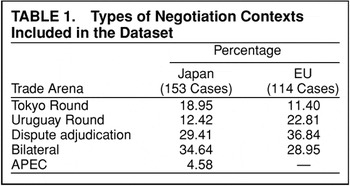
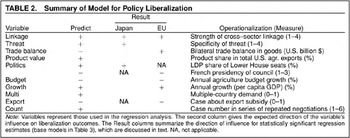
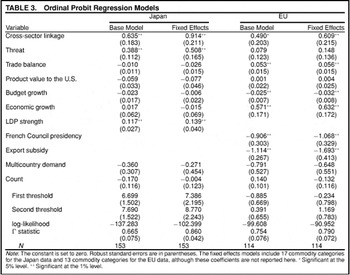

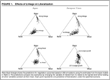
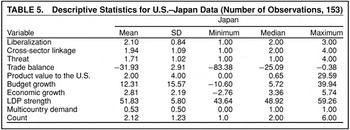
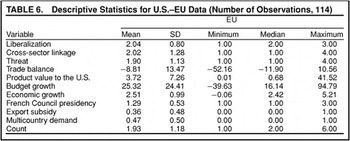



Comments
No Comments have been published for this article.