1. INTRODUCTION
Indigenous peoples are increasingly seeking to assert their rights over and responsibilities for water by challenging dominant ontologies and management approaches.Footnote 1 Recent scholarship highlights how the relationships of Indigenous peoples with waters are multifaceted, diverse, structured by values and protocols, and encompass practices and knowledge about the relationships between humans and more-than-human worlds that are the basis of Indigenous systems of law and governance.Footnote 2 Unlike settler-colonial legal frameworks, including those of Aotearoa New Zealand, which focus on rights to water, Indigenous governance and legal systems generally emphasize that people possess responsibilities towards water as a living (more-than-human) entity.Footnote 3 Indigenous peoples around the world are expressing concern over the decline in the quality and availability of water and freshwater biota, as well as their loss of access to socio-culturally, spiritually, and economically important waterscapes.Footnote 4 Tied to these concerns are understandings of rivers and freshwater systems as consisting of more than material components that encompass the metaphysical and more-than-human.
In this article we explore how Māori, the Indigenous people of Aotearoa New Zealand, are disrupting and decolonizing the dominant knowledge, governance, and management practices in relation to freshwater to address the negative effects on their rohe [traditional lands and waters]. In particular, we examine how treaty settlements – which involve the New Zealand government (NZ Crown) apologizing and providing reparations to the Māori iwi [tribe] for its breaches of the Tiriti o Waitangi/Treaty of Waitangi (ToW) – result in innovative legislation that is changing how rivers are conceptualized and managed. ‘Treaty settlements’, which began in the mid-1990s with the Waikato-Tainui Rauputu Settlement and continue to the present day, seek to address the historic and contemporary injustices experienced by Māori as a consequence of the NZ Crown failing to honour the ToW (outlined in Section 4). We focus our attention on the Nga Wai o Maniapoto (Waipa River) Act 2012 (NZ) (Waipā River Act)Footnote 5 and illustrate how this Act serves as the foundation upon which Ngāti Maniapoto seek to restore, manage, and enhance the health of their awa [river]. We outline the co-governance and co-management arrangements established for the Waipā River that provide for recognition of Ngāti Maniapoto relationships with and responsibilities for their awa. We argue that the legislation provides a far greater degree of recognition of Ngāti Maniapoto interests in the Waipā River than did previous laws, and enhances their capacity to shape river management and restoration while strengthening provisions under the Resource Management Act 1991 (RMA) regarding the role of Māori in resource management. We emphasize, in particular, how the inclusion of mātauranga Māori [Māori knowledge] and tikanga [customary laws] highlights the ways in which the legal order of Aotearoa New Zealand is increasingly being stretched to embrace truly legal pluralistic approaches. In acknowledging the potential for transformative change, we also draw attention to the difficulties associated with implementing legally and ontologically pluralistic legislation.
The article is structured as follows. Firstly, we provide a brief overview of legal pluralism and ontological pluralism scholarship. Secondly, we outline our case study location (the Waipā River in Aotearoa New Zealand). Thirdly, we outline the methodology we employed for this research project. Fourthly, we document how tikanga came to be excluded, and outline recent efforts to recognize tikanga within the legal order of Aotearoa New Zealand through new legislation and case law. Lastly, we analyze how the Nga Wai o Maniapoto (Waipa River) Act 2012 (NZ) recognizes tikanga and Te Ao Māori [Māori worldviews] as a cornerstone for governing and managing the Waipā River, which is a distinctive departure from previous legislation.
2. LEGAL AND ONTOLOGICAL PLURALISM WITHIN WATER GOVERNANCE
Recent critical legal pluralist research aims to radically de-centre settler-colonial state law.Footnote 6 The work of Curran, for example, shows how First Nations in Canada are seeking to repoliticize water governance regimes by situating their legal traditions and laws, and their expectations about what constitutes free prior and informed consent in joint water arrangements held with the provincial government.Footnote 7 Similarly, in the United States, numerous Indigenous nations continue to challenge the settler-state's legal order to expand how ‘Indian reserved water rights’ are defined within state and federal laws.Footnote 8 For instance, the decision in the case of Agua Calienta Band of Cahuilla Indians v. Coachella Valley District found that the Cahuilla tribe holds the rights to federal reserved groundwater and the tribe's right to use the water took precedence over the water allocation regime of the state government of California.Footnote 9 Similarly, the Standing Rock protest movement started by Standing Rock Sioux to resist the Dakota Access Pipeline is a declaration that Indigenous peoples (and their legal orders) remain despite ongoing colonial intrusions and dispossessions.Footnote 10 Such scholarship highlights the potentialities of pushing past the boundaries of property-based colonial structures and new ways of establishing meaningful shared partnerships between Indigenous and state actors.
Research focused on the ontological politics of governance demonstrates multiple injustices that are a product of the ongoing imposition of colonial understandings of water (as a material resource or commodity to be exploited, used, owned, and managed by humans). The exclusion of Indigenous ways of knowing water (as a living entity, as a relative, and an ancestor) and being (based on intergenerational responsibilities both to care for and sustainably use water) is equated with ontological and epistemological violence (an eco-violence).Footnote 11 Ontological and epistemological exclusions extend to the dismissal of Indigenous knowledge, social values, governance, and legal systems.Footnote 12 Addressing these injustices requires giving attention to avenues that allow for the inclusion of Indigenous ontologies and epistemologies; one way to do this is through legal reforms that embrace pluralism (legal and ontological) and the establishment of Indigenous-state co-governance arrangements that similarly are pluralistic.
3. CASE STUDY: WAIPA¯ RIVER
In Aotearoa New Zealand, the state of rivers and freshwater systems, including the Waipā River, is an area of considerable scientific, political, and public debate.Footnote 13 Despite claims that water quality in Aotearoa New Zealand is generally good by international standards, it is widely accepted that urbanization and intensive agriculture have led to persistent degradation and modification of rivers.Footnote 14 Moreover, the efficacy of established management approaches, and the extent to which current land-use practices are to blame, are increasingly controversial, as expectations about freshwater uses and aspirations for river futures are articulated by diverse elements of the public.Footnote 15
The Waipā River, located in the North Island of Aotearoa New Zealand, is the main tributary of the Waikato River and has a catchment of 306,569 hectares. The Waipā flows through land that was once native bush, wetlands and peat bogs, but is now mostly farmland and steep hill country. Approximately 78% of the catchment area is in pasture; 21% is native vegetation, scrub and other land uses; and 1% is production forestry. The habitat quality of streams in the catchment is below average nationally, while ecological health is around the regional average.Footnote 16
Present environmental degradation of the Waipā River is a result of complex socio-economic and political processes and practices, including the legacy and ongoing reality of colonization. The intensification of agricultural production within the Waipā catchment is traceable to the introduction of European technologies and biota (wheat and corn, fruit trees, as well as livestock) from the 1830s, first by missionaries, later by Māori hapū [sub-tribes], and European settlers.Footnote 17 Pressure on land and a management approach premised on increasing agricultural production also saw the drainage of wetlands so that now only pockets of wetlands and shallow peat lakes remain (less than 10%).Footnote 18
Ngāti Maniapoto are the iwi with mana [authority and sovereignty] in relation to the Waipā River, based on a long-standing relationship premised on kaitiakitanga [guardianship of environmental resources] and whakapapa [genealogy], which pre-dates European settlement in the early 19th century.Footnote 19 Ngāti Maniapoto recognize the river, and its material and metaphysical constituents, as an indivisible entity which includes water, banks, bed, streams, waterways, tributaries, lakes, fisheries, vegetation, floodplains, wetlands, islands, springs, geothermal springs, water column, airspace, and substratum.Footnote 20 Ngāti Maniapoto are concerned about the health of the Waipā River as it is considered a taonga [treasure] and the mauri [life force] of the iwi.
The Waikato Regional Council (WRC) is the local government authority responsible under the RMA for management of water resources in the Waikato region, which includes the Waikato and Waipā Rivers.Footnote 21 In addition to their responsibilities and obligations under the RMA, the WRC is one of five local authorities that is party to a joint management agreement with Ngāti Maniapoto under the Waipā River co-governance and co-management framework, established following treaty settlement (outlined in Section 5).Footnote 22
4. METHODOLOGY
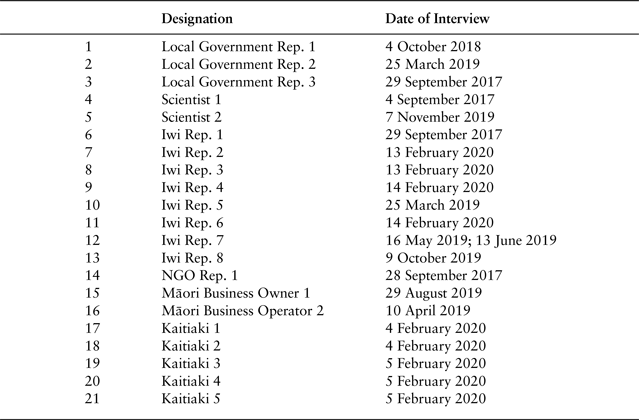
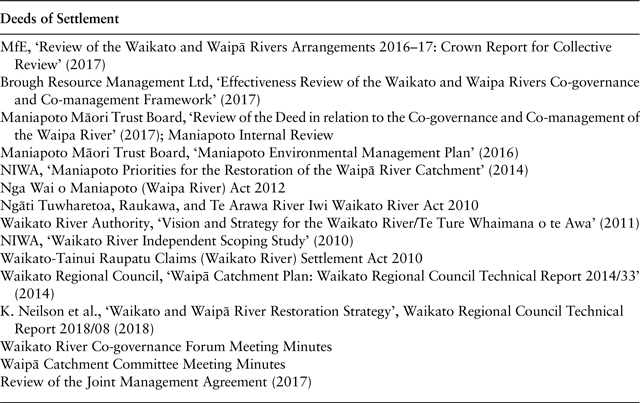
Our research project methodology involved the collection and analysis of primary and secondary data related to the historical and present-day governance and management of the Waipā River. We conducted 21 semi-structured interviews with representatives of iwi, and regional and local councils involved in the co-governance and co-management of the Waipā River (Table 1). In addition, we undertook archival-based research (following the method outlined by Parsons and Nalau) which involved the identification and analysis of historical government documents, policies, maps, and newspaper reports to provide background information about the drivers of environmental degradation, treaty settlements, and co-governance arrangements.Footnote 23 We also identified and analyzed a wide range of policy documents (including policies, external and internal reviews, plans, and legislation) related to the co-governance and co-management of the Waipā River (Table 2). Thematic analysis of all our collected data (interviews, archival sources, and policy documents) was conducted. We followed the six-step thematic analysis process outlined by Braun and Clarke, which involved deductive (theoretically informed) and inductive (data-driven) approaches to identify themes within the primary and secondary data.Footnote 24
List of Interviewees

List of Policy Documents Analyzed

5. FINDINGS AND DISCUSSION
5.1. Tikanga and Rohe Potāe (1800s to 1880s)
Māori and legal scholars increasingly acknowledge tikanga as the legal order that operated throughout Aotearoa New Zealand until the imposition of settler-colonial rule, including within the Ngāti Maniapoto rohe.Footnote 25 Justice Eddie Durie contrasts British (and then settler-colonial) legal order and tikanga and explains how western law is rule-based whereas tikanga is governed by values.Footnote 26 While Euro-western cultures generally ascribe to a clear distinction between law and morality, within Māori societies (as there are a number different tribal groups) under tikanga there is no separation between laws or rules and practices on the one hand, and one's values and ethics on the other. Morality and law are interwoven.Footnote 27 Tikanga, then, refers to laws that regulate the behaviour of people guided by the key principles of Te Ao Māori (the Māori world or worldview), which contrasts with Te Ao Pākehā (the Pākehā worldview – i.e., of non-Indigenous peoples in Aotearoa New Zealand in particular). As Mulgan observes:
All law, Pākehā as well as Māori, arises out of social norms and the need to enforce these norms within society. The ultimate source of Pākehā law is not the courts or statutes but the social values reflected by Parliament by statutes and by judges in their decisions.Footnote 28
Indeed, all societies have laws that represent certain socio-cultural values and fulfil particular functions within that particular society, most notably the preservation of social order and maintenance of collective security.
In 1840, Te Tiriti o Waitangi/the Treaty of Waitangi (ToW) was signed by representatives of the British Crown and more than 500 Māori rangatira [hereditary Māori leaders of hapū] including members of Ngāti Maniapoto.Footnote 29 The Māori and English language versions of the treaty differed substantively. The English version (signed by Crown officials) stated that Māori ceded their sovereignty to the British Crown (Article One), while retaining their property rights (Article Two) and giving Māori the rights and privileges afforded to British subjects (Article Three). The Māori version (of which multiple copies were signed by Māori throughout the country) recorded that Māori gave the British the right of kawanatanga [governorship] to oversee the country, while Māori continued to retain their rangatiratanga [chiefly authority which was inseparable from their sovereignty] over their lands. In both versions the British recognized some form of Māori customary tenure and resource rights, and promised that Māori would be able to retain possession of their lands, forests, and other resources. However, the nature of Māori modes of governance and understanding of land rights differed substantively from British notions of owning land and transferable property rights.Footnote 30
Māori tenure systems prior to European settlement were governed by Māori customary law and resembled common property relations and usufruct rights where rights to land and resources were held by an iwi or hapū. The concept of ahi ka – ‘keeping the fires burning’ or continued occupation or use – established claims to resources. According to tikanga, rivers were viewed as a taonga, and there was no separation made between water in a river, the riverbed, and surrounding land.Footnote 31 These Māori customary ownership and management rights to water were recognized in the ToW. The idea of ‘ownership’ or private property relations, as understood by British settlers, was a foreign concept to Māori.
British officials and later the settler-led colonial government quickly disregarded the ToW. Successive colonial justices and governors declared it as nothing more than a piece of paper that was immaterial to the newly establish colony of New Zealand.Footnote 32 Māori were dispossessed of their lands and lost access to resources through acts of war, the imposition of discriminatory legislation, the activities of the Native Land Court, and inequitable land purchase practices.Footnote 33
With the importation and implementation of British common law to Aotearoa New Zealand following the ToW, which accompanied the establishment of a parliament and the court system (seeking to replicate those of Britain), the role of tikanga gradually reduced. Dorsett's study of Māori interactions with the colonial courts in Aotearoa during the initial years of British colonization (1840–52) shows there was some recognition and tolerance of tikanga by British colonial officials on the basis that it was only temporary. The assumption was that tikanga would (in the words of Governor Grey) simply ‘wither away’ as Māori were forced to assimilate culturally into the settler-colonial culture and legal order.Footnote 34 War, infectious diseases, the breakdown of governance structures, the loss by Māori of the majority of their whenua [land] and degradation of their awa (both sources of their mana) resulted in severe impacts on Māori health and wellbeing, and contributed to a decline in the usage of tikanga.Footnote 35
5.2. Ngāti Maniapoto Tikanga
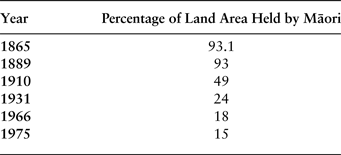
While British colonization of Aotearoa New Zealand commenced formally after the signing of the ToW in 1840, Ngāti Maniapoto maintained tino rangatiratanga [chiefly authority and self-determination] of their rohe (known as Te Rohe Potāe or the King Country from 1864) until the mid-1880s, which was much longer than experienced by iwi in other parts of the country.Footnote 36 During the period 1840 to 1885, tikanga was the legal order for Ngāti Maniapoto and for other Māori groups living in Te Rohe Potāe. It was not until the late 1880s, after Ngāti Maniapoto and the NZ Crown reached an agreement which allowed the government to build a railway line through Te Rohe Potāe, that colonial legal order began to supplant tikanga. The decline of tikanga and the ascent of colonial laws and governance structures in Te Rohe Potāe occurred because of the imposition of colonial Acts of Parliament, the arrival of large numbers of Pākehā settlers, and land loss as a result of the operations of the Native Land Court and NZ Crown purchasing practices (see Table 3).
Percentage of Land Held by Māori in Rohe Potāe (King Country) between 1865 and 1975

Note:
a L. Boulton, Land Alienation in the Rohe Potae Inquiry District, 1866-1908: An Overview (Waitangi Tribunal, 2011).
In addition to physical dispossession, Māori understandings, values, and socio-cultural and environmental practices were excluded from the governance and management of freshwater.Footnote 37 This exclusion was notable particularly in the efforts of individuals and government agencies, reflective of settler colonializing and modernizing processes, to transform the landscapes and waterscapes to create a so-called ‘Britain of the South Seas’.Footnote 38 This involved ongoing intervention to clear Indigenous forests (by logging and fire), drain wetlands, re-engineer rivers, and supplant Indigenous biota with exotic species. The cumulative impacts of these changes on Māori were the loss of access to places and things of cultural significance, the diminishing of social, spiritual, and economic resources, and lasting distress for iwi and hapū.Footnote 39
5.3. Legal Challenges to the Destruction of Taonga: Te Kawa Wetlands
Despite the catalogue of adversity which settler colonization inflicted upon Māori, including Ngāti Maniapoto, iwi around Aotearoa New Zealand continued to call the NZ Crown to account for its failure to honour the articles of the ToW.Footnote 40 From the inception of the settler-state, Māori, as individuals and groups, have resisted the confines of the settler-state legal order and sought to reassert their tikanga. This included numerous protests and legal cases mounted by Māori, including members of Ngāti Maniapoto, which sought to ensure the recognition of their interests in waterways and aquatic biota, as well as their tikanga. For instance, between 1908 and 1914, Māori landowners within Te Rohe Potāe launched a legal case against the Kawa Drainage Board challenging the Board's ongoing efforts to drain the entirety of the Te Kawa wetlands (deemed by Pākehā to be unproductive wastelands).Footnote 41 The Kawa Drainage Board, one of 13 operating within the Waipā River catchment during the first half of the 20th century, comprised elected local government officials charged with wetland drainage, dredging river channels, and the construction of flood structures.Footnote 42 Drainage boards possessed wide-ranging powers and could undertake drainage works on land if the landowners objected, with the costs of drainage works paid by all landowners through the levy of local rates. Thus, Māori in the Waipā were often forced indirectly to pay for the destruction of their repo [wetlands], which they considered to be taonga. Wetlands were treasured places not only because they were a plentiful source of food but also for socio-cultural reasons. For instance, wetlands were often home to taonga, metaphysical beings – which included taniwha [supernatural beings that live in waterways] and atua [deities].
In 1908, 12 Māori wrote a letter to the Minister of Native Affairs about the Kawa Drainage Board's planned drainage works, raising concerns that this would destroy their pā tuna [eel weirs] and affect their ‘main source of food supply’, namely tuna [freshwater eels].Footnote 43 The letter to the Minister cited the ToW and the protection of resource rights (Article Two) and requested that drainage works be halted until they reached agreement. After only limited inquiries by government and court officials, the Minister of Native Affairs declared that the Department of Native Affairs would not intervene in a local government matter and suggested the Māori seek legal advice to pursue the matter further.
Over the next few years, with legal advice and representation, Māori landowners within Te Kawa wetlands continued to plead their case against the planned drainage works. Arguments emphasized the interconnectedness of landscapes and waterscapes and the mutual benefits derived from it whereby the ‘piece of land [was] an eel pa [pā tuna]’ which they held ‘for their own benefit and for the benefit of the[ir] … tribe’ and it was of ‘great value … and importance to them’.Footnote 44 The proposed drainage canal would ‘destroy the character of the said piece of land as an eel pa’, and the owners could not ‘be adequately compensated for such destruction’. Indeed, money would be insufficient to compensate for the lack of eels. The drainage works were both ‘inequitable’ and would ‘infringe the just legal equitable rights of the objectors to maintain the said piece of land as an eel pa’.Footnote 45 The parties could not reach an out-of-court settlement and, in May 1910, the New Zealand Supreme Court heard the case. The Court sided with the Kawa Drainage Board and declared that, although Māori landowners could be compensated financially for the loss of the eel weirs, the rights of Māori ‘should not be allowed to stand in the way of draining a large area of country’.Footnote 46
Following the Supreme Court decision, the plaintiffs sought compensation as allowed under the Land Drainage Act 1908 (NZ).Footnote 47 By the time the Supreme Court heard the case again in 1914, most of the drainage works were complete and the pā tuna removed.Footnote 48 Accordingly, the case focused solely on the matter of compensation. The approach to compensation taken by the Māori claimants rested on western modernist framings of ownership and private property rights to support their argument, rather than on Te Ao Māori understandings of non-materialistic conceptualizations of tuna and the intergenerational usage of resources. The adoption of a modernist framing was a strategic approach taken by Māori to receive financial compensation for the loss of wetlands and the decreased (or destroyed) capacities to harvest tuna and other freshwater biota used for food, medicine, art, and cultural activities.
The Supreme Court determined in this matter that compensation applied only to damage to pā tuna but not to the reduction in the number of tuna in the stream. The Drainage Board, the Supreme Court declared, possessed exclusive authority to alter waterways and drain wetlands; thus the rights of Māori (and corresponding financial claims) were highly constrained.Footnote 49 The Supreme Court's decision reflected European understandings of land and water, with Judge Cooper declaring that the removal of the wetlands (formerly useful only as a ‘fattening place for eels’) was of benefit to all residents within the district, so the plaintiffs should be grateful that the Drainage Board was transforming their unproductive wastelands into ‘the most valuable dairy-farm land’.Footnote 50
The case of Te Kawa wetlands, as well as later challenges by Ngāti Maniapoto and other iwi regarding other water bodies, demonstrate that Māori sought to retain their rangatiratanga, practise kaitiakitanga, and maintain their tikanga despite the advent of the settler-state and its new legal order. In their different engagements with a variety of local government authorities and central government agencies as well as the courts, Māori discussed, negotiated and sought new ways to reconcile their tikanga with that of Te Ao Pākehā.Footnote 51 It is therefore inappropriate to think of this conflict as a straightforward ‘clash of civilizations’. The Te Kawa wetlands case also illustrates the different ways in which Māori sought to challenge the dominant settler-colonial assumptions about wetlands and to articulate relational connections with their whenua, awa, and repo. This differs fundamentally from western liberal ontologies centred on binary divisions between nature/culture and land/water.
Within Te Ao Māori, whānau [extended family], hapū, and iwi are linked through whakapapa to each other as well as their rohe and all beings living within it, including plants, animals, and the supernatural. Māori thus continued to advocate the importance of activities that were not part of the market economy or those of Te Ao Pākehā. While land, rivers, wetlands, and biota were fundamental for Māori subsistence activities, they were never reducible to exploitable resources. Instead, there were always social, ethical and spiritual dimensions that bound Māori as tangata whenua [people of the land] to their landscapes and waterscapes. Yet, not all Māori articulated these views, with some advocating the adoption of Te Ao Pākehā, at least where it concerned economic development and financial compensation.
In 1914, iwi members rejected the Court's judgment (although the landowners accepted compensation) and maintained that tuna were taonga which needed to be protected and preserved for both current and future generations. Throughout the remainder of the 20th century, individuals and groups within Ngāti Maniapoto campaigned against the ongoing destruction of their mahinga kai [food-gathering sites] and wāhi tapu [sacred sites] from drainage and flood control works, protested against local government's continued discharge of pollutants (most notably human waste) into waterways, and drew attention to declining aquatic biodiversity, including tuna.Footnote 52 In the first decade of the 21st century, the Maniapoto Māori Trust Board (MMTB), which represents the wider Ngāti Maniapoto iwi, articulated its concerns about the degradation of the Waipā River as the consequence of more than a century of colonial intervention:Footnote 53
Looking at the Waipa River today, it is hard to believe that our tupuna [ancestors] spoke of a time not so long ago when the waters of the Waipa were clear, deep and blue. Within the clear, clean waters of the Waipa were fat eels, large crayfish, and a variety of fish, a plentiful source of food. … The waters of the Waipa now run muddy brown, polluted with farm run-off, industry discharges, sewerage spills and stormwater drainage. Many food species have disappeared from the river, and the remaining tuna/eels within the river may not be safe for eating.Footnote 54
Ngāti Maniapoto highlight how the degradation of the Waipā River and its tributaries is an indicator of the state of not only the hau ora [health and wellbeing] and mauri [life force] of the river, but also the interconnections of awa, whenua, taiao [environment], and mana whenua [tribal group with authority over the territory]:
The streams and rivers are the lifeblood of our environment, and they tell us about the state of our environment … As with the human body, if the blood of the environment is poisoned, the rest of the body will also suffer … There are many activities within the Maniapoto territory that give cause for concern about the welfare of the environment.Footnote 55
The above quote indicates the continuation of Ngāti Maniapoto understandings of their awa and themselves as centred on their reciprocal relations based on whakapapa.Footnote 56 When articulating these relationships and engagement with the Waipā River, Ngāti Maniapoto speak of the essence of life or ‘the life blood of the people. Waipa she is the life blood of the land, verily she is! Indeed she is the unfailing spring of the earth!’.Footnote 57 Accordingly, as anthropologist Anne Salmond observes, an ‘attack on the hau [vital essence] of a river is an attack on the life force of its people, since they share ancestral hau [vital essence] together’.Footnote 58
Ngāti Maniapoto iwi representatives we interviewed described rivers as inextricably connected to streams, lagoons, wetlands and springs, and encompassing both metaphysical and material aspects.Footnote 59 One Ngāti Maniapoto interviewee draws on Māori cosmology of ‘Papatūānuku [the earth or Earth Mother, and] Ranginui [the sky or Sky Father]’ to explain the Ngāti Maniapoto ‘worldview’ centred on kaitiakitanga and understandings of good river governance and management: ‘It's about caring for everything that exists … You can't take a Pākehā process and put them [Papatūānuku and Ranginui into it] – you can't … it wouldn't work. It … [is] our mana, our sovereignty and our space’.Footnote 60 For Ngāti Maniapoto, the interweaving of human and more-than-human beings along with the biophysical, social, and spiritual retains its importance for understanding and managing the Waipā.Footnote 61 Such thinking emphasizes the interrelationships between individuals and collectives (human, ecological, and metaphysical communities) and the responsibility of mana whenua to maintain the mauri of their rohe.Footnote 62 Rather than a singular Māori worldview, this reflects a Māori world from the inside out wherein the creation of the cosmos is at the centre of all relationships.Footnote 63 Such an ontological perspective – centred on place-based, reciprocal, and intergenerational relations – has been undermined by policies and interventions that degraded waterways and contributed to substantive losses that extend beyond the material and encompass the metaphysical.
5.4. (Re)assertion of Tikanga: The Waitangi Tribunal and Treaty Settlements (1970s to 1990s)
For more than 150 years, Māori throughout Aotearoa New Zealand actively sought to resist challenges to their rangatiratanga and mana through armed and peaceful protests.Footnote 64 Ongoing protests during the 1970s directed at the protection of Māori catapulted Māori concerns about their land into the mainstream public (Pākehā-centred) and political consciousness.Footnote 65 The Treaty of Waitangi Act, in 1975, established a permanent commission of inquiry – the Waitangi Tribunal – to investigate claims made by any Māori individual or group that the Crown had breached the guarantees of the ToW. These initially concerned contemporary claims only but expanded from 1985 to include historic inquiries.Footnote 66
Following the setting up of this Tribunal, the NZ Crown established the Office of Treaty Settlements (OTS) in 1994 as a separate institution, located within the Ministry of Justice and entirely distinct from the Waitangi Tribunal, to negotiate with individual iwi, and sometimes larger pan-iwi groupings, legal-financial reparations packages that acknowledged and sought to address the Crown's failures to honour the ToW. These treaty settlements include a formal apology from the Crown for historic and contemporary injustices against a particular iwi, financial reparations to the iwi (in the form of monetary payments and return of Crown landholdings), and the introduction of new legislation.Footnote 67 In the case of the Waikato/Tainui iwi, whose rohe includes the lower reaches of the Waipā River, the choice was made to forgo the Tribunal and the iwi reached treaty settlement agreements with the Crown regarding its land claims in 1995, and about co-management of the Waikato River in 2010.Footnote 68 Similarly, Ngāti Maniapoto, whose rohe includes the middle and upper reaches of the Waipā River, engaged in direct negotiations with the OTS regarding co-governance and co-management of the Waipā River. The iwi chose to take its other treaty claims to the Waitangi Tribunal. The Te Rohe Potae Inquiry of the Tribunal is still ongoing (as of 2019), with the first pre-publication chapters of the inquiry report released in late 2018.Footnote 69
6. WAIPA¯ RIVER DEED OF SETTLEMENT AND NGA WAI O MANIAPOTO (WAIPA RIVER) ACT 2012
The Waipā River Deed of Settlement between Ngāti Maniapoto and the Crown was signed on 27 September 2010.Footnote 70 The Nga Wai o Maniapoto (Waipa River) Act 2012 (NZ) (Waipā River Act) gives effect to the 2010 Deed of Settlement.Footnote 71 The main purpose of the Waipā River Settlement is to achieve:
the restoration and maintenance of the quality and integrity of the waters that flow into and form part of the Waipa River for present and future generations and the care and protection of the mana tuku iho o Waiwaia [cl 3.6.1]; and the restoration and protection of the health and wellbeing of the Waikato River for future generations [cl 3.6.2].Footnote 72
Waiwaia is a taniwha that often assumes an eel-like form and dwells in the waters of the Waipā. The Deed recognizes Waiwaia as a kaitiaki [guardian] of both the Waipā River and the Ngāti Maniapoto people, as well as the essence and wellbeing of the Waipā River and the personification of the waters of the river. The Deed also recognizes the importance of the Waipā River as a taonga to Ngāti Maniapoto; the obligation and desire to restore, maintain and protect all the waters that flow into or fall within the Ngāti Maniapoto rohe; and the mana of Ngāti Maniapoto in respect of the Upper Waipā River. While signing the Deed of Settlement, [Ngāti] Maniapoto and the Crown entered into the Waiwaia Accord to enhance and sustain the relationship between Ngāti Maniapoto and the Crown.Footnote 73 The Waiwaia Accord affirms the commitment of Ngāti Maniapoto and the Crown to partner in co-governance and co-management of the Waipā and oversees and protects the integrity of the agreements set out in the Deed and the Ngāti Maniapoto legislation; a further nine accords followed from the Waiwaia Accord.
The Ngāti Maniapoto Deed of Settlement built on treaty settlements and resulting legislation between other iwi (Waikato-Tainui, Ngāti Tūwharetoa, Ruakawa, and Te Arawa) and the Crown regarding the Waikato River. It also contributes to the body of settlement legislation that challenges settler-colonial legal systems and sources. For example, earlier treaty settlements with Te Arawa and Ngāi Tahu included recognition of tikanga within their Deeds of Settlement and resulting legislation. The Ngāi Tahu Claims Settlement Act 1998 (NZ) includes pūrākau [traditions and stories] of the whenua, such as the origin story of Aoraki/Mount Cook and the naming of the South Island. More recent treaty settlements and statutes grant legal personhood to non-human entities (the Te Urewera forest and the Whanganui River), which represents another innovative attempt to incorporate Māori understandings of their taiao [environment] and to recognize the agency of more-than-human entities.Footnote 74 The inclusion of tikanga within deeds and resulting legislation provides an important catalyst for transforming legal education and public understandings of law.Footnote 75
The Ngāti Maniapoto Deed of Settlement serves to formalize co-governance and co-management arrangements in respect of the Waikato River and Lower Waipā River as established in Deeds of Settlement signed between the Crown and Waikato-Tainui, and Ngāti Tūwharetoa, Raukawa and Te Arawa, as well as legislation enacted in relation to the Waikato River.Footnote 76 Collectively, these three Deeds and resulting legislation determine the architecture and mechanisms to enable co-governance and co-management across the extent of the two catchments. Separately, each Deed acknowledges the significance of the Waikato and Waipā Rivers to each of the iwi and elucidates a set of principles to guide the interpretation of the Deed and legislation enacted as part of each settlement. The significance of the Waipā River as an important tributary of the Lower Waikato River, and the recognition of the need to take a holistic and integrated approach to ensure a healthy Waikato River, which includes the Waipā River, provided the impetus for aligning and coordinating co-governance and co-management arrangements.Footnote 77
The Waipā River Act rearticulates the central purpose of the Deed to ‘restore and maintain’ the Upper Catchment of ‘the Waipa River for present and future generations and the care and protection of the mana tuku iho o Waiwaia’.Footnote 78 Within the Act, Waiwaia is a central figure, with the mana tuku iho o Waiwaia meaning the ancestral authority and prestige handed down from generation to generation of Ngāti Maniapoto in respect of Waiwaia.Footnote 79 The recognition given to Waiwaia highlights the ways in which the elements of tikanga as well as Te Ao Māori and mātauranga are being incorporated into the legal order of Aotearoa New Zealand as it explicitly acknowledges that freshwater systems comprise physical and metaphysical elements. In particular, the legislation and accords mention the mauri of the river, which all Māori who connect via whakapapa to the Waipā River are required to maintain through correct behaviour and practices (through tikanga and mātauranga). In these dynamic, fluid, and interrelational landscapes-waterscapes, the Waipā River is not simply a physical feature; it is recognized as an agent that shapes and connects the physical and metaphysical worlds together, carrying with it the histories, stories, and whakapapa of specific iwi and hapū.Footnote 80
Though similar to the legislation passed for the Waikato River, there are differences in the Waipā River Act (in addition to the purpose of the enactment) whereby the co-governance framework is distinguished from co-management arrangements (whereas the Waikato River Acts refer only to ‘co-management’). Within the Waipā River Act, four mechanisms form the co-governance framework:
• the Waikato River Authority as the co-governance entity;
• Te Ture Whaimana o Te Awa Waikato / Vision and Strategy for the Waikato River (V&S);
• the Waikato River Clean-up Trust (WRCuT); and
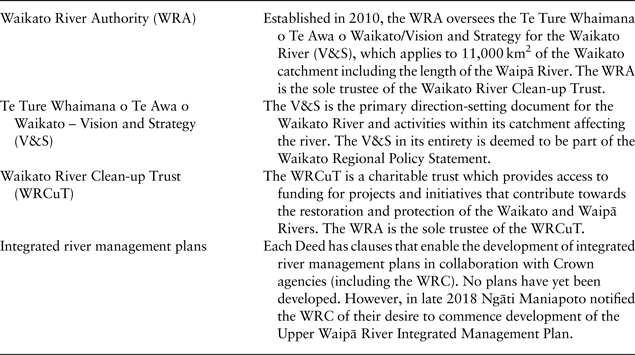
• the integrated river management plans (summarized in Table 4).
Table 4Co-governance Framework for the Waikato and Waipā Rivers


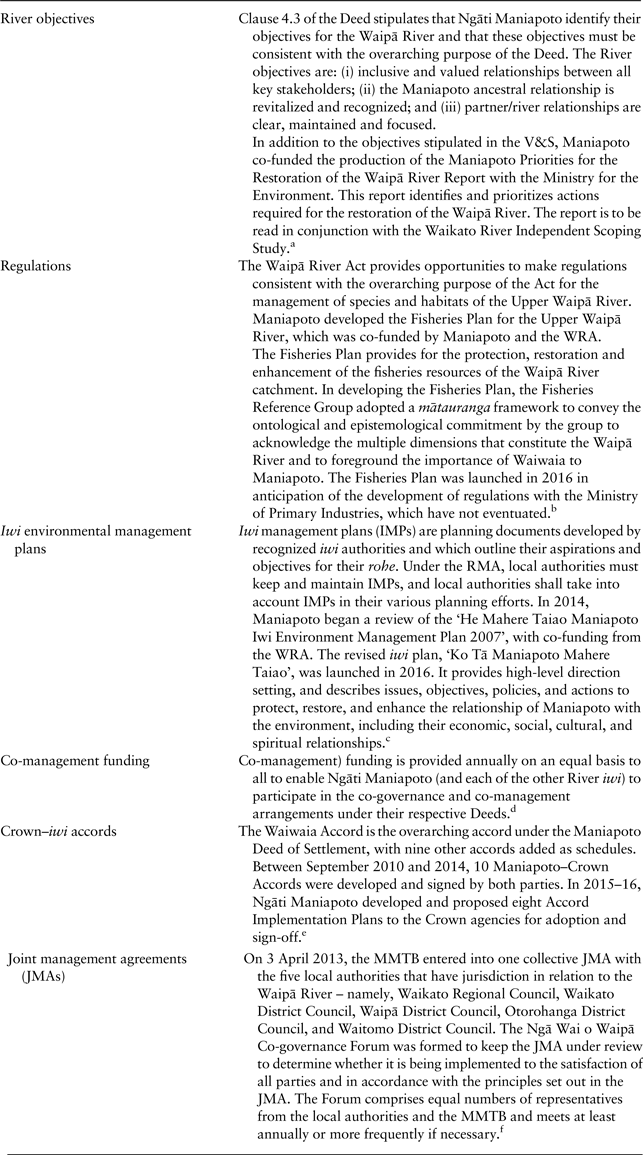
The Act also outlines six mechanisms which comprise the co-management arrangements: (i) river objectives; (ii) regulations; (iii) iwi environmental management plans; (iv) co-management funding; (v) Crown–iwi accords; and (vi) joint management agreements (summarized in Table 5).
Co-management Arrangements for the Waipā River

Notes:
a MMTB, ‘Review of the Deed in relation to the Co-Governance and Co-Management of the Waipa River’ (2017); National Institute of Water & Atmosphere Research Ltd, n. 89 below.
b MMTB, ibid.; Watene-Rawiri, Kukutai & MMTB, n. 87 below.
c MMTB, n. 88 below.
d Ministry for the Environment & Te Puni Ko¯kiri, ‘Review of the Waikato and Waipa Rivers Arrangements 2016–17: Crown Report for Collective Review’ (2017); Nga Wai o Maniapoto (Waipa River) Act (2012).
e MMTB, ‘Review of the Deed in relation to the Co-Governance and Co-Management of the Waipa River’ (2017).
f MMTB, Otorohanga District Council, Waikato District Council, Waikato Regional Council, Waipa District Council & Waitomo District Council, Joint Management Agreement (2013); Nga Wai o Maniapoto (Waipa River) Act 2012.
6.1. Vision and Strategy
The V&S is the primary direction-setting document for the Waikato River and activities within its catchment that affect the Waikato River, and is included in the form of schedules attached to each of the Waikato River Acts and the Waipā River Act. The V&S applies to the entirety of the Waikato and, since 2012, Waipā catchments and tributaries; it is deemed part of the Waikato Regional Policy Statement, a mandatory planning document prepared under the RMA. The provisions of the V&S prevail over any inconsistency in policy or planning documents, which include the RMA and ensuing national policy statements. In undertaking duties or exercising powers, decision makers ‘must have particular regard to the vision and strategy’ insofar as their actions relate to the Waikato River (and its catchment) or activities that may affect the Waikato River Catchment.Footnote 81
The drafting of the V&S by the Guardians Establishment Committee in 2008 positioned Māori as co-developers in the process of determining what should be included. The Committee comprised 16 members, half of whom were Māori, and signalled a watershed moment for environmental decision making on the Waikato, from which Māori had been excluded since the military invasion in 1864. A key point is that, because of the treaty settlement process, Waikato-Tainui were able to participate in the drafting of the V&S as well as its later revisions and approval. The V&S emphasized Waikato-Tainui iwi desires for a ‘healthy Waikato’ which can sustain an ‘abundant life and prosperous communities’ who are all ‘responsible for restoring and protecting the health and wellbeing of the Waikato River, and all its embraces, for generations to come’. The objectives not only reflect the aspirations of Waikato-Tainui as mana whenua but also the widespread views of Māori iwi about the need for action to protect and restore their ancestral rivers and ensure intergenerational health and wellbeing through the enactment of kaitiakitanga.
6.2. Waikato River Authority and Waikato River Clean-up Trust
The Waikato River Authority (WRA) is the co-governance entity established for the Waikato River following the passing of the Waikato-Tainui Raupatu Claims (Waikato River) Settlement Act 2010, with iwi membership expanding with the passing of subsequent legislation. The WRA consists of ten members, half of whom are appointed by the five mandated iwi authorities (including the MMTB), and five by the NZ Crown. The equal representation of the Crown and Māori on the WRA reflects the ToW principle of partnership.
The power given to the WRA strengthens the position of Māori with regard to council duties and functions under the RMA by requiring council authorities to engage with the WRA to amend planning documents to give effect to the V&S, and by requiring notification by councils of resource consent applications related to the Waikato or Waipā Rivers.Footnote 82 If a consent application proceeds to a public hearing, the hearing committee must consist of an equal number of members appointed by the council and the WRA (along with an independent chairperson). The WRA also has the power to request call-ins under sections 23 to 31 of the RMA. The WRA, thus, in giving effect to the V&S, seeks to ensure increased Māori participation and decision-making power within the environmental management processes beyond those provided under the RMA.
The WRA is also the sole trustee of the WRCuT, a charitable trust that provides funding for restoration within the Waikato and Waipā River catchments to achieve the V&S. As trustee, the WRA oversees the contestable funding rounds. Ngāti Maniapoto and other iwi have criticized the WRA for lacking transparency in its decision-making processes, for not providing adequate communication to people at the grassroots (local) level, and for adopting a western mode of governance (rather than Māori deliberative decision-making processes centred on extended discussions on marae, which is a courtyard or open area in front of a meeting house where formal greetings and discussions take place). Some Ngāti Maniapoto iwi representatives consider that the WRA, and co-governance initiatives connected with it, are failing to reach their ‘full potential’.Footnote 83 In particular, the WRA is criticized for its management of the WRCuT competitive funding process and for favouring political and industrial bodies over iwi groups when allocating funding. The contestable nature of the WRCuT, and the associated application processes, can present significant capacity and resource challenges for iwi, hapū or whānau who wish to apply, which limits the extent to which grassroots restoration works using mātauranga and governed by tikanga can be undertaken.
6.3. Integrated River Management Plans
In addition to these mechanisms, each of the River Acts contains provisions for the development of integrated river management plans in collaboration with Crown agencies (identified as a co-governance mechanism in the Waipā River Act). The purpose of these plans is to adopt an approach that integrates a range of different agencies and authorities to manage the aquatic life, habitats, and natural resources of the Waipā River. The scope of the integrated plans is more expansive than plans developed under the RMA. While these plans hold great potential for enabling iwi to have greater control over their awa in the exercise of mana whenua and kaitiakitanga, as of 2020 no iwi has yet developed an integrated river plan.
6.4. Co-management Arrangements
The co-management and co-governance arrangements for the Waikato and Waipā River Acts are notable as ‘[t]hese are the first statutes in New Zealand to elevate Māori to co-management roles with the Crown in regard to fresh water’.Footnote 84 The co-management arrangements specified in the Waipā River Act are: (i) river objectives, (ii) regulations, (iii) iwi environmental management plans, (iv) co-management funding, (v) Crown–iwi accords, and (vi) joint management agreements (JMAs). Ngāti Maniapoto have enacted each of these mechanisms, which has culminated in a number of planning documents that set out iwi aspirations and provide guidance for them and their partners, enhanced working relationships with local authorities, improved communication with Crown agencies, and prompted new workstreams to pursue work that directly benefits the Waipā and Ngāti Maniapoto.
Some of the plans and outcomes associated with co-management are summarized in Table 5; here, we focus on the JMA as an exemplar of using the treaty settlement process to enhance freshwater management in a way that addresses Māori knowledge, values, and tikanga. JMAs are intended to improve collaborative planning for the Waipā River between local authorities and the MMTB, and adhere to the overarching principles in the Deed. JMAs are required under the Waipā River Act. Their scope is wide, with some parts mandatory (for example, monitoring and enforcement, preparation and amendments to RMA planning documents), while other parts are by agreement. As with the provisions under the RMA, local authorities remain reluctant to share powers with iwi through JMAs under the Waipā River Act, although they have deepened their relationships with the MMTB. Rather than entering into multiple JMAs, the MMTB, in 2013, entered into one collective JMA with the five local authorities with jurisdiction in relation to the Waipā River – namely, Waikato Regional Council, Waikato District Council, Waipā District Council, Otorohanga District Council, and Waitomo District Council.
The Ngāti Maniapoto JMA provides a framework for local authorities and the MMTB to work together to carry out the functions, duties, and powers provided for, and to give effect to the Waipā River Act. The Nga Wai o Waipa Co-governance Forum was formed to determine whether the JMA is being implemented to the satisfaction of all parties and in accordance with the JMA principles. The Forum comprises equal numbers of representatives from the local authorities and the MMTB and meets at least once annually, with secretariat support provided by Waikato Regional Council.
A review conducted in 2017 to assess the effectiveness of the JMA and to identify areas of potential improvement found widespread iwi and local government support. Similarly, our interviewees expressed strong support for the JMA and cited the strong legal foundation from which to give effect to treaty partnerships.Footnote 85 Iwi representatives also cited the need to strengthen opportunities to expand the working relationships between the MMTB and local authorities to include those iwi members who are not employed by the MMTB yet work at the grassroots level to restore and protect the awa. Iwi members also wanted broader consideration of how the JMA could facilitate opportunities for iwi-led community, economic, and environmental projects that align with iwi aspirations for the Waipā catchment.Footnote 86
The co-management arrangements exemplify the challenges of accommodating ontological pluralism within formal institutional arrangements and in the implementation of management actions by government agencies. The Waipā River Act states that only Ngāti Maniapoto can represent their interests in the Upper Waipā River. Perhaps unsurprisingly, plans and documents produced by Ngāti Maniapoto achieve this easily, while it appears more challenging for local government to incorporate Ngāti Maniapoto interests, especially the use of mātauranga and tikanga. The Ngāti Maniapoto JMA allows for greater participation by the MMTB in decision making related to the Waipā than is available under the RMA; however, planning documents produced under the RMA and guidance documents for local authorities continue to be rooted in western legal and ontological frameworks. These documents differ markedly from those developed by Ngāti Maniapoto, which affirm foundational principles based in Te Ao Māori, mātuaranga and tikanga. For example, in developing the Upper Waipā Fisheries Plan (a regulation mechanism as noted in Table 5, which was produced entirely by and for Ngāti Maniapoto), the Fisheries Reference Group used a mātauranga framework to enable the expression of the multiple dimensions constituting the Waipā River.Footnote 87 Waiwaia is explicitly identified as a kaitiaki of Ngāti Maniapoto and acknowledged within the Fisheries Plan. Ensuring the continuation of the reciprocal relationship between Waiwaia and Ngāti Maniapoto is at the forefront of the Fisheries Plan. Similarly, Waiwaia features as an important non-human actor in Ko Ta Maniapoto Mahere Taiao (the Ngāti Maniapoto Iwi Management Plan), which has as one of its aims giving effect to the overarching purpose of the Waipā River Act and identifies the need to draw on mātauranga as well as scientific knowledge to achieve its objectives.Footnote 88
In comparison, the Waipā Catchment Plan (developed by the WRC to guide management actions within the catchment) acknowledges the special relationship between Ngāti Maniapoto, Waiwaia and the Waipā, but does not provide guidance on how to navigate this relationship. While the WRC developed the Plan in collaboration with Ngāti Maniapoto, at MMTB level as well as with iwi and hapū, and drew upon the priorities identified by Ngāti Maniapoto, a science-based approach to management is privileged over mātuaranga and use of tikanga. Rather than the WRC exhibiting a lack of care or disregard for Waiwaia and mātauranga, determining actions to care for and protect a supernatural creature and the spiritual dimensions of the river remain beyond the traditional purview of a management organization utilizing western science.Footnote 89
7. CONCLUDING REMARKS ON THE WAIPA¯ RIVER SETTLEMENT AND ACT
Compared with previous treaty settlements centred on water bodies, such as Te Arawa and Ngāi Tahu, the treaty settlements for the Waikato and Waipā Rivers ‘broke new ground in relation to the participation of Māori in the management of water resources’.Footnote 90 Indeed, the Waipā River Act went some way towards addressing the deficiencies of the RMA identified by Māori and allowed the incorporation of Ngāti Maniapoto tikanga, values, and aspirations into governance and management arrangements for the first time.
The language used within the Maniapoto Deed and Waipā legislation marks a significant shift away from viewing rivers as purely physical entities divisible into geomorphic, hydrologic, and ecological components. Indeed, the inclusion of Māori principles and values in the legislation destabilizes the authority of western liberal modernist assumptions and ways of thinking about water as a resource and commodity to be owned, exploited, and controlled.
The legislation recognizes and seeks to enable Ngāti Maniapoto to exercise their relational and reciprocal connections as kaitiaki with their awa. While there is potential for the new co-governance and co-management arrangements to enable transformative changes to river management and the knowledge used to inform decisions, there is also the possibility that the dual system may reinforce the status quo. At the institutional level, the WRA plays a role in advocating on behalf of Ngāti Maniapoto and the Waipā River, while the WRCuT is a source of potential funding for restoration projects undertaken by the MMTB and for hapū and marae kaitiaki. The V&S and the obligations and responsibilities it places on local government authorities provide a strong basis for the inclusion of mātauranga and tikanga in formal planning processes. This represents an enormous shift in the positioning of Māori within the Waikato region. Weaknesses of these institutional arrangements relate to concerns about transparency, authority, and legitimacy of the WRA to act on behalf of all iwi, and the perceived distance between the WRA and those at the grassroots level.
At the operational level, the co-management arrangements, and especially the JMAs, place the MMTB firmly in the sightlines of the local authorities whose jurisdictions overlap with the rohe of Ngāti Maniapoto. These arrangements strengthen provisions under the RMA and enhance the role of iwi in management and planning processes. However, the complex nature of the co-governance framework and co-management arrangements places an increased burden on the MMTB, which is compounded by the continued dominance of western bureaucratic processes. Ongoing success may require that local authorities give up some of their decision-making authority to Ngāti Maniapoto regarding resource use and allocation at both policy and implementation levels, and adopt new practices which conform more closely to tikanga and Māori modes of governing and practice. While there is no guarantee that the new co-management and co-governance arrangements will lead to the radical transformations desired by many Māori, there are clear signs that Aotearoa New Zealand is moving closer towards more sustainable and just river futures for all.