Introduction
Soil quality is one of the key components of sustainable agroecosystems. It is broadly defined as the ability of a specific soil to function within natural or managed ecosystem boundaries, to sustain plant and animal productivity, maintain or enhance water and air quality and support human health and habitation (Karlen et al., Reference Karlen, Mausbach, Doran, Cline, Harris and Schuman1997). Maintaining and improving the chemical, physical and biological factors that constitute the soil system is crucial for sustaining crop productivity (D'Hose et al., Reference D'Hose, Cougnon, De Vliegher, Vandecasteele, Viaene, Cornelis, Van Bockstaele and Reheul2014).
Assessment of soil quality is important to evaluate soil conditions and the effect of management practices on the soil as a medium for plant growth. Soil quality is assessed in the context of soil inherent capabilities, desired uses and the scale of assessment (Lewandowski et al., Reference Lewandowski, Zumwinkle and Fish1999). Several approaches have been developed and used by soil scientists to assess soil quality. For example, the soil quality indexing proposed by Andrews et al. (Reference Andrews, Mitchell, Mancinelli, Karlen, Hartz, Horwath, Pettygrove, Scow and Munk2002) involves selecting minimum data set of indicators that represent soil functions, scoring the indicators and integrating the indicators into a comparative index of soil quality. The scientific approach of assessing soil quality is often based on rigorous analytical approaches. Despite the usefulness of science-based assessment approaches, the results and their interpretation may not be readily accessible and usable by farmers in the developing world where low levels of dissemination, low technical know-how and farmers inability to afford soil scientist services exist (Tesfahunegn et al., Reference Tesfahunegn, Tamene and Vlek2011). However, several studies have shown that farmers are knowledgeable about soil conditions in their fields and they adopt different practices to maintain soil fertility (e.g., Mowo et al., Reference Mowo, Janssen, Oenema, German, Mrema and Shemdoe2006; Barbero-Sierra et al., Reference Barbero-Sierra, Marques, Ruíz-Pérez, Bienes and Cruz-Maceín2016).
In Ghana, vegetable farming in peri-urban areas is a major source of nutrition and economic livelihoods for many households in the inner-city and urban periphery. The contribution of urban and peri-urban vegetable production to household income is estimated to vary from about 40 to 90% depending on the type of irrigation system used (Drechsel and Keraita, Reference Drechsel and Keraita2014). Similar to all other agricultural production systems in Ghana, peri-urban vegetable production is constrained by poor soil quality because most of the soils in the country are developed from weathered parent materials (Jayne et al., Reference Jayne, Kolavalli, Debrah, Ariga, Brunache, Kabaghe, Nunez-Rodriguez, Baah, Bationo, Huising, Lambrecht, Diao, Yeboah, Benin and Andam2015).
A way of addressing this challenge is to understand farmers’ local knowledge and combine it with more complex science-based analytical approaches to provide a holistic understanding of soil conditions for agricultural production. Integrating farmers’ knowledge with that of scientists can also provide a platform to exchange knowledge that can enhance sustainable use of soils for agricultural production (Lima et al., Reference Lima, Hoogmoed, Brussaard and Sacco dos Anjos2011).
Dawoe et al. (Reference Dawoe, Quashie-Sam, Isaac and Oppong2012) showed that smallholder farmers in the Atwima Nwabiagya District of Ghana are well informed about the fertility status in their farms and use different indicators to describe soil conditions. It is important to extend the study to other communities in Ghana and more importantly to investigate farmers’ assessment of soil for a specific crop production. Such information will be important to build on the findings of the previous study and, also provide an in-depth understanding of how farmers’ local knowledge of soil quality influences farm management practices. Moreover, the study by Dawoe et al. (Reference Dawoe, Quashie-Sam, Isaac and Oppong2012) compared farmers’ assessment of soil fertility with quantitative laboratory-based measurement of soil properties. While the latter is potentially less affordable by farmers, an alternative method of semi-quantitative soil quality assessment such as the visual evaluation of soil structure (VESS) has been proposed (Ball et al., Reference Ball, Batey and Munkholm2007; Guimarães et al., Reference Guimarães, Ball and Tormena2011). It has been shown that the VESS method is a cost-effective and rapid technique for evaluating soil structural quality for crop establishment and growth (Emmet-Booth et al., Reference Emmet-Booth, Forristal, Fenton, Ball and Holden2016). It has been used to assess the structure for a range of soils under different management in temperate and tropical conditions (e.g., Pulido-Moncada et al., Reference Pulido-Moncada, Gabriels, Lobo, Rey and Cornelis2014). Despite its drawback such as being operator-dependent, results from the VESS method can provide information on which farm practices are being used for soil management.
Based on a case study of vegetable growers in the Sunyani Municipality, we investigated how farmers’ knowledge and science-based soil evaluation can be integrated for assessing soil quality in Ghana. The objectives were (i) to explore how Ghanaian peri-urban farmers assess and manage their farms according to their perception on soil quality and (ii) to conduct science-based semi-quantitative and quantitative soil quality evaluation to corroborate the farmers’ assessment.
Materials and methods
Description of study area
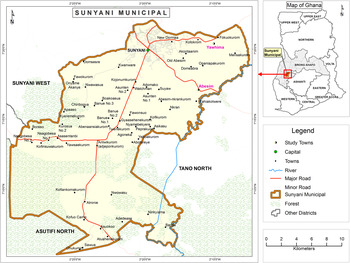
The study was conducted in the Sunyani Municipality, Ghana (Fig. 1) located in the moist semi-deciduous forest vegetation zone. The municipality lies at an altitude ranging from 229 to 376 m above sea level. Similar to other areas in mid-Ghana, Sunyani Municipality has a double maxima rainfall regime: major rainy season (March–July) and minor rainy season (September–October) after a short dry spell in August (Isaac et al., Reference Isaac, Anglaaere, Akoto and Dawoe2014). The mean annual rainfall and temperature are about 1300 mm and 27 °C, respectively. The double rainfall regimes offer two growing seasons in a year, which support agricultural production in the municipality. Approximately 85% of the soils in the municipality fall into the Forest Ochrosol group (Acrisols according to World Reference Base soil classification). The soils are, generally well-drained and support agricultural production (Owusu-Bennoah et al., Reference Owusu-Bennoah, Awadzi, Krogh, Breuning-Madsen and Borggaard2000).
Map of the study sites.

Abesim (7°17′11.7″ N and 2°16′44.3″W) and Yawhima (7°21′38.6″ N and 2°13′23.8″W) were selected for the study. The communities were chosen because they are the major vegetable producing areas in the municipality (Boateng, Reference Boateng2009). Abesim has a population of about 18, 968 and Yawhima about 1798 (Ghana Statistical Service, 2017). The dominant type of occupation in both communities is agriculture. It employs about 60% of the active working age group, while 40% are engaged in teaching, dress-making or tailoring and small-scale businesses. Agriculture is mostly done on a small-scale basis, and it involves the production of traditional root and tuber crops, plantain (Musa paradisiaca L.), maize (Zea mays L.) and livestock rearing (Sunyani Municipal Assembly, 2008). Over the years, the growing of high valued crops such as traditional and exotic vegetables has become a prominent economic activity among farmers in Abesim and Yawhima. Records from the vegetable growers associations in the study communities indicated that about 5–10% of the population in both communities are engaged in vegetable production. Production constitutes about 65% of the annual incomes of vegetable growers in the communities (Obour et al., Reference Obour, Dadzie, Kristensen, Rubæk, Kjeldsen and Saba2015).
Peri-urban vegetable production system
The average size of a vegetable farm in Abesim is 1 ha and 0.9 ha in Yawhima. The farmers in both communities are engaged in the cultivation of different varieties of exotic and traditional vegetable crops. The choice of crop cultivated is dependent on market demand. Exotic crops are grown mainly for commercial purposes—mostly to supply the market and restaurants in Sunyani and other cities in Ghana, while traditional crops are for both commercial and home consumption (MoFA, 2013). The common exotic vegetable crops produced include lettuce (Lactuca sativa L.), carrot (Daucas carota L.), green pepper (Capsicum anuum L.), spring onions (Allium fistulosum L.) and cabbage (Brassica oleracea L.). Farmers cultivate traditional vegetable crops like tomato (Solanum lycopersicum L.), onion (Allium cepa L.), eggplant (Solanum melongena L.), and okra (Abelmoschus esculentus (L.) Moench). Vegetables are cultivated all-year-round and production is highly rain-fed, especially, for the major and minor planting seasons from March to June, and August–October, respectively to synchronize with the bimodal climatic rainy seasons. Irrigation is also practiced to supplement rainwater. More details on the production system are provided in Obour et al. (Reference Obour, Dadzie, Kristensen, Rubæk, Kjeldsen and Saba2015).
Data collection
Eliciting information from farmers
Field work was conducted in March 2016 during the start of the major growing season in the study area. Prior to the field work, the researchers consulted key informants like the local civic authorities and representatives and leaders of the vegetable growers’ association who were familiar with vegetable farmers in their communities. The consultation helped the researchers to identify other vegetable farmers who were then targeted during the main field work.
Data were collected using interview guides and questionnaires (Please see details in supplementary materials A and B). Before primary data collection in the study communities, the interview guides and questionnaires were pre-tested in a nearby community, Kotokrom, which led to the following two modifications. (1) We limited the description of soil quality indicators to only the uppermost layer (~0–0.25 m depth). This layer is more visible to the farmers, even without tillage, which is important because the farmers mostly do shallow tillage using hoes and therefore may not have adequate information on subsoil properties. (2) We selected soil chemical properties that farmers know and are able to discuss in relation to soils in their farms.
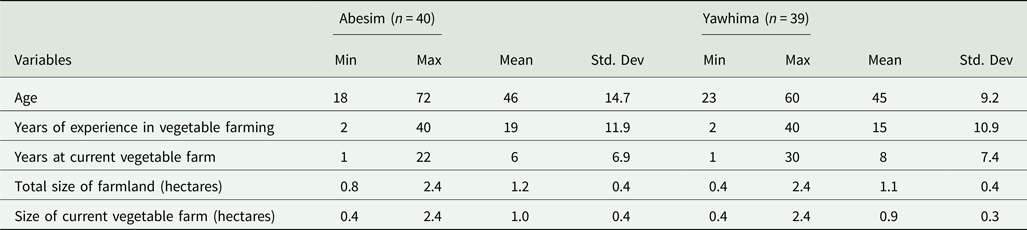
Information on socio-economic characteristics of farmers, farmers’ classification of soils in their farms and the characteristics of the indicators used, the influence of the farmers’ perception of soil quality on crop management, and constraints to soil quality management practices were gathered using interview guides. In total, 79 vegetable growers (40 in Abesim and 39 in Yawhima) were interviewed. We interviewed respondents with a range of demographic and farm characteristics to provide a representative sample of the study population (Table 1). The interviews were held in Twi, which is the language widely spoken and understood in both communities. The responses were recorded by the researchers and the trained research assistants who were fluent in both Twi and English languages. Key words and terminologies in Twi used by the farmers to describe soil quality indicators were recorded verbatim to reflect the farmers’ descriptions.
Demographic and farm characteristics of respondents interviewed

Additional information on how the farmers assess soil quality in their farms was solicited from a subset of eight farmers (four from each community) who were also included in the interviews. The participants targeted were those who were more experienced in the description of soil than the average farmer, willing to participate in this stage and also allowed the researcher to conduct a visual evaluation of soil in their farms. We focused on farmers who were more experienced descriptors because it has been shown that farmers experience about soils can reduce subjectivity in their assessment of soil (Ketcheson, Reference Ketcheson1982). To capture variations in soil types and other environmental factors in each community, owners/managers of farms in different locations within the community were included. Questionnaires made up of closed-ended questions were administered to each of the subset farmers. For each question, the farmer was asked to choose from a list of options that best described soil physical and structural quality of the reported good and poor soils in his/her farm. Hereafter, the term ‘good soil’ refers to soils described by the farmers as well-performing soils without any observable crop-limiting soil indicators, whereas ‘poor soil’, refers to those with observable crop-limiting soil indicators.
Soil evaluation in the field by researcher
The researchers visited the fields of each of the subset farmers. During the visit, the farmer was asked to locate the good and poor soils described in the questionnaire. Within each location, a spot for soil evaluation was randomly chosen by the researcher. Thereafter, a visual evaluation of soil was conducted by the researcher using the VESS method. The evaluation was done to assess soil properties. The researcher's evaluation of the good and poor soils in each farm was compared with the farmer's assessment. In brief, the VESS method involves extracting an undisturbed slice of soil from a given depth in the soil and manually breaking the soil along its natural plane of weakness. The fragmented soil is evaluated by assigning a score for size, strength, porosity and roots. The scores are used to define the soil structural quality (Sq) of the soil layer (Guimarães et al., Reference Guimarães, Ball and Tormena2011).
To do the visual evaluation, the researcher dug a shallow soil profile pit (0.5 m long × 0.4 m wide × 0.30 m deep) on each randomly chosen spot characterized as having good and poor soils i.e., a total of 16 soil profile pits (8 pits × 2 soil classes). The pit was dug in such a way that the surface where the soil block was extracted was left undisturbed prior to the evaluation of the soil structure. Thereafter, each pit was divided into two layers: ~0–0.15 m and ~0.15–0.25 m depth to evaluate the uppermost layer and the layer below, up to the plow pan. A spade was pushed horizontally under the soil layer from the wall of the soil profile to extract soil block from the first layer, and then the second layer. The extracted soil blocks were placed on a plastic sheet and carefully broken by hand along natural failure boundaries.
The appearance of the broken block was evaluated based on the following key diagnostic soil properties: ease of fragmentation when moist, size and appearance of aggregates, visible porosity and roots. Evaluation of the properties was ranked on a scale of 1–5 where Sq1 denotes best topsoil structural quality (friable soil) and Sq5 represents worst topsoil structural quality (compacted soil) (Ball et al., Reference Ball, Batey and Munkholm2007). The overall Sq score for each spot was calculated from scores of the two layers as described by Ball et al. (Reference Ball, Batey and Munkholm2007):
 $$\eqalign{\hbox{Overall}\;\hbox{Sq}\;\hbox{of}\;\hbox{spot} & = [(\hbox{Sqscor}\hbox{e}_1 \times \hbox{dept}\hbox{h}_1)/\hbox{dept}\hbox{h}_{{\rm total}} + (\hbox{Sqscor}\hbox{e}_2 \cr & \quad \times \hbox{dept}\hbox{h}_2)/\hbox{dept}\hbox{h}_{{\rm total}}]}$$
where Sqscore1 is the score for the first layer and Sqscore2 is the score for the second layer, depth1 and depth2 are depths of the first and second layers, respectively, and depthtotal is the overall depth of soil profile pit. To address the limitation of operator-dependent of the VESS method in our study, the visual evaluation was done by the same person.
Soil color determination, sampling and laboratory analyses
The researcher quantified the soil color of the 0–0.15 m depth for each of the soil profile pits in the field using the Munsell soil color chart. Thereafter, soil samples were collected from each of the layers of the 16 soil profile pits, summing to 32 samples (8 pits × 2 soil classes × 2 layers). All the samples were kept in plastic zip bags until laboratory analyses.
In the laboratory, we air-dried the soil samples and bulked the samples from the two layers for each soil profile pit before crushing and passing through a 2 mm sieve. The samples were used to determine particle size distribution by sieving and sedimentation method (Gee and Or, Reference Gee, Or, Dane and Topp2002). Basic soil chemical properties: total nitrogen (TN) by dry combustion method (Sørensen and Bülow-Olsen, Reference Sørensen and Bülow-Olsen1994); soil organic matter (SOM) by measuring the carbon dioxide evolved by igniting the soil using LECO IR-12 Analyzer (Sørensen and Bülow-Olsen, Reference Sørensen and Bülow-Olsen1994). Soil pH was determined with a glass electrode using 10 g of soil in 25 mL of 0.01 M calcium chloride (CaCl2) solution (Sørensen and Bülow-Olsen, Reference Sørensen and Bülow-Olsen1994). Potassium (K) and magnesium (Mg) contents were determined by flame photometry and atomic-absorption spectrophotometry, respectively (Sørensen and Bülow-Olsen, Reference Sørensen and Bülow-Olsen1994). Available P was determined by the Bray and Kurtz (Reference Bray and Kurtz1945) method. In the remainder of the paper, science-based or scientific soil assessment is used to refer to both visual soil evaluation by the researcher and laboratory analyses of soil properties.
Data analysis
Data obtained from the interviews were cleaned by editing and validating potential errors. Thereafter, the data were entered manually into SPSS version 16.0 software for processing. The processed data were imported into Excel and subjected to descriptive analysis for the frequency distribution of the variables studied.
Results and discussion
Characteristics of respondents
Out of the 79 respondents, there were 60 and 59% males; and 40 and 41% females in Abesim and Yawhima, respectively. The respondents in both communities had identical demographic and farm characteristics (Table 1). The educational attainment of the respondents ranged from no formal education to tertiary education. Basic education (grade six to nine) was the predominant level of education of the respondents (45% and 59% in Abesim and Yawhima, respectively). Land tenure arrangement of the farmers in both communities was own land, family/community land and rented/hired land.
Farmers’ assessment and classification of soil quality
The farmers interviewed in both communities were knowledgeable about the conditions of soils in their farms. The farmers (22% in Abesim and 18% in Yawhima) walked in their farms to observe the color of growing vegetation prior to preparing the field for crop establishment. The majority of the farmers (80 and 70% in Abesim and Yawhima, respectively) conducted a visual inspection of soils and crops in their fields during the growing seasons. They did this to evaluate the soil quality status in their fields to guide them in soil management.
Chemical indicators used by farmers
The commonly used chemical indicators in both communities were N, P and K, which were collectively referred to as asaase ahoɔden or asaase sradeε (literally meaning soil strength or fat, respectively) and SOM. These locally-defined terminologies were used interchangeably to describe soil quality status. The farmers considered N, P and K as essential nutrients for crop growth, but the majority of them had limited understanding of how these indicators are assessed.
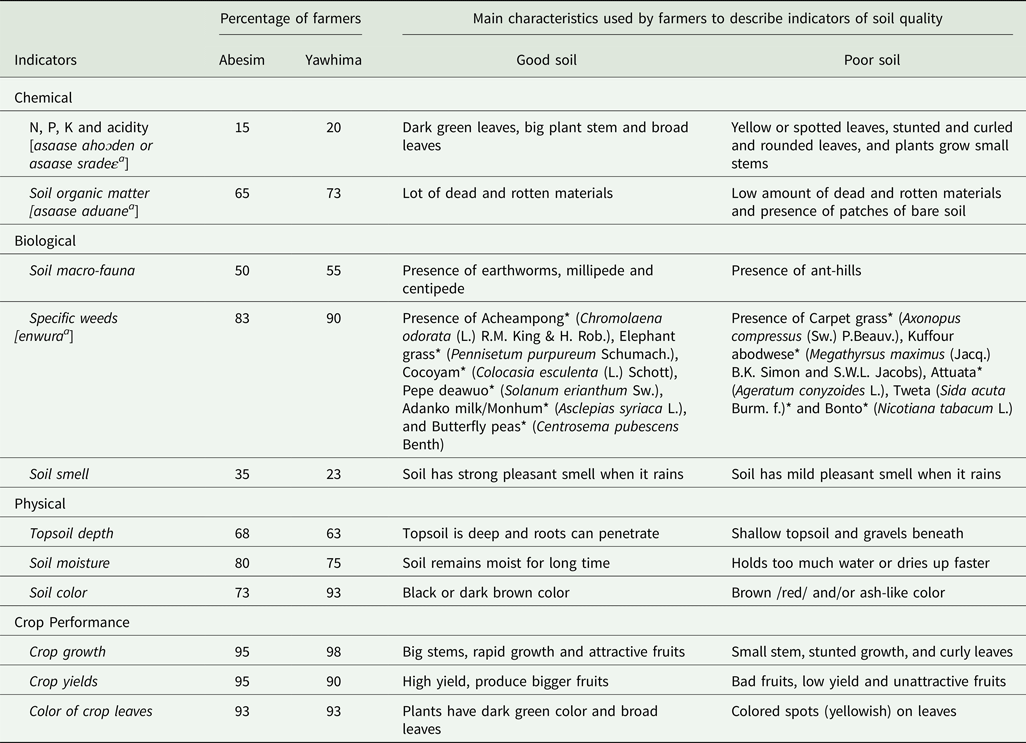
The few farmers who reportedly assessed the availability or deficiency of N, P and K did so by observing the color of crop leaves and size of crop stems (Table 2). According to them, crops that grow on soils that have asaase sradeε consistently have big stems, broad leaves and dark green leaves, whereas those that grow on soils that lacked the nutrients usually have stunted growth, yellow and spotted leaves, and small stems. The results illustrate that these farmers could provide a fairly good description of the availability or deficiency of the chemical nutrients. However, they could only describe the symptoms collectively for N, P and K, but not for individual nutrients. This is an indication that they have limited knowledge or understanding of the role of each nutrient and the different crop responses when one of them is limiting crop growth.
Main characteristics of observable indicators used by farmers in Abesim and Yawhima, Ghana to classify soil quality. Percentages are in multiple responses

a Local terminologies used to describe indicators.
Names with asterisk (*) indicate local name of plant and names in parentheses are the corresponding botanical names.
The farmers distinguished between good and poor soils based on SOM status, which was referred to as asaase aduane (meaning soil food). The extensive use of SOM by the farmers as soil quality indicator compared with N, P and K may be due to the association they made between SOM and the amount of visible stock of decomposed materials. According to them, soil which has dead and rotten materials is a characteristic of the presence of large amount of asaase aduane, an indicator of a good soil. Conversely, poor soils which lacked asaase aduane have less visible decomposed materials (Table 2). The terminology asaase aduane has also been used to describe soils with high organic matter content by smallholder farmers in Atwima Nwabiagya District in Ghana (Dawoe et al., Reference Dawoe, Quashie-Sam, Isaac and Oppong2012), which highlights a wide use of the terminology by farmers in describing soil quality. Although the farmers interviewed recognized the important role SOM plays in supplying the plant with the required nutrients, they had limited understanding of the processes involved in SOM–soil mineral interaction.
Soil biological indicators used by farmers
The principal biological indicators used by the farmers were the type of weeds (locally called enwura), macro-fauna and soil smell during rains (Table 2). The majority of farmers (83% in Abesim and 90% in Yawhima) agreed that soils dominated by weeds Adanko milk/Monhum (Asclepias syriaca L.) and butterfly peas (Centrosema pubescens Benth.) in their fields reflected good soils, whereas soils dominated by Carpet grass (Axonopus compressus (Sw.) P.Beauv.), Kuffour abodwese (Megathyrsus maximus (Jacq.) B.K. Simon and S.W.L. Jacobs), Attuata (Ageratum conyzoides L.), Tweta (Sida acuta Burm. f.) and Bonto (Nicotiana tabacum L.) indicated poor soils.
It was reported that, in general, the weeds that grow on good soils were easy to control mechanically or by using herbicides compared with those that thrived on the poor soils. For instance, the weed described as ‘Monhum’ (Asclepias syriaca L.) that grows on the good soil is a local terminology literally meaning ‘one should rest’. This name reflects the ease of clearing the weed manually using hoes and cutlasses. On the other hand, the ‘Attuata’ weed (Ageratum conyzoides L.) that commonly grows on poor soils literally means ‘one needs a lot of energy to uproot the weed’ shows that it is laborious to clear it manually. The difficulty to control weeds on the poor soils could be ascribed to the growth mechanisms of these weeds such as the extensive root system, seeds that tolerate a wide range of soil chemical and physical conditions, and quick regeneration after clearance (Liebman and Mohler, Reference Liebman, Mohler, Liebman, Mohler and Staver2001). These growth characteristics are the adaptation mechanisms used by these weeds to survive in harsh and nutrient-deficient environments and to compete with crops for resources.
Farmers’ use of weeds to distinguish between good and poor soils is consistent with other studies in Africa. For examples, Mairura et al. (Reference Mairura, Mugendi, Mwanje, Rarnisch, Mbugua and Chianu2007) and Tesfahunegn et al. (Reference Tesfahunegn, Tamene, Vlek and Mekonnen2016) reported that farmers in Kenya and Ethiopia, respectively, used the presence or absence of specific weeds as criteria for soil quality evaluation. The latter study found that the Datura spp. weed that grows on good soil had a shallow root system and was easier for farmers to control than, for example, the Striga hermonthica weed that grows on poor soils. Results from our study confirm these findings. It also highlights that farmers’ knowledge on specific weed species can be useful for developing a more robust and sustainable weed control system. Nevertheless, it is important that the weed species identified by farmers are investigated further in order to scientifically document their characteristics. The information can be used to improve recommendations for weed management since weeding is one of the most costly management techniques due to the sheer labor it requires, especially if the weeds have extensive root systems.
Other biological indicators used by the farmers to classify soil into good and poor qualities were soil macro-fauna. The presence of earthworms, earthworm holes and casts indicated a good soil while soil with many ant-hills showed a poor soil (Table 2). The farmers’ use of soil macro-fauna suggests an awareness of the role of organisms like earthworms on soil ecology, reflecting scientific knowledge about their roles. For example, earthworms play a key role in mixing SOM and soil minerals, and also produce intestinal mucus that binds soil aggregates to improve soil structural quality (Blouin et al., Reference Blouin, Hodson, Delgado, Baker, Brussaard, Butt, Dai, Dendooven, Peres, Tondoh, Cluzeau and Brun2013).
Crop performance indicators used by farmers
There was a wide use of physical and crop performance indicators among the farmers to classify soil quality (Table 2). The majority of farmers (68% in Abesim and 63% in Yawhima) mentioned that soils with dark brown to black topsoil, green leaves of crops and other vegetation and high crop yield indicated a good soil. Conversely, soils that exhibit a mild, pleasant smell after rain, held too much or too little water after rains, or produced crops with yellow or spotted leaves and low yield were classified as poor soils. Overall, the farmers associated soil color and smell after rain with SOM. They perceived that the more the amount of decomposed materials, the darker the soil color and thus, the more fragrant smell the soil produces after rains. The wide use of crop performance indicators such as the color of crops and yield may be explained by the economic benefit to the farmers. For example, they explained that the dark color of green leafy vegetables such as cabbage and spring onion fetched high market prices.
The combination of indicators used by the farmers suggests that no single indicator may be enough to describe soil quality. In general, it was easy for the farmers to distinguish and describe the characteristics of biological, physical and crop performance indicators on their good and poor soils, but found it difficult to do so for the chemical indicators, except for SOM. Less use of chemical indicators by the farmers could be because they are not easily visualized. Liebig and Doran (Reference Liebig and Doran1999) noted that farmers used different criteria, mostly based on observable indicators they can sense, for example, see, feel or smell, to categorize soils in their fields. Consequently, in instances where local knowledge on soil properties and assessment is passed on from one generation to the other through active participation as was generally the case for the farmers interviewed, soil assessment based mainly on the senses could falsely legitimize poor assessment techniques if the farmers describe good soils as poor or vice versa.
Farmers’ assessment vs researcher's visual evaluation and laboratory analyses of soil properties
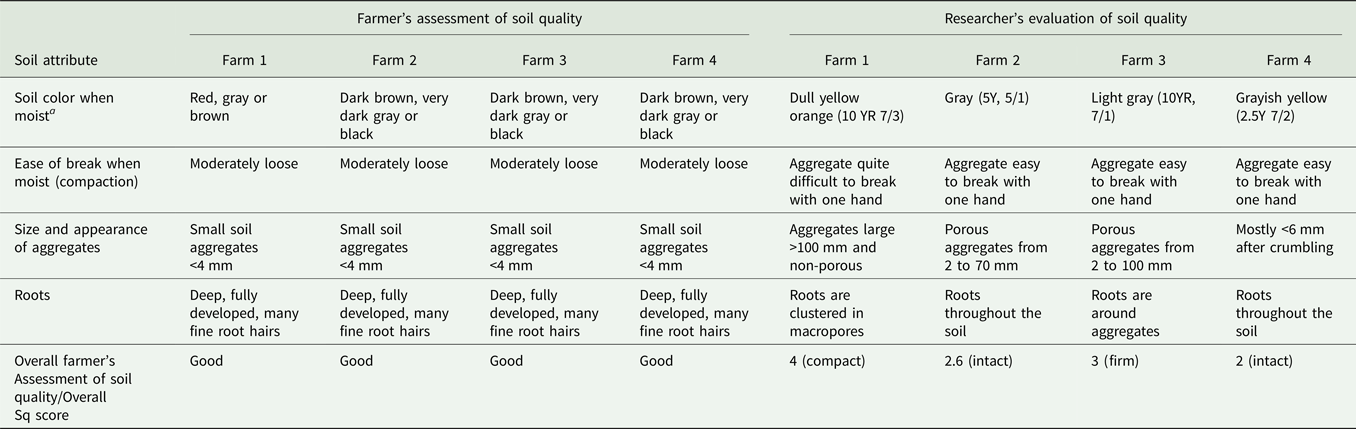
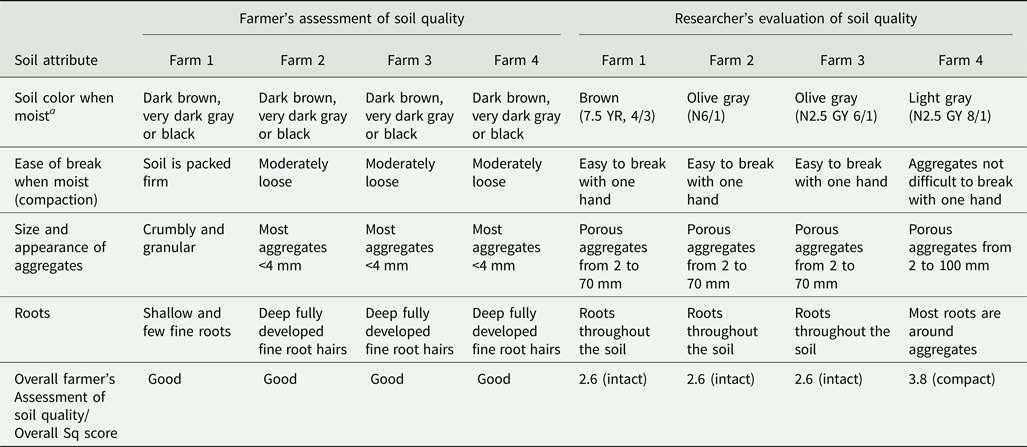
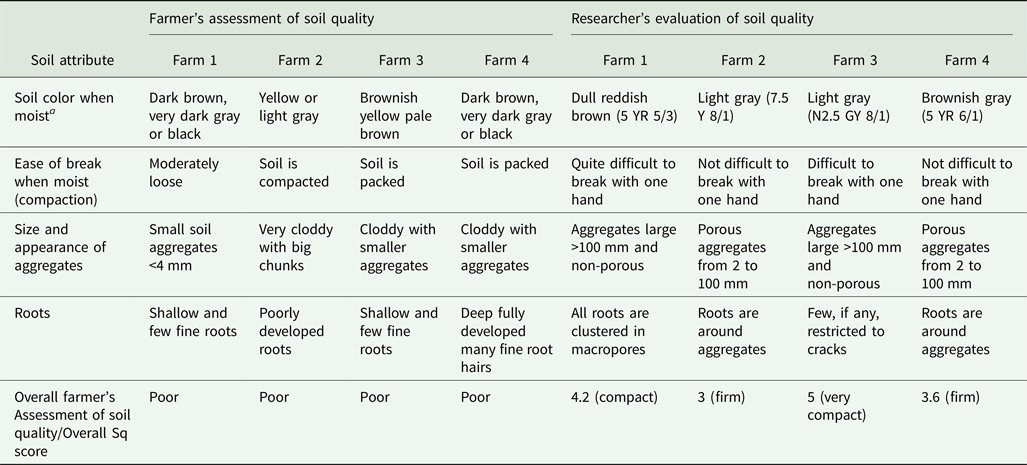
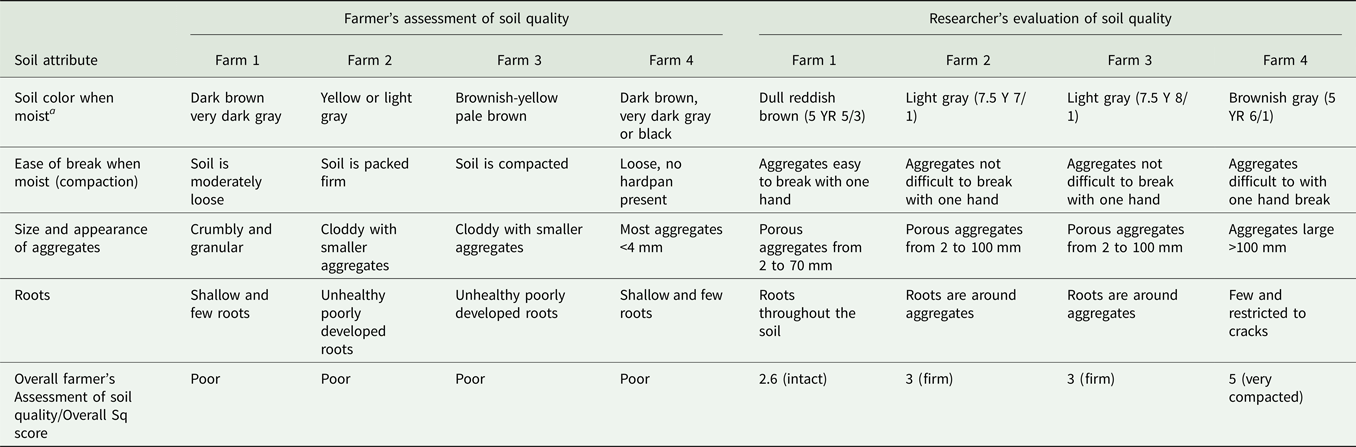
The description of the good and poor soils by each of the subset farmers in their respective farms are presented in Tables 3–6. Each table also presents the researcher's evaluation of soil in each farm based on the VESS method. There were similarities between the farms in terms of the farmers’ evaluation of good and poor soils. In general, they described the good soils in their farms as those that have dark/brown topsoil soil, easily fragmented by hand into smaller soil aggregates when moist and crops are able to grow deep roots. The description of the topsoil color of the good soils by the farmers emphasized that they strongly linked dark soil with the availability of SOM as discussed previously.
Farmers’ assessment of soil quality versus visual evaluation by researcher on good soil in Abesim (~0–0.25 m depth). Each farm is located in a different area within the Abesim community. ‘Farmer's assessment’ shows the farmer's description of soil quality in his/her farm. ‘Researcher's evaluation’ shows the visual evaluation of soil quality conducted by the researcher

a Soil color for the top 0–0.15 m layer.
Farmers’ assessment of soil quality versus visual evaluation by researcher on good soil in Yawhima (~0–0.25 m depth). Each farm is located in a different area within the Yawhima community. ‘Farmer's assessment’ shows the farmer's description of soil quality in his/her farm. ‘Researcher's evaluation’ shows the visual evaluation of soil quality conducted by the researcher

a Soil color for the top 0–0.15 m layer.
Farmers’ assessment of soil quality versus visual evaluation by researcher on poor soil in Abesim (~0–0.25 m depth). Each farm is located in a different area within the Abesim community. ‘Farmer's assessment’ shows the farmer's description of soil quality in his/her farm. ‘Researcher's evaluation’ shows the visual evaluation of soil quality conducted by the researcher

a Soil color for the top 0–0.15 m layer
Farmers’ assessment of soil quality versus visual evaluation by researcher on poor soil in Yawhima (~0–0.25 m depth). Each farm is located in a different area within the Yawhima community. ‘Farmer's assessment’ shows the farmer's description of soil quality in his/her farm. ‘Researcher's evaluation’ shows the visual evaluation of soil quality conducted by the researcher

a Soil color for the top 0–0.15 m layer.
There were also similarities and variations between the farmer's assessment and the researcher's visual evaluation (Tables 3–6). For example, soils in farms 1 and 3 in Abesim, and farm 4 in Yawhima were described by the respective farmers as good soils, whereas the researcher visual evaluation indicated the soils had poor structural quality (Tables 3 and 4). Also, the soil in farm 1 in Yawhima assessed by the farmer to have a poor structure was visually assessed by the researcher to have a good structural quality (Sq 2.6) (Table 6). The results are consistent with Ericksen and Ardón (Reference Ericksen and Ardón2003) who reported that in Honduras, farmers’ evaluation of fertile and infertile soils differed from the researcher in some aspects. For example, soils evaluated by the researcher as very friable were described by the farmers as loose and very susceptible to erosion.
The discrepancy between the two assessments in our study could be attributed to (1) the single spot evaluation by the researcher, i.e., single sample may not necessarily be representative of the entire farm, and (2) the farmers may have over- or underestimated the quality of the soil. The latter indicates the need to establish a common understanding of what is good and poor soil quality. The overlap between the farmers’ description of soil quality with the researcher's visual evaluation demonstrates the need for dialogue in integrating the two approaches as proposed in previous studies (e.g., Desbiez et al., Reference Desbiez, Matthews, Tripathi and Ellis-Jones2004; Dawoe et al., Reference Dawoe, Quashie-Sam, Isaac and Oppong2012).
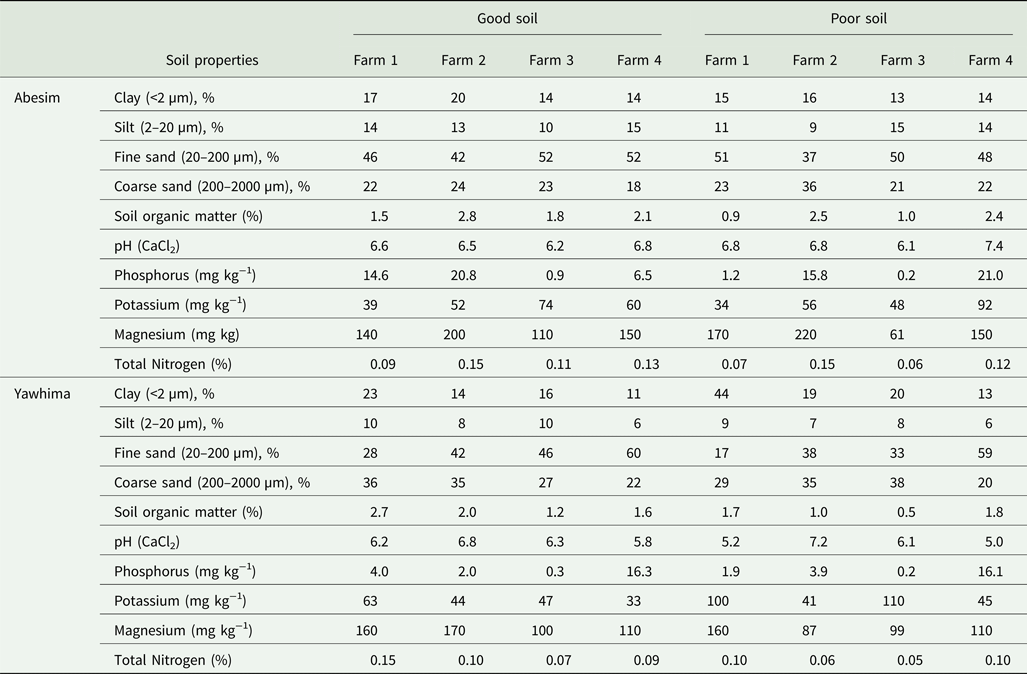
Results from the laboratory analyses indicate that, unlike the qualitative and the semi-quantitative assessment of the farmers and the researcher, respectively, there were no clear trends for the content of chemical properties for the good and poor soils (Table 7). For example, in Abesim, SOM ranged from 1.5 to 2.8% for the good soils and 0.9–2.4% for the poor soils. Likewise in Yawhima, it ranged from 1.2 to 2.7% and 0.5–1.8% for the good and poor soils, respectively. In general, SOM content of the investigated soils was low compared with the 3.8% reported by Abunyewa and Frey (Reference Abunyewa and Frey1998) (cited in Anthofer, Reference Anthofer2000) for soils in the Sunyani municipality. The contents of TN and P were also low as previously commented by the same authors. This demonstrates nutrient depletion in these soils and the need for pragmatic management practices to maintain the fertility of the soil and optimize crop production.
Laboratory analyses of soil properties for ~0–0.25 m depth of the good and poor soils in Abesim and Yawhima

From the discussion above, it can be argued that none of the approaches of soil quality assessment is necessarily superior in and of itself. A combination of the approaches will ultimately facilitate mutual learning between farmers and soil scientists to promote integral assessment of soils. For instance, the VESS method applied in this study can provide the farmers a semi-quantitative information on soil structural quality to add to their qualitative knowledge about soil. Subsequently, the laboratory analyses of soil properties is important to provide quantitative information on soil nutrient status. Such information can guide farmers’ decisions with regard to management practices, such as fertilizer application rates for specific crops required to optimize production. This can generate economic benefits for farmers because they can apply the most important limiting nutrient rather than all nutrients to reduce the risk of nutrient losses, which can be expensive for the farmers and detrimental to the environment.
Influence of perceived soil quality on crop management
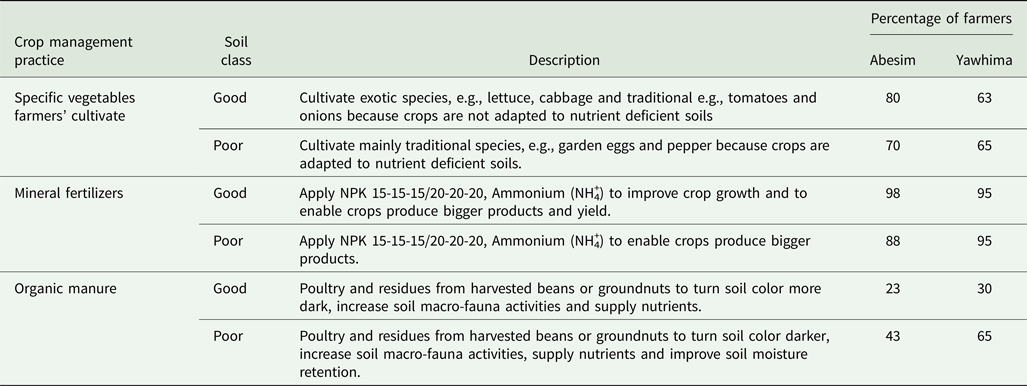
Farmers’ perception of good and poor soil quality in their fields and its influence on crop management was investigated (Table 8). The majority of the farmers interviewed cultivated exotic vegetables such as lettuce, carrot, green pepper, spring onions and cabbage on the good soils in their fields. The practice was based on the perception that, unlike most traditional vegetable species, the exotic species are not tolerant of nutrient deficient conditions. Therefore, the exotic crops are cultivated on the good soil perceived to be rich in N, P and K and SOM to enhance crop growth, increase yield and to produce dark green color for green vegetables such as spring onion, green pepper and cabbage. They also cultivated traditional species, mainly tomato, okra and onion, on the good soil to produce bigger fruits that fetched good market prices. Conversely, traditional vegetables like eggplant, pepper, beans (Phaseolus vulgaris L.) and groundnuts (Arachis hypogaea L.) were cultivated on the poor soils perceived to have low N, P and K and SOM. This practice was based on the perception that these crops were more tolerant of nutrient deficient conditions.
Influence of perceived soil quality on crop management. Percentages of farmers in multiple responses

The farmers applied mineral fertilizers and organic manure during crop growth on the good and poor soils (Table 8). For crops cultivated on the good soils, they applied, mineral fertilizers namely N, P and K (15/15/15) or (20/20/20), and ammonium (NH4+) to produce high yield and bigger products for market supply. The mineral fertilizers were applied at least three times before harvest as already reported by Obour et al. (Reference Obour, Dadzie, Kristensen, Rubæk, Kjeldsen and Saba2015). The quantity of fertilizer applied per dose was reported to vary from crop type and season. An estimate of 450–550 kg of poultry manure was applied per hectare, but the quantity applied can vary between seasons depending on the availability of the manure. The farmers held the view that the addition of organic manure helps to turn the color of the soil darker and improve soil fertility. They also mentioned that the addition of organic materials increases the presence and activities of macro-fauna like earthworms, millipede and centipede which are biological indicators of good soil.
The farmers also applied mineral fertilizers and organic manures on the poor soil for the same purposes as in the good soil, primarily, to improve moisture content, make the soil darker and increase soil macro-fauna activities. The quantity of poultry manure applied was similar to that for the good soil. As for mineral fertilizers, N, P and K (15/15/15) or (20/20/20), and ammonium (NH4+) the application regime was one time, i.e. just before fruit development. Less use of mineral fertilizers was ascribed to the perception that traditional crops cultivated on the poor soil were tolerant of nutrient deficient soils, but required mineral fertilizers at an early stage of their growth to produce bigger fruits for the market. The main constraint to the use of mineral fertilizers in both communities was high cost as previously commented on by Obour et al. (Reference Obour, Dadzie, Kristensen, Rubæk, Kjeldsen and Saba2015). For organic manures like poultry droppings, scarcity, bulkiness and cost of transportation from source (poultry farm) to the farm were the main limitations.
The results highlight that farmers’ perception of good and poor soil quality influence their management decisions such as choice of vegetables cultivated and fertilization application regimes, which contradict other studies in the sub-region. For example, Sheahan and Barrett (Reference Sheahan and Barrett2017) found that farmers’ perception of soil quality in Malawi, Tanzania and Uganda did not have a great influence on fertilizer application.
The application of N, P and K mineral fertilizers at different growth stages of crops emphasize their limited knowledge of the individual nutrients as discussed. It also shows that the farmers applied N, P and K as a ‘broad spectrum or insurance fertilization’ to avoid the risk of crop failure. This could be addressed when the farmers have quantitative information about the nutrient status of soils in their fields.
Conclusions
Soil quality in vegetable production fields was assessed qualitatively by farmers, semi-quantitatively by a researcher and quantitatively by laboratory analyses. The farmers demonstrated a good understanding of soil quality and adopted farm practices for management of the good and poor soils in their fields. Farmers’ assessment of soil quality for good and poor soils coincided to some extent with the researcher's VESS, but the laboratory-based analyses of soil chemical properties did not show any clear trends. Farmers in general had limited knowledge of the role of individual soil chemical nutrients and crop response to these nutrients. Findings from the study are of potential value for policies aimed at improving the capacity of agricultural advisors and farmers by highlighting that none of the approaches of soil quality assessment is necessarily superior in and of itself. A combination of the approaches can facilitate mutual learning between farmers, agricultural consultants/advisors and soil scientists to promote integral assessment of soils. To improve this integration, it is recommended that simple, rapid and affordable semi-quantitative and quantitative methods are combined with farmers’ assessment of soil quality to facilitate their ease of usage. The study also emphasized the need for soil scientists and soil management advisors to work closely with farmers in addressing soil quality problems for agricultural production. It is recommended that soil researchers actively engage farmers, whenever possible, to provide in-depth ethno-cientific knowledge of soil conditions for agricultural production.
Potential limitations of the study
The presented conclusions were based on a sample of eight farmers that were selected to participate in the farmer-based assessment of soil quality because of their experience and knowledge of soil characteristics. Also, a single area was selected by the researcher on each field to visually evaluate the good and poor soils. We acknowledge that these two issues (small sample size and sampling site selection) may limit generalization of the conclusions and possible extrapolation to the other field sites. We, therefore, recommend future studies to take into account these limitations to improve the scope of applicability of results.
Supplementary material
The supplementary material for this article can be found at https://doi.org/10.1017/S1742170518000340
Acknowledgements
We gratefully appreciate the technical assistance of Lene Skovmose Andersen who did the phosphorus analyses. We would like to thank all the vegetable growers in Abesim and Yawhima whose active participation made the study possible. The assistance of Andrews Obour, Samuel Adjei-Donkor and Yussif Iddrisu during the field work is much appreciated. The field work was funded by Oticon Fonden, Denmark.
Disclosure statement
No potential conflict of interest was reported by the authors.