Introduction
The world's population is aging. Ten-year projections suggest that the annual net increase of the number of people over the age of 65 years will be about 23 million (Kinsella and He, Reference Kinsella and He2009). Because the prevalence of many health problems increases with age, this demographic trend will also lead to a rising prevalence of multimorbidity in the upcoming years and probably also to an increased need for long-term care (LTC) (Schram et al., Reference Schram2008; Singh, Reference Singh2010a).
Multimorbidity is defined as the simultaneous occurrence of several medical conditions in the same person (van den Akker et al., Reference van den Akker, Buntinx and Knottnerus1996). Reported prevalence rates of multimorbidity vary widely across studies, from around 20% to 30% in the general population to 55% to 98% when only older persons were included (Marengoni et al., Reference Marengoni2011). The prevalence of multimorbidity in the elderly population is much higher than the prevalence of the most common diseases of the elderly such as heart failure and dementia (Marengoni et al., Reference Marengoni, Winblad, Karp and Fratiglioni2008). Still, the number of studies on multimorbidity is much smaller than those on individual chronic diseases (Fortin et al., Reference Fortin, Lapointe, Hudon and Vanasse2005). Moreover, research on multimorbidity mainly focuses on either somatic or psychiatric multimorbidity. Furthermore, multimorbidity by itself does not predict the need for LTC but its consequences with respect to disability and dependency (Singh, Reference Singh2010b). Given that psychosocial and mental health problems are strongly associated with a higher level of dependency (Scott et al., Reference Scott2009), mental–physical multimorbidity requires special attention (Bartels et al., Reference Bartels, Levine and Shea1999; Mercer et al., Reference Mercer, Gunn, Bower, Wyke and Guthrie2012). Yet, the few studies that do investigate mental–physical multimorbidity (Nuyen et al., Reference Nuyen2006) typically focus on the association between one somatic or one psychiatric index disease and one or a restricted set of comorbid conditions (Gijsen et al., Reference Gijsen, Hoeymans, Schellevis, Ruwaard, Satariano and van den Bos2001; Angelelli et al., Reference Angelelli2004; Frankenburg and Zanarini, Reference Frankenburg and Zanarini2004; Iacovides and Siamouli, Reference Iacovides and Siamouli2008; Reijnders et al., Reference Reijnders, Ehrt, Weber, Aarsland and Leentjens2008). Undeniably, the clustering of general somatic and psychiatric morbidity is hardly studied (Lobo-Escolar et al., Reference Lobo-Escolar, Saz, Marcos, Quintanilla, Campayo and Lobo2008; Andrade et al., Reference Andrade, Bensenor, Viana, Andreoni and Wang2010), although Lobo-Escolar et al. (Reference Lobo-Escolar, Saz, Marcos, Quintanilla, Campayo and Lobo2008) found it to be prevalent (20%) in elderly people over 55 years of age living in the community. LTC facilities will accommodate an even higher proportion of individuals with comorbid mental and physical illnesses compared to the community (Bartels et al., Reference Bartels, Levine and Shea1999).
In order to improve the cost-effectiveness of mental health care, a trend has been observed to reduce the number of psychiatric hospital beds for both short-stay and long-stay wards in many Western countries (Novella, Reference Novella2010). Consequently, the traditional asylum function of psychiatric hospitals for older adults with severe mental illness who require assistance with physical health care is largely taken over by nursing homes (Bartels et al., Reference Bartels, Miles, Dums and Levine2003).
Between 60% and 90% of nursing home residents have a mental condition, including dementia (Bartels et al., Reference Bartels, Moak and Dums2002; Li, Reference Li2010; Seitz et al., Reference Seitz, Purandare and Conn2010). A recent systematic review reported a median prevalence rate of 58% for dementia, 10% for major depressive disorder, and 29% for depressive symptoms (Seitz et al., Reference Seitz, Purandare and Conn2010). Data on other psychiatric disorders are scarce but suggest relatively high prevalence rates of anxiety problems (range, 3.5% for anxiety or panic disorder to 29.7% for clinically relevant anxiety symptoms), substance use disorders (SUDs) (range, 0.9%–18%), schizophrenia (range, 5.9%–9.8%), and bipolar disorder (3%).
Two recent studies in the United States using three different data sources (Bagchi et al., Reference Bagchi, Verdier and Simon2009; Fullerton et al., Reference Fullerton, McGuire, Feng, Mor and Grabowski2009) concluded that the prevalence rate of a primary diagnosis of mental illness excluding dementia in nursing home residents varied from 4.4% in Medicaid claims to 7% in the National Nursing Home Survey (NNHS). Taking secondary mental illness diagnoses into account, prevalence rates increased to 7% in Medicaid claims, 33.1% in the NNHS, and 46% in the Minimum Data Set (MDS (Morris et al., Reference Morris1990)) of the Resident Assessment Instrument (Bagchi et al., Reference Bagchi, Verdier and Simon2009). Using a sample of all “first-time” nursing home admissions from the MDS in 2005, Fullerton et al. (Reference Fullerton, McGuire, Feng, Mor and Grabowski2009) found that 24% had a mental illness as defined by schizophrenia, bipolar disorder, depression, or anxiety disorder.
The interpretation of the above-mentioned prevalence rates and consequences for LTC health care planning depends on the relative importance of three components within a society, that is, (1) the informal system, (2) the community-based system, and (3) the institutional system (Singh, Reference Singh2010b). In other words, from which component a patient will receive LTC depends not only on his level of functioning and the complexity of the services he or she needs but also on a host of sociocultural factors, such as the structure and organization of the health care system, the health insurance system by both the government and the private sector, the availability and type of housing, the structure of families, and the preferences of elderly people and their caregivers (Ribbe et al., Reference Ribbe1997). Nevertheless, potential decisions on these components should be driven by prevalence as well as care needs of this patient group.
In order to disentangle some of this heterogeneity, we aimed to perform a systematic review on the mental–physical multimorbidity of residents in LTC facilities.
The specific aims of the present literature review are to study
1. the prevalence of mental–physical multimorbidity in middle-aged and elderly LTC residents without dementia,
2. the characteristics and care needs of these residents, and
3. the determinants of mental disorders in physical disorders or vice versa.
Methods
Identification of relevant literature
A systematic search was conducted in PubMed, EMBASE, PsycINFO, and CINAHL in order to identify literature on the mental–physical multimorbidity of residents in LTC facilities. MeSH terms (Pubmed), Thesaurus terms (EMBASE, PsycINFO, CINAHL) and free text words were used for the search. These terms included (“residential facilities” or “assisted living facilities” or “group homes” or “homes for the aged” or “nursing homes” or “long-term care facilit*” or “supervised residential setting*” or “residential aged care facilit*” or “elderly care facilit*”) combined with (“comorbidity” or “multimorbidity”) or ((“mental*” or “psychiatr*”) and (“somatic*” or “physical*” or “general medical”)). Articles with the key words “dementia,” “mental retardation,” or “acute” were excluded from the search. Furthermore, the search was limited to residents in the age of 45 years and older and to English and Dutch publications from January 1, 1988 to August 16, 2011. The start date for the search was chosen because of the policy changes in the LTC in the United States by the introduction of the Omnibus Reconciliation Act of 1987 (OBRA 87). In addition, a search of the listed references in the reviewed papers was performed.
Selection of the literature
The first author (AvdB) screened all titles and abstracts on their potential to meet the inclusion criteria as described below. The second author (DG) checked all references published in the years 2009 to 2011 on the same potential. As the results were fully consistent with the results of the first author, titles and abstracts published before 2009 were screened by the first author only. Full text of the references remaining after the first screening was studied on the inclusion criteria by both authors. Disagreements were discussed until consensus was reached. Finally, the reference list of included articles was manually screened to identify any relevant references that had not yet been included.
Studies were included in the review if they
1. included original data on LTC residents aged 45 years and older,
2. comprised a substantive description of both chronic medical and psychiatric problems (not dementia or mental retardation), and
3. contained at least one of the following outcomes:
• prevalence rates of mental–physical comorbidity,
• characteristics and/or care needs of LTC residents with mental–physical comorbidity, and
• determinants of mental disorders in physical disorders or vice versa.
In order to determine whether mental–physical multimorbidity was investigated, a description of specific mental and physical diseases in the studies was a prerequisite. Studies in which multimorbidity was only numerically measured (for instance, with the Charlson Comorbidity Index or the Cumulative Illness Rating Scale) were excluded.
Data extraction
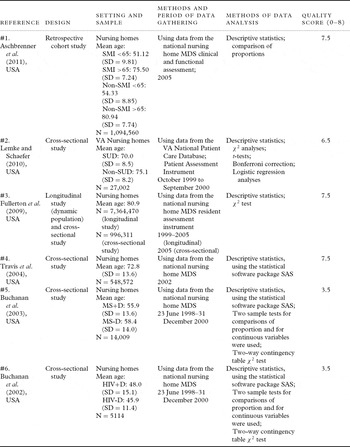
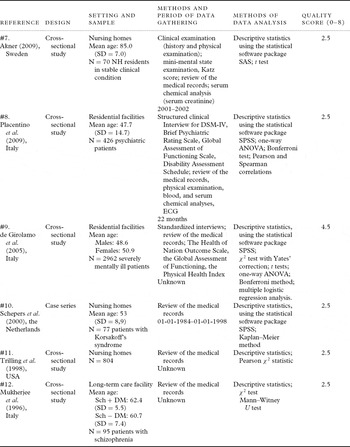
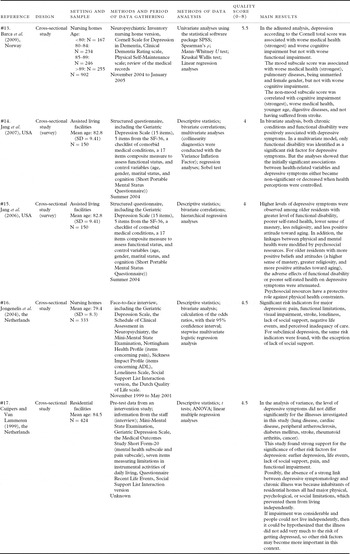
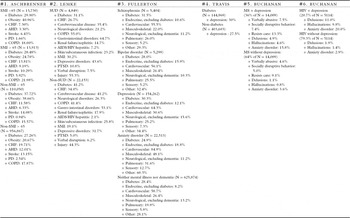
Information was collected on country and year of publication, study design, setting, sample size, mean age of patient population, method and period of data gathering, and statistical analysis (Tables 1, 2–3). For the purpose of this review, data about prevalence of mental–physical comorbidity (Tables 4 and 5) and associations between mental and physical conditions (Table 3) were included in the results tables. Data were extracted by one author (AvdB) and reviewed by the other authors.
Characteristics of included prevalence studies based on national databases

SMI = serious mental illness; MDS = Minimum Data Set; SUD = substance use disorder; SAS = Statistical Analysis Software.
Characteristics of included prevalence studies in selected subpopulations

NH = nursing home; ECG= electrocardiogram; ANOVA = analysis of variance; Sch = schizophrenia; DM = diabetes mellitus.
Characteristics of included other observational studies

ADL = activities of daily living; ANOVA = analysis of variance.
Results of included prevalence studies based on national databases

SMI = serious mental illness; SUD = substance use disorder; CHF = congestive heart failure; AHD = arteriosclerotic heart disease; PD = Parkinson's disease; COPD = chronic obstructive pulmonary disease; PTSD = post-traumatic stress disorder; MS = multiple sclerosis; HIV = human immunodeficiency virus.
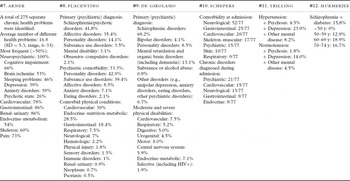
Results of included prevalence studies on selected subpopulations

Appraisal of the methodological quality
Gold standards to evaluate internal and external validity of observational research do not exist (Sanderson et al., Reference Sanderson, Tatt and Higgins2007). For the appraisal of the selected studies, two checklists with criteria for methodological quality were used.
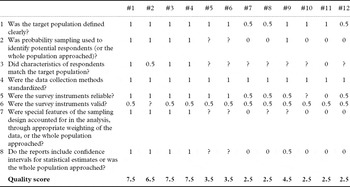
Prevalence studies were rated using the criteria adapted by Pitfield et al. from Boyle's guidelines (Boyle, Reference Boyle1998; Pitfield et al., Reference Pitfield, Shahriyarmolki and Livingston2011). Each paper was rated, with up to one point being given if a criterion was fulfilled and a total score was calculated (Appendix 1).
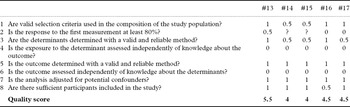
The same method was used for the non-prevalence studies, applying a checklist for etiological research as described by Van der Windt et al. (Reference van der Windt, Zeegers, Kemper, Assendelft and Scholten2000) (Appendix 2).
Two authors (AvdB and DG) rated the studies blind to each other's assessments. Disagreement between reviewers was resolved by discussion.
Results
Identification and selection of the literature
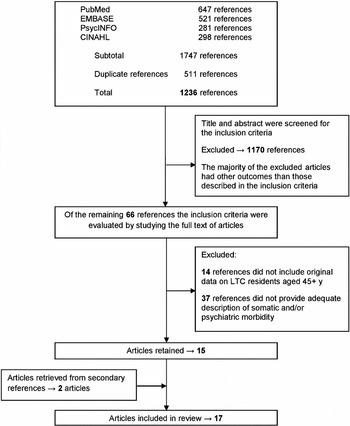
The electronic search generated a list of 1,747 references. All references were imported into a bibliographic management software program to detect duplicates.
After removing duplicates, a list of 1,236 references remained. From this list, 1,170 references were excluded because title and abstract made clear that, without any doubt, the articles did not meet one or more of the inclusion criteria. The vast majority of the articles that have been excluded had other outcomes than those described in the inclusion criteria.
The initial screening resulted in a list of 66 references of which the full texts were studied. Regarding 7 articles (11%) either the first or the second author was in doubt about the need to exclude the article. After consensus discussion, 51 articles were excluded because of failure to meet one or more inclusion criteria. Although both publications of Buchanan et al. (Reference Buchanan, Wang and Huang2002; Reference Buchanan, Wang, Tai-Seale and Ju2003) were conducted on the same source population, they were not considered duplicates as analyses were performed on two different subsamples (patients with multiple sclerosis (MS) and with human immunodeficiency virus (HIV), respectively). Comparably, Jang et al. (Reference Jang, Bergman, Schonfeld and Molinari2006; Reference Jang, Bergman, Schonfeld and Molinari2007) examined different sets of determinants of the association between depression and physical illness within the same study population, without duplication of quantitative data.
Two articles were retrieved from secondary references. Finally, 17 articles were retained for analysis in this review (flowchart: see Figure 1).
Flowchart of the articles involved in this systematic review.

Twelve prevalence studies were identified. Six of those were based on national nursing home databases in the United States (Buchanan et al., Reference Buchanan, Wang and Huang2002; Reference Buchanan, Wang, Tai-Seale and Ju2003; Travis et al., Reference Travis, Buchanan, Wang and Kim2004; Fullerton et al., Reference Fullerton, McGuire, Feng, Mor and Grabowski2009; Lemke and Schaefer, Reference Lemke and Schaefer2010; Aschbrenner et al., Reference Aschbrenner, Grabowski, Cai, Bartels and Mor2011). Six describe prevalence rates in selected subpopulations: three in residential facilities in Italy (Mukherjee et al., Reference Mukherjee, Decina, Bocola, Saraceni and Scapicchio1996; de Girolamo et al., Reference de Girolamo2005; Placentino et al., Reference Placentino2009), one in a nursing home in Sweden (Akner, Reference Akner2009), one in a nursing home in the United States (Trilling et al., Reference Trilling, Froom, Gomolin, Yeh, Grimson and Nevin1998), and one in a Dutch nursing home (Schepers et al., Reference Schepers, Koopmans and Bor2000). Furthermore, five observational studies were included: one in Norwegian nursing homes (Barca et al., Reference Barca, Selbaek, Laks and Engedal2009), two in assisted living facilities in the United States (Jang et al., Reference Jang, Bergman, Schonfeld and Molinari2006; Reference Jang, Bergman, Schonfeld and Molinari2007), and two in Dutch nursing homes (Cuijpers and Van Lammeren, Reference Cuijpers and Van Lammeren1999; Jongenelis et al., Reference Jongenelis, Pot, Eisses, Beekman, Kluiter and Ribbe2004).
Methodological quality
The percentage of agreement between the first and the second author in the scores on the checklists was 83.4%; regarding the score on 24 input fields discussion was needed to achieve consensus.
As shown in Appendix 1 (sum scores are displayed in Tables 1 and 2), four of the prevalence studies, based on national databases, are of good methodological quality (Travis et al., Reference Travis, Buchanan, Wang and Kim2004; Fullerton et al., Reference Fullerton, McGuire, Feng, Mor and Grabowski2009; Lemke and Schaefer, Reference Lemke and Schaefer2010; Aschbrenner et al., Reference Aschbrenner, Grabowski, Cai, Bartels and Mor2011). Whether the studies of Buchanan et al. (Reference Buchanan, Wang and Huang2002; Reference Buchanan, Wang, Tai-Seale and Ju2003) are of similar methodological quality is not clear, because in these studies the question “Was the whole population approached?” could not be answered.
Of the prevalence studies in selected subpopulations, one is of moderate quality (de Girolamo et al., Reference de Girolamo2005) and five studies (Mukherjee et al., Reference Mukherjee, Decina, Bocola, Saraceni and Scapicchio1996; Trilling et al., Reference Trilling, Froom, Gomolin, Yeh, Grimson and Nevin1998; Schepers et al., Reference Schepers, Koopmans and Bor2000; Akner, Reference Akner2009; Placentino et al., Reference Placentino2009) are of poor methodological quality. These studies were not primarily designed as prevalence studies but as descriptive studies. Hence, especially external validity is compromised.
As shown in Appendix 2 (sum scores are displayed in Table 3), the other five studies (Cuijpers and Van Lammeren, Reference Cuijpers and Van Lammeren1999; Jongenelis et al., Reference Jongenelis, Pot, Eisses, Beekman, Kluiter and Ribbe2004; Jang et al., Reference Jang, Bergman, Schonfeld and Molinari2006; Reference Jang, Bergman, Schonfeld and Molinari2007; Barca et al., Reference Barca, Selbaek, Laks and Engedal2009) are of similar moderate methodological quality. The most important flaw of all these studies is that determinants and outcomes were not assessed independently from each other.
Prevalence rates of mental–physical co- and multimorbidity
Of the 12 prevalence studies, only one study (Akner, Reference Akner2009) describes multimorbidity in LTC residents not starting from an index disease or a group of index diseases. Akner (Reference Akner2009) identified a total of 275 separate chronic health conditions in a sample of 70 nursing home residents. The residents had a mean of 17 different chronic health problems. The most prevalent chronic health conditions were neuropsychiatric, cardiovascular, and gastrointestinal conditions.
In 4 studies, the prevalence of comorbid depression in LTC residents with a somatic index disease was investigated (Trilling et al., Reference Trilling, Froom, Gomolin, Yeh, Grimson and Nevin1998; Buchanan et al., Reference Buchanan, Wang and Huang2002; Reference Buchanan, Wang, Tai-Seale and Ju2003; Travis et al., Reference Travis, Buchanan, Wang and Kim2004). This prevalence varied from 20.7% in residents with HIV to 36% in residents with MS.
The other 7 studies describe the prevalence of comorbidity in LTC residents with a psychiatric disorder (Trilling et al., Reference Trilling, Froom, Gomolin, Yeh, Grimson and Nevin1998; Buchanan et al., Reference Buchanan, Wang and Huang2002; Reference Buchanan, Wang, Tai-Seale and Ju2003; Travis et al., Reference Travis, Buchanan, Wang and Kim2004; Fullerton et al., Reference Fullerton, McGuire, Feng, Mor and Grabowski2009; Lemke and Schaefer, Reference Lemke and Schaefer2010; Aschbrenner et al., Reference Aschbrenner, Grabowski, Cai, Bartels and Mor2011). Several differences in the prevalence of mental and medical comorbidities were found, depending on the primary psychiatric disorder, age, and residential setting. Prevalence ranged from 0.5% (any psychiatric illness + psoriasis) to 64.7% (substance use disorder + gastrointestinal disorder) (Tables 4 and 5).
Characteristics and care needs of residents with both mental and physical disorders
Characteristics of LTC residents with mental–physical multimorbidity were embedded in the text of the studies rather than the primary focus of research. Therefore, for the second research question, relevant information is presented here as a narrative description.
Aschbrenner et al. (Reference Aschbrenner, Grabowski, Cai, Bartels and Mor2011) found that newly admitted nursing home residents with serious mental illness (SMI) were younger and more likely to become long-stay residents than those admitted with other conditions. Newly admitted residents with SMI had higher rates of psychiatric histories and psychiatric medication use but lower rates of dependence in transfer and less need for assistance with activities of daily living (ADLs).
Lemke and Schaefer (Reference Lemke and Schaefer2010) found that, compared with other residents, the residents with SUDs were more likely to be younger, male, African–American, unmarried, and have a low income. SUD residents were more independent in ADLs. They were more likely to engage in verbal disruption but not in other problem behaviors such as aggression.
Fullerton et al. (Reference Fullerton, McGuire, Feng, Mor and Grabowski2009) found that, compared with those who had neither mental illness nor dementia, residents with mental illness were in general younger and white (except for those with schizophrenia). Those admitted with schizophrenia or an anxiety disorder were less educated. Residents with schizophrenia or bipolar disorder were less likely to be married, had lower ADL scores, and had higher levels of cognitive impairment than those with depression, anxiety disorder, or those who had neither mental illness nor dementia.
Placentino et al. (Reference Placentino2009) and de Girolamo et al. (Reference de Girolamo2005) reported that the majority of mentally ill residents in Italian LTC facilities was male, middle-aged (40–64 years), and had never been married.
Buchanan et al. (Reference Buchanan, Wang and Huang2002) found that patients with HIV with depression were more likely to be older, female, and white than other residents with HIV. HIV residents with depression were approximately twice as likely as other residents with HIV to have a history of mental health conditions; also, they were more likely to have unsettled relationships, such as conflicts with staff, family, or friends; unstable health conditions; to be at the end stage of disease; and to have other diseases and infections.
In his other study, Buchanan et al. (Reference Buchanan, Wang, Tai-Seale and Ju2003) found that patients with MS with depression were more likely to be younger and female than other residents with MS; they were more likely to have a history of mental health conditions and to have unsettled relationships. Both groups of MS residents had high levels of physical disability, although MS residents with depression tended to be slightly less disabled, were more likely to experience daily pain, and to have the diseases common to residents with MS.
None of the studies included in this review had examined care needs of residents with both mental and physical disorders.
Associations between mental and physical disorders
Of the 5 studies that investigated associations between mental and physical disorders, all concern associations between depression and medical conditions or health-related variables (Table 3).
In these studies, the following risk factors for depression were found: pain (Cuijpers and Van Lammeren, Reference Cuijpers and Van Lammeren1999; Jongenelis et al., Reference Jongenelis, Pot, Eisses, Beekman, Kluiter and Ribbe2004), stroke (Jongenelis et al., Reference Jongenelis, Pot, Eisses, Beekman, Kluiter and Ribbe2004), number of chronic conditions (Jang et al., Reference Jang, Bergman, Schonfeld and Molinari2006; Barca et al., Reference Barca, Selbaek, Laks and Engedal2009), functional impairment (Cuijpers and Van Lammeren, Reference Cuijpers and Van Lammeren1999; Jongenelis et al., Reference Jongenelis, Pot, Eisses, Beekman, Kluiter and Ribbe2004; Jang et al., Reference Jang, Bergman, Schonfeld and Molinari2006), negative life events (Cuijpers and Van Lammeren, Reference Cuijpers and Van Lammeren1999; Jongenelis et al., Reference Jongenelis, Pot, Eisses, Beekman, Kluiter and Ribbe2004), and negative health perceptions (Jang et al., Reference Jang, Bergman, Schonfeld and Molinari2007).
Discussion
Main findings
This is the first systematic review of the literature describing older adults with multimorbidity of both physical and mental illnesses, other than dementia, living in LTC facilities.
Prevalence rates
We found only one study (Akner, Reference Akner2009) on multimorbidity, focusing on the whole range of chronic physical and mental morbidity affecting older persons in an LTC facility. In this study, among 70 LTC residents in Norway, nearly all patients were suffering from mental–physical multimorbidity. Because this study was conducted in a relatively small population, results are not generalizable. Therefore, the prevalence of multimorbidity of a wide range of chronic psychiatric and somatic conditions in a residential LTC population remains unclear.
All other studies included in this review show prevalence rates of comorbid physical and mental illnesses. These rates range from 0.5% (any psychiatric illness + psoriasis) to 64.7% (substance use disorder + gastrointestinal disorder). Depression appears to be the most studied psychiatric disorder. The prevalence of comorbid depression in LTC residents with a physical illness ranges from 20.7% to 36%.
These prevalence rates roughly correspond to the prevalence of mental–physical comorbidity in community-dwelling elderly (Haworth et al., Reference Haworth, Moniz-Cook, Clark, Wang, Waddington and Cleland2005; Yohannes, Reference Yohannes2005; Reijnders et al., Reference Reijnders, Ehrt, Weber, Aarsland and Leentjens2008; Robinson and Spalletta, Reference Robinson and Spalletta2010). This means that the diseases in themselves may not be the decisive factor for admission to an LTC facility. LTC residents probably have more severe symptoms and impairments than home-living elderly with the same diseases. Therefore, it is of great importance that research on multimorbidity focuses not only on diagnoses but also on the ensuing symptoms, impairments, and care needs.
Characteristics and care needs
The findings here show that LTC residents with mental–physical multimorbidity are more likely to be younger, male, and unmarried than other LTC residents. Also, these residents more often have problem behavior and cognitive impairment but no dementia, whereas results regarding the need for assistance with ADLs are inconclusive. These differences in characteristics indirectly point to different care needs for LTC residents with and without mental–physical multimorbidity. Therefore, it is remarkable that there is no published research into the care needs of residents with mental–physical multimorbidity. This seriously hampers political decision making on the strategies for future LTC delivery. In economic terms, Say's law will work, that is, people will ask for the care that is made available by the system. From a patient's perspective, it should be vice versa; the health care system should provide the care that is asked for by patients, based on their individual needs.
Associations between mental and physical disorders
Studies into associations between physical and mental disorders other than depression were not found. This is regrettable because these psychiatric disorders are common in the population of LTC residents without dementia (Seitz et al., Reference Seitz, Purandare and Conn2010) and will only further increase by political trends to minimize the traditional asylum function of psychiatric hospitals.
More knowledge about associations and risk factors can contribute to improving the diagnostic process and to preventing or reducing complications due to specific (co)morbidity.
Methodological considerations
A limitation of any systematic review is the potential omission of relevant articles.
In this review, only studies with a substantive description of both chronic medical and psychiatric conditions were involved. Studies on multimorbidity only recording the number of diseases were excluded because in these studies it is not clear whether they concern purely somatic multimorbidity or mental–physical multimorbidity. Furthermore, dementia was excluded a priori in the search strategy. Studies on dementia, however, might have secondary objectives relevant for the present review.
The study methods used in the selected studies vary and have some limitations.
Two studies were entirely or largely performed in VA nursing homes (Trilling et al., Reference Trilling, Froom, Gomolin, Yeh, Grimson and Nevin1998; Lemke and Schaefer, Reference Lemke and Schaefer2010), whereas these have a special resident population. Most notably, VA nursing home residents are predominantly men, in contrast with the population of community nursing homes (Lemke and Schaefer, Reference Lemke and Schaefer2010).
In 5 studies, data from the MDS were used (Buchanan et al., Reference Buchanan, Wang and Huang2002; Reference Buchanan, Wang, Tai-Seale and Ju2003; Travis et al., Reference Travis, Buchanan, Wang and Kim2004; Fullerton et al., Reference Fullerton, McGuire, Feng, Mor and Grabowski2009; Aschbrenner et al., Reference Aschbrenner, Grabowski, Cai, Bartels and Mor2011). The MDS is an important measurement tool used in the United States by the Centers for Medicare & Medicaid Services and the state health regulators. MDS data are collected for all nursing facility residents in the Medicare- and Medicaid-certified facilities and are used for two main purposes: to determine the appropriate daily case-mix nursing facility reimbursement rate for Medicare and Medicaid payment and to create the MDS quality indicators (Bellows and Halpin, Reference Bellows and Halpin2008). These purposes lead to unintended incentives for providers to both under or over-report the presence of mental illness in the MDS (Grabowski et al., Reference Grabowski, Aschbrenner, Rome and Bartels2010). This is why the use of the MDS to quantify prevalence and incidence rates of mental illness in nursing homes has drawbacks. Furthermore, the MDS depends on accurate recording of information by assessment nurses, including diagnoses. Studies have generally confirmed the reliability and validity of the MDS data (Mor et al., Reference Mor, Angelelli, Jones, Roy, Moore and Morris2003), but we have to keep in mind that the recorded diagnosis is not a validated method for assigning a diagnosis (Fullerton et al., Reference Fullerton, McGuire, Feng, Mor and Grabowski2009).
As a prevalence study, 5 of the 6 studies in selected subpopulations (Mukherjee et al., Reference Mukherjee, Decina, Bocola, Saraceni and Scapicchio1996; Trilling et al., Reference Trilling, Froom, Gomolin, Yeh, Grimson and Nevin1998; Schepers et al., Reference Schepers, Koopmans and Bor2000; Akner, Reference Akner2009; Placentino et al., Reference Placentino2009) have a moderate methodological quality because of limitations in sampling and analysis. In these studies, no probability sampling was used, which implies that the results may not be representative for all LTC residents with the studied comorbidities.
In the 5 studies in which associations between mental and physical disorders were investigated (Cuijpers and Van Lammeren, Reference Cuijpers and Van Lammeren1999; Jongenelis et al., Reference Jongenelis, Pot, Eisses, Beekman, Kluiter and Ribbe2004; Jang et al., Reference Jang, Bergman, Schonfeld and Molinari2006; Reference Jang, Bergman, Schonfeld and Molinari2007; Barca et al., Reference Barca, Selbaek, Laks and Engedal2009), a methodological limitation is the fact that the determinants (risk factors) and the outcome (depression) are not measured independently from each other. Thus, no firm conclusions can be drawn about the strength of the associations, although these are necessary for health care planning and addressing patients’ care needs.
Another difficulty within the context of health care planning and addressing patients’ care needs is the diversity of LTC residents with mental–physical multimorbidity without dementia. This is supported by the heterogeneity of the study populations that, despite the strict inclusion criteria, was included in this review.
An important reason for this diversity relates to differences between countries regarding the structure and the organization of the health care system. The functions of LTC facilities in the different health care systems are not uniform (Ribbe et al., Reference Ribbe1997). For instance, in the United States, the downsizing and closure of state hospitals have resulted in transinstitutionalization into nursing homes of many older persons with severe and persistent mental illness, especially those with severe psychiatric symptoms, cognitive deficits, functional and physical impairment, aggressive behaviors, and a lack of social support (Bartels et al., Reference Bartels, Mueser and Miles1997; Reference Bartels, Levine and Shea1999). As another example, during the process of deinstitutionalization the mental hospitals in Italy were replaced by small residential care facilities, with an average number of places of 12.5. Two-thirds of the residents have a diagnosis of schizophrenia (de Girolamo and Bassi, Reference de Girolamo and Bassi2004). Finally, in the Netherlands residential facilities were developed alongside the mental hospital. Yet, this has not led to a substantial decrease in the total number of available hospital beds compared with other European countries (de Heer-Wunderink et al., Reference de Heer-Wunderink, Caro-Nienhuis, Sytema and Wiersma2008). Nevertheless, also in the Netherlands the number of nursing home residents with mental illness other than dementia is rising, partly as a result of changed policy toward both mental health care and LTC for the elderly. International studies with similar designs across settings would reveal unique data.
Implications
Despite differences in LTC facilities, in all of them changes in the characteristics of their residents have occurred: an increasing number of them have both physical and mental problems (Fullerton et al., Reference Fullerton, McGuire, Feng, Mor and Grabowski2009). This creates problems for maintaining the quality of care. LTC facilities for physically disabled elderly are not sufficiently staffed and funded to provide mental health care which conversely holds for physical care in mental health care facilities.
It is clear that changes in the characteristics of residents require adjustments in the informal, the community-based, and the institutional LTC system. Unfortunately, the current research findings do not answer the question which adjustments are preferred, because no information was found about care needs. Nevertheless, several authors underscore the importance of a comprehensive assessment to identify specific clinical and care needs (Akner, Reference Akner2009; Placentino et al., Reference Placentino2009). Based on these needs, individually targeted treatment plans for each resident could be formulated and pursued, with special attention for mental health needs, advance care planning, and, if possible, discharge planning (Buchanan et al., Reference Buchanan, Wang and Huang2002; Reference Buchanan, Wang, Tai-Seale and Ju2003; Travis et al., Reference Travis, Buchanan, Wang and Kim2004; de Girolamo et al., Reference de Girolamo2005; Akner, Reference Akner2009; Placentino et al., Reference Placentino2009; Lemke and Schaefer, Reference Lemke and Schaefer2010). Results of de Girolamo et al. (Reference de Girolamo2005), Fullerton et al. (Reference Fullerton, McGuire, Feng, Mor and Grabowski2009), Lemke and Schaefer (Reference Lemke and Schaefer2010), and Aschbrenner et al. (Reference Aschbrenner, Grabowski, Cai, Bartels and Mor2011) suggest that a number of nursing home residents with mental illness may have the functional capacity to live in the community if these patients could participate in appropriate rehabilitation programs during their stay in the nursing home and if there would be a strong local mental health infrastructure to deliver suitable support.
Conclusion
So far, little research has been conducted on multimorbidity, focusing on the whole range of chronic physical and mental morbidity affecting older persons in LTC facilities, although it is common in LTC residents. Given the specific characteristics of the pertaining residents, more knowledge of their specific care needs is essential to improve the quality of care for these residents.
Possibly, there is not much difference in the need for LTC among older psychiatric patients with somatic comorbidity and elderly patients with a somatic disorder and psychiatric comorbidity. More than the diagnoses, symptoms and behavior are responsible for the limitations in functioning and therefore for the content of the care needs. The split between mental and physical health care is probably not desirable for both groups of patients. They are most likely best served by one LTC facility in which care for residents with physical disorders, residents with psychiatric disorders, and residents with mental–physical multimorbidity merges into each other in a hybrid manner. As such, radical decisions must be based on empirical findings; the first step now should be to perform research on symptoms, impairments, behavior, and care needs of LTC residents with mental–physical multimorbidity.
Conflict of interest
None.
Description of authors’ roles
AvdB, DG, ROV, and RK initiated the study concept and design. AvdB carried out the search, selected the literature for review, and wrote the first draft of the paper. DG contributed to selection of the studies, their interpretation, and the writing. ROV and RK assisted in the data interpretation and in writing the review.
Methodological quality of included prevalence studies (Boyle, Reference Boyle1998)

Methodological quality of included other observational studies (van der Windt et al., Reference van der Windt, Zeegers, Kemper, Assendelft and Scholten2000)