The Risso's dolphin (Grampus griseus Cuvier 1812) is a small cetacean with worldwide distribution, which inhabits temperate and tropical waters, primarily over the continental slope and outer shelf, in waters 400–1000 m deep. However, it can also be found in oceanic areas beyond the slope such as in the eastern tropical Pacific (Baird, Reference Baird, Perrin, Würsig and Thewissen2002; Jefferson et al., Reference Jefferson, Webber and Pitman2008). Mass strandings of this species are very rare and there are relatively few specimens collected around the world (Baird, Reference Baird, Perrin, Würsig and Thewissen2002). In Peru it has been sighted off central and northern Peru (Van Waerebeek et al., Reference Van Waerebeek, Reyes, Luscombe, Halzwedel and Landa1988; Sánchez & Arias-Schreiber, Reference Sánchez and Arias-Schreiber1998; Kinzey et al., Reference Kinzey, Gerrodette, Barlow, Dizon, Perryman, Olson and Von Saunder1999, Reference Kinzey, Gerrodette, Barlow, Dizon, Perryman and Olson2000, Reference Kinzey, Gerrodette, Dizon, Perryman, Olson and Rankin2001). Few records from entanglements in gill-nets have been reported from northern to central Peru (Van Waerebeek et al., Reference Van Waerebeek, Reyes, Luscombe, Halzwedel and Landa1988; Tenicela, Reference Tenicela1994; Van Waerebeek & Reyes, Reference Van Waerebeek and Reyes1994) and osteological remains have been recorded in northern Peru (García-Godos & Van Oordt, Reference García-Godos and Van Oordt2007). Despite the fact that Risso's dolphin is considered common in the south-east Pacific, the records are dispersed in the area (see map in Baird, Reference Baird, Perrin, Würsig and Thewissen2002) and there are no records between central Peru and northern Chile, which represents an apparent distributional gap of ~1000 km. In this paper we document the first mass stranding of Risso's dolphins for Peru, as well as the use and destiny of these animals engendered by the local people.
The event occurred close to the port of Ilo, which is the base of the most important long-line fishery for sharks and mahi-mahi (Coriphaena hippurus) in southern Peru. The area is characterized by a narrow continental shelf extending only 3 nautical miles at the 100 m isobat. The stranding occurred along Pozo de Lizas (17°42′30.3″S 71°18′48.7″W), a 2 km long sandy beach located 5.0 km south of downtown Ilo. This beach is visited only by some shore fishermen during the austral winter season, when the stranding occurred. Sea conditions were rough during the event, with waves of 3–4 m breaking in the surf and the port of Ilo was closed because of hazardous weather conditions for navigation.
On the morning of 7 June 2007, while monitoring seabirds at Punta Coles Reserve (Ilo), the authors were alerted that a group of dolphins was found stranded along Pozo de Lizas Beach, some of them still alive. The animals showed the diagnostic characteristics of the Risso's dolphins (Jefferson et al., Reference Jefferson, Leatherwood and Webber1993, Reference Jefferson, Webber and Pitman2008): robust blunt head without distinct beak, teeth present only in the lower jaw, dorsal fin very tall, slender and somewhat falcate and pointed, colour pattern grey with the body heavily covered with white scars. Fresh wounds produced by rocks were present in all the individuals, indicating that the stranding occurred during the previous night. No stranded animals were seen by the authors during the three previous days.
Of a total of 11 individuals found dispersed along 1.5 km of beach, only 7 could be measured and 8 sexed. Another three individuals were stranded the next day (J. Valdivia, IMARPE, personal communication), but could not be sampled, resulting in 14 confirmed stranded Risso's dolphins. The sample examined was composed of seven males and a single female, plus a juvenile of undetermined sex. The mean standard length of the males was 299.67 cm (SD: 9.91 cm, range: 292–317 cm) while the female measured 289 cm. Skin samples were taken from the eight adult individuals for further genetic analysis. Regurgitations from two individuals showed squids in the stomach contents. Photographs of squid carcasses and beaks were identified as the Humboldt squid Dosidicus gigas, family Ommastrephidae, by R. Tafur (IMARPE) and U. Markaida (ECOSUR—Mexico), respectively.
All the 14 stranded dolphins died and were butchered at site; the meat was taken for human consumption. Some remains (skin and flesh) were recovered by fishermen to be used as bait in the local long-line fishery for sharks and mahi-mahi. The stranding area was not secured, thus animals were easily manipulated by local people. Four individuals were found still alive by the authors; attempts were made with the help of fishermen to return two of them to the sea but without success. Details of the destiny of the live-stranded dolphins follow:
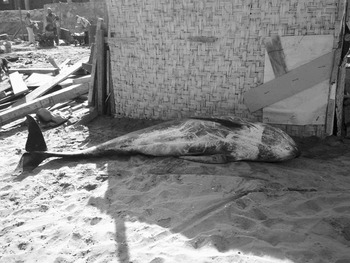
The first live animal found, a 2.92 m male, was removed from the beach by construction workers of a tourist facility just in front of the stranding site. Confronted by the authors, the workers refused to release the dolphin regarded as ‘granted’ to the people and stated that its meat would be shared by all workers at the end of the day. A front loader was used to move and hide the animal further inside the construction site (Figure 1). The animal was in poor condition and was sacrificed; the carcass was taken by the workers a few hours later.
Alive Risso's dolphin towed away from the beach for further consumption by workers of a construction site (top left come).

A second animal was found agonizing on the beach, 300 m away from the first one. A 40 cm section of dorsal muscle, from the skin to the bone, was cut and removed by a fisherman. The animal was alive at the time it was mutilated; it was sacrificed immediately it was found. A few hours later the carcass was butchered by local people and the tail was removed, probably as a souvenir.
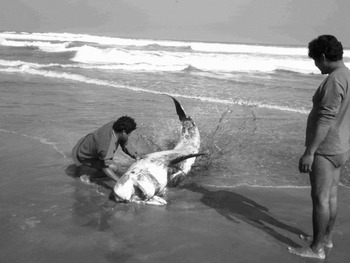
Another 200 m away a group of four animals was found stranded. One of them, already dead, was being butchered by local fishermen. A second had also died, but was intact, and the other two were still alive. The fishermen claimed that moments before the authors arrived they had successfully released a fifth dolphin, but this could not be confirmed. With the help of the fishermen at site (7 persons) we tried to release the two live animals without success. One swam off but stranded again some metres away while the other could not maintain a stable position and died some time after. A few hours later the first animal was killed by a fisherman (Figure 2), impatient for its death in order to take the meat.
Live stranded Risso's dolphin being killed by local people for meat consumption.

Another five carcasses already butchered were found at the end of the beach 800 m away. Local fishermen were taking the meat and skin remains of these animals to be used as bait for long-lines in the shark fishery.
Notably, as soon as news of the stranding had reached the town of Ilo, more people arrived at the beach toting knives, trying to recover some meat for food or bait. Although personnel from the Captaincy of Port arrived to verify the magnitude of the stranding, they just limited their actions to check the area and ‘authorize’ the use of the animals by the local people.
The cause of the stranding could not be determined because field conditions and logistic limitations did not allow proper necropsies. The animals' body conditions were good at the time of stranding, as suggested by semi-digested squids regurgitated and there were no signs of emaciation or human interactions (marks of nets, harpoons or propellers). However, rough weather could have been involved in the stranding. It must be considered that the shelf off Ilo is very narrow (~3 nautical miles), making an oceanic species like Risso's dolphins (Baird, Reference Baird, Perrin, Würsig and Thewissen2002; Jefferson et al., Reference Jefferson, Webber and Pitman2008) more vulnerable when approaching the coast during rough weather. Nevertheless, other causes such as cranial parasites, wrong navigation routes, diseases, contamination, etc. cannot be discounted.
The few previous records of Risso's dolphins from Peru (Van Waerebeek et al., Reference Van Waerebeek, Reyes, Luscombe, Halzwedel and Landa1988; Sánchez & Arias-Schreiber, Reference Sánchez and Arias-Schreiber1998; Kinzey et al., Reference Kinzey, Gerrodette, Barlow, Dizon, Perryman, Olson and Von Saunder1999, Reference Kinzey, Gerrodette, Barlow, Dizon, Perryman and Olson2000, Reference Kinzey, Gerrodette, Dizon, Perryman, Olson and Rankin2001) and Chile (Findlay et al., Reference Findlay, Pitman, Surui, Sakai, Ensor, Iguakami, Ljungblad, Shimada, Thiele, Van Waeerebeek, Hucke-Gaete and Sanino1998; Olavara et al., Reference Olavara, Aguayo-Lobo and Bernal2001; Hückstädt, Reference Hückstädt2005) suggest an almost continuous distribution in the south-east Pacific, from the Equator to central Chile, but with an apparent gap of 1000 km between central Peru and northern Chile, although limited survey efforts have been carried out in this area. The southernmost Peruvian record was an incidentally caught individual landed in Pisco (13°44′S 76°13′W; Tenicela, Reference Tenicela1994), while the northernmost Chilean record was a sighting located at 20°13′S 70°38′W, 27 nautical miles off Iquique (Findlay et al., Reference Findlay, Pitman, Surui, Sakai, Ensor, Iguakami, Ljungblad, Shimada, Thiele, Van Waeerebeek, Hucke-Gaete and Sanino1998). The present record partially fills this distributional gap.
Small cetacean exploitation for human consumption has been reported in Peru since the 1980s, with estimated total numbers of 10,000 to 17,500 annually (Read et al., Reference Read, Van Waerebeek, Reyes, McKinnon and Lehman1988; Van Waerebeek et al., Reference Van Waerebeek, Van Bressem, Félix, Alfaro, García-Godos, Chávez, Ontón, Montes and Bello1997) until the mid-1990s, when massive conservation campaigns led to new legislation, improved law enforcement and an important decline in landings (García-Godos, Reference García-Godos and Félix2007). However, the legislation may not have effectively changed people's habits and they may still consume small cetacean meat, especially in southern Peru, where conservation efforts are almost absent. It is clear that a co-ordinated network for marine mammals rescue is necessary to prevent any intentional killing of stranded cetaceans as well as to assure their rescue and release to sea, or appropriate euthanizing. Only one successful rescue of live-stranded whales (pigmy killer whales Feresa attenuata; Reyes et al., Reference Reyes, Echegaray, De Paz, Mendo and Wolf2002) has been previously recorded in Peru, namely in the Paracas National Reserve, where monitoring effort is permanent. It must be acknowledged that returning live-stranded cetaceans is usually not successful and also the conditions for releasing and sampling (see Geraci & Lounsbury, Reference Geraci and Lounsbury2005) were negative in this case.
The capture, consumption, landing and commerce of small cetaceans are explicitly prohibited by Peruvian legislation. Although some efforts to change people's attitude towards Peruvian cetaceans have been relatively successful locally (e.g. in Pucusana, Central Peru; Van Bressem et al., Reference Van Bressem, Alfaro-Shigueto, Geysen, Ontón, Vega, Chávez-Lisambart and Van Waerebeek2006) and massive campaigns had some impact on the people from the main cities in the 1990s (García-Godos, Reference García-Godos and Félix2007), these educational efforts have not been continued nor became mainstream. The circumstances of this Risso's dolphin live-stranding clearly demonstrate that awareness of cetaceans and their protected legal status is scarce or absent in southern Peru and that previous conservation efforts in the country must be re-evaluated in terms of rescuing live stranded cetaceans, humane killing and the role of local authorities and other stakeholders in these events. Additional education is needed to avoid recurrent events and to ensure that whenever they occur people involved react within the frame of the law, as well as to ensure appropriate data collection valuable for cetacean conservation.
ACKNOWLEDGEMENTS
Luis Piscoya (PROABONOS) alerted us to the stranding. Julio Valdivia (IMARPE) gave valuable information. We also thank Unai Markaida (ECOSUR—México) and Ricardo Tafur (IMARPE) for their support with the identification of squid beaks and carcasses, respectively. A draft version of this paper was reviewed by Koen Van Waerebeek (Centro Peruano de Estudios Cetológicos—CEPEC) and Elisa Goya (IMARPE). IMARPE—Ilo gave logistical support. Field work was done while we were monitoring the diet of seabirds at Punta Coles, Ilo, a project of the UBI Depredadores Superiores—IMARPE, lead by Elisa Goya.