In his seminal 1926 Preaching in Medieval England, G. R. Owst argues the case for examining ‘much-despised’ sermon literature.1 In his view, ‘the pulpit is itself a social activity’, a centre of talking and thinking, which allows a glimpse of medieval society.2 This chapter is concerned with evidence for English-language pastoral and preaching material in Ireland. Focusing on examples of texts and manuscripts localised to Ireland, this study builds on the scholarship on preaching in medieval Ireland and on vernacular preaching in the Anglophone world more broadly. It offers an overview of a number of religious books containing English-language material which can be linked to Ireland either by context or linguistic evidence. It will also examine anti-mendicant vernacular literature in Ireland, with a particular focus on The Land of Cokaygne, which is one of the most interesting poems in the mendicant BL Harley MS 913 and arguably the earliest satire in English.
Preaching was a powerful and important exercise for authorised agents of the church: priests, deacons, bishops, and other beneficed people. As Alan Fletcher eloquently puts it, ‘preaching presented ordinary men and women with the salvific maps by which they could trace the narrow way to heaven and avoid the primrose path to the everlasting bonfire’.3 In the late medieval period, who was permitted to preach was highly contested, and reformers were keen to see various changes implemented. Vicars, chaplains, and mendicant friars were allowed by special permission to preach. In this context, the utility of the vernacular allowing a preacher to reach the wider community made its use potentially dangerous for the church authorities, and it became necessary to monitor and, in some cases, restrict permission to preach.
Mendicant friars are renowned as ‘the pre-eminent pastoral agents in medieval Ireland’, and we catch a brief unexpected glimpse of the performance of their preaching in medieval Ireland in a rare illustration in the margins of the 1427 Dublin copy of the celebrated fourteenth-century religious poem Piers Plowman (Oxford, Bodleian Library, Douce MS 104) of a friar (I suggest most likely a Dominican) preaching at a wooden pulpit.4 The same manuscript depicts a Dominican friar giving absolution to a kneeling woman, a potentially controversial intimate interaction.5 These two exercises, preaching and confession, were central to the mendicant mission, and challenges regarding who had the authority to preach and offer religious interpretation were widespread in the Middle Ages. As is well known, Piers Plowman is attributed to William Langland, an ordained cleric who shared the widely held concerns of his age about pastoral guidance offered to the laity and the conduct of many mendicants and secular clerics, which motivated calls for reform and various literary responses.6 The laity received the majority of their ongoing religious instruction in popular piety through vernacular sermons preached primarily by clerics or mendicants, as well as through various art forms, including religious dramas and images. Affluent and literate members of the population could supplement such instruction with devotional material, frequently in the vernacular, such as personal prayer books along with prose, poetry, and other meditative works.
The political situation in Ireland added to the complexities of church organisation and preaching in this period. We find a vivid depiction of the division between the Irish and English communities (with their own separate church structures) operating on the island of Ireland in a letter written by the Dominican bishop of Cork, Philip of Slane (d.1326), to Pope John XXII. In the epistle, appended to Philip’s version of Giraldus Cambrensis’ twelfth-century Topographia Hibernica (the Topography of Ireland), the bishop reminds the pontiff that the celestial light and fountain of Christ’s truth has illuminated and nourished even the island of Ireland, and he points to the calamity of wars and continued discord of the two disunited groups in Ireland (the English and Irish), whose conflict must be addressed in order to unite the church in Ireland, which was (according to Philip) currently in ruins.7 Significantly, Philip’s adaptation of Giraldus’ work, known as Libellus de Descriptione Hiberniae (Book of the Description of Ireland), was presented to the Pope in Avignon in 1324, along with a plan, commissioned by his monarch King Edward II, to reorganise and reform the Irish church. In an effort to persuade the pope to take action, Philip describes Ireland as a remote place beyond which no man dwells, a description perhaps recalling the biblical Isaiah’s mission to convert and reform to the ends of the world and spread the message of God. Painting a picture of division between the Irish and English was not only rhetoric devised by Philip to create a sense of urgency; English legislation prohibited the ordination of Irish men to benefices among the English. As correctives to traditional views upholding the division between the English and Irish communities have demonstrated, such legislation (and rhetoric) did not prevent Irish clergy holding benefices with a significant number of licences issued to Irishmen in English areas of medieval Ireland.8 Significantly, however, such legislation attempted to regulate the use of language in preaching contexts, requiring those holding benefices to use English.9 One assumes that such legislation was required precisely because at least some clerics were not using English but rather speaking in Irish, presumably (and understandably) when dealing with Irish lay communities speaking Irish while living within the English community in medieval Ireland. English/Irish bilingualism within medieval Ireland is difficult to pinpoint; however, there was potential for Irish clerics to exploit an opportunity for benefices, which, if they could speak at least some English, may have given them an advantage over English clerics, who were unable to communicate with Irish-speaking parishioners. Thus, identification of vernacular material in preaching books may offer one way to further explore this question of language use within English Ireland.
Books and the Preaching Landscape
The preaching literature of medieval Ireland, particularly in Latin, has been the subject of much considered study. Fletcher, in particular, has examined preaching and preaching manuscripts in medieval Ireland in the context of Britain.10 Significantly, mendicants utilised the vernacular to communicate with the laity, and their efforts have left us considerable English- and Irish-language material from this period in Ireland.11 Colmán Ó Clabaigh has investigated the mendicant context, and Brian Murdoch and Edel Bhreathnach have examined medieval preaching in Irish.12 This chapter is focused on books with English-language material, the most significant of which is the remarkable fourteenth-century Harley MS 913, which likely emanated from a Franciscan preaching milieu.13 Among the many English-language texts it preserves – many with a preaching function – is perhaps the most famous of medieval English-language works from Ireland: The Land of Cokaygne (examined later in the chapter). A contemplative satire, this poem explores the challenges of trying to overcome human frailties and seek spiritual enlightenment. Cokaygne was a medieval utopia, a vision of plenty, reimagined in various locations and languages across Europe. The earliest surviving version, the early thirteenth-century French-language Fabliau de Cocagne, describes a journey to an imaginary island for penance and maintains a strong focus on food. As the story was adapted and recreated in various languages and locations, the specifics of plot and audience changed. However, the story retained the same basic elements critiquing the morality and sins of medieval society’s preoccupation with food, rest, and pleasure. The version of the tradition which appears in Harley MS 913 is playfully toying with the idea of spiritual and bodily nourishment: buildings are made of food, and monks can fly and pluck naked nuns from nearby lakes as the speaker extols the virtues of a place that appears paradisiacal, like a mirage emerging from the sea, ‘Fur in see bi west Spaynge’.14 In this pseudo-Ireland – the poet presumably familiar with the cartographical tradition which placed Ireland west of Spain – those living by its inverted monastic rule can eat and relax and enjoy themselves as much as they wish, submitting to their carnal desires, connecting Ireland into the wider medieval European imagination offered via the mirage of Cokaygne.
Priests had their own prayer books, psalters, and instructional volumes on confession and the Eucharist, with their library acquisitions depending on the availability of books to purchase or copy as well as on their spending power.15 All of these were essential tools for the job. The fourteenth- or fifteenth-century Cambridge University Library, Add. MS 710, associated with the chapter of St Patrick’s Cathedral, Dublin, included instructions for conducting confession and a text on the seven deadly sins.16 More educated priests might acquire or copy legal and theological volumes at university. We have evidence in Ireland of the latter material in the library of John Collyn, dean of the cathedral of Holy Trinity Christ Church, Waterford, from 1441. One of the entries in his will and testament bequests ‘books of sacred scripture with the doctoral tracts from me on the same’.17 Collyn’s book list is unmatched in Ireland as a record of a fifteenth-century private collection, although such collections were probably relatively typical. The majority of his books were presumably in Latin, with only one, on the genealogy of Mary, described as being in English.18 In the face of such lacunae, localised books become more important to provide a better impression of the literary geography.
The dominance of Latin material in the written record in relation to preaching can, of course, mask the everyday use of the English vernacular. The majority of sermons preached to the laity were in the vernacular. No reportationes (reports of sermons preached) or full accounts or transcriptions of a medieval friar’s sermon survive from medieval Ireland.19 What does survive, however, is the sermon diary of one of medieval Ireland’s great theologians and one of medieval Europe’s great thinkers, Drogheda-born Archbishop of Armagh Richard FitzRalph (b.c.1300–60). This records, in Latin, the text or summaries of many sermons he preached in Ireland from 1335 to 1357.20 Frequently, it provides the date and location, and notes that some of these sermons – predominantly those intended for a lay audience – were preached in English, spoken Latin being reserved for more ecclesiastical and prestigious contexts.21 Not everyone in the church, however, was fluent in Latin. To be installed in a benefice, priests were required to recite Latin formulae by heart and read the services in Latin, but they were not required to translate Latin.22 In 1281, the fourth Lateran Council envisioned the creation of a network of priests to deliver the church’s spiritual education. The growth in popular preaching from the thirteenth century increased the production of preaching aids, such as model sermons and florilegia (collections of excerpts), which were particularly popular among the mendicants.23 Archbishop of Canterbury John Pecham (1279–92) was particularly concerned with the care of souls, and, under his direction, the pastoral manual Ignorantia Sacerdotum (1281) emerged from the council of Lambeth to present a framework to solve what he saw as a priestly failing to adequately instruct parishioners. An English-language translation was subsequently made of Pecham’s Ignorantia Sacerdotum in 1357.24 Priests with only a cursory knowledge of Latin often required vernacular tools to aid them in their spiritual mission.25 A subsequent campaign by the archbishop of Armagh to improve the knowledge of his clergy suggested that they should update their libraries with appropriate manuals. A complicating factor in Ireland was the need for preachers to be able to preach in English or Irish to cater for their flocks.26
Once a friend and later a fierce critic of the friars, FitzRalph’s reforming zeal inspired John Wyclif (later synonymous with the reform movement known as Lollardy), and there is some evidence in Ireland of anti-mendicant preaching and vernacular English-language poetry inspired by the archbishop. The Cistercian monk Henry Crumpe (c.1350–1401) of Baltinglass was another high-profile voice in Oxford and Ireland against Wycliffite teaching in the late fourteenth century.27 His anti-mendicant stance was not itself without controversy, and his conclusions were deemed heretical by the Dominican bishop of Meath, William Andrew (d.1385). From the fifteenth century, the use of the vernacular in spiritual contexts was not without its own dangers. In 1401, the English parliament passed De Hertico Comburendo, which made adherence to Wyclif’s teachings – deemed heretical – punishable by burning. In 1407, the Constitutiones of Thomas Arundel, archbishop of Canterbury, forbade unauthorised translation of scripture, and also sought to restrict parish priests to teaching only that which aligned with church teaching and the basic tenets of faith in an attempt to maintain orthodoxy among its pastors and flock.28 In the Middle Ages, originality – particularly in the case of spiritual writing – was not always praiseworthy and could be closely linked to heresy.29
Preaching in Irish is outside the scope of this study, but there are examples of pastoral books predominantly in Latin with some Irish-language entries. TCD MS 72 is a rare case of a medieval manuscript containing Wycliffite material to which a calendar has been added (ff.2r–7v) and which has been annotated in Irish by a fifteenth- or sixteenth-century hand.30 The Wycliffite Psalter (ff.8r–86v) and Canticles in English (ff.82 –93r) are accompanied by additional material in English: various antiphons, readings, and prayers from the Placebo, Dirige, and Lauds in English (ff.93r–96r), a psalter (ff.96r–v), and ‘Austyn of þe preising of psalmis’ (ff.96v–97r).31 Written by three fifteenth-century hands, the calendar is executed in a considerably different style, and it may have originally circulated separately from the Wycliffite material, which makes its significance difficult to judge in an Irish context. It is likely, however, that the calendar – and possibly the whole manuscript – can be localised to Ireland in the late medieval period.32
The following catalogue of religious books with English-language material which can be localised to Ireland is undoubtedly incomplete, but further study on books with English and Irish will surely reveal not only connections between English and Gaelic Ireland but also those further afield. What is clear from the extant English-language material which can be traced to medieval Ireland is that it shares themes common in medieval England and offers a brief snapshot of what was a vibrant vernacular and multilingual preaching culture. Any study of localised books in medieval Ireland must include what is perhaps the most well-known of the vernacular preaching books localised to Ireland, TCD MS 201, a fifteenth-century manuscript which contains the earliest extant copy of the Festial sermon handbook of John Mirk, Austin canon, a prior in Lilleshall Abbey, Shropshire. Mirk’s compilation of the 1380s or 1390s became the most important vernacular sermon handbook in England.33 This volume has been linked to Ireland on linguistic grounds, possibly to county Louth (although such specific linguistic identifications are not definitive, certainly in the case of medieval dialects in Ireland).34 The Trinity text (Group B) has been written over a number of years in a practised professional hand – one that, in the opinion of its editor, was possibly used to copying musical notation and was probably that of a priest, with the book used at a later point by another priest.35 The name ‘Dominus Thomas Norreys’, possibly written in the same ink as the main hand of the manuscript, might indicate its scribe and has been identified as belonging to a member of the prominent county Louth family of that name.36 A Roger Norreys of Louth served as abbot of Lilleshall from 1369 to 1375 (Mirk mentions Lilleshall and his role as prior at various points), which might offer one route through which a copy may have made its way via a family connection to Ireland.37
The work is a comprehensive vernacular handbook of sermons, which cites in the prologue the intended audience of the ‘treti’ as ‘in helpe of suche mene clerkus’ (humble clerks) suffering from ‘defaulte of bokus and sympulnys of letture’.38 If accurately reflecting its audience, this lack of books and limited learning among less educated clerks with limited means propelled the Festial to becoming one of the most popular fourteenth-century vernacular preaching handbooks. It retained enough interest for William Caxton to deem it worthy of printing in 1483, and it was subsequently printed by Wynkyn de Worde in London in 1532. If, as suggested, Thomas Norreys wrote TCD MS 201 at the house of the Augustinian canons in the priory of Holy Trinity, Dublin (now Christ Church Cathedral), it indicates that this work circulated in Dublin (and possibly medieval English Ireland more generally).39 Even if it is our sole copy in Ireland, it is likely that its contents were familiar to the congregations of Dublin and perhaps Louth during the Middle Ages.
Many late medieval pastoral books are predominately written in Latin and English, with additions or short notes often added on spare or inserted pages. This is particularly true of books which have a connection to religious houses or Latin-literate ecclesiastical figures or contexts. This includes the famous vernacular English lyrics written alongside Latin songs in the fourteenth-century Red Book of Ossory RCB Library D11/1/2 of Bishop Ledrede, as discussed in Chapter 1. In this case, however, the evidence points to resistance to the apparent bawdy nature of the vernacular material; it seems unlikely, however, that the narratives were all as explicit as the most risqué scenarios suggested in The Land of Cokaygne.
A less well-known trilingual manuscript connected to Ireland is Cambridge, Corpus Christi College MS 405 (hereafter CCCC MS 405), a composite manuscript dating to the thirteenth to fourteenth century and made up of devotional works and civic documents once owned by the brethren of St John of Jerusalem at Kilbarry near Waterford.40 The sections are difficult to date; however, Colmán Ó Clabaigh has suggested that the manuscript was produced in the context of the transfer of the Templar estates in Ireland to the Hospitallers during the scandals of Archbishop of Dublin Alexander Bicknor (d.1349).41 The majority of the contents of CCCC MS 405 are in Latin and French, with a few shorter entries in English. Keith Busby has recently reviewed the French-language works in this manuscript, most of which are found in sections I, Va, and Vb.42 A number of lyrics in English appear in a fourteenth-century hand on page twenty-two of section one.43 A Latin work on indulgences (section VI) also contains phrases in French and English, including: ‘Blessed and worschepede be þat swete name of oure lord god IHS crist Amen +’.44
Busby has noted that the fourteenth-century hand responsible for the Latin and Middle English lyrics of page twenty-two (three and thirteen lines respectively) also copied pages one through seven, which contain Latin documents (and some French) relating to the transfer of Templar goods to the Hospitallers of Kilbarry, and suggests that this might offer evidence of a trilingual scribe writing in early fourteenth-century Waterford and that section one of the manuscript might have been produced in Ireland.45 He also notes points of connection (some previously accepted) between many of the works in section Va of the manuscript with Kilbarry (the bull of Boniface VIII and the Ancrene Wisse or Ancrene Riwle), a Benedictine link between Eli of Winchester and Waterford, and the identification of authors of two texts with origins in Ireland (Perot de Garbalei and, plausibly, Adam de Ross), which further supports the argument that portions of the manuscript were produced locally or imported for the Kilbarry Hospitallers.46
Middle English Lyrics
Rarely surviving in authorial hands, lyrics in Middle English are generally anonymous and frequently serve as aides-mémoires to help an audience memorialise the message of a sermon.47 The English lyrics of CCCC MS 405 appear in one continuous block of text, separated below as identified in the DIMEV as a seven-line poem. The first of the lyrics is a macaronic Latin and English verse on fortune:
Following directly below is a salutation of the Virgin Mary (six lines with medial rime):
This is followed by three lines with leonine rhyme or three couplets which may be part of the same verse:
The rest of the folio is followed by Latin entries in the same charter hand which include references to the provinces of Ireland. Kerby-Fulton has pointed out that the poems can be read as a reflection on the changing fortunes of the Templars (‘Templi’) by a Hospitaller scribe who, as previously noted, is unfamiliar with English orthography but also produces some unorthodox Latin spelling.51
Other similar verses in Latin and English localised to Ireland are found alongside Latin sermons in the late thirteenth-century Lambeth Palace Library, MS 557.52 Two Middle Hiberno English (MHE) verses appear in a late thirteenth-century charter hand which also penned Latin verses on the Council of Lyons, 1274.53 The first lyric in English is a well-crafted presentation of Jesus as lover, a popular motif in the fourteenth century frequently found in Franciscan preaching books such as the Fasciculus Morum, a compilation which arranges preaching material around the seven deadly sins and their opposite virtues.54 Rosemary Woolf described the poem in the Lambeth manuscript as ‘the earliest and best of the lover-knight complaints’:55
Woolf suggested this manuscript contains the earliest known version of this lyric, and the poem is adapted – reversed and augmented – and is thus connected to the lyric beginning ‘Vuno þi dore my spuse dere’ in Friar John of Grimestone’s preaching sermon book (Edinburgh, National Library of Scotland, Advocates MS 18.7.21).57 A slightly adapted inferior version of the ‘Allas’ poem is also found in Yale University, Beinecke Library, Takamiya Deposit 15.58
Montague Rhodes James and Claude Jenkins suggest that the book was probably compiled by an Irish friar or monk and may have come to Ireland via connections with the Augustinian priory of Llanthony Prima in Monmouthshire, Wales, which had been granted land in Meath by Hugh de Lacy and appears to have had tenants of English origin.59 (In support of such movement of books, it is worth noting that a copy of the mystic Richard Rolle’s writing in Latin is found in Lambeth Palace Library, MS 357, which was associated with the Augustinian canons of the cell of Lanthony at Duleek in Meath in the late fifteenth century.)60 The Lambeth volume’s connection to Ireland is confirmed by the presence of a fifteenth-century copy of a debt bondage of William Broun in Latin on 10 January 1487 at Cashel, county Tipperary.61
The second poem in Lambeth Palace Library, MS 557, presents a typical verse meditation on the wounds of Christ:
A later variant appears in Oxford, New College, MS 88, with an O-and-I refrain.63 Curiously, New College MS 88 is another manuscript which can be linked to medieval Ireland. One owner was Friar Robert (with an anathema on f.491v), and a note on f.1v suggests that the manuscript was bought in Oxford by Thomas Cranley, the noted preacher and archbishop of Dublin (1337–1417), who may have imported it into Ireland.64 The book contains Latin sermons and material relating to the mendicants, including Middle English verse and short passages in French. One verse (f.32r) expresses the fear of mortality; another (f.181r) is a meditation on the passion that reflects the fears of men and women and addresses them directly: ‘Man, þin hurte, þin hurte þu turne to me, / For þe vif wndes þe Ich tholede for þe.’65
It is of interest to note that another potential connection to New College, Oxford, comes in the form of a letter written by a Robert Preston and now preserved in Bodleian Library, Lat. Misc. MS c.66, the household book of Humphrey Newton of Pownall, a gentleman of Cheshire. In the letter, ‘from þe New College in Oxford Roberti Preston’, Robert explains that he had purchased fifty papal indulgences from ‘a certen frere beyng a doctur of diuinite and prouinciall of yrlond come late frome Rome’.66 It is possible that this Preston might be of the family which settled in Ireland (discussed in Chapter 4), which might explain his association with a friar from Ireland. The indulgences that Robert invested in would remit punishment to the wearer of ten beads (not supplied it seems because no one was available to transport them to Cheshire) in honour of Mary’s virtues by either looking at the beads or saying daily Aves.67
Another example of a short English entry is found in a parchment book, mostly in Latin, now TCD MS 97, signed by a former owner, Henry Duffe, ‘Per me Henricum Duf’.68 Duffe was the unfortunate last abbot of St Thomas’ Abbey in Dublin, elected in 1534 and forced to surrender the abbey to the crown four years later.69 This manuscript contains a large collection of late thirteenth- or early fourteenth-century religious material and a proverbial English couplet appearing as part of a short Latin text: ‘Euir is min eye / in þe wode leie / In quam delectant / illic mea lumina spectant … In te ducente / Mea lumina uident te’ (Here is my eye lying in the wood in which my eyes delight to gaze … led by you, my eyes see you).70 The earliest occurrence of this couplet is in the thirteenth-century prose Ancrene Wisse, also known as the Ancrene Riwle, produced in the West Midlands of England as a guide for female recluses.71 The presence of poetry in such contexts is not surprising; as Fletcher puts it, poetry might augment ‘those main staples of the sermon menu – pastoralia and catechesis – indigestible if served ungarnished.’72 This is not the only manuscript linked to St Thomas’ Abbey in Dublin; a missal in Latin with some musical notation, BL Add. MS 24,198, also survives and bares an owner’s note linking it with the penultimate abbot: ‘Jaobus Cottrell aba [1526] sancti thome me possidet.’73
Anti-Fraternal Literature
Literature critical of friars was penned by many of the well-known writers of the Middle Ages: the poets Petrarch and Boccaccio; Jean de Meun, author of the Roman de la Rose; and writers in Britain including, of course, Langland, Chaucer, and Gower. Anti-fraternal literature has a long-standing connection to Ireland; FitzRalph, one of Ireland’s great theologians, is credited with shaping the genre of anti-fraternal literature to channel his own frustration towards the monastic orders.74 Hugely influential in university circles and at the Avignon papal court, his sermon Defensio Curatorum was one of the first significant anti-mendicant sermons defending the secular clergy against the abuses of the friars and was preached before Pope Clement VI on 8 November 1357. This provoked a response from the friars (Defensio) and a counter-response from FitzRalph, Quia In Proposicione Nuper Facta. Defensio Curatorum was widely circulated in manuscript, with John Trevisa translating it into English in the 1390s. It was printed in the fifteenth century in Britain and Louvain (1475) and in Paris by Jehan Petit in the sixteenth century.75 John Foxe (1516–87) also included a detailed summary of it in his Protestant polemical work Actes and Monuments (1563), commonly known as the ‘Book of Martyrs’, with FitzRalph mentioned in the 1570 edition. James Ussher also refers to FitzRalph’s conflict with the friars. ‘Armachanus’, as FitzRalph was sometimes called, became one of the secular clergy’s spokesmen against the friars. This identification is vividly displayed in the illustration of FitzRalph in Cambridge, Corpus Christi College MS 180, a late fourteenth-century manuscript made for the English Benedictine Adam Easton (d.1397), a monk of Norwich, cardinal of St Cecilia, and dean of York.76 The illustration presents FitzRalph as an archbishop (his identity confirmed by the tag ‘Armachan[us]’ emerging from the figure) enclosed in a historiated initial, writing a book guided by the holy spirit (in the form of a dove by his head). He is presumably writing the text which faces him, his strident anti-mendicant dialogue De Pauperie Saluatoris (c.1350–6) concerning poverty and mendicant privileges, while representatives of the four mendicant orders stand in pairs in the opposite margin and are assaulted by devils.
We also have evidence of English-language poems connected to Ireland on topics which were near to the archbishop’s heart. Of the three anti-fraternal poems preserved in the aforementioned composite thirteenth- to fifteenth-century parchment and paper manuscript BL Cotton Cleopatra MS B II, two are in the MHE dialect and a third is in Latin. They attest to the discussion and chatter on these topics in the various languages in medieval English Ireland. The fact that the three poems are crossed out with a large X (but not rendered illegible), perhaps by a later owner, suggests that such material was not always deemed appropriate. Portions of this manuscript may not have started life as one unit, and some of the booklets are separated by early modern leaves. The early modern flyleaf preceding the booklet which contains these poems features a Latin poem on the Council of London in 1382 (with a short refrain in English).77
The first of two poems in English has been named in modern scholarship Song Against the Friars, and it is followed by the poem Against the Minorite Friars or Of thes Frer Mynours.78 The first, written from the perspective of a disillusioned former monk, presents a vignette of the hierarchical and dangerous allure of the friars infiltrating society for their own gain.79 It suggests, using clever wordplay which is also found elsewhere, that the murdering ‘cursed’ biblical Cain founded the four orders:
The mendicant association with Cain has a long tradition. For instance, in Mum and the Sothsegger, he is described as the father and ‘fundre of alle the foure ordres’ (l.494), and, after a reference to FitzRalph’s antifraternal arguments, an acrostic is used to connect the immorality of the orders to Cain (ll.496–504).81
The aforementioned second poem of forty-two lines in BL Cotton Cleopatra MS B II attacks the Franciscans for making false analogies between the friars and Christ. It has a changing O–I refrain, which is found in a number of other middle English poems as well as in the Latin poem The Council of London in the manuscript. This refrain might aid memorisation or perhaps enable the lyric to be sung.82 A reference to FitzRalph’s anti-mendicant agenda appears in a refrain: ‘With an O and an I, one sayd ful still, / Armachan distroy ham, if it is Goddes will.’83 References to Armachan, which appear in both this poem and the Latin poem on the council from the same manuscript, are not, of course, definitive proof of connections to Ireland (he was active elsewhere), but if this lyric was heard by a contemporary audience in Ireland, it is likely that the local resonance would have been particularly noted and suggests that anti-Wycliffite sentiment (if not danger) was relatively well-known in Ireland.84 The most important and innovative anti-mendicant literature from medieval Ireland appears in a mendicant manuscript, BL Harley MS 913, and a closer examination of this poem offers us an opportunity to examine how the criticisms were articulated.
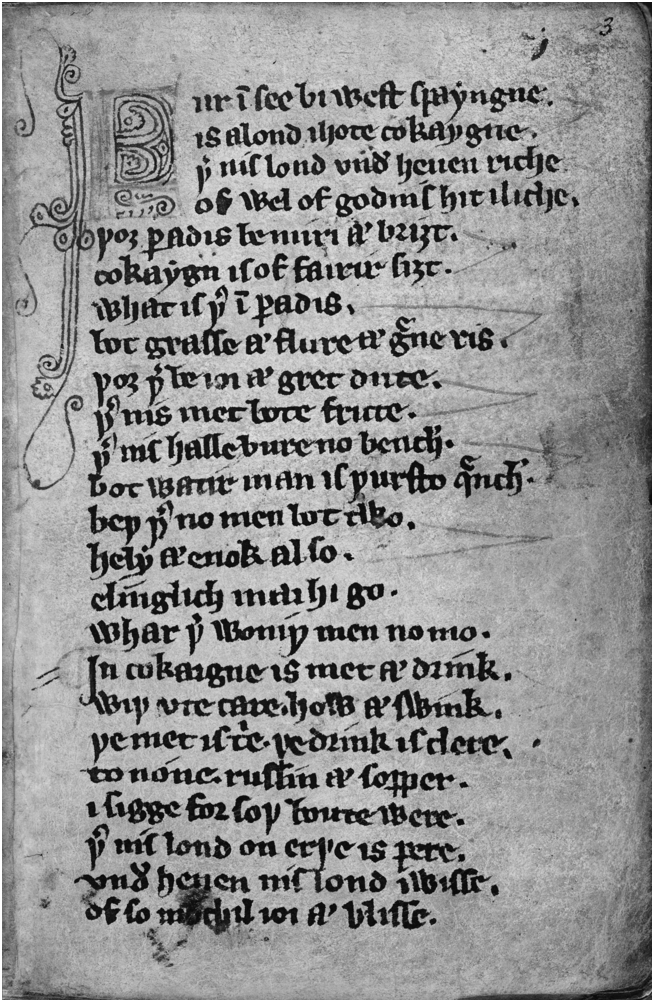
The presence of an anti-mendicant poem within a mendicant book is, of course, not surprising. Mendicants often enjoyed critiquing the vices of other orders, implying that their path to God was the correct route. Mendicant books were multipurpose volumes. They could serve as portable preaching handbooks, and many of the texts within a book offered moral guidance and entertaining exempla through which it was hoped that the true spiritual message would impress on the memory more firmly. The Land of Cokaygne, written in MHE, is found in the fourteenth-century trilingual (English, Latin, and French) manuscript (c.1330–42) Harley MS 913 (Figure 3). It has been called the earliest satire in the English language (although some scholars have argued it is more of a parody in nature than a true satire), and it is an important marker of engagement in satirical European literature.85 What has been less remarked on is how the poem is written with its local environment very much in mind. The importance of Harley MS 913 for English writing in Ireland is difficult to overstate. It has forty-eight items, some prose and some poetry. At least five works are lost from the manuscript but survive in a transcription made in 1608 by James Ware in what is now BL Landsdowne MS 418, and most of the surviving fifty-three works are unique.86 Harley MS 913 is our most substantial manuscript witness for fourteenth-century English literature in Ireland. This small book is most likely of Franciscan origins – possibly written in Kildare or Waterford – and contains many religious, penitential texts and others on the history of the Franciscans. Cokaygne points not only to the Franciscan literary reflex but also to their ability to absorb and translate literary material across Europe-wide fraternal networks. In Franciscan foundations, the library was accessible via chained books for consultation and individual borrowing, subject to mendicant legislation.87 Translation into the vernacular was often undertaken for pastoral purposes, and Cokaygne has at the heart of its humour a moralising voice.88
Opening folio of the poem The Land of Cokaygne. BL Harley MS 913, f.3r. London, British Library.
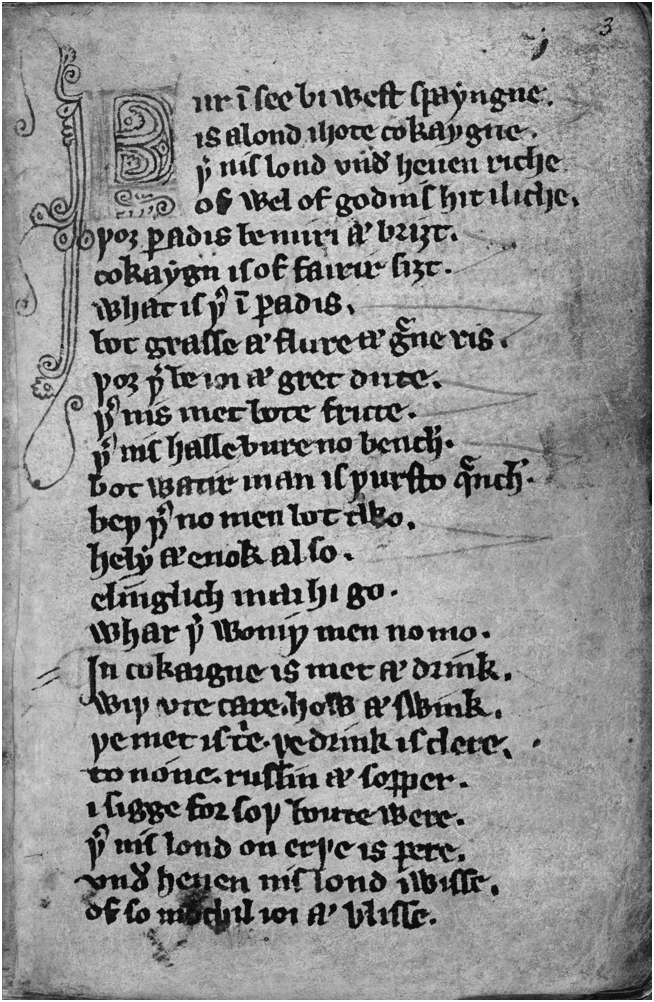
Figure 3 Long description
Decorative penwork and rubrication on the first letter F descends down the left margin. Less elaborate rubrication appears before the line that begins In Cokaigne.
Transcription:
Fur in see bi west Spayngne,
Is a lond ihote Cokaygne.
þer nis lond vnder heuenriche,
Of wel, of godnis, hit iliche.
þoȝ Paradis be miri and briȝt,
Cokaygn is of fairir siȝt.
What is þer in Paradis,
Bot grasse and flure and grene risȝ
þoȝ þer be joi and gret dute,
þer nis met bote frute.
þer nis halle, bure no benche,
Bot watir man is þurst to quench.
Beþ þer no men bot two,
Hely and Enok also.
Elinglich mai hi go,
Whar þer woniþ men no mo.
In Cokaigne is met and drink,
Wiþvte care, how and swink.
þe met is trie, þe drink is clere,
To none, russin and sopper.
I sigge for soþ, boute were,
þer nis lond on erþe is pere,
Vnder heuen nis lond iwisse,
Of so mochil ioi and blisse.
Transcription from Poems from BL MS Harley 913, ed. Turville-Petre, 4.
Versions of this medieval narrative about a mystical land of Cokaygne are found in Latin and many vernacular European languages, including Irish, although the criticism is not always directed at the monastic community.89 This poem is well known and often cited by scholars but rarely analysed to reveal the wordplay and allusions to aspects of the monastic community which often remain hidden from view. It is worth exploring how this poem functions as a critique of the monastic community, which also speaks to the wider social concerns of the age.90 The monastic ideal expected those who entered monastic orders to give up their worldly possessions, take a vow of celibacy, and live by the strict discipline of a monastic rule. The life of monasticism (the Greek word ‘monachos’ means a solitary person) involved withdrawing from worldly things but promised spiritual purpose and salvation. The extent to which each of the orders achieved the mendicant ideal was a matter of huge debate. There were fierce rivalries between the monastic communities themselves alongside significant tensions between parish priests and the mendicant (begging) orders (Franciscans and Dominicans who travelled and preached within predominantly urban communities, which was the domain of the secular clergy). There was thus a huge appetite for the production and consumption of satirical and critical literature on the vices of particular orders.
It has been suggested that the monks in Cokaygne are Cistercians – they are of a ‘wel fair abbei / Of white monkes and of grei’91 – since Cistercians were known as the White Monks due to their undyed habits of white or grey wool. The Irish name for Cistercians is, of course, ‘na Manaigh Liath’ (which translates to ‘the grey monks’). This might suggest knowledge of the Irish name. It is possible that some of the satire in this poem may be directed at the Benedictines (also known as ‘Grey Friars’), great rivals of the Franciscans and thus an understandable addition to a book likely produced by that order. There may, of course, be more than one monastic order pilloried in this poem of 190 lines by someone with the suspicion that each order has the potential to be as bad as the others. That the bulk of the jokes are aimed at the Cistercians, however, seems accurate. That order, founded by monks criticising laxity in the Benedictine Order, sought to establish the Cistercian life of simplicity and austerity as the true following of Christ. Critiques of Cistercian behaviour and adherence to the Rule of St Benedict and their declared refocus on the Benedictine dedication to ‘ora et labora’, then, can have an obvious edge when penned by those in other orders, who can take great delight in pointing out the lapses within that ambitious order in their supposed dedication to prayer and work.
Bernard of Clairvaux (1090–1153), founder of the Cistercian order, had criticised the often elaborate nature of Benedictine buildings, which he considered improper and distracting, but this criticism was directed at the Cistercians themselves when, in the late Middle Ages, the simplicity and austerity of their foundations became more elaborate, with flying buttresses and pointed ribbed vaulting decorated with stained glass (overdecoration had been criticised by early Cistercians as a distraction in Benedictine foundations).92 The cloister in the poem, arguably symbolic of the monastic world as a whole, is nothing if not an eye-catching spectacle:
More eye-watering, however, is the fact that this abbey is constructed entirely of food:
In stark contrast to the plain diet demanded by the monastic rule, it is acceptable to eat these rich foods in Cokaygne. This monastery is, quite literally, built for consumption and worldly pleasures. These criticisms, typical of the Middle Ages, may have had a strong resonance in an Irish context. The first Cistercian foundation in Ireland, Mellifont, established in 1142 as a daughter house of Clairvaux in Burgundy, became a dominant presence in county Louth, perhaps reflected in its Irish name, an Mhainistir Mhór (the Big Monastery), and – following the Cistercian tradition of food-production – it controlled large tracts of farmland around the monastic core. The name Mellifont derives from the Latin ‘Fons Mellis’ (Font of Honey), and, thus, a satirical portrayal of an abbey (and its order) dedicated to overindulgence of food and sweet things makes sense. Mellifont wielded significant power and prestige and had at least twenty-one daughter houses.95 At its dissolution in 1539, Mellifont was one of the richest abbeys in Ireland, valued at £352. 3s. 10d.96 As Roger Stalley writes, Mellifont ‘continued to be in the forefront of stylistic development in Ireland. In terms of scale and visual splendour, it appears that the thirteenth and fourteenth-century church had few rivals elsewhere in the country.’97 Thus, while the focus on food and appetite is typical of the anti-mendicant genre, it likely reflects contemporary criticisms of the order in Ireland. Such criticisms were heightened after a number of rebellions and depositions of abbots sought to quell the early thirteenth-century ‘conspiratio Mellifontis’. Nonetheless, the critical report from the order’s 1221 Visitation led by Nottinghamshire Cistercian Stephen of Lexington claimed that Cistercian life in Ireland was barely recognisable as the life outlined in the rule, a complaint that can certainly be made for the depiction of the monastic life in Cokaygne.98
The imagery in Cokaygne is visually striking. Geese fly already roasted on the spit without requiring any labour on the part of the monks: ‘þe gees irostid on þe spitte / Flee[þ] to þat abbai, God hit wot, / And grediþ: “Gees al hote, al hot!”’99 This feeding of the community by nature has echoes in the idea of the abbots and God as a mother nurturing her children, but it flies in the face of the order’s purported dedication to work.100 Symbolically, references to geese are instructive. Prior to the Black Death, wealthy monasteries consumed considerable quantities of geese in late spring and at Michaelmas. Unaffordable for much of society, the labour-intensive fowl was a good choice for the satire to demonstrate the extent of the leisure enjoyed by the community and the level of culinary indulgence on display.101 In an Irish context, there is evidence for their consumption for special occasions at the Priory of the Holy Trinity in Dublin; records suggest one goose cost 3d in the mid fourtheenth century.102 Costly consumption by the hierarchy may have helped forge the ideological connection between that bird and indulgence. It also has an analogue in possibly the earliest allusion to Cokaygne outside literature. In Paris in 1425, then under the control of the English and Burgundians, a challenge was set to climb a greasy pole to claim the prize of a basket with a goose and six coins balanced on top.103 As well as marking the goose out as frequently out-of-reach for the general populous, such appearances in popular entertainment underlie the adaptability of elements and the potent allure of Cokaygne, as well as its popularity.
Traditionally, geese betrayed the hiding place of St Martin of Tours, forcing him to become bishop of Tours in the late fourth century. In Cokaygne the cries of the geese literally warn their would-be consumers that they are ready to be eaten. (Is the joke on the monks? Are the ‘consumers’ to be themselves ‘consumed’ by the flames of hell?) St Martin was the patron saint of beggars with an obvious connection to the mendicant orders. In satirical animal symbolism, geese who trust foxes represent those foolishly putting their trust in monks or friars, a parallel which has an obvious application in the poem, as the geese warn readers or listeners of the self-serving nature of the members of this monastic community, who are not securing their own salvation but focused on their own pleasure. The poem maintains there are no foxes in the land (or any other beast of danger or working animal); however, this seeming lack of threat is a mirage:
As the poem will later demonstrate, the monks themselves display zoomorphic qualities of birds of prey. The narrative symbolism surrounding the self-cooking fowl, however, has a more urgent message. The Benedictine twin pillars of ‘ora et labora’ (pray and work) allocated an important role for manual labour – such as repairing roads or bridges and producing food – and ‘opus dei’ (the work of God) demanded reading, communal prayer, and song. In Cokaygne, the monks are doing remarkably little and being rewarded with abundant ready-cooked food, which is causing them to overindulge and commit the sin of gluttony. Indulging in earthly desires – such as eating and drinking – is necessary to some degree but dangerous: it is to be tolerated but not encouraged. One possible motive for the depiction of such behaviour in the poem can be seen in the commentary added to an exemplum found in the thirteenth-century Franciscan Latin preaching aid produced in Ireland, the Liber Exemplorum (c.1275). In this collection of preachers’ tales, one of the exempla, drawn from Gregory the Great’s Dialogues, tells of how a monk who was eating in secret while he should have been fasting became ill and died, exclaiming that he became food for the dragon (representing the devil), who bound his knees and feet and stole his breath.105 The narrator adds that ‘if the sermon is preached before the religious, the example will make an excellent attack on hypocrisy’.106
Fasting and deprivation of food and water were considered beneficial boons to withstanding the temptations of the flesh and the devil. Gluttony, however, was more dangerous than simply a sign of greed. The focus on gluttony in Cokaygne has a parallel in an Irish context in the eleventh or twelfth-century Aislinge Meic Conglinne (The Vision of MacConglinne), surviving in the fifteenth-century Leabhar Breac (The Speckled Book) RIA MS 23 P 16, where the main protagonist Ainíer Mac Conglinne, an ecclesiastical poet-scholar from Roscommon (roughly in the centre of Ireland and perhaps symbolising the whole), receives terrible hospitality at a Cork monastery (which he satirises) on route to save the king of Munster from the demon of gluttony.107 Both Cokaygne and Meic Conglinne are set in Ireland and deal with incorrect behaviour within the church as viewed through the prism of food.108 Influential early Christian writers such as Jerome and Cassian maintained that meat and wine created sexual lust, and gluttony itself was a base sin from which others flowed.109 The perception that gluttony – a staple vice of medieval satire – leads to other more dangerous transgressions makes it a gateway sin.110
The poem presents a wondrous land of plenty. The name ‘Cokaygne’ implies that it is a land of cooking.111 The word ‘cok’ has many meanings, including a male domestic fowl, but it can also refer to a cook – a person who provides various forms of physical and spiritual nourishment. In Cokaygne, the wider implications of that nourishment appear to go beyond traditional norms and embrace various social and sexual taboos. If the monks are idle and willing to overindulge on food consumption, other overindulgent sins will naturally follow. Constantinus Africanus (c.1015–87), a monk at Monte Cassino near Rome (the first Benedictine house established by Benedict of Nursia [c.529] for whose community the Rule of St Benedict was composed), was an influential medical scholar who produced a translation of an important treatise on sexual intercourse and fertility, De Coitu, written by Ibn al-Jazzara, which maintained that there was a close connection between nourishing foods consumed and the stimulation of the humours necessary for lust and sex.112 De Coitu also suggests that consumption of wine increases desire. This popular scientific work – which was translated in the fifteenth century into Catalan and partially into Middle English – was cited as a source of information on aphrodisiacs by the character January in one of Chaucer’s most explicitly bawdy fabliaux in The Canterbury Tales:113
Chaucer frequently satirised the monastic community, and here the link suggests a monk’s obsession with sexual pleasure. De Coitu is also referenced by the Physician in the General Prologue, and the work would presumably have been known to a medieval audience.115 Vignettes in Cokaygne of monks engaging in sexual pleasures of the flesh (with a village girl and nuns) suggest their lusty behaviour is borne out of their failure to regulate their appetites and is allied with dire leadership by the monastic hierarchy, who lead the congregation not through their model behaviour but through their inappropriate actions. St Bernard of Clairvaux claimed that living in a monastic community offered an opportunity to experience angelic life on earth; however, the monks of Cokaygne are no angels. They can, though, fly – presumably a play on the monastic ‘fuga mundi’ (flight from the world) – but this reference to flight is also perhaps a literary genre joke whereby the poet is pretending by this characteristic that the monks share a familiar marker of saintliness in hagiographical writing. An abbot gathers his monks, engaging in a literal flight from the world, by beating the drum to call them to prayer; here instead
A similarly inappropriate interaction involving the bare buttocks of a woman is found in Chaucer’s The Miller’s Tale, but in Cokaygne the significance of inappropriate interaction between monks and women plays on the oft-cited danger of monks as confessors for women and the dangers of leading by bad example. Significantly, one worry of Stephen of Lexington at Mellifont Abbey was the situation of the abbot’s house in the curia (courtyard) of the nuns, which he feared would bring scandal and confusion to the order.117 As one of the MHE poems in BL Cotton Cleopatra MS B II puts it in another anti-mendicant context:
Trevisa’s translation of FitzRalph’s Defensio Curatorum suggests – among other things – that, as the rule of St Francis proclaimed, the interaction between men of the cloth and women could be an occasion for sin, ‘alle freres that thei have noon suspect company as counseil of wymmen’.119 This, perhaps, marked a rare occasion the orders may have found when they broadly agreed. The problematic nature of the vignettes in Cokaygne presents the cloistered monastic community not as a paradigm of virtue but of vice. Monks literally fly out of control rather than symbolically flying to God and are more interested in play than labour or prayer. The predatory monks, described here as birds of prey, fly and pluck young naked nuns out of the river where they have been swimming, and they bring them back to their monastery:
These lines build up a number of false analogies of engagement with Christ and the rule of their order. The Rule of St Columba dictated Irish monasticism from the sixth century and suggested that being naked imitated Christ and the Evangelists; however, in the context of Cokaygne, this nakedness holds specific sexual dangers.121 The spectacle of the monks teaching such an ‘oreison’ to the nuns under their tutelage underlines the inversion of social and religious expectations on display in Cokaygne. The spectre of flying monks also recalls the common depiction of Christ hovering above St Francis of Assisi when he received the stigmata and suggests a more dangerous narrative being peddled by the order. While St Francis had actively sought to imitate Christ and his order, the Franciscans (of the ‘grei abbei’ above?) were frequently criticised for following in the footsteps of ‘the second Christ’ and making inaccurate analogies between themselves and Christ. Thus, seeing the monks take to the sky might be an allusion both to the stigmata and to their projected parallel with Christ. Indeed, this comparison might be behind the lines in the second MHE poem in Cotton Cleopatra MS B II which seem to imagine a Franciscan appearing out of the sky directly after referencing the stigmata: ‘Ther comes one out of the skye in a grey goun, / As it were an hog-hyerd hyand to toun.’122 The final lines of Cokaygne also suggest that after the misguided pleasures of the land, the reparation is seven years in pig’s dirt:
Along with denouncing and ridiculing the monastic community of lusty monks and nuns, the allegory ultimately forces its audience (which may be monastic) to come to its own conclusion about what is to be desired in life and to question the validity of the story they are being told – by the poem but also by the orders – and to interpret that narrative not simply as entertainment but as an allegorical morality tale. Earthly pleasures are ultimately false, unworthy, and unfulfilling. To truly know God, one must reject such misleading visions and seek the correct path to salvation. The false vision of what one might imagine an earthy paradise to be, where fowl land in the pan begging to be cooked, is not what the poem’s audience should recognise as a worthy or true paradise because it is ultimately earthly in nature rather than spiritual; such base desires will lead to further sin and damnation. Other birds (generally representative of the spiritual world, Christianity, and the soul) violate the normal expectations of the animal world and prepare themselves to be eaten:
Christ’s sacrificing of his body, which becomes Eucharistic bread, is here echoed by the birds sacrificing themselves for consumption, but it is not a direct parallel. The rewards offered by Christ vastly exceed earthly and transitory pleasure for the monks of the poem and for the audience, who are themselves hearing about food they cannot taste, food which, like the paradise of Cokaygne, is an illusion. The excesses of lust and gluttony destroy what would otherwise be a potentially utopian landscape; as Neil Cartlidge has noted, playful parody between ‘gula’ (gluttony) and ‘regula’ (the monastic rule) was a medieval commonplace.125 This might be considered alongside the common medieval analogy of the value of mentally ‘chewing’ on literature as a form of contemplation and spiritual nourishment. The carnivalesque inversion of civilised norms in Cokaygne serves to focus on what is good and what should be one’s goal in life in preparation for a good death. In the tradition of satirical poetry, one should challenge excesses: wealth, immorality, and a focus on the secular to the exclusion of the spiritual. By so doing, Cokaygne prompts its audience to readjust their own desires and actions while allowing them to indulge in a little imaginative entertainment.
Through contemplation, the audience should be empowered to reject the pleasures of the flesh and realise that idleness and gluttony, which naturally lead to lust and sexual sins, are ultimately unrewarding. This should lead them to recognise that conventional theology, which teaches that sin is a source of guilt and shame, could better serve them than the distractions of a false promise:
Although Raymond Hickey’s suggestion that the author of Cokaygne had Irish as their first language is no longer considered accurate, the poem does have an Irish flavour.127 The poem is set in a land that is like Ireland but turns out not to be. Similarly, it promises to prove better than paradise and is truly nothing of the sort. Seeking to identify potential specific monasteries against which the satire is directed is perhaps reductive; however, from the foundation of the Cistercian order in Ireland, French and Irish monks had clashed. The French complained of anti-foreign sentiment and ill-discipline by the Irish (some of whom remained focused on Celtic monasticism even within this new Cistercian context). After the arrival of the English in Ireland in the 1160s, the composition of the monastic community changed again, and by 1227 Mellifont was described by Stephen of Lexington as being located in a dangerous march territory between the English and the Irish, which meant that any peace enjoyed there was temporary and unstable.128 As John Watt noted in his examination of the visitation of 1221, Stephen viewed Ireland as ‘a world engulfed in national hatred’ and singled out the archbishop of Cashel, Mairín Ó Briain (1223–37), as being too focused on advancing his (Irish) nation rather than religion (an Augustinian canon, he adopted the Cistercian habit after becoming ill while journeying to Rome in 1231).129 He also pointed to the ejection of English monks by Irish monks (a pattern of discrimination by Cistercian factions for some time to come). Born in Nottinghamshire, Stephen had only recently joined the Cistercians when he was appointed Visitor-General to the Cistercians at Mellifont. A former pupil of then-archbishop of Canterbury, Edmund Rich, Stephen was to become successively abbot of Stanley, Savigny, and Clairvaux, and demonstrated a particular concern with the need to modernise and reform the order. What he encountered seemed to confirm rumours of misrule and disobedience among the Cistercians of Ireland. Whether or not Cokaygne pointed directly to Mellifont or the Cistercians and reflected on a moment when criticism emerged from within their own order, which was ripe for parody, or whether it might reflect anti-Irish prejudice from a poet of the English nation based in Ireland, the idea of individuals following a false path is found everywhere gluttony rules, and many of the vices of the community in Ireland are scarcely different from vices elsewhere in the medieval Christian world.
Conclusion
In a multilingual, literate church community, creating hard divisions between writing in English and writing in Latin is frequently unhelpfully restrictive, although the number of those within the church who were literate in Latin as well as English was relatively slim. What is clear, however, is the validity of both languages to contribute to not only the pastoral care of a community but also the protection of that community’s history. The ability of scribes, and at least some readers, to switch between languages and genres is important to recognise. Fletcher has examined surviving evidence for the liturgy and manuscripts – the majority of which are in Latin – of Dublin’s two medieval cathedrals, the cathedral priory of Holy Trinity (Christ Church Cathedral) and St Patrick’s Cathedral.130 Audiences, however, received moral instruction in a multilingual environment. Occasionally, traces of medieval material in the vernacular is evident; for instance, the Liber Niger of the cathedral priory of Holy Trinity, Dublin (Christ Church Cathedral), had a rhyming chronicle in English on a martyrdom.131 There is, of course, evidence for vernacular English writing in personal devotion, evidenced in the circulation of longer vernacular works such as the popular Prick of Conscience in Ireland (discussed in Chapter 5). Much of this pastoral material was circulating in manuscript in the Middle Ages. Caxton felt there was a sufficient market to justify his printing of Mirk’s Festial in 1483; however, the availability of early printed books did not revolutionise the market in Britain and Ireland. Rab Houston suggests that, even by the sixteenth century, print may have had only a slight impact on access to texts in rural communities, and oral transmission remained a hugely important tool to influence public opinion and effect change.132 In Ireland, this footprint was likely lighter again. By chance, de Worde first published Edmund of Abingdon’s Mirror of Holy Church in London in 1521 using what appears to be an English-language translation likely undertaken in medieval Ireland (discussed in Chapter 4).133 Raymond Gillespie suggested the economic impact of the printing ‘revolution’ was limited in sixteenth- and seventeenth-century Ireland, both for those directly employed in the printing trade and for those who imported books.134 As evidenced by the first section of this chapter, the presence of English-language material in medieval pastoral manuscripts was considerably varied, and the circulation of such material in clerical and monastic circles attests to the importance of the vernacular. As Part II has demonstrated, anti-fraternal literature is a rich resource for vernacular poetry and, along with satirical moralising, has important messages for an audience. Such a survey as offered here cannot hope to do justice to the breadth of the vibrant and contested preaching culture of the late Middle Ages, but it offers a flavour of vernacular elements in Anglophone Ireland which often remain hidden from our picture of the literary world of Ireland and offer a key to reveal many of the concerns of the age shared across Christendom.