


Introduction
Although women’s political representation is on the rise, albeit slowly, women with multiple marginalized identities are still severely underrepresented. As part of an effort to better understand the experiences of different groups of women in the political recruitment and representation processes, scholars are increasingly moving beyond the one-dimensional approach to gender that has long dominated the discipline. A key factor is group stereotypes, which shape both access to elected office and experiences in office. Gender stereotypes mean that women politicians tend to be associated with weak leadership skills and competence limited to “feminine” issues (e.g., Bauer Reference Bauer2020; Dolan Reference Dolan2010; Lawless Reference Lawless2004; Liu Reference Liu2019; Schneider and Bos Reference Schneider and Bos2016). Even if research suggests that these stereotypes do not necessarily imply that women candidates are punished at the ballot box (Dolan Reference Dolan2014; Schwarz and Coppock Reference Schwarz and Coppock2022), once in office, they are frequently assigned to “feminine” committees that are considered less prestigious and influential, whereas men are more likely to be given portfolios viewed as “masculine” and highly important (Kroeber Reference Kroeber2024; Krook and O’Brien Reference Krook and O’Brien2012).
Recognizing both the relevance of stereotypes and the fact that women do not constitute a monolith, scholars have proceeded to examine how the intersections of gender with race and ethnicity (e.g., Bejarano Reference Bejarano2013; Carey and Lizotte Reference Carey and Lizotte2019; Cargile Reference Cargile2023; Gershon and Lavariega Monforti Reference Gershon and Monforti2021; Philpot and Walton Reference Philpot and Walton2007), sexual orientation (e.g., Doan and Haider-Markel Reference Doan and Haider-Markel2010; Loepp and Redman Reference Loepp and Redman2022), social class (Kim and Kweon Reference Kim and Kweon2024), and political party (Schneider and Bos Reference Schneider and Bos2014) affect voter perceptions. Disabled women are a group that has been sidelined in this work, despite an urgent need to understand the barriers they face in politics. One in six people worldwide has some form of disability (World Health Organization 2023), and women have higher disability rates than men (Office for National Statistics 2023). Disabled women often experience particularly poor socioeconomic outcomes (Schur Reference Schur2003), including lower employment and income levels, and are at heightened risk of violence and abuse (Dockerty et al. Reference Dockerty, Varney and Jay-Webster2015), underscoring their need for a stronger voice in politics. Yet, disabled people remain starkly underrepresented in decision-making positions around the world (Evans and Reher Reference Evans and Reher2024), and disabled women report unique challenges in the political recruitment process (Evans and Reher Reference Evans and Reher2025).
To find out whether disabled women also face unique biases when it comes to public perceptions, this project asks and answers the following question: How do candidate gender and disability operate together in influencing voters’ perceptions and evaluations of political candidates? Linking insights from political science on the roles of gender, disability, and intersecting identities in candidate evaluations and from social psychology on gender and disability stereotypes, we develop a set of hypotheses about both independent (i.e., additive) and interactive effects of gender and disability on voter perceptions of candidates’ traits, issue competences, and ideology, as well as on electoral support. We test these hypotheses through a survey experiment with a conjoint design in the United Kingdom (UK) and the United States (US).
We find that in most cases, gender and disability stereotypes are additive: for example, both women and disabled candidates are perceived as more compassionate, meaning that disabled women are rated the highest and non-disabled men the lowest. Additive effects are also evident for perceived competence regarding family and children policy and for left-right ideology. In other cases, disability but not gender shapes evaluations, for example with respect to healthcare policy competence. In the case of general competence perceptions, neither gender nor disability has an effect. Importantly, in a few cases, disability and gender intersect to produce distinct stereotypes. For example, disabled men are seen as the least strong and authoritative group of candidates, not benefiting from the masculine stereotype of strength. Notably, we find that despite the marginalization that disabled women face in society, they are not necessarily disadvantaged when it comes to voter perceptions: for the majority of outcomes we analyzed, women — and particularly disabled women — did not score poorly, although they were seen as less competent on traditionally “masculine” issues.
Aligned with other scholarship highlighting the importance of accounting for intersectionality, our findings on the intersections of gender and disability help develop a comprehensive understanding of the nature of voter perceptions and the dynamics of candidate competition, underscoring the vital role of an intersectional lens in the quest to reduce inequalities in political participation and representation (see, e.g., Liu and Estampador-Hughson Reference Liu and Estampador-Hughson2023; Liu Reference Liu, Cooke and Nyhagen2025). As the first study, to our knowledge, to explore attitudes toward women politicians with disabilities, our study adds new insights to experimental research analyzing candidate gender from an intersectional perspective (e.g., Doan and Haider-Markel Reference Doan and Haider-Markel2010; Kim and Kweon Reference Kim and Kweon2024; Gershon and Lavariega Monforti Reference Gershon and Monforti2021), as well as to research on the formation of attitudes toward political candidates more generally. The study also provides valuable insights for researchers in other disciplines who interrogate the ways in which the intersections of gender and disability shape individuals’ experiences in contexts other than politics. Finally, the findings are relevant for practitioners working to make politics more inclusive, as well as for disabled (prospective) candidates and their parties, helping them better understand and navigate public opinion.
Theoretical Framework: Candidate Stereotypes and Intersectionality
Stereotypes represent subtle biases and provide the most readily accessible information for voters (Taylor and Fiske Reference Taylor and Fiske1978). They serve as cognitive shortcuts for making inferences about candidates’ personality traits, political beliefs, and competence on different policy issues. Thus, in addition to pledges and track records, when evaluating candidates, voters also rely on candidates’ characteristics and identities, such as gender and gender identity, race and ethnicity, attractiveness, social class, and family status (e.g., Campbell and Cowley Reference Campbell and Cowley2014, Reference Campbell and Cowley2018; Carnes and Lupu Reference Carnes and Lupu2016; Huddy and Terkildsen Reference Huddy and Terkildsen1993; Jones and Brewer Reference Jones and Brewer2019; Sigelman et al. Reference Sigelman, Lee Sigelman and Nitz1995). Ample scholarship shows that gender is a common cue for voters’ evaluations of candidates. For example, women political leaders are seen as kind, warm, and more liberal, whereas men politicians are seen as assertive, tough, and more conservative (e.g., Alexander and Andersen Reference Alexander and Andersen1993; Celis and Childs Reference Celis and Childs2024; Dolan Reference Dolan2010; Hayes Reference Hayes2011; Huddy and Terkildsen Reference Huddy and Terkildsen1993; Schneider and Bos Reference Schneider and Bos2016). Whether and when these perceptions result in a penalty or advantage at the ballot box for women candidates is a question of ongoing debate (Dolan Reference Dolan2014; Schwarz and Coppock Reference Schwarz and Coppock2022).
By contrast, scholars have only recently started to explore how disability shapes voters’ opinions of candidates (Magni and Reynolds Reference Magni and Reynolds2024; Reher Reference Reher2021, Reference Reher2025; Reher and Evans Reference Reher and Evans2025; Smith Reference Smith2026). Stereotypes about disabled people in general tend to be mostly negative, with weakness, vulnerability, and incompetence among the most prevalent (Nario-Redmond Reference Nario-Redmond2020). However, recent research on disabled candidates suggests that citizens perceive them rather positively on several trait and policy dimensions (Evans and Reher Reference Evans and Reher2024). In some cases, gendered and disability stereotypes align; for example, both women and disabled people tend to be perceived as less strong and agentic than men and non-disabled people. However, this does not necessarily mean that these stereotypes simply “add up” or cancel each other out. A central tenet of the concept of intersectionality is that the intersections, or combinations, of different identities produce distinct experiences, interests, and patterns of oppression (Crenshaw Reference Crenshaw1991). That is, political candidates with multiple marginalized identities might be perceived by voters in unique, often inferior, ways.
This intersectional dynamic is reflected in Evans and Reher’s (Reference Evans and Reher2025) interviews with disabled women who have stood for office or considered doing so. Participants reported often being treated as incompetent, feeling compelled to downplay one dimension of their identity to better fit in and not be othered, and feeling hyper-visible. While the latter was described by some disabled women as an asset, helping voters recognize and remember them, it also means that they are more closely scrutinized and expected to act as representatives for their entire group. These observations suggest that voters’ perceptions of disabled women in politics may differ from their perceptions of both non-disabled women and disabled men. At the same time, these findings reflect only how disabled women in politics perceive how others see them (including voters, but also members of their parties and political opponents), rather than voters’ actual perceptions.
To better understand how candidate gender and disability affect voter perceptions, we explore the extent to which disabled women candidates are subject to intersectional stereotyping. Cassese (Reference Cassese and Hannah2019) defines intersectional stereotypes as “the set of stereotypes that occur at the nexus between multiple group categories. Rather than considering stereotypes associated with individual social groups in isolation (e.g., racial stereotypes vs. gender stereotypes), this perspective acknowledges that group-based characteristics must be considered conjointly as mutually constructing categories.” Ample scholarship finds evidence of intersectional stereotyping with respect to various identities, such as gender and sexual orientation: for example, Doan and Haider-Markel’s (Reference Doan and Haider-Markel2010) study shows that heterosexual citizens feminize gay men and masculinize lesbian women. Other research demonstrates voters’ intersectional stereotyping with respect to gender and race and/or ethnicity (e.g., Cargile et al. Reference Cargile, Merolla, Schroedel, Navarro, Hernandez and Navarro2016; Cargile Reference Cargile2023; Gershon and Lavariega Monforti Reference Gershon and Monforti2021; Livingston et al. Reference Livingston, Rosette and Washington2012). Building upon prior literature assessing the relevance of stereotyping in voters’ opinion formation, and drawing on evidence on stereotypes about women and people with disabilities specifically, we develop a set of hypotheses about how the intersection of gender and disability affects voters’ perceptions of candidates’ (1) personality traits, (2) policy-specific competences, and (3) political ideology, as well as (4) voter support.
Personality Traits
Due to gender norms that expect women to be emotional and nurturing, women politicians tend to be perceived and portrayed as more compassionate than men (Alexander and Andersen Reference Alexander and Andersen1993; Dolan Reference Dolan2010; Huddy and Terkildsen Reference Huddy and Terkildsen1993; Lawless Reference Lawless2004; Liu Reference Liu, de Geus, Tolley, Goodyear-Grant and Loewen2021; Schneider and Bos Reference Schneider and Bos2016). Like other low-status groups, disabled people are also frequently argued to be more strongly associated with warmth or compassion and less with competence than non-disabled people (Canton et al. Reference Canton, Hedley and Spoor2023; Fiske et al. Reference Fiske, Amy, Glick and Xu2002; McDonald Reference McDonald2021). Evidence from survey experiments on disabled politicians confirms that they are perceived as more compassionate (Evans and Reher Reference Evans and Reher2024). If we think about these gender and disability differences as additive, we might expect disabled women candidates to receive the highest compassion ratings of all groups.
Yet, Nario-Redmond’s (Reference Nario-Redmond2010) study finds that gender stereotypes are applied to a much lesser degree to disabled than to non-disabled people. While non-disabled women are frequently described as nurturing, sensitive, and emotional, none of these traits related to compassion were strongly associated with disabled women. This resonates with findings about other marginalized groups of women: in Cargile’s (Reference Cargile2023) study, white respondents rate Latina candidates lower on feminine traits than both white female candidates and Latino male candidates. Based on this evidence, we expect gender and disability to interact in affecting perceptions, such that the feminine stereotype of being compassionate is applied to non-disabled women but not to disabled women.Footnote 1
Compassion Hypothesis: Non-disabled, but not disabled, women candidates are perceived as more compassionate than disabled and non-disabled men candidates. We expect no differences between disabled women, non-disabled men, and disabled men candidates.
When it comes to evaluating general competence, evidence suggests that men and women candidates are perceived differently. Voters view women as less capable, strong, and decisive leaders than men (Dolan Reference Dolan2010; Lawless Reference Lawless2004; Paul and Smith Reference Paul and Smith2008). Moreover, role congruity theory suggests that because leadership is seen as masculine, voters are likely to react with negative prejudice when women occupy leadership roles because they are seen as violating the expectations associated with their gender (Eagly and Karau Reference Eagly and Karau2002; Schneider and Bos Reference Schneider and Bos2019). The weak association of leadership skills with women can be further activated by stereotypic campaigns portraying women as sensitive and emotional, leading voters to believe that women are unfit to be political leaders (Bauer Reference Bauer2015).
Similarly, the dominant image of disabled people is that they are weak and dependent on the help and support of others and the state (e.g., Anspach Reference Anspach1979; Oliver Reference Oliver1996; Rohmer and Louvet Reference Rohmer and Louvet2018). Because disabled people are frequently excluded from resources, they experience lower levels of education and higher rates of unemployment and poverty. This might potentially make it difficult for people to imagine disabled people holding leadership positions. On the other hand, disabled people are sometimes portrayed and perceived as courageous (Canton et al. Reference Canton, Hedley and Spoor2023; Louvet and Rohmer Reference Louvet and Rohmer2010), inspirational, heroic (Nario-Redmond Reference Nario-Redmond2010), and hard-working (Bell and Klein Reference Bell and Klein2001), which might be considered qualifying and desired traits particularly for political leadership (Sapiro Reference Sapiro1981/1982, 64). In Evans and Reher’s (Reference Evans and Reher2024) survey experiments, disabled politicians are perceived as equally competent, slightly less strong and authoritative, but more hard-working than non-disabled candidates. This finding suggests that voters might hold different — and more positive — stereotypes about disabled politicians than about disabled people more generally (cf. Schneider and Bos Reference Schneider and Bos2016, Reference Schneider and Bos2019). Yet, comparing disabled and non-disabled candidates without considering their other identities might also conceal important differences.
How might disability and gender interact in individuals’ perceptions of traditionally masculine traits, including strength and competence? Disabled men are often emasculated: strikingly, in Nario-Redmond’s (Reference Nario-Redmond2010: 479) study, the two most frequent descriptions of non-disabled men are “ambitious” and “strong,” whereas those of disabled men are “dependent” and “incompetent.” Because of the barriers that disabled people face, the ability of disabled men to protect themselves, others, and the nation might come into question. Furthermore, evidence shows that attacks on a candidate’s masculine traits decrease perceptions that the male candidate has leadership skills, such as being strong, tough, and confident (Cassese and Holman Reference Cassese and Holman2018). Consequently, we suspect that voters’ trust in the competence, strength, and authority of disabled men candidates may be lower compared to non-disabled men candidates. By contrast, since masculine qualities are not expected as much from women politicians anyway (Eagly and Karau Reference Eagly and Karau2002; Schneider and Bos Reference Schneider and Bos2019), disabled women are less likely to face this kind of disadvantage vis-à-vis non-disabled women. This suggests that any positive effect of candidates’ male gender on their perceived competence and strength is likely to be weaker among disabled than among non-disabled candidates. Again, Cargile (Reference Cargile2023) makes similar observations regarding gender and ethnicity, where Latino male candidates are rated lower on masculine traits not only compared to white men but also compared to women candidates. We therefore hypothesize:
Competence Hypothesis: Non-disabled, but not disabled, men candidates are perceived as more competent than disabled and non-disabled women candidates. We expect no differences between disabled men, non-disabled women, and disabled women candidates.
Strength Hypothesis: Non-disabled, but not disabled, men candidates are perceived as stronger than disabled and non-disabled women candidates. We expect no differences between disabled men, non-disabled women, and disabled women candidates.
Issue Competence
A consistent finding across the gender and politics literature is that women politicians are seen as more competent on issues that are considered feminine or related to women. “Feminine” issues are policy domains that are culturally associated with stereotypically feminine traits (e.g., warmth, care, empathy), rather than being defined strictly by who is affected. Issues like family, education, or health are considered feminine; issues like defense or agriculture are considered masculine (e.g., Eagly et al. Reference Eagly, Karau and Makhijani1995; Huddy and Terkildsen Reference Huddy and Terkildsen1993; Krook and O’Brien Reference Krook and O’Brien2012; Lawless Reference Lawless2004; Sanbonmatsu Reference Sanbonmatsu2002; Sapiro Reference Sapiro1981/1982; Schneider and Bos Reference Schneider and Bos2016). Research consistently shows that women politicians are seen to be more qualified to oversee feminine issues. This is visible in political appointments and portfolio allocation: Krook and O’Brien (Reference Krook and O’Brien2012) show that women politicians are more likely to be appointed as cabinet ministers in feminine or low-prestige areas.
In addition to issues coded as “feminine,” women politicians are also considered to be more likely to advocate for “women’s issues,” or women-friendly policies, including reproductive rights, equal pay, and family leave policy. This is partly rooted in gendered perceptions of personality traits, such as compassion, and partly in assumptions about women’s personal interest and experience (Huddy and Terkildsen Reference Huddy and Terkildsen1993). It may seem intuitive that women have a stronger desire and qualifications to propose and implement bills related to women. Moreover, this expectation is often reinforced: Schwindt-Bayer (Reference Schwindt-Bayer2006) finds that women legislators in Latin America feel compelled to represent their constituents in women-friendly policy areas, despite their own interests in other areas. However, these perceptions are not always accurate; examples are women politicians from conservative political parties supporting restrictions on abortion rights — a women’s issue, but not advocacy of women’s rights. Still, many voters might assume a conservative woman would be better at overseeing such an issue than a liberal man because of her shared lived experiences with other women.
These patterns are likely to apply to candidate disability in similar ways; therefore, we expect that disabled candidates are considered more competent on disability-related issues with which they are likely assumed to have lived experience, including healthcare and civil rights. Women might also be seen as more competent on these issues than men, since these issues tend to be considered more “feminine” (Alexander and Andersen Reference Alexander and Andersen1993; Schneider and Bos Reference Schneider and Bos2016); however, we do not expect disability to interact with gender in influencing these perceptions, since voters’ assumptions about the personal experiences of disabled people are unlikely to be gendered (even if in reality they are).
Disability Experience Hypothesis: Disabled candidates are perceived as more competent in handling healthcare and minority rights policy than non-disabled candidates. We expect no interaction effects with gender.
In other policy areas, gender and disability might interact in influencing competence perceptions. As discussed above, women politicians are generally perceived to have greater expertise related to family, children, and reproduction than men (Lawless Reference Lawless2004; Schneider and Bos Reference Schneider and Bos2014). However, this might only apply to non-disabled women. Due to pervasive discrimination, compounded by internalized stigma, disabled women are less likely to marry (Savage and McConnell Reference Savage and McConnell2016) and are still subject to reproductive injustice, including forced sterilization.Footnote 2 This is echoed in commonly held views of disabled women as unattractive, asexual, and unfit to have children and families (Nario-Redmond Reference Nario-Redmond2010). Accordingly, we expect that disabled women are not seen as equally experienced and competent on these “women’s issues” as non-disabled women, and likely not even more so than men politicians.
Women’s Experience Hypothesis: Non-disabled, but not disabled, women candidates are perceived as more competent in handling family and children policy than disabled and non-disabled men candidates. We expect no differences between disabled men, non-disabled men, and disabled women candidates.
Building on the Strength Hypothesis, we expect that voters perceive non-disabled men as more competent than women on traditionally masculine issues, such as military and defense policy (see Eagly et al. Reference Eagly, Karau and Makhijani1995), but that these perceptions are not applied to disabled men because they are seen as weaker and less masculine than non-disabled men. Again, we expect that candidate gender and disability have interactive effects.
Masculine Issue Hypothesis: Non-disabled, but not disabled, men candidates are perceived as more competent in handling military and defense policy than women candidates. We expect no differences between disabled men, non-disabled women, and disabled women candidates.
Ideology
In addition to character traits and issue competences, voters also infer candidates’ political ideology from their social identities — particularly when they lack other information about candidates’ policy views and priorities. Women politicians tend to be seen as more left-wing than men, in line with being stereotyped as having higher levels of compassion and concern about “feminine” and “women’s issues” (Huddy and Terkildsen Reference Huddy and Terkildsen1993; Koch Reference Koch2000; McDermott Reference McDermott1997; Schneider and Bos Reference Schneider and Bos2016). These perceived gender differences in political ideology are to some extent reflected in actual differences: women have gradually become more left-wing over the past decades and are now more likely to vote for left-wing parties than men (Inglehart and Norris Reference Inglehart and Norris2003; van Ditmars and Shorrocks Reference van Ditmars and Shorrocks2024), while left-wing parties tend to have higher proportions of women MPs than right-wing parties (Caul Reference Caul1999).
When voters have no information about candidates’ party affiliation or policy preferences, they also assume that disabled candidates are more left-wing (Reher Reference Reher2025). Presumably, voters expect disabled politicians to have experiences of socioeconomic marginalization, discrimination, and reliance on public services, making them less individualistic, more egalitarian, and more tolerant toward diversity. Again, these perceptions are mirrored in greater support of left-wing positions and parties among disabled citizens (e.g., Gastil Reference Gastil2000; Reher Reference Reher2022; Schur and Adya Reference Schur and Adya2013). Since we have no reason to expect that candidate gender and disability interact in ideology perceptions, we hypothesize that they have independent additive effects.
Ideology Hypothesis: Women candidates are perceived as more left-wing than men candidates, and disabled candidates are perceived as more left-wing than non-disabled candidates. We do not expect candidate gender and disability to have interactive effects.
Voter Support
The last outcome we study is electoral support. Although it has long been believed that voters punish women candidates because of the association of leadership traits with masculinity, an increasing number of studies fail to find any gender effect on candidate support (see Schwarz and Coppock Reference Schwarz and Coppock2022). Rather, voters’ policy preferences and priorities may lead to gendered candidate preferences; for example, voters who care about “women’s issues” are likely to be more supportive of women candidates (Kahn Reference Kahn1996; Sanbonmatsu Reference Sanbonmatsu2002). Differences in distributions of voter preferences or political contexts — for example, the salience of specific policy issues — might lead to aggregate differences in voter support for women and men candidates, but these differences are likely to often cancel out across the electorate. This has been shown to be the case for disabled candidates, too, with a small positive effect of candidate disability in the UK but not in the US (Reher Reference Reher2025).Footnote 3 Therefore, we expect that neither candidates’ gender nor their disability status affects voter support.
Support Hypothesis: Neither candidate gender nor candidate disability affects voter support.
Table 1 summarizes our hypotheses and predictions in terms of both the expected ranking of the four groups and the independent and interactive effects of disability and gender (cf. Sigelman et al. Reference Sigelman, Lee Sigelman and Nitz1995).
Hypotheses and predictions

Table 1. Long description
The table consists of two columns: Hypothesis and Prediction.
* Personality trait compassion: Predicts non-disabled women score higher than disabled women, disabled men, and non-disabled men. This suggests an interaction where the positive effect of being a woman exists only among the non-disabled.
* Personality trait competence: Predicts non-disabled men score higher than disabled women, non-disabled women, and disabled men. This suggests an interaction where the positive effect of being a man exists only among the non-disabled.
* Personality trait strength: Predicts non-disabled men score higher than disabled women, non-disabled women, and disabled men. This suggests an interaction where the positive effect of being a man exists only among the non-disabled.
* Issue competence disability experience: Predicts disabled women and disabled men score higher than non-disabled women and non-disabled men. This indicates an independent effect of disability with no interaction.
* Issue competence women’s experience: Predicts non-disabled women score higher than disabled women, disabled men, and non-disabled men. This suggests an interaction where the positive effect of being a woman exists only among the non-disabled.
* Issue competence masculine issue: Predicts non-disabled men score higher than disabled women, non-disabled women, and disabled men. This suggests an interaction where the positive effect of being a man exists only among the non-disabled.
* Ideology: Predicts disabled women score higher (more left-wing) than non-disabled women and disabled men, who score higher than non-disabled men. This indicates independent effects of gender and disability with no interaction.
* Support: Predicts no significant differences between disabled women, non-disabled women, disabled men, and non-disabled men, indicating no gender or disability effects.
Method and Data
We test our hypotheses with data from a survey experiment conducted in the UK and the US in 2020 and 2021Footnote 4 (Reher Reference Reher2024). The samples, obtained through Qualtrics, contain about 3,000 respondents in each country and are representative of the population in terms of gender, age, and region. The two countries are suitable cases since British and American voters are used to voting for individual candidates in single-member district electoral systems. Moreover, both countries have had several prominent disabled politicians,Footnote 5 meaning that most respondents are unlikely to be exposed to the idea of a disabled politician for the first time. Studying two countries also provides increased confidence that the results are not unique to just one context. While we pool the data in the analysis below, we also show that the results are overall similar in both countries (Online Appendix [OA] 3).
Survey experiments that present respondents with vignettes describing candidates and asking them to evaluate them are the most common method to study how citizens stereotype and support candidates based on their identities and other characteristics. By allowing researchers to present realistic descriptions of candidates with a range of information alongside the main variables of interest, the method mitigates issues such as social desirability bias, researcher demand effects, and low external validity (Hainmueller et al. Reference Hainmueller, Hangartner and Yamamoto2015).
Our study uses a paired-vignette design, in which respondents are shown texts describing two candidates competing against each other. The descriptions contain information about a range of characteristics, most importantly their gender (male or female) and disability: 40% of the vignettes mention no disability, and 20% each mention that the candidate is (i) “paralyzed below the waist and uses a wheelchair to get around,” (ii) “blind and reads using text-to-speech software,” or (iii) “deaf and communicates mostly in British/American Sign Language.” By including these three different disability types, the experiment likely yields results that are generalizable across a wide range of physical and sensory disability types.Footnote 6 We selected impairments that are well-known and for which respondents are likely to be able to imagine the barriers that candidates might face, which is aided by our mentioning of mobility aids, assistive technology, and mode of communication.
Candidates’ gender and disability are randomly varied alongside a set of other characteristics, including age, ethnicity, number of children, profession, years of political experience, and previous experience of elected office, in a conjoint design (the vignettes and attributes are shown in OA 1). Each respondent, in randomized order, evaluated two pairs of candidates: for one pair the candidates’ parties are mentioned (a Labour and a Conservative candidate competing in the UK; a Democrat and a Republican candidate competing in the US), whereas no party is mentioned in the other comparison. The effects of candidate characteristics on citizen perceptions tend to be larger when information on political parties is excluded or when respondents compare candidates from the same party, because party affiliation acts as a particularly strong — perhaps the strongest — heuristic in voter decision-making (Hayes Reference Hayes2011). We pool the data from both experiments with and without party information to maximize the number of observations, which we might think of as yielding average effects between settings with and without strong party cues. The overall number of observations included in the dataset is 24,044: 2,998 UK respondents and 3,013 US respondents, all of whom evaluated four candidates each (before excluding observations due to missing values).
After seeing each pair of vignettes, respondents are asked to evaluate each candidate along a set of trait, belief, and issue competence dimensions, as well as indicate which candidate they would vote for. To test our hypotheses about personality traits, we analyze respondents’ agreement with the candidates being compassionate (“cares about people”), competent (“has the competence and skills required of a politician”), and showing strength (“is strong and authoritative”), measured on a 5-point agreement scale, which was normalized to range from 0 (“strongly disagree”) to 1 (“strongly agree”). We measure issue competence perceptions (“How competent do you think the candidates would be in handling these issues if elected?”) on the policy areas of healthcare, minority rights, and family and children on a 4-point scale, which we normalized to range from “not competent at all” (0) to “very competent” (1). Respondents’ perceptions of candidates’ ideology are measured on an 11-point scale, which we normalized to range from left (0) to right (1). Finally, candidate support is measured as 1 if a respondent chose the candidate and 0 if they chose the competitor.
Results
To analyze the joint effects of candidate gender and disability on voter perceptions, we estimate a set of linear regressions with candidate-by-respondent as the unit of analysis on the pooled sample.Footnote 7 To reduce complexity, we summarize the three disability types and use a binary variable indicating whether a candidate is presented as disabled or not (we present separate models by disability type in OA 4). We use two strategies to estimate the additive and interactive effects of gender and disability (Block et al. Reference Block, Golder and Golder2023). In the first, we combine the candidate disability and gender indicators to generate a nominal variable with four categories: disabled women, non-disabled women, disabled men, and non-disabled men candidates. We then regress the outcome measures on these group dummies in linear regression models to estimate their average marginal component effects (AMCEs) (Hainmueller et al. Reference Hainmueller, Hopkins and Yamamoto2014) (the estimates are reported in OA 2; analyses by country are reported in OA 3). This approach allows us to compare all four groups with each other and to produce predicted values on the outcome measures for each group, which we present below. In addition, we also estimate models containing the disability and gender variables as well as the interaction of the two. These models are equivalent to the models with the group dummies, but they test whether gender and disability have statistically significant interaction effects. All models also contain the indicators of the other randomized candidate attributes as well as candidate fixed effects, indicating the position of the candidate in the survey (1–4), and country fixed effects (these are omitted from Tables 2 and 3 but shown in Tables A2 and A3 in OA 2). Since the attributes are randomly assigned to respondents, we do not need to control for any respondent variables (Imbens and Rubin Reference Imbens and Rubin2015). The hypotheses and results are summarized in OA 6.
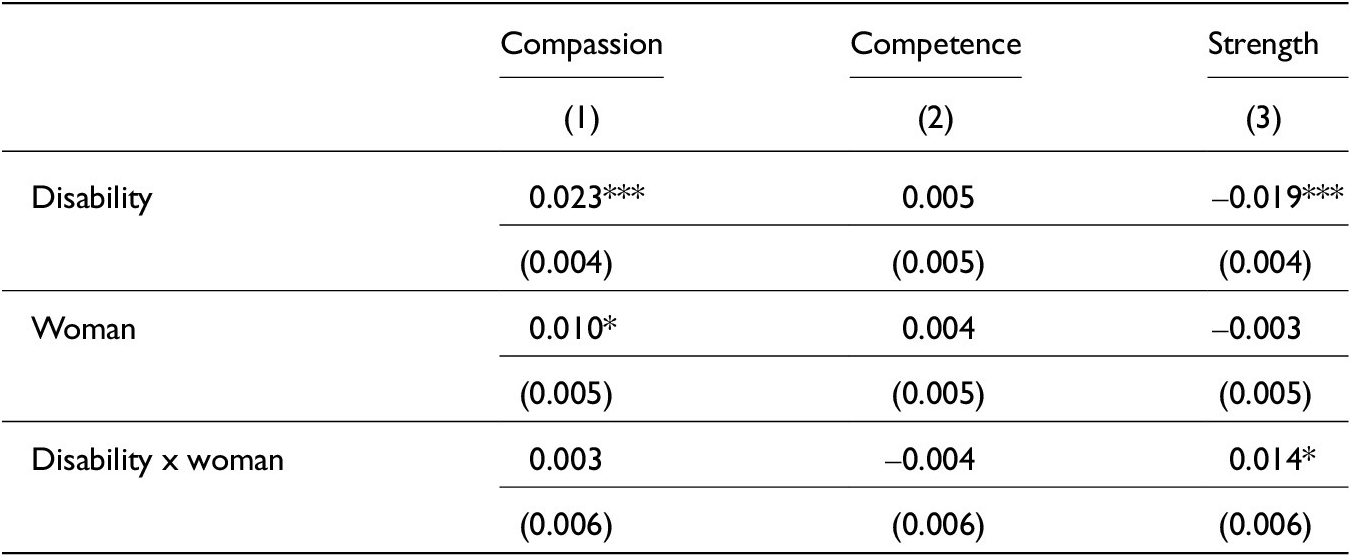
Linear regression analysis of personality traits, with disability-gender interactions

Table 2. Long description
The table presents linear regression results across three columns representing personality traits. Each cell contains a coefficient followed by a standard error in parentheses.
* Column 1, Compassion: Disability has a coefficient of 0.023 with three asterisks (standard error 0.004). Woman has a coefficient of 0.010 with one asterisk (standard error 0.005). The interaction of Disability x woman is 0.003 (standard error 0.006).
* Column 2, Competence: Disability is 0.005 (standard error 0.005). Woman is 0.004 (standard error 0.005). Disability x woman is minus 0.004 (standard error 0.006).
* Column 3, Strength: Disability is minus 0.019 with three asterisks (standard error 0.004). Woman is minus 0.003 (standard error 0.005). Disability x woman is 0.014 with one asterisk (standard error 0.006).
Statistical significance is indicated by asterisks: one asterisk for p less than .05, two asterisks for p less than .01, and three asterisks for p less than .001.
* p < .05; ** p < .01; *** p < .001
Notes: The models include the same covariates as those in Table A2 (Online Appendix 2) but we only report the coefficients for disability and gender here. The covariate estimates and N are the same as in Table A2, since the models are equivalent. All models include candidate and country fixed effects.
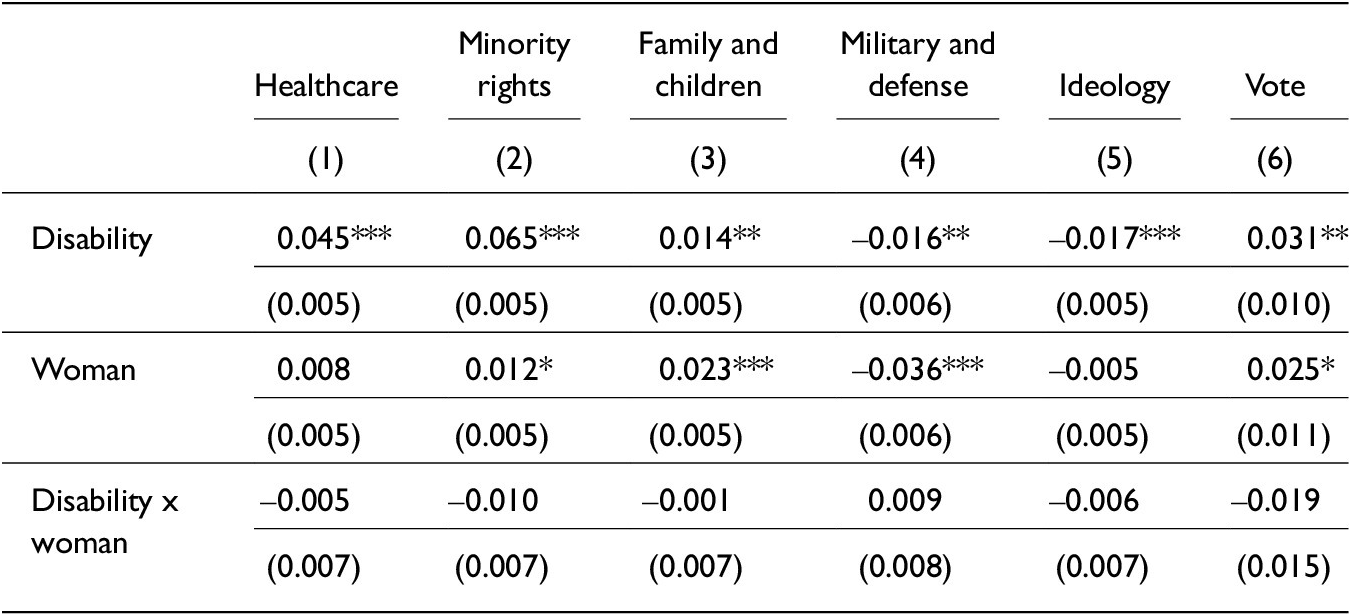
Linear regression analysis of issue competences, ideology, and vote choice, with disability-gender interactions

Table 3. Long description
A statistical table with six numbered columns representing dependent variables: 1 Healthcare, 2 Minority rights, 3 Family and children, 4 Military and defense, 5 Ideology, and 6 Vote.
Row 1: Disability. Shows positive significant coefficients for Healthcare (0.045), Minority rights (0.065), Family and children (0.014), and Vote (0.031). It shows negative significant coefficients for Military and defense (-0.016) and Ideology (-0.017).
Row 2: Woman. Shows positive significant coefficients for Minority rights (0.012), Family and children (0.023), and Vote (0.025). It shows a negative significant coefficient for Military and defense (-0.036). Healthcare (0.008) and Ideology (-0.005) are not statistically significant.
Row 3: Disability x woman interaction. All coefficients in this row are statistically non-significant. The coefficients are -0.005 for Healthcare, -0.010 for Minority rights, -0.001 for Family and children, 0.009 for Military and defense, -0.006 for Ideology, and -0.019 for Vote.
Standard errors are provided in parentheses below each coefficient. Significance levels are indicated by asterisks: * p < .05, ** p < .01, *** p < .001.
* p < .05; ** p < .01; *** p < .001
Notes: The models include the same covariates as those in Table A3 (Online Appendix 2) but we only report the coefficients for disability and gender here. The covariate estimates and N are the same as in Table A3, since the models are equivalent. All models include candidate and country fixed effects.
Personality Traits
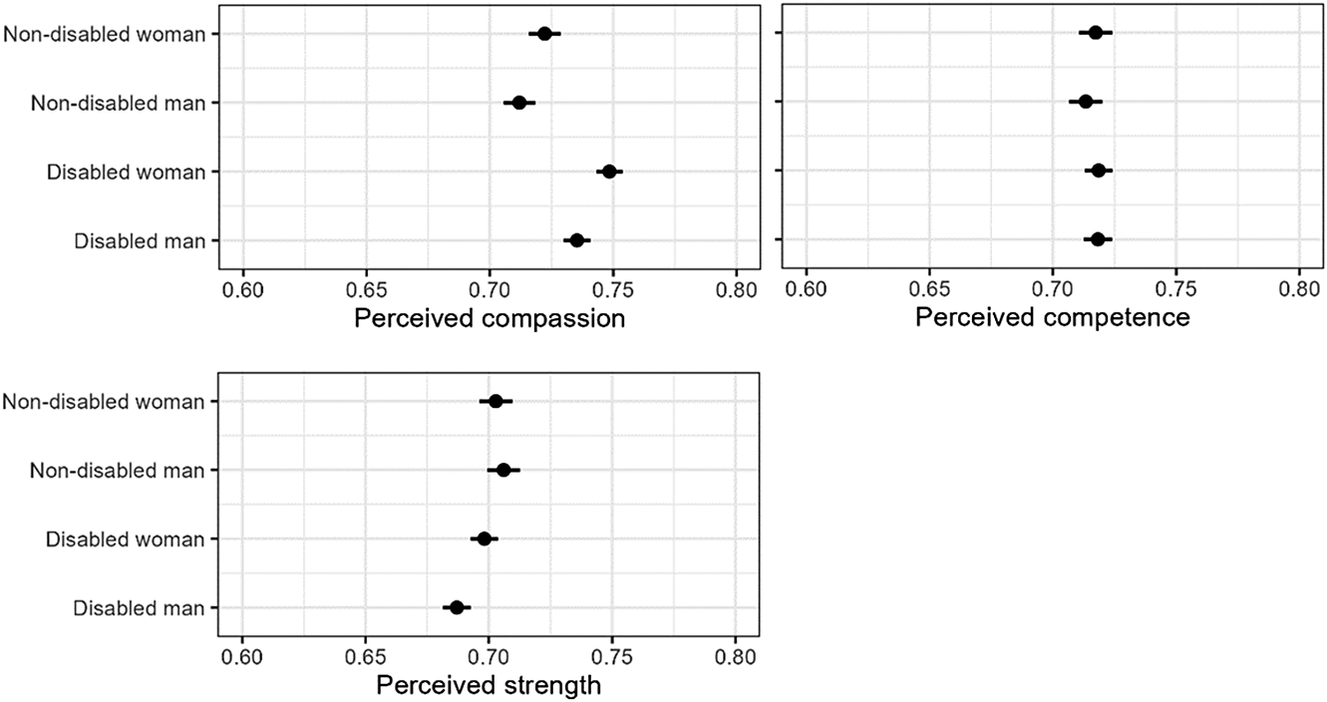
Figure 1 shows the predicted values of the perceived candidate traits for the four groups of candidates based on the regression analyses. We find the largest group differences for compassion: disabled women candidates are seen as the most compassionate, followed by disabled men, then non-disabled women, and finally non-disabled men. All of the differences between the candidate groups are statistically significant (Table A2). This means that both being disabled and being a woman positively affect compassion perceptions. These effects are additive and do not interact (Table 2, Model 1). Therefore, our Compassion Hypothesis, which stated that only non-disabled women candidates would benefit from feminine stereotypes of being more caring, whereas disabled women would not, is not supported.
Predicted levels of perceived candidate traits.
Notes: Full results in Table A2. Other attributes held constant at their sample means.

Figure 1. Long description
The figure consists of three panels arranged in two rows. All panels share a common Y-axis with four categories from top to bottom: Non-disabled woman, Non-disabled man, Disabled woman, and Disabled man. The X-axis for all panels ranges from 0.60 to 0.80.
Top-left panel: Perceived compassion. The data points with horizontal error bars are positioned as follows:
* Non-disabled woman: approximately 0.72
* Non-disabled man: approximately 0.71
* Disabled woman: approximately 0.75
* Disabled man: approximately 0.735
Top-right panel: Perceived competence. All four categories show nearly identical scores clustered tightly around 0.72, with very narrow error bars.
Bottom-left panel: Perceived strength. The data points are positioned as follows:
* Non-disabled woman: approximately 0.705
* Non-disabled man: approximately 0.705
* Disabled woman: approximately 0.70
* Disabled man: approximately 0.685
Meanwhile, we find no differences between any of the groups for competence perceptions, showing no support for our Competence Hypothesis that non-disabled (but not disabled) men would benefit from masculine stereotypes (Table 2, Model 2).Footnote 8 We do, however, find partial support for the Strength Hypothesis. We expected that non-disabled men, but not disabled men, would be perceived as stronger than the women candidates. Instead, we find that both disabled and non-disabled women candidates are rated as strong as the non-disabled men, with no statistically significant differences between them (Figure 1 and Table A2). In other words, non-disabled men do not have an advantage over women candidates regarding this “masculine” trait. At the same time, disabled men are seen as less strong than all other groups. It appears that disabled men are perceived as not meeting traditional ideas of masculinity compared to non-disabled men, whereas women do not face this disadvantage. Thus, for strength perceptions we find a statistically significant interaction between candidate disability and gender, and evidence of intersectional stereotyping: a disability gap exists among men but not among women candidates (Table 2, Model 3).
Issue Competence
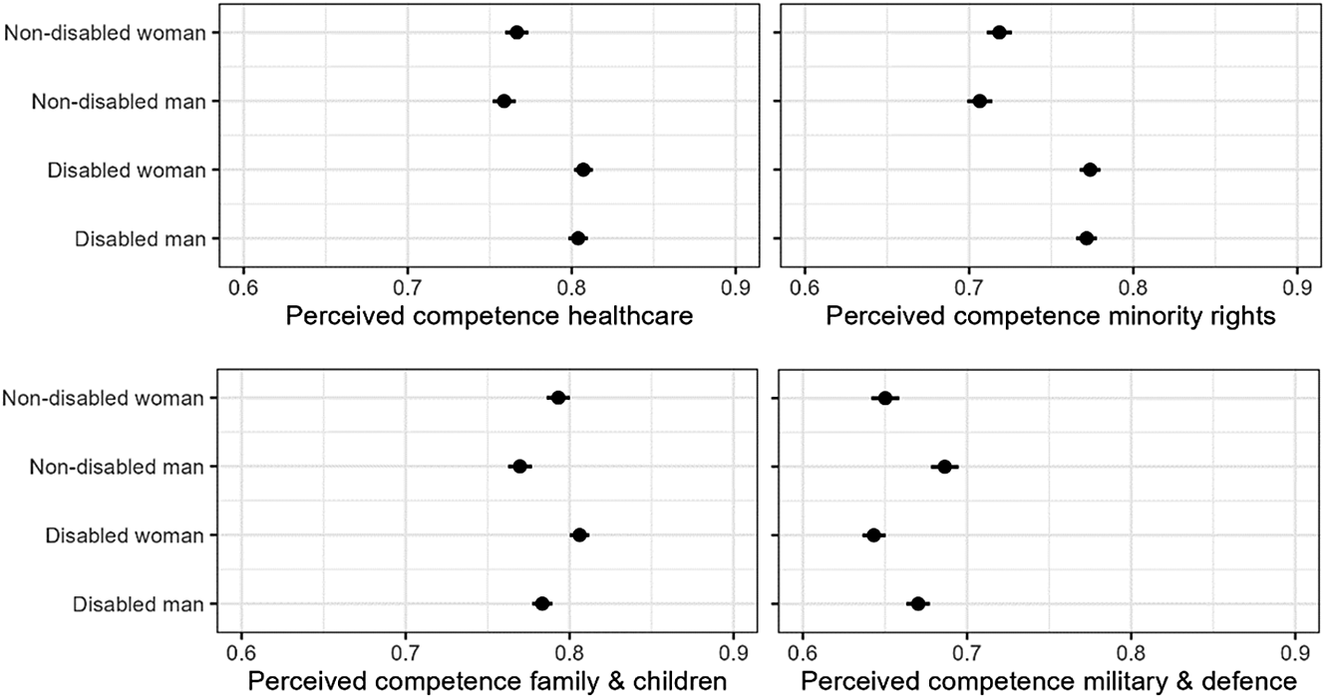
Next, we examine perceptions of issue-specific competence (full estimates in Tables A3 and A5). Figure 2 shows that on both disability-related issues — healthcare and minority rights — candidate disability exerts clear effects: citizens perceive both disabled men and disabled women candidates to be more competent than the non-disabled candidates. Gender has no effect on perceived competence on these issues, with one exception: non-disabled women candidates are seen as slightly more competent in tackling minority rights than non-disabled men, perhaps because women — although representing at least half of the population — remain marginalized in many areas of life, or because they are seen as more compassionate (Table 3, Models 1 and 2). However, the predicted values illustrate that this difference is much smaller than that between the disabled and non-disabled candidates, which is around 4 percentage points on the scale for healthcare and around 6 percentage points on the minority rights scale. There are no statistically significant interactions between disability and gender. Thus, in line with the Disability Experience Hypothesis, candidate disability is the main variable affecting perceived competence on issues on which the public is likely to assume disabled people to have lived experience and a particular personal interest; this effect exists regardless of candidate gender.
Predicted levels of perceived candidate issue competences.
Notes: Full results in Table A3. Other attributes held constant at their sample means.

Figure 2. Long description
The figure consists of four panels, each with a y-axis listing four categories: Non-disabled woman, Non-disabled man, Disabled woman, and Disabled man. The x-axis for all panels ranges from 0.6 to 0.9. Each data point is represented by a black dot with horizontal error bars indicating confidence intervals.
* Top-left panel: Perceived competence healthcare. Non-disabled woman and man are clustered around 0.76. Disabled woman and man are higher, clustered around 0.81.
* Top-right panel: Perceived competence minority rights. Non-disabled woman is at 0.72 and non-disabled man is at 0.71. Disabled woman and man are higher, both near 0.77.
* Bottom-left panel: Perceived competence family & children. Non-disabled woman is at 0.79 and non-disabled man is at 0.77. Disabled woman is highest at 0.81, while disabled man is at 0.78.
* Bottom-right panel: Perceived competence military & defence. Non-disabled woman is lowest at 0.65. Non-disabled man is highest at 0.69. Disabled woman is at 0.64 and disabled man is at 0.67.
Moving on to the issues where we did expect disability and gender to interact, we find — against the expectations of our Women’s Experience Hypothesis — that not only non-disabled but also disabled women candidates are perceived as more competent on policy related to family and children than men candidates. Although previous research suggests that disabled women are seen as less nurturing than non-disabled women (Nario-Redmond Reference Nario-Redmond2010), this stereotype seemingly does not harm them here. Additionally, there is a positive effect of candidate disability (about two thirds of the size of the gender effect), which does not interact with but adds to the gender effect (Table 3, Model 3). This is somewhat surprising, considering that disabled people are often not seen as potential parents. Perhaps voters consider disabled candidates’ personal experience as valuable for dealing with policy aimed at supporting families with disabled children.Footnote 9 The effects of candidate gender and disability are additive and do not interact; consequently, disabled women score the highest on perceived competence on family and children policy, followed by non-disabled women, then disabled men, and finally non-disabled men.
Our final policy issue is military and defense, a traditionally masculine issue associated with qualities such as strength. Given our previous finding that disabled men are perceived as less strong than the other candidates, we might expect to see a similar pattern here. Instead, we find that even disabled men benefit from a “male advantage”: while they are rated statistically significantly less competent than non-disabled men on the issue, they are still rated higher than the female candidates (Table A3). There is no difference between the disabled and non-disabled women. Although the interaction between disability and gender is not statistically significant (Table 3, Model 4), the observation that being disabled negatively affects men but not women candidates provides some evidence for intersectional stereotyping. To conclude, the Masculine Issue Hypothesis — that non-disabled, but not disabled, men have a perceived advantage over women candidates with regard to military and defense policy — is partially supported. We find that non-disabled men have a stronger advantage over women here, but disabled men also have one.
Ideology
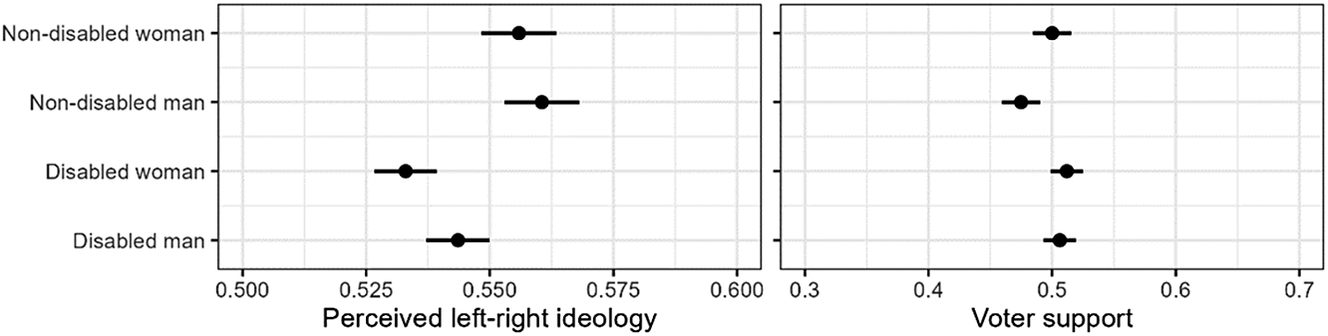
We expected that gender and disability have independent additive effects on perceived ideology, since both women and disabled people are generally perceived as more left-wing (Ideology Hypothesis). We have no compelling reason to expect the identities to interact here. However, although no statistically significant interaction effect exists between disability and gender (Table 3, Model 5), Figure 3 shows that gender affects perceived ideology only among disabled candidates. Disabled men are seen as more right-wing than disabled women candidates. Both are placed to the left of the non-disabled candidates (these gaps are statistically significant). Meanwhile, we see no difference between the non-disabled men and women candidates. A potential interpretation of this result is that voters assume that disabled women have stronger support for left-wing policies, such as a more generous welfare state, redistribution, and equality legislation, than all the other groups due to their experiences of multiple marginalization. Still, it is somewhat surprising that non-disabled men and women are placed so closely together on the ideological scale, given that previous research has found female candidates to be perceived as more left-wing or liberal (e.g., Huddy and Terkildsen Reference Huddy and Terkildsen1993; Schneider and Bos Reference Schneider and Bos2016). These previous findings might have potentially been driven by perceptions of multiply marginalized women candidates like disabled women.
Predicted levels of perceived candidate ideology and voter support.
Notes: Full results in Table A3. Other attributes held constant at their sample means.

Figure 3. Long description
The multi-panel figure consists of two horizontal dot plots sharing a common vertical axis. The vertical axis lists four categories from top to bottom: Non-disabled woman, Non-disabled man, Disabled woman, and Disabled man.
Left Panel: Perceived left-right ideology.
The horizontal axis ranges from 0.500 to 0.600. Data points with horizontal error bars indicate:
* Non-disabled woman: approximately 0.555.
* Non-disabled man: approximately 0.560.
* Disabled woman: approximately 0.533.
* Disabled man: approximately 0.543.
This shows disabled candidates are perceived as more left-leaning than non-disabled candidates.
Right Panel: Voter support.
The horizontal axis ranges from 0.3 to 0.7. Data points with horizontal error bars indicate:
* Non-disabled woman: approximately 0.50.
* Non-disabled man: approximately 0.47.
* Disabled woman: approximately 0.51.
* Disabled man: approximately 0.50.
Support levels are relatively similar across categories, with the non-disabled man receiving the lowest point estimate of support.
Vote Choice
Finally, we examine voter support for the four types of candidates. Surprisingly, we find that the candidates who are best represented in elected office among the four groups we are studying — non-disabled men — receive lower support than the other groups (Figure 3). Meanwhile, the other three all receive equally strong support. Although gender only has an effect among non-disabled candidates, indicating that the intersection of gender and disability matters to the vote choice, the interaction between the two variables is not statistically significant (Table 3, Model 6). The findings here differ somewhat between the US and UK (see discussion in OA 3) and by disability type, with wheelchair-using candidates receiving the highest support (see OA 4). Given that the vote choice is influenced by a vast range of factors, and that the effects of candidate perceptions on candidate choice depend strongly on voters’ own views and preferences, this is an area where further research is needed.
Conclusion
Women and disabled people are commonly stereotyped in similar ways: as vulnerable and in need of protection, but also as more compassionate toward others. Yet, when gender and disability intersect, these stereotypes do not necessarily add up neatly. Instead, categorical differences exist in how, for example, disabled and non-disabled women are perceived (Nario-Redmond Reference Nario-Redmond2010). Examining the nature of intersectional stereotypes as applied to election candidates in the UK and the US, our conjoint experiment reveals that in some cases we indeed cannot determine how voters perceive disabled women and men candidates by simply estimating disability and gender stereotypes and adding them up. For example, voters perceive disabled men as weaker than all the other candidates, presumably because they are seen to violate the masculine norm of strength and authority. This incongruity is to the detriment of disabled male candidates but does not affect non-disabled or disabled women. Another example is the issue of minority rights: while non-disabled women are rated as more competent than non-disabled men, this gendered stereotype does not exist for disabled candidates, presumably because disability trumps gender as a driver of discrimination in citizens’ eyes. On the masculine issue of military and defense, disabled men are seen as less competent than non-disabled men, whereas there is no disability penalty among women candidates.
While the intersections of disability and gender create unique perceptions in some cases, in most cases gendered and disability stereotypes turn out to be independent and additive. For example, both women and disabled candidates are seen as more compassionate, with the result that disabled women receive the highest ratings and non-disabled men the lowest. Perceptions of healthcare competence are shaped by candidate disability but not gender. A rather unexpected result is that disability and gender do not intersect in perceived competence regarding family and children. Despite being commonly stereotyped as not being nurturing and able or fit to have children, disabled women are not perceived as less competent in handling family and childcare policy.
When it comes to voter support, our findings indicate — rather surprisingly — that non-disabled men may face an overall disadvantage. This may be due to their lower ratings on compassion and the policy issues related to it, including healthcare, minority rights, and family, which many voters might strongly value. Alternatively, the higher support for disabled and women candidates might reflect a desire among citizens to increase the representation of underrepresented groups in politics, which Reher (Reference Reher2025) found to drive support for disabled candidates among left-wing voters. This desire might motivate in particular women and disabled voters. Exploring intersectional patterns of affinity voting requires a large sample with enough respondents in the different groups, which is why we do not investigate it in this study.
However, we know that voters’ own identities, views, and priorities play a key role in voting, and future research should consider them when studying how candidate characteristics affect candidate choice. To study how voters’ intersecting identities matter, oversampling smaller demographics might be necessary. Moreover, voters are influenced by a wealth of contextual factors and actors. For example, when our experiment was fielded, during the COVID-19 pandemic, perceived healthcare competence might have been particularly salient to voters. Some research suggests that stereotypes may exist but are not always activated (see Kunda and Spencer Reference Kunda and Spencer2003). Therefore, experimental research needs to be supplemented with observational evidence from real-world elections, especially when it comes to candidate choice.
Another key consideration when studying voter perceptions of candidates is the crucial role that political parties play in selecting candidates, and voters’ knowledge of this. When presented with disabled candidates who have successfully navigated and competed in the party selection process, especially in the case of larger parties, voters might assume that they are exceptionally capable and qualified — and perhaps in reality they often are, given that they have been selected in a process that is often ableist (Evans and Reher Reference Evans and Reher2024). This is potentially one reason why voter perceptions of disabled candidates might not always match the more negative general disability stereotypes. Indeed, it is remarkable that, based on our findings, disabled women candidates — the group at the intersection of two dimensions of marginalization — do not seem disadvantaged when it comes to public perceptions of their traits and competences (except in military and defense). This contrasts somewhat with the self-reported experiences of disabled women in politics (Evans and Reher Reference Evans and Reher2025), calling for further research on the experiences of disabled women at the various stages of the recruitment process.
Our study makes several important contributions to the study of politics, gender, and disability. It contributes to a literature that is moving away from approaching candidate identities as independent dimensions in studies of candidate evaluations, informed by a growing awareness of the importance of the intersectionality of identities, and in particular intersecting marginalized identities. The complexity in our findings — with some additive and some intersectional effects — suggests that no single formula can be applied to understanding how candidates’ intersectional identities shape voter evaluations. Specifically, our findings demonstrate that while candidate dimensions do not always interact to produce distinct patterns of stereotypes and expectations, they do in enough cases to warrant attention in future research. As such, our study encourages scholars to examine how other intersecting identities affect candidates’ images and chances of success, including underexplored intersections such as disability and race or sexuality.
Future research should also explore to what extent our findings apply to other contexts: while we find very similar stereotypes in two Anglophone countries with first-past-the-post electoral systems, broadly similar gender relations, and active disability rights movements, the ways in which gender and disability intersect in public perceptions might be different in other contexts. Such research would further our understanding of the role of disability in politics in comparative perspective, which remains underexplored (Heffernan Reference Heffernan2024).
Our study adds nuanced theoretical and empirical insights into how candidates with marginalized (oftentimes multiple and intersectional) identities shape voters’ perceptions of their varying qualifications to be political leaders. Not only does this knowledge help us understand how and why some (minoritized) people might be underrepresented in political institutions, but it also enables us to seek creative ways to ensure equal representation of marginalized groups. Our research serves as a stepping stone for learning about how other types of disability (including learning and cognitive disabilities, neurodivergence, and mental health conditions; see Canton et al. Reference Canton, Hedley and Spoor2023; Magni and Reynolds Reference Magni and Reynolds2024) and other marginalized identities — for example, citizenship status and sexuality — might also intersect with gender and with one another to influence voter evaluations of candidates.
Finally, our findings inform and support efforts to make politics more accessible for disabled women, and disabled people more generally, and increase their presence in parliaments. By showing that stereotypes are not always negative (or as negative as we have previously presumed), and that voters might not punish candidates with multiple marginalized identities, our results might prevent party gatekeepers from only nominating candidates they assume to have a chance to win, such as non-disabled men. Moreover, by illustrating that disability is not always dissociated from leadership, our results might encourage more disabled people, especially disabled women, to run for public office. The political representation of marginalized groups in office has been shown to positively impact the policy outcomes for the group and their political engagement (Gay Reference Gay2002; Liu and Banaszak Reference Liu and Banaszak2017; Wängnerud Reference Wängnerud2009), meaning that tackling both parties’ and potential candidates’ hesitations about disabled women’s prospects of getting elected could be a crucial step in improving the political integration and socioeconomic conditions of this group.
Supplementary material
The supplementary material for this article can be found at http://doi.org/10.1017/S1743923X2610107X.
Acknowledgements
The research was supported by the Economic and Social Research Council (ES/S015469/1) and the Carnegie Trust for the Universities of Scotland (RIG007430). We would like to thank the participants at the “Political Science and Political Economy” lecture series at the University of Cologne in 2024 and at the 2019 EPSA and EPOP, and 2024 ECPG conferences for their valuable feedback on earlier versions of this article.
Competing interests
The authors declare no conflict of interest.
Data availability statement
Replication files can be accessed at https://doi.org/10.7910/DVN/JPSPBY.



 Open access

