1 Introduction
The so-called into-causative construction, exemplified by the naturally occurring data in (1), displays revealing properties in terms of diachronic as well as synchronic English syntax (see, among others, Hunston & Francis Reference Hunston and Francis2000; Gries & Stefanowitsch Reference Gries, Stefanowitsch, Achard and Kemmer2003; Rudanko Reference Rudanko2005, Reference Rudanko2006, Reference Rudanko2011; Wulff et al. Reference Wulff, Stefanowitsch, Gries, Radden, Köpcke, Berg and Siemund2007).Footnote 2
-
(1)
-
(a) Love at first sight had coerced him into marrying a complete stranger. (COCA 2006 FIC)
-
(b) I probably pressured him into driving around the barricades. (COCA 1997 FIC)
-
The construction, introduced by verbs like coerce and pressure as in (1), has three arguments: subject, object and into-gerundive clause. In terms of meaning, the subject referent causes the object referent to be in the state of affairs expressed by the gerundive clause.
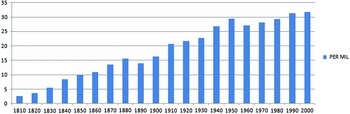
The construction pattern in Present-day English (PDE), noted by the previous literature (see, among others, Bridgeman et al. Reference Bridgeman, Dillinger, Higgins, Seaman and Shank1965; Francis et al. Reference Francis, Hunston and Manning1996; Hunston & Francis Reference Hunston and Francis2000; Rudanko Reference Rudanko2011), raises several empirical and analytic questions. For instance, questions arise as to which verbs are allowed as matrix verbs, how much lexical creativity there is with the construction, what semantic classes these verbs belong to, and whether there are ongoing changes in these semantic classes among dialects (British and American English). The uses of the into-causative construction have increased and are quite innovative, as is evidenced from its normalized frequency from 1810 to 2009 in the Corpus of Historical American English (COHA) (see figure 1).
Frequency per million words (pmw) of the into-causative construction in COHA

The normalized frequencies in figure 1 show us that the use of the construction has increased from 1.69 tokens per million words to 31.01 per million since 1810. Seeing this noticeable increase in the use of the construction, the first question is how creatively speakers use it and why the increasing use occurs (see section 4 for discussion).Footnote 3 The construction also challenges theoretical sides with a number of questions: what is its underlying syntactic structure? What ambiguity exists in terms of identifying the construction? How can we capture the construction's grammatical properties? And what insights does the into-causative give into the nature of constructions themselves? As we will see in due course, the construction has a tight syntactic constraint such that the complement phrase of into cannot be a sentential VP but needs to be a VP-gerundive type (e.g. *I pressured him into his driving around the barricades). The construction also entails a resultant state denoted by the into PP complement. Given that not all verbs can introduce the construction and further that the construction is related to similar constructions such as the resultative construction, we run into the question of what licenses such a construction and how we can account for its grammatical properties in a feasible, robust way.
In terms of these empirical and theory-oriented questions, the construction has received a fair amount of attention over the past decade or so. Hunston & Francis (Reference Hunston and Francis2000) offer a corpus-based analysis of the into-causative construction and suggest that the verbs introducing the construction are all concerned with ‘negative’ emotions. Rudanko (Reference Rudanko2002, Reference Rudanko2005) also provides an in-depth corpus-based investigation of the construction with corpora such as the Bank of English Corpus, the United States News, SUNNOW and Time Magazine Corpus. Rudanko (Reference Rudanko2006, Reference Rudanko2011) further examines the construction with seven verbs of manner-neutral causation (e.g. impel, induce, influence, lead, motivate, prompt and stimulate), and points out that the construction, originally linked to negative overtones, has spread to these manner-neutral verbs and that the innovative uses of the construction are more common in British English than in American English. Gries & Stefanowitsch (Reference Gries, Stefanowitsch, Achard and Kemmer2003), based on a single register (journalese), investigate the association strength between the construction and the verbs that occur with it. In doing so, they employ the technique called ‘collostructional’ analysis to determine how words and constructions interact (in particular how cause and result predicates covary in the construction). Using the same method, Wulff et al. (Reference Wulff, Stefanowitsch, Gries, Radden, Köpcke, Berg and Siemund2007) compared British English (in the Guardian corpus) and American English (in the LA Times corpus) and found that the construction uses persuasion verbs more in American English but physical force verbs in British English. All of these studies, whose main points we will discuss in due course, offer useful insights, but they are based on rather small corpora or limited registers leading to the question of how much their findings can be generalized to other types of genres and types of text. As a way of filling this gap, this study uses much larger and more balanced corpora, which contain data from a wide range of registers, such as spoken, fiction, newspapers, popular magazines, academic journals and web pages. This allows us to answer the above-mentioned research questions with more balanced and authentic data.
The article is organized as follows. Section 2 discusses key grammatical properties of the into-causative construction as well as its distinctive syntactic, semantic and pragmatic properties which cannot be predicted from other related constructions. Section 3 discusses the way in which we extracted data for the construction from different corpora, including some interesting cases of ambiguity in terms of structure. We also provide evidence for the extremely wide range of verbs that can occur in this construction – many more than have been noted in previous studies. In section 4, we lay out a Construction Grammar analysis of the construction, which provides the theoretical framework to account for the wide (and increasing) range of verbs that occur with the construction. Section 5 returns once again to the corpus data and considers several different phenomena related to ‘non-prototypical’ uses of the construction, and we also briefly discuss some interesting issues related to dialectal variation. Section 6 concludes the article.
2 Basic grammatical properties
2.1 Lexical and syntactic properties
A variety of verbs can be used in the into-causative construction. With respect to the complementhood pattern of the verbs in the into-causative construction, we can classify them into three types (see also Rudanko Reference Rudanko2006). The first type is object control verbs such as cajole, coax, con, embolden, force and persuade. These verbs can combine with either an infinitival VP, as given in (2), or an into-gerundive phrase as its second complement, as given in (3):
-
(2)
-
(a) Throughout history we could never actually coerce someone [to reveal information]. (COCA SPOK 2009)
-
(b) That forced him [to get rid of the copper and start over with strips of nickel]. (COCA MAG 2012)
-
-
(3)
-
(a) They figured we'd coerced Jeffrey [into coming with us]. (COHA 2011 FIC)
-
(b) I can use the proxies to force him [into giving me those mineral rights]. (COCA FIC 1991)
-
The second type includes verbs like fool, frighten, deceive, bully, provoke, tease, intimidate, etc. These verbs are typically used as transitive verbs selecting two arguments, as illustrated in (4), but can also introduce the into-gerundive complement, as seen from the corpus data in (5):
-
(4)
-
(a) For a long time Mama had fooled him anytime she wanted to. (COCA FIC 2011)
-
(b) Kids teased her until she could rid herself of her old accent. (COCA FIC 2011)
-
-
(5)
-
(a) He's an actor we hired to fool the girls into believing he's drunk. (COCA SPOK 2012)
-
(b) I teased and razzed them into getting off the car. (COCA ACAD 1993)
-
The third minor type includes verbs like talk and laugh which can also select an object and the into-gerundive complement:Footnote 4
-
(6)
-
(a) Carl Perkins has actually talked Scotty into playing again now. (BNC MAG C9J)
-
(b) The Major was trying to laugh him into forgetting. (COHA 1935 FIC)
-
Neither talk nor laugh combines with an infinitival VP as its complement, as shown in (7). Even when they are used as a transitive verb, their object is different from the object of verbs like fool in the sense that its object is not a patient or undergoer, as seen from (8) (see Rudanko Reference Rudanko2005: 172):
-
(7)
-
(a) *He talked me to do that.
-
(b) *He laughed her to fall off the chair.
-
-
(8)
-
(a) He talked politics.
-
(b) He laughed himself off the chair.
-
What we have seen from the data is that the construction cannot be introduced by a pure intransitive verb:
-
(9)
-
(a) *John ran Bill into stopping the crime.
-
(b) *John cried Bill into singing the song.
-
The data imply that a set of transitive verbs can be introduced in the into-causative construction, but controlled by syntactic and semantic properties of the construction.
The construction also raises a locality issue with respect to the selection of the gerundive complement (Kim & Lee Reference Kim and Lee2013). The typical gerundive clause can have either a genitive or accusative subject, as given in (10) (see Malouf Reference Malouf2000):
-
(10)
-
(a) I believe that him taking a leave of absence bothers you.
-
(b) I believe that his taking a leave of absence bothers you.
-
However, the gerundive clause in the into-causative construction does not have such a subject:
-
(11)
-
(a) He fooled Sam into believing he was fast.
-
(b) *He fooled Sam into him believing he was fast.
-
(c) *He fooled Sam into his believing he was fast.
-
Considering typical cases in (9) where the prepositional complement can be satisfied either by a gerundive VP or clause with the accusative or genitive subject as in (10), this restriction makes the into-causative quite a distinctive construction. This constraint on the into-gerundive phrase also implies that the construction would have at least the following syntactic structure for (11a):
-
(12)


The matrix verb fooled combines with an NP and a PP headed by into as its complements. But the problem is that, as observed, the verb also needs to have access to the prepositional object, the gerundive (ger) phrase, which is not accessible within the verb's local domain. That is, the c-selection (category-selection) information of the verb fool here thus needs to include the nonlocal VP[ger] too, which makes the construction syntactically peculiar. This means that the complement (COMPS) information of the lexical verb fool needs to be something like (13b), not like (13a):
-
(13)
-
(a) COMPS <NP, PP[into]>
-
(b) COMPS <NP, PP[into + VP[ger]]>
-
In sum, the lexical and syntactic properties of the into-causative construction we have seen so far indicate that it is a candidate for an independent construction licensed by the interaction of lexical and syntactic properties.
2.2 Semantic and pragmatic properties
The semantic locus of the construction is that the subject referent of the construction causes the object referent to perform the action denoted by the gerundive clause and then be in the resultant state described by the gerundive clause. For example, consider one typical example:
-
(14) John bribed Lily into buying the gift.
There are two subevents in (14): a bribing and a buying subevent. With the action of bribing, the subject referent ‘John’ causes the object referent ‘Lily’ to buy the gift. This in turn means that the second event is caused by the subject referent (see, among others, Hunston & Francis Reference Hunston and Francis2000: 102; Rudanko Reference Rudanko2006: 316; Wulff et al. Reference Wulff, Stefanowitsch, Gries, Radden, Köpcke, Berg and Siemund2007: 268).
The matrix verb in the into-causative construction causes the causee to be in a resultant state, inducing a special entailment relationship. Consider examples with the simple PP complement:
-
(15)
-
(a) Mary asked him into the room. (But he didn't enter the room.)
-
(b) Mary urged him into the room. (But he didn't enter the room.)
-
The motion of entering the room is not entailed in both examples here, as hinted by the expression in the parentheses. The sentences mean that the subject referent caused the object referent to move into the room, but the action may not be performed (see Goldberg Reference Goldberg1995 for discussion). The situation is different in the into-causative construction. Consider the following examples:
-
(16)
-
(a) Mary fooled him into wearing the clothes. (# But he didn't wear the clothes.)
-
(b) Mary coaxed students into violating the rules. (# But they didn't violate the rules.)
-
What we observe here is that the sentences entail that the events of wearing the clothes and violating the rules really happened. The into-causative construction thus evokes a direct entailment relationship with respect to the movement holding in the construction (see Rudanko Reference Rudanko2006: 317 for a similar point).
In terms of meaning, the verbs in the into-causative construction can be classified into several different types. Hunston & Francis (Reference Hunston and Francis2000) classified them into three main types:Footnote 5
-
• annoy-class: the verbs in this group are concerned with making someone feel something and typically evoke negative emotion. Verbs in this class include annoy, scare, shock, frustrate, embarrass, frighten, intimate, irritate, panic, etc.
-
(17)
-
(a) She annoyed them into letting her join the band. (BNC CK5)
-
(b) They had no swords, only cudgels, with which they frightened people into giving them money. (COHA 1913 MAG)
-
-
• coax-class: the verbs in this class are concerned with using language cleverly, deviously, or forcefully to make someone do something. The verbs include badger, cajole, coax, flatter, persuade, tease, wheedle, etc.
-
(18)
-
(a) I coaxed her into talking about herself. (COCA 2008 FIC)
-
(b) She badgered another group into going skiing. (COHA 1920 FIC)
-
-
• fool-class: the verbs in this class have to do with deceiving or misleading. Verbs like con, deceive, fool, mislead and so forth belong to this class:
-
(19)
-
(a) Imitation and affectation may deceive people into thinking that such an instinct is quickening amongst us. (COHA 1882 NF)
-
(b) It may mislead people into obeying the law. (BNC ANH)
-
These three main types can cover most of the data for the into-causative construction, but as we will see from corpora data there are also quite a variety of matrix verbs whose semantic category cannot be classified as one of these three. For example, all three classes imply a certain degree of negative connotation, but verbs like encourage, inspire or those like guide, startle, launch cannot belong to any of them. In section 3, we discuss a more flexible grouping of the verbs in the construction, based on our corpus data.
3 Corpus data I
3.1 Corpora and search methods
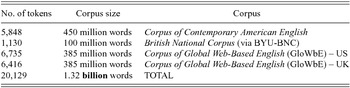
As we will see in this section, large corpora provide us with much more detail on the construction than we would have with smaller corpora. This was recognized by Rudanko (Reference Rudanko2006), who used 144 million words of British English (news, books and spoken) and 117 million words of American English corpora (news, books and spoken) in the Bank of English and investigated about 1,050 tokens of the into-causative construction. Our study uses a much larger data set of tokens – 20,129 in all, which is nearly twenty times as many tokens as in Rudanko (Reference Rudanko2006). Table 1 shows which sources our tokens are taken from (see Davies Reference Davies, Nevalainen and Traugott2012).
Corpora used in the present study

The search method we have used to obtain the tokens from these corpora is a simple one, as represented in the following:
-
(20) [vv*] {0,4} into [v?g*]
This searches for any string that is a lexical verb followed by the preposition into and a gerundive verb, where the distance between the verb and into can be from zero to 4. The context {0,4} represents 4 or fewer (including zero) collocate distances between the main verb and the into gerundive.Footnote 6 The distance zero includes examples like the following passive construction:
-
(21)
-
(a) She said she was coaxed into joining a tour of the fraternity house. (COCA SPOK 2006)
-
(b) He was forced into performing many similar surgical operations. (COCA FIC 2009)
-
In addition, we have manually ruled out examples where the gerundive -ing verb form is not a verbal expression:Footnote 7
-
(22)
-
(a) Thousands of others turned the highways into parking lots. (COCA NEWS 2012)
-
(b) To turn them into voting booths just doesn't make sense at this point in time. (COCA NEWS 2002)
-
A note of caution is also sounded for examples like (23) since it is not the verbs try and let here that introduce the into-causative construction, but rather the verbs manipulate and goad (and these sentences would be included for the verbs manipulate and goad).
-
(23)
-
(a) He was also trying to manipulate you into changing your testimony. (COCA SPOK 2012)
-
(b) I let him goad me into taking a drink. (COCA FIC 2005)
-
We have also ruled out examples with intransitive verbs like look into and be into which do not have any causative meaning and lack any object.
-
(24)
-
(a) The restaurant is looking into having T-shirts made for the winners. (COCA NEWS 2011)
-
(b) She was into seeing people who were into LSD. (COHA FIC 1979)
-
More complicated cases are those like (25) with matrix verbs like pour, invest and so forth. We do not count these as prototypical examples of the into-causative construction, because the object does not function as a causee performing the action represented by the gerundive clause:
-
(25)
-
(a) . . . the foundation poured millions of dollars into creating art and history museums. (COCA ACAD 2011)
-
(b) Cruise lines are investing more money into refurbishing older ships. (COCA NEWS 2012)
-
(c) telcos are not plowing their profits into expanding their overloaded network as they should (GloWbE-US)
-
And yet these sentences are in a certain sense ‘quasi-examples’ of the construction. In (25a), for example, what is creating art and history museums – the foundation (matrix clause subject), or the millions of dollars (matrix clause object)? Likewise in (25c), what is not helping to expand the overloaded networks – the telephone companies (matrix clause subject), or the profits from these companies (matrix clause object)? The most straightforward answer is that it is the matrix clause subject, but with these verbs the matrix clause object (the ‘means’ to complete the action – money or profits or energies) also seems to be involved in some way in the completion (or non-completion) of the activity in the lower clause. In this sense, these verbs are rather taken to be not object control but subject control verbs. In this article, we focus mainly on the object control verbs in which the object plays the role of a causer performing the action denoted by the gerundive clause.Footnote 8
3.2 Lexical diversity in the corpora
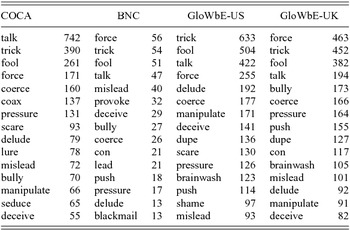
As mentioned earlier, there are nearly 20,000 tokens of the construction in the different corpora. Table 2 shows the most frequent matrix verbs in the into-causative construction used in the corpora.
Most frequent verbs in the four corpora

Perhaps more than a listing of the most frequent verbs in each corpus, a meaningful consideration would be the question of what verbs are attested in our corpora, which have not appeared in previous studies (Bridgeman et al. Reference Bridgeman, Dillinger, Higgins, Seaman and Shank1965; Francis et al. Reference Francis, Hunston and Manning1996; Rudanko Reference Rudanko2005). We have identified 335 new matrix verbs with the construction, which are not mentioned in the previous studies, and these verbs are distributed as shown in table 3.
‘New’ forms in different corpora (compared to previous research)

As emerges from table 3, there are 38 verbs that are found in both COCA and the BNC, which are not found in Rudanko (Reference Rudanko2005), Bridgeman et al. (Reference Bridgeman, Dillinger, Higgins, Seaman and Shank1965), or Francis et al. (Reference Francis, Hunston and Manning1996) and these account for 234 tokens. The twelve most frequent verbs in this category are given in the following:
-
(26) startle 22 (tokens), tease 19, guide 14, torture 13, will 13, trigger 11, sway 10, beat 9, surprise 9, galvanize 8, bamboozle 7, organize 7
Another 50 verbs are found in COCA but not the BNC, and these account for 119 tokens. Most of the 50 verbs occur once or twice, but verbs in (27) occur more than three times:
-
(27) spook 7 (tokens), summon 5, snooker 5, corner 5, draft 5, launch 5, shape 4, hook 4, twist 4
Note that the verb harry is the only verb that occurs in the BNC but not COCA, and it has only 2 tokens. In addition to COCA and the BNC, we also have tokens from 770 million words of data in the US and UK portions of the 1.9 billion word GloWbE corpus. There are 52 verbs (549 tokens) that occur in GloWbE (US or UK), which also appear in COCA or the BNC, but in no previous studies.Footnote 9 There are a number of new verbs we have identified from GloWbE as well. Of these, 46 verbs (424 tokens) occur in both GloWbE-US and GloWbE-UK, and those occurring more than three times include:
-
(28) convince 16 (tokens), tie 15, guilt-trip 13, herd 7, propagandize 7, reinvest 6, shoehorn 6, fake 6, assist 5, inculcate 5, dilute 4 (apparently a misanalysed form of delude), exploit 4, and support 4
There are 111 verbs (143 tokens) that occur only in GloWbE-US, and those that occur three times or more include the following:
-
(29) warp 6 (tokens), modify 4, transition 4, abuse 4, box 4, control 4, dissuade 3, harness 3, troll 3
Finally, there are 89 additional verbs (101 tokens) that occur only in GloWbE-UK, and those that occur two times or more include verbs like the following:Footnote 10
-
(30) blinker 3 (tokens), boost 2, cloud 2, constrain 2, free 2, marshal 2, wriggle 2
The corpus data show that speakers and writers tap into the thousands of possible verbs of English in very novel ways to use them in new and unexpected contexts. To take just a few examples, consider these sentences with carve, complain, deflect, depress, edge, or Google in GloWbE-US:Footnote 11
-
(31)
-
(a) how did you all even managed to carve yourselves into thinking that it's a right thing to do?
-
(b) and maybe I can deflect them into being impressed with that
-
(c) I think Burger King is trying to depress me into getting fat
-
(d) and the people of Bethlehem saw a good match for Ruth and edged her into meeting Boaz
-
(e) Scott is after a royal title and has Googled his way into getting one
-
Or consider the sentences with blag, cloud, cuddle, hack and randomize from GloWbE-UK in (32), none of which (at first glance) we would think of as occurring with the into-causative construction:
-
(32)
-
(a) And well done Auntie to blag your way into getting some funding from overseas
-
(b) to cloud and deceive us into believing that all hope is lost
-
(c) He'd been cuddled into doing some work experience by a social worker
-
(d) Microsoft is forced to hack Windows into behaving more like a multi-user system
-
(e) He was told that this blood had been randomised into having a HIV test
-
With such a wide range of verbs, we might briefly address a topic that has been discussed in previous studies, which deals with the different semantic classes for the verbs in the into-causative construction. In section 2.2, we have seen Hunston & Francis's (Reference Hunston and Francis2000) classification of the verbs into three groups: ‘annoy’, ‘coax’ and ‘fool’. As we look at the wide range of new verbs, we see that many do not fit into these simple categories, such as carve, deflect, edge, Google, cuddle, randomize and style. Many others have been twisted into the three classes, such as depress, lumber, slant, squirrel, blag, cloud, magick and tug. As suggested in Hunston & Francis (Reference Hunston and Francis2000: 103), there seem to be no limits to the creativity of speakers. The data from nearly 20,000 tokens in the 1.32-billion-word corpus imply that there is in fact a great deal of lexical and semantic flexibility.
Rudanko (Reference Rudanko2011: 25), based on the nature of the means that the verbs in question express, identifies six different groups of verbs used in the construction:
-
(33)
-
(a) means of deception (e.g. beguile, betray, deceive)
-
(b) exerting force (e.g. coerce, drive, force, harass)
-
(c) arousing fear (e.g. astonish, badger, exasperate, frighten)
-
(d) enticing (e.g. bribe, cajole, coax)
-
(e) specific means (e.g. fascinate, hush, laugh)
-
(f) non-specific means (e.g. lead)
-
These six semantic classes, although not exhaustive, are more flexible in classifying the semantic class of the matrix verb involved, but not all the classes are easier to define. For example, the class of ‘deception’ is easier to define than others, but examples like carve, deflect, Google are hard to classify. However, one common property we can notice is that all verbs in the construction include the meaning component of ‘causation’ in one way or the other. That is, all the matrix verbs represent some sense of causation by the agent subject and the object performing the action represented by the gerundive clause. The cause–effect semantic linkage between the matrix verb and the gerundive verb is also observed by Gries & Stefanowitsch (Reference Gries, Stefanowitsch, Achard and Kemmer2003). They observed that the two verbs represent frame-semantic knowledge as in con into paying, mislead into buying and lure into purchasing. This implies that the into-causative construction represents a distinctive link between form and function, calling for a construction-based account, which we will provide in some detail in section 4.
3.3 Marginal uses of the construction
We have seen prototypical examples of the into-causative construction (see section 4 for more). However, once we immerse ourselves in the actual corpus data, we find that there are ambiguous types of sentences, where it is unclear whether we are in fact looking at the into-causative construction. For instance, when the embedded expression comes after the preposition into, there is ambiguity about whether the gerundive-form verb is actually a verb, or whether it is a noun:
-
(34)
-
(a) a humble blog may become the multi-voiced autobiography that writes itself into being (COCA ACAD 2006)
-
(b) History belongs to the intercessors, who believe the future into being (COCA MAG 1992)
-
Examples like these, where being is used as a nominal, are considered to be examples of the resultative construction with the path-denoting PP, as in examples such as John chopped the carrot into the dish (see section 4). The expression being in these examples does not introduce a clause, as in the following:
-
(35)
-
(a) A cigar boinked itself into being between my lips (COCA FIC 1997)
-
(b) the message is distorted into being about what is required to be a woman (GloWbEUS)
-
In these examples, being occurs with its complement PP, representing an event caused by the subject. What we assume is thus that these two types are closely related, but we take only those like (35) to be the into-causative construction.
Caution is required when considering cases (besides being) where, even though the sense is slightly more nominal, a verbal reading is also possible (see the words underlined below):
-
(36)
-
(a) threats sent her into hiding in a tribal leader's house (COCA MAG 2007)
-
(b) a conductor who recognized the potential of his voice sent him off into singing (COCA NEWS 1998)
-
These examples are all included in the into-causative construction, since the complement of into is not a simple NP but represents a clause whose unexpressed subject is linked to the object. The gerundive verb singing here is purely an intransitive verb, not requiring any complement.
There is sometimes ambiguity about whether the main clause verb is actually a verb (in a passive context), or whether it is an adjective. Consider the following, which are just a few examples from among hundreds in the corpora:
-
(37)
-
(a) the message is distorted into being about what is required to be a woman (GloWbEUS)
-
(b) there are a lot of people today who are addicted into drinking coffee (GloWbE-US)
-
Note the fairly strong adjectival sense in which the verbs are used in these sentences, in that we can say, for example, very distorted. Further, examples like addict are simple intransitives which have no object. We excluded such adjectival uses.
4 On the innovative uses of the construction: a Construction Grammar view
4.1 Fundamentals of Construction Grammar
As we have seen in section 3.2, corpus-based data provide evidence for extremely novel uses of the construction. In this section, we will provide a detailed Construction Grammar account that allows for and even predicts such a situation. Construction Grammar (CxG) is a model of grammar whose main features can be summarized as follows (see, among others, Goldberg Reference Goldberg1995, Reference Goldberg2006; Michaelis Reference Michaelis, Boas and Sag2012; Sag Reference Sag, Boas and Sag2012):
-
∙ All levels of description (including morpheme, word, phrase and clause) are understood to involve pairings of form with semantic or discourse functions.
-
∙ Constructions vary in size and complexity, and form and function are specified if not readily transparent.
-
∙ Language-specific generalizations across constructions are captured via inheritance networks, reflecting commonalities or differences among constructions.
-
∙ Constructions are understood to be learned on the basis of the input and general cognitive mechanisms.
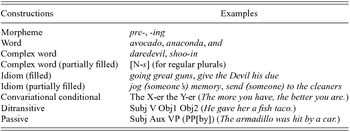
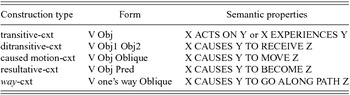
Constructions vary in size and complexity, and form and function are specified if not readily transparent, as seen from table 4.
Examples of constructions, varying in size and complexity (Goldberg Reference Goldberg2006: 5)

The table implies that there is no principled distinction between words, phrases and even rules: a lexical entry is more word-like to the extent that it is fully specified, and more rule-like to the extent that it can also have variables that have to be filled by other items in the sentence. In CxG, any linguistic pattern is thus taken to be a construction as long as it has a form–function relation not strictly predictable from its components or related constructions.
One novel idea of CxG is that argument structures are taken to be ‘constructions’, and that a verb's inherent ‘core’ lexical meaning is distinguished from the semantics associated with the argument structure constructions (Jackendoff Reference Jackendoff1990; Goldberg Reference Goldberg1995, Reference Goldberg2006; Rappaport Hovav & Levin Reference Rappaport Hovav and Levin2001). In CxG, the main verb is thus taken to combine with argument structure constructions such as intransitive, transitive, ditransitive, caused-motion, way construction and resultative, each of which bears its own constructional meaning. The pivotal role of argument structure constructions can be found from the fact that verbs typically appear in a variety of complement configurations, as illustrated by the following data set (from Goldberg Reference Goldberg2003: 221):
-
(38)
-
(a) He sliced the bread. (transitive)
-
(b) Pat sliced the carrots into the salad. (caused-motion)
-
(c) Pat sliced Chris a piece of pie. (ditransitive)
-
(d) Pat sliced the box open. (resultative)
-
The traditional wisdom assumes that the verb slice in each of these cases has different lexical entries with different subcategorization information, but within the CxG framework, in all these examples there is only one identical slice that evokes the core meaning of cutting with a sharp instrument. The difference lies in the argument structure it combines with. Each argument structure construction (given in parentheses) has its own constructional meaning. For example, the transitive argument structure in (38a) carries the meaning of someone acting on something, the caused-motion construction in (38b) evokes the meaning of someone causing something/someone to move, the ditransitive construction in (38c) provides the meaning of someone intending to cause someone to receive something, and the resultative construction in (38d) causes something to change state. When each of these constructional meanings, schematized in table 5, is linked to the matrix verb, the proper interpretations are composed (see Goldberg Reference Goldberg1995).
Related constructions and semantic properties

These constructions are related to each other through inheritance hierarchies in which subconstructions can inherit form and functional properties from their superconstructions, as illustrated in the following subhierarchy:
-
(39)

The inheritance networks allow us to capture broad generalizations as well as construction-specific idiosyncrasies. That is, constructions inherited by many other constructions allow us to capture broader generalizations, while midpoint constructions of the hierarchical network spell out more limited patterns. Low-level constructions represent exceptional patterns. Constructions form taxonomic networks, modeling the relations between constructions. The inheritance network system of constructions thus plays a key role in capturing generalizations as well as subgeneralizations among a family of constructions (see Goldberg Reference Goldberg1995, Reference Goldberg2006; Sag Reference Sag, Boas and Sag2012; Trousdale Reference Trousdale2013). In section 5.1 we discuss the interconnectedness of the resultative and way construction with the into-causative construction.
One final tenet of CxG worth mentioning here is how constructions are learned. Constructionist theories argue that language must be learnable from positive input together with fairly general cognitive abilities. This in turn means that CxG is usage-based, in that frequency plays a key role in accounting for a construction's productivity, i.e. the speaker's ability to extend argument structure constructions to new verbs. The assumption is that patterns occurring with sufficient frequency are stored as constructions alongside more general linguistic generalizations (Goldberg Reference Goldberg2006). Within the CxG view, increased frequency directly correlates with a construction's ability to occur with novel items. For example, as noted by Goldberg (Reference Goldberg1995: 199–218), the construction is very productive as it appears with an extensive number of verbs. If a construction is more frequent, it is more likely that it will spread to other existing lexical items.
4.2 Interactions between the lexicon and constructions
The corpus data show the innovative use of the construction over the years, and this section discusses how a CxG perspective can offer a feasible account for this development over the years. Our key assumption for the into-causative construction is that the construction is a metaphorical extension of the caused-motion construction.Footnote 12 Let us consider what kind of semantic properties it shares with the caused-motion constructions and what kind of its unique constructional constraints it produces.
In considering the grammatical status of the into-causative construction, two similar constructions are concerned:
-
(40)
-
(a) John forced him into marrying her. (into-causative)
-
(b) John forced him into marriage. (PP path resultative)
-
(c) John forced him to marry her. (infinitival caused-motion)
-
These three types of sentences are similar in respect to several syntactic and semantic phenomena. For example, the matrix verb here requires three arguments and each includes the meaning of ‘causation’ by the subject agent and the object being involved in the situation, denoted by the second complement. However, each of these is different in several respects too. For example, not all of the matrix verbs in the into-causative construction, as we have seen in section 2, license the infinitival VP as the second complement. We have seen that the verbs, in particular those like talk, typically do not allow the object complement alone as in *John talked him, but can license the into-causative construction. The preposition into also cannot be replaced by others like in or off. In addition, the controller is different in the infinitival construction:
-
(41)
-
(a) The children fooled him (to avoid the penalty).
-
(b) The children deceived us (to get the candy).
-
The optional infinitival clause here is controlled not by the object but by the subject, describing a purpose.
Another difference among these three constructions concerns the entailment of accomplishment with respect to the caused event, as we discussed in section 2.2. That is, unlike the into-causative construction, with the infinitival and PP-path resultative constructions there is no direct entailment relationship invoked with respect to the movement indicated by the construction. Consider the following examples:Footnote 13
-
(42)
-
(a) They bribed her to spy on the prince, but she refused to do so.
-
(b) He urged them into the room, but they did not go into the room.
-
(c) #They bribed her into spying on the prince, but she refused to do so.
-
(d) #They urged her into going into the room, but she refused to do so.
-
As illustrated here in (42a) and (42b), the to-infinitive goal construction and the resultative construction do not entail that the action of spying or the action of entering the room happened, respectively. The into-causative, however, does imply that the action has really happened. This is why (42c) and (42d) sound unnatural.
Except for the difference in the sense of accomplishment, the into-causative construction is thus similar to its supertype construction, the caused-motion construction, sharing many grammatical properties with its extensions, including the resultative construction. We thus can conclude that the into-causative construction inherits constructional properties from its supertypes, while employing its own constructional properties, as given in figure 2.
The into-causative construction

The figure tells us that the into-causative construction is a subtype of several constructions. Syntactically, it selects three arguments: causer subject, causee object and an into VP[ing]. Meanwhile, the construction entails that the causee becomes Z, implying that the result state of affairs is in fact accomplished. For instance, let us consider how this system can compose an appropriate meaning for the prototypical example Bill talked Sue into paying for the meal. As discussed earlier, independently existing meaningful constructions are capable of contributing additional arguments to the basic sense of verbs. The syntactic frame [V NP into-VP[ing]] expresses the combined semantics of the verb and the into-causative construction whose meaning is also inherited from its supertype constructions, transitive-cxt and caused-motion-cxt. We can informally represent this meaning composition as follows:
-
(43)
-
(a) transitive-cxt: Bill acts on Sue by talking to her.
-
(b) caused-motion-cxt: Bill causes Sue to pay for the meal by talking to her.
-
(c) into-causative: Bill causes Sue to pay for the meal by talking to her and the event of Sue's paying for the meal in fact happened as the result of causation.
-
The final meaning is thus related to the meanings of the parts (each expression in the sentence) from which it is constructed as well as the independently motivated constructional meaning in question. This constructional view hints at the fact that as long as a verb (with the subject's role as a causer) can fit into this frame semantics, it may be used in the construction. As we have discussed in section 3, our corpus search also yields quite innovative uses of verbs in this sense. See, for example, the use of verbs like argue and charm in the following:
-
(44)
-
(a) I wish you'd promise me not to let anyone argue you into changing your mind. (COHA 1935 FIC)
-
(b) I used my powers to charm him into selling it to me for almost nothing. (COHA 1993 FIC)
-
The verbs argue and charm at first glance may not be used in the into-causative construction, but they are employed in the construction since their semantic properties match with the constructional meaning. That is, as long as the semantic properties of the matrix verb in question match with the into-causative constructional meaning, we would expect its use in the construction, as illustrated in the following:
-
(45)
-
(a) Scott is after a royal title and has Googled his way into getting one. (GloWbe US)
-
(b) Though the point is well worth making, Socrates has to be lassoed into making it. (COHA 1952 MAG)
-
With the CxG view of the into-causative construction, there is no need to introduce another sense for each innovative use of the matrix verb in the construction. This is possible since it is the combination of the matrix verb's core meaning with the constructional meaning that determines the whole meaning of the sentence in question. In other words, the innovative use of the construction is also expected since the set of possible matrix verbs that can occur in the construction is not predetermined: any verb can be a candidate for the construction as long as it can evoke a causation reading. Thus, not only does the theory allow for the extremely wide range of verbs shown in section 3.2, but it actually predicts such a situation.
5 Corpus data II
5.1 Some non-prototypical uses
While we believe that the CxG approach that we have just proposed accounts nicely for the corpus-based data, there are nevertheless a few ‘wrinkles’ in terms of this approach. There are three phenomena that suggest ‘marginal’ uses of the construction, and one phenomenon that ties into other aspects of the CxG model in intriguing ways.
First, in terms of the ‘wrinkles’, we suggested above (following Vosberg Reference Vosberg, Dossena and Jones2003) that the to-infinitive and the resultative construction do not entail that the action described in the subordinate clause really happened, but the into-causative implies that it did. In addition, there is another distinctive property of the into-causative construction. Consider the following verbs discussed in Goldberg (Reference Goldberg1995: 166):
-
(46)
-
(a) *Pat encouraged him into the room.
-
(b) *Pat begged him into the room.
-
Unlike verbs like ask or urge, verbs like encourage and beg cannot occur in the into-NP construction. Goldberg's account relies on the fact that the object here, unlike the object of ask or urge as in Pat asked/urged him into the room, does not make a cognitive decision for the motion of moving into the room. This ‘no cognitive decision’ constraint also accounts for the following contrast:
-
(47)
-
(a) Sam convinced/encouraged/instructed/persuaded him to go into the room.
-
(b) Later we coaxed/conned/frightened a chauffeur to disobey official instructions.
-
-
(48)
-
(a) *Sam convinced/encouraged/instructed/persuaded him into the room.
-
(b) Linda tried to coax/con/frighten the child into a sitting position from where she lay on the tile floor.
-
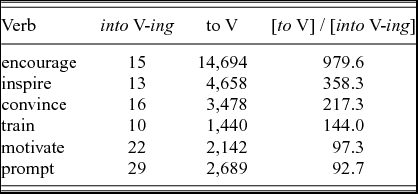
The difference has to do with the fact that unlike verbs like coax and frighten, those like convince, instruct and encourage entail that the entity denoted by the direct object makes a cognitive decision. Based on this contrast, Goldberg (Reference Goldberg1995: 166–7) suggests that examples like (48a) are ill-formed since they violate the constraint for the direct causation that no cognitive decision can mediate between the causing event and the entailed motion. The problem, however, is that such verbs (convince, encourage, instruct) do occasionally occur in the into-causative construction, albeit quite infrequently. In order to find such sentences, we looked specifically for the three verbs convince, encourage and instruct, as well as other verbs whose frequency with [to V] complements is much higher than [into V-ing] complements. Table 6 shows the frequency of the [into V-ing] construction, the [to V] construction and the resulting ratio of the two.
[into V-ing] with verbs that normally take [to V]

The examples that follow provide two examples with each of these six verbs – one from GloWbE-US and one from GloWbE-UK.
-
(49)
-
(a) to help and encourage others into finding that purpose that God has put them on earth (US)
-
(b) They want to encourage young people into having safer, more sensible sex (UK)
-
-
(50)
-
(a) He didn't have to inspire others into creating socially conscious corporations. (US)
-
(b) The aim of the project is to inspire more young people into working actively together (UK)
-
-
(51)
-
(a) he secretly hoped they would be of any help to convince her into believing those words (US)
-
(b) I was convinced into buying our tourer caravan by the phrases, “its so easy” (UK)
-
-
(52)
-
(a) from a young age most of us were trained into believing many ideas related to religion (US)
-
(b) So in a cumulative way you are trained into seeing your sex as public or valueless (UK)
-
-
(53)
-
(a) [to] grow your value as a business to motivate customers into becoming raving fans (US)
-
(b) we've had to try to motivate the school into raising its expectations of him (UK)
-
-
(54)
-
(a) And perhaps that will prompt people into demanding more (US)
-
(b) That sign might be enough to prompt you into calling a cab (UK)
-
In each of these examples, the object appears to make a cognitive decision, as seen from the fact that each can be interpreted with the adverb ‘willingly’ or ‘unwillingly’. This difference with (53a) once again reveals the distinctive property of the into-causative construction. We may conclude that the into-causative construction, unlike the direct causation, can be interpreted as an indirect causation of the subevent, which in turn does not need to be temporally dependent.
The second ‘wrinkle’ in terms of the constructional view has to do with the idea that:
-
(55) X CAUSES Y TO BECOME Z & BECOME Z happened
If this is interpreted as X directly causes Y to VERB, then the following type of sentences from the corpus might be problematic:
-
(56)
-
(a) It's helped to build America into exploring new frontiers (COCA SPOK 1994)
-
(b) the Kurds have been gerrymandered into being mere minorities (COCA ACAD 2004)
-
(c) Fran also organized Kathy into buying some smart cotton dresses (COCA FIC 1997)
-
(d) I guess I finally molded him into taking responsibility for his life (COCA MAG 1994)
-
(e) this is can be factored into making the Philippine Defence Force more modern (GloWbE-US)
-
Compare these to prototypical cases like:
-
(57)
-
(a) He (X) talked his parents (Y) into letting him see the band (Z). (COCA 2011 NEWS)
-
(b) He's (X) always bamboozling me (Y) into watching the fire (Z). (COCA 1990 FIC)
-
In (57), we can clearly see the direct force or influence exerted by X (subject) on Y (object) to do Z (into complement). But in (56), this causation is much more indirect. For example, in (56a) something (X) has helped America (Y) to be a certain way, and then (indirectly) America (Y) can explore new frontiers (Z). There are also cases like (56c), where it is not clear just how much Fran (X) influenced Kathy (Y) to buy some dresses (Z). In other words, there is probably a continuum in terms of force or influence, with the most prototypical sentences being like (57), but extending out to much more indirect causation, as in the examples in (56). Considering these, there is no need for the causation to be direct; the causation involved can be indirect or a metaphoric event, which is another key property of the into-causative construction.
The final phenomenon that we will discuss concerns the relationship with the way construction, illustrated in (58) (Goldberg Reference Goldberg1995: ch. 9):
-
(58)
-
(a) Sam joked his way into the meeting.
-
(b) We elbowed our way out of the building.
-
(c) It clawed its way up the ladder.
-
In these sentences, the subject referent moves along the path denoted by the PP. The way construction is quite productive and forms an independent grammatical construction, as is evidenced by several facts. For example, the possessive (POSS) pronoun must be coindexed with the subject; the construction must imply movement of a subject along a path (explicitly or implicitly) indicated by a directional, and the directional must modify the path designated in the possessive way (see Goldberg Reference Goldberg1995: 199; Mondorf Reference Mondorf2011: 402).Footnote 14 The key semantic feature of the construction is ‘causation’. That is that X (subject) causes Y (POSS) to go along the path denoted by Z (PP) either by means of the main predicate or in the manner denoted by the main predicate. The construction thus relates the subject of the sentence, X, to the object of the sentence, Y, the traversal predicate, GO, and the path along which the motion occurs, Z. This in turn means that the way construction is an extension of the caused-motion construction.
What we expect from these grammatical properties of the way construction (involving the meaning of causation as its key semantic feature) is that the construction may interact with the into-causative construction too. In fact, this prediction is borne out by corpora data:
-
(59)
-
(a) how they lie and cheat their way into getting passes for the paddock!
-
(BNC FIC HGM)
-
(b) A conman tricks his way into being elected to the US Congress
-
(BNC NEWS HJ4)
-
(c) Mr. Zell talked his way into managing some off-campus housing property (COCA NEWS 2001)
-
(d) Stephanie blackmails her way into taking a case that will pay out $10,000 (GloWbE-US)
-
(e) yet tries to wheedle his way into sharing Christmas (GloWbE-UK)
-
In all of these cases, X is creating a ‘situation’ Y in which Z results, but there is no specific Y mentioned, and way (his way, her way, their way, etc.) is used as a ‘placeholder’ for the missing Y. Perhaps even more unusual are cases like the ones in (60):Footnote 15
-
(60)
-
(a) “I had to imagine my way into being a good mother,” she said. (COCA NEWS 2009)
-
(b) and now I have lied my way into having to leave the house altogether (COCA FIC 1996)
-
(c) he had stammered his way into asking Lois to dance with him (GloWbE-US)
-
(d) Nose your way into doing extracurricular activity you are interested in (GloWbE-US)
-
In these cases, there is at first glance no possible Y (separate from X), but note that the Y must be coindexed with the subject. For example, in (60a) it would be difficult to say ‘I (X) had to imagine Sue (Y) into being a good mother’ or in (60c) ‘he (X) had stammered his brother (Y) into asking Lois to dance with him’. All such examples are thus instances of the combination of the into-causative and way construction in which X causes Y (= X himself or herself) to be in the resultant state described by the gerundive phrase.
The interaction of the way construction and into-causative construction gives rise to an interesting prediction. Mondorf (Reference Mondorf2011: 399) observes that the way construction can have several variants including the one with a reflexive object, as in Max married himself into big money. What this means is that this reflexive variant may also be in the into-causative construction. This is in fact borne out by a rich set of corpus data:
-
(61)
-
(a) I began to immerse myself into helping create a new wave (COCA NEWS 2000)
-
(b) But we must never resign ourselves into believing that it has to be that way forever (COCA SPOK 2002)
-
(c) Do you think a gay person could pray himself into being not gay? (COCA SPOK 2002)
-
(d) He didn't want to chitchat himself into getting dropped off somewhere (COCA FIC 2008)
-
(e) while politicians routinely squirm and wriggle themselves into holding onto their posts (GloWbE-UK)
-
Similar to the way construction, there is a causation relation in these examples in which the reflexive object is coreferential with the subject. In each case, the subject X causes the object Y (equal to X) to be in the resultant situation described by the gerundive clause. This resultant situation is controlled by the object which is in fact the subject. In this sense, we could take such examples as another instance of the into-causative construction, an extension of the caused-motion construction.
5.2 Differences between dialects in terms of semantics
An interesting case of possible dialectal variation in the use of the into-causative construction in American and British English has to do with which semantic categories (such as persuasion, coercion, force and so on) are more common in each dialect. Wulff et al. (Reference Wulff, Stefanowitsch, Gries, Radden, Köpcke, Berg and Siemund2007) argue that corpus-based evidence shows that verbs of physical force (e.g. bully or force someone into doing something) are more common in British English, whereas verbs of persuasion (e.g. talk someone into doing something) are more common in American English.
While the argument is a persuasive one, the authors mention that one of the weaknesses of their study is that it is based on a fairly unbalanced, ad hoc corpus. The American English data come just from articles in the LA Times since 1992, and the British English corpus is based on texts from the Guardian newspaper from the 1990s. But there are no fiction, magazine, academic, spoken (or for that matter, informal) texts in the corpus. As a result, in our study we have decided to try to replicate the study in Wulff et al. (Reference Wulff, Stefanowitsch, Gries, Radden, Köpcke, Berg and Siemund2007), using a larger and more balanced corpus.
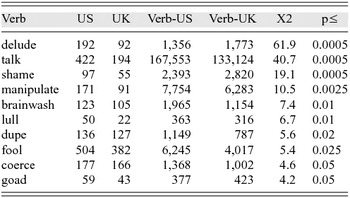
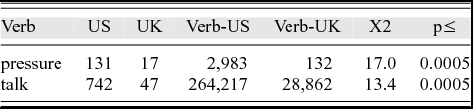
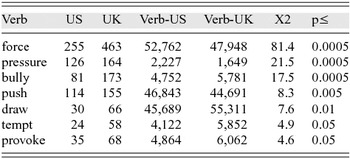
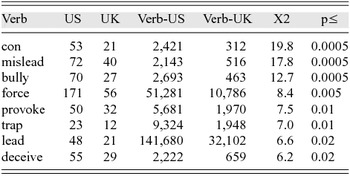
Table 7 shows verbs that are more common in the American English portion of GloWbE (385 million words) compared to the 385 million words of British English in GloWbE. The table shows the raw frequency of the construction with each verb, the total number of tokens of that verb in the entire corpus (Verb-US and Verb-UK), the chi-square value and the p value. Table 8 shows verbs that are more common in COCA than in the BNC. Table 9 shows verbs that are more common in GloWbE-UK than GloWbE-US. Table 10 shows verbs that are more common in the BNC than in COCA (and which occur at least ten times in the BNC). Note that only those verbs with p≤.05 (which was our level of statistic significance) are shown in each of the tables.
GloWbE: +US / -UK

COCA/BNC: +US / -UK

GloWbe: +UK / -US

COCA/BNC: -US/ +UL

In general, our data set supports that of Wulff et al. (Reference Wulff, Stefanowitsch, Gries, Radden, Köpcke, Berg and Siemund2007). The verbs that are more common in American English do deal with persuasion and ‘mental coercion’, including verbs such as delude, talk, shame, manipulate, dupe, fool and goad. Many of the more British verbs, as Wulff et al. (Reference Wulff, Stefanowitsch, Gries, Radden, Köpcke, Berg and Siemund2007: 273) have suggested, do relate more to physical force (force, bully, push and provoke). It is quite striking that there are no verbs of physical force at all in the American English data, whereas they are fairly common in British English.
5.3 Changing uses of the construction: the rise of neutral verbs?
In section 3, we noted the three main categories of the matrix verbs in the construction that are discussed in Hunston & Francis (Reference Hunston and Francis2000), which are the ‘coax’, ‘annoy’ and ‘fool’ type of verbs. Rudanko (Reference Rudanko2006), however, investigates whether there might be a recent change, in which there may have been an increase in what he calls ‘unflavored’ or even ‘neutral’ verbs. In order to examine this, he looks at the frequency of seven verbs: influence, impel, induce, lead, motivate, prompt and stimulate (with examples given here from our corpora):
-
(62)
-
(a) He seems to have influenced Rhodanius of Toulouse into going into exile also. (COCA ACAD 2007)
-
(b) the more I am impelled into suggesting that they (elections) should be placed under Chapter 7 (GloWbE-KE)
-
(c) the enriched program induced these mothers into taking a much more active plan (COCA MAG 1990)
-
(d) Oziel was leading the brothers into making those damaging statements on tape (COCA SPOK 1993)
-
(e) to grow your value as a business to motivate customers into becoming raving fans (GloWbE-US)
-
(f) That sign might be enough to prompt you into calling a cab (GloWbE-UK)
-
(g) healthy sex might, in fact, stimulate the uterus into starting contractions (COCA SPOK 1997)
-
As table 11 indicates, Rudanko finds that these seven neutral verbs are more frequent in the British than in the American portion of his corpus.
into-causative construction with neutral verbs (Rudanko Reference Rudanko2006)

These data lead Rudanko (Reference Rudanko2006) to suggest that British English is being more innovative in terms of the shift towards into V-ing with these neutral verbs. Our data support Rudanko's point in one sense, but at the same time question it in a more important sense. Our corpus data show that the ‘neutral’ verbs are in fact more common in British English, supporting his analysis. Rudanko's analysis is based on 81 tokens with seven verbs, whereas we expand our analysis to 25 ‘neutral’ verbs that occur three times or more in the corpus, for a total of 638 tokens. These ‘neutral’ verbs include:
-
(63) lead 173 (tokens), draw 138, guide 42, influence 41, condition 30, prompt 29, trigger 26, propel 22, stimulate 20, steer 18, recruit 15, redirect 15, galvanize 15, induce 12, spark 8, dazzle 4, usher 4, modify 4, transition 4, reason 3, program 3, spend 3, harness 3, fund 3, interest 3
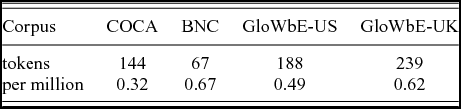
These verbs occur 144 times in COCA, for a normalized frequency (per million words) of 0.32, whereas it is more than twice that in the BNC (at 0.67). In GloWbE, British English is still higher, although the difference is not as pronounced (0.62 compared to 0.49). So in terms of our data, the claim that neutral verbs are more common in British English is supported (see table 12).
into-causative construction with neutral verbs in the different corpora

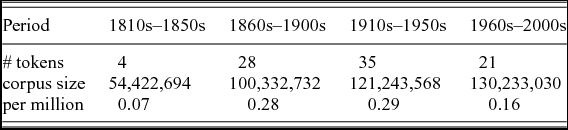
The problem, however, has to do with the claim that neutral verbs are somehow more ‘innovative’. In order to prove this, we would need to know the frequency of these verbs in older stages of English. Fortunately, the 400-million-word Corpus of Historical American English (COHA) allows us to do this. Table 13 shows the frequency of the seven verbs (that Rudanko uses) – impel, induce, influence, lead, motivate, prompt, stimulate – in four different fifty-year periods since the early 1800s. The data show that the use of these neutral verbs has actually decreased over time, from a high of 0.28 and 0.29 per million words for the periods 1860s-1900s and 1910s-1950s (respectively) to only 0.16 in the 1960s-2000s.
into-causative construction with neutral verbs in COHA (historical)

In this sense, then, Rudanko actually has it the wrong way round. British English does use the neutral verbs more than American English, but neutral verbs are not innovative – they were actually more common in earlier decades.Footnote 16
6 Conclusion
As we have noted, this is the most comprehensive study to date of the into-causative construction, and the corpus data have enabled us to provide a detailed analysis of nearly 20,000 tokens of the construction in more than 1.3 billion words of text. The data show that there is an incredible range of lexical creativity with the construction, as speakers and writers use the construction in very innovative ways with hundreds of different verbs. While most verbs do belong to the prototypical semantic categories of ‘annoy’, ‘coax’ and ‘fool’ verbs, we find many cases of verbs that are outside these categories as well. On the periphery of this construction, we also find many verbs that occur only in the reflexive sense. In terms of regional variation, our data support previous research that shows that American and British English tend to use different matrix verbs, with British English using verbs of physical force more, and American English using verbs of persuasion more. Finally, our data support previous research showing that British English tends to use ‘neutral’ verbs more, but it also shows that this is not evidence for a more innovative use of the construction.
This article has also sketched a Construction Grammar-based analysis to account for the grammatical properties of the into-causative construction. The construction inherits properties from the caused-motion constructions, but it is different from these with respect to the entailment relationship of the gerundive phrase: it entails that the situation denoted by the gerundive phrase actually happened. Such an entailment relationship is not found in the infinitive or resultative constructions. The strong advantage of this constructional view is that we can expect innovative uses of the construction with a variety of new matrix verbs. This is rendered possible by allowing tight interactions between lexical properties and argument structure constructions, including the caused-motion construction as well as its extension, the into-causative constructions.