1. Introduction: A Metaphor
Imagine that you stepped into a new world. Houses would not look like houses, streets not like streets, trees not like trees. Although communication would be still made through language, this language would be different from your own. In order to orientate yourself within this new world, you would need to be able to speak the language and have a basic map that explains the structure of this world and tells you where to go. While some visitors to a new world will find this exciting and will be able to pick up the necessary skills and knowledge needed quite easily, others will find it confusing to begin with. However, after learning the language and acquiring a basic concept of the structure of this world, it would become easier.
Listening to electroacoustic music for the first time can be compared to stepping into a new world of sounds. A first-time visitor to an acousmatic concert would recognise certain parts that are similar to a ‘traditional art music’ concert (concert space, general setup, such as chairs facing some kind of stage, probably tickets or programme notes). However, listening to music that features material consisting of sounds which have not yet been considered to be musicalFootnote 2 and without musicians on stage, the impression of this event will be different from what is generally expected from a ‘traditional art music’ concert. Some first-time listeners of electroacoustic music find the experience exciting straight away. However, others might struggle and will not find their way into electroacoustic music easily.
So if a person dislikes the music played at the concert mentioned above, is this because the visitor does not like the music or because she or he is challenged by the situation? What can be done in order to make it easier for an inexperienced listener to orientate within this new sound world? As pointed out above, for the discoverer of a new world, a language course and a map would help in this situation. What would be the means to help inexperienced listeners to find their way within the new world of sounds?
This article will look at the question of how appreciation for electroacoustic music can be enhanced for inexperienced listeners by explaining the key concepts of electroacoustic music. To investigate this, a curriculum for Key Stage 3 UK school students (11–14 years old) was developed, which is presented in an online learning environment (prototype of the EARS 2 environment).
The following areas will be introduced in more detail:
-
• Music appreciation research and the need for a curriculum for electroacoustic music
-
• The EARS 2 (P) musicological framework
-
• The prototype of the pedagogical ElectroAcoustic Resource Site
-
• The EARS 2 (P) study
-
• Implications and conclusions
2. Music Appreciation Research and the Need for a Curriculum for Electroacoustic Music
Music appreciation is a manifold field, as the diversity of literature centred around issues regarding music appreciation shows: in fact, the current literature does not deal with the term ‘music appreciation’ and instead features different terms depending in which field the research is located.
While psychology research investigates reactions to acoustic stimuli, sociological research looks at musical preference (for example North and Hargreaves Reference North and Hargreaves2008). Questions regarding beauty and/or the process of liking have traditionally been part of philosophy, and also the aesthetic discussion regarding musical appreciation has been taken over by the philosophers (Barrett Reference Barrett2007).Footnote 3
The meaning of the term ‘music appreciation’ has a number of facets; often it is considered to be concerned with how people ‘like’ music. The study does not intend to teach pupils to ‘like’ electroacoustic music. Liking can happen spontaneously, but does not need to happen in order to see the artistic merits within a composition. According to a position paper of the leading music education researchers in 1936, music appreciation cannot be fostered by pure listening to music; instead the researchers agree that individual exploration and participation fosters music appreciation. Many of the definitions mentioned in this position paper link back to knowledge as a prerequisite for a deeper appreciation (Gehrkens, Glenn, Dykema, McConathy, Pierce, Scholes, Smith and Van Dyke More Reference Gehrkens, Glenn, Dykema, McConathy, Pierce, Scholes, Smith and Van Dyke More1936).
2.1. Information can influence musical preference
Rigg, Weale and Landy demonstrate that knowledge plays a major role within appreciation by showing that musical preference can be influenced with the help of information (North and Hargreaves Reference North and Hargreaves2008; Weale Reference Weale2005 and Reference Weale2006; Landy Reference Landy2006). Of these studies, only Weale and Landy's Intention/Reception project has focused on electroacoustic music. Weale's data show that a more positive response to electroacoustic music occurs when
-
1. recognisable sounds are present and
-
2. when dramaturgic information for a piece is provided (Weale Reference Weale2006).Footnote 4
2.2. Prototype theory in cognitive psychology
Another way to explain the possible confusion of the first-time listener of electroacoustic music is provided by Daniel Berlyne's arousal theory.
Berlyne states that
-
1. music which is predictable is liked better; and
-
2. music which is familiar is liked better (Berlyne Reference Berlyne1971).Footnote 5
Applying these two statements to electroacoustic music can create a vicious circle: if music is appreciated more when familiar, but listeners generally do not get exposed to electroacoustic music,Footnote 6 the listeners will not gain deeper appreciation nor develop an interest in listening to the music. This circle can be broken by enhancing the listener's knowledge. For this, a teaching resource that will enable easy access to material needs to be provided.
Further, a cognitive prototype needs to be built to match the experience of an acousmatic concert or listening to electroacoustic music. The prototype theory forms part of perception theory in cognitive psychology. A prototype is understood as ‘a sort of average of a class of related objects or patterns, which integrates all the most typical (most frequently observed) features of the class’ (Sternberg Reference Sternberg2009: 103). North and Hargreaves (Reference North and Hargreaves2008) summarise:
Many studies in cognitive psychology have indicated that people classify stimuli by successfully matching them with an abstract schema, or ‘prototype’, representing the appropriate category … In other words, our everyday experiences are classified more easily if they correspond with a prototype for that kind of experience. These prototypes come about through experience of the world, so that through repeated exposures to exemplars of a category we learn what the prototype should be. (North and Hargreaves Reference North and Hargreaves2008: 85)
Electroacoustic music can be challenging for an inexperienced listener. New listening strategies have to be developed to appreciate this music. The experience of electroacoustic music does not match any prototype of music in the inexperienced listener's mind. Looking back to the metaphor of the listener stepping into a new sound world, one of the problems is that this sound world does not match any previous experience. This means that the arousal is too high – no prototype exists. Repeated exposure (for example, repeated listening to electroacoustic music) will help to build the prototype, as categories and concepts will be formed through repetition of perception. However, teaching concepts of an unfamiliar experience (in this case electroacoustic music) will assist in creating a new prototype in a more systematic way. Therefore, assisting the development of a cognitive prototype will be one of the tasks of this curriculum.
2.3. The need for an electroacoustic music curriculum
Knowledge, which has been associated with appreciation at the beginning of this article, can be enhanced through learning and teaching. However, little learning and teaching about electroacoustic music takes place in (UK) schools.
Schools offer courses in music technology, but often such courses do not begin before GCSE or A-level.Footnote 7 Furthermore, in many cases the teaching of music technology is focused on the use of technology and can therefore be alienating for those pupils who do not feel comfortable with technology but would be interested in the musical opportunity that technology offers.
Although current music education literature agrees that the use of technology in music lessons enhances the learning (Cain Reference Cain2004; Savage Reference Savage2005; Burnard Reference Burnard2007; Bolton Reference Bolton2008), few conceptual frameworks ‘for investigating the multifaceted nature of creativity and technology’ (Burnard Reference Burnard2007: 39) are available for educators.Footnote 8 The teachers that took part in the EARS 2 (P) case studies emphasised in interviews that they were interested in teaching electroacoustic music; however, there was not enough time to develop their own curriculum or material. Hence, the idea of providing a curriculum accompanied by a scheme of work was appreciated by the teachers and offers a potential solution.
3. The EARS 2 (P) Musicological Framework
In order to create the EARS 2 (P) curriculum, a musicological framework has been developed. For this purpose, Leigh Landy's proposed framework for the study of electroacoustic music (Landy Reference Landy2007) has been adapted. Landy's original framework embraces the following fields:
-
(1) Classification: from sound to work level;
-
(2) The listening experience;
-
(3) Models of discourse, analysis, and representation;
-
(4) Organizing sound from micro- to macro-level;
-
(5) New virtuosity;
-
(6) New means of presentation;
-
(7) Achieving interdisciplinarity and holism. (Landy Reference Landy2007: 188)
As Landy's framework addresses researchers and experienced listeners of electroacoustic music, a new framework had to be developed in order to teach listeners that have not yet been acquainted with electroacoustic music. The target group of the EARS 2 (P) curriculum is much younger than the target group of Landy's framework, hence the amount and complexity of information had to be broken down to a level appropriate to Key Stage 3.
Three areas of the above list provide the ground for this smaller framework for the EARS 2 (P) curriculum:
-
• classification of sounds
-
• listening experience
-
• modes of discourse, analysis and representation.
3.1. Classification of sounds
This concerns real-world sounds and generated sounds (from sound to music) as starting point for the research and the pedagogical concept of the curriculum.
In order to enable a basic way of orientation in many different types of sounds used within electroacoustic music, it was decided to distinguish between real-world sounds and generated sounds. Based on this matrix, the curriculum was filled with content inspired by the original EARS project.Footnote 9
Of course, borders between real-world sounds and generated sounds are blurry. (What, for example, is the ringtone of a mobile phone?) However, the empirical testing showed that there was not one case where this differentiation resulted in more confusion than understanding. Landy points out quite clearly: ‘What is likely, and this is quite understandable given the vast variety of sounds and compositional approaches we are dealing with, is that no single classification system will be universally applicable’ (Landy Reference Landy2007: 189). Therefore, a classification of real-world sounds and generated sounds might not be accurate in all cases, but works on an educational level and hence fulfils its purpose.
3.2. Listening experience
This encompasses reduced listening and referential listening as a starting point for the learner.
Listening is the first way learners come in contact with electroacoustic music, hence an introduction to how to listen to electroacoustic music is required.
The list of terms related to listening experience on the EARS website demonstrates the number of different aspects of listening:
-
- Acousmatic
-
- Causal Listening
-
- Clairaudience
-
- Composed Space
-
- Contextual Listening
-
- Gesture
-
- Intention and Reception
-
- Listening Strategy
-
- Modes of Listening
-
- Morphology
-
- Quatre Ecoutes
-
- Reduced Listening
-
- Referential Listening
-
- Semantic Listening
-
- Sound Image
-
- Source Recognition
-
- Source Bonding
-
- Surrogacy
-
- Technological Listening
-
- Texture
-
- Timbre
-
- Utterance. (Landy Reference Landy2007: 195)
When devising a pedagogical resource, it is important to consider which and how listening strategies will be introduced. Only those listening strategies that were easy to understand and practise were chosen for the EARS 2 (P) curriculum. Furthermore, they needed to match the concepts of real-world and generate sounds.
Hence, a focus was laid on referential listening (understood as natural way of listening to sounds) and reduced listening (understood as ignoring sound source and focusing on musical parameters of sounds) as a starting point for learners. Both listening strategies form part of a listening training offered within the curriculum.
The concepts of source recognition and source bondingFootnote 10 are considered important, especially when introducing reduced listening. In order to be able to listen for the musical parameters of a sound, it is necessary to learn not to focus entirely on the source of the sound. This separation of sound and sound source is a key skill that enables a different experience of electroacoustic music.
3.3. Modes of discourse, analysis, and representation
This refers to aural analysis and the use of graphical representation of sounds as an educational tool.
Aural analysis is a skill that not only is necessary when dealing with electroacoustic music without notation, but also directly evolves from section 3.2. In the EARS 2 (P) curriculum aural analysis is used especially for the listening training, in quizzes and listening tasks as well as during composition tasks.
Graphical representation of sounds would offer the participants a so-called Something-To-Hold-On-To Factor (Landy Reference Landy2007). The current version of the EARS 2 (P) curriculum does not include graphical representation of sound as pedagogical feature; rather, it covers the topic in a tutorial to make the learners aware of the problems occurring when notating electroacoustic music. The framework deliberately leaves scope for development at this point as the new software Compose With Sounds will work with graphical representations of sounds (such as associating a sound with a picture in order to build a ‘sound card’).
4. The Prototype of the Pedagogical ElectroAcoustic Resource Site
The development of the prototype of the pedagogical ElectroAcoustic Resource Site (EARS 2 (P)) consisted of two main parts: the curriculum and the online environment in which the curriculum is presented. The curriculum offers two ways of usage: as a stand-alone online tool or as classroom-based teaching resource. As curriculum and environment are interdependent, both were developed in parallel. The next paragraphs will introduce the different theories and tests that supported the development of the curriculum. A detailed description of the development of the environment can be found in Wolf (Reference Wolf2013).
4.1. Curriculum design
The pedagogical decisions regarding the development of the EARS 2 (P) curriculum were influenced by educational theories that informed the structure and the learning style of the curriculum.
Central theories were Anderson and Krathwohl's revision of Bloom's taxonomy of educational objectives (Reference Anderson and Krathwohl2001) as well as the phenomenographic approach and the media taxonomy by Diana Laurillard (Reference Laurillard2002).
4.2. Learning outcomes
The learning outcomes of the EARS 2 (P) curriculum are split into three areas: factual, conceptual and procedural knowledge. Not every learner will necessarily achieve every learning outcome of the list below. However, these are the possible learning outcomes that can be accomplished when using the EARS 2 (P) curriculum.
4.2.1. Factual knowledge
-
• The learner can use musical vocabulary and meanings in the realm of electroacoustic music.
-
• The learner is familiar with a selected body of electroacoustic works.
-
• The learner can remember, recognise and recall pitch, rhythm and duration, and analyse music and sounds heard.
-
• The learner can remember details of the genres soundscape and musique concrète and can define the difference.
4.2.2. Conceptual knowledge
-
• The learner can differentiate real-world sound from generated sound, as well as reduced listening from referential listening.
-
• The learner can remember, identify and apply different ways of using sound in music.
-
• The learner can remember the principal concepts and key figures of electroacoustic music.
-
• The learner can explain the issues in electroacoustic music concerning technology and theoretical discussions (e.g. performance, notation, …).
4.2.3. Procedural knowledge
-
• The learner can run the basic functions of Audacity.
-
• The learner has developed an awareness of the sonic environment.
-
• The learner can read a graphical representation of sound.
-
• The learner can distinguish between different listening strategies and use reduced and referential listening strategies.
-
• The learner can analyse a sound for musical parameters.
-
• The learner can create a composition using sounds by planning the composition, generating the sounds (recording) and producing the composition (compositional process).
-
• The learner can record sounds and soundwalks with the help of a hand-held recording device.
-
• The learner can evaluate which listening strategy to employ.
-
• The learner can analyse the main elements of an electroacoustic composition.
4.3. Design of the EARS 2 (P) environment
The EARS 2 (P) environment was developed supported by two small-scale pilot studies using a two-step user-centred design process. These studies validated that navigation of the website as well as the content were understandable for the target group as the EARS 2 (P) curriculum was introduced on an online platform during the subsequent case studies. As this article focuses on the educational aspects of this project, the reader may be referred to Wolf (Reference Wolf2013) for more details on decisions and findings regarding learning technology.
5. The EARS 2 (P) Study
To investigate the question of how appreciation for electroacoustic music can be enhanced for inexperienced listeners by explaining the key concepts of electroacoustic music, outlined at the beginning of this article, the curriculum was taken into schools.
Case studies with workshops consisting of five sessions were carried out in three different school classes of Key Stage 3. Prior to this, a beta study was carried out to test methodology and learning content of the workshops. The main finding of the beta study was that the participants did not have any listening strategy when listening to electroacoustic music. Subsequently, a listening training was developed for the further case studies.
5.1. Participants of the case studies
The participants were 11–14 years old and in Key Stage 3 classes of secondary schools within Leicester. Of the 64 participants, 33 were male and 31 female.Footnote 11 Two of the participating classes were at a private grammar school and one class was part of a state comprehensive school (the beta study also took part in a state school). The schools were located in different areas throughout Leicester.
5.2. Content of workshops
5.2.1. Lesson 1: Introduction
The difference between real-world sounds and generated sounds were discussed and trained with the help of a listening quiz.
5.2.2. Lesson 2: A new way of listening
A listening training took place focusing on analysing sounds for musical parameters (rhythm, pitch, duration in all schools, additionally timbre in the third school). Looped sounds were analysed with the whole class and then individually.
5.2.3. Lessons 3 and 4: Practical work focusing on soundscape and musique concrète
The lessons consisted of two learning units run in parallel. Both units focused on different topics, but applied the same teaching method to them.
In unit three, the participants focused on soundscape with the task either to record sounds of their school and to compose a piece with it, or to create a role play dealing with the genre soundscape. Unit 4 was centred around musique concrète. The participants recorded sounding objects and composed a piece with these sounds or devised a role play. The participants had to decide if they wanted to complete unit 3 or 4 and then which of the tasks within the units they wanted to do.
While the composition task was planned as a practical application of newly acquired knowledge on the compositional process, the groups devising a role play had to complete a higher proportion of research tasks and through the means of a role play were challenged to explain what they had learned.
5.2.4. Lesson 5: Finishing off
The last lesson included the presentation of the compositions as well as dealing with open questions. Furthermore, a good deal of the lesson was used to collect data, which included not only additional listening but also an individual recapitulation of the acquired knowledge from the last five weeks.
5.3. Methodology
Two tests were developed in order to capture a diversity of views of the workshops and electroacoustic music. The first test – the Listening Response Test (LisRes) – was informed by the methodology of the Intention/Reception Study, but adapted for the purposes of this study. The participants listened to a piece of electroacoustic music before the workshop started (without any knowledge of electroacoustic music) and wrote down their thoughts while listening. This test was repeated at the very end of the workshops, which enabled the comparison of the two responses.
The second test took place at the end of the workshops. The participants were asked to write a letter to someone who had not taken part in the workshops, explaining what they had learned. This test served also a second purpose: by writing the letters the participants had to reflect critically on the workshops, which was pedagogically a good way to finish.
Additionally, two questionnaires were used: one before the start of the workshops and one after they had taken place. While the first questionnaire established whether the listeners were inexperienced and gave a picture of their musical knowledge in general, the second questionnaire asked for enjoyment of the workshop as well as if the participants’ listening had changed.
5.4. Evaluation
5.4.1. Questionnaires
The questionnaires were evaluated with the help of an Excel spreadsheet. The second questionnaire was also analysed for correlations between listening change, appreciation and rote/conceptual knowledge questions, in order to follow up the influence of rote or conceptual knowledge on the appreciation.
5.4.2. Listening Response Test
The data of the Listening Response Test was transcribed and then analysed with the help of summarising qualitative content analysis (Mayring Reference Mayring2004). Each comment was coded with one or more keywords. At the end of the coding process, the comments were sorted by codes. This made it possible to get hold of the participants’ associations with the music (for example ‘film music’) as well as to compare the responses of the first and second listening process by comparing the emerging codes as well as the dominance of the codes (how many comments were coded with keyword xyz; whether this changed).
5.4.3. Letter test
The letter test was also transcribed and coded with summarising qualitative content analysis. This method allowed for the crystallisation and comparison of answers independent of spelling and grammar mistakes.
5.5. Results of the EARS 2 (P) study
In the following section a selection of the results will be introduced. Each test will be discussed at the time. The full results can be found in Wolf (Reference Wolf2013).
5.5.1. Questionnaire 2
In the second questionnaire especially the questions dealing with appreciation, knowledge and listening were of interest. Not all questions will be evaluated below. The questions will be introduced where relevant.
Listening change
To see if the listening of the participants has changed, the participants were asked:
‘Since you've done the workshop: Do you think you hear sounds in a different way?’ (Question 3 (listening change)).
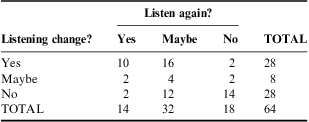
Of the 64 participants who completed the second questionnaire, 28 answered the question with yes, 8 with maybe and 28 with no. To find out what caused the listening change (or the awareness of it) for almost 50 per cent of the participants, correlations between the different questions were considered.
Listening change and appreciation
To investigate the appreciation of electroacoustic music, two questions were asked:
Question 7 (listen again): ‘Would you like to listen to electroacoustic music (music with sounds) again?’
Question 8 (second workshop): ‘If there were a second workshop going into more detail, would you like to take part?’
The following paragraph investigates if the change of the participants’ listening influenced their appreciation.
The analysis of the correlation between questions 3 (listening change) and 7 (listen again) shows that those participants who stated that their listening had changed wanted to listen again. Likewise, those participants who stated that their listening had not changed did not want to listen again to electroacoustic music. Hence it can be concluded that the listening change of the participant had a direct influence on their appreciation, which means that the listening change is crucial for inexperienced listeners to allow a greater appreciation (Table 1).
Listening change and listen again

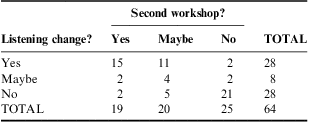
This conclusion is supported by the second appreciation-related question, as the correlation between questions 3 (listening change) and 8 (second workshop) shows that those participants who stated that their listening had changed also ticked that they wanted to do another workshop. Equally, those, who stated that their listening had not changed, did not want to do another workshop (Table 2).
Listening change and second workshop

Factual knowledge and appreciation
In order to investigate if more factors influence the appreciation, more questions were employed. Two questions were asked to see how much factual knowledge the participants have acquired during the workshop:
Question 4 (factual knowledge 1): ‘What is the difference between Soundscape and Musique Concrète?’
Question 6 (factual knowledge 2): ‘Can you remember … [a composer/a piece]?’
Both questions were assessed by using a marking scheme of 1 point per correct answer, 0.5 points for a partly correct answer and 0 points for an incorrect answer.
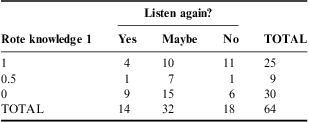
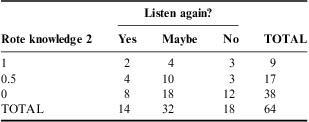
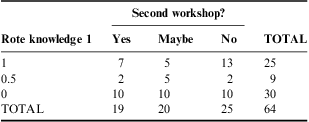
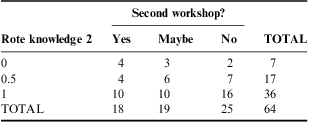
Interestingly, neither the correlations between factual knowledge 1/2 and listen again nor between factual knowledge 1/2 and second workshop gives a clear result. Hence, factual knowledge does not seem to influence the participants’ appreciation of electroacoustic music. Thinking about the initial hypothesis that knowledge can influence appreciation this statement seems to cause a contradiction. However, it will be shown in Tables 3–6 that different types of knowledge will have an influence on appreciation.
Factual knowledge 1 and listen again

Factual knowledge 2 and listen again

Factual knowledge 1 and second workshop

Factual knowledge 2 and second workshop

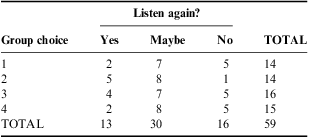
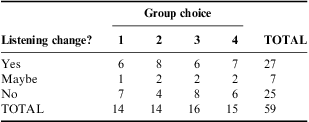
Further, the choice of group (composition or role play) did not have any influence on the appreciation nor on the listening change (Tables 7 and 8).Footnote 12 Such a finding allows for the conclusion that the listening change has taken place before the participants split into groups.
Group choice and listen again

Note: 5 participants (4 boys, 1 girl) did not tick in which group they had participated. Hence, there are only 59 participants in total in this table.
Listening change and group choice

Note: 5 participants (4 boys, 1 girl) did not tick in which group they had participated. Hence, there are only 59 participants in total in this table.
5.5.2 Listening response test
Table 9 shows the pieces listened to during the listening response tests. A discussion of the choice of pieces can be found in Wolf (Reference Wolf2013).
Pieces used for the listening response tests

The results of the listening response test show:
-
1. Enhancement of factual knowledge: In the second listening process fewer comments could be coded with ‘Sound Descriptions’; instead, the participants used musical terms learned during the workshops. These responses show very clearly that the participants developed a new vocabulary, which enabled them to describe new listening experiences. This means that the introduction of new vocabulary offers a way for participants to experience and appreciate electroacoustic music differently. Further, it shows that the participants were more attentive to listen to musical details and to describe them.
-
2. Through development of new vocabulary as well as through continuous listening experience and training, it is likely that participants developed their own prototype of electroacoustic music. This conclusion is especially prompted by the decrease of comments coded with ‘alienation’ and ‘film music’. The participants do not need to compare their listening experience to something else they know, but have acquired so much knowledge that they are able to ‘judge within the system’.
The findings above show that learning with the EARS 2 (P) curriculum can enhance the appreciation of inexperienced listeners by providing new vocabulary that enables the participants to describe their listening experience and help to develop their own (cognitive) prototype of electroacoustic music.
5.5.3 Letter test
The analysis of the letters showed four different categories:
-
1. knowledge-related codes (e.g. correct definitions)
-
2. preference-related codes (e.g. workshop or music like/dislike)
-
3. method-related codes (e.g. comments on workshop)
-
4. miscellaneous (comments that do not fit in the above categories).
Data of categories 3 and 4 mainly informed the running of the workshops. Therefore the following paragraphs will focus on the analysis of categories 1 and 2.
-
1. Although it was not asked for in the task, many participants wrote definitions of terms they came across during the study. Participants were able to explain electroacoustic music, soundscape, music concrète, real-world sounds and generated sounds. The data show an immense learning progress: the knowledge-related codes show that the participants have reached their learning target with help of the concept-based teaching that had taken place beforehand. The choice of words also shows that the participants did not just repeat but formulated their definitions with their own words.
-
2. The preference-related codes show that participants liked the workshop. Reasons mentioned included the triangulation of listening, learning and making as well as the aim to have fun while learning. Both of the reasons reflect the basic aims of the curriculum.
This shows that it is possible to enthuse young and inexperienced listeners for electroacoustic music following the EARS 2 (P) curriculum. Furthermore, the learning with the curriculum was successful.
5.6. Summary of results
Factual knowledge was acquired during the workshops. The participants reached learning targets, as they were able to give correct definitions in the letter test. They further developed a new vocabulary that enables the participants to describe their (new) listening experience (listening response test).
Conceptual knowledge could be seen in the fact that the learners developed new listening strategies and aural analysis skills (questionnaire 2). Further, it is likely that the participants developed their own cognitive prototype of electroacoustic music (evidenced by ther decrease of comments coded with ‘sound description’ and ‘film music’ in the listening response test).
Procedural knowledge was gained within the listening training in which participants learned to distinguish between referential and reduced listening and to apply the different listening strategies. Furthermore, almost half of the participants stated that their listening had changed.
Interestingly, the letter test and questionnaire 2 show different results for the correlation of rote knowledge and appreciation: the letters seem to show more correct definitions and higher enjoyment. An explanation for this could be that the thinking process was different in the letter task: when facts embedded in concepts, the participants were able to remember them better. This supports the concept-based teaching approach.
Looking especially at the results of the second questionnaire, it can be seen that the listening training of the second lesson is the key to enhancing the appreciation.
The ability to apply different listening strategies to different listening situations can be classified as conceptual knowledge. Hence, conceptual knowledge influences appreciation. This answers the question asked at the beginning of the article: the appreciation of electroacoustic music can be enhanced for inexperienced listeners by teaching the key concepts of electroacoustic music. Applying different listening strategies is the key to more appreciation.
6. Implications
The findings of this project link directly to the final phase of the EARS 2 project hosted by the Music, Technology and Innovation Research Centre of De Montfort University Leicester. The prototype of the EARS 2 curriculum and environment provides a proof of concept for a curriculum that can be used for online and classroom-based teaching. Furthermore, the curriculum shows that the concept-based teaching approach was successful.
The listening training turned out to be much more important than anticipated at the beginning of the research. It would be worth investigating the power of this listening training in a wider context. Thinking about Edwin Gordon's investigations in audiation (Reference Gordon1997) and combining them with the current listening research in electroacoustic music will be potentially very interesting.
The EARS 2 (P) curriculum presents a similar framework to that of a basic musicianship course. Musicianship courses deal with learning of skills such as rhythm, pitch relationship, form understanding, improvisation, composition and so on (Vinden and Vinden Reference Vinden and Vinden2008). Therefore this curriculum could be an answer to Landy's question:
will there ever be a foundational musicianship course (or, in Schaeffer's terms, solfège) of sound-based music? (Landy Reference Landy2007: 230)
Especially in combination with the new Compose with Sound software and with the additions of social networking as the new EARS 2 website will offer, this curriculum provides a powerful resource.
7. Final Conclusion
Considering the metaphor stated at the beginning of this article, it can be said that the situation of the first-time visitor to the unknown sound world has changed after working with the EARS 2 (P) curriculum. The learners have completed their ‘language course’ (listening training) and have acquired a ‘map’ (concepts of electroacoustic music). Still, the new world in its fullness might be overwhelming. However, the orientation within it will be easier than at the beginning. Therefore the EARS 2 (P) curriculum proves to be successful in helping inexperienced listeners to understand (at least parts of) this new world of sounds.Footnote 13