Prior research has mainly considered the compositional process as an individual act, with less research focused on collaborative music composing or group composing (also referred to in the literature as ‘composition’). Most of the research into collaborative music composing has been conducted with children and students in school settings (MacDonald & Miell, Reference MACDONALD, MIELL, Joiner, Littleton, Faulkner and Miell2000; Dillon, Reference DILLON2003). The current research project inquires into the collaborative composing process by investigating group composing within the framework of an adult rock band. The activities surrounding adult group composing and the main processes involved were considered, using an observational method in the natural setting of the participants.
Aims and research questions
The aims of this research project are to define the main composing activities of a rock group as they compose a new piece for their repertoire. In many prior compositional research projects, the task was defined by the researcher (Smith, Reference SMITH2008) and the results were correlated to the imposed task. When actions are driven by the researcher, the participants are not free to express all possible behaviours. Because of this, the final analysis does not reflect typical behaviour patterns. Few research projects on composing have been developed in naturalistic settings (Campbell, Reference CAMPBELL1995), and within these mainly individual activities were considered (Collins, Reference COLLINS2005). The aim of the current research paper is to analyse the activities and the processes of musicians working in group while they are composing a new piece. The following research questions were addressed:
(1) What are the activities engaged by a group in composing a new piece?
(2) How did the group members use their time in composing a new piece?
Literature review
Prior research largely considered the process of music composing (by adults and children) as an individual act. Several elements such as the cognitive processes (Sloboda, Reference SLOBODA1985), the generative processes (Marsh, Reference MARSH1995; Kennedy, Reference KENNEDY1999, Reference KENNEDY2002), the revision strategies (Kaschub, Reference KASCHUB1997; Webster, Reference WEBSTER2003), the differences between improvisation and composing (Burnard, Reference BURNARD2000a, Reference BURNARD2000b, Reference BURNARD2002), and the role of Information and Communication Technology (ICT) in composing (Webster, Reference WEBSTER and Colwell1992; Folkestad et al., Reference FOLKESTAD, HARGREAVES and LINDSTROM1998) were considered. Although models of the general composing process have been developed (Webster, Reference WEBSTER, Sullivan and Willingham2002), usually individual differences and the idiosyncratic nature of the compositional process were demonstrated (Kennedy, Reference KENNEDY2002). More recently, research on composing has been expanded towards collaborative music composing involving children and students in school settings (Morgan et al., Reference MORGAN, HARGREAVES and JOINER1997; MacDonald & Miell, Reference MACDONALD, MIELL, Joiner, Littleton, Faulkner and Miell2000; Dillon, Reference DILLON2003; Miell & Littleton, Reference MIELL and LITTLETON2004; Gall & Breeze, Reference GALL and BREEZE2005, Reference GALL and BREEZE2008). With regard to group creativity, Sawyer (Reference SAWYER2003, p. 4) reported:
the defining features of group creativity are that it involves two or more people, creating together at the same time . . . Group creativity is found in all group performances, whether on stage or in the privacy of rehearsal. Group creativity is not only a trivial pastime or an entertainment goal; it is essential in many problem-solving groups . . .
This statement pointed out that group creativity occurs in rehearsing and performing and is a fundamental process in group problem-solving activities. Some research studies considered musical creativity as a general trait that could be expressed by anyone in collaborative composing (Hewitt, Reference HEWITT2008) and involved also untrained musicians as participants. Sometimes the computer was used, allowing an untrained musician to create compositions by manipulating the sound events and to fulfil closed and open tasks. In the closed tasks the compositional actions were driven by the researcher controlling all the variables, allowing only specific actions such as ‘Add a note to the melody’, ‘Delete the last note from the melody’, ‘I don't like that note’ (Hewitt, Reference HEWITT2008), which limited the variability of the creative acts. Instead, in open tasks the participants’ behaviour is focused more on exploration and discovery than on solution and closure (Dillon, Reference DILLON2003).
Previous research on collaborative composing considered different aspects, such as communication, roles within the group and actions surrounding the process (Burnard & Younker, Reference BURNARD and YOUNKER2008; Gall & Breeze, Reference GALL and BREEZE2008; Hewitt, Reference HEWITT2008). Children's dialogue and other aspects such as their proposal, reiteration, information, agreement, disagreement, ‘refinement or reworking of a musical idea’, ‘elaboration of a previous idea’, and ‘to extend a previous idea or suggestion’ were considered (Hewitt, Reference HEWITT2008). Morgan et al. (Reference MORGAN, HARGREAVES and JOINER1997) showed the importance of conversation in the various assigned compositional tasks. Burnard and Younker (Reference BURNARD and YOUNKER2008) considered the interactive relationship of adolescents engaged in small-group composing and dividing various activities as horizontal (democratic leadership) or vertical (hierarchically driven). The horizontal decision-making process involved actions such as discussing, describing, arguing, negotiating, explaining, playing and evaluating. Hewitt (Reference HEWITT2008) compared composing in pairs, showing differences related to roles assumed by the pupils at the computer rather than previous musical experience. Fautley (Reference FAUTLEY2004) showed the following nine phases which engaged pupils aged 11–14 in basic music classes during group composing: initial confirmatory phase, generation, exploration, organisation, work in progress performance, revision, transformation/modification, extension and development, and final performance. The analysis of the time spent in each phase showed the longest duration was for ‘work in progress performance’ (45.03%), followed by ‘organisation’ (15.45%). Hewitt (Reference HEWITT2002) investigated the processes involved in group composing by university students showing the following activities: uses of stimuli, macro-level processes of construction, origination, experimentation, discrimination and refinement, the selection of instruments. Hennessy (Reference HENNESSY and Wilson2007), in adapting a model from Wallas (Reference WALLAS1926) for children's engagement with the creative process, discussed the phases of preparation, incubation, illumination and verification. During preparation the modes of working and ground rules are defined. Incubation is the phase in which students are exploring and experimenting with the material. During illumination the music material is selected and organised. During verification the piece is rehearsed, performed and evaluated.
With regard to the musical genres in the various studies on composing, different styles and music genres were used, such as contemporary, classical and electronic music (with experienced adults). For children and students, mostly pentatonic, tonal and sound-events composing were used. The research also involved other musical genres, such as pop and rock music. Although there is an increasing interest in how pop musicians learn in informal conditions (Green, Reference GREEN2002, Reference GREEN2008; Jaffurs, Reference JAFFURS2004; Johansson, Reference JOHANSSON2004; Westerlund, Reference WESTERLUND2006), few researchers have analysed how pop or rock musicians compose within groups. Fornäs et al. (Reference FORNAS, LINDBERG and SERNHEDE1995) studied three Swedish garage bands' composing involving informal learning between members, although no definite method of working was adopted. Thorpe (Reference THORPE2008) showed that members of the bands were highly engaged in self-directed music learning, finding meaning and identity in a community of practice. Green (Reference GREEN2002) reported that group composing usually involved one or more group members proposing ideas to the band for elaboration by the others. Campbell (Reference CAMPBELL1995) interviewed and observed the practice sessions of nine young musicians in two garage bands, and described the collective compositional activities. Writing a piece was rare among the activities of the two bands. They composed their pieces individually at home and brought them to practice when they were ready for group input. The new pieces were presented to the other musicians who observed and listened, and then played along. In creating an original piece, previous musical statements such as a short chord pattern or a melodic figure were used. Oral practices were central, and no melody was written on a musical score. Some other information about how a rock band composes can be drawn from non-academic texts such as the autobiographies of Slash, Steven Adler, Joey Kramer, John Densmore, Jon Hiseman and Bill Bruford (Densmore, Reference DENSMORE1991; Bozza, Reference BOZZA2007; Bruford, Reference BRUFORD2009; Kramer, Reference KRAMER2009; Hanson, Reference HANSON2010; Adler, Reference ADLER2010). The collaborative composing processes were reported by Bozza (Reference BOZZA2007) about the Slash in the song ‘Welcome to the Jungle’ which was the first song in which the band worked together. Also the process of experimenting can be found in rock music composing (Densmore, Reference DENSMORE1991; Bruford, Reference BRUFORD2009). The main problem here is that the descriptions are not focused on the band composing process, but describe the events in general terms.
Several elements emerged from the reviewed literature, although it is quite difficult to compare the results, since different aims and methods were used. In relation to collaborative composing, the importance of group member roles, communication and processes emerged. It seems evident that sharing and collaborating are important elements for successfully developing the piece. Also, the importance of informal learning for a genre such as pop music was shown. These prior studies provided insight mostly from an educational perspective; and musically experienced participants composing in group settings were not studied. Although most of the research was conducted in educational settings, the possibility to apply approaches based on the development of cognitive processes in composing, rather than the product, was not sufficiently considered. The current study aims to study the group composing strategies considering the activities engaged by a group in composing a new piece and how the group members used their time in doing so.
Methods
A case-study methodology using observation as the technique for gathering data was adopted. The rock band members were observed in their natural environment and the researcher did not interfere in any way with the task. These conditions provided an ecological validity for the research. The current research data were analysed with a qualitative approach based on the ‘Grounded Theory’ (Glaser & Strauss, Reference GLASER and STRAUSS1967). The Constant Comparative Method (CCM) (Strauss & Corbin, Reference STRAUSS and CORBIN1998; Charmaz & Henwood, Reference CHARMAZ, HENWOOD, Willig and Stainton Rogers2008) was used to categorise the sequence of recorded events. The categorisation was followed by a time analysis to detect the time percentages spent by band members in each of the group composing activities. A similar approach has been productively followed in earlier research on musical communication (Seddon & Biasutti, Reference SEDDON and BIASUTTI2009a, Reference SEDDON and BIASUTTI2009b), on-line music learning (Seddon & Biasutti, Reference SEDDON and BIASUTTI2008, Reference SEDDON and BIASUTTI2009c), and online participants’ perspective (Biasutti, Reference BIASUTTI2011).
Participants
The participants in this research project were three musicians performing in a rock band based in the north-east of Italy. The band was created in 2006 and the members had previous experience playing in other groups. The instruments played were bassist (Paul), guitar (Phil) and drums (Tommy) and band members did not swap instruments (participant names have been changed to protect their anonymity). All three were trained in private music schools or at the conservatory of music for a minimum of three years. They studied music regularly for a few years but without a diploma. The musicians’ average age was 24. There was no singer in the band. The band members usually rehearsed and composed pieces in group sessions at their rehearsal room on Sunday afternoons.
Tools
A Sony digital video camera, a tripod and mini DVC cassettes were used in the research. The tapes were digitised on a computer, and seven DVDs were burned and used for the analysis.
Procedure
The band members were recruited by a personal contact and they were informed that they were to be video-recorded during rehearsing and composing. The band members informed the researcher when they were in the process of composing a new piece. They were composing the new piece to add to their repertoire and to perform in concert. All the group composing sessions were videotaped in the band's rehearsal room. The video camera was placed on a tripod and all the events (including talking, tuning of instruments and warm-up sessions) were recorded. The videographer did not interfere in any way with the band work. His function was only to observe and take video recordings during the sessions. Composing a new piece required seven sessions of approximately 45 minutes each. Only one piece was composed by the band over the course of the sessions. The succession of events recorded corresponds to a representative composing mode of a new piece for the band, which involves collaboration between members. All rehearsals were video recorded and then analysed by the researcher using the CCM (Strauss & Corbin, Reference STRAUSS and CORBIN1998).
Results
The collected data consisted of the videotapes recorded during the seven sessions. The video recordings were subjected to two analyses: an analysis using CCM which was followed by a time analysis. The analysis using CCM produced a coding scheme based on the themes which was later employed in the time analysis of the video data. The analyses were conducted by two researchers who first independently reviewed the videotapes and then compared their analyses. When inconsistencies occurred, a consensus was found. Before going into a detailed data categorisation, it is helpful to read a qualitative description of the rehearsals to explain what really occurs during the group composing sessions.
Description of the sessions
During the sessions the band members were using a collaborative approach; which means sharing, discussing, experimenting, performing, analysing, evaluating and making decisions together. Group member ideas were received, adjusted, modified or rejected through a process which involved all group members. The ideas developed in the group composing sessions were agreed or disagreed upon through constructive conversation rather than by argumentation. This approach happened in almost all steps of the composing process, although at the beginning Paul proposed to the others his basic ideas and feelings about a new piece. Paul, the bassist asserted (quoting his own somewhat unscientific words, translated freely into English):
I mean, what I was trying to say . . . life is a bitch. One is jobless, another one is on the dole, and yet another one . . . The world could explode. But in the end it is okay for us because we have music . . .
This statement points out Paul's original idea and expresses also some general intentions about the musical context of the piece. The ideas were presented and discussed by the band members and then were translated from feelings to sound. In this phase, primary sketches of musical ideas were developed towards a melodic line. Subsequently, the group explored the ideas in various directions by experimenting with sounds, rhythms, melodies and harmony. The musical material produced at this point was used to construct the piece in various ways, such as chaining phrases, adapting ideas and finding the harmonic contour. When necessary, the group revised the material. As choices were being made, the music started to take shape and the band members began to practice it in a more systematic way. The musicians worked from memory, since no notes were written in the form of a musical score. Only the harmonic contour was defined and written down in form of chord symbols. The evaluation of the piece was performed aurally (Campbell, Reference CAMPBELL1995) rather than checking notes on a score. The group made audio recordings of the rehearsals, which were used for listening to and evaluating.
CCM analysis of the video recordings
A qualitative approach based on the ‘Grounded Theory’ by Glaser and Strauss (Reference GLASER and STRAUSS1967) was followed as theoretical framework for analysing the data. An inductive method based on CCM (Strauss & Corbin, Reference STRAUSS and CORBIN1998) was employed to analyse and to categorise the sequence of recorded events. One of the main characteristics of this inductive approach is that the categories emerge from the data by use of inductive analysis rather than coding the data according to prearranged categories (Charmaz & Henwood, Reference CHARMAZ, HENWOOD, Willig and Stainton Rogers2008). The following five CCM phases were used for analysing the videotapes of the group composing sessions: (1) Immersion, in which all the discernibly different behaviours are recognised; (2) Categorisation, in which ‘categories’ appear from the discernibly different behaviours; (3) Phenomenological reduction, in which ‘themes’ come out from the ‘categories’; (4) Triangulation, in which supplementary elements were used for sustaining the researchers’ interpretations; (5) Interpretation, the final step in which a complete explanation of outcomes is carried out in connection to previous research and/or models. CCM analysis was validated involving another researcher who independently analysed the coding of the videotape data and then the two researchers compared their analyses. When inconsistencies occurred, a consensus was found. For further clarification, a diagram of the first three steps of the video data analysis is reported in Fig. 1.
Diagram of the first three steps of analysis of video data

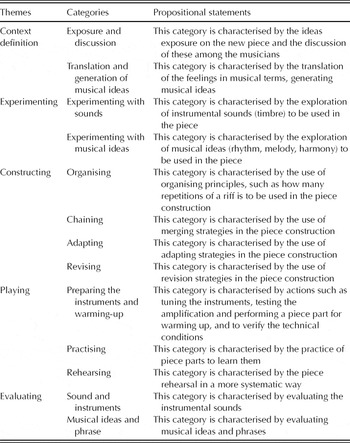
In the immersion phase, the video-recorded group composing sessions were viewed several times to acquire a high level of familiarity with the raw data and then 59 discernibly different behaviours were identified. The behaviours were labelled by the researcher in order to explain the intentions thereof. Some of these are: ‘explaining the motivation for composing the piece, ‘experimenting with melodies’, ‘experimenting with chords’, ‘adapting a rhythm to the melody’, ‘chaining phrases’, ‘tuning the instruments’, ‘warming-up’, ‘playing the refrain’, ‘playing the melody without drum’, ‘evaluating the drum part’, ‘evaluating the melody’. In the categorisation phase, the similar behaviours were grouped and 13 categories emerged from the 59 discernibly different behaviours. The 13 categories were labelled by the researcher as: (1) Exposure and discussion; (2) Translation and generation of musical ideas; (3) Experimenting with sounds; (4) Experimenting with musical ideas; (5) Organising; (6) Chaining; (7) Adapting; (8) Revising; (9) Preparing the instruments and warming-up; (10) Practising; (11) Rehearsing; (12) Evaluating instrumental sounds; (13) Evaluating musical ideas and phrases. Further clarification is given in Table 1 with the propositional statements of the categories.
Propositional statements for the 13 behaviour categories which emerged during the inductive analysis

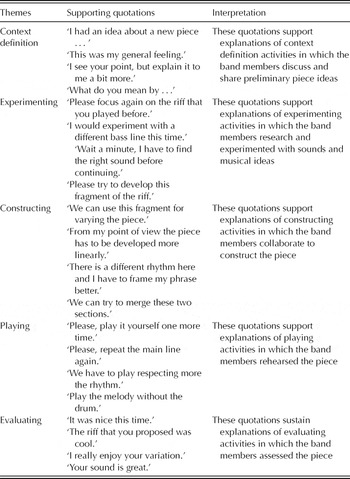
The phenomenological reduction phase is a data-reduction process and it is a central part of the analysis by which the many categories are classified into fewer themes. The phenomenological reduction phase involved grouping the categories into themes according to a rule of inclusion which was constructed through a propositional statement. Each category had to comply with the rule of inclusion. When a category did not fit into any of the existing themes so far, a new theme was created with its own rule of inclusion defined by a new propositional statement (Seddon & Biasutti, Reference SEDDON and BIASUTTI2009a, p. 401). Five themes were formed out of the 13 behaviour categories during the phenomenological reduction phase. The researcher interpreted the following five themes as group composing activities: context definition, experimenting, constructing, playing and evaluation. In the context definition phase, the band members discussed the motivation for composing the piece, and defined a general background and first form of development of musical ideas. Experimenting was defined during activities in which band members were looking for musical ideas to be used in the piece. Constructing was defined during activities in which band members collaborated to construct the piece and shaped it using several strategies such as chaining, adapting and revising. While playing, participants were rehearsing the piece in a more systematic way, with the intention of learning and practising it. Practising was defined during activities in which the band members practised piece parts to learn them, while rehearsing was defined during activities in which the band members rehearsed the piece in a more systematic way considering larger piece sections. During evaluation, participants listened to the recordings and produced focused comments and evaluations of the entire piece (or parts of it). The comments were about the instrumental sounds and about musical ideas/phrases. In the triangulation phase support for researcher interpretations of themes is sought in additional data (Seddon & Biasutti, Reference SEDDON and BIASUTTI2009c). Quotations extracted from the transcription of verbal communication between band members during the seven collaborative composing sessions were used to support the researchers’ interpretation of the themes as group composing activities. These quotations are reported in Table 2.
Triangulation phase: supporting quotations for the five themes extracted from the transcription of verbal communication between band members during the seven collaborative composing sessions

Time analysis of the video recordings
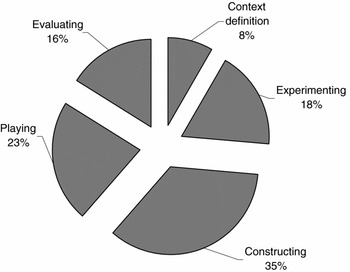
Time analysis was subsequently conducted with the aim of revealing the time percentages spent by the band members in each of the following themes: context definition, experimenting, constructing, playing and evaluation. A basic principle used in the coding procedure was that, to be coded as an observed behaviour, the behaviour must be ‘sustained’ for a period longer than five seconds (Kratus, Reference KRATUS1989, Reference KRATUS1994). The coding procedure was validated involving another researcher who independently analysed the time coding of all the videotape data. Afterwards, the two researchers checked and discussed any incongruities of their coding and/or timing. Disagreement about the original coding and timing was less than 20%, and during a process of negotiation, the researchers reached full agreement. During time analysis all the video events were classified. Results from this final time analysis representing the time percentages by the group members in all seven sessions are reported in Fig. 2.
Duration of the activities

Discussion
With regard to the first research question, the following five group composing activities emerged from an inductive analysis: context definition, experimenting, constructing, playing and evaluating. It would be interesting to discuss the relevance of similar categories in other research projects, although there is a wide variability in the research since the contexts and the participants involved were very different.
Context definition, as in the activities in which the band members discuss and share preliminary piece ideas, is not evident in previous research, probably because for individual composers it is an internal process (Sloboda, Reference SLOBODA1985). But it is an important aspect for group composing (Hewitt, Reference HEWITT2002). In this setting, context definition is the starting point and becomes a social activity rather than an internal process. Context definition is based upon sharing feelings and ideas, and translating those into the first version of a piece. In the current research, Paul presented his original aim and some ideas about the musical context of the piece. The ideas were discussed by the band members and then were translated from feelings to sound.
Experimenting is a process reported in the literature (Kratus, Reference KRATUS2001; Hewitt, Reference HEWITT2002). Discovery, orientation and exploration processes are common ways for starting a piece in open-ended tasks (Dillon, Reference DILLON2003). There is frequent reporting on experimenting also among the activities of famous rock bands such as Yes, King Crimson, Genesis (Bruford, Reference BRUFORD2009) and Doors (Densmore, Reference DENSMORE1991).
Experimenting is the process in which participants sort out ideas and solutions regarding sounds (timbre), rhythm, melody and harmony. Our bassist Paul asserted: ‘This fragment was nice and we have to try to develop it’. This statement pointed out that experimenting was generally conducted collectively and all members were helping to develop the musical fragment. In experimenting, thoughts are mediated musically, through actions and the explicit manipulation of the compositional structure, which can be performed without engaging in extended verbal reasoning (Dillon, Reference DILLON2003). Composing musicians challenge each other by taking risks. When experimenting, new elements and novel musical concepts emerge.
The constructing processes of a piece are very well documented in the literature (Kennedy, Reference KENNEDY1999, Reference KENNEDY2002; Fautley, Reference FAUTLEY2004; Hewitt, Reference HEWITT2008). Actions such as organising, merging different ideas or modifying them when it is difficult to fit them in the musical context are quite common (Fautley, Reference FAUTLEY2004). Our guitar player Phil suggested: ‘We can try to merge these two sections’ pointing out that ‘merging’ was the composing strategy to be used. In group composing, the process of revising is quite interesting (Webster, Reference WEBSTER2003). Revising a piece is a different process for composing techniques of when comparing group or an individual (Kaschub, Reference KASCHUB1997). During the group revision process, musicians challenge each other's musical ideas and frequently offer new solutions as they look to reach for a compromise. At this stage Paul asserted: ‘The melody line at this point could be different’ pointing out that revising is important for reaching the final result.
Playing during composing activities is important for practising the piece. In this case, the band's goal was not only to compose but also to learn and to practice the piece (Campbell, Reference CAMPBELL1995), as reported in the following dialogue: ‘Let's practice the refrain then’ (Paul).
The evaluation process is probably the least-considered activity in music composing research. It is an inner process in individual composing, since it is based on inner feedback (Biasutti, Reference BIASUTTI2003). During group composing, however, it becomes a social activity, activating discussions and being based on verification if the material produced so far was congruent with the piece philosophy. There could be various other factors to be evaluated, as well as related characteristics of the participants. Priest (Reference PRIEST2001) noted that highly creative students (as opposed to the other participants) were more likely to cite temporal factors as contributing to creativity. These present research quotations sustain explanations of evaluating activities in which the band members assess the piece: ‘It was nice this time, I really enjoy your variation’, ‘The riff you proposed was cool’. These statements pointed out that participants provided focused comments and evaluations of the piece.
With regards to the second research question (time use in group composing), the most relevant activities were constructing and playing. This result differs from research done on children by Fautley (Reference FAUTLEY2004), where ‘work in progress performance’ occupied about 45% of the time. These differences could be explained by the different participants and the diverse tasks proposed in the two studies. In this study, the total percentage of playing was not the largest component; probably because the band members engaged in group composing had a clear objective which was to produce a new piece. This focus on construction during group composing may have reduced the possibility for the musicians to concentrate on performance because their attention was focused on composing rather than performing. In any case, the musicians are also performers and a relevant sub-task was to rehearse the piece in order to learn and memorise it.
In the current research, the band's method of working was intuitive, and was not defined or discussed in advance. Time percentages for experimentation and revision of the piece were not set out up front since it was not predetermined how long they had to develop the experimentation phase or in revising the music piece. The band members made decisions step by step based on the group activities. There was a high level of implicit communication between them, and many details were clear without any discussion (such as the genre of piece). While working, there was an exchange of roles: Paul (the bassist) was the leader at the beginning since he proposed the primary ideas, but then the material was developed by the other members, with varied leadership. Individual ideas were tried out, received, modified, adapted and revised through a democratic process involving all the musicians. A similar process was defined by Burnard and Younker (Reference BURNARD and YOUNKER2008) as horizontal.
Conclusions
Some final suggestions for future research could and should be given, since this study presents a perspective that could be applicable towards other studies on collaborative composing and education. This study reports on the activities observed during group music composing sessions of a rock band, and shows the importance of actions such as context definition, experimenting, constructing, playing and evaluating. It would be interesting to see if similar activities emerge in group contexts in diverse musical genres and using different tools and settings. The results of this research are limited by its exploratory nature and by the fact that only one group was considered. It would be interesting to analyse more groups to verify the similarities and differences which recur in a collaborative composing context. The results could also be expanded by researching other aspects such as an aesthetic evaluation of the final product (which was not considered here because of the emphasis on the processes rather than the product). However, these results indicate that there is ground for further research development focused on the processes involved in collaborative composing across a wide range of music genres, and in comparison to the individual process. Our results reveal the creative process of music composing in a group format. These results provide a structure for developing research in comparing collaborative composing in small groups versus individual composing. One option is to evaluate if one approach is more efficient than another, and if the processes activated during collaborative composing facilitate small groups to generate more creative ideas than individuals.
The final statements are in regards to education. The importance of the development of compositional group activities in education was shown (Wiggins, Reference WIGGINS2001), and it would be interesting to develop teaching strategies that foster creativity in musical composing (Paynter, Reference PAYNTER2000; Burnard & Younker, Reference BURNARD and YOUNKER2002). The importance of approaches based on the development of cognitive processes rather than the product was shown in many disciplines, but it is generally not applied in music (Biasutti & Frezza, Reference BIASUTTI and FREZZA2009). Didactic approaches, based on the development of processes, are also important for the development of meta-cognition strategies.
The main activities showed in this research project (context definition, experimenting, constructing, playing and evaluating) could be used in defining a new method, based on the development of cognitive processes in composing music creatively within small group settings.