Cardiovascular disease (CVD) is a major cause of death and disability worldwide. In 2004, 29 percent of all global deaths and 148 disability-adjusted life-years were due to CVD (23). Furthermore, CVD consumes approximately 10 percent of the health care expenditures across the European Union (Reference Allender, Scarborough and Peto3). CVD and its consequences can, at least partially, be avoided by the adoption of a healthy lifestyle (Reference Graham, Atar and Borch-Johnsen10). Consequently, effective and cost-effective behavior change programs are needed to manage behavioral risk factors for CVD. Such programs should be theory-based and use effective behavior change techniques and an autonomy-supportive interpersonal interaction style to establish long-term behavior change (Reference Jacobs and Claes11;Reference Ryan and Deci19). Economic evaluations of these programs are crucial for the decision-making process of health resource allocation (Reference Ament and Evers4).
Cost benefit analysis (CBA) is an example of an economic evaluation that is often used as a tool to compare costs with the outcome benefits (Reference Drummond, Sculpher, Torrance, O'Brien and Stoddart9). The major issue for CBA is the evaluation of health outcomes in monetary terms. One approach to do this is that of stated preferences or willingness to pay (WTP), also known as contingent valuation (Reference Drummond, Sculpher, Torrance, O'Brien and Stoddart9). In contingent valuation, individuals are directly asked what they are willing to pay for a service or benefit (Reference Bala, Mauskopf and Wood5). Different formats can be used for WTP questionnaires. First, an open-ended format can be used in which scenarios are described and participants are free to fill in the amount of money they are willing to pay. Second, a closed-ended format in which participants are asked to give a yes or no answer to a predetermined WTP amount can be used. Third, a bidding game format in which participants are asked to give a yes or no answer to an alternate WTP question after a prior WTP question was answered can be used (Reference Bala, Mauskopf and Wood5). A disadvantage of contingent valuation is that people receive scenario's of interventions and/or benefits but do not experience these programs directly which may result in an hypothetical bias and an overestimation of the true WTP value (Reference Cookson8).
The latter bias, however, can be avoided by truly exposing people to an intervention and after they have experienced it, determining their WTP. Therefore, the WTP can be determined for different study conditions of a randomized controlled trial. To our knowledge, this method has rarely been used before. Romé et al. (2010) determined the WTP of chronically ill and sedentary adults for health improvements of physical activity on prescription (Reference Romé, Persson, Ekdahl and Gard18). Nevertheless, this study considered a single-behavior intervention whereas prior studies found multiple behavior and more intensive interventions to be more effective in promoting behavior change (Reference Krebs, Prochaska and Rossi17).
The main aim of the current study was to determine the WTP of the participants of the study conditions and intervention dose groups of a randomized controlled trial on CVD prevention including a multiple behavior change program.
METHODS
Participants and Study Design
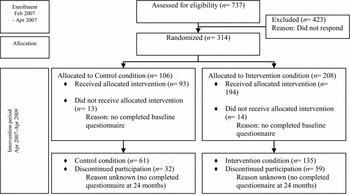
The recruitment period for the study took place from February 2007 to April 2007 (Figure 1). Requests for study participation were sent to the customers of an insurance company that insures self-employed professionals (e.g., lawyers) against loss of income due to sickness (n = 737). Eligibility criteria were subjects aged between 25 and 65 years who signed an informed consent and had Internet access.
Study flow.
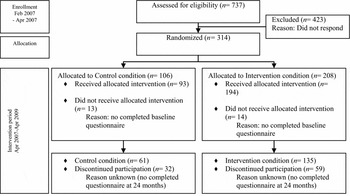
The study population at baseline consisted of 314 highly educated participants (Master's degree in Law; Reference Bala, Mauskopf and Wood5 years of studying at university level in Belgium) who were randomly allocated to a control condition and an intervention condition using a 1/3 ratio to keep enough power to study dose-response effects (Reference Claes and Jacobs6). Questionnaires were completed at baseline (April 2007) and at 6, 12, and 24 months post baseline (Reference Claes and Jacobs6;Reference Jacobs, Evers, Ament and Claes14). Two hundred eighty-seven participants completed the questionnaire at baseline. The study was approved by the Hasselt University Ethics Committee and was registered (ISRCTN23940498).
Intervention
Both study conditions consisted of CVD risk assessment, risk communication and medical follow-up. The assessment took place at Hasselt University where general practitioners determined the 10-year risk of dying from a cardiovascular event using the Systematic COronary Risk Evaluation (SCORE) algorithm (Reference Conroy, Pyorala and Fitzgerald7). The intervention condition additionally included a tailored behavior change program, consisting of a tailored Web site and individual coaching (Supplementary Figure 1, which can be viewed online at www.journals.cambridge.org/thc2011019).
The tailored Web site could be visited to gain information on risk factors for CVD and to read guidelines on behavior change and tailored advices on physical activity and fat intake (Reference Jacobs, De Bourdeaudhuij and Claes12;Reference Vandelanotte, De Bourdeaudhuij and Sallis21). The individual coaching was given by a health psychologist, and the dose and delivery mode (e-mail, regular mail, telephone and/or face-to-face) of it were self-selected by the participants during the first intervention year (Reference Jacobs, De Bourdeaudhuij and Claes12). During the second intervention year, the individual coaching was adapted because people administered themselves an insufficient intervention dose. Therefore, the dose of the individual coaching became fixed and the number of delivery modes limited (i.e. ten messages delivered through e-mail or regular mail). The techniques of the individual coaching targeted determinants of behavior derived from theories such as the Theory of Planned Behaviour (TPB) and Self-Determination Theory (SDT) (Reference Ajzen, Kuhl and Beckmann2;Reference Ryan and Deci19). These determinants included, amongst others, knowledge, skills, self-efficacy and motivation. The tailored behavior change program was autonomy-supportive to increase motivation and behavioral engagement on the long-term (Reference Ryan and Deci19).
Measures
The participants were categorized according to their CVD risk: they had a low, medium, or high risk of dying from CVD in the next 10 years (Reference Conroy, Pyorala and Fitzgerald7). Twenty-four months after baseline, the participants completed a questionnaire that additionally contained questions about perceived autonomy support (PAS) and WTP questions. The WTP questions were: (i) a take-it-or-leave-it-question (TOL question) and (ii) closed-ended format questions dependent on the TOL answer (Reference van Helvoort-Postulart, Dirksen and Kessels20). The TOL question was “Are you willing to pay €90 per year for the program you received?”. The received program the participant had access to was summarized before this question was asked. The closed-ended format question was dependent on the TOL answer. In case people were willing to pay €90, they were asked to choose between predetermined maximum WTP options of €182, €336, €568, or €726 per year. In case people were not willing to pay €90, they were asked to choose between predetermined maximum WTP options of €0, €11, €23, or €45 per year. WTP amounts on the payment cards were presented in Euros and inspired by a previous WTP study related to CVD prevention (Reference van Helvoort-Postulart, Dirksen and Kessels20). However, two figures (€336 and €568) were adapted to represent the average annual subscription fees at respectively simple and more exclusive (e.g., including a personal coach) fitness centers in Belgium. Participants were also asked for reasons of their WTP decision. In case people were willing to pay, an open-ended format was used. In case people were not willing to pay, a closed-ended format was used with the following options: (i) Out of principle; (ii) Insufficient support of the program; (iii) Not the right support for me. For the assessment of PAS, the Dutch version of the short 6-item form of the Health Care Climate Questionnaire (HCCQ) was used (Reference Williams, Grow and Freedman22).
Data Analyses
Mean and median WTP were determined for both study conditions. Pearson Chi-Square and student's t tests were used for the drop-out analysis (gender, age, study condition, body mass index, smoking status, and CVD risk). Pearson Chi-Square tests were used to assess the relation between WTP and CVD risk groups. This was done by transforming WTP results in two groups: those wanting to pay less than €90 and those wanting to pay €90 or more.
Pearson Chi-Square tests, Student's t-tests, and one-way ANOVAs were used to compare study conditions and different intervention dose groups within the intervention condition. These intervention dose groups were created post hoc, using the 50th and 75th percentile of the total duration of individual coaching. This resulted in a low, a medium, and a high intervention dose group, respectively. Pearson correlations were used to test the relation between continuous measures of WTP, intervention dose, and PAS. SPSS 15.0 for Windows was used and the significance level was set at α = .05.
RESULTS
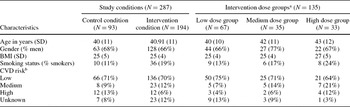
Twenty-four months after baseline, a total of 196 participants (134 male, 62 female) and a mean age of 41 years (SD = 11) completed the questionnaires of whom 61 were in the control condition and 135 were in the intervention condition. The drop-out analysis showed that there were no differences with regard to gender, age, study condition, BMI, smoking status, and CVD risk. Table 1 shows the baseline characteristics of the participants that completed the questionnaire at baseline for both study conditions and the intervention dose groups. For the intervention dose groups, there were baseline differences for BMI with BMI being significantly higher in the high dose group compared to the low and medium dose groups (p < .05).
Baseline Characteristics of the Study Sample and the Intervention Dose Groups
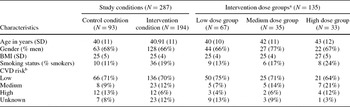
a Mean intervention duration for low dose 325 minutes, medium dose 472 minutes, and high dose 903 minutes.
b CVD risk = 10-year risk of dying from a cardiovascular event using SCORE (7).
BMI, body mass index; CVD, cardiovascular disease.
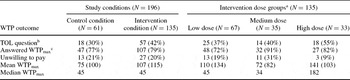
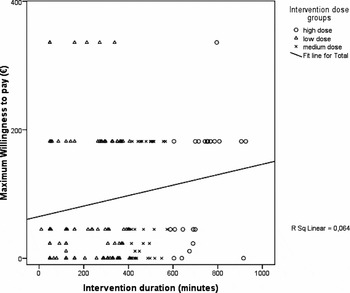
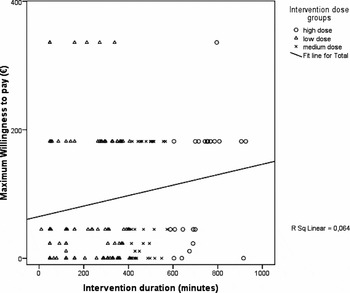
The take-it-or-leave-it question (TOL question), namely to pay €90 for the received program, was answered positively by eighteen participants (30 percent) of the control condition and fifty-seven participants (42 percent) of the intervention condition (Table 2). However, this difference was not significant (χ2(1) = 2,88; p = .06). For the different intervention dose groups, the answers on the TOL question were not statistically different either (Table 2). For the different CVD risk groups, no differences for the TOL question were found (χ2(2) = 1.06; p = .59). Of the participants that answered the TOL question, 154 also answered the Maximum WTP question (WTPmax). The mean and median WTPmax values can be found in Table 2. No differences were found between the study conditions for WTPmax. However, the WTPmax was significantly different for the high versus the medium/low dose groups (F = 3.09; df(2); p = .04) (Figure 2). Participants with a high intervention dose were willing to pay more for the behavior change program. In accordance, a strong correlation was found between the continuous measure of the intervention dose and maximum WTP (r = 0.25; p = .01). The low intervention dose group (n = 67) had a mean intervention duration of 325 minutes and a median WTP of €45. The medium intervention dose group (n = 35) had a mean intervention duration of 472 minutes and a median WTP of €34. The high intervention dose group (n = 33) had a mean intervention duration of 903 minutes and a median WTP of €182. Seventy participants mentioned a reason why they did not want to pay: out of principle (66 percent); the program didn't give enough support (14 percent); the program did not give the right support (20 percent).
WTP Outcomes for Different Study Conditions and Intervention Dose Groups
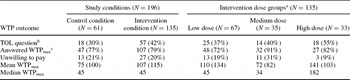
a Mean intervention duration for low dose 325 minutes, medium dose 472 minutes, and high dose 903 minutes.
b Number of participants (%) that positively answered the take-it-or-leave-it question (pay €90 for the received program).
c Number of participants (%) that answered the maximum WTP question.
WTP, willingness to pay; TOL, take-it-or-leave-it question.
Intervention dose* and maximum WTP for each participant in the intervention condition. *Mean intervention duration for low dose 325 minutes, medium dose 472 minutes, and high dose 903 minutes.
A significant, positive relation was found between continuous measures of PAS and WTP (r = 0.29; p < .001). People with a higher perceived autonomy support were willing to pay more for the behavior change program.
DISCUSSION
There were no WTP differences between both study conditions. This means that people want to pay the same amount of money for a CVD prevention program, irrespective of the availability of a tailored behavior change program. However, the self-selected intervention dose of the latter program was positively associated with WTP. There were no differences between the CVD risk groups. Furthermore, a relation between WTP and PAS was found.
The mean maximum WTP in the control condition was €75 per year, and this was €107 per year for participants in the intervention condition. Our WTP values were lower than those found in the study of Romé et al. (2010) (Reference Romé, Persson, Ekdahl and Gard18). In that study, the mean WTP for improved health by exercise for 4 months was €45 in the control condition and €64 in the intervention condition. This is surprising because people with a higher education and income, as included in our study, are believed to have a higher WTP than the lower educated (Reference Johnson, Manjunath and Mansfield15). A possible explanation for this result may be the difference in the WTP questionnaire at item level. Romé et al. (2010) asked participants what they were willing to pay for the health benefits of the program (long-term health improvements), and in the present study the participants were asked what they were willing to pay for the program itself. In the present study, the question potentially captured three elements: the health benefits of the program, the disutility of the program itself; and the subjective perception of the program's effectiveness in terms of health. Furthermore, the study of Romé et al. (2010) included a patient sample, whereas our study included a sample of overall healthy adults (i.e., 70 percent had a low CVD risk).
In a previous study, WTP and perceived risk were found to be positively related (Reference Johnson, Manjunath and Mansfield15). In a WTP study of Johnson et al. (2006) wherein scenario's of Diabetes Prevention Programs were used, the participants with a low perceived risk of diabetes wanted to pay €33 per year, and those with a high risk wanted to pay €1,080 per year (Reference Johnson, Manjunath and Mansfield15). Our findings do not corroborate these results because no association between WTP and CVD risk groups was found. Adler et al. (2006) determined the WTP of a representative sample of primary care patients (Reference Adler1). Of those participants with Internet access, 60 percent were willing to pay $10 or more per year and 31 percent were willing to pay $50 or more per year for a primary care Web-portal (e.g., with e-mail possibilities with their physician). In the latter study, the participants did experience the intervention in contrast to that of Johnson et al. (2006).
In the present study, no WTP differences between the study conditions were found. This is in line with the findings of Romé et al. (2010). Reasons for this lack of difference may be the small sample size and the presence of risk assessment and communication in both conditions. In previous a study, a nurse practitioner determining CVD risk in both the control and intervention condition of a randomized controlled trial nullified the intervention effect (Reference Koelewijn-van Loon, van der Weijden and Ronda16). Consequently, risk assessment may not only influence the effect of the intervention but also the participants’ WTP.
The behavior change program of this study was based on SDT, a theory that recommends to design interventions as autonomy-supportive contexts with choice possibilities (Reference Jacobs and Claes11;Reference Ryan and Deci19). This can influence the participants to become intrinsically motivated for behavior change. Participants could choose their own intervention dose and delivery mode of the coaching during the first intervention year. This self-selected intervention dose led some participants to underuse the program but was found to be significantly related to the program's effectiveness (Reference Jacobs, De Bourdeaudhuij and Thijs13). The present study emphasizes the importance of the intervention dose and showed that the dose that participants received is associated with their WTP.
The strengths of the present study were that participants actually experienced the program and no scenarios were used; the long duration of the program; the use of a randomized controlled trial and the inclusion of a tailored behavior change program using modern technologies. Weaknesses of the study were the small sample size and the fact that the sample only included highly educated adults limits the generalizability of the results.
Nevertheless, to our knowledge, the present study is the first that examined the WTP for a CVD program including a multiple behavior change program. The findings from the present study give policy makers an idea about the WTP of highly educated adults for health promotion programs. It also indicates how much money a sponsor organization can recover from the program's participants. For the present intervention, the mean yearly costs per participant, determined for the first intervention year, equaled €136 and €568 for the control and intervention condition, respectively (Reference Jacobs, Evers, Ament and Claes14). Thus, participants of the control and intervention condition would be willing to pay 55 percent and 19 percent of the actual program costs, respectively. This information is valuable for the development and implementation of future health promotion interventions, certainly for their feasibility at societal level. Future CBA studies could be performed to calculate the net benefit of health promotion programs to aid the decision-making process even further.
CONCLUSIONS
Cardiovascular disease (CVD) is a major cause of death and disability worldwide. The objective of the present study was to determine highly educated adults’ Willingness To Pay (WTP) for CardioVascular Disease (CVD) intervention programs of different intensities. Two study conditions were compared to each other: (i) CVD risk assessment/communication; (ii) CVD risk assessment/communication + a tailored behavior change program. One can conclude from the present study that, in general, people are willing to pay the same amount of money, whether a tailored behavior change program is additionally offered or not. Nevertheless, the people that deliberately exposed themselves more to the program's components wanted to pay significantly more than those who used a low program dose.
CONTACT INFORMATION
Nele Jacobs, MSc (nele.jacobs@uhasselt.be), Faculty of Medicine, Hasselt University, Agoralaan Building D, 3590 Diepenbeek, Belgium
Rubin Drost, MSc (rmwa.drost@student.maastrichuniversity.nl), Andre Ament, MSc, PhD (A.Ament@BEOZ.unimaas.nl), Silvia Evers, MSc, PhD (S.Evers@BEOZ.unimaas.nl), Associate Professor, Department of Health Organization Policy and Economics, Maastricht University, P.O. Box 616, 6200 MD Maastricht, The Netherlands
Neree Claes, MD, PhD (neree.claes@uhasselt.be), Associate Professor, Faculty of Medicine, Hasselt University, Agoralaan Building D, 3590 Diepenbeek, Belgium
CONFLICT OF INTEREST
Nele Jacobs and Neree Claes report their institute has received financial support from Chair ‘Dederlinge Ziekenkas–Prevention’ for this work. The other authors have no potential conflicts of interest.