INTRODUCTION
The marine resources of Asia-Pacific's Coral Triangle region are globally recognized for their exceptional biodiversity, and their importance for the food and livelihoods of millions of people (Coral Triangle Initiative Secretariat 2009). As part of efforts to redress resource declines in the region, non-government organizations (NGOs) and government agencies seek solutions that balance immediate needs to harvest resources with conservation or longer-term sustainability agendas. In finding these solutions, it is now well recognized that those who are affected by management should be involved in making management decisions (Mascia Reference Mascia2003; Berkes Reference Berkes2009). Particularly in developing country contexts, co-management emerges as a mainstream way forward (Evans et al. Reference Evans, Cherrett and Pemsl2011; Cinner et al. Reference Cinner, McClanahan, MacNeil, Graham, Daw, Mukminin, Feary, Rabearisoa, Wamukota, Jiddawi, Campbell, Baird, Januchowski-Hartley, Hamed, Lahari, Morove and Kuange2012 b). In co-management for fisheries and conservation, responsibilities and authority are shared between a resource-user group (for example, local fishers) and partner (such as a government agency or NGO) (Pomeroy & Berkes Reference Pomeroy and Berkes1997; Evans et al. Reference Evans, Cherrett and Pemsl2011). In practice, co-management arrangements vary according to the degree of authority and influence the resource users and partners have over management (Sen & Nielssen Reference Sen and Nielsen1996). We focus on the ‘collaborative, community-based’ end of the co-management spectrum (Pomeroy Reference Pomeroy1995), which many initiatives within the Coral Triangle aspire towards.
Coastal communities throughout the Coral Triangle region have developed customary institutions that influence the way marine resources are used and governed. In areas that fall under customary ownership for example, particular clans or families can implement restrictions on when and how resources within those areas are accessed, used and distributed, and by whom (Johannes Reference Johannes1982; Thorburn Reference Thorburn2000; Colding & Folke Reference Colding and Folke2001). While conservation and sustainability are not necessarily the explicit intent of these customary institutions (Zerner Reference Zerner1994; Pannell Reference Pannell1997; Foale et al. Reference Foale, Cohen, Januchowski-Hartley, Wenger and Macintyre2011), they perform functions analogous to contemporary environmental management measures (Colding & Folke Reference Colding and Folke2001; Cinner & Aswani Reference Cinner and Aswani2007). However, to improve conservation or sustainability outcomes in contemporary contexts, where pressures on resources are more diverse and intense, scholars argue that the application and intent of customary institutions will need to evolve to incorporate scientific information, modern management principles, and potentially, enforcement support (Cinner & Aswani Reference Cinner and Aswani2007; Foale et al. Reference Foale, Cohen, Januchowski-Hartley, Wenger and Macintyre2011). It is held by many (but see Davis & Ruddle Reference Davis and Ruddle2012) that co-management may provide this avenue, where local objectives, knowledge and institutions are a foundation, where partner agencies provide management advice, and where responsibility for recognizing and enforcing local and state regulations is shared. In practice, a hybrid between local (customary) and science-based management and conservation practice is often sought (Aswani & Ruddle Reference Aswani and Ruddle2013). However, the extent and nature of customary influences and contemporary conservation influences can be difficult to disentangle from participatory processes and hard to discern in many reported cases of co-management (see for example Jupiter et al. Reference Jupiter, Weeks, Jenkins, Egli and Cakacaka2012; Cohen et al. Reference Cohen, Cinner and Foale2013).
In Solomon Islands, coastal ecosystems are governed by the state through environment and fisheries legislation, and also via customary tenure and governance systems that are recognized in the national constitution (Lane Reference Lane2006). In recognition of customary rights and the limited capacity of central government to effectively manage marine resources and achieve conservation outcomes in rural locations, national government policies support co-management as a principle fisheries and conservation strategy (Solomon Islands Government 2009). In response to concerns over resource sustainability and biodiversity loss, a multitude of communities and partner agencies have established over 100 co-managed marine areas that integrate elements of local and customary governance (Govan Reference Govan2009). Similarly, in Indonesia, centralized management is challenged to meet conservation and management objectives (United Nations Environment Programme-World Conservation Monitoring Centre 2008), and, in 1999, there was a shift towards decentralized governance that was subsequently supported by legislative amendments (Lindsey Reference Lindsey2008). Nearshore marine areas are considered common property under national legislation (Cribb & Ford Reference Cribb, Ford, Cribb and Ford2009), but coastal communities can claim traditional tenure rights under local resource management legislation. Coastal communities in some parts of eastern Indonesia still recognize and practice sasi, namely sets of rules applying to resources under control of a specific social group (Harkes & Novaczek Reference Harkes, Novaczek, Persoon, van Est and Sajise2003). In Indonesia, conservation programmes increasingly employ co-management regimes to build environmental stewardship within these customary and local governance systems (Phillips Reference Phillips2003).
Marine closures, in particular permanent marine reserves, tend to dominate the discourse, and debates, on conservation solutions within the Coral Triangle region (Foale et al. Reference Foale, Adhuri, Aliño, Allison, Andrew, Cohen, Evans, Fabinyi, Fidelman, Gregory, Stacey, Tanzer and Weeratunge2013). Marine closures in a range of forms are commonly reported in both historical and contemporary accounts of management in Solomon Islands and Indonesia. For example, in eastern Indonesia marine closures can be applied to particular resources (for example, sasi-lola for trochus (Trochus niloticus) or sasi-teripang for sea cucumber), or applied more broadly and labelled according to the governing institution (for example, sasi-gereja church or sasi-adat custom) (Adhuri Reference Adhuri2013). Historically, marine closures were often temporary and allowed control over use and access to resources for social, economic and cultural objectives (Zerner Reference Zerner1994; Ruttan Reference Ruttan1998; Foale et al. Reference Foale, Cohen, Januchowski-Hartley, Wenger and Macintyre2011), for example to mark the death of a prominent community member, protect sacred sites, affirm rights and control access to fishing grounds, or to stock pile resources prior to harvests for feasts or trading (Hviding Reference Hviding1998; Thorburn Reference Thorburn2000). In contemporary efforts to address sustainability and conservation, area closures emerge as a prominent feature of many co-management initiatives (Cohen & Foale Reference Cohen and Foale2013). For example, periodically-harvested closures (PHCs), and less commonly permanent closures, are employed within most co-managed areas in Solomon Islands (Govan Reference Govan2009). PHCs are often simply described in conservation literature as ‘customary closures’ or ‘hybrids’ between local (customary) practice and contemporary management and conservation practice (see for example Bartlett et al. Reference Bartlett, Pakoa and Manua2009; Feary et al. Reference Feary, Cinner, Graham and Januchowski-Hartley2011; Jupiter et al. Reference Jupiter, Weeks, Jenkins, Egli and Cakacaka2012). While critical appraisals have suggested that customary institutions were not historically intended for conservation or to enhance sustainability, environmental initiatives often seek to adapt them into tools able to meet conservation objectives or deliver improvements to sustainability in contemporary, competitive resource-use contexts. There have, to date, been few studies that critically appraise contemporary formation and form of conservation and management measures (such as PHCs) employed via co-management, or that describe the process and nature of such hybridization in practice. With these understandings lacking, the duplication of approaches and measures that have achieved social and economic successes is made all the more difficult.
In this paper, our objective is to describe the fusion of customary practices, with ideas and practices associated with environmental management interventions implemented via co-management. To do so, we analyse local management practices, and, more specifically, examine the design and use of area closures in four case study communities across two Coral Triangle countries; namely Solomon Islands and Indonesia. We present accounts of the customary practices that related to resource use before engagement with environmental management initiatives; we then use these accounts to describe how environmental management initiatives have been influential on management arrangements and resource-use patterns. We explore implications for three aspects that are commonly held as key to the success of co-management: firstly, we describe the governance arrangements, secondly, we explore how the new forms of management might be contributing towards conservation and sustainability objectives, and, finally, we examine social outcomes in terms of the distribution of management and resource-use costs and benefits amongst different social groups.
METHODS
Study sites
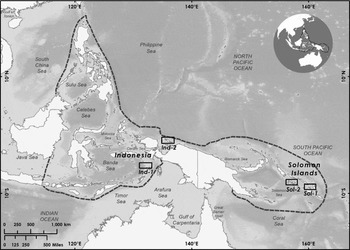
We conducted case studies in two communities in each of Solomon Islands and eastern Indonesia (Fig. 1). We selected communities primarily because they had co-management arrangements for marine resources; arrangements that had resulted from environmental management initiatives facilitated by external partners. Co-management partners were NGOs or research organizations (henceforth referred to as ‘partner agencies’), with some involvement from government. Community names are not provided because of confidentiality arrangements.
Map of the Coral Triangle region (demarcated by the dashed line). Research locations are indicated for eastern Indonesia (Ind-1 and Ind-2) and Solomon Islands (Sol-1 and Sol-2).

Qualitative data collection
We collected data during 2010 and 2011, employing a mixed methods ethnographic research approach over three month periods in each of the Solomon Island communities (Sol-1 and Sol-2) and over 12 months cumulatively in the eastern Indonesian communities (Ind-1 and Ind-2). All communities were small, remote coastal communities of less than 125 households that demonstrated high dependence on marine resources (that is fishing was the first or second most prevalent or important livelihood, alongside small-scale agriculture). We conducted unstructured interviews with staff from partner agencies that supported co-management at each of the four case study sites. We asked them to explain the objectives of their engagement, the nature of their role and timing of input, and their understanding of local contextual influences on governance and management arrangements. We also reviewed written management plans to allow comparison of ‘rules-on-paper’ to ‘rules-in-use’. At research locations, methods included semi-structured interviews (Solomon Islands n = 78, Indonesia n = 104) and focus group discussions (Solomon Islands n = 20, Indonesia n = 15); we aimed to interview 10–20 % of the fishing population. Interviewees were selected by stratified random sampling (Indonesia) and snowball sampling (Solomon Islands) from the pool of people who resided locally, were known to regularly participate in fishing activities, and were willing and able to be interviewed. We interviewed men, women or youth separately and sought respondents across different social groups (such as clans or religions). Focus groups were comprised of three to six men, women or youth (separately), and participants were those who responded to an invitation open to those residing within the community. Most focus group discussants were involved in fishing. Unstructured methods involved participant observations and key informant interviews with village elders, leaders and management committee members.
There were two sets of interview and focus group questions; firstly to enquire about broader resource management and governance arrangements before and after the environmental management initiative, and secondly to understand changes specific to periodically-harvested closures. The former set asked: why people managed resources; how resources were managed (such as controls placed on harvesting, enforcement and sanctioning); the areas or resources to which management applied; and how historical customary practices varied from recent management practices. In terms of the periodically-harvested closures, respondents described both historical and contemporary closures; where closures applied, and for what objective; who had rights to access (for example, arrangements of exclusivity); who held responsibility over harvesting (private versus communal rights); how harvests were managed (rules and controls); and how rules were enforced (for example, whether there were sanctions for non-compliance). Interviews were conducted in Solomon Islands pijin and Bahasa Indonesia.
RESULTS
Fishing taboos in rural coastal communities of Solomon Islands
The environmental management initiatives in both communities were supported by partner agencies who had no formal governing authority, nonetheless some respondents perceived that the partner agency had some authority in implementing and enforcing management. The partner agencies’ role focused on consultations with communities to raise awareness about conservation and sustainability concerns, and to encourage the formation of management committees, resource-use controls, and compliance, enforcement and monitoring strategies. Responsibilities and authority to govern were implicitly shared between community and government; people who held tenure had rights to manage their resources, and all community members were concurrently (officially) obliged to uphold national regulations. Yet, legal instruments to explicitly and formally share management responsibilities were still being developed by the government.
Community consultations ultimately led to the formation and commitment (in Sol-1 in 2005, and in Sol-2 in 2008) to ongoing, but adaptive, arrangements that were detailed in written management plans. The area to which these arrangements applied was based on the tenure of clans within that community, but did not include all areas to which they held rights. Management plans included a suite of resource-use control measures that applied to anyone fishing in the managed waters; measures included size limits for some species, time restrictions for certain methods, method and gear restrictions, and areas designated as closed to fishing. We observed that a more limited set of measures were actually practised (Cohen et al. Reference Cohen, Cinner and Foale2013). An additional resource-use control, namely a ban on fishing on Sundays in Sol-2, was a norm established by the Church, but was not captured by the management plan.
Management arrangements in both communities included the establishment of PHCs over areas of reef (each less than 0.7 km2); these were referred to locally as taboos, reserves or MPAs (marine protected areas). During periods of closure all extractive activities were banned. There was one PHC in Sol-1 and two in Sol-2, as well as a third closure that had initially been established as a PHC but since implementation had remained closed indefinitely. The locations of closures were selected by communities because ownership was not contested, they were in line of sight for easy surveillance, and they were considered to be important fishing grounds where resources had been depleted and where communities were interested in seeing resource increases.
Respondents reported that prior to the intervention of the partner agency, temporary spatial closures had been employed in both communities. In Sol-1, reef closures or sanda were declared by reef owners most commonly to replenish and limit access to trochus stocks. The nature of the closure (whether it applied to trochus or all resources), its duration, the timing of opening and permission to participate in harvesting were decided by the reef owning clan. The areas could either be closed again immediately or remain open for some time at the discretion of the reef owner. A few respondents mentioned that sanda had also been used as a mark of respect in the case of a death. In contrast, in Sol-2, respondents commonly spoke of jiru, a closure of 100 days or a full year that was declared as a mark of respect for the death of a prominent community member. After the period of closure the jiru reef would be harvested to provide fish for a commemoratory feast. That reef would remain open unless it was selected again for closure in response to a further event. In contrast to Sol-1, it was only rarely mentioned that jiru had been invoked to stockpile resources for tribe-specific or community-wide economic needs.
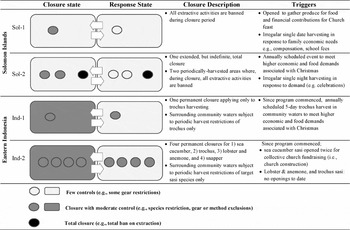
Since co-management had been established, all three PHCs had been opened numerous times, and during the previous 12 months they had been opened in response to requests from community, clan or family members to meet short term economic and social needs (Fig. 2). The PHC in Sol-1 was opened so the reef owner could harvest fish and raise money for his contribution to a community-wide feast celebrating the completion of building the church. The opening was not publicly announced, as access to the fishing ground was limited to the reef owner's family. In Sol-2, the month-long opening of the two PHCs was an annual event scheduled each December to allow communities to prepare for Christmas and save funds for school fees in the subsequent year. The opening was announced in the church, and a reminder of the harvesting rules was given in a short opening-day service. Other, shorter and unannounced openings had occurred throughout the year in both communities to collect fish for birthday or wedding celebrations, to raise money for school fees, and, in the case of Sol-1, to compensate for misdemeanours of the reef-owning family. To help determine management success, or the need to adapt management, partner agencies had supported both communities to conduct underwater counts of trochus and sea cucumber. However, there was no evidence that these data had been used to guide decisions about the timing of openings, quantities harvested or duration of harvests. Decisions to harvest were largely based on social reasonings rather than environmental management or conservation rationale, or the management plan in place.
Schematic of marine resource management measures applied to small areas (indicated by the embedded circles) and in broader territorial waters (indicated by the box) of the four case study sites. Observations of periodically-harvested closure management are summarized in the ‘closure description’, and events that resulted in a change to the closure state (the response state) are summarized in ‘triggers’.

When recounting both historical and contemporary closures, respondents described three broad types. The first, referred to as kastom (customary) taboo, or sanda in Sol-1 and jiru in Sol-2, were closures declared by reef owners and were typically demarcated by a stick with a coconut frond wrapped around it. The sanction for non-compliance was a ceremonial payment of food or shell money to the reef owners. The second type of closure or lotu (church) taboo was declared by reef owners and blessed and/or declared by a church representative. Church closures were demarcated with a cross made of sticks, or if on land, by a sign with reference to the bible. It was believed that bad fortune would befall those who broke the closure. Thirdly, closures referred to as taboo, reserve or MPA were those established by the reef owner(s) in consultation between a partner agency and/or the broader community. Sanctions, in the form of a warning or a monetary fine were determined in consultative processes and described in management plans. Respondents perceived these three types of closures to be distinct, but not mutually exclusive. For example, a reef manager from a community adjacent to Sol-1 mentioned that to improve compliance he might also place a kastom taboo over his ‘MPA’. When asked whether he would consider also applying a church taboo he said ‘No, I don't want to do that because [my community] is mostly family and I don't want to curse them if they break it’.
In Sol-1, anyone wishing to fish in the opened PHC required permission from the reef owner, whereas, in Sol-2, once the PHC was officially opened any member of the community could harvest there without seeking permission. The reef owners were responsible for both sanctioning and declaring areas opened or closed. In Sol-2, the reef-owning clan had delegated these responsibilities to two non-clan members as the ‘resource management team’. These delegates reported that it was ‘very hard to say no to a custom request’ (namely a request from a member of the reef-owning clan) to open and harvest the reef during periods of intended closure. Further, they reported they had only issued warnings because offenders resisted further sanctions, and, in some cases, asserted their clan-based rights to harvest that reef. Some respondents felt that because the resource management team were not from the reef-owning clan, they lacked the respect needed for stronger enforcement. Nonetheless, it was commonly perceived that compliance with closures in Sol-2 was high.
In both Solomon Island cases, those who had primary rights over the PHCs benefited more from harvesting compared to others in the community. In Sol-1, the direct benefits from harvesting the closure accrued mainly to the chief and his family. Respondents indicated that all fishers in adjacent communities could access that reef area in Sol-1 prior to the implementation of the closure in 2005; subsequently they continued to fish in other locations. The two closures in Sol-2 were accessible to all fishers in the community throughout the 31 days of the annual opening. However, all trochus harvested in the first two days became the property of the reef-owning clan regardless of who harvested them. Subsequent to those first two days, any trochus harvested could be kept and sold by the fisher no matter which clan he or she was from.
Applying sasi in management practices in island communities of eastern Indonesia
In each community resource management initiatives were locally coordinated by an elected team. Decision-making and enforcement authority rested with all three governing institutions within the community, namely the council of religious leaders, traditional council and village government. The partner agency provided technical training and funding (for example, for mapping and monitoring), issued advice about management and conservation practices, and facilitated links to local government for enforcement support. In consultation with the partner agency, both communities developed harvesting controls (such as net mesh size limits, trochus size restrictions and ban on destructive gears) focused on resources perceived to be in decline. In Ind-1, arrangements included designation of a small (> 0.04 km2) no-take area for trochus. In Ind-2, four resource-specific no-take areas (each less than 0.05 km2) were established; two to protect known spawning sites of snapper and sea cucumber, and two on heavily-fished sections of reef to facilitate resource and habitat replenishment (Fig. 2). Additionally, both communities implemented community-wide species-specific sasi closures that were to be lifted only for communal needs. Rules were formalized into written regulations that prescribed penalties and defined the territories under management, and were submitted to the local government for approval. There were additional restrictions within the community (such as fishing banned in sacred sites) or family belief systems (such as bans on consumption of certain species) that pre-dated the new environmental management arrangements and, while these were not written into regulations, they were still adhered to.
We found there was a strong historical tradition of closures under sasi in both eastern Indonesian cases, however their application and governance broadly differed. In Ind-1, respondents reported that, prior to involvement of the partner agency, designation of temporary closures (namely on sections of reef around an adjacent uninhabited island) were triggered primarily by social events such as the death of an esteemed community member, or to conserve resources for trade (for example, a half-year ban on harvesting economically valuable trochus within all the community's coastal waters). Community elders and traditional leaders decided where and for how long closures should occur. Harvest success was perceived to be determined by spirits and where success or failure of a harvest reflected the community's moral integrity. Consequently, social conflict or misbehaviour in the community was perceived as a bad omen for harvests. These beliefs still persisted, particularly amongst the elderly. However, respondents also recognized human impacts of overfishing and destructive fishing. This awareness was attributable to people's past experiences with cyanide and dynamite fishing, and the conservation discourse of the partner agency; as evident in respondents’ paraphrasing of technical language: ‘people fished more than the sustainable yield, so there were not enough fish to breed again’. In Ind-2, the church council had played a significant role in coordinating sasi closures, mainly to save for collective income objectives (such as church construction or religious celebrations), but in some cases also to provide for family-focused social events like funerals or weddings. Following closures, collective harvesting would ensue, often with the sale of the yield assured through a pre-agreed arrangement with a trading middleman.
Since involvement of the partner agency in Ind-1 (the last four years), the no-take areas had remained closed to harvesting. The surrounding communal waters under sasi closure had been opened for about five days on four occasions (once a year since 2006) coinciding with the Christmas period, when there was an elevated need for cash (Fig. 2). Collaboration with the partner agency had led to a change in the trochus harvesting regime; as a community coordinator noted: ‘before we opened reefs for trochus harvest for half of the year, but now only five days a year’. Prior to these five-day sasi openings, certain people assisted in collective copra production to raise communal funds for Christmas celebrations. Participation in copra production reserved them exclusive rights to harvest trochus for the first two days of sasi opening (exceptions were made for certain community members based on their social standing), after which time harvesting was opened to the whole community for the remaining three days.
In Ind-2, the sasi closure had been implemented with partner agency support for six years, during which time openings had occurred on a more spontaneous, response-to-demand basis. In 2010, two sasi openings for sea cucumber occurred based on agreements (stipulating price and harvest quantity) with middlemen. Prior to involvement of the partner agency, sea cucumber harvests under similar agreements with middlemen were reportedly more frequent and often included harvests of lobster, anemone fish and oysters, which now fell under sasi closure due to concerns about resource decline. So, in comparison, the 2010 harvests were more tightly restricted, targeting only sea cucumber within clearly defined temporal limits. Peoples’ strong social accountability towards the church meant there was high participation from the community, and there were no rules stipulating privileged harvesting rights of some people over others. All revenue from these two harvests contributed towards the construction of communal infrastructure or other church activities.
In both communities, the conservation teams, with partner agency support, conducted quarterly resource and habitat monitoring; this influenced harvesting in several ways. Data were plotted on graphs, displayed on community noticeboards, and explained in communal meetings to guide discussions about whether an opening event was feasible. In Ind-1, results showed where there were high trochus densities within a particular part of the no-take area and this led fishers to target that particular area during the harvest. In Ind-2, the church council, conservation team and partner agency reached a consensus that data indicated sufficient growth of the sea cucumber population within the permanent no-take area to assume that there would be spill-over into surrounding areas, and this was used to justify harvesting the sasi closure twice in 2010. However, once decisions to harvest were made, harvests (specifically yields) were influenced by community needs or agreements with middlemen, without further reference to results from monitoring.
Historical accounts of sanctions for sasi violation varied from payments of brass tallies and offerings, public humiliations, or even physical beatings depending on the severity of the infringement. Since partner agency engagements, new legislative tools (such as government-backed regulations) had been formulated to support communities to address local violations. The institutions with most authority in each community (the traditional councils in Ind-1 and the church in Ind-2) could use these to facilitate sanctioning via monetary fines. On two occasions in Ind-1, we observed ‘outsiders’ apprehended for illegal fishing. In one case, fishers were brought in front of the community council where sanctions were negotiated using the regulations as a main point of reference. Although a smaller fine than defined in the regulations was applied, the regulations functioned as a negotiation tool, primarily because no individual could be identified as the prosecutor; as one leader noted ‘we simply followed our village regulations’. Moreover, the public act of agreeing upon a lower sanction reflected mercy and goodwill, which respondents reported was important to maintain good intercommunity relations; ‘we agreed that [the prosecuted fishers] did not have to pay the full sanction because they are our ‘neighbours’ and friends’ While community sanctions had been successfully applied in Ind-1, no sanctions had been applied in Ind-2 despite offences occurring.
DISCUSSION
In examining contemporary co-management in the Coral Triangle, we found that management arrangements, including a suite of resource-use rules, displayed some similarities, but also some distinct differences to historical cultural practices. Here we discuss the factors and processes that we found to be influential on management in practice. We then critically examine the implications of our findings about management-in-practice for achieving conservation and sustainability objectives. We also discuss our findings about local governance arrangements, given that these will be critical to realising sustainability and conservation objectives, and social outcomes. Finally, we discuss social outcomes in terms of the distribution of management costs and benefits amongst different sectors of society.
Co-management in practice
The co-management arrangements we observed, including PHCs, have emerged and evolved amongst persistent but changing economic, political, religious and traditional contexts, alongside the relatively recent influence of the environmental management initiatives. Intensifying demand for resources has led to changes in management practices, for example by modifying the use of closures and strengthening the exclusivity of tenure claims (Carrier Reference Carrier, McCay and Acheson1987; Ruddle Reference Ruddle1994; Zerner Reference Zerner1994; Ruttan Reference Ruttan1998). In eastern Indonesia periodic harvesting of trochus and other commodities was influenced by trade (Thorburn Reference Thorburn2000). Throughout the region religious institutions have also been influential on the use and governance of marine resources (McLeod et al. Reference McLeod, Szuster and Salm2009). Likewise, we found the church was central to the governance of management measures such as PHCs and also the distribution of benefits from openings. Lastly, in Ind-1, traditional councils assumed a leading role in defining the limits and rules associated to closures, which represented their broader agenda to uphold customary law in the face of ongoing globalization forces they felt to be encroaching on the community's social fabric.
We observed that economic, religious and traditional influences merged with environmental sustainability and conservation ideas to shape management practices. However, some fishers in Solomon Islands also drew distinctions between types of closures based on those influences (namely those governed by custom or by church, and those implemented with the partner agency). A similar distinction was made in the eastern Indonesian cases, where permanently closed areas were regarded as a foreign intervention. These distinctions are frequently blurred or ignored in contemporary reports of community-based co-management, thereby underplaying these critical shifts in objectives and practice. Eastern Indonesian PHCs, however, were still largely regarded as being custom or church measures, although their rules, conduct or rationale were also morphed with other institutions; for example, PHC harvests were responsive to economic needs and conducted in line with local social events, while also influenced by new sources of information (such as resource monitoring) and employed alongside new environmental management measures (such as permanent closures). The resulting practices we observed were therefore influenced by both local (for example customary belief systems and dominant institutions) and external (for example technical information, legislation and markets) factors. This cross-borrowing of norms and rules from other institutions is also documented for other eastern Indonesian coastal communities (see McLeod et al. Reference McLeod, Szuster and Salm2009). In summary, interventions seeking to change behaviours or views, for example to enhance a conservation or sustainability ethos, are operating within dynamic sociopolitical and economic arenas that will ultimately affect outcomes.
In the cases we examined, rules were written into management plans that clarified governance arrangements, articulated tenure claims, and detailed sanctions. These comprehensive and formalized management arrangements appear to be a more modern construct. While documented customary practices represent a full suite of contemporary resource management measures (such as species and gear restrictions, and spatial closures; Colding & Folke Reference Colding and Folke2001; Cinner & Aswani Reference Cinner and Aswani2007), there are few accounts of a comprehensive assemblage of measures employed in one place. Whereas in contemporary management efforts a range of resource-use control measures represent explicit efforts to enhance environmental sustainability. Yet, in Solomon Islands there were fewer management measures applied in practice than were committed to paper. Consistent with other findings (see Léopold et al. Reference Léopold, Beckensteiner, Kaltavara, Raubani and Caillon2013), PHCs were a measure employed by communities with relative enthusiasm, yet may not be adequate to ensure resource sustainability or enhance conservation due to their small size and heavy fishing during openings (Jupiter et al. Reference Jupiter, Weeks, Jenkins, Egli and Cakacaka2012; Cohen et al. Reference Cohen, Cinner and Foale2013).
Harvesting patterns and conservation outcomes
PHCs provide a useful illustration of the trade-off faced by conservation strategies in developing country contexts where there are commonly tensions between socioeconomic needs and aspirations, and goals of longer-term ecological conservation (Salafsky Reference Salafsky2011; Foale et al. Reference Foale, Adhuri, Aliño, Allison, Andrew, Cohen, Evans, Fabinyi, Fidelman, Gregory, Stacey, Tanzer and Weeratunge2013). In the cases we examined, PHCs represent a negotiated midway between unrestricted open access harvesting on the one hand, and resources users’ complete exclusion from no-take reserves on the other. If the intensity, duration and frequency of harvesting of closures are low enough, habitats and harvested species can be replenished or sustained while allowing opportunities for fishers to periodically harvest (Cohen & Foale Reference Cohen and Foale2013). We observed this balance had been altered in contemporary practice, in that the closures we examined were generally more persistent than their historical origins; they were in a state of closure for longer and were reinstated again after being opened, as other researchers have previously observed (Cinner et al. Reference Cinner, Basurto, Fidelman, Kuange, Lahari and Mukminin2012 a; and, for Fiji, S. Jupiter, personal communication 2013). This shift from temporary closures to temporary openings likely reflects attempts to reduce levels of exploitation (by reducing the opportunity to harvest) and to promote ecological sustainability. However, we note that closures of similar permanency have also been reported to be employed where the primary objective was to promote exclusivity, rather than to promote sustainability (Foale Reference Foale1998).
We found that the way in which PHCs were employed was tightly tied to local social and economic contexts. Because PHCs were predominantly closed, the response to key social events and elevated needs for marine resources had switched. For example, in the past in Sol-2 a jiru closure could be instituted if a prominent community member died, whereas now, as there was already a closure in place, respondents suggested that a death would prompt the opening of an area to harvesting. The duration of harvests was often predetermined to align with community needs, and limited to avoid ‘overharvesting’. Yet, despite some efforts to understand changes in resource abundance through monitoring, in all cases the decisions to open and the quantities harvested were dictated by social and economic factors. The flexibility to change management practices in response to altered conditions or new knowledge is an important element of adaptive co-management (Armitage et al. Reference Armitage, Marschke and Plummer2008), yet the flexibility of openings that we observed may not promote outcomes of improved longer-term sustainability. For example, in some circumstances socially and economically driven agendas and demands for harvesting may not allow sufficient time for replenishment of some taxa (Foale et al. Reference Foale, Cohen, Januchowski-Hartley, Wenger and Macintyre2011). For vulnerable or heavily fished taxa, and where resource use is intense, referencing harvesting limits to ecological condition will be important to ensure sustainability (Jupiter et al. Reference Jupiter, Weeks, Jenkins, Egli and Cakacaka2012). Our results highlight that attempts to enhance the sustainability of resource use exclusively via local, and often strongly social, institutions represents a substantial challenge.
Governance
It is not surprising to identify plural and simultaneous governance structures in a co-management setting (Jentoft et al. Reference Jentoft, Bavinck, Johnson and Thomson2009), or in Melanesian societies (Filer Reference Filer2006). We found specific governing roles were allocated to different institutions, but also that different governing structures were simultaneously influential over marine resource use and management. For example, the externally driven management initiatives attempting to work within local governance structures were also influential upon them. The management initiatives we examined had all facilitated the formation of local committees who were given responsibilities for resource management. In Sol-2, incongruence between the customary and contemporary governance institutions may have weakened the management committee's legitimacy, because those nominated as committee members did not have the customary authority to enforce rules (an analogous situation was reported in eastern Indonesia; McLeod et al. Reference McLeod, Szuster and Salm2009). In contrast, the conservation team in Ind-1 was largely made up of individuals from traditionally powerful kinship groups, which led to complaints from youth groups that the monopoly of the traditional council did not fit with ‘modern democratic ways’ of governing. While the responsibility of the committees was to promote and support improved management of marine resources, their social relations and associated social obligations remained influential. This was evident in Solomon Islands, where requests from reef-owning clan members to harvest the PHC during times of closure were found to be difficult to deny, and in eastern Indonesia, where sanctions were reduced or not applied at all, largely to maintain cordial relations with neighbouring communities. The importance of local networks, social obligations and societal norms is illustrated by these deviations from plan to practice, and represent local attempts to improve the ‘fit’ of arrangements to better account for local social norms and to mitigate conflict.
In the face of intensifying competition for resources and weakening traditional institutions, bolstering local governance via relationships with external agencies may enhance the durability of management (Cudney-Bueno & Basurto Reference Cudney-Bueno and Basurto2009). In the cases we observed, management arrangements were formalized by local governments, or strengthened or legitimized through connections to partner agencies. Strengthening customary tenure claims is reported as a key motivation for community participation in resource management, including in these eastern Indonesian cases (see also Steenbergen Reference Steenbergen2011). While formal recognition of traditional institutions and practices can support management to function effectively (Ostrom Reference Ostrom1990), modern legal systems can also potentially erode customary management (Cinner & Aswani Reference Cinner and Aswani2007). Getting this balance right will continue to be a challenge to co-management initiatives, and will be highly variable within the Coral Triangle region.
Distribution of benefits
While many co-management initiatives aim to improve community-wide well-being, inequitable distribution of costs or benefits is not uncommon when initiatives work within customary governance structures (Béné et al. Reference Béné, Belal, Baba, Ovie, Raji, Malasha, Njaya, Andi, Russell and Neiland2009). We found that the benefits from harvesting were used for common purposes in some cases, but in others participation and access to benefits were restricted based on pre-requisites such as genealogy, social standing or earned merit. Particular groups benefited from the potentially more profitable early stages of harvesting PHCs, and in the most extreme case benefits were appropriated largely by particular elites. As competition for resources intensifies, scenarios of ‘elite capture’ or inequitable distribution of benefits will almost certainly become more common (for analogous scenarios in Philippines, see Fabinyi et al. Reference Fabinyi, Knudsen and Segi2010) and have greater implications for non-elite or marginal groups. Inequitable distribution of benefits may instigate tension within the community and bring the partner agency's legitimacy into question, and so therefore needs to be explicitly considered in co-management initiatives. Yet, development and conservation partners face a significant and ongoing challenge to understand and align with local governance and social structures without compromising their equitability objectives. A complete negation of traditional authority and local social hierarchies so as to ensure equitable benefit sharing and decision making may be less likely to result in local acceptance.
CONCLUSIONS
Our findings have implications for initiatives that seek to identify socially acceptable and locally implementable environmental management solutions. In the cases we examined, ideas and concepts of environmental sustainability were evident in local management measures. Measures such as PHCs reflect customary practices within the Coral Triangle and are recognized as being a locally-implementable strategy with potential to could contribute towards conservation and fisheries sustainability while allowing local communities to retain access to resources (see McLeod et al. Reference McLeod, Szuster and Salm2009). We find that sustainability agendas, and relationships between partner agencies and communities, have been influential in modifying the use of closures, influencing the form they take and the way they are governed.
We have highlighted that these local management practices do not reflect a singular collective objective (such as conservation), but represent a merger of multiple objectives. While conservation and sustainability concepts are influential, social relations and obligations remain pervasive in local management decisions about harvesting, enforcement, and the distribution of benefits. To improve environmental management and to replicate favourable outcomes, we argue that it is in fact critical to acknowledge and understand the broader historical, sociopolitical and economic spheres in which co-management institutions operate and evolve. To develop these understandings, studies of co-management should also explore and deconstruct the involvement and influence of partner agencies and their conservation discourse. As more critical studies and evaluations emerge from the field, scholars and managers will be better able to discern how co-management can be fostered to better meet both conservation and social objectives.
ACKNOWLEDGEMENTS
We are very grateful to the communities in which we worked for their support and participation in this research. Thanks to Mike Fabinyi, Simon Foale and Louisa Evans for valuable comments on earlier drafts. We thank the Asia Research Centre at Murdoch University for funding the early collaborative writing process. We also thank the Foundation for People of the South Pacific International, the Solomon Islands Government and the Ministry of Research and Technology (RISTEK) in Indonesia. This work was supported by an Australian Research Council Discovery Project grant (DP0987537), an Australian Centre for International Agricultural Research grant (FIS/2010/056) and the CGIAR Research Program on Aquatic Agricultural Systems.