Introduction
Increasing life expectancy has resulted in a higher proportion of the population aged 65 years and older compared to a decade ago (United Nations, 2013). As individuals age, the risk of age-associated health conditions, such as dementia, increases. Around the globe, there are an estimated 44 million individuals who have been diagnosed with dementia, with 7.7 million new dementia cases identified annually (Alzheimer's Disease International, 2013). By 2030, there will be an estimated 76 million people living with dementia worldwide, growing to 135 by 2050 (World Health Organization, 2014). In Australia, the number of older individuals with dementia is set to rise from 2,78,700 in 2012 to 9,42,600 by 2050 (Deloitte Access Economics, 2011).
Injury is one of the most common causes of hospitalization for people with dementia (Australian Institute of Health and Welfare, 2012), with poisoning identified as the third most common injury-related cause of hospitalization. Medicinal substances have been identified as more common agents of both unintentional and intentional poisoning among older individuals (Woolf et al., Reference Woolf, Fish, Azzara and Dean1990). In Australia, around two-thirds of individuals aged 60 years or older use four or more medications (Elliot, Reference Elliot2006). Furthermore, in a survey of 4,500 randomly selected Australians aged 50 years and older regarding their medication use, 87% reported taking one or more medications and 43% reported taking five or more medications in the previous 24 h (Morgan et al., Reference Morgan, Williamson, Pirotta, Stewart, Myers and Barnes2012).
People with dementia can experience difficulty with compliance with prescribed medications (and multiple medications) at different dates and times (Woolf et al., Reference Woolf, Fish, Azzara and Dean1990; Klein-Schwartz et al., Reference Klein-Schwartz and Oderda1991) resulting in unintentional errors with medication (Klein-Schwartz et al., Reference Klein-Schwartz and Oderda1991). Individuals with dementia have experienced confusion with household products, such as household cleaners, that resulted in unintentional substance ingestion (Woolf et al., Reference Woolf, Fish, Azzara and Dean1990; Klein-Schwartz et al., Reference Klein-Schwartz and Oderda1991) or have deliberately ingested substances in an attempt at self-harm (Woolf et al., Reference Woolf, Fish, Azzara and Dean1990; Chan et al., Reference Chan, Draper and Banerjee2007; Doak et al., Reference Doak, Nixon, Lupton and Waring2009). This research aims to compare the characteristics of poisoning resulting in hospitalization in older people with and without dementia and their clinical outcomes in New South Wales (NSW), Australia during 2003 to 2012.
Method
A retrospective analysis was conducted of poisoning of individuals aged 50 years and older identified in linked hospital admission and mortality records during 1 January 2003 to 31 December 2012. Ethical approval was obtained from the NSW Population and Health Services Research Ethics Committee (2013/09/480).
Data collections
The Admitted Patient Data Collection (APDC) includes information on all inpatient admissions from all public and private hospitals, private hospital day procedures, and public psychiatric hospitals in NSW. Diagnoses, external cause codes and substance type were classified using the International Classification of Diseases, 10th Revision, Australian Modification (ICD-10-AM). Unintentional poisoning was identified using a principal diagnosis of ICD-10-AM: T36-T60 and an external cause classification of ICD-10-AM: X40-X49. Intentional poisoning was identified using a principal diagnosis of ICD-10-AM: T36-T60 and an external cause classification of ICD-10-AM: X60-X69. There were 1513 poisoning-related hospitalizations of undetermined intent identified using a principal diagnosis of ICD-10-AM: T36-T60 and an external cause classification of ICD-10-AM: Y10-Y19 that were not considered further.
Mortality data were obtained from the NSW Registry of Births, Deaths, and Marriages (RBDM).
Data linkage
The APDC was probabilistically linked to mortality records by the Centre for Health Record Linkage (CHeReL) using ChoiceMaker. The CHeReL uses identifying information (e.g. name, address, date of birth, gender) to create a person project number (PPN), for each unique person identified in the linkage process. A successful link was defined if the PPN matched in both data collections. Upper and lower probability cut-offs started at 0.75 and 0.25 for a linkage. Record groups with probabilities in between the cut-offs were subject to clerical review.
Identification of dementia
Dementia was identified using the ICD-10-AM diagnosis classifications of F00-F03, F05.1, G30 and G31 recorded in any hospital episode in any of 40 additional diagnosis fields in the year of, and the year prior to, identification of the poisoning-related hospital admission (i.e. a 12 month look back period to 1 January 2002 was used to identify dementia).
Identification of comorbidities
The Charlson Comorbidity Index (CCI), excluding dementia, was used to identify comorbidities using diagnosis classifications from hospitalization records (Quan et al., Reference Quan2011). The CCI was categorized as severe comorbidity (CCI ≥ 3), mild comorbidity (CC1 = 1 or 2) and no reported comorbidity (CCI = 0). A 12 month look back period was used for the identification of comorbidities.
Three health conditions associated with poisoning were identified within the poisoning-related episode of care only. These were mental health conditions (ICD-10-AM: F20-F50), depression (ICD-10-AM: F20.4, F31.3, F31.4, F31.5, F32, F33, F34.1, F41.2, F43.2), delirium (ICD-10-AM: F05), and alcohol abuse and dependence (ICD-10-AM: F10, Y90, Y91, Z50.2, Z71.4, Z72.1).
Data management and analysis
All analyses were performed using SAS version 9.4. To examine the association between gender, age group, comorbidities and substance type and dementia status, χ 2 tests of independence were used. Where the medicinal substance type was ≥5 hospitalizations for individuals with dementia, the type of drug ingested was reported. Thirty-day mortality was calculated from the date of admission of the first poisoning-related hospital admission (i.e. the index admission). Twenty-eight day hospital readmission was considered as readmission within 28 days of hospital discharge for any cause. The calculation of hospital LOS included transfers between hospitals and both LOS and age-adjusted LOS was truncated to three standard deviations in order to exclude extreme outliers (National Health Performance Authority, 2013). T-tests were used to compare unadjusted and age-adjusted LOS. Cell sizes were not large enough to age-adjust for 30-day mortality or 28-day readmission.
Denominator data for the number of people with dementia in NSW were obtained from published estimates and were only available for people aged 60 years and older (Deloitte Access Economics, 2011). Denominator data for the number of people aged 60 years and older residing in NSW were obtained from the Australian Bureau of Statistics population estimates (Australian Bureau of Statistics, 2014) (Supplementary Table S1, available as supplementary material attached to the electronic version of this paper at www.journals.cambridge.org/jid_IPG). Age-adjusted incidence rates were calculated using PROC STDRATE for individuals aged 60 years and older. Logistic regression was used to examine the association of poisoning intent and demographic characteristics. Significant univariate predictors of poisoning intent were included as a set of predictors in a multi-variable logistic regression model using the method of purposeful selection (Bursac et al., Reference Bursac, Gauss, Williams and Hosmer2008), where statistical significance and confounding were assessed at the 0.25 and 0.15 levels, respectively. In the multi-variable model the significance of both main effects and interactions was assessed at 0.1.
Results
During the ten year period, 6,240 individuals aged 50 years and older were hospitalized after unintentionally ingesting poisonous substances, of whom, 581 (9.3%) were identified as having dementia. The 10,451 individuals aged 50 years and older hospitalized after intentionally ingesting poisonous substances included 314 (3.0%) individuals with dementia.
Unintentional poisoning
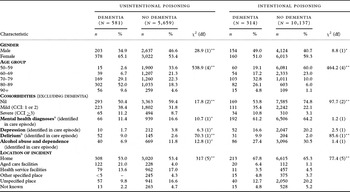
For individuals with dementia, almost double the proportion of females compared to males were hospitalized following unintentional ingestion of a poisonous substance. Almost two-thirds of those hospitalized for unintentional poisoning who had dementia were aged 80+ years, whereas for individuals without dementia, 22.9% were in this age group. For individuals aged 60+ years the age-adjusted hospitalization rate of unintentional poisoning for people with dementia was 69.5 per 100,000 (95%CI 60.4–78.6) which was double the hospitalization rate of unintentional poisoning for people without dementia (31.6 per 100,000 (95%CI 30.6–32.6)).
Eleven percent of individuals with dementia who were hospitalized for unintentional poisoning had three or more additional comorbidities compared to 8.7% of individuals without dementia. Of the individuals with dementia who had an additional comorbidity, the three most common comorbid conditions were diabetes with or without chronic complication (55.2%), congestive heart failure (25.7%) and cerebrovascular disease (22.2%). In the current care episode of unintentional poisoning, 11.4% of individuals were diagnosed with a mental health condition (including 1.7% of individuals with depression), 9.0% with delirium and 6.9% with alcohol abuse and dependence. The location of the incident was predominantly the home for individuals with and without dementia. Poisoning of individuals with dementia was more likely to occur in aged care facilities (e.g. nursing home, retirement village) and health service facilities (including hospitals, health centers, hospices, and outpatient clinics) (Table 1).
Characteristics of unintentional and intentional poisoning for individuals with and without dementia aged 50 years and older in linked hospitalization-mortality data in NSW, 2003–2012

*p < 0.01, **p < 0.0001.
aIncludes depression.
bIncludes ICD-10-AM: F05.1 delirium superimposed on dementia.
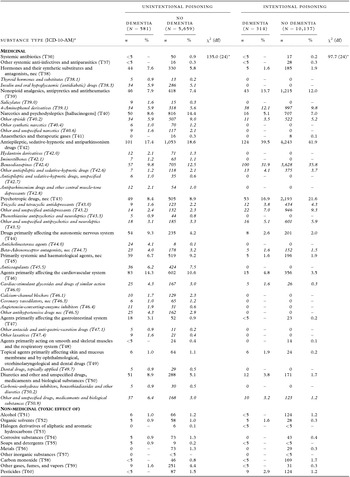
The majority of unintentional poisoning involved medicinal substances for both individuals with and without dementia (94.2% and 88.0%, respectively). Compared to individuals without dementia, individuals with dementia ingested a higher proportion of drugs primarily affecting the autonomic nervous system (9.3% vs. 4.2%), including anticholinesterase agents, agents primarily affecting the cardiovascular system (14.3% vs. 10.6%), agents primarily affecting the gastrointestinal system (3.1% vs. 0.9%), hormones and their synthetic substitutes and antagonists not elsewhere classified (nec) (7.6% vs. 5.8%), and diuretics and other unspecified drugs, medicaments and biological substances (8.9% vs. 5.1%). Individuals with dementia ingested a lower proportion of narcotics and psychodysleptics (i.e. hallucinogens) (8.6% vs. 14.4%) compared to individuals without dementia. The proportions of ingested non-medicinal substances for individuals with and without dementia were relatively similar, except individuals without dementia had a higher proportion of toxic effect of other gases, fumes and vapors (1.6% vs. 4.4%) (Table 2).
Medicinal and non-medicinal substance ingested for unintentional and intentional poisoning for individuals with and without dementia aged 50 years and older in linked hospitalization-mortality data in NSW, 2003–2012

*p < 0.0001, NEC = not elsewhere classified.
aCell sizes representing fewer than five hospitalizations have been disguised or data have been removed to prevent identification of cell sizes less than five.
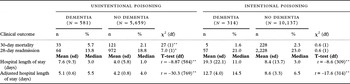
Individuals with dementia had a significantly higher 30-day mortality rate following unintentional poisoning compared to individuals without dementia (5.7% vs. 2.1%), a significantly lower proportion of readmission within 28 days (13.8% vs. 18.8%), and a significantly longer age-adjusted mean LOS (5.1 vs. 4.2 days) (Table 3).
Clinical outcomes for unintentional and intentional poisoning for individuals with and without dementia aged 50 years and older in linked hospitalization-mortality data in NSW, 2003–2012

*p < 0.001, ** p < 0.0001.
Intentional poisoning
Almost equal proportions of males and females with dementia were hospitalized following intentional poisoning, while a higher proportion of females without dementia were hospitalized following intentional poisoning (59.3% vs. 40.7%). For individuals 60 years and older, the age-adjusted hospitalization rate for intentional poisoning in people with dementia was 56.4 per 100,000 (95%CI 46.7–66.2) which was over one and a half times the rate for people without dementia (32.5 per 100,000 (95%CI 31.5–33.5)).
Eleven percent of individuals with dementia who were hospitalized for intentional poisoning had three or more additional comorbidities compared to 3.1% of individuals without dementia. Of the individuals with dementia who had an additional comorbidity, the three most common comorbid conditions were diabetes with or without chronic complication (46.9%), congestive heart failure (17.9%), and cerebrovascular disease (22.1%). In the current care episode of intentional poisoning, 61.2% of individuals also had a diagnosis of a mental health condition (including 16.6% with depression), 9.9% were diagnosed with delirium and 27.4% were diagnosed with alcohol abuse and dependence. The location of the intentional poisoning was predominantly the home for individuals both with and without dementia.
Almost all intentional poisoning involved medicinal substances for both individuals with and without dementia (93.0% and 94.0%, respectively). Compared to individuals without dementia, individuals with dementia ingested a higher proportion of other unspecified drugs, medicaments and biological substances (3.8% vs. 1.7%) and a lower proportion of narcotics and psychodysleptics (5.1% vs. 7.0%), antiepileptic and sedative-hypnotic and antiparkinsonism drugs (39.5% vs. 41.9%), and psychotropic drugs nec (16.9% vs. 21.6%). The proportions of ingested non-medicinal substances for individuals with and without dementia were all relatively low.
Individuals with dementia did not have a significantly higher 30-day mortality rate (1.6% vs. 2.3%) or readmission within 28 days (21.0% vs. 23.0%), but did have a significantly longer age-adjusted mean LOS (12.7 vs. 8.3 days) following intentional poisoning compared to individuals without dementia.
Unintentional and intentional poisoning
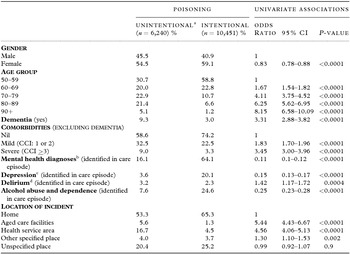
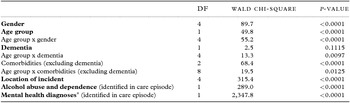
Univariate associations identified that unintentional poisoning was more likely to involve males than females (OR 1.21; 95%CI 1.13–1.28), older age groups compared to individuals aged 50–59 years, individuals with dementia (OR 3.31; 95%CI 2.88–3.82), individuals with multiple comorbidities compared to individuals with no identified comorbidities, and individuals residing in aged care facilities (OR 5.44; 95%CI 4.43–6.67) or health service facilities (OR 4.56; 95%CI 4.06–5.13) compared to at home (Table 4). Type 3 analysis results from multi-variable logistic regression are shown in Table 5. Within the multi-variable analysis, the interaction effects showed that older age groups had higher odds of having dementia than those aged 50–59 years and that the older age groups were more likely to have a higher number of comorbidities (data not shown).
Univarate logistic regression analysis of demographic characteristics of poisoning-related hospitalizations by intent for individuals aged 50 years and older in linked hospitalization-mortality data in NSW, 2003–2012

aUnintentional poisoning is the outcome.
bIncludes depression.
cAs mental health diagnoses includes depression, depression was not included in the multi-variable analysis.
dIncludes ICD-10-AM: F05.1 delirium superimposed on dementia.
Type 3 analysis results from multi-variable logistic regression of poisoning-related hospitalizations by intent for individuals aged 50 years and older in linked hospitalization-mortality data in NSW, 2003–2012

aIncludes depression.
Discussion
This study identified that older individuals with dementia were at a higher risk of poisoning compared to older individuals without dementia, with hospitalization rates for individuals with dementia double those of individuals without dementia for unintentional poisoning and 1.5 times higher for intentional poisoning. This may reflect the larger number of medications used for more comorbid conditions by people with dementia with greater opportunity both for error and intentional harm. Medication error is known to be associated with more prescribed medications and more complex drug regimens and the presence of dementia is likely to increase the potential for error and problems of adherence to a prescribed regimen. The findings may also reflect higher ingested doses and/or potential medical complications associated with poisoning in individuals with dementia who require hospital admission.
As a proportion of all hospitalized poisoning events among older individuals, unintentional poisoning experienced by individuals with dementia was three times higher (9.3%) than intentional self-poisoning (3.0%). A review of self-harm and dementia, identified that previous studies all identified low proportions of hospital admissions for individuals with dementia who self-harmed, ranging from between 0 to 12% (Haw et al., Reference Haw, Harwood and Hawton2009), which is in keeping with the current study, with poisoning being identified as one of the most common methods of self-harm used by individuals with dementia (Purandare et al., Reference Purandare, Voshaar, Rodway, Bickley, Burns and Kapur2009).
Individuals with dementia had a higher proportion of three or more comorbidities for both unintentional and intentional poisoning, potentially increasing the likelihood that they were taking multiple medications. Within the multivariate analysis, unintentional poisoning was one and a half times the odds for individuals with dementia compared to intentional poisoning. Depression was more commonly identified in the care episode of individuals without dementia than those with dementia. Mental health diagnoses, including depression, and alcohol abuse and dependence were more commonly identified for individuals who were hospitalized for intentional poisoning. Depression, psychiatric symptoms, chronic disease, social isolation, financial worries, and bereavement can all trigger self-harm by older people (Draper, Reference Draper1996; Eddleston et al., Reference Eddleston, Dissanayake, Sheriff, Warrell and Gunnell2006; Hawton et al., 2006; Dennis et al., Reference Dennis, Wakefield, Molloy, Andrews and Friedman2007; Doak et al., Reference Doak, Nixon, Lupton and Waring2009; Haw et al., Reference Haw, Harwood and Hawton2009). Individuals at earlier stages of dementia have more preserved insight and may be more at-risk of self-harm than those with severe dementia due to feelings of hopelessness regarding their condition (Haw et al., Reference Haw, Harwood and Hawton2009). In a population-based study in Denmark during 1990 to 2000, individuals aged 50 years and older with dementia compared to individuals without dementia also had higher rates of self-harm (Erlangsen et al., Reference Erlangsen, Zarit and Conwell2008). These findings are contrary to previous research that identified lower rates of self-harm among individuals with dementia compared to the general population (Haw et al., Reference Haw, Harwood and Hawton2009). The higher rates of self-harm among individuals with dementia in the current and Danish studies might reflect that these studies were population-based compared to previous studies that were not (Harwood et al., Reference Harwood, Hawton, Hope and Jacoby2001). This study also confirmed that alcohol dependency and use of alcohol in combination with other drugs is associated with intentional self-harm among older individuals (Hawton et al., Reference Hawton and Fagg1990; Reference Hawton and Harriss2006).
The home was the most common location for poisoning for individuals with and without dementia. This is likely to reflect where older individuals spend most of their time and where their medications are located. In the home environment, it is possible that individuals with dementia may inadvertently confuse medication doses or could find it challenging to comply with complex medication regimens (Woolf et al., Reference Woolf, Fish, Azzara and Dean1990; Morgan et al., Reference Morgan, Williamson, Pirotta, Stewart, Myers and Barnes2012). Polypharmacy among older people can increase the likelihood of adverse medication reactions requiring hospitalization (Klein-Schwartz et al., Reference Klein-Schwartz and Oderda1991; Elliot Reference Elliot2006; Morgan et al., Reference Morgan, Williamson, Pirotta, Stewart, Myers and Barnes2012), with between 15–22% of all emergency admissions of older individuals found to be medication-related (Roughead et al., Reference Roughead, Gilbert, Primrose and Sansom1998). Aged care facilities and health service facilities were also common locations of unintentional poisoning for individuals with dementia. Unintentional poisoning had twice the odds of occurring in an aged care facility and almost four times the odds of occurring in a health service facility compared to intentional poisoning. When older individuals transition between the home, hospital and age care facilities there is potential for information regarding medications to be inadvertently omitted from medical records (Woolf et al., Reference Woolf, Fish, Azzara and Dean1990).
The current study identified that anticholinesterase medications (used for Alzheimer's disease), antihypertensive drugs and laxatives were all ingested unintentionally resulting in hospitalization at a higher proportion for individuals with dementia than those without dementia. Psychotropics were the most common medication attributed to intentional poisoning-related hospitalizations. Similarly, a study of self-poisoning among individuals 55 years and older in one UK hospital, found that minor tranquillizers and sedatives (45.6%), non-opiate analgesics (29.6%), and anti-depressants (18.1%) were the most common medications used (Haw et al., Reference Haw, Harwood and Hawton2009).
For unintentional poisoning, individuals with dementia had a higher 30-day mortality, lower 28-day readmission and a longer LOS, whereas for intentional poisoning-related hospitalizations individuals with dementia had similar mortality and readmission rates and a longer LOS after adjusting for age. It is possible that poisoning whether intentional or unintentional has a greater impact on both cognitive and physical function in individuals with dementia and hence the longer observed LOS. In general, older compared to younger individuals, are more physically vulnerable to the toxic effect of the medications and may also be less likely to physically cope with treatment (Doak et al., Reference Doak, Nixon, Lupton and Waring2009).
Opportunities for prevention of unintentional poisoning by individuals with dementia include improved storage options, such as the use of blister packs or Dosette boxes, increased involvement of carers with medication administration and, in the aged care and hospital settings, ensuring quality use of medicines and improved documentation and review regarding polypharmacy (Klein-Schwartz et al., Reference Klein-Schwartz and Oderda1991; Elliot, Reference Elliot2006). Options for prevention of intentional poisoning by individuals with dementia include monitoring for signs of mood disturbances, increased aggression, hallucinations, resurgence of painful memories, and expressions of self-harm by the individual (Chan et al., Reference Chan, Draper and Banerjee2007; Haw et al., Reference Haw, Harwood and Hawton2009). There is evidence that the risk of self-harm is greatest in the period within three months of dementia diagnosis (Erlangsen et al., Reference Erlangsen, Zarit and Conwell2008).
There are a number of limitations associated with the current study. No information was available on dementia severity or on the quantity or number of substances ingested. Data validity was not able to be assessed and it is possible there could be some misclassification in records. Any under-enumeration of dementia cases would result in lower hospitalization rates for poisoning of individuals with dementia, potentially showing a lower burden of poisoning for these individuals. The determination of the intent of the individual could have been misclassified, with the intent of 1,513 poisoning-related hospitalizations unable to be determined. It is also possible that some individuals may choose not to disclose that their hospitalization was a result of self-harm or may not be able to confirm their intent due to their injury or the ambiguity of their motive. This type of uncertainty in terms of intent can affect the certainty of estimates of intended self-harm (Tovell et al., Reference Tovell, McKenna, Bradley and Pointer2012). For any age group, determining injury intent can be problematic, more so for individuals with dementia (Camidge et al., Reference Camidge, Wood and Bateman2003; Haw et al., Reference Haw, Harwood and Hawton2009). While the toxicological effects of poisoning on an individual and the type of treatment provided do not differ by intent, the intent should be distinguished as the substance type, amount ingested, and subsequent preventive strategies will differ (Camidge et al., Reference Camidge, Wood and Bateman2003). For individuals with dementia and no dementia, respectively, 12.0% and 25.4% of location of the event were unspecified or unknown. There was no information available regarding the living arrangements of the individual, particularly whether they lived alone. Only health conditions that were relevant to the current hospital episode of care are reported in each hospitalization record. However, by using a one year look-back period, better estimates of the prevalence of health conditions were able to be obtained in the current study (Preen et al., Reference Preen, Holman, Spilsbury, Semmens and Brameld2006).
No information was available on poisoning of individuals who died prior to hospitalization. It is possible that there is a degree of survival bias, with older individuals who experience adverse health conditions, more likely to have premature deaths than healthy individuals (Begg et al., Reference Begg, Vos, Barker, Stevenson, Stanley and Lopez2007). Lastly, when using record linkage there is likely to be some degree of error in the data linkage process. However, for the current study, the CHeReL estimates the false positive rate for this linkage to be 0.4% (i.e. the proportion of false matches) and estimated the rate of false negatives at 0.5% (i.e. failure to identify matches).
Conclusion
This research has identified that older individuals with dementia have higher hospitalization rates of both unintentional and intentional poisoning compared to older individuals without dementia. It also found that unintentional poisoning was more likely to occur in aged care facilities and health service facilities than in the home environment than intentional poisoning. This raises the importance of appropriate prescribing and linking prescription to the review of ability to comply with a drug regimen. Poisoning prevention strategies need to be tailored to target individuals residing at home, and in aged care and health care facilities. Further information is required regarding the severity of cognitive impairment experienced and the quantity of substance(s) ingested to assist in tailoring prevention strategies.
Conflict of interest
None.
Description of authors’ roles
All authors were involved in the design of the study. RM was responsible for the statistical analysis and drafting the paper. All authors commented on the paper and approved the final version.
Acknowledgments
This research was funded by the Dementia Research Collaborative Centre - Assessment and Better Care, UNSW. The authors wish to thank the NSW Ministry of Health for providing access to the APDC, the NSW Registry of Births Deaths and Marriages for providing access to mortality data, and the CHeReL for conducting the record linkage.
Supplementary Material
To view supplementary material for this paper, please visit http://dx.doi.org/10.1017/S1041610215001258.