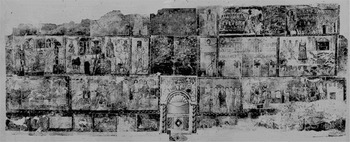
The painted decoration in the Dura-Europos synagogue (Syria, 244–245 CE) is the most extensive surviving example of Jewish pictorial narrative in the ancient world. In its final stage, the decoration consisted of three bands of narrative panels that surrounded all four walls of the synagogue's assembly hall and led up to the Torah shrine at the center of the west wall (Figure 1).Footnote 1 Imagery related to the Jerusalem Temple, including a symbolic image of the Temple on the Torah shrine, made up a significant part of the decoration of the Dura synagogue. There is, however, considerable scholarly disagreement as to how this imagery should be interpreted, particularly as part of a “programmatic” structure.Footnote 2 Because the Temple image on the Torah shrine was positioned at the liturgical focal point of the synagogue and was created before the other surrounding narrative panels, the function of this image is a key component of the synagogue's decoration as a whole. Two contextualizing factors would have informed the function and meaning of the image: the reception of the image as part of the liturgical activity carried out by the congregation, and the place of the image as the conclusion to the middle level of surrounding narrative panels that depicted the journey of the Ark of the Covenant from Sinai to Zion. This narrative helped to situate the members of the congregation in relation to the Temple image, defining the community's active role as a part of the narrative itself.
Dura-Europos Synagogue, west wall with Torah shrine at center (composite image), 244–45. (Yale University Art Gallery, Dura-Europos Collection)

In making this argument, I will integrate (and, at points, challenge) the work of three scholars who have considered the Temple image and surrounding narrative. First, Carl Kraeling's final report of 1956 offered the fundamental basis on which all subsequent studies have been built.Footnote 3 In a central component of my article, I will reevaluate Kraeling's identification of the first two panels of the middle level. Both panels are set in the Sinai Wilderness: In the first, Aaron and his sons offer sacrifice in the Tabernacle where the Ark was first placed; in the second, the twelve tribal representatives of Israel offer prayer just outside the Tabernacle as they surround a miraculous well. Kraeling identified the rituals taking place in the sanctuary with the consecration of the Tabernacle and the elite caste of priests who served there. And he found the inclusion of the panel with the well puzzling because he understood it as an isolated miracle having nothing to do with the ostensible “liturgical” focus of the middle level. In contrast, I offer a new identification of the rituals in the Tabernacle as part of the ongoing sacrificial service that the priests presented for the benefit of Israel as a whole; the Israelites are, in turn, shown just outside the Tabernacle offering their own complementary service of prayer while the springing up of the miraculous well has been transformed into a ritually recurring event. Together, the panels offer an idealized image of the whole community of Israel at worship in the Sinai Wilderness.
Whereas Kraeling saw the middle level of narratives as tied together only by the general theme of liturgical activity, Joseph Gutmann's study of 1973Footnote 4 argued that the surrounding narrative panels constituted one continuous narrative related to the Ark, beginning with the Tabernacle in the Sinai Wilderness and ending with the Torah shrine. When the congregation placed the Torah cabinet—called the “ark” in a dedication text on the shrine itself—into the shrine, they liturgically enacted the high point of Israel's history: Solomon's placement of the Ark of the Covenant in the “house” that he had built for it. The addition of narrative panels to the surrounding walls in the second phase of decoration transformed this liturgical event into the conclusion of a larger narrative sequence. In particular, the middle level of narratives depicts the Ark of the Covenant in the guise of the Torah cabinet and tells the story of the Ark's journey from the Sinai Wilderness to Mount Zion. The placement of the Torah “ark” in the shrine represented the liturgical completion of this sacred narrative within the synagogue itself. In this way, Gutmann emphasized the role of the synagogue as a replacement for the Temple and as a “small sanctuary” where Jews could continue to worship in the wake of the Temple's destruction.
I accept Gutmann's general idea of a liturgical completion for the historical narrative, though I will nuance his arguments in key places throughout this article. However, I will go beyond the emphasis found there on the construction of the synagogue as a sacred place to elaborate on the role of the synagogue community as a holy people liturgically positioned to interact with the shrine and its Temple image. In doing so, I will draw on more recent work by Steven Fine, who emphasized the receptive context that synagogue liturgy would have provided for the viewing of the Temple image.Footnote 5 He has offered crucial observations about what we might know of the liturgy, and on how the liturgy would have framed the congregation's perception of the image. Though taking these observations into consideration, I will also argue that my rereading of the Tabernacle images just mentioned suggests more specific and intentional connections between the rituals represented in the Tabernacle panels and the liturgical activity of the synagogue community. In particular, the liturgical interaction between the congregation and the shrine that displayed the “ark,” as sketched out by Fine, has an analogue in the liturgical interaction between the biblical tribes of Israel gathered outside the Tabernacle and the priestly activity taking place within the sanctuary that contained the Ark. Thus, the liturgical activities of the Tabernacle form a historical precedent for the celebration of liturgy in the synagogue itself. Liturgical activities of the congregation also served to complete the narrative on the surrounding walls by positioning the gathering of the congregation around the shrine as a means of enacting the gathering of the Israelites to the Temple under Solomon. In this way, the congregation not only echoed events on the surrounding walls, but also embodied in their own worship a key concluding moment in the drama of Israel's sacred narrative.
Many earlier studies on Dura, including those of Kraeling and Gutmann, presupposed a strong and relatively unproblematic relationship between the synagogue and rabbinic Judaism.Footnote 6 However, we cannot assume that the rabbinic movement in this period exercised the kind of centralized control over all aspects of Jewish life (including the synagogue) that was once taken for granted in the scholarly literature.Footnote 7 A priest is mentioned among the leaders of the synagogue in the Dura dedication text,Footnote 8 and we know of other examples of synagogue inscriptions in both the late Second Temple period and late antiquity that list priests as leaders in this setting.Footnote 9 In contrast, no rabbi is named in the Dura dedication text. Nevertheless, we do not need to adopt the view once presented by E. R. Goodenough that Dura and other synagogues of the period followed a radical alternative to the “kind” of Judaism represented by the rabbis.Footnote 10 Fine has proposed that though the rabbis may not have controlled all aspects of late antique Jewish life, there appears to be a considerable overlap between the expectations regarding the synagogue and its function as found in rabbinic texts and in archaeological contexts such as Dura,Footnote 11 and his observations provide a useful vantage point for considering the relationship between the two. In this light, Steven Fraade's recent study on Temple vessels and imagery as a marker of identity should be noted. In it he asked “How much influence did the rabbis exert on the synagogue?” in order to consider the influence of synagogue practices on the rabbis.Footnote 12 Rather than see the rabbis in the third century as in control of synagogues like Dura, it is certainly possible that rabbinic texts reflected or responded to developments in such synagogues.
Finally, this article emphasizes archaeological comparanda from areas further west of Dura because there are no remaining synagogues from the eastern centers of the Jews associated with the Babylonian Talmud. It in no way implies that the conception or pictorial sources for the images in Dura must necessarily be understood exclusively as “influences” from these western centers. We do not need to postulate that the synagogue decoration was copied wholesale from a no longer extant synagogue in a western site such as Antioch.Footnote 13 Rather, although the general focus on Temple imagery seems to have been a broad preoccupation for Jewish communities throughout the ancient world in late antiquity, the Dura synagogue's particular decorative structure can be understood as a local creation. The stylistic idiom of the synagogue reflects the local hybridized culture of the city itself, with both Greco-Roman and Persian influences. Likewise, Kraeling suggests that for the synagogue as a whole, midrashic sources for key elements of the narratives are almost equally divided between Palestinian and Babylonian sources.Footnote 14 One scholar has recently suggested that antecedents of Targum Onkelos and Jonathan, for example, may actually stem from an area between Babylon and Palestine that would include the city of Dura itself.Footnote 15 The Dura synagogue likely represents crosscurrents of influences from both west and east in a way that resists strict categorization, reflecting both broader Jewish developments in the transformation of the synagogue and the particular culture of the city in which the Jewish community conducted its affairs.
I. The Torah shrine and the Temple under Solomon
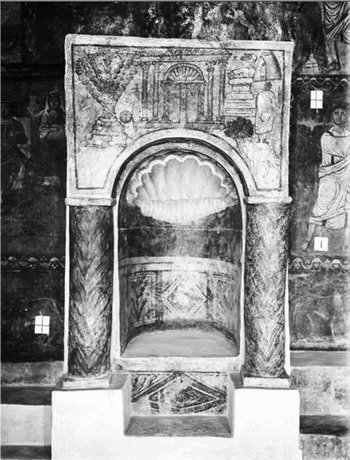
After the Temple's destruction in 70 CE and the failure of Bar Kokhba to rebuild that Temple during the revolt of 132–135 CE, late antique synagogues began to fill the vacuum that the sanctuary's loss had created.Footnote 16 The first phase of decoration in the Dura synagogue is directly related to this development. Like most synagogues in the late antique period, the Dura synagogue's assembly hall centered on a shrine for the liturgical display of the Torah cabinet (Figure 2).Footnote 17 Although no wooden Torah cabinets have survived from the third century,Footnote 18 many Jewish images of such cabinets displayed in shrines exist.Footnote 19 At Dura, a simple image of the Temple was painted at the center of the decorative panel affixed to the top of the shrine.Footnote 20 This panel is best understood as a crystallization of the community's liturgical reorientation to the site of the Temple itself in an era when direct military response to the Roman occupation of that site was no longer deemed a present possibility.
Dura-Europos Synagogue, Torah shrine with “temple panel,” center of west wall, first half of third century. (Yale University Art Gallery, Dura-Europos Collection)

The Temple imagery defined the symbolic reference point for the Torah shrine. Although the tetrastyle form of the temple facade at the center of the panel is rather generic, elements to its right and left help to establish that it was intended as the sanctuary in Jerusalem. These include the ‘akedah or “binding [of Isaac],” a “foundation narrative” for the Temple's construction on the right;Footnote 21 a gold menorah, the lamp stand that once illuminated the Temple, on the left;Footnote 22 and the etrog (citrus fruit) and lulav (palm branch)Footnote 23 that were taken up as part of the feast Sukkot,Footnote 24 preeminent among the three pilgrimage feasts associated with JerusalemFootnote 25 and strongly connected to the Temple in historyFootnote 26 and eschatology.Footnote 27 These elements surrounding the central temple facade indicate that it represented the sanctuary in Jerusalem, focus of the pilgrimage at the feast first celebrated there under Solomon when he dedicated the Temple.Footnote 28
An Aramaic dedication text scratched into the lower left corner of the panel provides a link between the shrine itself and the Temple image. Now only partially legible, it reads:
I… made the beit (“house”) [for the] arona (“ark”).
[I,]… Joseph son of Abba.…Footnote 29
The biblical antecedent for the phrase “house for the ark” is crucial for the text's meaning. Like the biblical Hebrew aron, arona means “chest” or “ark,” as in the aron ha-berit or Ark of the Covenant. As described in Exodus 25:10–22, the Ark was an oblong box covered in gold, fitted with rings in which to insert carrying poles, and surmounted by a cover with an inward-facing cherub carved at each end. Whereas the tablets of the Torah that Moses had brought down from Sinai were the most significant contents of the Ark, the Ark itself also served as the visible reference point for the invisible presence “enthroned upon the cherubim.”Footnote 30 The Ark moved with the Israelites through the Wilderness and then into the Promised Land with them, remaining in a mobile “tent,” until King David sought to build a permanent “house” or Temple in which the Ark could be placed.Footnote 31 Only David's son Solomon was allowed to build such a “house.” At the Temple's consecration, he declared that he had “built the house for the name of the Lord, the God of Israel. And there I have provided a place for the Ark, in which is the covenant of the Lord.…”Footnote 32 At the Temple's consecration, God condescended to “dwell” in the Temple on Zion, even as he transcended the need for a “house.”Footnote 33 When Solomon consecrated the Temple, “an exalted house, a place for [the divine presence] to dwell in for ever” (I Kings 8:13), it represented a high point in the narrative of Kings and in Israel's history as a whole. Whereas the “ark” in the biblical narrative is the Ark of the Covenant that contained the tablets of the Torah, arona is also a term that referred to the wooden cabinets holding the synagogue's Torah scrolls in other synagogue inscriptions,Footnote 34 as well as in rabbinic texts. As Fine has demonstrated, the first use of the term arona to refer to such cabinets in rabbinic texts is found in two baraitot from the Babylonian Talmud (b. Shabbat 32a);Footnote 35 in Palestinian sources it is found only in the amoraic period.Footnote 36 Just as the biblical “house for the ark” referred to the Jerusalem Temple, the “house for the ark” in a Dura synagogue referred to the Torah shrine, the niche or aedicular structure where the Torah “ark” or cabinet was placed.Footnote 37 The combination of the inscription and the Temple image helps to mark the shrine that contained the wooden cabinet at Dura in connection to the Temple that Solomon had constructed as a “house for the ark.”
Solomon's prayer at the time of the Temple's consecration had established Jerusalem as the direction for prayer. Should Israel find itself in exile, according to his prayer, it should “pray to you toward their land, which you gave to their fathers, the city which you have chosen, and the house which I have built for your name” (I Kings 8:48).Footnote 38 Second Temple texts set in the Diaspora assume the orientation of prayer toward Jerusalem,Footnote 39 although synagogues in Israel dating from this period are not positioned in this way.Footnote 40 However, by the late antique period the majority of synagogues in both the Diaspora and Israel were aligned to the site of the Temple Mount.Footnote 41 Whereas rabbinic texts continued the long-standing tradition that offered Jerusalem as the prayer direction,Footnote 42 they also reflect the assumption that the congregation would face the Torah shrine itself in prayer.Footnote 43 Rachel Hachlili has noted a resulting conflation between the interior and exterior points of prayer focus.Footnote 44 In the context of prayer, the image of the Jerusalem Temple and surrounding motifs are best understood as a flexible set of signs that provided orientation for worship. They served, literally, as a signpost directing devotion toward Jerusalem, thus bridging the space between the synagogue and the inaccessible site of the lost Temple. They also functioned as an existential positioning mechanism for a community that had lost its sacred center by “projecting” a virtual sanctuary onto the site, bridging the disruption of the Temple's loss in the context of liturgy.
The laconic decoration on the shrine was only the first stage in what was to be a far more dramatic intervention: In the second phase of decoration, the surrounding walls of the synagogue's assembly hall were covered completely with narrative panels. In the middle level of these panels, the Ark of the Covenant appears repeatedly as the Torah “ark,” reinforcing the connection first established in the construction and decoration of the Torah shrine. The addition of the surrounding narrative images transformed the symbolic interconnection between Temple image and shrine from the first phase of decoration into the conclusion of a larger narrative account of the journey of the Ark of the Covenant from Sinai to Zion. Only sections of the middle level extending from the Torah shrine on the west wall to the north and south walls have been preserved, leaving a significant gap on the eastern side of the assembly hall where panels have not survived. Those panels of the middle level that remain can be read from right to left and are positioned in keeping with the order of the biblical narrative itself. Two panels on the west wall, to the left of the Torah shrine, are set in the Sinai Wilderness under the leadership of Moses and Aaron and represent the earliest episodes from this narrative. After offering a crucial rereading of the two panels that begin the narrative, the stage will be set for a discussion of the congregation's relationship to the Ark narrative.
II. Worship in the Wilderness Tabernacle
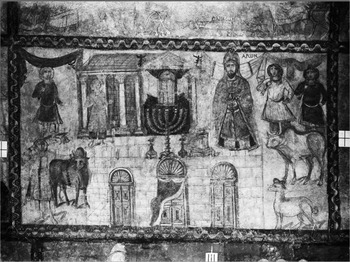
The first panel in the sequence depicted on the middle level shows the Ark of the Covenant at the center of the Tabernacle in the Sinai Wilderness, surrounded by figures performing various cultic acts (Figure 3). Kraeling's discussion of key aspects of the Tabernacle image needs to be rethought. A reconsideration of the Tabernacle panel allows for a clearer sense of how a second panel depicting the miraculous well can be integrated into the narrative of the middle level, and how the both images together depict an idealized scene of worship from Israel's past.
Dura-Europos Synagogue, The Tabernacle in the Wilderness, detail from the west wall, 244–45. (Yale University Art Gallery, Dura-Europos Collection)

Whereas the Tabernacle of biblical description was, essentially, a tent, the painter responsible for the Dura panel has modeled his depiction of the sanctuary on a classical temple structure, with Nike figures as acroteria on each corner.Footnote 45 The Tabernacle comprised an outer area, the “holy place,” and an inner area, the “most holy place” for the Ark of the Covenant. Although the two spaces were separated by a curtain in the biblical account (Exodus 40:3 and 20–21), this division is not clear in the panel. Here, the artist has followed Roman conventions for the depiction of a cult image within a temple, placing the Ark before the curtain at the threshold of the sanctuary. A seven-branched menorah stands below the Ark, and objects flanking it are incense burners that evidently served in place of the incense altar required in the biblical account.Footnote 46 The menorah and incense altar were to be placed in the “holy place” of the Tabernacle but have, again, been externalized to the area before the threshold in the panel. Although an altar conforming to the description of the incense altar in Exodus stands to the right of the menorah and incense burners, it functions here as the altar of burnt offering, as suggested by the sacrificial animal placed upon it.Footnote 47 This altar was to stand in the courtyard surrounding the sanctuary. In the panel, a masonry wall encloses this courtyard, though curtains hung in the background and over the door recall its cloth construction.
Six figures are at work in the Tabernacle panel. Aaron, labeled in Greek,Footnote 48 stands before the altar, his dress conforming to the description in Exodus.Footnote 49 He is at least a head taller than the other five figures who occupy the panel, all dressed in Parthian garments. The figure in the lower left-hand corner can be identified as Aaron's son Eleazar leading the red heifer to sacrifice, as required by Numbers 19. The other four figures, two to the right of Aaron and two at the left of the panel, hold trumpets. Their identity is not as clear. Kraeling argued that these figures are Ithamar (Eleazar's younger brother), and Gershon, Kohath, and Merari (heads of the Levite families).Footnote 50 But Numbers only describes two trumpets, not four,Footnote 51 and stipulates that only priests (“sons of Aaron”), not Levites, were allowed to blow the trumpets;Footnote 52 most likely, all of the figures are priests. I propose that the two “sons of Aaron” (Eleazar, in red, and Ithamar) are repeated as part of a continuous narrative.Footnote 53 They assist their father with the sacrifice to the right, and appear again on the opposite side, while Eleazar alone leads the red heifer.
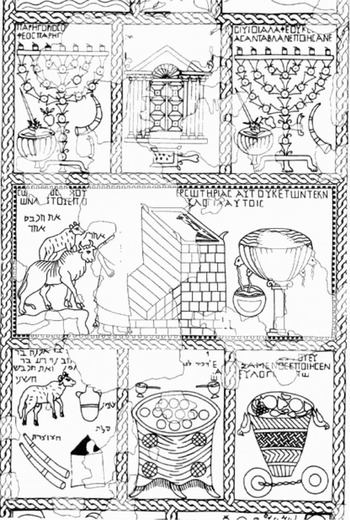
The cultic focus of the panel is clearly the offering that Aaron presents on the altar. According to Kraeling, the rite shown “is unlikely… to represent the cultus as such. Some particular scene must be alluded to.”Footnote 54 He understood this scene as the consecration of Aaron's sons (described in Exodus 29:1–25) on the basis of his identification of sacrificial animals, including the one on the altar (identified as a “ram” based on the shape of its tail) and another “ram” and a bull waiting below.Footnote 55 Kraeling's interpretation of all other elements in the panel in connection to the consecration flowed from this initial argument. Moreover, his interpretation of the Dura panel has influenced the identification of rites in the Tabernacle-related panels from the more recently discovered Sepphoris synagogue mosaic (Figure 4).Footnote 56 Ze'ev Weiss argues that the bull that Aaron leads before the altar in the mosaic is the bull offered for the consecration of Aaron's sons, with other elements in the panel understood in connection to these rites.Footnote 57 However, a reconsideration of the Sepphoris and Dura Tabernacle images suggests that they both depict, in their different ways, the “cultus as such,” the ongoing rituals within the Tabernacle, rather than the consecration and the beginning of cultic worship.
Sepphoris Synagogue, Aaron in the Tabernacle, detail of floor mosaic. (Courtesy of the Sepphoris Excavation, the Hebrew University of Jerusalem, drawing by Pnina Arad)

In the Sepphoris mosaic, there are no clear links to the consecration. Aaron's sons are not present at all. Although the precise function of the bull is not clear, the two rams that were to accompany it as an offering for the consecration are not depicted; the animals behind the bull are labeled specifically in Aramaic as the “lambs” that were to be part of the daily offering (also known as the tamid or “perpetual” offering), as were the clearly labeled flour, oil, and trumpets below. Censers flanking the showbread table to the right would have been used for the daily offering of incense, and the basket of first fruits to the right of the showbread table is a seasonal offering. Weiss argues that the wash basin above the basket of first fruits was for the consecration of the priests, as in Exodus 29:4. However, Aaron and his sons were to purify themselves every day, according to Exodus 30:17–21, and it is here that we find the textual description of the basin itself that Weiss cites.Footnote 58 The shofarot, incense pans, and etrog and lulav surrounding the menorot on the top level, an assemblage familiar from other synagogue mosaics, may be related to the yearly celebration of Rosh Hashanah, Yom Kippur, and Sukkot. And at Sepphoris, the tongs with which Aaron would trim the menorot every day have been added to these symbols. Thus, a specific connection with the consecration of Aaron's sons is not supported by any of the details in the image itself. Rather, the mosaic appears to present the ongoing celebration of the ‘avodah (service) within the Tabernacle.
Dura, likewise, is better understood in connection with this ongoing “service.” According to the text describing the consecration, the bull was to be sacrificed first; but at Dura another animal is offered on the altar while the bull waits its turn below. Although Kraeling identified the animal on the altar as a “ram,” the most common offering presented there was the lamb for the tamid. Exodus 29:38 instructs Aaron: “This is what you shall offer on the altar: two lambs a year old, day by day continually [tamid].” The significance of the tamid lay in the fact that it was a ritually reoccurring point of reference for God's dwelling with his people:
It shall be a continual burnt offering throughout your generations at the door of the tent of meeting before the Lord, where I will meet with you, to speak there to you. There I will meet with the people of Israel, and it shall be sanctified by my glory.… And I will dwell among the people of Israel, and will be their God. And they shall know that I am the Lord their God, who brought them out of the land of Egypt that I might dwell with them. (Exodus 29:42–46)
Below the altar, the combination of the menorah with its lamps lit and the burning incense in the panel recalls the command of Exodus 30:7–8:
Aaron shall burn fragrant incense on it [the altar]; every morning when he dresses the lamps he shall burn it, and when Aaron sets up the lamps in the evening, he shall burn it, a perpetual (tamid) incense before the Lord throughout your generations.
Aaron's sons blow the trumpets to announce the sacrifice, as Numbers 10:10 specifies that they are to “blow the trumpets over your burnt offerings and over the sacrifices of your peace offerings.” The Mishnah stipulates that two priests were to blow trumpets to announce the tamid offering in particular, and in the later Sepphoris mosaic the two trumpets are included among the items specifically associated with the tamid offering.Footnote 59 With the trumpets to their lips, the two “sons of Aaron” at Dura announce the sacrifice on the altar, while the lamps illuminate the sanctuary and the incense smokes. If my reading is correct, we see the priests performing the most frequent and representative acts of the sacrificial “service” (‘avodah), including the offering of the lamb and the incense, and the lighting of the lamps. Of all the sacrificial offerings Aaron was to present, Sirach chose the lamb of the tamid as representative of his office, recounting that “[h]is offering shall be burned entire, even each day, continually, twice.…”Footnote 60 All other elements of the “cultus as such,” sacrifices associated with Sabbaths and holy days, were performed in addition to this offering. In the Dura panel, the bull and the “ram” standing ready below, representing sacrifices brought “from the herd or from the flock,” may serve as generic indications of sacrifices offered in addition to the tamid without providing an exhaustive catalogue or tying the image to a specific holy day.Footnote 61
Priests appearing on the left side of the panel also perform activities that are best understood in connection to the ongoing “service,” rather than the consecration narrative. In the upper left-hand corner, a pair of priests (or Eleazar and Ithamar in their second appearance) mirrors the two priests behind Aaron. They hold, but do not sound, their trumpets. As Kraeling has noted, the second of these two priests holds a coin. This may be the half-shekel offering that the priests were to collect from every Israelite according to Exodus 30:11–16.Footnote 62 The half-shekel supported “the service of the tent of meeting” (avodat ohel mo‘ed).Footnote 63 In the lower left-hand corner, Eleazar leads the red heifer for sacrifice in accordance with the description from Numbers 19:1–3:
Now the Lord said to Moses and to Aaron, “This is the statute of the law which the Lord has commanded: Tell the people of Israel to bring you a red heifer without blemish, and upon which a yoke has never come. And you shall give her to Eleazar the priest, and she shall be taken outside the camp and slaughtered before him.
The ashes of the red heifer were mixed with water and used for purification. Kraeling connected the rite to the consecration of the Levites, as Numbers 8:7 stipulates that Moses should “sprinkle the water of purification on them.”Footnote 64 However, the Numbers 19 passage itself clearly has nothing to do with the Levites, but with any Israelite who becomes unclean through contact with a corpse (Numbers 19:5–10). Refusal to purify one's self results in exclusion from the assembly:
But the man who is unclean, and does not cleanse himself, that person shall be cut off from the midst of the assembly, since he has defiled the sanctuary of the Lord; because the water for impurity has not been sprinkled upon him, he is unclean. (Numbers 19:20–21)
Thus, the rite relates to the ritual cleansing of every Israelite before entering the assembly.
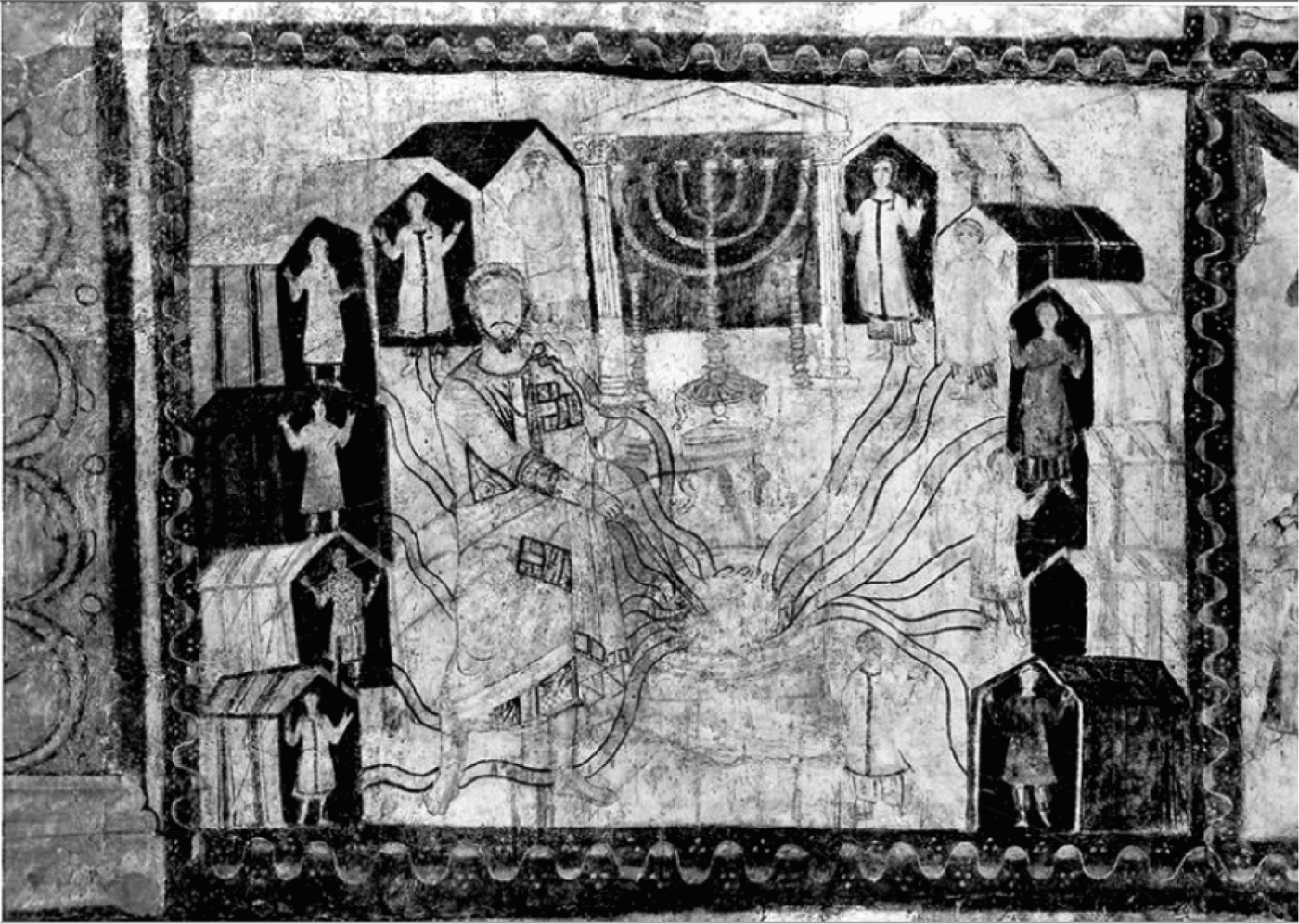
Whereas Kraeling assumed that the sacrifices and offerings the priests present in the Tabernacle panel relate to their own consecration, I have argued that they represent key elements of the ongoing sacrificial service performed by the priests in the sanctuary for the benefit of all Israel. So far as I can determine, the rituals represented in the Tabernacle panel are part of a service carried out by a specific caste of qualified professionals, but performed for (and financed by) the community at large. This community is not shown within the Tabernacle itself, for only members of the cultic personnel could enter this area (and, thus, this panel). Rather, they are gathered outside the Tabernacle in a second panel, shown to the left (Figure 5). Because this panel lacks a depiction of the Ark of the Covenant and does not include priests, it does not appear to fit comfortably with the other images on the middle level. Kraeling therefore characterized it as the “least germane to the cultic interest” that held the Ark-related panels of the middle level together.Footnote 65 I propose, however, that the panel depicting the miraculous well (Figure 5) is related to Israel's cultic narrative. Unlike the priests who work in the Tabernacle in the panel to the right (Figure 3), nonpriestly Israelites could not enter the court of the sanctuary to perform sacrifice. The image of the well is important precisely because it includes “ordinary” Israelites at prayer just outside the Tabernacle as a balance to the priestly performance of sacrifice within.
Dura-Europos Synagogue, The Miraculous Well, detail from the west wall, 244–45. (Yale University Art Gallery, Dura-Europos Collection)
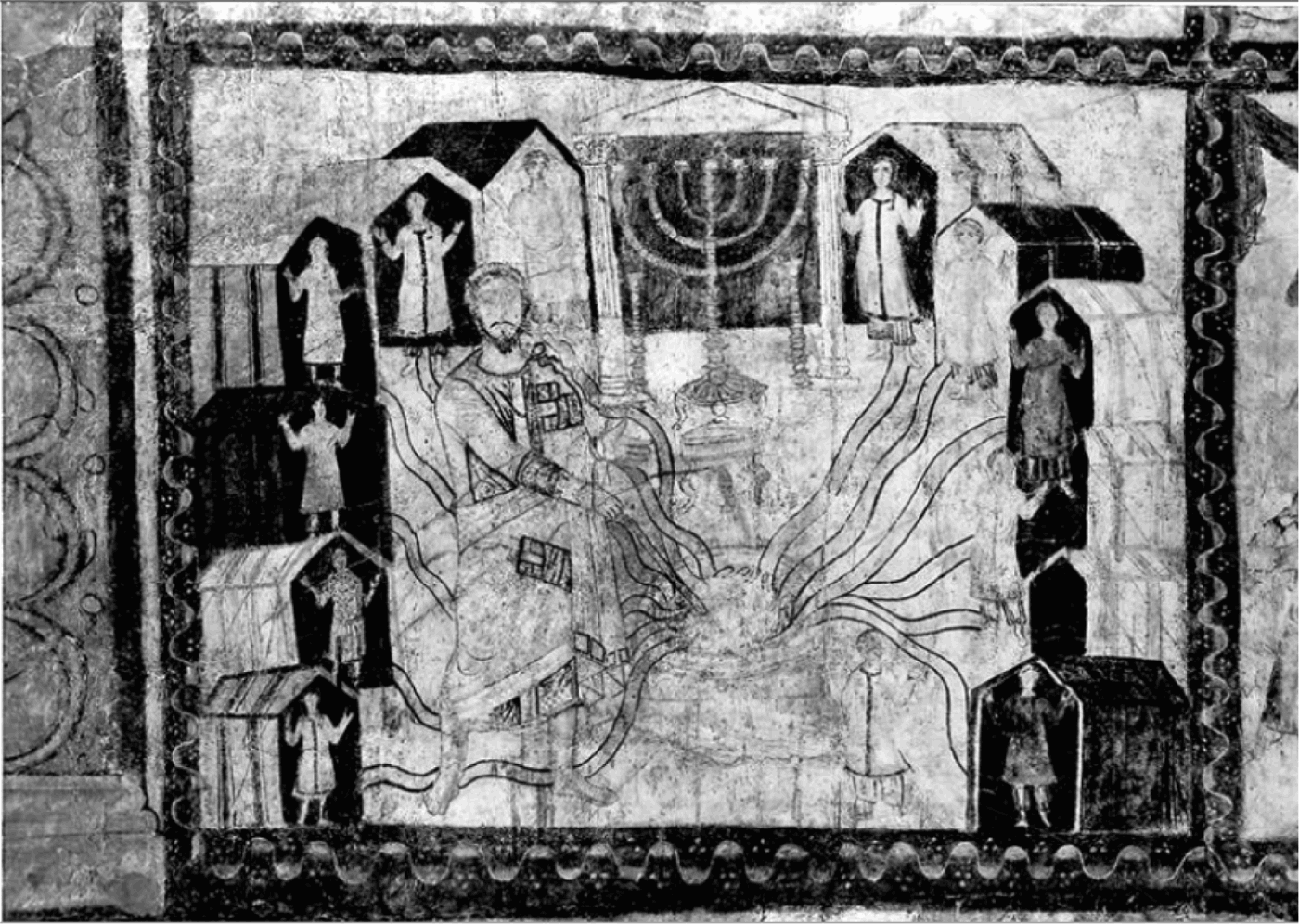
Numbers 2 describes the way that Israel was to set up their camps according to tribe. In the panel to the left, twelve tribal representatives stand in twelve tents, arranged in a circle. Moses is also in their midst, unlabeled, but easily identifiable in comparison to other images of the leader elsewhere in the frescoes, where he is considerably larger and wields his staff. Although the panel is often identified as the “encampment” of the Israelites, its composition suggests a more complicated identification. Whereas Numbers 2 describes the encampment as encircling the whole Tabernacle, the circle of tents is shifted to an area before the door of the Tabernacle in the panel. The doorway at the top of the panel is identified as the door to the Tabernacle in particular through the items externalized to this threshold: The menorah is shown prominently in the center, and the two implements flanking it seem to be additional lighting devices.Footnote 66 A gold table (the showbread table?) is also depicted below the menorah.Footnote 67 In this way, the panel conflates the encampment with the assembly, for “[a]t the door of the tent of meeting before the Lord,” is the location where the divine presence would “meet with the people of Israel” and speak with them when the tamid was presented (Exodus 29:42–45).
The overflowing well has generally been identified as a legendary elaboration of a miracle that occurred in the Sinai Wilderness.Footnote 68 It is based on Numbers 21:16–20b:
And from there they went to ha-be'er [literally, “the well”] concerning which the Lord said to Moses, “gather the people and I will give to them water.” At that time, sang Israel this song:
The place names in the last portion of the text, from Mattanah to Pisgah, can be read as an itinerary from the “giving” (mattanah) of Torah (on Sinai) to Mount Pisgah (Nebo), whence Moses could see Canaan beyond the plains of Moab.Footnote 69 Legends envision a miraculous well that followed Israel from Sinai to the border of the Promised Land.Footnote 70
Though drawing on Numbers 21, such legends may also reference other water miracles; when in motion, the well took the form of a large stone like the one Moses struck to bring forth water (Exodus 17:1–7). In the Tosefta:
The well that was with the children of Israel in the Wilderness, to what could it be compared? To a giant stone. In the place where the children of Israel found themselves, it accompanied them always finding itself in a high place near the door of the Tent of Meeting. The chiefs of the tribes of Israel used to come and march around it with their staffs and they would sing this song “Come up, o well, answer us.” And the water would bubble up as a pillar above them and each one would dip his staff into it, each man for his tribe, each man for his family, as it is said, “The well which the princes dug, which the nobles of the people delved with the scepter, and with their staves.”Footnote 71
Likewise, the well in the image dispenses water in individual streams to the tribal leaders.
In the passage that refers to the miraculous well, the Tosefta also cites prophetic descriptions of waters that flow from the door of the Temple.Footnote 72 The most extensive passage related to this phenomenon is Ezekiel's description in which “water was flowing from below the threshold of the Temple toward the east (for the Temple faced east); and the water was flowing down from below the south end of the threshold of the Temple, south of the altar.” (Ezekiel 47:1) This flowing water becomes a stream, and then a great river, that will flow to the Dead Sea, making its waters fresh, and irrigating the surrounding land (verses 2–12). This motif is likewise found in Joel 3:18 (“a fountain shall come forth from the house of the Lord / and water the Wadi Shittim”) and in Zechariah 14:8 (“On that day living waters shall flow out from Jerusalem, half of them to the eastern sea and half of them to the western sea…”). The Tosefta passage appears to graft the location of the miraculous water's origin (the threshold of the Temple) onto the legendary description of the well as just before the threshold of the Tabernacle. Thus, in both the Tosefta and the Dura image, the well has acquired a specific place before the door, just as the other sanctuary implements had their designated places within the sanctuary.
In the biblical account, the provision of water from the well occurs only once, satisfying the Israelites’ thirst. Previous scholars have tended to treat the image as the representation of an isolated miraculous event in Israel's history. However, legendary elaborations transform the springing up of the well into a recurring event taking place every time the Tabernacle is set up and worship occurs within. As Moses gathers the people before the sanctuary in the panel, they also worship, forming a circle and raising their hands in an orant gesture that signified prayer in the surrounding culture. The panel is thus imbued with a formal, ceremonial quality. Although all physical provision for Israel (including manna and quail) had a divine origin, the provision of water from the well here has effectively become part of the regular cultic service.
In accordance with the biblical pattern, the division between the Tabernacle and the surrounding encampment in the two panels conforms to the hierarchical division of Israel's holiest place, with the priests within and the lay people without. The pairing of the two panels suggests a distinction between people and priests, and between outside and inside, with the center of the Tabernacle, where the Ark of the Covenant was kept, representing the place of greatest holiness and least access. Yet, the relationships among the two panels, spaces, and castes, can also be understood as a complementary and mutually beneficial one, in which the community at large supports the priesthood and receives the spiritual benefit of their service as figured by the outpouring of the water in their midst. Together, the two panels represent an idealized vision of the entire community at worship in the Sinai Wilderness.
I do not suggest by any means that the images here are illustrations of either the biblical texts in question or of later texts such as the Mishnah or Tosefta. Moreover, unpacking specific textual points of reference in an attempt to better understand the imagery does not imply that the congregation itself would necessarily have seen the images as an amalgamation of different textual sources. The images derive from an evolving tradition regarding the Tabernacle that wove the later history of Israel's holy places, specifically the Temple (first, second, messianic/eschatological) and the synagogue (when, for example, the Ark is shown as the Torah “ark”), back into a conception of a divinely authorized original, whose plan was revealed to Moses on Sinai. Certain themes (such as the legend of the mobile well) are presented in both the image at Dura and in textual sources, particularly rabbinic ones. It is not necessary to argue that the synagogue community drew on a specifically “rabbinic” tradition regarding the well, and that both the synagogue community (with its leaders) and the rabbis were heirs to an older repertoire of legendary elaborations known (in the case of the well, for instance) by such first-century CE figures as Saul of Tarsus and the author of the Antiquities of Pseudo-Philo.
The creation of the images likely depended on this tradition as it was communicated orally by members of the synagogue community to the workshop responsible for the synagogue decoration.Footnote 73 This workshop, in turn, appears to have drawn from a repertoire of locally available pictorial sources that were transformed for the synagogue context.Footnote 74 For example, the presentation of the Wilderness Tabernacle as a Greco-Roman temple, complete with Nike acroteria, can probably be seen in this light. Moreover, the single most popular type of image (painted or relief) recovered from the city of Dura at large is the depiction of a figure (or figures) offering incense on incense burners (similar to those depicted in the synagogue's Tabernacle panel) before a cult image.Footnote 75 Thus, while Aaron may be offering incense in accordance with ancient Israel's earliest cultic practices, he also does what many worshipers were depicted doing in their non-Jewish cult sites down the street from the synagogue. Whereas older scholarly publications on the synagogue began with the assumption that the images should be understood as illustrations that deviated from a text through the intrusion of Greco-Roman (or other) motifs,Footnote 76 perhaps a reversal is in order. We could describe the Tabernacle panel as an image that began in the workshop, compositionally or conceptually, as a generic type of incense offering and was modified to accommodate the idiosyncratic tradition of a Jewish minority in the city.
III. The Ascent to the Temple in Jerusalem
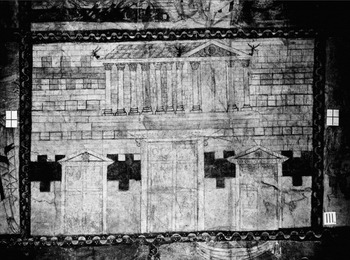
Directly opposite the Tabernacle panel (Figure 3) on the left side of the west wall, and to the right of the shrine, there is another panel depicting a temple (Figure 6) that is obviously paired with the Tabernacle panel in a number of ways. Like the Tabernacle panel, this panel has three doorways at the bottom of the composition, similar to the doors of the wall that marks off the holy precinct of the Tabernacle. The pseudoperipteral temple on the right is similar in structure to the Tabernacle on the left and, like the Tabernacle, is also decorated with Nike acroteria figures. The temple to the right is a grander version of the Tabernacle, with larger and more elaborate gates below and more columns. It also appears to be situated at the top of a hill surrounded by seven multicolored walls, a feature corresponding to a much later rabbinic description of the heavenly Jerusalem, but having an earlier precedent in Herodotus's description of the city of Ecbatana in Persia, surrounded by seven walls of different colors to indicate its cosmic significance and orientation.Footnote 77 As a similar but more impressive version of the Tabernacle, the temple structure can provisionally be identified as the Jerusalem Temple itself, as conceived in the hybrid Greco-Roman/Persian visual idiom that characterized the city of Dura.
Dura-Europos Synagogue, The Jerusalem Temple, detail from the west wall, 244–45. (Yale University Art Gallery, Dura-Europos Collection)

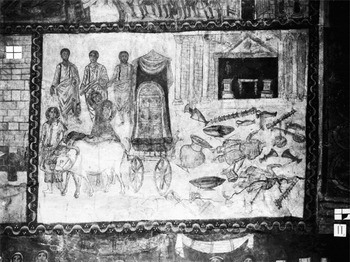
In addition to the clear status of the Tabernacle and Temple panels as pendants, they are also part of a larger series of panels on the middle level as a whole, many of which center on the Ark of the Covenant. To the left of the Tabernacle and well panels, the narrative series continued on the south wall with the tail end of a procession involving the Ark. The beginning of this procession has unfortunately been destroyed, and its identification is difficult to determine. However, it clearly moves from right to left and thus away from the Tabernacle images.Footnote 78 This seems to indicate that the Ark's story continued, though it is followed by the lacuna up to and just beyond the doorway on the east side of the assembly hall. The story resumes on the north wall with an extended series of narrative panels leading up to the Temple image, beginning with the account in I Samuel 4 of the Ark's capture at the hands of the Philistines at the Battle of Ebenezer.Footnote 79 As the Philistines carry the Ark from the field of battle, they parallel the procession with the Ark on the opposite wall. The narrative continues on the west wall with a panel showing two episodes from the events subsequent to the battle (Figure 7). To the right, the Philistine idols have fallen, broken, in the presence of the Ark of the Covenant, which the Philistines had placed in the temple to their god. In response, the Philistines have placed the Ark on a cart to send it away from their country toward Israel (I Samuel 5), as shown at the lower left of the panel.Footnote 80 Whereas the empty threshold of the Philistine temple echoes the threshold of the corresponding panel with the well, the chaotic scattering of the idols and the presence of several cultic objects on the ground form a contrast to the orderly worship of the Israelites. The narrative panels to the right of the shrine have been carefully planned so that they are balanced compositionally and thematically with the narrative panels on the left side of the middle level. The narrative moves chronologically from right to left, leading up to the Temple panel itself, and recounts events leading up to the period of David and Solomon, when the Temple was first vowed and constructed. As the panel depicting the temple (Figure 6) follows these episodes, it would, again, make sense to call it the Jerusalem Temple, the final destination for the Ark of the Covenant.Footnote 81
Dura-Europos Synagogue, The Ark Triumphant, detail from the west wall, 244–45. (Yale University Art Gallery, Dura-Europos Collection)

Although both the pairing of the panel with the temple and the Tabernacle, and the panel's position at the end of a series of images related to the Ark support its identification as the Jerusalem Temple, both the pairing and the narrative position also emphasize the very thing that the Jerusalem Temple lacks in comparison to the Tabernacle image: the Ark of the Covenant. Moreover, there are no priests, no sacrifices, and no worshipers in this structure. The Temple is beautiful, but empty. Explanations for this contrast run the gamut of possibilities, ranging from the argument that the Temple is a spiritualFootnote 82 or messianic TempleFootnote 83 somehow in no need of an Ark or of sacrifice, to the proposal that the Temple has been profaned, or even that it is a pagan temple.Footnote 84 These arguments all imply a comparison in the inherent value of the respective sanctuaries (and their representations), the nature of which is fundamentally important to the pictorial rhetoric of the holy places in the decoration of the synagogue.
I am not inclined to see the contrast between the Tabernacle and the Temple panels in terms of the ontological status of each shrine relative to the other (“holy” vs. “profaned,” or “earthly” vs. “heavenly” or “messianic”). What the viewer now sees is the Ark of the Covenant in the panel to the right, victorious over the Philistine idol and set on a path toward Israel and toward the panel depicting Jerusalem with its Temple. Taken together, the panel with the Ark moving away from the land of the Philistines and the panel with the Temple actually figure the movement or ascent of the Ark as it “goes up” toward Jerusalem. The panel with the Temple serves as the penultimate set painting in a drama centered on the Ark of the Covenant.
The contrast between the two sides and the “incompleteness” of the Ark's journey has a specific narrative function: It creates suspense. The worshiper/viewer who has followed the narrative thus far is made to wonder when the Ark will finally arrive at the Temple to complete the narrative. Like watching a slow-motion film of a runner in the last lap of a race, one feels the tension of the final phase of the competition and, perhaps, is tempted to shout out encouragement to the favored contestant. Moreover, as Joseph Gutmann has argued, the movement of the Ark of the Covenant in a narrative ring around the assembly hall may also have echoed and reified liturgical processions with the Torah “ark” within the synagogue itself.Footnote 85 A relief carving from the synagogue at Capernaum may show a Torah shrine on wheels that could be moved as part of such a procession.Footnote 86 Although Gutmann's argument that a specific hymn implying such an interconnection was the precise source for the imagery is probably too specific, his general idea that processions may have taken place at Dura seems plausible. Interestingly, in the hymn that Gutmann cites (associated with a third-century rabbi and found in the Babylonian Talmud) the milk kine who pull the Ark (presented in the guise of the Torah cabinet in the hymn) exhort the Ark to “ascend in the fullness of your majesty” to the “sanctuary place.”Footnote 87
Considered in isolation, the middle level of narratives is thus curiously lacking in closure. However, to have depicted the Ark at the center of the Temple panel from the second phase of decoration would have created structural and narrative problems in connection to the synagogue decoration as a whole. The Ark (or “ark”) would already have been shown placed in the Temple (the shrine) in the first phase of decoration. To place the Ark in the Temple panel to the right would have meant a redundant and off-center narrative focus that would have competed with the liturgical focus on the Torah shrine itself. Building on the interconnections between the Ark of the Covenant and the Torah “ark,” Gutmann argued that the placement of the “ark” in the Torah shrine actually constituted the completion of this narrative.Footnote 88 By placing the “ark” in the shrine at the center of the west wall, the congregation completed the narrative of the Ark's journey so that the Ark had come to rest at the center of the “house” constructed by Solomon. The tension created by the images to the right had been resolved and worship could begin.
Kraeling has argued that the consecration of the Temple under Solomon was the subject of the incompletely preserved panel depicting the end of a procession with the Ark depicted on the south wall of the synagogue, to the left of the panels with the Tabernacle and well.Footnote 89 However, this identification would disrupt the otherwise chronological sequence of the existing panels on the second level. The procession could just as well be identified as the crossing of the Jordan with the Ark, as suggested by Gutmann,Footnote 90 or the Battle of Jericho. The victory at Jericho, entailing multiple processions with the Ark, would provide a foil for the defeat at Ebenezer, with its removal of the Ark from the field of battle as depicted on the wall directly opposite. In addition, Kraeling's identification of the fragmentary Ark procession with the consecration of the Temple under Solomon would also have offered a redundancy: The Sukkot symbols next to the Temple image on the Torah shrine's decorative panel were a previously existing reference to the feast celebrated at the time of the consecration and the initial placement of the Ark in the Temple. It is the placement of the Torah “ark” in the “house” represented by the shrine that signals the central event in the consecration narrative; there was no need to represent this event on the surrounding walls if the congregation already enacted it through their liturgical interaction with the Torah shrine.
Thus far, I have said little about any “messianic” or “eschatological” meanings that either the Temple image on the Torah shrine or the surrounding narrative may have had. On the one hand, I see no evidence that the Temple or any other images on the middle level have any discrete iconographical features requiring that they be understood as inherently “messianic” structures. On the other hand, the historical construction of the Jerusalem Temple under Solomon was the basis for all subsequent expectations regarding its restoration, as these expectations depended on the historical background and surrounding circumstances for their extrapolation. To return to the Temple courts in the age to come would be to replicate the great age in Israel's history under Solomon. Gathering for prayer in the synagogue represented a liturgical completion to a historical narrative at Dura that could also, potentially, prefigure a future age of restoration to the site of Jerusalem itself.Footnote 91 Whereas the consecration of Solomon's Temple took place during Sukkot, the great pilgrimage feast was also associated with a return of the Israelites to Jerusalem and to the Temple in the age to come.Footnote 92 There is no reason either to insist on an eschatological reading as the exclusive interpretation to the images or to deny the possibility that the congregation could have read the images in this way.Footnote 93
The placement of the Torah “ark” in its shrine marks the moment when the liturgical present is linked to the past and, potentially, to the future. I would like to use the connections between the Ark as presented at the center of the Tabernacle and the “ark” displayed in the Torah shrine of the synagogue as a starting point to explore further links between the liturgical activities presented in the Tabernacle and well panels and the worship of the synagogue congregation itself. In what follows, I will offer some suggestions as to how two liturgical activities in the synagogue—prayer and the reading of the Torah—could have been understood: in connection to the images of worship in the Sinai Wilderness; as part of the larger Temple-focused narrative recounted on the surrounding walls; and, potentially, in anticipation of the restoration of worship in the Jerusalem Temple in the age to come. These suggestions are heuristic, but not farfetched, and would offer plausible (if not provable) accounts as to how the congregation would have understood its own activities in light of this narrative framework.
IV. Prayer and Sacrifice in Tabernacle, Temple, and Synagogue
Kraeling's reconstruction of the synagogue's dedication text suggests that at least some members of the congregation at Dura would have “spread out” their hands (in prayer) in the synagogue,Footnote 94 a gesture that would have echoed the orant pose of the Israelites who gather just outside the door of the Tabernacle. Whether or not intended, such activity would create a link between the assembled Israelites and synagogue assembly itself as they oriented themselves toward the shrine. Prayer toward the sanctuary in the Tabernacle was thus made to provide the authenticating model for the activities of the synagogue congregation. Having placed the “ark” in its “house,” and positioned in prayer before the shrine, the congregation also played the role of Israelites who were assembling in Jerusalem for the pilgrimage feast of Sukkot. In this way, the synagogue not only constructed a link between the “ark” and the Ark, but also between the congregation and the biblical tribes of Israel as they gathered in the outer courts of the Temple for prayer.
Although we don't know precisely what the synagogue community at Dura would have prayed, Fine has recently pointed to a fragment of Hebrew text found at the site of the Dura synagogue similar in form to prayers known from rabbinic literature.Footnote 95 Fine offers that exploring the ‘Amidah (or “standing” prayer) often referred to in rabbinic texts may serve as a test case as to how liturgical prayer created a receptive context for the congregation's own interaction with the images. Having identified the activities taking place in the Tabernacle panel in connection to the sacrificial “service,” I would like to suggest that the ‘Amidah use of the terminology related to this “service” may provide a lens for both the images of sacrifice in the Tabernacle and the prayer that the Israelites offer at its threshold to the left.
The “service” offered in the Tabernacle continued in the Temple in the First and Second Temple periods. The interruption of the tamid offering toward the end of the first Jewish revolt was understood as a great calamity. Josephus reports that during the course of the revolt, on “the seventeenth day of Panemus [Tammuz], the sacrifice called “the Daily Sacrifice” had failed, and had not been offered to God for want of men to offer it, and… the people were grievously troubled at it.”Footnote 96 The Mishnah likewise records the cessation of the “Daily Whole-offering” as one of the “Five things [that] befell our fathers on the 17th day of Tammuz.”Footnote 97 For the priestly leader of Dura, for the congregation, and for the Jewish community as a whole in this period, the cessation of the tamid and its continuing absence would have been cause for concern.
In the period contemporary with Dura, however, rabbinic texts suggest that prayer was timed so as to continue the prayer that had once been offered by the priests in the Tabernacle and Temple at the time of the tamid. Footnote 98 This synchronization was already in evidence from the late Second Temple period, as Judith is depicted as timing her prayer in this way. Footnote 99 Following the fall of the Temple itself, such prayer was increasingly understood to substitute for the tamid.Footnote 100 As the Sifre on Deuteronomy notes, “just as the service of the altar is called ‘service,’ so is prayer called ‘service.’”Footnote 101 As recorded in the Babylonian form of the ‘Amidah, blessing 17 weaves back and forth between prayer and “service” so as to suggest their interconnection:
Be pleased, Lord our God, with your people Israel and with their tefillah [prayer].
Return the ‘avodah [service] to the Temple precincts.
Accept willingly and with love the offerings of Israel and their tefillah [prayer].
May the tamid offering of the ‘avodah [service] of Israel, your people, be acceptable to you.Footnote 102
As Reuven Kimelman points out, the ‘avodah in question could be “service” to God in general, but also may refer to prayer “service” or to the “service” in the Temple.Footnote 103 Contemporary writings on prayer, and the text of the prayers themselves, thus suggest a strong connection between prayer and sacrifice (particularly the tamid).
If the wording or conception of the prayers offered at Dura was at all similar to the ‘Amidah, as described above, they would have had a strong resonance with the presentation of the tamid offering as depicted (I argue) in the Tabernacle panel. But while the images of the Tabernacle show the Israelites offering prayer in tandem with, but separate from, the priestly offering of the sacrificial “service,” the prayer “service” offered by the congregation at Dura would itself have perpetuated the sacrificial “service.” The structural interconnections between the congregation and the shrine would have mirrored (though in transformed fashion), the interconnections between the congregation in the Sinai Wilderness and the “service” performed in the Wilderness Tabernacle. However, for the congregation to emulate the activities taking place in (or just outside) the Tabernacle was also to complete the narrative of the Ark's journey by embodying the liturgical fulfillment of worship established in the Jerusalem Temple itself. The offering of the “service” in the synagogue would have been a hinge between the panels to the right and left: It not only echoed and embodied the worship depicted in the Tabernacle but also brought closure to the narrative of the Ark's journey to the right through the same embodiment of worship. Offering the “service” in this fashion, members of the congregation become actors in a drama played out on the walls surrounding them.
Whereas the congregation's liturgical activity could have brought to life the completion of the historical narrative in Solomon's Temple, it could also have anticipated the restoration of worship in a messianic/eschatological Temple, as located on the site in Jerusalem toward which the synagogue was aligned. Contemporary sources suggest that liturgical activity in the synagogue was a multivalent endeavor that did not merely “replace” the lost Temple service, but also—simultaneously—anticipated its restoration. For example, as in contemporary rabbinic texts,Footnote 104 blessing 17 of the ‘Amidah also suggests a hope for the restoration of the Temple itself, along with its sacrificial service. The terse phrase, “May the tamid offering of the ‘avodah (service) of Israel, your people, be acceptable to you,” could refer to the acceptability of “service” in both the present and the future and the blessing also specifically petitions, “Return the ‘avodah [service] to the Temple precincts.” To offer the prayer “service” in the synagogue was to follow the pattern established in the Tabernacle, but also to play a role in the narrative drama of the middle level by liturgically offering the “service” toward the “house for the ark” (e.g., Solomon's Temple), and, moreover, to anticipate the restoration of that “service” to the Temple court in the age to come.
The image of Aaron offering incense in the Tabernacle, as pointed out earlier, is similar to the many images of incense-offering in the city of Dura at large. If the images of worship in the Tabernacle were to be understood in connection to worship in the synagogue itself, the function of these images would be remarkably similar to that of the images in the surrounding city. The major difference between the synagogue and these sites would be the degree to which the Tabernacle images were part of a larger narrative that depended, ultimately, on another site in Jerusalem itself for its significance. Thus, the synagogue community appropriated the use of cultic images from the city at large in order to define themselves as different from the other communities who met for worship. In this way, the Jewish congregation at Dura was both similar to and distinct from the culture of the city in which they lived.
The fact that the extant synagogue with the next most complex assemblage of pictorial decoration after Dura (Sepphoris) also features a representation of the tamid offering in the Tabernacle may suggest a degree of liturgical continuity between the two communities. The composition and iconographic details of the Tabernacle images in each site are not particularly similar. For instance, unlike Dura, the Sepphoris mosaic does not include an image similar to that of the Israelites worshiping just outside the Tabernacle to complement the priestly activity within. In keeping with this distinction, the mosaic offers the wash basin for the daily cleansing of the priests, while the Dura panel depicts the red heifer sacrifice for the purification of the community at large, as shown in the next panel. It is the subject matter and the context that connects the two sets of images at Dura and Sepphoris. If my argument is correct, the daily offering of the tamid is central to the activities taking place in the Tabernacle, as depicted in the decoration of both synagogues. The images in both would be appropriate complements for the content of the Amidah, the most frequently recited prayer in the liturgy. Yet, the imagery of sacrifice in the Tabernacle could have functioned flexibly in connection to most any holy day or ritual in the synagogue and would not have been narrowly linked only to this prayer.
V. Water from the Well as the Outpouring of Torah
That the Torah is a central focus for Judaism—ancient and modern—needs no elaboration here. At Dura, it was the cabinet containing this Torah that served as both the focus of worship and the central key to the interconnection between the congregation and the narrative recounted on the surrounding walls. There is, however, a widespread tradition that water flowing from the well—and the Temple—represented the study and interpretation of this Torah, a tradition that illumines how the congregation may have understood the image of the well in the midst of the praying Israelites.Footnote 105
Broad connections between water and Torah abound from the earliest phases of Jewish tradition. For example, the prophet Amos speaks of an age to come when there will be a thirst for Torah rather than water (Amos 8:11), while Isaiah 11:9 speaks more positively (and more generally) of a time when divine knowledge will “fill the world as the water covers the seas.” The connection between water and Torah was expanded in different ways in the late Second Temple period. Sirach wrote of the Torah as primordial wisdom that had found its dwelling on Zion and flowed from it like the rivers in Paradise. The scholar is “like a canal from a river” channeling wisdom to those who seek it.Footnote 106 Philo also connected the well in the Numbers passage in particular with wisdom.Footnote 107 The priest-led Qumran community elaborated on the connection between the well and the Torah. In the Damascus Covenant, their wise men interpret the Torah anew:
But God remembered the covenant of the very first, and from Aaron raised men of knowledge and from Israel wise men, and forced them to listen. And they dug the well: [Numbers 21:18] “A well which the princes dug, which the nobles of the people delved with the staff [mehokkek].” The well is the law. And those who dug it are the converts of Israel, who left the land of Judah and lived in the land of Damascus, all of whom God called princes for they sought him, and their renown has not been repudiated in anyone's mouth. And the staff is the interpreter [“searcher,” doresh] of the law.…Footnote 108
As Michael Fishbane has pointed out, the word “staff” (mehokkek) is related to the word for instituting laws (hakak), and by stating that the “staff” is the “searcher” (doresh) of the Law,” the Damascus Covenant also employs a word related to midrash, or biblical interpretation.Footnote 109 The link between well water and Torah also informs a number of other passages from the scrolls.Footnote 110
Rabbinic texts most often connect well and water imagery to the individual teacher of Torah: In the Mishnah, for example, if one studies Torah “for its own sake,” the “mysteries” (razim) of the Torah are revealed to him, and he becomes like an overflowing fountain and ceaseless torrent.” This one who “diligently studies the Torah repeatedly is exalted, as [Scripture] says: ‘And from Mattanah [“giving” (of the Torah)] to Nahaliel [inheritance], and from Nahaliel [inheritance] to Bamot [high places]’ (Numbers 21:19).”Footnote 111 But such water/Torah could also be dispensed in the synagogue, as in the Mekhilta, where water given at Marah (Exodus 15:22–25) is likened to synagogue readings:
The ancient interpreters said “And they did not find water…” refers to divine teachings, which are compared to water.… And since they were separated from “water” for three days and thereupon rebelled, for this reason did the prophets and sages make it a rule that the Torah is to be read publicly on the Sabbath, on Monday, and on Thursday.Footnote 112
In the Mekhilta, the subsequent reference to the Israelites encamping by the water at Elim hearkens back to this interpretation, for “it is merely to teach that they were occupied with the words of the Torah which had been given to them at Marah.”Footnote 113 And the Mekhilta also refers to the Numbers passage specifically in connection with the Torah: “The Torah is called an inheritance, as it is said: ‘And from Mattanah to Nahaliel’ (Numbers 21:19).”Footnote 114 In a liturgical setting, the waters from the miraculous well could be understood in connection to the Torah read in the synagogue.
Would the congregation at Dura have also known about the connection between Torah and water from the well in order to read the image in this fashion, or even to have included it as an intentional evocation of this symbolic meaning? Although it is impossible to argue this with any certainty, the tradition is certainly both broad and deep. As noted, we find versions of this interconnection in the late Second Temple period in authors as diverse as Sirach, Philo, and those responsible for the Dead Sea Scrolls. In addition to the tannaitic texts cited above, the tradition also makes its way into later Palestinian midrashim, as in Genesis Rabbah, where a reference to Jacob's well (“for out of that well the flocks were watered”) is glossed as “from there each one drew water for his standard, tribe, and family,” as in the Number's passage, as well as “for from there they hear the reading of the Torah.”Footnote 115 Likewise, the tradition in the Mekhilta linking the lack of water in the desert with the need for Torah was also cited in the Babylonian Talmud.Footnote 116 Without suggesting knowledge of a specific rabbinic textual source, it seems plausible that the Dura community could have known about this tradition.
Conversely, the overflowing of the waters could also anticipate the outpouring of waters from the eschatological Temple, as envisioned by the prophets. In particular, the passage in Zechariah regarding the celebration of the feast of Sukkot in the eschatological future is the same one that refers to waters pouring out of Jerusalem in this coming age. As noted, the Tosefta makes reference to such prophetic texts in connection to the miraculous well.Footnote 117 Those gathered in prayer before the Torah shrine, with its image of the Temple and Sukkot symbols, could have anticipated not only a return to the Temple courts to pray but also the outpouring of divine blessing from the Temple to the land and people surrounding. Nothing in the image itself necessitates that the well in the panel at Dura be interpreted in connection to Torah in either the liturgical present or the messianic future. Nevertheless, the texts cited above provide possible ways in which the congregation at Dura could have understood the significance of the well in the midst of the congregation gathered in the Sinai Wilderness. The connection between water and Torah would certainly relate to the central focus of the community on the Torah cabinet housed at the center of the west wall. If the Torah in the “ark” was a source of the synagogue's holiness and blessing, it was by reading and studying the sacred scroll that the water was drawn from its source.
VI. Conclusion
This account of images of holy places at Dura stresses the underlying significance of the placement of the Ark of the Covenant in the Temple under Solomon as the high point of Israel's history and the focus of the synagogue's decoration. The narrative focus on Solomon's Temple and the way in which the surrounding narratives of the middle level frame the “house for the ark” provide a way of understanding the basic structure of the decoration and the logic behind the conception and the placement of the narrative panels. It also suggests how the imagery at Dura could have functioned as a means of orientation for the congregation in the period after 70 CE and 135 CE, when Jewish communities at large were coping with the extremely disruptive aftermath of two failed revolts against Rome. The images served as, first, a spatial signpost toward the site of Jerusalem and, second, as a narrative framework that integrated the congregation into a sacred history that would seem to have come to a disastrous end. In doing so, the decoration constructed the synagogue itself as a holy place where the congregation could still offer “service” and, quite likely, pointed beyond this site toward an age to come when the sanctuary could be restored to Jerusalem itself.
In suggesting a definite structure for the Temple-related images and narrative, I nevertheless believe that the congregation and its leaders could have composed flexible interpretations of the imagery that would have depended on changes in the liturgy, holy days, or the particular circumstances of the community. The imagery could have excited a range of responses, including memory of and pride in a glorious shared past, anger at the loss of the Temple, spiritual exultation in the offering of the service, and desire for the culmination of Israel's redemptive history on Zion in the messianic future. The crucial and unchanging function of the images, however, is the way in which they draw the congregation itself into the sacred narrative, designating them as Israel at worship before the sanctuary.