Introduction
Agricultural productivity of plants decreases due to various biotic and abiotic stresses. Salinity has affected 10% of arable land, 25 to 30% of irrigated land in commercially productive areas (FAO 2008; Shahid et al., Reference Shahid, Zaman, Heng, Pharis and Zaman2018) that affects more than 20% of present-day global agriculture (Mickelbart et al., Reference Mickelbart, Hasegawa and Bailey-Serres2015). Upland cotton (Gossypium hirsutum L.) is relatively salt tolerant that grows up to salinity level of 7.7 dSm−1 without any detrimental effects on growth and yield (Kamaran et al., Reference Kamaran, Khan, Shakeel, Ahmad and Zeb2016). However, reduction in germination and emergence percentage and 15 to 55% reduction in cotton yield occurs at salinity level ranging from 8–18 dSm−1 has been reported (Sevik and Cetin, Reference Sevik and Cetin2015) which necessitates the development of salt tolerant cotton cultivars.
Salinity is a severe problem in arid and semiarid regions where it decreases the number of mature bolls and boll weight and deteriorates fibre quality leading to the reduction of cotton overall yield. (Satir and Berberoglu, Reference Satir and Berberoglu2016). Reduction of mature bolls under salinity stress is mainly due to delay of flowering, increased shedding of flowers and bolls (Farooq, Reference Farooq2019). Higher sodium and chloride ions in the soil disturb the osmotic and ionic homoeostasis at cellular level as well as inhibits photosynthesis. Inhibition of photosynthesis leads towards abnormal plant growth by damaging cellular metabolism (Chen et al., Reference Chen, Wan, Liu, Fan, Zhang, Wang, Xia, Yuan, Deng and Shen2016). Salts produce toxicity of that causes imbalance of metabolic ions limiting the expansion of cell size which leads towards reduction of plant growth (Dong, Reference Dong2012). Mature fibre hold more than 85% cellulose which is generated from the sucrose, however, under the saline conditions sucrose is available but it does not efficiently convert into cellulose which leads towards poor quality of fibre (Peng et al., Reference Peng, Zhang, Liu, Luo, Zhao, Dong, Ma, Sui, Zhou and Meng2016).
Salt stress disrupts the cellular ions resulting in ionic toxicity, osmotic stress and over production of reactive oxygen species (ROS). Plants have efficient complex enzymatic and non-enzymatic antioxidant defence systems to avoid the toxic effects of free radicals (Khan et al., Reference Khan, Ungar and Showalter2000). Salt stress causes excessive generation of ROS such as superoxide anions, hydrogen peroxide (H2O2), and hydroxyl radicals (OH−) (Zheng et al., Reference Zheng, Jiang, Liu, Dai, Jing and Cao2009). To mitigate the oxidative damage initiated by ROS under salt stress, plants employ a complex antioxidant system, i.e., enzymatic antioxidants such as superoxide dismutase (SOD), catalase (CAT) glutathione peroxidase, and peroxidases (POD) and ascorbate peroxidase and glutathione reductase and, non-enzymatic antioxidants such as ascorbic acid, glutathione (GSH), tocopherols, and carotenoids. This antioxidant quenches the free radicals to alleviate the cellular damage due to the oxidative stress (Farooq et al., Reference Farooq, Shakeel, Zafar, Farooq, Chattha and Husnain2020).
Toxic effects of salt stress can be improved by developing the salt tolerant varieties (Tiwari et al., Reference Tiwari, Picchioni, Steiner, Jones, Hughs and Zhang2013). In the cotton germplasm sufficient variations have been reported for salt tolerance which are genetically controlled (Noor et al., Reference Noor, Azhar and Khan2001; Bhatti and Azhar, Reference Bhatti and Azhar2002). The present research work was done to study the genetic basis of salinity tolerance in cotton genotypes. The results of present study would be useful for cotton breeders to initiate a sustainable breeding programme for improving seed cotton yield and quality of fibre under salt stress.
Materials and methods
Experiment design
The research was conducted in the research area of Department of Plant Breeding and Genetics, University of Agriculture Faisalabad. For crossing in line × tester mating design, five parents (FH-214, RH-647, CIM-595, VH-371 and VH-377) were used as line and three parents (FH-2015, KEHKSHAN and VH-327) were used as tester and were sown in the earthen pots in the year 2018 in the glasshouse conditions. F 0 seeds were produced from these parents by making crosses between them in line × tester mating design. After making crosses, separate picking and ginning of each selfed and crossed boll was done and were kept in butter paper bag to avoid from any damage till next season of cotton sowing.
Sowing and developing electrical conductivity of required concentrations
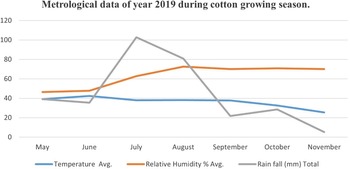
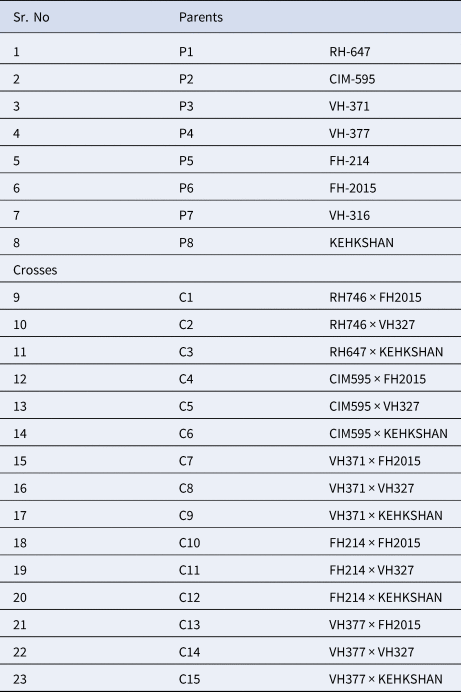
At the time of next sowing season of cotton crop, 23 cotton genotypes (Table 1) including eight parents and 15 crosses were sown in three replications during May 2019 and metrological data of cotton growing season is given in Fig. 1. Sowing was done in the earthen pots that were placed in split plot arrangement under randomized complete block design under control and salt stresses. For developing the required concentration of salts in the earthen pots, samples were collected with the help of Augur to check the electrical conductivity (EC) of the soil. The samples were sun dried for 24 h. Paste of sieved soil was made with distilled water and was placed for 24 h. After the drying, EC of the soil was found 2.4 dSm−1. By using method of U.S Salinity laboratory 1954 (Richards, Reference Richards1954), the required levels of salinity (10 and 20 dSm−1) were developed in earthen pots. For this purpose, earthen pots were filled with weighed soil. Cotton seeds were sown in the pots and were placed in the open field. EC was checked twice a week to maintain required concentration of salt levels. Additions of extra salts in the earthen pots were done if the EC of soil in earthen pots became low. All other proper agronomic practices were carried out from sowing to harvesting. When crop reached at maturity stage data were taken from five cotton plants of each treatment.
Metrological data of year 2019 during cotton growing season.

Cotton genotypes used in present research

Data collection
When plants reached at maturity stage, manual picking of cotton was done. Picking of cotton was done after the sun rise to ensure that the bolls are dry. Different plants of each treatment were selected to collect the data related to cotton yield, within yield components, ionic concentration, fibre quality and biochemical traits. After completion of cotton picking, collected cotton was placed in different bags with proper tagging of treatments.
Yield related traits
Plant height (PH)
Height of individual plant was measured from the 1st cotyledon node to apical bud with the help of measuring stick and expressed in centimetre.
Number of bolls per plant (NB)
All cotton bolls were picked from each replicated plant in controlled and salt stress conditions. Average number of bolls for each cotton genotype in each replication was recorded.
Individual boll weight (BW)
For this purpose, total cotton yield of every plant was divided on the total collected bolls from that plant. Individual boll weight was measured in grams.

Seed cotton yield (SCY)
Picking of cotton crops was done manually. Picking was done after the sun rise when no dew drops were present on the opened cotton bolls. Seed cotton yield of every plant from each replication was stored in the separate paper bags. Electric weight balance was used to measure the weight of seed cotton yield of every plant. Yield of seed cotton of every plant was expressed in grams.
Within boll yield components
Seed index (SI)
After ginning process 100 seeds were counted from seed sample and they were weighed on electrical balance to calculate weight of 100 cotton seeds or seed index. Seed index was expressed in grams.
Lint index (LI)
Lint index was calculated as

Lint percentage (LP)
Total yield of single plant was ginned, and lint of each sample obtained after ginning was weighed to calculate lint percentage. It was calculated by following formula.

Seed number per boll (SNPB)
Number of seeds per boll was calculated by given formula.

Seed mass per boll (SMPB)
Seed mass per boll was calculated by dividing the total seed mass of sample on total numbers of bolls in that sample.

Lint mass per ball (LMPB)
Lint mass per boll was calculated as

Lint mass per seed (LMPB)
Lint mass per seed was calculated as

100 Seed volume (SV)
By using ethanol displacement method volume of 100 seeds was calculated. Preference was given to ethanol because of its low specific gravity and fast drying. To calculate volume of 100 seeds, ethanol was taken in 50 ml graduated cylinder. 100 calculated cotton seeds were put in graduated cylinder. Volume of graduated cylinder was raised up after adding 100 cotton seeds in it and total volume was measured. Volume of 100 cotton seeds was calculated by subtracting the volume of ethanol from total volume of graduated cylinder. Volume of 100 seeds was expressed in cm3.
Seed density (SD)
Seed density was calculated by dividing seed index to seed volume.
Fibre quality traits
Fibre quality traits including fibre length, fibre strength and fibre fineness of all 23 genotypes were measured by using spin lab HVI-9000. It is computerized ‘High volume instrument’ which provides a detailed profile of raw fibre.
Ion concentration
Sodium and potassium ions concentration were measured according to (Farooq et al., Reference Farooq, Shakeel, Atif and Saleem2018) with minor changes. When plants achieved maturity stage, green leaves were picked up at noon, washed with distilled water and were subjected to hot air for 72 h. Mortar and pestle were used to grind the dried leaves. After grinding, digestion was done with 2: 1 ratio (molar concentration) of concentrated nitric acid and sulphuric acid on hot plate. Samples were cooled down at room temperature with the addition of distilled water and by using flame photometer. Concentration of potassium ion was divided by concentration of sodium to calculate potassium to sodium ratio.
Biochemical attributes
Biochemical parameters i.e., proline, POD, catalase (CAT), hydrogen peroxide (H2O2), SOD and total soluble protein (TSP) were measured by using leaf tissues that were previously stored at −80°C refrigerator. Proline contents were determined by following the protocol as proposed by (Bates et al., Reference Bates, Waldren and Teare1973). The POD activity was assessed following Fielding and Hall (Reference Fielding and Hall1978). Catalase activity was assayed according to (Chance and Maehly, Reference Chance and Maehly1955). H2O2 content was estimated according to the method of (Bergmeyer and Bernt, Reference Bergmeyer and Bernt1974). The SOD activity was determined by following the methods of (Beauchamp and Fridovich, Reference Beauchamp and Fridovich1971), while TSP was estimated by following the protocol of (Bradford, Reference Bradford1976).
Results
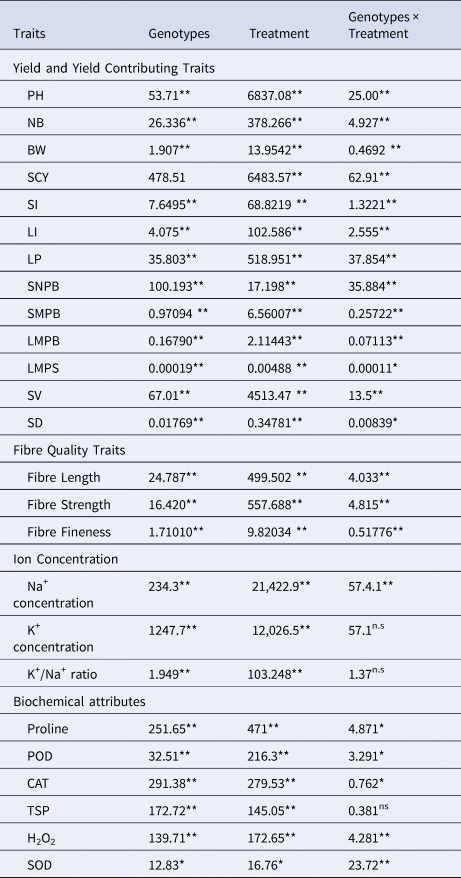
Analysis of variance exhibited highly significant differences for all the characters under study among parents and hybrids, thereby indicating the presence of genetic variability among them. Genotypes × Treatment interaction for Na+ ion concentration showed highly significant difference which indicates that all genotypes behaved differently under salt stress conditions. Genotypes × Treatment interaction for TSP, K+ ion concentration, Na+ concentration and K+/Na+ ratio showed non-significant differences which indicates that all genotypes (tolerant and susceptible) showed similar behaviour for these traits under different level of stress conditions (Table 2).
Mean square from analysis of variance for yield and yield contributing traits of 23 cotton genotypes grown under control and salinity stress of NaCl @ 10 and 20 dSm−1

*, Significant at P < 0.05; **, Highly significant at P < 0.01; n.s, Non Significant.
Yield contributing traits
Salinity stress negatively affected plant height, with the increase of salinity stress plant height decreased. At 10 dSm−1 level of salt stress, genotypes VH-377 × FH-2015 gave minimum plant height while at 20 dSm−1 salinity level minimum plant height was observed in CIM-595. At 20 dSm−1 salt stress condition, maximum plant height was observed in genotypes KEHKSHAN and RH-647 × KEHKSHAN, respectively. Number of bolls per plant decreased at both level of salinity stress. At 20 dSm−1 salt stress, minimum number of bolls per plant was observed in cross VH-377 × KEHKSHAN while maximum number of bolls per plant was observed in RH-647. Reduction in boll weight was recorded in all genotypes at both level of salinity stress. At 10 dSm−1 salt stress, minimum boll weight was recorded in genotypes VH-377 while maximum boll weight was recorded in cross RH-647 × KEHKSHAN. At 20 dSm−1 salt stress, maximum boll weight was observed in cross FH214 × FH-2015. At 20 dSm−1 salt stress, maximum seed cotton yield was observed in genotype RH-647 and among crosses in FH214 × FH-2015.
Seed index of all genotypes reduced at each level of salinity stress. Minimum seed index was found in cross CIM-595 × FH-2015 while maximum seed index was observed in KEHKSHAN at 10 dSm−1 salt stress. At 20 dSm−1 salt stress, maximum seed index was recorded in FH-2015 while minimum seed index was observed in cross CIM-595 × VH-327. Under control condition maximum lint index was observed in cross VH-377 × VH-327. At 20 dSm−1 salt stress maximum lint index was found in cross VH-371 × KEHKSHAN while minimum lint index was observed in cross RH-647 × VH327.
Seed number per boll, seed mass per boll, lint mass per boll and lint mass per seed decreased with the increase of salinity stress and maximum reduction in all these traits were recorded at 20 dSm−1. Seed volume of all studied genotypes decreased at both level of salinity stress. At 10 dSm−1 level of salt stress maximum seed volume was observed in genotypes KEHKSHAN and minimum seed volume was observed in genotypes VH-327. At 20 dSm−1 salinity level, minimum seed volume was recorded in genotype VH-371 and maximum seed volume was recorded in genotype KEHKSHAN. At 10 dSm−1 salt stress, minimum seed density was observed in cross RH-647 × VH-327 and maximum seed density was recorded in genotype FH-2015 while at 20 dSm−1 salinity level maximum seed density was observed in genotype FH-214.
Fibre quality traits
The quality of fibre traits got negatively affected due to salinity stress. Lint percentage of genotypes increased at both level of salinity stress. At 10 dSm−1 salt stress, maximum lint percentage was recorded in genotype CIM-595 while minimum lint percentage was observed in genotype KEHKSHAN. At 20 dSm−1 salt stress, maximum lint percentage was recorded in cross CIM-595 × VH-327 while minimum lint percentage was recorded in genotype RH-647. Fibre length of all genotypes decreased at both level of salinity stress. Maximum fibre length was recorded in cross CIM-595 × FH-2015 while minimum fibre length was found in cross VH-377 × KEHKSHAN at 10 dSm−1 salt stress. At 20 dSm−1 salt stress, maximum fibre length was found in cross FH-214 × KEHKSHAN while minimum fibre length was found in genotype VH-327. At 20 dSm−1 salt stress, maximum fibre strength was observed in genotype KEHKSHAN while minimum fibre strength was found in genotype CIM-595 × FH-2015. Fibre fineness of studied genotypes increased under salinity stress. Maximum fibre fineness was recorded in the genotype FH-2015 while minimum fibre fineness was found in cross FH-214 × VH-327 at 10 dSm−1 salt stress. At 20 dSm−1 salt stress, maximum fibre fineness was observed in cross FH-214 × VH-327 while minimum fibre fineness was found in genotype VH-371.
Ion concentration
Concentration of Na+ in leaves of all genotypes increased under salinity stress conditions. At 10 dSm−1 salt stress, minimum Na+ ion was observed in genotype KEHKSHAN and maximum Na+ ion was observed in cross CIM-595 × VH-327 while at 20 dSm−1 salt stress, minimum Na+ ion was recorded in cross RH-647 × KEHKSHAN and maximum Na+ ion was observed in genotype CIM-595. Concentration of K+ ion in leaves of all genotypes decreased under salinity stress conditions as compared to control. Under 10 dSm−1 salt stress, minimum K+ ion was observed in cross VH-371 × KEHKSHAN and maximum K+ ion was observed in genotypes KEHKSHAN while at 20 dSm−1 salt stress, minimum K+ ion was recorded in cross RH-647 × VH-327 and maximum K+ ion was observed in genotype KEHKSHAN.
Biochemical traits
Under controlled condition, maximum proline contents recorded were (0.43 μmol g−1 (FW)) and minimum were (0.16 μmol g−1 (FW) whilst under 10 dSm−1 maximum and minimum proline contents were (0.91 μmol g−1 (FW)) and (0.37 μmol g−1 (FW)), respectively. However, under 20 dSm−1 salinity level, maximum and minimum value for proline contents were (1.02 μmol g−1 (FW) and (0.57 μmol g−1 (FW)), respectively. Peroxidase level was measured under controlled and both level of salt stress. The maximum value for peroxidase was (18.51 U mg−1 protein) and minimum value was (11.07 U mg−1 protein) under control condition whilst under 10 dSm−1 level of salt stress maximum value was (21.38 U mg−1 protein) and minimum value was (13.71 U mg−1 protein).
Under control condition, the maximum value of catalase contents was (30.81 U mg−1 protein) and minimum value recorded was (19.62 U mg−1 protein) whilst under 10 dSm−1 level of salt stress maximum and minimum catalase content was (42.71 U mg−1 protein) and (24.01 U mg−1 protein) respectively. However, in case of 20 dSm−1 salinity level, maximum and minimum values were (54.04 U mg−1 protein) and (36.01 U mg−1 protein) respectively. H2O2 contents were also determined under control and both level of stresses. The maximum (0.32 μmol g−1 (FW)) and minimum (0.05 μmol g−1 (FW)) values were found under normal conditions whereas under 10 dSm−1 level of salt stress, maximum and minimum values were (0.51 μmol g−1 (FW)) and (0.14 μmol g−1 (FW)). Under 20 dSm−1 salinity level, maximum and minimum H2O2 contents were (0.76 μmol g−1 (FW)) and (0.42 μmol g−1 (FW)), respectively. Under control conditions, the maximum value of TSP was (7.02 U mg−1 protein) and minimum value was (1.78 U mg−1 protein) whereas under 10 dSm−1 level of salt stress maximum and minimum values for TSP were (9.07 U mg−1 protein) and (3.72 U mg−1 protein) respectively. Under 20 dSm−1 level of salt stress, the maximum and minimum values were (9.07 U mg−1 protein) and (9.07 U mg−1 protein) respectively.
Under control condition, the maximum value of SOD was (12.63 U mg−1 protein) and minimum value was (3.76 U mg−1 protein) whilst under 10 dSm−1 level of salt stress maximum and minimum SOD contents were (27.72 U mg−1 protein) and (12.07 U mg−1 protein) respectively. However, in case of 20 dSm−1 salinity level, maximum and minimum values were (35.71 U mg−1 protein) and (17.84 U mg−1 protein) respectively.
Correlation and heritability analysis
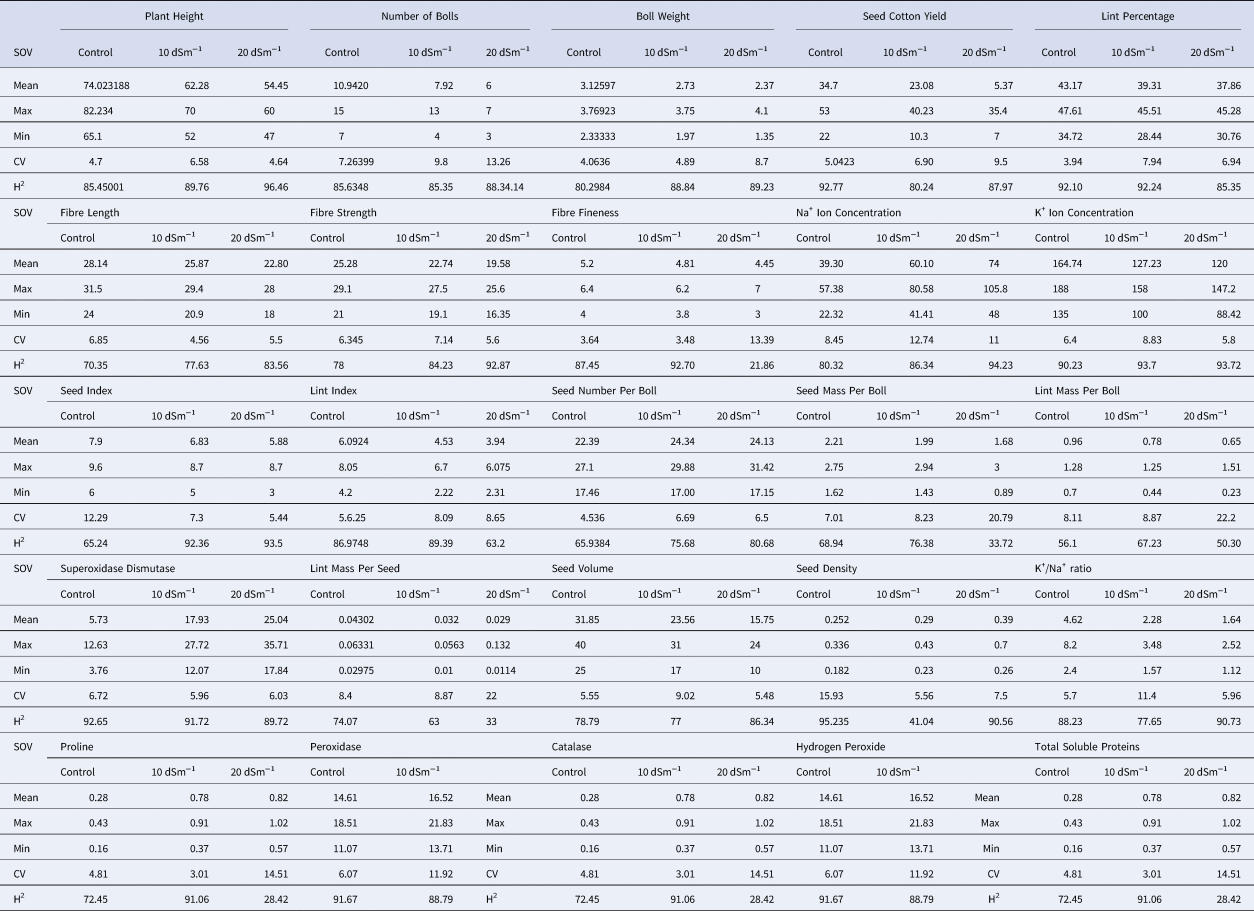
Under control condition plant height showed highly significant positive correlation with NBPP, SI, BW, SV, LI, and SD while significant positive correlation was observed with SCY (online Supplementary Table S1). Under 10 dSm−1 salt stress, SCY showed highly significant positive correlation with FL, LMPB, NBPP, SMPB, and BW while fibre fineness showed highly significant negative correlation with FL, LMPB, LMPS, NBPP, PH, SMPB, SI, BW, and SCY. Under 10 dSm−1 salt stress, Na+ ion gave highly significant negative correlation with K+ and K+/ Na+ ratio (online Supplementary Table S2). Under 20 dSm−1 salt stress, Na+ ion showed significant negative correlation with SCY and LP while highly significant negative correlation showed with K+/Na+ ratio. Under 20 dSm−1 salt stress, SCY showed highly significant positive correlation with FL, K+ ion, K+/ Na+ ratio, LMPB, LMPS, NB, PH, SI, SMPB, and BW while there was significant negative correlation with Na+ ion. Under 20 dSm−1 salt stress, seed density showed highly significant negative correlation with LMPB, LMPS, NB, PH, SMPB, SI, BW, FS, and LI (online Supplementary Table S3). In most of the traits, moderate to high level of broad sense heritability was observed under both salinity levels which indicated that most of the traits were genetically controlled (Table 3). Under control conditions minimum broad sense heritability was observed for LMPB while maximum broad sense heritability was found for LP. Under 20 dSm−1 salt stress, minimum broad sense heritability was observed for SMPB while maximum broad sense heritability was found for PH. Estimated heritability of the traits increased with the increase salinity level which might be due to expression of salt tolerant genes. It might give another opportunity to uncover hidden genetic variation under salt stress.
Components of variability and heritability of various traits under control and stress conditions

Discussion
For selection of better genotypes against different biotic and abiotic stress, presence of genetic variation within crop species is very important as it provide important germplasm to the breeder for future plant breeding programs (Tyagi et al., Reference Tyagi, Gore, Bowman, Campbell, Udall and Kuraparthy2014). Under salinity stress all genotypes behaved differently which reflected the presence of genetic variability among them. Level of salinity stress, screened germplasm type and stage of crop exposed to salinity stress affect the degree of variability among genotypes (Farooq et al., Reference Farooq, Shakeel, Atif and Saleem2019). Differences appeared among different genotypes at low salinity level are not easy to understand as compared with high level of salt stress. Under high salt stress plant height of salt sensitive genotypes reduced much more as compared with salt tolerant genotypes. KEHKSHAN gave maximum height at high level of salt stress. Reduction in the height of cotton plants grown at different level of salt stress was also observed. Reduction of plants height under salinity stress could be due to reduction of carbohydrates, growth hormones as well as negative affect of NaCl ions on photosynthetic rate (Wang et al., Reference Wang, Qi, Qiao, Shi, Xu, Zhou, Yan and Huang2017). Although cotton is considered salt tolerant crop having threshold level of 7.7 dS m−1, but beyond the threshold level, per unit dS m−1 increase leads to 5.2% per cent reduction in yield (Abdelraheem et al., Reference Abdelraheem, Esmaeili, O'Connell and Zhang2019). Therefore, in our experiment in field condition under 20 dS m−1 upto 64% reduction in yield occurred in salt sensitive genotypes (VH-327). Salinity stress caused reduction in boll numbers as well as weight of the bolls which led toward overall decrease in cotton yield. Lint percentage of all genotypes increased under salinity stress and salt sensitive genotypes (CIM-595, VH-377 × FH-2015) gave more lint percentage as compared with salt tolerant genotypes (KEHKSHAN). It was reported that lint percentage increased with the increase of salinity stress (Chen et al., Reference Chen, Wan, Liu, Fan, Zhang, Wang, Xia, Yuan, Deng and Shen2016). Under high level of salt stress, expression of salt tolerant genes at early stage of fibre development may influenced the lint percentage in salt tolerant cotton genotypes (Chen et al., Reference Chen, Wan, Liu, Fan, Zhang, Wang, Xia, Yuan, Deng and Shen2016).
Fibre fineness increased under salinity stress (low micronaire values give high fibre fineness). Maximum fibre fineness under 20 dS m−1 salt stress was observed in FH-2015. High salinity tends to reduced seed index and increase fibre fineness (Zafar et al., Reference Zafar, Razzaq, Farooq, Rehman, Firdous and Shakeel2022). Fibre length and fibre strength decreased under salinity stress and salt tolerant genotypes have more fibre length and fibre strength. Several experiments have confirmed that high salinity level influenced the quality of fibre and our results were consistent with earlier studies (Peng et al., Reference Peng, Zhang, Liu, Luo, Zhao, Dong, Ma, Sui, Zhou and Meng2016).
In leaves of salt tolerant cotton genotypes Na+ ions were in low concentration as compared to salt sensitive cotton genotypes and K+ ions were high in salt tolerant genotypes as compared to salt sensitive genotypes. Cross RH-647 × KEHKSHAN and genotype FH-2015 maintained low Na+ ions in their leaves at both level of salinity stress so these genotypes were considered salt tolerant genotypes. It may be because salt tolerant genotypes uptake more K+ ions and maintained K+/Na+ ratio (Abbas et al., Reference Abbas, Khan, Farooq, Mahmood, Abbas, Nazeer, Farooq, Hasnain and Akhtar2011; Zhang et al., Reference Zhang, Li, Zhou, Zahoor, Chen and Meng2017; Farooq et al., Reference Farooq, Shakeel, Atif and Saleem2018). Higher concentration of Na+ ions in saline media maybe interfere with K+ ions uptake which cause reduction of K+ ions the leaves (Chattha et al., Reference Chattha, Patishtan, Shafqat and Maathuis2022). Salt tolerant genotypes have also capacity to retain more Na+ ions in their roots under salt stress (Tsialtas et al., Reference Tsialtas, Shabala, Baxevanos and Matsi2017). KEHKSHAN, RH-647 × KEHKSHAN and RH-647 × FH-2015 maintained high K+/Na+ ratio in their leaves and salt tolerant genotypes. High K+/Na+ ratio is very important selection criteria for salt tolerant genotypes (Ali et al., Reference Ali, Salam, Azhar and Khan2007).
High broad sense heritability was observed at both levels of salt stress as compared to control for all traits except SMPB, LMPB and LMPS which showed low broad sense heritability under high salinity stress. Broad sense heritability ranges from 96–33% for studied traits. Traits that showed high broad sense heritability under salt stress conditions are due to expression of salt related genes for those traits (Deinlein et al., Reference Deinlein, Stephan, Horie, Luo, Xu and Schroeder2014). High broad sense heritability of given traits revealed that these traits are under genetic control and were less affected by environmental influence (Salam et al., Reference Salam, Ali and Aslam2011). Low broad sense heritability under salinity stress for LMPS was also found by other researcher in cotton (Shakeel et al., Reference Shakeel, Naeem, İmtiaz, Allah, Afzal, Saeed and Iqbal2017).
Seed cotton yield showed highly significant positive correlation with NB, BW, LP, SD, K+ ions, PH, LMPS, LMPS, FL, K+/Na+ ratio, and FS while seed cotton yield showed significant negative correlation with Na+. Same results of correlation in cotton crop under salinity stress were also found by other researchers (Abbas et al., Reference Abbas, Khan, Farooq, Mahmood, Abbas, Nazeer, Farooq, Hasnain and Akhtar2011; Ahmad et al., Reference Ahmad, Khan, Muhammad, Khan, Munir, Bibi and Shaheen2011). Under 20 dSm−1, NBPP showed highly significant positive correlation with boll weight (Abbas et al., Reference Abbas, Khan, Farooq, Mahmood, Abbas, Nazeer, Farooq, Hasnain and Akhtar2011). SNPB showed highly significant negative correlation with LMPS, NB, SI, LI, and LP. Highly significant negative correlation of SNPB with LP, NB, and LMPS (Imran et al., Reference Imran, Shakeel, Azhar, Farooq, Saleem, Saeed, Nazeer, Riaz, Naeem and Javaid2012). Highly significant negative correlation of FF was observed with FL and FS under salinity stress (Abbas et al., Reference Abbas, Khan, Farooq, Mahmood, Abbas, Nazeer, Farooq, Hasnain and Akhtar2011). Significant positive correlation of SCY under salinity stress with most of traits except Na+ and FF pointed out that indirect selection can be carried out for any of these positively correlated traits. CAT is a first line of the antioxidant defence system, as it catalyses the dismutation of O2 into H2O2 and O2 in the cytosol, chloroplasts and mitochondria (Zhang et al., Reference Zhang, Dong, Deng, Wang, Cheng, Song, Hu, Shen, Xu and Shen2019). POD is mainly located in the apoplastic space and vacuoles, where it plays an important role in catalysing the conversion of H2O2 to H2O and O2 (Khalid and Aftab, Reference Khalid and Aftab2020). H2O2 is scavenged by CAT and POD. CAT dismutates H2O2 to H2O and O2, whereas cell membrane stability has been widely used to differentiate between stress-tolerant and susceptible cultivars of some crops in some cases, higher membrane stability could be correlated with abiotic stress tolerance.
In most plants, higher levels of the activity of the above-mentioned antioxidant enzyme are considered a salt tolerance mechanism. Indeed, previous studies have shown that within the same species, salt-tolerant cultivars generally have enhanced or higher constitutive antioxidant enzyme activity under salt stress when compared with sensitive-cultivars. This has been demonstrated in numerous plant species such as cotton, rice, and pea. Moreover, the response of plant antioxidant enzymes to salinity has been shown to vary among plant species, tissues, and subcellular localizations. Several studies have demonstrated that salt-tolerant species show increased antioxidant enzyme activities and antioxidant contents in response to salt stress, whereas salt-sensitive species fail to do so. Thus, the evidence accumulated to data indicates that intrinsic antioxidant resistance mechanisms of plants may provide a strategy to enhance salt tolerance. However, to achieve efficient selection of genetically transformed salt-tolerant plants, the mechanisms underlying the effects of salt on the morphology, physiology, growth, and antioxidative responses of plants must first be identified.
Conclusion
It is concluded from the above research that genetic variability exists in cotton germplasm for salinity stress. Morphological and physiological traits of cotton were disrupted under high salinity stress and led towards low production of seed cotton yield. Among 23 studied genotypes RH-647 × KEHKSHAN, FH-214 × FH-2015, KEHKSHAN, FH-214 and FH-2015 performed better under salt stress and regarded as salt tolerant cotton genotypes. Cotton production can be increased under salt stress by using these genotypes in cotton breeding programme.
Supplementary material
To view supplementary material for this article, please visit https://doi.org/10.1017/S1479262123000217
Author contributions
M. T, M. A. F and wrote the 1st original draft. UA and MTC assisted in designing and statistics of the experiment. M. A. F and A. S edit the manuscript and proofread the manuscript and gave final approval for publication.
Competing interest
Authors declare that there is no conflict of interest.