INTRODUCTION
Phonology plays a central role in reading acquisition (see Share, Reference Share1995; Ziegler & Goswami, Reference Ziegler and Goswami2005). In alphabetic writing systems, learning to read amounts to learning the alphabetic principle according to which there is a systematic correspondence between graphemes and phonemes. It is widely accepted that learning this principle requires possessing good upstream representations of the phonological constituents of the language, such as phonemes, syllables, and rimes (Adams, Reference Adams1990). The quality of phonological representation refers to phonological awareness, which can be defined as the ability to successfully identify the phonological components of linguistic units and to manipulate them in a deliberate way (Gombert, Reference Gombert1992). The relationships between the level of phonological awareness and success in learning to read have been extensively examined (see Adams, Reference Adams1990; Gombert, Reference Gombert1992; Share, Reference Share1995; Ziegler & Goswami, Reference Ziegler and Goswami2005). Studies have demonstrated that there are bidirectional relationships between phonological skills and learning to read (e.g. Wagner & Torgesen, Reference Wagner and Torgesen1987; Wagner et al., Reference Wagner, Torgesen, Rashotte, Hecht, Barker, Burgess, Donahue and Garon1997): on the one hand, learning to read is predicted by the score of phonological abilities in kindergarten, and on the other hand, children with early reading disabilities perform worse on phonological tasks than good readers. Data have also showed that phonological abilities keep on increasing with reading experience (e.g. Sprenger-Charolles, Colé, Béchennec & Kipffer-Piquard, Reference Sprenger-Charolles, Colé, Béchennec and Kipffer-Piquard2005).
The dual-route hypothesis (Coltheart, Rastle, Perry, Langdon & Ziegler, Reference Coltheart, Rastle, Perry, Langdon and Ziegler2001) has been taken as a reliable framework to account for the processes of reading acquisition. According to this hypothesis, the link between letter sequences and word phonological forms is based on grapheme-to-phoneme conversion rules, which makes it possible to convert a given grapheme into the corresponding phoneme (phonological recoding procedure). The primary phonological recoding procedure is then followed by the use of an additional procedure (lexical procedure), whereby letter strings are processed without any phonological recoding. Together with the idea according to which phonemes are central units of reading acquisition, it has been proposed that syllables could be preferred units of phonological recoding in written word processing in young readers, given that syllables are easier to process in speech processing than phonemes (e.g. Bruck, Genesee & Caravolas, Reference Bruck, Genesee, Caravolas and Blachman1997; Courcy, Béland & Pitchford, Reference Courcy, Béland and Pitchford2000; Liberman, Shankweiler, Fischer & Carter, Reference Liberman, Shankweiler, Fischer and Carter1974).
Accordingly, syllable units have been included into developing model of reading. First, it has been assumed that syllable units are units activated on the indirect route of phonological recoding, at an intermediate level between the structure of grapho-phonemic recoding and the lexicon (Colé, Magnan & Grainger, Reference Colé, Magnan and Grainger1999). In this framework, phonological recoding occurs via grapho-phonemic units at the beginning of reading acquisition and, gradually, a syllabic procedure is used instead. This can be explained by the fact that it is less costly to assemble syllables of words than phonemes. Thus, activation of syllable units in written word identification might follow phonological recoding, and should therefore disappear with reading experience and the abandonment of phonological decoding as the main reading procedure (see Katz & Baldasare, Reference Katz and Baldasare1983). Second, it has been proposed that syllables might be special units for the establishment of spelling-to-sound correspondences during reading acquisition, rather than phonemes (Doignon-Camus & Zagar, Reference Doignon-Camus, Zagar, Marec-Breton, Besse, de la Haye, Bonneton-Botte and Bonjour2009). Hence, phonological recoding intervenes first by means of syllable units, phonemic representations developing only subsequently. Syllables would therefore constitute an intermediate level between the letter units and the lexicon, and the connections between letters and syllables would increase as a function of exposure to print. Thus, syllables may be functional units of lexical access even when phonological recoding is not the dominant reading procedure. This means that, contrary to the dual-route models hypothesis (Coltheart et al., Reference Coltheart, Rastle, Perry, Langdon and Ziegler2001), the reliance on phonological information might not decrease in favour of orthographic processing, but rather it might increase (Booth, Perfetti & MacWhinney, Reference Booth, Perfetti and MacWhinney1999; Morais, Reference Morais2003). This framework is in line with the development in adults of interactive activation-based models (McClelland & Rumelhart, Reference McClelland and Rumelhart1981), including syllables (Conrad, Carreiras, Tamm & Jacobs, Reference Conrad, Carreiras, Tamm and Jacobs2009; Mathey, Zagar, Doignon & Seigneuric, Reference Mathey, Zagar, Doignon and Seigneuric2006). In such models, two paths to access the mental lexicon are assumed: an orthographic path (letters – words) and a phonological path (letters – syllables – words). The phonological path is not thought to reflect phonological recoding as in the first steps of reading acquisition, but rather consists in rapid, parallel and interactive spread of activation and inhibition processes. However, this framework does not rule out the possibility that syllables are both units of phonological recoding and units activated during the lexical procedure.
At an empirical level, the role of syllables in reading has been assessed in children mainly with the syllable congruency situation. This experimental situation was first developed for the auditory modality. In their seminal study, Mehler, Dommergues, Frauenfelder and Segui (Reference Mehler, Dommergues, Frauenfelder and Segui1981) asked participants to detect phonemic segments like /pa/ and /pal/ in pairs of spoken words matched for the first three phonemes but not for the first syllable (pa.lace/pal.mier).Footnote 1 A syllable congruency effect was found in adults, showing that segment detection was faster when segments matched the first syllable of words (e.g. /pa/ in pa.lace, /pal/ in pal.mier) rather than when they did not match it (/pal/ in pa.lace, /pa/ in pal.mier). Since that study, the segment detection task has been adapted to the visual modality and has been used to investigate whether young readers are sensitive to syllable congruency in reading, mainly in letter detection tasks (e.g. Colé et al., Reference Colé, Magnan and Grainger1999; Doignon & Zagar, Reference Doignon and Zagar2006; Rativeau, Zagar, Jourdain & Colé, Reference Rativeau, Zagar, Jourdain, Colé, Barré De Miniac and Lété1997, in French; Jiménez, Garcia, O'Shanahan & Rojas, Reference Jiménez, Garcia, O'Shanahan and Rojas2010, in Spanish). Data showed that children in grade 1 to 5 detected written segments such as co faster in co.pier than in com.pote, that is in the case of syllable congruency (Rativeau et al., Reference Rativeau, Zagar, Jourdain, Colé, Barré De Miniac and Lété1997). More precisely, first-graders were sensitive to syllable congruency after only ten months of reading tuition (Colé et al., Reference Colé, Magnan and Grainger1999; Jiménez et al., Reference Jiménez, Garcia, O'Shanahan and Rojas2010). In fifth-graders, the syllabic effect was found in good readers for low-frequency words, while it was found in poor readers for high-frequency words (Colé & Sprenger-Charolles, Reference Colé and Sprenger-Charolles1999). Additionally, the effect was more prone to emerge in grade 1 and 3 when the segment corresponded to a frequent syllable, while effects were obtained in grade 5 whatever the frequency of the segment (Maïonchi-Pino, Magnan & Ecalle, Reference Maïonchi-Pino, Magnan and Ecalle2010). Thus, syllable congruency effects were reported on many occasions with letter detection tasks.
On the other hand, very few studies have examined this effect in young readers specifically in word reading tasks (Chetail & Mathey, Reference Chetail and Mathey2009a; Katz & Baldasare, Reference Katz and Baldasare1983). In the segmented lexical decision task (LDT), Katz and Baldasare (Reference Katz and Baldasare1983) showed that second-graders made fewer errors in recognizing words segmented into syllables (e.g. pa/per) than words segmented in other ways (e.g. p/aper), but this effect was present only in poor readers. The authors explained that this syllable congruency effect ensued from the use of a phonological coding in poor readers, which can be related to the proposition according to which syllable units would be functional units on the indirect route of phonological recoding (e.g. Colé et al., Reference Colé, Magnan and Grainger1999; Rativeau et al., Reference Rativeau, Zagar, Jourdain, Colé, Barré De Miniac and Lété1997). In the coloured LDT, Chetail and Mathey (Reference Chetail and Mathey2009a) also reported an effect of syllable congruency varying with reading level in grade 2. Poor readers were faster to recognize coloured words when the colours matched for the syllabic segmentation (e.g. CA.rotte, CAR.ton) rather than not (e.g. CA.Rotte, CAr.ton),Footnote 2 while word identification was slowed down in the case of syllable congruency in good readers. The authors accounted for these data within interactive activation models including syllables (Conrad et al., Reference Conrad, Carreiras, Tamm and Jacobs2009; Mathey et al., Reference Mathey, Zagar, Doignon and Seigneuric2006). In this framework, syllabic effects ensue from two complementary processes: sublexical facilitation and lexical inhibition. When a letter string is displayed, the corresponding syllables are activated (especially the first syllable), and activation reaches the word level via direct connections between the syllable and the word levels. In addition, syllable activation spreads to syllabic neighbours (i.e. words sharing the first syllable) and these neighbours compete with each other via inhibitory connections, thus slowing down the recognition of the target word. The respective weight of these two processes – sublexical facilitation and lexical inhibition – determines the direction of syllabic effects. If sublexical facilitation is stronger than lexical inhibition, a net facilitatory effect is obtained. In the opposite case, a net inhibitory effect is obtained. Hence, the lexical competition that is responsible for delayed responses in syllable congruency conditions may have time to be triggered in good readers in grade 2 but not in poor ones in the coloured LDT.
Interestingly, Chetail and Mathey (Reference Chetail and Mathey2009a) proposed that the dissociation of the syllable congruency effect – explained in terms of reading speed – could stem from differences in the precision of sublexical phonological representations. Actually, good and poor readers differing in the use of syllables in reading also differed according to their score of phonemic awareness (Colé & Sprenger-Charolles, Reference Colé and Sprenger-Charolles1999), but such an interaction has never been directly investigated. The aim of the present study was therefore to examine the relationships between syllabic effects and phonemic abilities. Given that the score of phonological awareness is assumed to reflect the quality of representation of sublexical phonological units, it should be related to the strength of syllabic effects in reading if the precision of phonological representations influences syllabic activation. Thus, readers with good phonemic abilities should exhibit inhibitory syllable congruency effects, whereas readers with weaker abilities should exhibit facilitatory ones.
To assess these hypotheses, we tested the syllable congruency effect in a primed LDT in grade 5, while collecting phonemic awareness scores. Few studies including reading tasks have been conducted to examine syllable congruency effects in primary school readers (none in fifth-graders for example). In addition, Maïonchi-Pino et al. (Reference Maïonchi-Pino, Magnan and Ecalle2010) recently called into question the reality of inhibitory syllabic effects in grade 5. According to Chetail and Mathey (Reference Chetail and Mathey2009a), such results – apparently inconsistent – can be explained by task differences. In previous studies, syllable congruency effects have been investigated in fifth-graders only with letter detection paradigms (e.g. Doignon & Zagar, Reference Doignon and Zagar2006; Maïonchi-Pino et al., Reference Maïonchi-Pino, Magnan and Ecalle2010; Rativeau et al., Reference Rativeau, Zagar, Jourdain, Colé, Barré De Miniac and Lété1997) that do not necessarily involve the stage of lexical access, a stage during which lexical competition is thought to arise. Hence, using the LDT to investigate syllable congruency effects in grade 5 would make it possible to precisely investigate syllable activation during lexical access per se, and to bring to light any dissociation of syllabic effects not possible with letter detection tasks (Chetail & Mathey, Reference Chetail and Mathey2009a). On the other hand, data in adults have shown that combining the LDT with masked priming (Forster & Davis, Reference Forster and Davis1984) provides a fruitful paradigm to investigate syllable congruency effects in reading (e.g. Carreiras & Perea, Reference Carreiras and Perea2002; Dominguez, de Vega & Cuetos, Reference Dominguez, de Vega and Cuetos1997; Chetail & Mathey, Reference Chetail and Mathey2009b; Ferrand, Segui & Grainger, Reference Ferrand, Segui and Grainger1996). In these experiments, a target word (e.g. BA.LANCE) is briefly preceded by a prime that either shared the first syllable (e.g. ba.lieux) or not (e.g. bal.veux). Given that this paradigm makes it possible to assess precisely automatic word recognition processes even in young readers (Castles, Davis, Cavalot & Forster, Reference Castles, Davis, Cavalot and Forster2007), it seemed suitable to examine interaction between syllabic effects and phonemic abilities.
METHOD
Participants
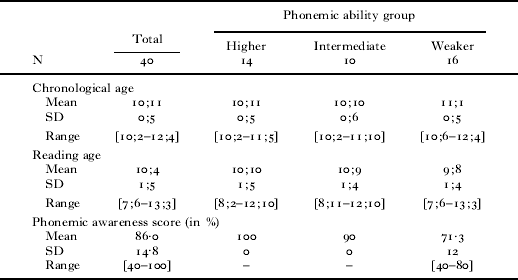
Forty fifth-graders were tested at two French primary schools. All children were native French speakers and had corrected-to-normal vision. According to their teachers, none of the children had reading difficulties or sensory impairment. Their reading level was evaluated with a standardized reading test (L'Alouette; Lefavrais, Reference Lefavrais1967) (see Table 1).
Characteristics of the participants
Materials
Forty pairs of bisyllabic words were selected in the French lexical database Manulex (Lété, Sprenger-Charolles & Colé, Reference Lété, Sprenger-Charolles and Colé2004). In each pair, words shared the same first three letters, but one word had a CV structure in the first syllable (CV target, C for consonant, V for vowel) such as GA.RAGE, and the other word had a CVC structure in the first syllable (CVC target) such as GAR.DIEN. All targets were middle- to high-frequency words (number of adjusted occurrences U: 33·89, standard frequency index SFI: 53·24). In each pair, words were controlled for their lexical frequency. For each target word, two types of pseudo-word primes were used, each prime sharing the three initial letters with the target. Pseudo-word primes were used rather than word primes so that it was possible to select groups of six items while controlling for linguistic variables. In one case, the primes had a CV structure in the first syllable (CV primes) such as ga.reul for the target GA.RAGE and ga.roule for GAR.DIEN. In the other case, the primes had a CVC structure in the first syllable (CVC primes) such as gar.nel for GA.RAGE and gar.cole for GAR.DIEN (see Appendix for stimuli). There were therefore two congruent conditions (CV prime – CV target, CVC prime – CVC target) and two incongruent conditions (CVC prime – CV target, CV prime – CVC target). Eighty orthographically legal and pronounceable pseudo-words were added for the task requirements. Two lists of stimuli were used so that the eighty target words were presented in each list, but with a different prime. All the participants were therefore presented with the same items no more than once.
Procedure
All children were tested individually in a single session of approximately 25 minutes beginning with the reading level test. This was followed by the LDT and the phonemic awareness task. For the LDT, the participants performed first a warm-up exercise prior to the LDT experiment per se to ensure they understood the principle of the task (see Castles, Davis & Letcher, Reference Castles, Davis and Letcher1999). Then, they performed the primed LDT on a laptop computer using the DMDX software (Forster & Forster, Reference Forster and Forster2003). For each trial, a forward mask consisting of a row of hash marks and matched for length with the prime was presented for 500 ms in the centre of the screen. Next, a centred lowercase prime was presented for 67 ms. The prime was immediately replaced by an uppercase target, which remained on the screen until the participants responded. Participants had to decide as quickly and as accurately as possible whether the target was a French word or not by pressing one of two buttons on the keyboard. Visual feedback was provided when they failed to respond. Reaction times (in milliseconds) were measured from target onset until response. All participants performed fourteen practice trials before receiving the 160 trials in a different random order. The participants were randomly assigned to one of the two lists of materials.
After the LDT, the children performed a task of phonemic awareness from a French standardized battery of language assessment (BELEC; Mousty, Leybaert, Alegria, Content & Morais, Reference Mousty, Leybaert, Alegria, Content, Morais, Grégoire and Piérart1994). In this task, they had to reverse the phonemes of ten biphonic syllables. For example, when they were given /fi/, they had to respond /if/. This task was chosen because previous studies showed that it is a relevant task to assess metaphonological processing and to observe differences among children of various reading level (Mousty et al., Reference Mousty, Leybaert, Alegria, Content, Morais, Grégoire and Piérart1994; Mousty & Leybaert, Reference Mousty and Leybaert1999). Before beginning the phonemic task, participants performed three practice trials. During the task, they were given feedback on the accuracy of their responses. For all the participants the items were pronounced by the same experimenter. The accuracy of response was collected.
RESULTS
In the LDT, response times outside the range of two standard deviations from the individual mean of the participants per condition were excluded (4·74% of the data). Two words were excluded from the analyses because of a high error rate. Mean correct reaction time was 1,057 ms (SD = 301), and mean error rate was 6·97% (SD = 3·78). In the phonemic test, the accuracy rate was 86·0% (SD = 14·8).
General analyses
To test the relationships between phonemic abilities and the syllable congruency effect, a Spearman's correlation was performed between the magnitude of the syllable congruency effect in the LDT and the phonemic awareness score.Footnote 3 A negative correlation was found (r = − 0·50, p < 0·001), showing that the higher the phonemic awareness score, the lower the congruency effect (see Figure 1a). Given that phonemic abilities and reading level were also correlated (r = 0·37, p = 0·02), we conducted a partial correlation between phonemic awareness score and syllable congruency effect while controlling for reading level score. The correlation remained significant (r = − 0·42, p = 0·005). Finally, there was no significant correlation between phonemic awareness score and error rate in the LDT (r = 0·04).

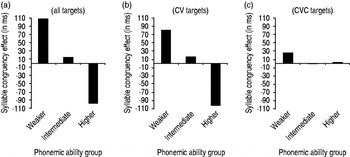
To assess the size of the syllable congruency effect according to phonemic skills, children were separated into three groups according to their phonemic awareness score: a group of fourteen children who succeeded in all the trials (group of higher phonemic awareness score), a group of sixteen children who failed on two trials at least (weaker group). The ten remaining children who failed only once were assigned to an intermediate group (see Table 1). The three groups significantly differed according to their phonemic awareness score (F(2,37) = 54·31, p < 0·001, f = 1·71). The size of the congruency effect over participants according to phonemic abilities is presented Figure 2a. Reaction times in the LDT were submitted to a congruency (congruent condition, incongruent condition) × phonemic ability group (higher, intermediate, weaker) mixed ANOVA. Neither the main effect of group (F(2, 37) = 2·67, p = 0·08, f = 0·38), nor the effect of congruency (F < 1), was significant, but there was an interaction effect between the two variables (F(2, 37) = 5·77, p = 0·007, f = 0·56).This interaction indicated that children in the higher group of phonemic abilities processed words more slowly in the congruent than in the incongruent condition (F(1, 37) = 4·82, p = 0·03, f = 0·36), while children in the weaker group were more rapid to process words in the congruent than in the incongruent condition (F(1, 37) = 6·89, p = 0·01, f = 0·43). There was no effect for children in the intermediate group (F < 1). In the error rates, neither the main effects nor the interaction was significant (all ps > 0·18).

Second, we conducted separated analyses according to target type (CV, CVC) to examine whether congruency effects vary according to syllabic complexity of target words.
Analyses for CV targets
A negative correlation was found between the syllable congruency effect for CV targets and phonemic abilities (r = − 0·56, p < 0·001), showing that the higher the phonemic awareness score, the lower the congruency effect (see Figure 1b). This correlation remained significant when the effect of reading level was partialled out (r = − 0·50, p < 0·001). There was no significant correlation between phonemic awareness score and error rate in the LDT (r = 0·05).
When submitting reaction times in the LDT to a congruency (2) × phonemic ability group (3) mixed ANOVA, neither the main effect of group (F(2, 37) = 1·82, p = 0·18, f = 0·31), nor the effect of congruency (F < 1), was significant, but there was a significant interaction (F(2,37) = 7·16, p = 0·002, f = 0·62). Children in the higher group processed words more slowly in the congruent than in the incongruent condition (F(1, 37) = 8·13, p = 0·007, f = 0·47), while children in the weaker group were more rapid to process words in the congruent than in the incongruent condition (F(1, 37) = 6·04, p = 0·02, f = 0·40) (see Figure 2b). There was no effect for children in the intermediate group (F < 1). There was no significant effect in the error rates (all ps > 0·09).
Analyses for CVC targets
There was no significant correlation between the syllable congruency effect for CVC targets and phonemic abilities (r = − 0·17) (see Figure 1c), even when reading level was controlled for (r = − 0·08). Similarly, there was no correlation between phonemic awareness score and error rate (r = 0·08).
When submitting reaction times to a congruency (2) × phonemic ability group (3) mixed ANOVA, neither the main effect of congruency nor the interaction was significant (all Fs <1). Only the main effect of group was significant (F(2, 37) = 3·51, p = 0·04, f = 0·44) (see Figure 2c). There was no effect in the error rates (all ps >0·23).Footnote 4
DISCUSSION
The aim of the study was to investigate the syllable congruency effect in grade 5 in the primed LDT and to examine the relationships between syllabic effects and phonological abilities. Reliable negative correlations between phonemic abilities and syllable congruency effects were found, showing that word recognition of CV words was delayed in the congruent condition (e.g. ga.reul – GA.RAGE, gar.cole – GAR.DIEN) compared to the incongruent condition (e.g. gar.nel – GA.RAGE, ga.roule – GAR.DIEN) for children with good phonemic skills, while it was speeded up for children with weaker phonemic skills.
The interaction between the magnitude of the syllable congruency effect and the phonemic abilities score can be understood within an interactive activation-based framework including syllables (e.g. Conrad et al., Reference Conrad, Carreiras, Tamm and Jacobs2009; Mathey et al., Reference Mathey, Zagar, Doignon and Seigneuric2006). The level of phonological awareness is assumed to account for the quality and precision of phonological representations in the language system, and clear phonemic representations allow the mapping between individual letters and the pronunciation of words (Perfetti, Reference Perfetti, Gough, Ehri and Treiman1992). Thus, orthographic and phonological processes underlying lexical access may be less efficient in the case of imprecise and sparse sublexical representations (Booth et al., Reference Booth, Perfetti and MacWhinney1999). In addition, syllabic effects are assumed to ensue from a dual process involving both sublexical facilitation due to the activation of the syllabic units, and lexical inhibition due to the competition between syllabic neighbours (see Conrad et al., Reference Conrad, Carreiras, Tamm and Jacobs2009; Mathey et al., Reference Mathey, Zagar, Doignon and Seigneuric2006). These two complementary processes are already at work in young readers (e.g. Chetail & Mathey, Reference Chetail and Mathey2009a; Reference Chetail and Mathey2009c; Jiménez & Rodrigo, Reference Jiménez and Rodrigo1994). However, the strength of the competition between syllabic neighbours – which is responsible for the inhibitory nature of syllabic effects – depends on the amount of syllabic activation ensuing from the syllabic level. Chetail and Mathey (Reference Chetail and Mathey2009a) showed that this competition occurs only when word recognition processes are quick and efficient in grade 1, since, in that case, sublexical units are sufficiently activated to fire lexical units sharing the corresponding syllables. They hypothesized that this could be related to the quality of sublexical representations.
The present findings support this assumption. Children with high phonemic abilities scores may have precise sublexical phonological representations, so the orthographic and phonological processes underlying their lexical access may be rapid. Thus, when a congruent prime is displayed (e.g. gareul), this might strongly pre-activate the representation of the corresponding syllable (e.g. /ga/). Activation from the syllabic level quickly spreads to the lexical level, also pre-activating the neighbouring representations. When the target word is displayed (e.g. GARAGE), competition at the lexical level therefore rapidly comes into play, leading to a net inhibitory syllabic priming effect. On the other hand, when the children have weaker phonemic abilities, their sublexical phonological representations may be more imprecise and sparse, and the orthographic and phonological processes underlying their lexical access may be less rapid and efficient. Hence, when a congruent prime is displayed, the corresponding syllabic representations are pre-activated, but not sufficiently to pre-activate the competitors. The lexical competition does not noticeably arise to influence visual word recognition and, when the target word is displayed, it therefore benefits only from sublexical facilitation. A net facilitatory syllabic priming effect is thus obtained. Consistently, the null effect of syllable congruency in the group of readers with intermediate phonemic abilities can be explained by the cancellation of the weak lexical inhibition by the sublexical facilitation. It should be noticed, however, that the syllable congruency effects in the higher and weaker groups were found only in CV words, CVC words yielding null effects, as previously reported in some studies with the LDT (e.g. Alvarez, Carreiras & Perea, Reference Alvarez, Carreiras and Perea2004; Chetail & Mathey, Reference Chetail and Mathey2009b) or the segment detection task (Colé et al., Reference Colé, Magnan and Grainger1999; but see Maïonchi-Pino et al., Reference Maïonchi-Pino, Magnan and Ecalle2010). A possible explanation could be that CVC syllables are less well represented than CV syllables, especially because they are less frequent (Colé et al., Reference Colé, Magnan and Grainger1999). Hence, for CVC words preceded by a CVC prime, activation from the syllabic level would spread to the lexical level, but less rapidly than when CV words are preceded by CV primes. This would produce a weaker sublexical facilitation, and eventually a weaker inhibition at the lexical level in readers with good phonemic abilities, yielding null effects.
In a previous LDT experiment, it was found that syllabic effects varied according to reading level in grade 1 (Chetail & Mathey, Reference Chetail and Mathey2009a). Phonemic abilities and reading level are often correlated, but here, we show that syllabic effects in grade 5 depend on the quality of sublexical representations evaluated by phonological awareness tasks even though the effect of reading level was controlled for by means of partial correlation analyses. The present study therefore sheds more light on the nature of what could modify syllabic effects across reading experience. The more precise the phonological representations, the greater are the speed and strength of spreading activation between sublexical and lexical units. The quality of phonological units might therefore be one of the factors influencing the respective weight of the processes of sublexical syllabic facilitation and lexical inhibition between syllabic neighbours, at least in grade 5. On this, it should be interesting to investigate what individual characteristics (e.g. reading level, phonemic abilities) influence the direction of the syllable congruency effect in adults (e.g. Alvarez et al., Reference Alvarez, Carreiras and Perea2004; Chetail & Mathey, Reference Chetail and Mathey2009b, facilitatory effects; Dominguez et al., Reference Dominguez, de Vega and Cuetos1997, inhibitory effect; Ferrand et al., Reference Ferrand, Segui and Grainger1996, null effect).
Finally, the fact that a similar pattern was found in both second-graders (Chetail & Mathey, Reference Chetail and Mathey2009a) and fifth-graders (the present study) could be surprising, and one might argue that fifth-graders should have elicited the same pattern of results as the most proficient second-graders. This can be explained by differences in the duration for which syllables were made salient. In the present study, primes made syllables salient during 67 ms (prime duration), whereas in the coloured LDT used by Chetail and Mathey (Reference Chetail and Mathey2009a), colours made syllables salient during at least 500 ms (duration from the onset of word presentation to participant's response). In other words, the second-graders benefited from syllabic activation longer than our fifth-graders, and this amount of activation may have become equivalent to that of older children, thus yielding a similar pattern of results. In the same vein, the fact that more reliable syllable congruency effects were reported for CVC targets in the segment detection task (e.g. Maïonchi-Pino et al., Reference Maïonchi-Pino, Magnan and Ecalle2010) can be accounted for by the fact that syllables were made salient during 1,000 ms, compared to 67 ms in the present study.
Further studies should now examine how the interaction between the syllable congruency effect and phonemic abilities develops with reading experience. Importantly, the fact that syllabic priming effects were found in grade 5 suggests that phonological effects do not decrease with reading experience, as proposed by Katz and Baldasare (Reference Katz and Baldasare1983), but rather are modified (see Booth et al., Reference Booth, Perfetti and MacWhinney1999). Finally, from a methodological point of view, the present findings suggest the use in young readers of paradigms initially developed in adults, such as masked priming. This procedure could be one way to tap the acquisition of rapid and automatic word recognition processes (Castles et al., Reference Castles, Davis, Cavalot and Forster2007) and help in understanding the transition from beginning to skilled reading.
APPENDIX: target words and corresponding primes