‘It is no new thing to see how current a vulgar report, though erroneous, passeth in the world.’Footnote 1
Sir William Dugdale (1684)
In a recent review article, Sally Badham and Philip Lankester referred to the traditional association between medieval cross-legged effigies and crusading as ‘an idea to be found in many a church guide and quite impossible, it seems, to kill off’.Footnote 2 The present essay does not pretend to contribute directly to what Enoch Powell called the ‘continuing pother’ over the iconographic, aesthetic or structural origins of the crossed-legged pose.Footnote 3 It does, however, aim to add a fresh dimension to the debate by taking a long view of its intellectual, historiographical and folkloric background.Footnote 4 At the same time, it sets out to chronicle a minor but significant chapter in the wider story of antiquarianism, archaeology and art history.
We may begin by reprising a few basic facts. The recumbent cross-legged attitude was a widespread artistic fashion on tomb monuments in the British Isles from the mid-thirteenth to the mid-fourteenth centuries.Footnote 5 Throughout this period, the great majority of military effigies erected in England, Wales and Anglo-Norman Ireland appeared in the pose. It was given both to three-dimensional effigies in stone and wood and to two-dimensional representations in incised stone and brass. Latterly, but less commonly, the convention was extended to figures of women and male civilians.
No direct references to cross-legged effigies, either descriptive or interpretive, are known from medieval texts. To sit cross-legged, however, was sometimes regarded as an attribute of kings. A fourteenth-century poem, ‘Somer Soneday’, includes a description of the kingly figure at the top of Fortune’s wheel as ‘Caste kne over kne as a kyng kete’; and the idea that it had formerly been ‘customary for kings to sit with the right foot resting on the left thigh’ was still familiar to Erasmus in the early sixteenth century.Footnote 6 Images of kings and other figures of authority, from the mid-eleventh century to the early fifteenth, do indeed depict them, on occasion at least, sitting cross-legged.Footnote 7 The attitude is also found in sculptural representations, and may arguably have passed by such a route to tomb effigies.Footnote 8 But the question is far from straightforward, and it remains difficult to draw any direct line between the ‘kingly’ seated pose and the sepulchral recumbent pose.
Our investigations into perceptions of the attitude on tombs therefore begin in earnest with the rise of antiquarian activity in the sixteenth century. The earliest explicit report of one of the effigies is by John Leland, writing probably in 1542. At Dorchester Abbey (Oxfordshire), he recorded the tomb of ‘a knight … with an image crosse leggid, whos name is there oute of remembrance’.Footnote 9 The Dorchester figure is by any standards a striking piece of sculpture, and it is not surprising that Leland should have used its dynamic and contorted posture as the principal means of distinguishing it from a second military effigy of later date, stiff and straight-legged, in the abbey church. It is also worth remarking, therefore, that this was the only occasion (at least as far as his surviving notes are concerned) on which Leland saw fit to report the pose. His notices of no fewer than ten cross-legged effigies elsewhere fail to mention their attitude; he overlooked entirely several examples in churches where he did record other monuments; and he even ignored the figure at Great Haseley (Oxfordshire), the church of which he himself was rector.Footnote 10 His note at Dorchester may suggest that there existed some dim perception, perhaps more popular than scholarly, of the pose as a distinguishing feature of certain effigies, but it seems unlikely that Leland attached any particular significance to it.
Rising Interest And Theories Of AntiquITY
A consciousness of crossed legs becomes more widely evident in antiquarian texts from the beginning of the reign of Elizabeth i. It must be appreciated that, despite a burgeoning interest in monumental commemoration in this period, antiquaries only rarely and exceptionally paid attention to the sculptural or architectonic characteristics of tombs.Footnote 11 Their interest and their records instead fell into three largely distinct spheres: simple catalogues of noteworthy burials, descriptions or sketches of heraldry (the genre of record known as ‘church notes’) and transcripts of monumental inscriptions (a class of record rare before the 1590s, and one that was only occasionally combined with heraldic recording until well into the seventeenth century). Only in church notes do we find any attention paid to the design of monuments, and even here it remains highly unusual, and incidental to the heraldic and genealogical rationale of the genre. Drawings of effigies or monuments are largely unknown before the 1590s, and remain rare for the next half century: when they do appear, they tend to serve primarily as schematic vehicles for the heraldry. Yet it is in these church notes that we begin to find references to crossed legs; and, indeed, the pose rapidly establishes itself as the only stylistic or formal feature of tombs to be recorded with any degree of regularity or consistency. The antiquaries’ primary concern, of course, remained the identities of the individuals commemorated, and, throughout what follows, it should be understood that the identities assigned in the past to particular monuments do not necessarily reach the standards of modern scholarship.
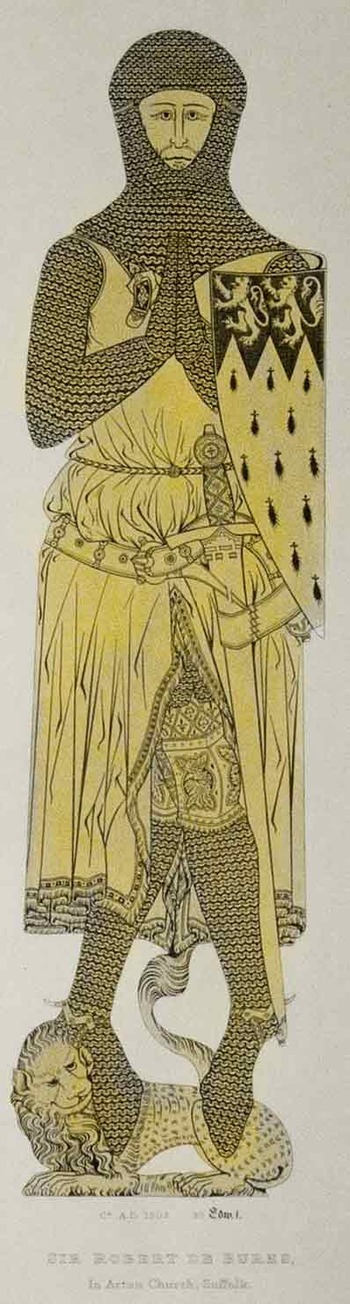
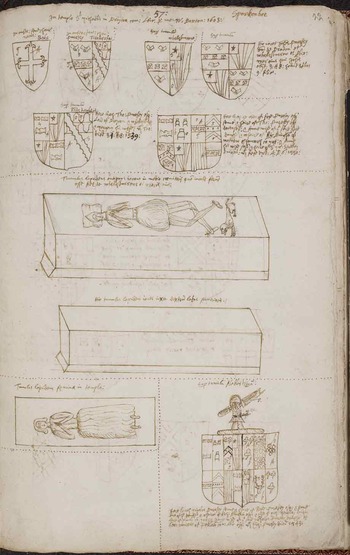
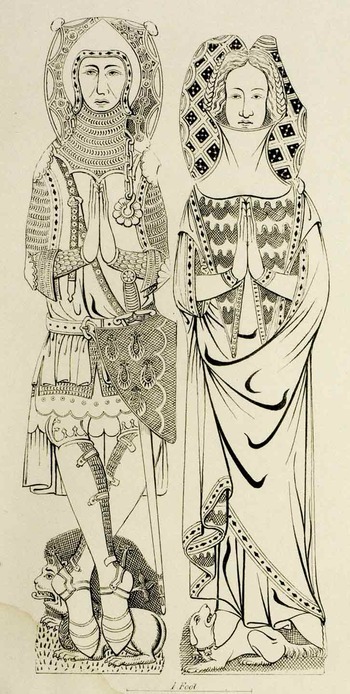
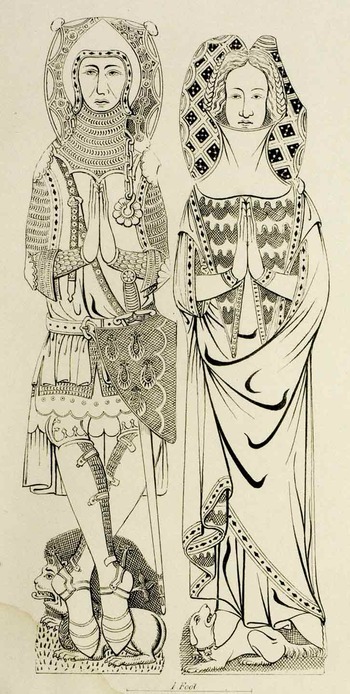
The earliest relevant record known was made in 1560–1 by William Hervy, Clarenceux King of Arms: he noted the brass to Sir Robert de Bures (d 1331) at Acton (Suffolk) as ‘crosse leged’ (fig 1).Footnote 12 Given that the disposition of the legs is, in this case, fairly unobtrusive, being partially obscured by the figure’s gown, it seems likely that the attitude was now more generally recognized as a feature to be looked for. Interest was by no means universal, but it grew, and by the turn of the seventeenth century it was commonplace for crossed legs to be mentioned in church notes. William Wyrley and William Burton between them, for example, identified twenty-three effigies of the type, in Staffordshire, Leicestershire, Warwickshire and Berkshire (fig 2),Footnote 13 while an anonymous antiquary, working in about 1602–5, discovered seventeen cases in Lincolnshire.Footnote 14 It is true that instances can still be found of the same antiquaries noting examples without mentioning their pose, or missing the figures entirely, but such oversights increasingly tend to be the exception. In general, if an antiquary visited a church containing an effigy with crossed legs, he was likely to record the fact; and commonly, with the exception of the heraldry, it was the only detail he did record.
Brass commemorating Sir Robert de Bures (d 1331), Acton (Suffolk), from Waller and Waller (Reference Waller and Waller1864). Photograph: Society of Antiquaries of London

Drawing made by William Burton in 1603 of an effigy in the churchyard of Fenny Drayton (Leicestershire), said to represent Adam de Whellesburgh, from BL, Egerton ms 3510, fol 22. Photograph: © The British Library Board
A feature of many of the early reports is the appearance of such adjectives as ‘ould’, ‘auntient’, ‘antiquus’, ‘venerabile’, or similar suggestions of age. Qualifications of this sort are far less often found applied to straight-legged effigies. These observations may often have been impressionistic, prompted by evident signs of decay, but they also contain the germ of a stylistic judgement: it was recognized that cross-legged figures were older than most of the effigies the antiquaries came across, and that the pose itself could be equated with an early date. In 1587, the poet Thomas Churchyard made an explicit statement of this perception, describing a wooden effigy at Brecon, attributed to Reginald de Briouze (d 1227/8), as ‘Crosse legg’d … as was the ancient trade’.Footnote 15
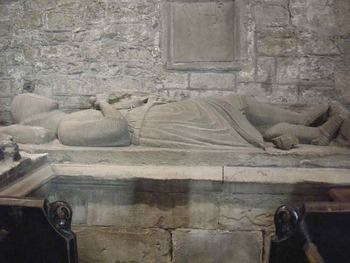
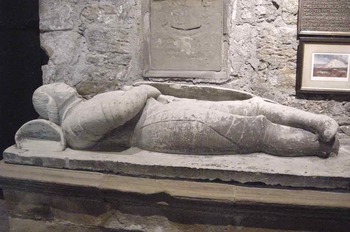
The consequence of this association was that cross-legged effigies became prime candidates for identification – frequently spurious – as founders or progenitors. Robert Kemp considered that the effigy at Mautby (Norfolk), which bore the Mautby arms, was ‘I suppose the firste of that name’; and an unidentified Dorset antiquary in c 1579 believed that a figure at Milton Abbey commemorated a baron who had been instrumental in the house’s re-foundation by William the Conqueror.Footnote 16 Either Robert Glover, Somerset Herald, or his nephew, Thomas Milles, reported that two effigies in Shrewsbury Abbey, in cross-legged pose ‘as in old times was used’, portrayed the founder, Roger de Montgomery, earl of Shrewsbury (d 1094), and his son and heir, Hugh (d 1098); and that a third at Hatfield Broad Oak Priory (Essex) represented that house’s founder, Robert de Vere, earl of Oxford (d 1221).Footnote 17 Sampson Erdeswick was drawn to investigate an effigy at Dudley Priory (Staffordshire; now West Midlands) by the fact that it was ‘cross-legged and a very old one’: after close inspection, he concluded that it was, ‘as I take it, the first founder of the said priory’.Footnote 18 In 1570 a fourteenth-century cross-legged effigy, apparently brought some twenty-five miles from Drogheda, was installed by Sir Henry Sidney in Christ Church Cathedral, Dublin, to represent Richard ‘Strongbow’, earl of Pembroke (d 1176), traditionally identified as the cathedral’s builder.Footnote 19 John, Lord Lumley, assembling an ersatz family mausoleum at Chester-le-Street (County Durham) in the 1590s, appropriated a fourteenth-century cross-legged effigy to become the late twelfth-century William de Lumley, the first to bear the family name; and he commissioned a new cross-legged figure to represent the next generation of the family, Sir William Lumley (figs 3 and 4).Footnote 20 On the tomb of Sir Gawen Carew (d 1583×5) and his wife, Mary, in Exeter Cathedral, a cross-legged figure (wearing archaized armour and an Elizabethan ruff), set in a recess beneath the two principal effigies, is most probably meant for Adam de Montgomery de Carew, the reputed Norman founder of the family.Footnote 21
Early fourteenth-century effigy at Chester-le-Street (County Durham), appropriated by John, Lord Lumley, in the 1590s to serve as William de Lumley. Photograph: author

Effigy at Chester-le-Street (County Durham) representing Sir William Lumley, commissioned by John, Lord Lumley, in the 1590s. Photograph: author

Associations between crossed legs and antiquity survived in the popular mind well into the seventeenth century. It seems likely that the persistent tradition, first recorded by Lieutenant Hammond in 1635, that five effigies at Winchelsea (Sussex) – including three cross-legged ‘knights’ – had been salvaged from the drowned church of Old Winchelsea, stemmed in part from an assumption that their attitudes were indicative of extreme age.Footnote 22 In the 1640s, Richard Symonds reported of the wooden effigy at Abergavenny Priory that ‘[t]hey call him the builder of the church’; and of the diminutive figure at Bottesford (Leicestershire) that ‘[t]hey say it was for him that built Belvoir Castle’.Footnote 23 A few years later, another visitor recorded the same Abergavenny effigy as ‘supposed to be Hamelen de Batadini or Bauloon cross legged the Founder of the said Church’; and the stone example in the church’s south aisle chapel as ‘Hastinges Earle of Pembrok cross leggedd the founder as mr Miles saith of that chapell’.Footnote 24 Even in the eighteenth century, figures at St Peter’s, Dorchester (Dorset), and Stansted Mountfitchet (Essex) were still identified locally as founders of their respective churches.Footnote 25
It is in fact likely that popular beliefs about the antiquity of the pose may have existed at a rather earlier date than their appearance in the better-documented antiquarian record. Two examples of retrospective and consciously archaized cross-legged figures are of particular interest here, as they are thought to date from the early decades of the sixteenth century. At the Augustinian nunnery of Minster-in-Sheppey (Kent), a fourteenth-century military brass of French workmanship to a member of the Northwood family, doubtless originally straight-legged, was given a new pair of crossed legs, probably in c 1515, and relaid alongside an originally separate lady (fig 5). Subsequently – probably in c 1581–2 – an inscription was added identifying the couple as Sir Roger Northwood and his wife Bona, honoured as the priory’s thirteenth-century re-founders.Footnote 26 A cross-legged alabaster effigy at Burton Abbey (Staffordshire), commemorating its founder, Wulfric Spot (d 1002×4), is likewise believed to have been executed early in the sixteenth century.Footnote 27
Brasses at Minster-in-Sheppey (Kent), from Neale Reference N[eale]1846, 204. The male figure was restored by the Waller brothers in 1881, when they replaced a lost strip at its hips, so correcting both its proportions and the corrupted heraldry of the shield. Photograph: Society of Antiquaries of London
Not so early, but also suggestive of the link arising more from folk belief than from scholarly inference, is a passing allusion made in 1572 in the context of a land dispute in the Court of Exchequer.Footnote 28 Thomas Digges, an ambitious young scholar, had identified three tracts of land at Lydd (Kent), on Romney Marsh, to be the subject of a test case, by which he hoped to establish the Crown’s title to reclaimed marshland. John Heblethwayte, the town clerk, defending Lydd’s customary rights, argued that the town’s site, actually on one of the contested parcels, proved that Digges’s presumption was false, and that the land was not newly reclaimed. He drew on an eclectic catalogue of documentary and physical evidence to demonstrate the settlement’s long history, including the presence of cross-legged effigies in the church: ‘For the Antiquity of the Towne & plott, Not to be lately won from the Sea, it appeareth by the face & Vieu of the Antienty of the Towne & Church & buryall of men Cross Legged and such like Monuments’.Footnote 29 Digges eventually withdrew his suit; but we may gather from this unexpected appearance of the belief in the hard-nosed arena of the law that assumptions about the antiquity of the cross-legged attitude must have been fairly widespread.
Somewhere along the way, the tradition crystallized into a more precise belief that cross-legged effigies pre-dated the Norman Conquest. The inscription added to the Minster-in-Sheppey brasses identified Sir Roger and Bona as ‘sepulti ante Conquestum’, despite the fact that they were known to have lived in the reign of Henry iii.Footnote 30 William Wyrley, in his heraldic textbook, The True Use of Armorie (1592), disparaged the pretensions of those who ‘make small account of anie ancestour except before the Conquest, weening that all that lie crosse-legged so were’.Footnote 31 Paul Hentzner, a Silesian tourist, was informed in 1598 that the effigies in the Temple Church, London, commemorated the Danish kings of England; and Arthur Agarde in 1600 described the Burton Abbey effigy as depicting Wulfric Spot, ‘who was founder of that abbeye before the Conqueste’.Footnote 32
Almost as soon as it had surfaced in the written record, however, the theory of pre-Conquest origins was already beginning to fall from favour among critical antiquaries. Wyrley argued that, far from being assignable to such an early date, the convention was actually ‘not had in use until after the Palestine wars’.Footnote 33 The True Use was a respected work, and either his point was taken, or his views are a reflection of a wider scholarly consensus. From the beginning of the seventeenth century we hear little more in informed antiquarian contexts of ideas of extreme age. The notion none the less survived for a time in the wider community. The poet Richard Brathwayte still believed in 1618 that an effigy’s cross-legged pose ‘inferreth his being before the Conquest’.Footnote 34 Richard Symonds in the 1640s recorded examples at Chilton Foliat (Wiltshire) and Chetwynd (Shropshire) which local tradition assigned to pre-Conquest dates; while a figure at Orton Longueville (Huntingdonshire; now Peterborough) was, in the same period, ‘reported to be one of ye Longviles killed by ye Danes’.Footnote 35 Symonds clearly lacked confidence in such claims, and Thomas Gerard in 1633 was openly sceptical, describing an example at Pendomer (Somerset) as ‘crosse legged and yet I assure myselfe long since the Conquest’.Footnote 36 By the end of the seventeenth century, even as folklore, the pre-Conquest theory seems largely to have faded away.
The emergence of the crusader theory
Wyrley’s almost incidental allusion to the ‘Palestine wars’, while contributing to the demise of one fallacy, may unwittingly have helped spark another. Although his argument was that cross-legged effigies were not merely post-Conquest, but also post-crusades, his point had been turned on its head within less than a decade. Crossed legs and the crusades became inextricably linked in the antiquarian mind, the pose being defined as the mark of a crusader, or one who had taken crusading vows. One contributory factor may have been a simple misreading of Wyrley’s comments; another, knowledge of the retrospective cross-legged effigy of the eminent crusader, Robert of Normandy (d 1134), at Gloucester. The principal catalyst, however, seems to have been a growing interest in the Temple Church effigies, and the crusading associations evoked by their location, the leading preceptory of the Knights Templar in the British Isles. It is not surprising that these particular figures should have prompted speculation, as the Inns of Court served as a crucible of antiquarian ideas and practice, and the church must have been familiar to many active antiquaries.Footnote 37
The belief first surfaced in print in 1594, in the account of the Temple Church effigies given by William Camden in the fourth edition of his Britannia:
Plurimique nobiles apud eos tumulati fuerunt, quorum imagines visuntur in hoc Templo tibijs in crucem transversis: sic enim sepulti fuerunt, ut accepi, quotquot illo saeculo, nomina bello sacro dedissent, vel qui (ut tunc temporis sunt locuti) Crucem suscepissent.
Many noblemen were buried among them, whose images are to be seen in this Temple with their legs transverse in a cross: for, as I have heard, so all were buried, in that age, who had pledged themselves to the Holy War, or who (as was then said) had taken the Cross.Footnote 38
He added the supposed identities of some of the individuals commemorated, and may have been swayed in his view by the knowledge that one of them – Gilbert Marshal, earl of Pembroke (d 1241) – had indeed taken crusading vows, though he did not live to fulfil them. However, Camden did not identify the source of his information, and his circumspect ‘as I have heard’ (‘ut accepi’) suggests that the crusader theory was still somewhat tentative.
Four years later, in his Survey of London, John Stow evinced no such ambivalence. Describing the same Temple Church effigies, he observed that ‘eight of them are Images of armed knights, five lying crosse legged as men vowed to the holy land, against the infidels and unbeleeving Jewes’; and in St Paul’s Cathedral, he recorded in similar terms the figure of Henry de Lacy, earl of Lincoln (d 1311), ‘crosse legged, as one professed for defence of the holy land against the infidels’.Footnote 39 In 1600, a contributor to a Society of Antiquaries meeting elaborated with confidence on the cruciform iconography:
such noblemen and gentlemen, as did take upon them the crosse to serve against the enemys of the crosse in the Holy Land, which were then called Cruce Signati, or croised, were buried for the most parte with their leggs acrosse. And whereas that taking of the crosse ceased about the tyme of king Edward the second, you shall find none afterward buried in that manner with their legges acrosse.Footnote 40
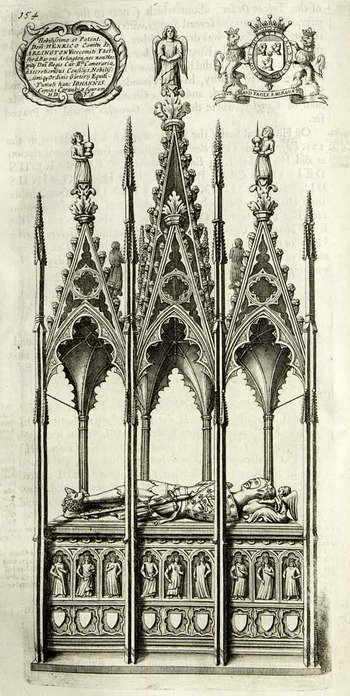
The issue was also raised in the course of the scholarly feud between Camden and the vituperative Ralph Brooke, York Herald, in relation to an effigy in St Edmund’s Chapel, Westminster Abbey (fig 6). Camden accepted the tomb’s conventional (and correct) attribution to John of Eltham, earl of Cornwall (d 1336); but Brooke insisted that it commemorated Henry Holland, duke of Exeter (d 1475).Footnote 41 In addition to much disputation focused on the tomb’s heraldic elements, Camden contended that ‘the fashion of buryall, with the legges a crosse … was growen out of use a good while before’ the reign of Edward iv, Brooke’s favoured date.Footnote 42 Brooke retorted that a cross-legged attitude might in fact be quite recent. He used two arguments: the first theoretical, that as the order of Hospitallers had survived in England until 1540, so too had crusading vows and, by implication, their iconographic representation; the second empirical, that he knew of modern examples of the type:
Which severall Tombes and pictures (with manie others in like manner) I trust wilbe sufficient proofe for me against this learned man, to prove that the use and fashion of burieng men with theire legges a crosse, was not oute of use (as hee affirmeth it was) before the death of Henry Holland in king .E4. tyme.Footnote 43
Engraving of the monument of John of Eltham, earl of Cornwall (d 1336), in St Edmund’s Chapel, Westminster Abbey, from Sandford Reference Sandford1677, 154. Photograph: Society of Antiquaries of London

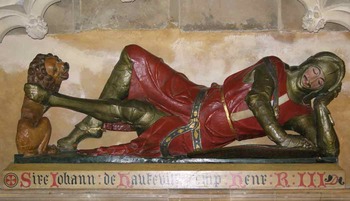
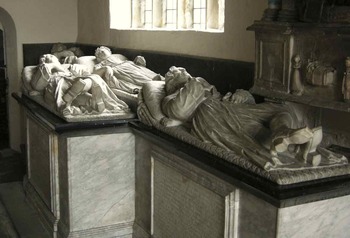
Brooke cited two modern instances, both of which appear to survive. The first, at Chew Magna (Somerset), was ‘one Hawkewood with his legges a crosse, hee beinge knowne to live in the memorie of dyvers of that parishe yet lyvinge’: this must be the wooden reclining figure identified by later tradition as Sir John Hauteville (sometimes rendered Hawkfield), who, though unknown to history, was supposed to have participated in the Lord Edward’s crusade of 1270–2 (fig 7). Although the effigy’s dating remains problematical (it has been identified both as over-restored fourteenth-century work, and as a late sixteenth-century archaized creation), it was later said to have been brought to Chew church at the Reformation from the nearby suppressed chapel of Norton Hawkfield.Footnote 44 Brooke had been on visitation to Somerset in 1591, and his understanding that ‘Hawkewood’ had died within living memory could reflect a report of its relatively recent installation. His second example, ‘with his legges a crosse uppon a faire Tombe of Aliblaster’, was Sir Thomas Hoby (d 1566), figured alongside his half-brother, Sir Philip Hoby (d 1558), on a strikingly innovative and possibly French-influenced monument at Bisham (Berkshire), commissioned by Sir Thomas’s widow, Elizabeth (fig 8).Footnote 45 Despite his claim of ‘manie others in like manner’, Brooke actually seems to have lighted on two rather exceptional cases.
Effigy traditionally identified as Sir John Hauteville, Chew Magna (Somerset). Photograph: author

A 1905 photograph of the monument at Bisham (Berkshire) commemorating Sir Thomas Hoby (d 1566), in front, and his half-brother, Sir Philip Hoby (d 1558), behind. Photograph: © Country Life

Brooke’s comments were unpublished, and his attempt to extend the chronological range of cross-legged figures failed to dent the association with the crusades, which had now received the sanction in print of both Camden and Stow. Camden himself grew more confident: his cautious ‘ut accepi’ of 1594, repeated in 1600, was dropped from the 1607 edition of Britannia and the 1610 English translation. Indeed, in 1600 he made another unqualified assertion of the claim, in reporting an effigy in Hexham Abbey (Northumberland): ‘After which fashion in those daies were they onely enterred … who tooke upon them the crosse, and were marked with the badge of the crosse for sacred warfare, to recover the Holy land from the Mahometanes and Turkes’.Footnote 46 Stow’s remarks on Henry de Lacy were echoed by Henry Holland in 1614 and John Weever in 1631.Footnote 47 The Devon antiquary Tristram Risdon regarded crossed legs as ‘the manner of such, as in elder ages went to war in the holy land’.Footnote 48
The conceit also surfaced in France, despite the complete absence there of concrete examples of the type. André Favyn, in his Théâtre d’honneur et de chevalerie (1620), reported that those who had taken crusading vows were buried cross-legged. ‘In this fashion, and no otherwise were they figured on Tables, Tombes, flatte Grave Stones, or raised by Carving; as yet is to be seene in the Cloysters of Ancient Monasteries of France, Flanders, and in divers other places else.’Footnote 49 The theory then re-crossed the Channel, appearing in 1623 in the English translation quoted here. One reader was Thomas Habington, who identified fourteen cross-legged effigies in Worcestershire.Footnote 50 He termed them ‘knight[s] of the holy voyage’, an evocative phrase, drawn from Favyn, which resonated with his own Catholicism and sympathy for the crusading ideal; their pose was ‘the ensigne of [their] order’. Conversely, he argued that an effigy at Wolverley, being straight-legged, could not be a crusader.Footnote 51 He further suggested that crossed legs could be used as dating evidence since knights ‘could not be thus buryed beefor An. Do. 1095 for then began thys war agaynst the Infydells nor after the yeere 1310 for then it ended’ (the latter date representing the suppression of the Templars).Footnote 52
Further assertions of the crusader theory were published by William Gray in 1649, Thomas Philipot in 1659 and Sir William Dugdale in 1656 and 1682.Footnote 53 The attitude, Dugdale affirmed, had been ‘onely used by those that had taken upon them the Cross, to serve in the Holy-land’. The belief was now firmly entrenched among antiquaries, and in 1663 it emerged in a non-specialist context: Samuel Butler, in his satire Hudibras, referred to
… cross-legg’d Knights,
Fam’d for their faith and warlike fights
Against the bloudy Caniball.Footnote 54
The idea of the cross-legged crusader had by now permeated the popular imagination and common parlance, and would not be readily expunged.
The rise and fall of the Templar theory
Many antiquaries, rather than identifying the effigies as generic crusaders, preferred to make a more specific association with the Knights Templar (though it must be added that a clear distinction between the two categories was not always made). Undoubtedly, this variant theory was again prompted by knowledge of the Temple Church monuments. In particular, the most prominent individual believed to be represented cross-legged – William i Marshal, earl of Pembroke (d 1219) – was known to have been received into the order on his deathbed; and the same was understood of Robert de Ros (d 1226/7), identified with one of the other figures in the group.Footnote 55
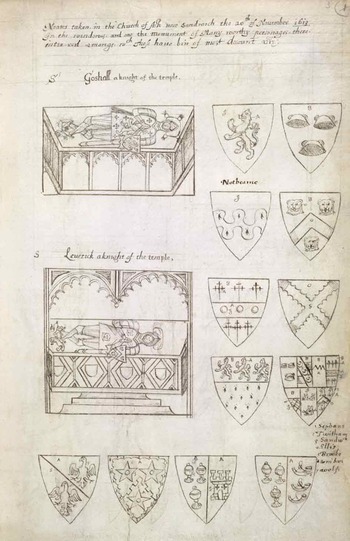
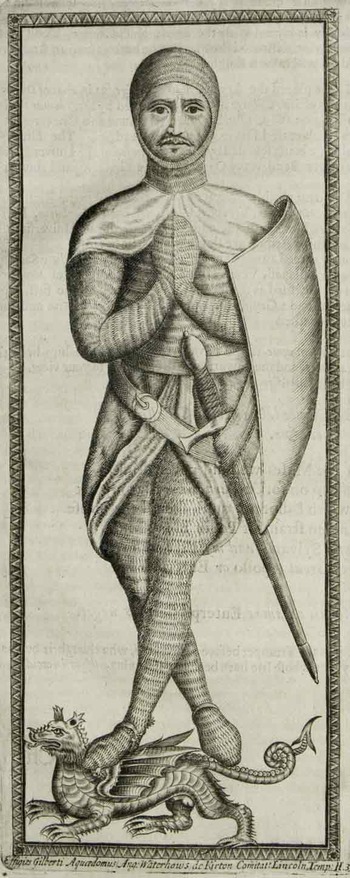
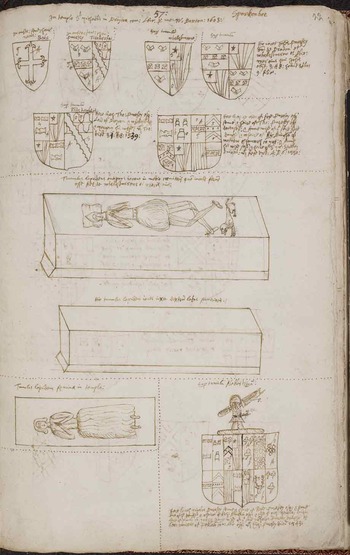
The Templar theory surfaced a decade or two later than the crusader theory. In 1613, John Philipot identified two cross-legged effigies at Ash-next-Sandwich (Kent) as ‘knight[s] of the temple’ (fig 9); and Weever, drawing on Philipot’s notes, described the same two figures in 1631 as ‘crosse-legged, as knights of Ierusalem’.Footnote 56 Anthony Munday, revising Stow’s Survey of London in 1617, glossed Stow’s notice of Henry de Lacy’s effigy by stating that it was posed ‘like a Knight Templer’.Footnote 57 William Burton referred in his Description of Leicester Shire (1622) to the Temple Church figures as ‘many of the Order ly[ing] buried, their proportions cut in Stone, some of them crosse legged’: his description did not make the connection between order and pose explicit, but it can only have helped to consolidate the belief.Footnote 58 Lieutenant Hammond, in 1635, William Somner, in 1640, and Richard Symonds, in 1644, all identified effigies from their attitude alone as Templars.Footnote 59 Sylvanus Morgan, in 1661, commented that whereas ‘this order is extinct, yet their Monuments remain buried cross-legged’ (fig 10); Thomas Dineley, in the 1680s, observed that Templars bore a red cross, ‘in token that they should shed blood for Xst sake & defence and were buried Cross legg’d’; and John Aubrey, in 1691–2, described the wooden example at Southwark as posed ‘just as the Knights Templars’.Footnote 60 Indeed, in antiquarian writings from the 1650s onwards, the term ‘Knight Templar’ became a common shorthand designation for cross-legged effigies, with little or no comment deemed necessary. In the 1730s or 1740s, the Norfolk antiquary Charles Parkin penned a detailed elaboration of Templar monuments and their iconography, claiming that, ‘to show that they were not ashamed of the Cross, they are pourtray’d and carv’d, with their Legs forming a Saltire-Cross in Armour’.Footnote 61 A blurring of the distinctions between the military orders led to the attitude also being occasionally assigned to Hospitallers: Hammond described two of his discoveries in Winchester and Exeter Cathedrals as ‘Knight[s] of the Rhodes’, while William Stukeley, in the 1720s, referred to ‘Jerusalem knight[s]’, or knights ‘of St John of Jerusalem’.Footnote 62
Church notes by John Philipot, 1613, of arms and monuments at Ash-next-Sandwich (Kent), including two ‘knight[s] of the temple’, from BL, Egerton ms 3310 A, fol 3. Photograph: © The British Library Board

Engraving of an effigy traditionally identified as that of Sir Gilbert Waterhouse, at Kirton-in-Lindsey (Lincolnshire), from Morgan Reference Morgan1661–3, bk 3, 84 recte 82. Photograph: Society of Antiquaries of London

In 1761, the cross-legged pose and its Templar associations were used to justify the prospective removal of a medieval tomb from Westminster Abbey. A proposal had been aired that the monument to Aymer de Valence, earl of Pembroke (d 1324), should be sacrificed to make way for one to General Wolfe, hero of Quebec. The Dean, Zachary Pearce, was hesitant, but his initial misgivings were assuaged by his understanding that the effigy ‘had the appearance of being designed for a Knight Templar’ – ‘a very wicked set of people as his Lordship had heard’. In the event, assured of the true identity of the tomb’s occupant, Pearce vetoed the suggestion, and Wolfe’s monument went elsewhere.Footnote 63
By this date, however, the first reservations about the Templar theory were beginning to be voiced. Nathaniel Salmon in 1728 had identified three cross-legged effigies in Hertfordshire as Templars, but was reluctant to acknowledge a fourth, at Benington.Footnote 64 His reasoning was, first, that it was ‘not to be supposed a Knight Templar from the Posture for he has no Shield’, and, second, that the knight lay alongside a lady, a clear impediment to his membership of a celibate order. There were, Salmon affirmed, other instances of ‘cross-legg’d Figures, which are known to have been neither Templars nor Hospitallers’: he exemplified the diminutive effigy at Tenbury Wells (Worcestershire), which he took to represent a child, and so, again, an improbable candidate for religious knighthood.
A decade or so later, Smart Lethieullier considered the topic in greater depth.Footnote 65 His thoughts were expressed in letters to three friends: James West, Treasurer of the Royal Society, Francis Wise, keeper of the Oxford University archives, and Charles Lyttelton, rector of Alvechurch (Worcestershire) as well as future Bishop of Carlisle and President of the Society of Antiquaries.Footnote 66 In his letter to West, written probably at the beginning of the 1740s, Lethieullier accepted a Templar origin for the pose, but doubted that the link had remained inviolate: ‘though all [monuments] which we me[e]t with in that shape are vulgarly called so, yet I am certain many are not; and indeed I have rarely found any which I could be certain were for persons who had been of that Order’. Nevertheless, he continued to believe that the abandonment of the convention had broadly coincided with the suppression of the Templars in 1312, when ‘their fashions of all kinds seem to have been totally abolished’.Footnote 67 By the time he wrote to Lyttelton in 1744, his scepticism had hardened. Cross-legged effigies were ‘even by Writers as well as Vulgar Tradition call’d in general Knights Templars, & yett I am fully convinced I never yett see or read of one of them wch was made in memory of a Person who had been of that Order’.Footnote 68 This was, he acknowledged, ‘a bold Assertion against so Current an Opinion’. His arguments now were that the monuments were found from dates both before and after the presence of the Templars in England; that almost all of the men commemorated, where they could be identified, had been married; that the attitude was unknown on the continent, although the order had been pan-European; and that none of the effigies wore the Templar mantle or other distinguishing badge.Footnote 69 Instead, he concluded:
The truth I make no doubt is that they were intended to preserve the Memory of such Persons as had either actually been in Palastine, during the Rage of what was call’d the Holy War, or of such who had vow’d to go thither tho’ perhaps by Death or Dispensation prevented from it – & some perhaps for Persons who had made pilgrimages thither meerly out of private Devotion.
Lyttelton echoed these opinions in his own review of the matter, included in his manuscript history, completed in 1756, of the manor and parish of Alvechurch, where the church contained a cross-legged effigy.Footnote 70 He too was reluctant to concede a direct link with the Templars, but believed that the figures ‘had some Relation to them, being ye Memorials of those Zealous Devotees who had either been in Palestine personally engaged in what was call’d ye Holy War, or had laid themselves under a Vow to go thither’. Continuing to associate the motif with the ‘Religious Madness’ of the crusades, he suggested that the effigies could be dated broadly to a period between the reign of Stephen and the beginning of that of Edward iii.
A third antiquary whose opinions shifted at this time – probably under Lyttelton’s influence – was John Hutchins. In 1743, drafting his county history of Dorset, Hutchins wrote of the Milton Abbey effigy that ‘by ye Position of his Leggs, he must have been a Crusader or Knight Templar’. However, he subsequently deleted the Templar reference, and in its place explained: ‘Statues cross legged were not allways Kts Templars but Persons who had made a Crusade to ye H[oly] Land or vowed to do so’.Footnote 71
In the second half of the century, these views were brought before a wider public. Lethieullier’s letter to West was read to the Antiquaries in 1772 and published in Archaeologia in 1773; Hutchins’s Dorset was published posthumously in 1774; and Lyttelton’s account of Alvechurch was incorporated into Thomas Nash’s History of Worcestershire, published in 1781. Refutations also surfaced in more popular publications. Michael Tyson, in a contribution to the Antiquarian Repertory in 1779, argued that the figures ‘commonly stiled’ Knights Templar were not necessarily so, and might encompass a much wider range of persons with crusading links.Footnote 72 Francis Grose, in his serial work The Antiquities of England and Wales, was still content in 1774 to describe an effigy as having a pose ‘like that of a Knight Templar’, but revised his views on reading Lyttelton. By 1784 he was acknowledging that such effigies were ‘commonly, though falsely, stiled knights templers, although scarce one of them ever belonged to that order’; and by 1787 was suggesting that the ‘absurdity’ of the Templar attribution ‘must be immediately recognized’.Footnote 73 ‘The true appellation for these figures,’ he now believed, ‘seems to be Crusaders, or the knights of the crusade’; and even this term, he argued, should be understood to embrace those who had merely taken crusading vows, or given financial support. Sir John Cullum included a similar rebuttal in his History and Antiquities of Hawsted (1784).Footnote 74
In 1786, Richard Gough (who, among his many antiquarian endeavours, had helped see Hutchins’s Dorset through the press) found the question ‘curious and interesting’, and addressed it in detail in the first volume of his Sepulchral Monuments in Great Britain. He was, again, sceptical of the ‘vulgar error’ of the Templar theory, as he knew of many examples of the type dating from after the order’s suppression; but he also knew of an authentic cross-legged crusader, Edmund ‘Crouchback’, earl of Lancaster (d 1296), in Westminster Abbey, and was confident that at least two of the earls of Pembroke in the Temple Church had taken crusading vows. He therefore concurred with ‘what I take to be the most probable hypothesis, that the crossing of the legs was a badge of a croisader, and not of either of the military orders’.Footnote 75 The Templar theory was now effectively doomed among informed antiquaries, and further refutations are found in local and county histories, including Valentine Green’s Worcester (Reference Green1796), Stebbing Shaw’s Staffordshire (1801) and John Nichols’s Leicestershire (1804).Footnote 76 In Charles Mills’s History of the Crusades (Reference Mills1820) it is termed ‘a notion long since exploded’.Footnote 77
Elsewhere, however, the theory continued to be entertained well into the nineteenth century. In 1814, Henry Hatcher described the pose as ‘the manner [in which] the knights templars have been generally represented’; and in 1819 Charles Stothard reiterated that it ‘was certainly allusive to Templars, or Knights of the Holy Voyage’ (that is, generic crusaders).Footnote 78 Samuel Lewis included mention of about ten ‘Knights Templar’ in the 1831 edition of his Topographical Dictionary of England, and by 1848 was reporting over sixty.Footnote 79 The ecclesiologists of the Cambridge Camden Society, in one of their widely circulated tracts, were still referring to ‘Knights Templars’ in 1843.Footnote 80 In an exotic display of invented tradition, members of the Templar Masonic lodge at Douglas (Lanarkshire) customarily drank toasts with their legs crossed, in deference to their medieval forebears.Footnote 81
A renewed flurry of discussion was sparked in part by Edward Richardson’s restoration of the Temple Church effigies in 1842. Richardson himself regarded it as ‘doubtful’ that any of the effigies in the church represented Templars, though he remained receptive to the idea of crossed legs as signifying a crusading vow.Footnote 82 George Ayliffe Poole refuted the Templar theory; while C G Addison and W S Walford both argued independently that cross-legged effigies did not commemorate full knights of the order, but might represent lay associates.Footnote 83 The ecclesiologists wavered: a correspondent in 1846 contended that the presence of three examples at Winchelsea proved ‘how fallacious the usual theory is, that this attitude was the badge of a Knight Templar’.Footnote 84 As Walford admitted, however, the type was still ‘commonly miscalled a Templar’.Footnote 85 T W Weare clung to the association precisely because he knew that the cross-legged pose often post-dated the crusading era, and so could not be the mark of an active crusader. He argued that, ‘having been originated during the wars against the infidels, it still prevailed as a custom, after those expeditions to the Holy Land had ceased, in connection especially with the several members (whether knights or associates) of that order of knighthood, which had its birth beneath the temple of Jerusalem’.Footnote 86 Other writers, perhaps oblivious to the shifting consensus, continued to refer to the effigies as ‘Templars’ for several decades more.Footnote 87
It is evident none the less that the theory was on the wane; by the end of the nineteenth century it had largely died out. There were, of course, a few sites of stubborn resistance. Among them was the theory’s birthplace, the Temple Church: T H Baylis in 1893, while allowing that a Templar identity could not be assigned to all cross-legged effigies, believed that the figures here were likely exceptions.Footnote 88 The effigy at Minster-in-Sheppey was still ‘commonly called “The Templar” ’ in 1897.Footnote 89 Faint echoes of the theory survive as a folkloric undercurrent to the present day: thus, a claim initially made by James Hill at the beginning of the eighteenth century, that the cross-legged figure at Bishop’s Frome (Herefordshire) commemorated ‘a Knight Templar, as appears from the habit [sic] agreeable with that order’, has been carried through in paraphrase to the current church guide.Footnote 90 The belief also occasionally surfaces on the fringes of ‘alternative’ historiography: in a work published in 2007, Robert Lomas asserts that the ‘distinctive feature of Templar grave images’ is that ‘the knights are shown with legs crossed in a particular way’.Footnote 91
The reluctant decline of the crusader theory
While the Templar theory was in debate from the 1720s onwards, the broader associations of the attitude with crusading were not. When William Stukeley, in 1749, referred to certain Roman carvings as ‘cross-legg’d, like our Effigies of Croisaders in Churches’, it was an allusion which he and his readership took for granted.Footnote 92
Nevertheless, by the end of the eighteenth century the convention of crossed legs on tomb monuments was increasingly being perceived as symbolic of a crusading vow, of crusading ideals, or of the financial support of crusading, and not necessarily of active military experience. This range of associations had been present from the beginning, but it was raised to a new prominence by a growing awareness that the pose had occasionally been given both to effigies of women and to diminutive figures assumed to represent children, none of whom seemed likely, in the normal course of events, to have been active warriors.Footnote 93 The point was emphasized by Tyson and Grose, and became a keynote in Gough’s 1786 discussion: ‘To have taken the vow of croisading was enough to be so commemorated, whether they actually went or not’.Footnote 94 In 1809, Theophilus Jones explained that whereas
many writers and some antiquaries of the last century were in the habit of concluding that these were the monuments of knights templars, or at least of crusaders, the public opinion is since very properly changed upon this subject. … [E]ven a vow to make a pilgrimage to the holy land, especially if commuted for by a benefaction to the church, was sufficient to intitle the donors to this memorial of their faith and intention … so that we are not from hence to infer that this knight ever was actually at Jerusalem, but merely to consider it as the fashion of the day.Footnote 95
‘On contemplating the cross-legged figures in the aisles of our venerable cathedrals’, wrote Charles Mills in 1820, ‘the days of chivalry rise before us in awful and splendid recollection’: again, however, he contended that the monuments were ‘not only of people who went to Palestine as soldiers or pilgrims; but of those who vowed to go, or who contributed to the expence of the Crusades’.Footnote 96 Alfred Suckling alluded airily to ‘the well-known fact, that at least one half of those knights … were never engaged in the crusades; the mere circumstance of having taken the vow of fighting for the Holy Land, entitling them to this honourable mode of sepulture’.Footnote 97
This modest repositioning aside, however, the crusading association survived largely intact through the first third of the nineteenth century. It continued to feature without reservation or qualification in such landmarks of antiquarian industry as the Lysons brothers’ Magna Britannia (1806–22) and Charles Stothard’s Monumental Effigies of Great Britain (1817–32), as well as numerous local publications.Footnote 98 Philip Bliss, in his 1824 account of the monument at Douglas (Lanarkshire) attributed to Sir James Douglas (d 1330, killed by the Moors in Spain while escorting the heart of Robert Bruce to the Holy Land), proposed
as a reason for the figure being crossed-legged, after that custom had been nearly abolished in this country, that Sir James died when engaged on a pilgrimage, and in battle against the infidels, – circumstances which would doubtless induce the sculptor to adopt such a mode of representation as had been previously usual under similar circumstances.Footnote 99
The first serious doubts to reach print were advanced by the twenty-nine-year-old architectural historian, Matthew Holbeche Bloxam, in 1834. Bloxam observed that the crusading link was ‘but conjectural, and can be traced to no sufficient authority; and besides this, the cross-legged attitude was retained for more than half a century after the cessation of the last crusade’.Footnote 100 He was followed in 1840 by Charles Hartshorne, who dismissed the crusader attribution as a ‘fanciful idea’ for which there was ‘no actual proof’, but conceded the pragmatic point that the term was convenient shorthand: ‘the name is objectionable in the same degree as “Druidical” monuments has been shewn to be, yet they each serve to distinguish works that belong to a particular age’.Footnote 101 As the debate began to warm up, a reviewer of 1845 sagely proposed that it would be ‘highly satisfactory’ if the mystery could be resolved by investigating ‘the history of every person to whom a tomb of this character has been erected’.Footnote 102 The theory was again condemned by Hartshorne in 1846 as based on ‘insufficient evidence’; and in 1847 by Charles Boutell, who refuted what he termed ‘the generally received opinion’.Footnote 103 A bemused correspondent to Notes and Queries in 1851 plaintively inquired: ‘What is the date of the latest cross-legged effigy known, and is the person commemorated known to have been connected with the Crusades?’Footnote 104
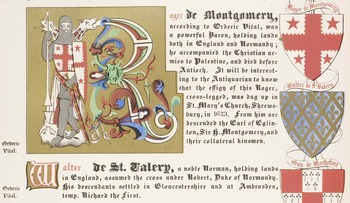
Some clung to received orthodoxy. In 1849, J C Dansey published a nominal roll of English crusaders, including mention of some sixty cross-legged effigies, virtually all assigned (through a credulous reliance on tradition and speculation) to named individuals: the majority, he was convinced, had not merely taken crusading vows, but had actually journeyed to the Holy Land (fig 11).Footnote 105 J H Shorthouse, in the mid-1850s, knew that the theory had been challenged, but confessed that ‘I hardly like to believe this’.Footnote 106 Vincent Wing restated the crusading-vow theory in 1865, on the authority of ‘a learned and able writer’.Footnote 107 From the mid-1840s onwards, however, most serious antiquaries were beginning to acknowledge the improbability of any link with the crusades. Sir Stephen Glynne, who generally strove to be punctilious in his terminology, occasionally used the ‘Crusader’ label in notes made before 1840, but subsequently abandoned it.Footnote 108 The brothers J G and L A B Waller, still inclined in 1842 to accept the theory, were persuaded by 1864 that it was baseless: ‘of all traditions there are none so little worthy of respect as those of antiquaries’.Footnote 109
Lithograph representing Roger de Montgomery (d 1094), from Dansey’s faux-medieval roll of The English Crusaders (1849). Dansey has confused the cross-legged effigy in St Mary’s Church, Shrewsbury, with the straight-legged effigy traditionally identified as Montgomery in Shrewsbury Abbey. Photograph: © The British Library Board (shelfmark 1321.l.5)

Among the wider public, the connection remained a commonplace, reflected not least in its literary appearances: passing allusions to it were made by Wordsworth, in 1822, Dickens, in 1861, and Tennyson, in 1886.Footnote 110 The popular author (and FSA) John Timbs informed his readers in 1861 that ‘[t]he devices which we see on old tombs distinguish, by their emblematic differences, the dead which they inclose. The legs of crusaders were crossed’.Footnote 111 A refinement of the theory, established by the 1880s, held that the point at which an effigy’s legs crossed – at ankles, knees or thighs, or in other accounts at ankles, shins or knees – signified the number of crusades in which the knight had participated.Footnote 112 Dr E C Brewer, in 1895, in his successful Dictionary of Phrase and Fable, reported that ‘the person so represented died in the Christian faith. As crusaders were supposed so to do, they were generally represented on their tombs with crossed legs’.Footnote 113 Up to the end of the century, unqualified references to ‘crusaders’ could still occasionally appear even within the pages of respectable archaeological journals.Footnote 114
Reports of the death of the crusader theory were issued, but were clearly premature. J R Planché remarked, in 1857, that it had ‘for some time been abandoned’; in the following year he recorded that revisionist opinion was ‘fast gaining ground’.Footnote 115 George Vere Irving in 1864 called it ‘entirely exploded’, although he later added that ‘[n]o one denies’ that many of the commemorated had been crusaders: he merely disputed a direct link.Footnote 116 Albert Hartshorne, in 1876, echoing his father’s scepticism of three decades earlier, dismissed the Templar attribution as a ‘popular fiction’, and the crusader attribution as a ‘fancy’ (with the qualification that the pose might none the less signify a crusading intent).Footnote 117 In the view of Arthur Vicars in 1888, ‘[e]veryone knows now’ that the theory was disproved; and of J Latimer in 1894, ‘[f]or the last forty years, to say the least, no one claiming to possess even an inkling of antiquarian knowledge has believed in the old fancy’.Footnote 118 However, J C Cox, addressing the Congress of Archaeological Societies in the latter year, still found it necessary to attack the ‘imaginary connection’, observing ‘how rampant is that fiction in certain places, and how constantly it has to be contradicted’.Footnote 119 Albert Hartshorne returned to the fray in 1899, and further refutations included one published in French by Camille Enlart in 1906.Footnote 120 In 1923, the theory achieved the dubious distinction of being condemned in A S E Ackermann’s handbook of Popular Fallacies.Footnote 121
Its tenaciousness could be explained in part by the lack of any satisfactory alternative. ‘That this posture denoted the crusader has long been the received opinion’, the Waller brothers had argued in 1842, ‘and may still be retained with propriety until a better theory is advanced.’Footnote 122 A correspondent to Notes and Queries in 1868 challenged sceptics to explain ‘the almost simultaneous disappearance of the custom with the decline of the Crusades, and the extinction of the Templars; and how it comes to pass that so few of such persons of distinction are thus commemorated … except such as had taken the vow to go to Palestine’.Footnote 123 One commentator in 1880 characterized the problem as ‘an archaeological nut’.Footnote 124 Canon William Thompson in 1904 dismissed the doubters as ‘[u]nimaginative people’, deferring instead to the ‘important authority’ of Tennyson.Footnote 125 ‘If these effigies do not denote a connexion with crusading’, demanded John Page two years later, ‘what was the particular reason why the legs were crossed?’Footnote 126 The only alternative iconographic theory to have emerged – promoted particularly by Planché and Irving in the 1850s and 1860s – was the idea noted at the beginning of this paper of a connection with the seated ‘kingly’ or authoritarian pose.Footnote 127 Although occasionally revived since by continental scholars, the interpretation has never gained widespread support.Footnote 128
Among those who rejected the pose’s specific crusading associations, many were still unwilling to abandon the idea of cruciform and Christian symbolism. As early as 1782, Thomas Pennant had noted the seventeenth-century cross-legged effigies at Mitton (Yorkshire; now Lancashire) to members of the Catholic Shireburn family (fig 12), and argued that the attitude had ‘sometimes been considered merely as a reverential sign of our Saviour’s suffering’.Footnote 129 Charles Boutell in 1847 saw in the convention an ‘expressive token’ that the warrior had ‘died professing the Christian faith’: unconsciously reverting to one of the sixteenth-century theories, he hypothesized that it might indicate church founders and benefactors.Footnote 130 James Graves in 1853 considered that the interpretation ‘least open to objection’ was that the pose was ‘designed to be symbolical of the Christian faith of the deceased’.Footnote 131 M H Bloxam, in the 1830s the first to question the crusader attribution, viewed the issue in the 1860s and 1870s as still unresolved: he now contended that crossed legs did denote a ‘cruce signatus’, but argued that this term did not necessarily imply a crusader, but rather a member of the ‘fratres crucis’, a fraternity also embracing pilgrims and patrons.Footnote 132 Edward Blore in 1872 saw in the attitude ‘merely … an emblem of the Cross’; and Herbert Macklin in 1907 suggested that the knight had been ‘a benefactor of the church’.Footnote 133 Others, however, found the notion of cruciform symbolism untenable. In the words of the Waller brothers in 1864, ‘it would be strange, if there were no more positive way of indicating a crusader than by crossing the legs’; and of George Vere Irving four years later: ‘it certainly never to my mind conveyed any idea of the Holy Cross, which might be so much more reverently indicated in many ways’.Footnote 134
Monuments commemorating three generations of the Shireburn family at Mitton (Yorkshire), by William Stanton, erected c 1699. The effigies represent Richard iii Shireburn (d 1668), in the foreground, his son, Richard iv Shireburn (d 1689), with his wife Isabel (d 1693), at centre left, and their son, Richard v Shireburn (d 1690), obscured in the background. All three men are cross-legged. Photograph: author

More generally, the twentieth century saw the scholarly debate move on from iconographic to technical and stylistic explanations of the pose – matters which fall outside the scope of the present essay.Footnote 135 Yet, despite being abandoned by the great majority of informed critics, the crusader theory has resurfaced periodically in reputable scholarly discourse and has never been entirely banished. E S Prior and Arthur Gardner in 1912, while rejecting a universal identification with crusaders, argued that the conception behind some cross-legged figures ‘may derive from the Crusades, and might well be first applied to the Knights of the Cross, especially to the Knights Templar, to give them, we may say, the posture of their devotion’.Footnote 136 The folklorist Eliza Gutch, who confessed herself to being ‘behindhand in not having yet wholly freed myself of the Crusading theory’, claimed in 1913 that she had even ‘met with an FSA clinging to the old belief … and the fiction is dear to many less learned than he’.Footnote 137 Erwin Panofsky reverted to the theory in 1964, observing that ‘[t]here may be, after all, some truth in the traditional assumption that the motif of the crossed legs initially designated a Crusader’.Footnote 138 Richard Morris, writing in 1998, suggests a connection with the idea of knights on quest, and particularly with the quest for the Holy Grail.Footnote 139 And, most recently, Rachel Dressler in 2004, while allowing that the effigies do not necessarily represent active crusaders, firmly identifies the deceased with the crusading ideals of the ‘miles Christi’: ‘For those who had not participated in the Holy War, the tomb effigy might have in some way performed as a surrogate’.Footnote 140
Even those who have been sceptical of conscious symbolism have been prepared to read a bewildering range of subconscious and subliminal meanings into crossed legs. J R Planché regarded the attitude as ‘ungraceful’; yet W H Tregellas, in 1875, thought it ‘a not uncommon posture of repose’, and F P Barnard, in 1910, ‘an easy and a natural pose’.Footnote 141 Harry Quilter, in 1913, argued that the intended ‘psychological suggestion’ was to show ‘the militant knight … now resting in peace’, and Paul Binski sees ‘a certain aristocratic nonchalance’ in the attitude; but most modern scholars have interpreted it rather in terms of alertness, activity and energy.Footnote 142 Dressler – in unwitting but dramatic contrast to a rumoured nineteenth-century theory that the effigies represent castrated crusader prisoners – discerns in the pose a ‘foregrounding of male physicality’: the legs ‘block the approach to the genitals but also call attention to those organs upon which the discourse of sexual difference focused its assertions’, and so ‘signify phallic potency’.Footnote 143
At a popular level, the crusader theory continues to flourish, disseminated above all orally, but also through church guides and similar well-intentioned but ill-informed heritage publications and media.Footnote 144 It is probably true to say that it is less prevalent than it was a century ago and that, in print at least, it now appears as a myth to be rebutted almost as often as it does as a statement of fact; but it has been reinvigorated in recent years by the mushrooming of the heritage industry – including church tourism – and by the rise of the internet as a medium of misinformation. In Candace Robb’s The Cross-Legged Knight (2002), a mystery novel set in fourteenth-century York, the attitude is described as ‘the style of many crusaders’ tombs’ (a claim only lightly qualified in an authorial postscript).Footnote 145 Brewer’s Dictionary of Phrase and Fable continues to assert in its eighteenth edition, published in 2009, that crusaders were ‘generally represented on their tombs with crossed legs’.Footnote 146
Conclusions
The crusader theory of crossed legs has now survived, battered but unbroken, for over four centuries. Other examples can be cited of misinterpreted details of commemorative monuments prompting or shaping popular beliefs. These range from legends of giants and heroes, by way of tales of extraordinary deaths and bizarre burials, to the modern American conceit that the number of hooves raised by the horse of an equestrian statue denotes the manner of the rider’s demise.Footnote 147 No other instance of what has been dubbed ‘monument lore’, however, has achieved the ubiquity, the longevity or the resilience of the myth of the cross-legged crusader, in which the weight of tradition and the appeal of romantic legend continue to defy the challenges of scholarship. The one arena which the notion has never penetrated to any significant degree is, perhaps surprisingly, the broader historiography of the crusades themselves. The explanation can only lie in the gulf throughout much of the period under review between the disciplines of antiquarianism and history.Footnote 148
The presumption throughout this paper has been that the crusader theory and its analogues are erroneous and have little to tell us about medieval effigies. But what do they have to tell us about the antiquaries and commentators who were viewing and judging the monuments? From John Stow’s declaration that ‘a heape of old monumentes, wytnesses of tymes, & bright beames of the truth, can testifye, that I have not swarved one whyt from the truthe’, to Sir Richard Colt Hoare’s ‘We speak from facts not theory’, antiquaries prided themselves on their objective dependence on primary evidence.Footnote 149 What we have instead seen in these pages has been a recurrent willingness to allow judgement to be swayed by preconception and prejudice. Phillip Lindley has suggested that Dressler, in her studies of cross-legged effigies, is guilty of ‘reading into her subject twenty-first century American concerns’: equivalent charges of presentism could be levelled at several of the seventeenth-century religious nostalgists, the eighteenth-century virtuosi and rationalists, the nineteenth-century chivalric romantics and the modern conspiracy theorists that we have met in the course of this story.Footnote 150 It is clear, none the less, that the roots of the iconographic interpretation of the pose lie in the Elizabethan and Jacobean passion for imagery, allegory and symbolism. The contemporary arts were steeped in iconographic allusions, and equivalent ideas were applied retrospectively and anachronistically to work of earlier eras. Heraldic writers, for example, began to assign to charges and tinctures a range of fantastically recondite meanings, unknown to medieval armory.Footnote 151 The crusader and Templar theories of crossed legs are manifestations of this same tendency. But if they are primarily the offspring of an early modern mindset, they hold lessons, too, for our own age of post-modern, hyper-relativist and hermeneutic scholarship. A laudable desire to delve beneath the surface is ever in danger of being taken to unreasonable and over-imaginative extremes and the cultural productions of the past of being read in ways that pass far beyond what their original creators and audiences may have intended or understood. Patterns and meanings are sought and found in places where, sometimes at least, none exist. As Sir Geoffrey Elton observed, ‘[h]ermeneutics is the science which invents meaning; historical study depends on discovering meaning without inventing it’.Footnote 152
We should not, however, rush to pass too harsh a judgement on the early antiquaries. The investigative disciplines of typological and stylistic diagnosis, which underpin so much modern archaeology and art history, were barely capable of conception, let alone articulation, in the sixteenth century. The study of the past was still predominantly text-based, and, where antiquaries were beginning to take an interest in material remains, their attentions were largely focused on the semi-textual and quasi-textual media of lapidary inscriptions, coins, seals and heraldry. There was little attempt to read beyond the surface, the ‘witting’ testimony of such relics, and only the crudest understanding of formal or stylistic changes across time.Footnote 153 Observers occasionally hazarded a guess at the approximate date of an enigmatic document, building or monument, but could rely on little more than intuition and they rarely progressed beyond such broad assessments as that of Thomas Hawley, in 1530, that the brass to Sir Alan Buxhull (d 1381) might, from its ‘old and anschant lying’, date from the time of Henry v; or of Leland a few years later that Robert of Normandy’s effigy was made ‘longe since his death’.Footnote 154 More substantive were Erdeswick’s analysis of Wulfric Spot’s effigy as ‘fashioned … something like to our new monuments’, so that it could date from no earlier than the time of Edward iii and, more probably, from the reigns of Edward iv or Henry vii; or Symonds’s appraisal of several late fourteenth- and fifteenth-century effigies as made ‘in the forme of the Black Prince’; such insights as these remained exceptional, however.Footnote 155
A firmer sense of the problem and its resolution emerged in the second half of the seventeenth century, with the adoption from the natural sciences of Baconian principles of induction from empirical evidence: John Aubrey termed the application of such techniques to antiquarian material ‘comparative antiquitie’.Footnote 156 Stylistic chronologies began to be constructed, particularly in relation to palaeography and medieval architecture. By the 1740s, Smart Lethieullier could appreciate that the same diagnostic methodology, of identifying the distinctive characteristics of securely dated examples and testing undated examples against them, was applicable to tomb design.Footnote 157 The fruits of this approach materialized a generation later in Richard Gough’s Sepulchral Monuments in Great Britain (1786–99), which laid the foundations for the modern critical study of tomb monuments.Footnote 158
Against this background, then, antiquarian interest in crossed legs from the mid-sixteenth century onwards appears less a tale of ill-informed and misjudged speculation and more a case of the early and successful isolation of a characteristic typological feature. A parallel may be drawn with the rather later recognition of the pointed arch as a defining feature of late medieval architecture: the speculative and outlandish theories of origins which accompanied this insight were eventually abandoned, but the consideration and discussion of them fostered a more mature understanding of the Gothic form.Footnote 159 An incipient sense that the cross-legged attitude might be linked to a chronological period appears in the earliest fumbling suggestions, shaped by popular tradition, that it was ‘very ould’ or ‘the ancient trade’; was refined in the belief that it dated from ‘before the Conquest’; and was then challenged by Wyrley on a sounder evidential basis with his assertion that it emerged ‘after the Palestine wars’.Footnote 160 Subsequent attempts to delimit the dating, however, such as the views of the anonymous antiquary in 1600 and Gervase Holles in the 1650s that the effigies were not found after the time of Edward ii, Thomas Habington’s proposed date range of 1095–1310, and even Lethieullier’s of 1224–1313, were hamstrung by an underlying conviction that the primary meaning of the motif must be symbolic, and associated with either the crusades or the Templars.Footnote 161 An opportunity to formulate a valuable diagnostic principle was effectively delayed for over a century, a failure as regrettable in hindsight as the perpetuation of the fallacious iconographic readings of the pose. Such shortcomings should not blind us, however, to the more fundamental achievement of the Elizabethan antiquaries: the perspicacious identification by a discriminating intellectual community of a distinctive and important class of antiquity, on typological grounds, at a precociously early date.
Acknowledgements
I am indebted to the referees of this paper for their helpful criticism of an earlier draft; to Fr Eugenio Alliata, Pat Bancroft, Rosamund Caird, Dominic Farr, Stephen Friar, Philip Lankester, Hannah Partos, Paul Shirley, Jean Wilson and Robert Yorke for advice and assistance on points of detail; and to Tim Cockburn for innumerable lessons in the deflation of cant and charlatanry.
ABBREVIATIONS AND BIBLIOGRAPHY
- Abbreviations
- BL
British Library, London
- Bodleian
Bodleian Library, Oxford
- CA
College of Arms, London
- HRO
Herefordshire Record Office
- N&Q
Notes and Queries
- SAL
Society of Antiquaries of London