





The duration of untreated psychosis (DUP) has been widely studied as a prognostic indicator in first-episode psychosis (FEP), with shorter DUP associated with improved symptomatic and functional outcomes. Reference Catalan, Salazar de Pablo, Aymerich, Guinart, Goena and Madaria1 However, DUP is shaped by care pathways and contextual factors and, by definition, does not capture symptom persistence following antipsychotic initiation.
Attention has therefore shifted to temporal markers of post-treatment symptom persistence. Duration to remission (DTR), defined as the time from antipsychotic initiation to symptom remission, indexes early treatment response. Active psychosis after treatment initiation includes persistent symptoms until first remission and subsequent relapses during early follow-up. Reference Crowley, Healy, McNamara, Twomey, Sadowska and Firth2 Combining DUP and DTR yields the duration of active psychosis (DAP), defined as the time from symptom onset to first remission. Although DAP summarises overall active psychosis, DUP and DTR capture distinct pre- and post-treatment phases shaped by different factors (e.g. referral patterns, service availability and stigma for DUP; adherence, substance use and treatment resistance for DTR).
Notably, few long-term studies have directly compared DUP, DTR and DAP. We examined whether duration- and severity-weighted indices of active psychosis predict 10-year symptomatic and functional outcomes in FEP.
Method
Participants and study context
Data were derived from a 10-year naturalistic follow-up of 178 individuals with FEP who achieved full positive symptom remission and participated in a 12-month randomised controlled trial (RCT) comparing maintenance treatment with treatment discontinuation in Hong Kong (2003–2014; ClinicalTrials.gov: NCT01926340). Reference Hui, Honer, Lee, Chang, Chan and Chen3 Participants had received continuous antipsychotic treatment for at least 12 months (mean duration of approximately 22 months) and were free of positive symptoms at randomisation. After trial completion, participants received routine clinical care and completed a 10-year follow-up interview with longitudinal clinical record review. All participants met the DSM-IV criteria for non-affective psychotic disorders and provided written informed consent.
All procedures contributing to this work comply with the ethical standards of the relevant national and institutional committees on human experimentation and with the Helsinki Declaration of 1975, as revised in 2013. All procedures involving human participants were approved by the Institutional Review Boards of the University of Hong Kong/Hospital Authority Hong Kong West Cluster (UW 11-453), Kowloon Central/Kowloon East Research Ethics Committee (KC/KE-13-0175/ER-2), New Territories West Clinical and Research Ethics Committee (NTWC/CREC/1216/13), Kowloon West Cluster Research Ethics Committee (KW/EX-13-127[68-11]), Joint Chinese University of Hong Kong and New Territories East Cluster Clinical and Research Ethics Committee (2014.308) and Hong Kong East Cluster Ethics Committee (HKEC-2013-083).
Outcomes
Active psychosis was assessed monthly by medical record review, using the Clinical Global Impression-Schizophrenia (CGI-SCH) Positive Symptoms subscale, Reference Haro, Kamath, Ochoa, Novick, Rele and Fargas4 from RCT baseline to 10 years after randomisation. Scores ranged from 1 (normal) to 7 (severely ill), with scores ≥3 (mild or above) indicating active psychosis Reference Haro, Novick, Bertsch, Karagianis, Dossenbach and Jones5 and ≤2 (borderline or normal) indicating remission.
DUP was assessed with the Interview for the Retrospective Assessment of the Onset of Schizophrenia. Reference Häfner, Riecher-Rössler, Hambrecht, Maurer, Meissner and Schmidtke6 DTR was defined as the duration (months) from antipsychotic initiation to first remission, and DAP as the duration (months) from symptom onset to first remission. Duration and severity (area under the curve (AUC)) were calculated for all three active psychosis indices. Because pre-treatment symptom severity was not available, the DUP AUC was estimated with CGI-SCH scores from the initial treatment period corresponding to each participant’s DUP duration.
Clinical and functional outcomes at 10 years were assessed with the Positive and Negative Syndrome Scale, Reference Kay, Fiszbein and Opler7 Scale for the Assessment of Positive Symptoms, Reference Andreasen8 Scale for the Assessment of Negative Symptoms, Reference Andreasen9 Calgary Depression Scale for Schizophrenia, Reference Addington, Addington and Schissel10 Clinical Global Impression-Illness Severity scale, Reference Busner and Targum11 Social and Occupational Functioning Assessment Scale, Reference Goldman, Skodol and Lave12 Role Functioning Scale Reference Goodman, Sewell, Cooley and Leavitt13 and Strauss and Carpenter Outcome Scale. Reference Strauss and Carpenter14
Statistical analysis
Using SPSS Statistics version 28.0 for Windows (IBM, Armonk, New York, USA; https://www.ibm.com/products/spss-statistics), linear regression was used to examine associations between active psychosis indices (duration and AUC) and 10-year outcomes. Significant univariate associations (p < 0.05) were entered into multivariate models adjusted for onset age, gender, baseline education (years), diagnostic group (schizophrenia spectrum versus other non-affective psychoses), psychiatric comorbidity (absent versus present) and randomised treatment allocation (maintenance versus discontinuation).
Results
Of 178 randomised participants, 142 (79.8%) completed the 10-year follow-up. Reference Hui, Honer, Lee, Chang, Chan and Chen3 Mean baseline age was 24.5 years; 45.8% were male, 71.1% were employed and 9.5% reported lifetime illicit drug use. Diagnoses included schizophrenia (51.4%), schizophreniform disorder (16.2%), schizoaffective disorder (5.6%), brief psychotic disorder (10.6%) and psychosis not otherwise specified (16.2%). Median durations were 3.0 months for DUP, 2.0 months for DTR and 5.8 months for DAP; mean AUC values were 13.4, 11.6 and 25.1, respectively.
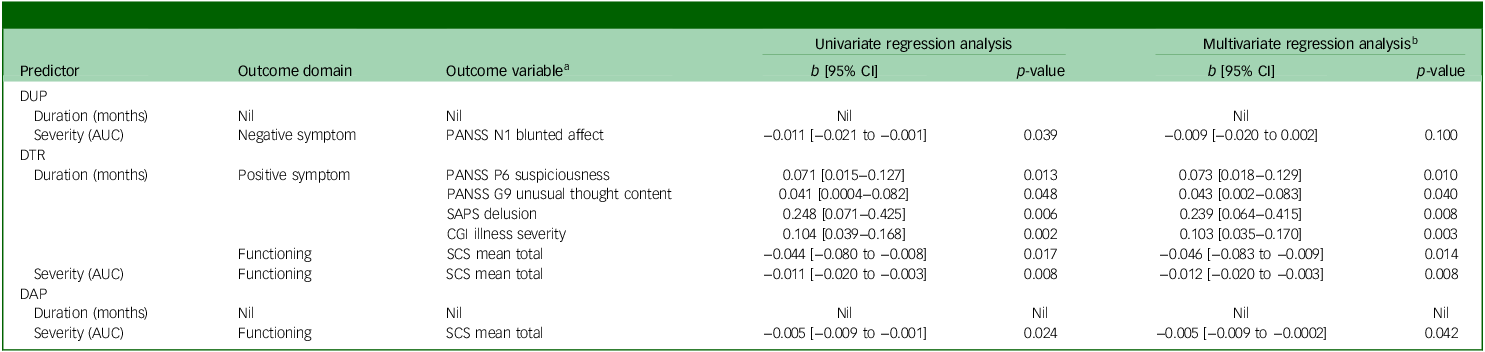
DTR was the most consistent and strongest predictor of long-term outcomes. Longer DTR duration was associated with greater positive symptom severity (suspiciousness, unusual thought content, delusions) and overall illness severity. Both longer DTR duration and higher DTR AUC predicted poorer functioning. In contrast, higher DUP AUC was associated with more severe negative symptoms, whereas higher DAP AUC predicted worse functioning. All associations remained significant after multivariate adjustment, except for the association between DUP AUC and blunted affect, which was attenuated (adjusted p = 0.100) (Table 1).
Significant associations between active psychosis duration and severity indices and 10-year clinical and functional outcomes

Table 1 Long description
The table has 10 rows and 6 columns. The columns are labeled Predictor, Outcome domain, Outcome variable, Univariate regression analysis b [95 percent CI], Univariate regression analysis p-value, Multivariate regression analysis b [95 percent CI], and Multivariate regression analysis p-value. The rows are labeled with different predictors: DUP Duration (months), DTR Duration (months), DTR Severity (AUC), and DAP Severity (AUC). Each row provides specific outcome domains and variables, along with corresponding b values, 95 percent confidence intervals, and p-values for both univariate and multivariate regression analyses. Notable predictors include DTR Duration and Severity, which show significant associations with various outcome variables.
DUP, duration of psychosis; AUC, area under the curve; PANSS, Positive and Negative Syndrome Scale; DTR, duration to remission; SAPS, Scale for the Assessment of Positive Symptoms; CGI, Clinical Global Impression Scale; SCS, Strauss and Carpenter Outcome Scale; DAP, duration of active psychosis.
a. Outcome measures included clinical symptoms, relapse,and functional outcomes, assessed by trained research assistants at 10-year follow-up. Candidate outcome variables entered into the univariate regression analyses included total, subscale and individual item scores from the PANSS, SAPS and Scale for the Assessment of Negative Symptoms; total scores from the Calgary Depression Scale for Schizophrenia, Clinical Global Impression-Illness Severity scale and Social and Occupational Functioning Assessment Scale; total and domain scores from the Role Functioning Scale and the total score from the SCS. Sample sizes were as follows: PANSS (n = 142), SAPS (n = 142), Scale for the Assessment of Negative Symptoms (n = 142), Calgary Depression Scale for Schizophrenia (n = 141), Clinical Global Impression-Illness Severity scale (n = 143), Social and Occupational Functioning Assessment Scale (n = 147), Role Functioning Scale (n = 147) and SCS (n = 136). No imputation or carried-forward data were applied.
b. Sensitivity multivariable regression analyses were adjusted for age at onset, gender, baseline education (years), baseline diagnostic group (schizophrenia spectrum disorder versus other non-affective psychosis), baseline psychiatric comorbidity (absence versus presence) and randomised treatment allocation (maintenance treatment versus treatment discontinuation).
Discussion
These findings indicate that persistence of active psychosis after treatment initiation, indexed by DTR, is more strongly associated with long-term outcomes in FEP than DUP or DAP, underscoring the importance of achieving early symptom remission. A longer DTR may reflect reduced responsiveness to dopamine-targeted treatment, suggesting greater involvement of non-dopaminergic mechanisms underlying the psychotic episode. Reference Chen, Wong, So, Suen and Hui15 Emerging theoretical frameworks, such as the State-Based Autobiographical Memory of Psychosis, may provide one possible lens for understanding these associations, Reference Chen, Wong, So, Suen and Hui15 alongside other plausible neurobiological and psychosocial explanations. Further empirical work is needed to evaluate these potential mechanisms.
Our findings also support distinguishing DUP and DTR as distinct phases with different determinants. The limited sensitivity of DUP is unsurprising given its pre-treatment nature and susceptibility to care pathways, contextual factors and uncertainty inherent in retrospectively recalled illness onset. Contrastingly, DTR reflects early treatment response and emerged as the most informative prognostic marker in this study. These findings suggest that distinguishing pre-treatment and post-treatment phases provides greater prognostic insight than considering their composite, DAP.
Limitations include restricting the sample to individuals who achieved full remission, and potentially limiting the applicability of DTR to those who disengage from treatment or never remit. Participants were also recruited from a cohort originally enrolled in a 12-month RCT comparing maintenance treatment with discontinuation, which may have influenced long-term clinical trajectories. However, all had achieved remission before randomisation, making an effect on early-course measures unlikely. Generalisability may be further limited by the early intervention setting and a cohort with relatively low substance use and high employment. Additionally, some measures relied on retrospective record review, DUP AUC was estimated because symptom severity before treatment initiation was unavailable, and residual confounding by unmeasured variables, such as socioeconomic status, cannot be excluded.
In conclusion, active psychosis persistence following antipsychotic initiation was more strongly associated with long-term clinical and functional outcomes than treatment delays in FEP. DTR emerged as the most consistent and robust predictor, suggesting that optimising early treatment response may represent a promising target for improving long-term prognosis in psychosis.
Data availability
The data used in this study include individual-level assessments collected over long-term follow-up as part of a randomised controlled trial. These data cannot be shared publicly due to ethical constraints, participant consent restrictions and institutional data governance policies. Reasonable requests for clarification of analytic methods and for academic research purposes may be considered by the corresponding authors.
Author contributions
C.L.M.H. and E.Y.H.C. had full access to all of the data in the study and take responsibility for the integrity of the data and the accuracy of the data analysis. C.L.M.H. and E.Y.H.C. contributed to the study concept and design; acquisition, analysis or interpretation of data; statistical analysis; funding; administrative, technical or material support; study supervision and drafting the manuscript. N.C.L.Y. contributed to statistical analysis and drafting the manuscript. All authors critically revised the manuscript for important intellectual content.
Funding
The randomised-treatment phase of the study was supported by the Research Grants Council of Hong Kong (grant number 7655/05M) and AstraZeneca (investigator-initiated study award). AstraZeneca prepared the quetiapine and the placebo, packaged the study medications according to the randomisation schedule. The follow-up study was supported by the Food and Health Bureau of Hong Kong (grant number 10111101). The funding sources had no role in the design or conduct of the study; collection, management, analysis or interpretation of the data; preparation, review or approval of the manuscript; or decision to submit the manuscript for publication.
Declaration of interest
E.Y.H.C. reports having received speaker honoraria from Otsuka and DSK BioPharma; received research funding from Otsuka; participated in paid advisory boards for Jansen and DSK BioPharma; and received funding to attend conferences from Otsuka and DSK BioPharma. All other authors have no conflicts of interest to declare.

 Open access


eLetters
No eLetters have been published for this article.