

‘Our constitution – especially those articles in it that confer on our citizens the most cherished of human rights – must on no account be given a literal meaning. It should not be read as a last will and testament. If we do that then that is what it will become.’Footnote 1
In a constitutional democracy with a legally supreme written constitution such as Malaysia, the judiciary – in particular the apex court – can justifiably be regarded as the ‘guardian of the constitution’.Footnote 2 The very existence of a written constitution, especially one that expressly proclaims its supremacy over other inconsistent sources of law, connotes the idea that it shall be the duty of the judicial branch to uphold the constitution and to invalidate any legislation that is in conflict with its provisions.Footnote 3 This understanding – imbued with the fundamental concept of separation of powers and its associated checks on governmental power – has become central to the functioning of constitutionalism and the rule of law.Footnote 4
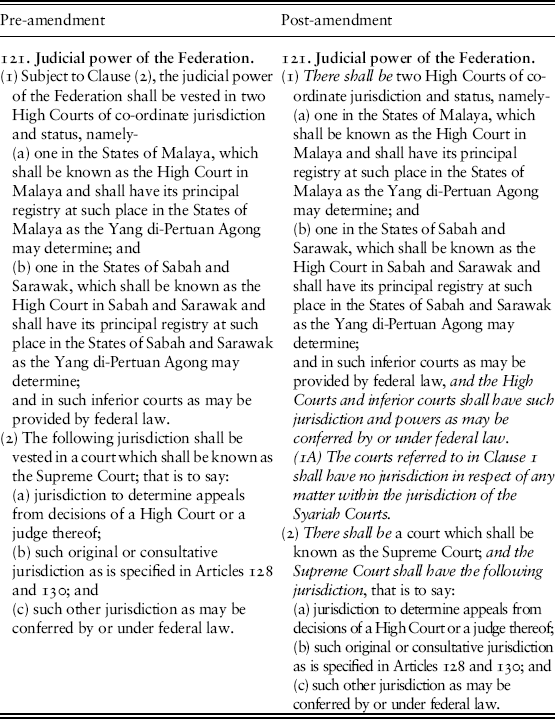
However, what recourse does the judicial branch have when the legislature, acting at the behest of the executive, employs the amendment procedure provided for in the constitutional text to strike at judicial power by making its exercise entirely subordinate to the dictates of legislation? This was the dilemma that arose in Malaysia, where in 1988 the Federal Constitution of Malaysia 1957 (Federal Constitution) was amended – in accordance with the stipulated amendment procedure – to delete the provision which had vested ‘the judicial power of the Federation’ in the courts, inserting instead a clause that the High Courts ‘shall have such jurisdiction and powers as may be conferred by or under federal law’Footnote 5 (see Appendix I below). This amendment was subsequently interpreted judicially to mean that the scope and extent of the Malaysian courts’ jurisdiction and powers had become entirely coterminous with what legislation provides, no more and no less.Footnote 6 The problem with this, which increased in obviousness and urgency over time, was that the courts’ ability to dispense justice became fully subject to such as limits as Parliament could – by ordinary legislation requiring only a simple majority to enact – and did impose.Footnote 7 The status of the judicial branch as a separate and co-equal branch of government – let alone guardian of the constitution – appeared to have evaporated, to be replaced by a role clearly subordinate to the diktat of the legislature. With the constitutional separation of powers thus undermined by the amendment, it became possible for legislation to be enacted in ways that further marginalized the courts as an independent avenue for upholding the Constitution and the laws.Footnote 8
However, in the recent case of Semenyih Jaya Sdn Bhd v Pentadbir Tanah Daerah Hulu Langat,Footnote 9 the apex court of Malaysia appears to have struck back – nearly thirty years after the amendment – by declaring unconstitutional a recently-inserted provision of the Land Acquisition Act 1960 (LAA) that purported to require High Court judges presiding over contested land acquisition cases to be bound by the determinations of lay assessors in their judgments. This provision – a further example of legislation making a complete mockery of the judicial branch and its role in the administration of justice – was invalidated on the basis that ‘the judicial power of the court resides in the judiciary and no other’, and that only judges can exercise decision-making powers in the courts.Footnote 10 Considerable interest was generated by the apex court’s further dicta that Parliament does not have power to amend the Federal Constitution so as to undermine the separation of powers and the independence of the judiciary, which form part of the ‘basic features’ of the Constitution.Footnote 11 This position, reminiscent of the Indian Supreme Court’s so-called ‘basic structure doctrine’ under which the Parliament of India cannot amend the Constitution of India 1950 (Constitution of India) in a way that alters or destroys the ‘basic structure’ of that constitution,Footnote 12 naturally generated significant attention, for it seemed that the Federal Court had finally stood up in defence of constitutionalism and the rule of law.
This paper examines the extent to which Semenyih Jaya can truly be said to have repaired the damage caused by the amendments which deleted ‘the judicial power of the Federation’ from the constitutional text in 1988. While it is undoubtedly a welcome and progressive judgment compared to its precedents on this issue, I suggest that its articulation of the ‘basic structure’ and the exclusivity of the courts’ control over ‘the judicial power’ is still relatively underdeveloped. The Federal Court also left the status of the 1988 constitutional amendment ambiguous; it was denuded of effect in the particular circumstances of Semenyih Jaya, but without an express overruling of the amendments, it is respectfully submitted that it remains possible for a future court to interpret the amended constitutional provisions in ways that are still highly detrimental to the checks and balances envisioned by the separation of powers and the independence of the judiciary.Footnote 13 I suggest that at best, Semenyih Jaya should be seen as a progression in the ‘constitutional dialogue’ between the judicial branch and the ‘political branches’ of the constitution ie the legislature and the executive.Footnote 14
Part I below sets out the context in which Semenyih Jaya emerged, canvassing the issues arising from the 1988 constitutional amendments and the Malaysian courts’ previous attitudes towards these amendments, as well as towards the ‘basic structure doctrine’. Part II provides a conspectus of how judiciaries in comparable constitutional systems on the so-called ‘Westminster model’ have dealt with similar issues, and some key lessons that have emerged from these experiences. Part III focuses on Semenyih Jaya itself, examining the extent to which it charted a new course for constitutional discourse in Malaysia. Part IV situates Semenyih Jaya in the context of what I postulate as an ongoing ‘constitutional dialogue’ between the judiciary and the political branches in Malaysia. Part V concludes.
I. BACKGROUND TO SEMENYIH JAYA
The fundamental idea of constitutionalism – that the exercise of political power shall be bound by rules that determine the validity of legislative and executive action by reference to either procedure or permissible substantive content – has been well-accepted in Malaysian jurisprudence.Footnote 15 Thus, maintaining a system of effective restraints on governmental action, in accordance with a higher law that binds all constitutional actors, is essential to the continued practice of constitutionalism.Footnote 16 Accordingly, the Federal Constitution embodies elements of the doctrine of separation of powers – wherein the executive, legislative and judicial powers of the state are distinguished from one another and vested in different personnel and institutions – in an attempt to prevent the excessive and potentially abusive accumulation of power in one individual or group.Footnote 17
Although there is no universally applicable definition of ‘judicial power’, it can be broadly defined as ‘the power to examine questions submitted for determination with a view to the pronouncement of an authoritative decision as to the (legal) rights and liabilities of one or more parties.’Footnote 18 The Supreme Court of Malaysia, now known as the Federal Court, has cited with approval the definition given by the High Court of Australia, ie that judicial power is ‘the power which every sovereign authority must of necessity have to decide controversies between its subjects or between itself and its subjects, whether the rights relate to life, liberty or property.’Footnote 19 Judicial power thus connotes the power to determine disputes of a legal nature in which parties are concerned with protecting their legal interest, as opposed to any other interest.Footnote 20 The precise limits of the judicial power in a constitutional system may vary between jurisdictions, depending on political and legal factors as well as ‘the imperatives of events and contemporary imponderables’.Footnote 21 In constitutions established on the ‘Westminster model’, the judicial power is typically vested in the courts, whose function is to ‘interpret all written law … and to declare the unwritten common law and rules of equity.’Footnote 22
A. The Malaysian Constitutional Context
Malaysia is a federal constitutional monarchy based largely on the ‘Westminster model’ of government instituted by the British colonial authorities when the then Federation of Malaya attained independence in 1957.Footnote 23 The Declaration of Independence read by the first Prime Minister, Tunku Abdul Rahman envisioned ‘the peaceful and orderly advancement of the Federation of Malaya as a constitutional monarchy based on Parliamentary democracy’, pledging that the new nation ‘shall be for ever a sovereign democratic and independent state founded upon the principles of liberty and justice, and ever seeking the welfare and happiness of its people.’Footnote 24
The Federal Constitution provides in Article 4(1): “This Constitution is the supreme law of the Federation and any law passed after Merdeka DayFootnote 25 which is inconsistent with this Constitution shall, to the extent of the inconsistency, be void”. The legal supremacy of the Federal Constitution is well-recognized in Malaysian jurisprudence and in academic commentary.Footnote 26 In the oft-quoted locus classicus on this issue, Ah Thian v Government of Malaysia, the then Lord President, Tun Suffian said:
The doctrine of Parliamentary sovereignty does not apply in Malaysia. Here we have a written constitution. The power of Parliament and of state legislatures in Malaysia is limited by the Constitution, and they cannot make any new law they please.Footnote 27
In line with the ‘Westminster model’ of constitutionalism, at its inception the Federal Constitution separated governmental power into ‘the executive power of the Federation’, ‘the legislative power of the Federation’ and ‘the judicial power of the Federation’, which were vested in the constitutional monarch (the Yang di-Pertuan Agong), Parliament, and the two High Courts in the country, respectively.Footnote 28 Similar to the British ‘parliamentary executive’ model, the executive branch governs with the confidence of the majority in Parliament, and also invariably comprises the leaders of the political parties who command a majority in Parliament. Thus, the ominous ‘fusion of powers’ between executive and legislature that characterizes the British tradition of constitutionalism is replicated in Malaysia.Footnote 29 Nonetheless, the idea that ‘no single man or body shall exercise complete sovereign power, but that it shall be distributed among the Executive, Legislative and Judicial branches of government’ was specifically affirmed as a guiding constitutional principle by Raja Azlan Shah FCJ (as His Royal Highness then was) in Loh Kooi Choon v Government of Malaysia.Footnote 30
The two High Courts – in Malaya, and in Sabah and Sarawak – exercise original jurisdiction as well as appellate and supervisory jurisdiction over decisions of subordinate courts, tribunals, and public authorities.Footnote 31 Appeals may lie from decisions of the High Court to the Court of Appeal, and thereon to the Federal Court.Footnote 32 The Federal Court also exercises a limited form of original and advisory jurisdiction, as provided by the Federal Constitution.Footnote 33 There is no specialized constitutional court in Malaysia; questions of constitutional interpretation are resolved through the ordinary judicial mechanism.
The High Courts, the Court of Appeal, and the Federal Court are collectively referred to as the ‘superior courts’ due to their original and supervisory jurisdiction, and the safeguards in place towards securing the independence of their judges. For instance, new appointments to the superior courts are made on the recommendation of an ostensibly independent appointments commission.Footnote 34 Once appointed, judges of the superior courts enjoy security of tenure and remuneration guaranteed by the Federal Constitution.Footnote 35 The Federal Constitution also restricts parliamentary discussion of the conduct of judges,Footnote 36 and statute confers legal immunity from civil suit in respect of anything done in the discharge of judicial duty.Footnote 37 A judge of the superior courts cannot be removed from office except by way of a tribunal process stipulated under the Federal Constitution,Footnote 38 although in the infamous ‘1988 judicial crisis’ it appeared nonetheless possible for dismissal to occur under circumstances that would ordinarily be considered a serious breach of natural justice.Footnote 39 These safeguards are available only to justices of the superior courts; they do not apply to judges of the subordinate courts (the Sessions Court and the Magistrate’s Court), who are public service employees under the Judicial and Legal Service.Footnote 40
The Federal Constitution provides for the possibility of its amendment ‘by federal law’; generally, most provisions can be amended with the support of at least two-thirds of the total number of members in each of the two Houses of Parliament – the elected lower house and the Senate or upper house.Footnote 41 Amendments affecting the position of the hereditary Malay Rulers or the position of the states of Sabah and Sarawak require also the consent of the Conference of Rulers or the Governors of these states, respectively.Footnote 42
B. The 1988 Amendments
In practice, however, amending the Federal Constitution presented no special difficulty to the Government from independence in 1957 to March 2008, because the same ruling coalition (in two different iterations) retained power at federal level with a two-thirds majority in every election during this period. This enabled a deluge of constitutional amendments; Andrew Harding has noted forty-two amending Acts and over 600 textual amendments to the Federal Constitution within this time.Footnote 43 These include highly controversial amendments removing limits on executive and legislative powers, ousting judicial review, and reversing inconvenient judicial decisions.Footnote 44 Dr Mahathir Mohamad, a one-time critic of the government who later rose to power, observed:
Parliamentary sittings were regarded as a pleasant formality which afforded members opportunities to be heard and quoted, but which would have absolutely no effect on the course of the Government. The general feeling was that whether or not the Parliament sat, the Government would carry on. The sittings were a concession to a superfluous democratic practice. Its main value lay in the opportunity to flaunt Government strength. Off and on, this strength was used to change the constitution. The manner, the frequency and the trivial reasons for altering the constitution reduced this supreme law of the nation to a useless scrap of paper.Footnote 45
In March 1988, tensions boiled over between the judiciary and the executive branch – ironically now headed by Dr Mahathir who had meanwhile become the country’s fourth Prime Minister – over a series of superior court decisions in which the judiciary demonstrated its ability and willingness to check perceived excesses of power by the executive.Footnote 46 One such decision in fact specifically concerned the judicial power, wherein the Supreme Court struck down an amendment to the Criminal Procedure Code that unconstitutionally vested an element of ‘the judicial power of the Federation’ in the Attorney-General, a member of the executive.Footnote 47 The upshot of this confrontation was that in March 1988 the government used its two-thirds majority in Parliament to amend the Federal Constitution, deleting ‘the judicial power of the Federation’ from the constitutional text.Footnote 48
When moving the amendments in the House of Representatives, the Prime Minister claimed that they were necessary ‘to further clarify the position of the courts.’Footnote 49 The Hansard transcript indicates clearly the intent behind the amendment:
With the provision vesting the judicial power of the Federation, the boundary between the judiciary and the executive or the legislature is vague. With this amendment, the Government hopes to demarcate that boundary clearly. This is essential so that the executive, legislature and judiciary can perform their responsibilities without disturbing or being disturbed by the others.Footnote 50
Accusing the courts of misusing judicial power by ‘making interpretations far removed from the meaning and spirit of the law’s enactment’, ‘rendering the debates in this Legislature useless’ and ‘giving priority to cases in Britain and other countries over written law’,Footnote 51 the Prime Minister continued:
This Bill is not intended to take power from the Judiciary, or from the Courts. It is only to ensure that we in this House can make laws, and the Judges can determine matters in accordance with the law ... this Bill does not give judicial power to us. It only ensures that the Judges, in sentencing and judging, must be guided by the law made by this House, which is regarded as Federal Law. That is all we are doing, nothing more than that.Footnote 52
Since Hansard is an accepted guide to interpretation, these remarks are potentially valuable in assessing the intent behind these amendments.Footnote 53 However, they also demonstrate a serious misunderstanding of the judiciary’s role in a system of constitutional as opposed to parliamentary supremacy, for how could the amendment ensure that the judiciary’s actions are guided by the laws made by Parliament whilst not ‘taking power away’ from the judiciary? When laws made by Parliament infringe the Federal Constitution, the duty of the courts must surely be to declare that inconsistency and give effect to the Federal Constitution. Otherwise, the supremacy clause in Article 4(1) would be rendered meaningless. Furthermore, the supremacy clause provides that any law that is ‘inconsistent with this Constitution’ – not any provision of the Constitution – shall be void to the extent of the inconsistency. This includes not merely inconsistency with express provisions of the Federal Constitution, but also inconsistency with fundamental principles and features that can be inferred from its structure and provisions.Footnote 54
C. Case Law on the 1988 Amendments
Post-1988, there was considerable uncertainty about whether ‘the judicial power of the Federation’ continued to vest in the judiciary, and if so, to what extent.Footnote 55 The ‘judicial power of the Federation’ or constitutional judicial power is conceptually distinct from the ordinary ‘jurisdiction and powers’ conferred by the legislature through statute, which the courts have undoubtedly continued to exercise even after the amendments.Footnote 56 The former connotes a particular type of sovereign power that is vested exclusively in the judicial branch, and it serves at least two functions that go beyond statute-based ‘jurisdiction and powers’: first, it forms a reserve repository of authority, enshrined in the constitution, that the courts can draw upon to act in situations that warrant the exercise of judicial power but which are not covered specifically by statute.Footnote 57 Second, it demarcates an exclusive constitutional domain for the judiciary as a co-equal branch of government insofar as it designates certain functions and powers as exclusive to the judicial branch,Footnote 58 and precludes the assignment to the judiciary of functions incompatible with its role as the repository of judicial power.Footnote 59
In Sugumar Balakrishnan v Pengarah Imigresen Negeri Sabah Footnote 60 the Court of Appeal attempted to invoke the concept of inherent constitutional judicial power to overcome a statutory ouster clause preventing judicial review of decisions made by the Sabah State Immigration Director. This judgment was overturned on appeal by the Federal Court.Footnote 61 In Danaharta Urus, the Federal Court (again overruling the Court of Appeal) affirmed the validity of another statutory ouster clause protecting decisions of a national special-purpose investment vehicle from judicial review, even though violations of constitutionally-protected rights were at issue.Footnote 62 The Federal Court interpreted the amended Article 121(1) as providing that ‘access to justice shall be available only to the extent that the courts are empowered to administer justice … the manner and extent of the exercise of the right to justice is subject to, and circumscribed by, the jurisdiction and powers of the court as provided by federal law.’Footnote 63
The most restrictive and controversial interpretation of the post-amendment Article 121(1) came in Public Prosecutor v Kok Wah Kuan, Footnote 64 involving a provision of the Child Act 2001 that effectively vests in the executive branch the power to determine the length of incarceration of juveniles convicted of a capital offence. The Federal Court, by a 4-1 majority, overturned the Court of Appeal’s decision that such an arrangement violates the separation of powers and the exclusive vesting of judicial power in the courts. Abdul Hamid PCA, for the majority, held that ‘after the amendment, there is no longer a specific provision declaring that the judicial power of the Federation shall be vested in the two High Courts.’Footnote 65 Consequently:
There is no longer a declaration that the ‘judicial power of the Federation’ as the term was understood prior to the amendment vests in the two High Courts. If we want to know the jurisdiction and powers of the two High Courts we will have to look at the federal law. If we want to call those powers ‘judicial powers’ we are perfectly entitled to. But, to what extent such ‘judicial powers’ are vested in the two High Courts depend (sic) on what federal law provides, not on the interpretation of the term ‘judicial power’ as prior to the amendment. Footnote 66
Our Constitution does have the features of the separation of powers and at the same time, it contains features which do not strictly comply with the doctrine. To what extent the doctrine applies depends on the provisions of the Constitution.Footnote 67
A provision of the Constitution cannot be struck out on the ground that it contravenes the doctrine. Similarly no provision of the law may be struck out as unconstitutional if it is not inconsistent with the Constitution, even though it may be inconsistent with the doctrine. The doctrine is not a provision of the Malaysian Constitution even though no doubt, it had influenced the framers of the Malaysian Constitution, just like democracy.Footnote 68
This was a surprisingly restrictive and self-abasing position which, taken to its logical conclusion, subordinates the entirety of the Malaysian courts’ jurisdiction and powers to what Parliament might see fit to provide. In other words, Parliament could even by ordinary legislation (‘federal law’) disable the courts from enforcing the Federal Constitution, if it wanted to. Although the majority’s position is probably in accordance with the legislative intention behind the amendment,Footnote 69 this fatally undercuts the principle that in a system of constitutional supremacy and rule of law no one – including Parliament – ought to be above the law.Footnote 70
Indeed, Richard Malanjum CJSS issued a strong dissent in which he was ‘unable to accede to the proposition that with the amendment of Article 121(1) ... the courts in Malaysia can only function in accordance with what [has] been assigned to them by federal laws.’Footnote 71 His Lordship opined that the amendment ‘should by no means be read to mean that the doctrines of separation of powers and independence of the Judiciary are now no more the basic features of our Federal Constitution’.Footnote 72 He also added: ‘I do not think that as a result of the amendment our courts have now become servile agents of a Federal Act of Parliament and that the courts are now only to perform mechanically any command or bidding of a federal law.Footnote 73
Cases subsequent to Kok Wah Kuan were unable to make any substantial contribution towards resolving this dilemma.Footnote 74 In a statement characteristic of the prevailing uncertainty, in Yang Dipertua, Dewan Rakyat v Gobind Singh Deo, the Federal Court asserted that ‘the doctrine of separation of power is a feature of our Constitution’, but (citing Kok Wah Kuan) ‘the extent to which the doctrine applies depends on the provisions of the Constitution’.Footnote 75
D. Basic Structure Doctrine
The ‘basic structure doctrine’ is the idea that a legislature cannot amend a written constitution in a way that destroys the ‘basic structure’ of that constitution, even if it complies with the amendment procedure provided for therein.Footnote 76 This is an implied limitation – imposed by the courts – on the amending power of the legislature, as opposed to the express limitations contained in so-called ‘eternity clauses’ present in the constitutions of Germany and Indonesia, for example.Footnote 77 The doctrine connotes the idea of an unconstitutional constitutional amendment – a purported constitutional amendment that is void for non-compliance with fundamental principles implicit in the constitution itself.Footnote 78 In the common law tradition, the ‘basic structure doctrine’ developed from the jurisprudence of the Indian Supreme Court, starting from the landmark case of Kesavananda Bharati v State of Kerala Footnote 79 and further articulated in cases such as Minerva Mills Ltd v Union of India Footnote 80 and IR Coelho v State of Tamil Nadu.Footnote 81
In Malaysia the argument has been raised, even prior to Kesavananda, that certain alterations to the Federal Constitution are so fundamental that they require more than just compliance with the stated amendment procedure.Footnote 82 However the first Lord President dismissed the idea, and so did the judges in two later Federal Court cases in which constitutional amendments were challenged on the basis that they violated basic principles enshrined in the fundamental liberties provisions of the Federal Constitution.Footnote 83 It has nonetheless been highlighted that in these three cases the courts took care to reject only the application of the ‘basic structure doctrine’ to the factual matrixes before them, without asserting that the doctrine could never apply in the context of Malaysia.Footnote 84 It should also be noted that these cases were all decided well before the amendments of 1988, and thus the eminent judges who decided them could not have contemplated that the executive would later launch such a brazen assault on the judicial branch itself by way of constitutional amendment.Footnote 85
In the post-1988 case of Sivarasa Rasiah,Footnote 86 involving the fundamental liberty to form associations, the Federal Court did once assert that:
It is clear from the way in which the Federal Constitution is constructed that there are certain features that constitute its basic fabric. Unless sanctioned by the Constitution itself, any statute (including one amending the Constitution) that offends the basic structure may be struck down as unconstitutional.Footnote 87
However, these remarks were purely obiter, as no issue of unconstitutional amendment arose on the facts of that case and thus, no amendment was actually impugned. To this day, no constitutional amendment has been declared unconstitutional in Malaysia.
II. COMPARATIVE LESSONS FROM THE REALM OF ‘WESTMINSTER MODEL’ CONSTITUTIONALISM
Comparable jurisdictions on the ‘Westminster model’ of constitutionalism have also grappled with the two issues highlighted above: amendments that threaten the basic structure of a supposedly supreme written constitution; and efforts to undermine the judicial power vested in the courts by the constitution. Cases from foreign jurisdictions are not binding on Malaysian courts, but they have persuasive value – particularly cases from England and the Privy Council.Footnote 88
In three classic authorities – Liyanage v The Queen,Footnote 89 Hinds v The Queen,Footnote 90 and Bribery Commissioner v Ranasinghe,Footnote 91 the Privy Council addressed the issue of ordinary legislation passed by the legislatures of Ceylon (Sri Lanka) and Jamaica which impinged on the judicial power that had been constitutionally allocated to the judicial branch in these countries. In these cases, it was established that in what Lord Diplock termed ‘a constitution on the Westminster model … it is taken for granted that the basic principle of separation of powers will apply to the exercise of their respective functions by the three organs of government.’Footnote 92 Lord Diplock added:
What, however, is implicit in the very structure of a Constitution on the Westminster model is that judicial power ... is to continue to be vested in persons appointed to hold judicial office in the manner and on the terms laid down in the Chapter dealing with the judicature, even though this is not expressly stated in the Constitution’.Footnote 93
As Liyanage, Hinds, and Bribery Commissioner dealt with ordinary legislation infringing the judicial power of the courts, they are only of limited relevance in a situation where the legislature has passed not merely ordinary legislation but a constitutional amendment to that effect. In fact, in Hinds itself, Lord Diplock acknowledged that there could be ‘a machinery whereby any of the constitutional provisions ‘may be altered by those peoples through their elected representatives in Parliament acting by specified majorities, which is generally all that is required’Footnote 94 . Likewise, in Bribery Commissioner, the Privy Council held that ‘such a Constitution can, indeed, be altered or amended by the legislature, if the regulating instrument so provides and if the terms of those provisions are complied with, and the alteration or amendment may include the change of these very provisions’ that were in issue in that case.Footnote 95 In Hinds, as with Liyanage and Bribery Commissioner, no such scenario arose on the facts.
What that oft-cited trio of cases tells us is that in the ‘default state’ of Westminster model constitutionalism, the judicial power of the courts is to be separate and independent, and it cannot lawfully be usurped by the legislature through statutes that reassign elements of the judicial power to other branches. Crucially, this is also the position where a Westminster model constitution is silent (or in the case of Malaysia, subsequently made silent) on the allocation of judicial power. The Privy Council, in its appellate capacity for Caribbean jurisdictions, continues to cite Hinds for the proposition that separation of powers is a basic principle on which Westminster model constitutions are founded.Footnote 96 The Privy Council has also asserted that the separation between the judicial power and the executive or legislative powers is ‘a characteristic feature of democracies’,Footnote 97 and that direct interference with judicial proceedings is ‘inherently contrary to the separation of powers as well as the rule of law.’Footnote 98
In the case of State of Mauritius v Khoyratty,Footnote 99 the Privy Council reviewed an amendment to the Constitution of Mauritius 1968 (Constitution of Mauritius) which excluded, in criminal cases involving dangerous drugs, the otherwise constitutionally-guaranteed right to a determination of a court on bail pending trial. The Privy Council upheld the view of the Supreme Court of Mauritius that such exclusion amounted to an unconstitutional interference by the legislature into functions intrinsically within the domain of the judiciary. Uniquely, the Constitution of Mauritius provides in Section 1 that ‘Mauritius shall be a democratic state’, and in Section 47(3) that Section 1 can only be amended with the support of three quarters or more of the electorate, plus a unanimous vote in the legislature. The Supreme Court of Mauritius held, and the Privy Council agreed, that the purported constitutional amendment removing the power of the courts to adjudicate on bail impinged on the nature of Mauritius as a ‘democratic state’, and since it had not overcome the exceptional degree of entrenchment stipulated by Section 47(3), that amendment was unconstitutional. Khoyratty thus also highlights that legislative interference with the courts’ inherent judicial power is directly inimical to the existence of a ‘democratic state’.
I have outlined above the genesis of the ‘basic structure doctrine’ in the Indian Supreme Court.Footnote 100 The key rationale behind the doctrine, as expressed by Khanna J in Kesavananda, is that ‘the power of amendment … does not include the power to abrogate the Constitution nor does it include the power to alter the basic structure or framework of the Constitution.’Footnote 101 Khanna J approved as ‘substantially correct’ the observations by the German jurist Dietrich Conrad that ‘any amending body organized within the statutory scheme, howsoever verbally unlimited its power, cannot by its very structure change the fundamental pillars supporting its constitutional authority.’Footnote 102 Since Kesavananda, the ‘basic structure doctrine’ has engendered a voluminous amount of debate, attracting vociferous criticism and articulate defences that extend well beyond the scope of this paper.Footnote 103
The ‘basic structure doctrine’ has also been adopted by the courts in Bangladesh (1987)Footnote 104 and Pakistan (2015)Footnote 105 in addressing constitutional amendments that threatened to weaken the separate and independent position of the judiciary. In Bangladesh, the attempted establishment of a new system of courts parallel to the High Court by way of constitutional amendment was struck down as ‘destroying a basic structural pillar of the constitution and taking away the plenary judicial power of the Republic vested in the High Court Division.’Footnote 106 In Pakistan, the Supreme Court recently reviewed the Eighteenth Amendment to the Constitution of the Islamic Republic of Pakistan 1973 (Constitution of Pakistan), which significantly altered the method by which judges of the superior courts in Pakistan are appointed. The Supreme Court held that it could review the amendment for compliance with the ‘basic structure’ of the Constitution of Pakistan, but on the facts, it upheld the amendment as being compatible with judicial independence.Footnote 107
Similarly, the Supreme Court of Belize has blocked an attempt by the Government of Belize to amend the Belize Constitution 1981 (Belize Constitution) so as to vest control over all land containing ‘petroleum minerals and accompanying substances’ in the Government and deny landowners the right to apply to the courts for compensation following the deprivation of their proprietary interests in the land.Footnote 108 In Bowen v Attorney General of Belize,Footnote 109 the Supreme Court invoked the idea of basic structure laid down in Kesavananda, holding that all laws enacted by the National Assembly, including constitutional amendment laws, must be ‘subject to the Constitution’, and further added that any view to the contrary would replace constitutional supremacy with parliamentary supremacy.Footnote 110 Subsequently, the Government of Belize attempted to amend the constitution to disapply the supremacy clause of the Belize Constitution to any law passed under the amendment procedure, inserting a provision that the existing constitutional rules governing amendment are ‘all-inclusive’ and ‘there is no other limitation, whether substantive or procedural, on the power of the National Assembly to amend this Constitution.’Footnote 111 This attempted legislative overruling of the decision in Bowen by way of constitutional amendment was struck down by the Supreme Court in British Caribbean Bank v Attorney General of Belize, Footnote 112 again on the basis of the basic structure doctrine. The Supreme Court asserted that ‘the basic structure doctrine is a feature or part of the Constitution of Belize’, and the purported amendment was void as it ran contrary to the separation of powers that forms the basic structure of the Constitution.Footnote 113
In Singapore, Article 93 of the Constitution of the Republic of Singapore (Singapore Constitution) provides that ‘the judicial power of Singapore shall be vested in a Supreme Court and in such subordinate courts as may be provided by any written law for the time being in force.’ The term ‘judicial power of Singapore’ was discussed in Mohammad Faizal bin Sabtu v Public Prosecutor, where Chan Sek Keong CJ opined that the status of the judicial power in Singapore is that of ‘a constitutional power derived directly from Article 93 and hence may be said to be co-equal in constitutional status with the legislative and executive power, subject only to the limitations expressed in the Singapore Constitution’.Footnote 114 This is consistent with the Singapore courts’ generally restrictive approach towards attempts to curtail judicial power using legislative ouster clauses; for instance, in Yong Vui Kong v Attorney-General, it was held that ‘in any modern State whose fundamental law is a written Constitution based on the doctrine of separation of powers … there will (or should) be few, if any, legal disputes between the State and the people from which the judicial power is excluded’.Footnote 115 The Singapore courts have also noted that since Article 93 has the effect of vesting the judicial power exclusively in the Supreme Court and the subordinate courts, this power cannot be vested in any entity which is not a court.Footnote 116
In Mohammad Faizal bin Sabtu Chan CJ concluded, following a review of ‘the Westminster model of constitutional government’, that ‘the principle of separation of powers, whether conceived as a sharing or a division of sovereign power between these three organs of state, is part of the basic structure of the Singapore Constitution’.Footnote 117 Although no issue of unconstitutional amendment arose in that case, Chan CJ’s usage of the term ‘basic structure’ is interesting because firstly, that term is loaded with the jurisprudence of Kesavananda and subsequent cases from various jurisdictions; and secondly, the Singapore courts had previously declined to adopt the basic structure doctrine, holding instead that an amendment could never be invalid if enacted in compliance with the amendment procedure.Footnote 118 In recent years, the learned former Chief Justice has continued to vigorously advocate the view that the legal supremacy of the Singapore Constitution supports the applicability of the ‘basic structure doctrine’ in order to render void any purported constitutional amendment that destroys the basic features of the Constitution.Footnote 119
This brief overview of practices elsewhere in the realm of ‘Westminster model’ constitutionalism demonstrates that the issue of constitutional amendments affecting the basic structure of the constitution and/or undermining the judicial power continues to be one of contemporary relevance across jurisdictions. Although the ‘basic structure doctrine’ as set out in Kesavananda is still far from being universally accepted, there appears to be a growing willingness on the part of courts to identify and defend what are perceived to be fundamental features of the constitutional system, especially with regard to the nature and extent of their own powers as a separate and independent branch of government. Experience from Commonwealth jurisdictions suggests that courts may be able to draw upon the structure of their written constitution and the implicit principles therein to challenge, if not invalidate, constitutional amendments that attempt to undermine these principles.
III. SEMENYIH JAYA: A PARADIGM SHIFT IN MALAYSIA?
In Semenyih Jaya, a challenge was brought against a compulsory acquisition of land in the state of Selangor for a highway project. The landowners’ challenge was principally against the District Land Administrator’s valuation of the land for the purpose of compensation under the LAA. Compulsory acquisition of land without adequate compensation is a violation of Article 13 of the Federal Constitution, which provides:
13. Rights to property.
(1) No person shall be deprived of property save in accordance with law.
(2) No law shall provide for the compulsory acquisition or use of property without adequate compensation.
Pursuant to the LAA, the dispute was referred to the High Court as a land reference case, involving a High Court Judge sitting with two lay ‘assessors’ – a government valuer and a private valuer. However, with effect from March 1998, the LAA had been amended to include a new Section 40D governing the procedure of such cases:
Decision of the Court on compensation
40D. (1) In a case before the Court as to the amount of compensation or as to the amount of any of its items the amount of compensation to be awarded shall be the amount decided upon by the two assessors.
(2) Where the assessors have each arrived at a decision which differs from each other then the Judge, having regard to the opinion of each assessor, shall elect to concur with the decision of one of the assessors and the amount of compensation to be awarded shall be the amount decided upon by that assessor.
(3) Any decision made under this section is final and there shall be no further appeal to a higher Court on the matter.Footnote 120
Upon receiving an unfavourable verdict from the High Court, the landowners appealed on the basis, inter alia, that the provisions of Section 40D were ultra vires Article 121 of the Federal Constitution read together with Article 13, since they made the assessors and not the High Court judge the final arbiters on the amount of compensation. It was argued that this contravenes Article 121(1), which – even in its post-amendment iteration – was said to require ‘that judicial power to decide a dispute brought before the courts is vested in the courts’.Footnote 121 A related question in the appeal was the extent to which Section 40D(3) barred any appeal against the decision of the High Court.
The landowners’ argument on Article 121(1) thus necessitated judicial re-evaluation of the impact that the 1988 amendments had had on that Article, since it was necessary to establish whether after 1988, ‘the judicial power of the Federation’ continued to vest exclusively in the judicial branch established by the Federal Constitution. The court’s position on this would accordingly determine the constitutionality of Section 40D. On a more literal reading of the post-amendment Article 121(1), as articulated in Danaharta Urus and Kok Wah Kuan, the High Courts are to have strictly ‘such jurisdiction and powers as may be conferred by or under federal law’, and accordingly there would be nothing objectionable about a federal law that limits its powers vis-à-vis the assessors, like Section 40D of the LAA. That the claimants would consequently have no recourse for a breach of their Article 13 constitutional rights would be none of the court’s concern; as the Federal Court rather brazenly stated in Danaharta Urus, ‘access to justice shall be available only to the extent that the courts are empowered to administer justice … the manner and extent of the exercise of the right to justice is subject to, and circumscribed by, the jurisdiction and powers of the court as provided by federal law.’Footnote 122
On one level, the argument on Section 40D highlighted the scale of the damage that could be caused by a literal interpretation of the amended Article 121(1), inviting the court to reconsider its self-limiting approach in the earlier precedents. On a deeper level however, it also engaged the question of whether and to what extent the constitutional amendment procedure could be used to alter fundamental features of the Federal Constitution such as the separation of powers and the independence of the judiciary, bearing in mind that these features are not themselves express provisions of the Constitution but are instead to be inferred from the constitutional matrix. This is, of course, the question that has in some other jurisdictions been answered with the basic structure doctrine.Footnote 123
In Semenyih Jaya, the Federal Court unanimously allowed the appeal on the point of constitutionality and struck down Section 40D as being ultra vires Article 121(1) of the Federal Constitution.Footnote 124 In its reasoning, the Federal Court departed from what it called the ‘narrow interpretation of Article 121(1)’ in Kok Wah Kuan, citing with approval Richard Malanjum CJSS’s dissenting judgment in that case instead.Footnote 125 Beginning from the well-accepted premise that a written constitution must be interpreted generously, ‘organically and with less rigidity than ordinary legislation’,Footnote 126 the court held that the legal implication of Article 121(1) goes well beyond the idea that the powers of the High Court to adjudicate disputes are merely those which have been conferred by federal law.Footnote 127 Rather, that provision enshrines (i) the doctrine of separation of powers and (ii) the independence of the Judiciary as features of the Federal Constitution.Footnote 128 The 1988 amendment thus ‘had the effect of undermining the judicial power of the Judiciary’ and impinging on these features. Referencing Sivarasa Rasiah and the Kesavananda doctrine, the Federal Court asserted that:
With the removal of judicial power from the inherent jurisdiction of the Judiciary, that institution was effectively suborned to Parliament, with the implication that Parliament became sovereign. This result was manifestly inconsistent with the supremacy of the Federal Constitution enshrined in Art 4(1).
It is worthwhile reiterating that Parliament does not have power to amend the Federal Constitution to the effect of undermining the features [of separation of powers and the independence of the Judiciary].Footnote 129
The Federal Court also referred to the Privy Council decision in Liyanage, emphasising that ‘any alterations made in the judicial functions would tantamount [sic] to a grave and deliberate incursion in the judicial sphere.’Footnote 130 Moreover:
The Judiciary is thus entrusted with keeping every organ and institution of the state within its legal boundary. Concomitantly, the concept of the independence of the Judiciary is the foundation of the principles of the separation of powers. This is essentially the basis upon which rests the edifice of judicial power. The important concepts of judicial power, judicial independence and the separation of powers are as critical as they are sacrosanct in our constitutional framework.Footnote 131
With that reasoning, the Federal Court determined that ‘the judicial power of the court resides in the Judiciary and no other, as is explicit in Article 121(1) of the Constitution.’Footnote 132 Therefore, Section 40D was unconstitutional, as it allowed lay assessors to ‘in effect take over the judicial power of the court enshrined under Article 121(1) in deciding on a reasonable amount of compensation in land reference matters.’Footnote 133 The High Court Judge, under that statutory scheme, merely ‘sits by the side-line and dutifully anoints the assessors’ decision’, rubber-stamping it as a so-called judgment of the High Court.Footnote 134 Since the Federal Court in Semenyih Jaya regarded the power to award compensation in land reference proceedings as a judicial power that is vested in the High Court, ‘the discharge of judicial power by non-qualified persons or non-judicial personages renders the said exercise ultra vires Article 121 of the Federal Constitution’.Footnote 135 Accordingly, the Federal Court struck down Section 40D, applying the doctrine of prospective overruling to maintain awards already made previously.Footnote 136 Furthermore, as Section 40D contained the only set of procedural guidelines on the disposal of land reference cases, the Federal Court took the unprecedented step of not only proposing that a new Section 40D be put in place, but also stating the contents that ‘are to be made clear in the proposed new section’.Footnote 137 The court took it upon itself to set out seven paragraphs of the replacement procedure it envisioned in place of the previous Section 40D – the key idea being that the system of having two assessors could continue, but ‘it is for the judge, and the judge alone, to deliberate on the issue of quantum before him, after taking into account all the issues’:Footnote 138
It is reiterated that the opinion of the assessors is not binding on the judge. In the event the assessors disagree (as between themselves on the amount of quantum) the judge may, after considering both opinions, elect to consider which of the two opinions in his view is appropriate in the circumstances of the case. However he is not bound by either one of the opinions. Should the judge finds (sic) himself in disagreement with the opinion of both the assessors, he is at liberty to decide the matter, giving his reasons for so doing.Footnote 139
This act of ‘judicial legislation’ or ‘judicial rewriting of the statute’, without waiting for Parliament to enact a replacement to Section 40D, was certainly courageous and novel, since previously the superior courts were simply content to declare statutory provisions unconstitutional, leaving it to Parliament to do the necessary follow-up measures. On this occasion, however, the Federal Court’s guidelines promptly developed into a new set of procedural rules on resolving land reference cases, at least until the legislature produces a replacement. By the Chief Judge of Malaya’s Practice Direction No 1 of 2017 (Practice Direction),Footnote 140 the procedure stipulated by the Court in Semenyih Jaya was formalized and all High Court Judges and practitioners were directed to comply with the new, judicially-imposed procedure.
Another interesting aspect of Semenyih Jaya was how the court approached Section 40D(3) and its purported ouster of the right of appeal in respect of compensation. Here the Federal Court insisted that the ouster clause ‘ought to be narrowly and strictly construed’ in view of Article 13 of the Federal Constitution, which protects the right to ‘adequate compensation’ for loss of property in the event of acquisition ‘in accordance with law’.Footnote 141 Thus, according to the Federal Court the ouster clause could only bar appeals arising purely on issues of fact relating to the quantum of compensation, since an aggrieved party always has ‘the right to appeal on questions of law’, which raises the question of whether the constitutional requirements in Article 13 were duly satisfied.Footnote 142 This was significant as it reaffirmed the Federal Court’s jurisdiction to hear the appeal notwithstanding the purported ouster clause in Section 40D(3). The Court thereupon proceeded to identify instances of procedural non-compliance in the first instance judgment that had resulted in the appellant’s Article 13 right to ‘adequate compensation’ being violated.Footnote 143 Thus, on a point additional to and separate from the issue of unconstitutionality, the first instance judgment was also impugned. The Federal Court’s restrictive approach towards the purported ouster clause, in line with well-reasoned authorities in Malaysia and elsewhere,Footnote 144 also bodes well for the defence of constitutional judicial power. This willingness to use judicial creativity to overcome ouster clauses that might otherwise shield abusive, unlawful or erroneous ‘determinations’ from curial scrutiny, is indeed a laudable step forward for the rule of law.
IV. CONSTITUTIONAL DYNAMICS IN LIGHT OF SEMENYIH JAYA
Semenyih Jaya has been hailed as a courageous and progressive decision that restored constitutional judicial power to whom it rightfully belongs.Footnote 145 Retired Justice Gopal Sri Ram, who authored the Court of Appeal decisions in Kok Wah Kuan, Danaharta Urus and Sugumar Balakrishnan that were all overturned by the Federal Court, wrote that ‘Semenyih Jaya has correctly consigned the majority decision in Kok Wah Kuan to the judicial waste bin, where it rightfully belongs.’Footnote 146 Notable constitutional commentator Shad Saleem Faruqi opined that Semenyih Jaya ‘has restored some of the old lustre of Article 121’ and ‘reasserted the notions of separation of powers and judicial independence as central to the Constitution’.Footnote 147 However, retired Justice Abdul Hamid Mohamed – who wrote the majority judgment in Kok Wah Kuan – also took to the press and the blogosphere in a two-part series,Footnote 148 criticizing the ‘unchecked expansion of the grounds for intervention by the judges’ in Semenyih Jaya and contending that:
[T]he doctrines of independence of the judiciary, separation of powers, rule of law, Parliamentary democracy and supremacy of the Constitution … are distorted by the judges to give themselves the power to encroach into the jurisdiction of the Legislature, and rewrite or amend the Constitution or the law.Footnote 149
A. Outstanding Areas of Concern
Semenyih Jaya undoubtedly marked a radical departure from the rather moribund approach to Article 121(1) displayed by the earlier case law. In four respects – (1) the assertion that ‘judicial power’ continues to vest in the courts; (2) the invocation of the Kesavananda-style ‘basic structure doctrine’; (3) the affirmation that the doctrine of separation of powers animates the Federal Constitution; and (4) the reluctance to accept the statutory ouster clause as a bar to judicial review, Semenyih Jaya appears to have laid the groundwork for a more courageous approach by the Malaysian judiciary in upholding constitutional liberties and the rule of law. However, it is respectfully submitted that one should also be wary of overstating its importance, considering what was actually said and decided in Semenyih Jaya. Here I identify three areas of concern surrounding the judgment.
First, by striking down the offending legislation but not the constitutional amendment involved, the Federal Court has left the status of the post-amendment Article 121(1) unclear. In an absence of a declaration striking down the 1988 amendment, there is no doubt that Article 121(1) remains, at least for now, in its amended, post-1988 form. There is a certain inconsistency about ‘reiterating that Parliament does not have power to amend the Federal Constitution to the effect of undermining the features [of separation of powers and the independence of the judiciary]’,Footnote 150 yet refraining from a definitive declaration that the Amendment Act of 1988 was unconstitutional, and that Article 121(1) shall henceforth revert to its pre-amendment wording. A more resolute approach, as taken by the Indian Supreme Court in Kesavananda, the Bangladesh Supreme Court (Appellate Division) in Anwar Hossain Chowdhury, and the Privy Council in Khoyratty,Footnote 151 would have been to strike down the amendment and restore the Federal Constitution to its pre-amendment ‘basic structure’ – for is that not what the doctrine seeks to vindicate, after all? Instead Semenyih Jaya suggests that the Federal Court has taken a position whereby it apparently accepts the amended Article 121(1), but seeks to deprive it of its literal meaningFootnote 152 as well as its intended effectFootnote 153 by interpreting it as subject to inherent overarching principles, in this case the separation of powers and the independence of the judiciary.
This interpretative approach to Article 121(1) may work, but only as long as future courts continue to adhere to the specific interpretation adopted in Semenyih Jaya. Should a future panel of the Federal Court decide that it wishes to take a different view of the amended Article 121(1) – perhaps even by going back to the Kok Wah Kuan perspective – the approach in Semenyih Jaya could collapse like a house of cards. Like in other common law jurisdictions, it is by no means uncommon for radical shifts of interpretation to take place in the Malaysian courts. To name but three examples: (1) the courts’ position on the operation of ouster clauses in administrative law;Footnote 154 (2) the so-called expansive or ‘prismatic’ interpretation of the Part II fundamental liberties;Footnote 155 and (3) the requirement (or otherwise) for legislative restrictions imposed on Article 10 fundamental liberties to be limited to ‘reasonable’ restrictions.Footnote 156 Thus, the approach in Semenyih Jaya appears dangerously over-reliant on future courts continuing to adhere to its particular view of Article 121(1). It would have entrenched the intended outcome much further, had the Federal Court concluded its admirable reasoning in Semenyih Jaya by restoring Article 121(1) to its pre-amendment state.
Second, declarations of unconstitutionality can be reversed in Malaysia. This was demonstrated in Public Prosecutor v Yuneswaran a/l Ramaraj,Footnote 157 where the Court of Appeal ‘resurrected’ Section 9(5) of the Peaceful Assembly Act 2012 (PAA) which had been declared unconstitutional the year before by another bench of the Court of Appeal in Nik Nazmi bin Nik Ahmad v Public Prosecutor.Footnote 158 Section 9(5) provides that it shall be an offence for an organizer of a public assembly not to comply with the requirement to provide ten days’ notice of that assembly to the Officer in Charge of the Police District where the assembly is held. In Nik Nazmi, the Court of Appeal had held that this was a disproportionate restriction on the freedom of assembly protected under Articles 10(1)(b) and 10(2)(b) of the Federal Constitution. Although Article 10(2)(b) permits Parliament to impose ‘such restrictions as it deems necessary or expedient in the interest of security … public order or morality’, the Court of Appeal required that any such restrictions had to be ‘reasonable restrictions’, as provided for by earlier Federal Court authorities.Footnote 159 The Court opined that since there was no rational or reasonable basis for criminalising a failure to comply with the ten-day notice period, Section 9(5) was a disproportionate restriction on a constitutionally-protected fundamental liberty, and thus unconstitutional.
In Yuneswaran, a subsequent bench of the Court of Appeal simply felt free to ‘depart’ from the reasoning in Nik Nazmi, and restored the operation of Section 9(5) of the PAA more than a year after it had been declared unconstitutional.Footnote 160 This was done even though it would result directly in the conviction and sentencing of the defendant in Yuneswaran. The Court of Appeal also overruled the doctrine of ‘reasonable restrictions’ that had been applied in Nik Nazmi, returning the law to the position declared in the earlier case of Public Prosecutor v Pung Chen Choon:
the scope of the court’s inquiry is limited to the question whether the impugned law comes within the orbit of the permitted restrictions … if the impugned law, in pith and substance, is a law relating to the subjects enumerated under the permitted restrictions, the question whether it is reasonable does not arise.Footnote 161
No further legislative or judicial response to Yuneswaran has occurred to date. Notwithstanding theoretical debates about the propriety of a later court resurrecting a statutory provision that has earlier been declared unconstitutional,Footnote 162 the precedent in Yuneswaran is a cautionary reminder against getting overexcited about Semenyih Jaya. What has been declared unconstitutional on one day can, apparently, be restored to ‘business as usual’ on another.
Third, Semenyih Jaya did not articulate a sufficiently clear and forceful picture of the ‘judicial power’ that it sought to protect from interference. It appears that what particularly perturbed the court was that the impugned Section 40D ‘allowed persons other than the judge to decide on the reference before it’, whereas ‘only judges as appointed under the Federal Constitution can exercise decision-making powers in our courts’.Footnote 163 Its appraisal of Article 121(1) was that ‘the judicial power or the power to adjudicate in civil and criminal matters brought to the court is vested only in the court’.Footnote 164
This assessment is of course correct, but with great respect, it is submitted that the Federal Court missed the opportunity to further articulate and uphold the notion of constitutional judicial power – ‘the judicial power of the Federation’ – which cements the position of the judiciary as a co-equal third branch of government. Having rightly seized on the fact that the phrase ‘Judicial power of the Federation’ was left unamended in the shoulder note to Article 121, and can thus be taken into account in interpreting its meaning and purpose,Footnote 165 the Federal Court curiously refrained from expounding further on this concept or exploiting its potential as an inherent source of power and authority for the judiciary. Instead the Court preferred to use more ambiguous terms such as ‘the judicial power of the Judiciary’Footnote 166 and ‘the judicial power of the court’, presenting its substantive conclusion as ‘the judicial power of the court resides in the Judiciary and no other as is explicit in article 121(1) of the Constitution’.Footnote 167
With great respect, the concept of ‘the judicial power of the Federation’ being vested in the courts goes further than the idea articulated in Semenyih Jaya that disputes brought before the courts must be determined only by the judges of these courts. It also encapsulates the principle of exclusive vesting, ie that Parliament may not vest non-judicial bodies outside the courts established by Part IX of the Federal Constitution with elements of ‘the judicial power of the Federation’.Footnote 168 Indeed, it was on this basis that the Supreme Court in the pre-amendment case of Dato’ Yap Peng struck down a statutory amendment for vesting the power to compulsorily transfer cases between courts in the hands of the Attorney-General, a member of the executive. The Supreme Court held that the power to transfer cases was an element of ‘the judicial power of the Federation’, and it was thus unconstitutional to vest that power in anyone other than the judiciary.Footnote 169 Furthermore, the corollary to the vesting of ‘the judicial power of the Federation’ in the courts may also be (if the Australian precedent is adopted) that non-judicial functions cannot be vested in the courts by Parliament or by anyone else.Footnote 170
Seen from this perspective, the constitutional vesting of ‘the judicial power of the Federation’ in the courts effectively prevents Parliament from diminishing the courts’ role as guardian of the constitution and the rule of law by simply diverting functions of a judicial nature to other non-independent bodies, thereby preventing the exercise of these functions from ever reaching the courts in the first place. Armed with the ‘the judicial power of the Federation’, in the Huddart Parker sense of a ‘power that every sovereign state must necessarily have’,Footnote 171 plus the ability to demarcate the limits of that sovereign power through its function of constitutional interpretation, the courts would be well-equipped to resist any such attempts to marginalize its role.Footnote 172 Unfortunately, using the term ‘the judicial power of the court’ instead does not underline clearly that the Federal Court in Semenyih Jaya was aiming for a restoration of the pre-1988 ‘judicial power of the Federation’. Other instances of curious terminology – such as describing the 1988 amendments as a ‘removal of judicial power from the inherent jurisdiction of the court’Footnote 173 – also add unnecessary ambiguity.
To reiterate, constitutionalism is ‘the constraining of government in order to better effectuate the fundamental principles of the political regime’.Footnote 174 It is a ‘commitment, on the part of any given political community, to accept the legitimacy of, and to be governed by, constitutional rules and principles.’Footnote 175 Constitutionalism therefore necessarily connotes a system of effective restraints on governmental action in accordance with a higher law that binds all constitutional actors, including those who occupy positions of power.Footnote 176
In Malaysia, the Federal Constitution is the ‘higher law’ that regulates all constitutional actors – Parliament, the courts, and the executive. As seen above, the Declaration of Independence shows that the ideals of parliamentary democracy, liberty and justice were very much part of the fundamental principles originally underpinning the Malaysian state.Footnote 177 Insofar as these principles continue to underpin Malaysia’s ‘Westminster model’ constitution, the courts will remain the branch of government charged with determining, in the final instance, what the law requires, guided ultimately by the provisions of the Federal Constitution. The courts are therefore the ‘guardians of the Federal Constitution’, and the tool which they must have to discharge this function is ‘the judicial power of the Federation’.
B. Basic Structure Review and its Critics
To be sure, the idea of judicial intervention against constitutional amendments using the ‘basic structure doctrine’ is not without its critics. It has, for instance, been contended that even if we concede the existence of an unwritten ‘basic structure’, these underlying structural principles themselves should nonetheless still be amendable.Footnote 178 Second, judicial intervention in defence of the purported ‘basic structure’ encounters the well-known ‘counter-majoritarian difficulty’Footnote 179 associated with the act of unelected judges striking down the apparent ‘choices’ of the majority expressed through the constitutional amendment Acts, and this outcome is arguably undemocratic.Footnote 180 Unelected judges could even come to be seen as blocking democratic change whilst perpetuating norms from an earlier era.Footnote 181 Third, entrenching elements of the constitution by making them unamendable creates the so-called ‘dead hand’ problem in which present and future generations are inflexibly bound by rules set by the ‘dead hand’ of their ancestors.Footnote 182 Fourth, although ‘unwritten’ principles beyond the constitutional text could be used in constitutional interpretation, it is not immediately obvious that these could be used to challenge constitutional amendments, especially in view of the enhanced majority requirement for amendment that usually applies.Footnote 183
These objections are not new, and they have been addressed in the course of exchanges debating the legitimacy of judicially-imposed limits on constitutional amendments. Some of these arguments, in fact, touch on the very nature and legitimacy of judicial review in general, not merely judicial review of constitutional amendments.Footnote 184 To the first argument it is pointed out that the amendment power is different from – and subordinate in nature to – the constituent power, and hence it cannot be used to undermine the basic structure of the very constitution that conferred the amending power in the first place.Footnote 185 Against the second point it is highlighted that the ideal of democracy is distinct from majoritarianism, and while the former is generally thought desirable, the latter is not necessarily so.Footnote 186 Moreover, the role of judicial review is precisely to mitigate the dangers of majoritarianism and to prevent the abuse of power that could stem from it.Footnote 187 The idea of the basic structure and its accompanying doctrine of unamendability could also, in fact, be used to protect elements of the constitution that characterize and secure democracy in the system. In that sense, unamendability is consistent with a broad substantive theory of democracy.Footnote 188
The ‘dead hand’ objection is met by pointing out that the ‘basic structure doctrine’ merely closes off one avenue of constitutional change – the amendment process – to proposals that would destroy the basic identity of the constitutional system.Footnote 189 The current generation can still change the constitution through a wholesale replacement of the constitution with another in order to obtain the fundamental revisions it desires, but the additional costs, risks and strategic bargaining attendant upon this much more drastic option would ensure that it is not a course of action that will be embarked on lightly.Footnote 190 Last but not least, it is emphasized that to use the amendment power in a way that destroys fundamental characteristics of the constitution is in fact a form of abusive constitutionalism, or ‘rule by law’ as opposed to the rule of law.Footnote 191
In the context of Malaysia, it is clear that the amendments to Article 121(1) in 1988 were a travesty borne out of political machinations and an overzealous prime minister who either did not or would not understand the danger of undermining constitutional checks and balances. In fact, it would be quite tenuous even to claim that the government of the day had any democratic mandate to effect amendments of such fundamental implications, for in the General Election immediately prior to that in 1986, the ruling National Front polled only approximately 57.3 per cent of the total votes cast and therefore could only legitimately claim to speak for slightly over half of the turnout, let alone a significant majority of the entire population.Footnote 192 Despite this, through the first-past-the-post election system and a highly questionable delineation of constituency boundaries,Footnote 193 the ruling party secured 83.6 per cent or 148 out of 177 parliamentary seats, well above the two-thirds majority needed to amend the Federal Constitution. Moreover, notwithstanding the grave concerns articulated both within and outside the legislature at that time, the constitutional amendment bill was rushed through, without alteration, after only two days of debate in the House of Representatives, and another two days in the Senate.Footnote 194 Such unseemly haste and unwillingness to consider alternative viewpoints lend no credence to any idea that proper deliberation had taken place resulting in a democratic decision to alter a fundamental feature of the constitutional settlement.
C. A Uniquely Moderate Approach?
Interestingly however, in Semenyih Jaya, the Federal Court appears to have ‘pulled its punches’ in not striking down outright the amendments of 1988 – an outcome which would have opened the door for other constitutional amendments arguably inconsistent with the basic structure of the constitution to be impugned as well.Footnote 195 Instead, the Court appears to have chosen to contribute more incrementally to the ‘constitutional dialogue’Footnote 196 between itself and the political branches of the constitution by signalling clearly, yet with a modicum of self-restraint, that it is prepared to draw the line at certain extreme forms of interference with the judicial power. The idea of dialogic judicial review envisions that courts can and should engage in ‘a continuing colloquy with the political institutions and with society at large’ on what a constitutional democracy requires.Footnote 197 In this process, courts can draw on the institutional advantages they enjoy (such as less susceptibility to electoral pressures) in order to bring constitutional values, such as respect for due process and the rule of law, into focus.Footnote 198
In line with the model of constitutional dialogue, the Federal Court in Semenyih Jaya could be seen as having deliberately elected to apply particular techniques and canons of interpretation to the problematic Article 121(1).Footnote 199 This approach, in turn, permits a range of responses from the political branches, thereby allowing the ‘dialogue’ to progress. Ideally, the legislature and the executive would now, post-Semenyih Jaya, be more mindful of the boundaries of the judicial branch, as well as the possibility of adverse judicial responses if these limits are disregarded. If Semenyih Jaya heralds a period of mutual respect between the judiciary and the legislature, as well as greater awareness amongst constitutional actors regarding the importance of constitutionalism, then the broader aim of dialogic judicial review ‘to introduce new ideas, perspectives or even equilibriums into the political process, with a view to encouraging the broader constitutional culture to reconsider its allegiance to the previous status quo’ would be further advanced.Footnote 200
Furthermore, if the Federal Court’s interpretative approach to the post-amendment Article 121(1) endures in future cases, this could indicate a new and promising variation of the ‘basic structure doctrine’ as set out in Kesavananda and its progeny of cases. Under the Semenyih Jaya approach, it could be unnecessary after all for courts to strike down constitutional amendments that destroy the ‘basic structure’ – a direct challenge that risks cornering the political branches into retaliation. Instead, the courts could simply deploy interpretative techniques to ‘read down’ the offending amendments in view of fundamental principles that form the basic structure of the constitutional system. This is consistent with an approach that has been called ‘covert unamendability’, in which judiciaries in systems with strongly-positioned legislatures employ judicial creativity and ‘disobedience’ when necessary to mitigate the effect of certain purported constitutional alterations, as though there exists ‘a particular convention that the legislature will not abolish or significantly alter a given constitutional arrangement’.Footnote 201
In Semenyih Jaya, the Federal Court certainly did an excellent job of invoking numerous core principles, stressing inter alia that the Judiciary is entrusted with keeping every organ of the state within its legal boundary; and that judicial power, judicial independence and the separation of powers are critical and sacrosanct within the constitutional framework.Footnote 202 Although I have highlighted above the inherent risks of this particular approach, if it ultimately succeeds, this could carry new implications for our understanding of the ‘basic structure doctrine’ and the means by which the objectives of the doctrine can be achieved.
V. CONCLUSION
Semenyih Jaya once again drew into focus the extensive implications of the amendments to Article 121(1) of the Federal Constitution in 1988. In re-examining the overly restrictive and literal approach in earlier cases regarding the post-amendment Article 121(1), the Federal Court has shown a laudable willingness to contemplate the application of fundamental principles such as the separation of powers and judicial independence in construing the provisions of the constitution. It must be emphasized that this in no way constitutes judicial adventurism – the operation of such fundamental principles does not involve the court ‘reaching beyond’ the constitution to pluck theories from thin air. Rather – as the local and Commonwealth precedents canvassed above demonstrate – it is about acknowledging what is already present within the ‘four walls’ of the constitution itself.Footnote 203 Moreover, as set out above, Semenyih Jaya may indeed presage the germination of a particular and uniquely local variant of the ‘basic structure doctrine’, under which the Malaysian courts could in future be invited to examine other constitutional amendments that have eroded key tenets of constitutionalism and the rule of law.Footnote 204 More importantly for the future of the rule of law in Malaysia, Semenyih Jaya also has considerable potential to contribute towards restoring public confidence in the judiciary following the ‘1988 judicial crisis’ and the scandals that rocked the Malaysian judiciary afterwards.Footnote 205
However, it is also clear that Semenyih Jaya was by no means a Kesavananda moment for the Malaysian judiciary. The Federal Court’s reluctance to complete the picture by definitively pronouncing on the status of the amendment to Article 121(1) was decidedly anticlimactic. It does not compare very well with the courageous example shown by the Indian Supreme Court in Kesavananda, Indira Nehru Gandhi v Raj Narain Footnote 206 and Minerva Mills, in which the Court did not hesitate to strike down the amendments that were found to have violated the basic structure of the Constitution of India. A striking down of the 1988 amendment would have been truly unprecedented in Malaysian jurisprudence, restoring Article 121(1) to its pre-amendment position and going beyond the ordinary context of legislation being declared unconstitutional.
In fairness, it must also be pointed out that the political reality in Malaysia imposes considerable external constraints that affect the courts’ exercise of judicial review.Footnote 207 The 1988 judicial crisis, described by Andrew Harding as ‘the most traumatic constitutional episode in Malaysian history’ which has ‘defined the judiciary and the limits of judicial power’,Footnote 208 stands as a stark reminder of what could happen if the courts are seen to have overstepped its proper boundaries. In view of this, it may be that the ideal time for a Kesavananda moment in Malaysia is yet to come. The limited nature of the Federal Court’s intervention in Semenyih Jaya must therefore be appraised against this context.
In this article, I have argued that by leaving the post-amendment Article 121(1) intact, but instead interpreting it consistently with the separation of powers and judicial independence, the Federal Court has made a limited and somewhat cautious move in its ‘constitutional dialogue’ with the political branches. Undoubtedly, the Federal Court has provided a basis which, unless and until it is departed from, can in future be built upon to strengthen the co-equal position of the judiciary in the constitutional order, and even to challenge other constitutional amendments that arguably undermine the ‘basic structure’ of the Federal Constitution. Moreover, it has signalled a willingness, at long last, by the Federal Court to defend the boundaries of judicial power vis-à-vis the legislature. In the classic model of ‘constitutional dialogue’ which I have argued is applicable to this scenario, this signal should now be taken into account when future legislative and executive actions are on the drawing board. This model of interaction holds out the prospect that the Malaysian courts and legislature can be ‘fellow collaborators in upholding the rule of law’, each participating in a dynamic process in which ‘constitutional meanings’ such as the post-1988 status of constitutional judicial power are evolved collaboratively instead of being determined unilaterally.Footnote 209 Indeed, in the six months that have elapsed since the unconstitutional LAA framework was replaced with guidelines set out by the court-issued Practice Direction, neither Parliament nor the executive has shown any inclination to intervene or retaliate.
Nonetheless, as canvassed above, the weight of earlier precedents stacked against the particular approach in Semenyih Jaya is substantial, and the Federal Court’s reluctance to pronounce definitively on the status of the amendments to Article 121(1) may yet turn out to be the Achilles’ heel of that judgment. There remain good reasons to be concerned that the former restrictive approach to Article 121(1) could yet return to cast its long shadow over constitutional development in Malaysia. The watchmen of constitutionalism in Malaysia would do well to avoid any irrational exuberance over Semenyih Jaya.
APPENDIX I
Comparison of the pre- and post-amendments of Article 121(1) and (2)
Federal Constitution of Malaysia Footnote 210